Do Oil Heaters Emit Carbon Monoxide? The Short Answer and the Safety Checks That Matter
Do oil heaters emit carbon monoxide? No. A working electric oil-filled heater emits no carbon monoxide, because it burns no fuel. Electricity warms oil sealed inside the heater, and that warm oil heats the room. With no flame and no combustion, there is no carbon monoxide to produce.
That short answer covers the heater in your living room. It does not cover every heater with the word “oil” in its name. A furnace that burns home heating oil is a different machine, and it can produce carbon monoxide. A kerosene or propane heater is different again. This guide sorts out which is which, shows you how to check your own heater in about 15 minutes, and walks through the carbon monoxide alarm setup that protects your home from the heaters that do burn fuel.
By the end, you will know how to identify your heater type, spot the damage that turns a safe heater into a hazard, place a carbon monoxide alarm where it can wake you, and react the right way if an alarm ever sounds.
⚠️ Heads Up: Carbon Monoxide Is Silent, So Alarms Do the Watching
Carbon monoxide has no smell, no color, and no taste. You cannot sense it, and a working electric oil heater will never make it. Fuel-burning heaters, furnaces, and gas appliances can. Put a carbon monoxide alarm on every level of your home and outside each sleeping area, test it monthly, and replace it when the maker says to. If an alarm sounds, get everyone outside into fresh air and call 911 or your local fire department from outside. Do not go back inside to open windows or find the source.
Disclaimer: This article gives general safety information, not medical or professional advice. Follow your heater and alarm manuals, follow local building codes, and call a licensed heating professional or your fire department if anything about your heater seems wrong.
Total Time
15 minutes
Active Time
10 minutes
Difficulty
Beginner
What You Need
- Your oil heater and its manual (or the model number from the rating label)
- A flashlight for reading small labels and checking the cord
- A UL 2034-listed carbon monoxide alarm with a digital display, if you do not already have one
- Fresh batteries for the alarm, if it uses replaceable batteries
- A tape measure for the 3-foot clearance check
- A phone, in case you need to call for help from outside
At a Glance: The 6 Safety Checks
- Identify your heater type from its label
- Confirm the power source and rating plate
- Inspect the heater, cord, and plug for damage
- Test your carbon monoxide alarm and fix its placement
- Set the heater up with clear space around it
- Learn the alarm response and rehearse it once
Do Oil Heaters Emit Carbon Monoxide? How the Heater Makes Heat
No. An electric oil-filled heater cannot emit carbon monoxide during normal use. Carbon monoxide forms when a carbon-based fuel burns without enough oxygen. An oil-filled radiator burns nothing. A sealed electric element warms a special thermal oil inside closed metal fins, and the fins give off heat into the room. The oil stays sealed, it never burns, and no exhaust leaves the unit.
The confusion comes from the word “oil.” People hear “oil heater” and picture a furnace burning heating oil. Those are two different machines that share one word. A home oil furnace burns fuel oil in a burner, and like any fuel-burning appliance it needs a vent and a working carbon monoxide alarm nearby. A portable oil-filled radiator plugs into a wall outlet and uses oil only as a heat carrier, the way a hot water bottle uses water. Learn more about the mechanism in our guide to how oil-filled heaters work.
That distinction matters for your whole home. If your only heater is an electric oil-filled radiator, carbon monoxide is not your worry. The real risks are heat, fire, and electricity. If your home also has a gas furnace, a gas water heater, a fireplace, or an attached garage, those can produce carbon monoxide, and alarms still belong in your home. For the gas side of the house, see our guide to whether gas fireplaces produce carbon monoxide.
What Carbon Monoxide Is and Where It Comes From
Carbon monoxide (CO) is a gas made when fuel such as natural gas, propane, oil, wood, or coal burns without enough oxygen. You cannot see it, smell it, or taste it. It binds to the hemoglobin in blood and blocks oxygen from reaching the body, which is why it can make people sick or worse before they know anything is wrong.
Early signs of carbon monoxide poisoning look like the flu: headache, dizziness, nausea, weakness, and confusion. People who are asleep may never wake to notice them. That is why alarms sit outside sleeping areas, and why the response to a sounding alarm is to leave the house first and ask questions later.
The U.S. Consumer Product Safety Commission (CPSC) runs a Carbon Monoxide Information Center and advises homes to place alarms on every level and outside each sleeping area. The CPSC also warns that portable electric heaters bring fire risk, and it advises keeping them at least 3 feet from anything that can burn and plugging them straight into a wall outlet. Those two rules cover the two real dangers in this story: carbon monoxide from fuel-burning equipment, and fire from electric heaters used the wrong way.
Heater Types Compared: Which Ones Can Make Carbon Monoxide
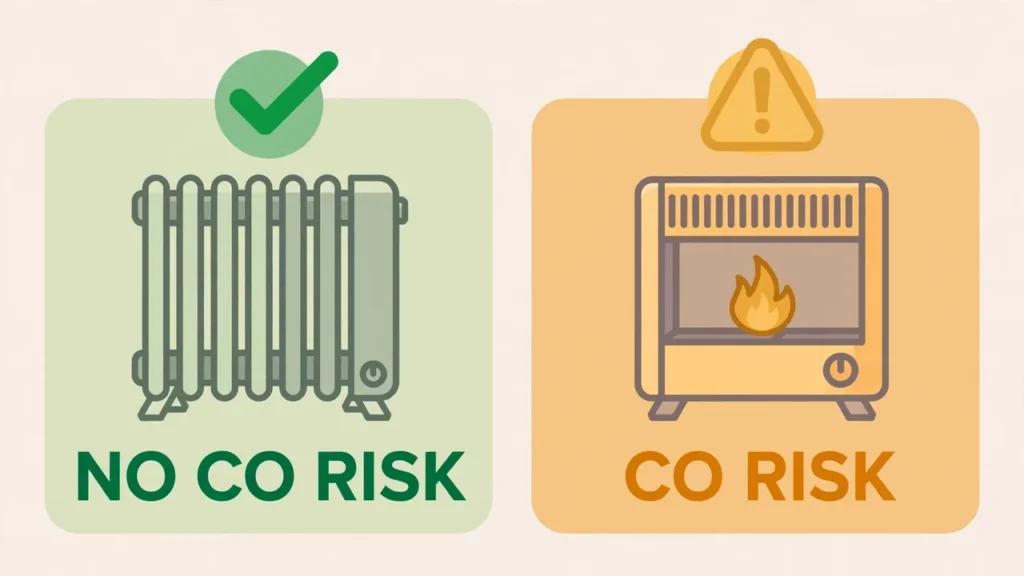
The table below puts the common portable and household heaters side by side. Read the “CO risk” column first, then check which row matches the heater in your home. If your heater sits in the top row, carbon monoxide is not something it can make. If it sits lower, ventilation and alarms are part of using it.
Heater Types and Carbon Monoxide Risk
| Heater type | Fuel burned | CO risk | Ventilation needed | CO alarm needed |
|---|---|---|---|---|
| Electric oil-filled radiator | None (electricity only) | None | No | Still advised for the home, not the heater |
| Electric ceramic / fan heater | None (electricity only) | None | No | Still advised for the home, not the heater |
| Oil furnace (home heating) | Heating oil | Yes | Yes, flue vent required | Yes |
| Vented gas heater / fireplace | Natural gas or propane | Yes | Yes, vent required | Yes |
| Unvented gas / kerosene heater | Gas or kerosene | Yes, highest | Yes, fresh air required | Yes, and follow local rules |
Rule of thumb: if it plugs into a wall outlet and has no fuel tank, filler cap, or flue, it burns nothing and makes no carbon monoxide. If it has a fuel tank or a gas line, treat it as a carbon monoxide source.
Why People Think Oil Heaters Make Carbon Monoxide
Three mix-ups feed this worry, and each one has a plain explanation. The first is the name. “Oil heater” sounds like a heater that burns oil, and a home oil furnace does burn oil. A portable oil-filled radiator uses oil as a sealed heat store, and the oil never meets a flame.
The second is the smell. A new oil-filled radiator often gives off a faint smell during its first hours of use. That smell comes from paint, dust, or factory coatings curing on warm metal, not from combustion. It fades with use. A smell that stays strong, smells like fuel, or appears on an old heater that never smelled before is a different matter, and it calls for the inspection in Step 3.
The third is the leak. If a radiator seal fails, a little thermal oil can seep out and leave a dark stain or a slick patch on the floor. That oil is not fuel burning in your room, but a leaking heater is still a damaged heater. Stop using it, unplug it, and follow the maker’s guidance or replace it. Our guide to whether oil-filled heaters are safe to leave unattended covers the daily habits that keep these heaters safe.
Step 1: Identify Your Heater Type From Its Label
Turn the heater off, let it cool, and find the rating label, usually on the back or the side near the base. A flashlight helps with small print. Read the fuel and power lines: an electric oil-filled radiator lists volts, watts, and amps, and it has a power cord and a wall plug.
Look for the signs that mean fuel burning instead. A filler cap, a fuel tank, a gas hose, a flue pipe, or a warning about ventilation all point to a fuel-burning heater. If you find any of those, stop treating the unit as an oil-filled radiator and follow the fuel heater rules in your manual, with a carbon monoxide alarm in the room and fresh air available.
Step 2: Confirm the Power Source and Rating Plate
With the label in view, check three numbers: the wattage, the voltage, and the certification mark. Most portable oil-filled radiators sold in the United States run at 1,500 watts on a 120-volt circuit, which draws about 12.5 amps. That is most of what a standard 15-amp household circuit can carry, so the heater should have the outlet to itself.
Look for a listing mark from a recognized testing lab, such as UL, ETL, or CSA. The mark shows the heater passed independent safety testing for its design. It does not make a damaged heater safe, and it does not replace the inspection in the next step. If the label is missing or unreadable, treat the heater as unknown and check the maker’s site with the model number before you run it.
Step 3: Inspect the Heater, Cord, and Plug for Damage
Run your eyes and hands over the whole unit while it is unplugged and cool. Check each fin for dents, cracks, or oil stains, and check the floor under the heater for dark patches. A dented fin can hide a broken seal, and any sign of leaked oil means the heater stays off until a professional or the maker clears it.
Check the cord along its full length for cuts, melted spots, or stiff, cracked insulation. Wiggle the plug gently: it should sit firm, with no loose prongs and no scorch marks. A warm plug, a plug that falls out of the outlet, or an outlet that feels loose all point to a wiring problem. Use a different outlet, and call an electrician if the outlet itself is loose or scorched.
Pro Tip: The 3-Foot Rule Catches Most Heater Fires
Keep the heater at least 3 feet from beds, curtains, papers, and furniture, on a hard, flat floor. Oil-filled radiators have no open element, so they are lower risk than fan heaters, but the surface still gets hot enough to scorch fabric that touches it. Measure once with a tape measure, then remember the gap by sight.
Step 4: Test Your Carbon Monoxide Alarm and Fix Its Placement
Press the test button on each carbon monoxide alarm and wait for the beep pattern the manual describes. A weak sound, no sound, or a low-battery chirp means new batteries or a new alarm. Check the date on the back of the unit: most alarms last 7 to 10 years, and the maker prints the replace-by date on the label.
Place one alarm on every level of your home and one outside each sleeping area, where it can wake you at night. Keep alarms at least 15 feet from fuel-burning appliances so start-up puffs do not set them off, and keep them out of steamy bathrooms and dusty garages. Carbon monoxide mixes evenly with room air, so mounting height matters less than location, and you should follow the instructions that came with your alarm. If you use any fuel-burning heater, a gas fireplace, or a gas furnace, this step is the one that protects you from carbon monoxide. If your only heater is the electric oil radiator, the alarm still guards the rest of the house.
Step 5: Set the Heater Up With Clear Space Around It
Put the heater on a hard, level floor where it stands upright and cannot tip. Never lay it on its side, and never run it on a bed, a rug with a thick pile, or a wobbly table. Plug it straight into a wall outlet. Skip extension cords and power strips, which can overheat under a heater’s steady load.
Clear a 3-foot ring around the unit and keep it clear while the heater runs. Hang nothing on it, and never drape wet clothes over it to dry. Set the thermostat to the room temperature you want, then let the heater cycle on and off by itself. Our guide to how to use an oil-filled radiator heater walks through thermostat and timer settings in more detail.
Step 6: Learn the Alarm Response and Rehearse It Once
Read the alarm pattern in your manual now, while nothing is wrong. Most alarms use four quick beeps, a pause, and four more beeps for carbon monoxide. Learn the difference between that pattern, a single chirp for low battery, and an end-of-life signal.
Walk the exit route with everyone in the house once. Agree on a meeting spot outside, away from the house, and agree that nobody goes back inside for pets, phones, or windows. If the alarm sounds, leave, call 911 or your local fire department from outside, and let firefighters check the house. Tell them which fuel-burning appliances you have. If anyone has headache, dizziness, nausea, or confusion, say so to the dispatcher and seek medical care.
⚠️ Heads Up: Never Ignore a Sounding Alarm
A carbon monoxide alarm sounding is not a false alarm until firefighters say so. Do not unplug the alarm, open windows, or search for the source first. Get out, call for help from outside, and stay out until professionals clear the home. Children, older adults, pregnant people, and anyone with heart or lung disease face higher risk from carbon monoxide, so act fast for them first.
When a Carbon Monoxide Alarm Actually Matters for Oil Heater Owners
The alarm matters because homes mix heating types. Your oil-filled radiator may be the heater in the bedroom, while a gas furnace heats the whole house, a gas water heater sits in the basement, and a car idles in an attached garage. Any of those can make carbon monoxide, and the alarm is the only watcher that never sleeps.
Some homes also mix old and new heaters. A kerosene heater pulled out of a shed for a cold snap, a portable propane heater used in a garage workshop, or a ventless gas heater in a cabin all carry carbon monoxide risk. If any fuel-burning heater runs in your home, even for one night, the alarm belongs in place before it starts, and the room needs the fresh air the manual calls for. Our overview of what an oil heater is, how it works, and what it costs helps you tell the electric radiator apart from fuel-burning heaters that share the name.
How Carbon Monoxide Alarms Decide When to Sound
Residential carbon monoxide alarms follow the UL 2034 standard, which sets how fast an alarm must sound at a given level of carbon monoxide, measured in parts per million (ppm). The alarm waits longer at low levels, where a short exposure is less dangerous, and sounds fast at high levels. The table below shows the required response windows, as published by alarm makers under UL 2034.
UL 2034 Alarm Response Times (Data Table)
| Carbon monoxide level | Required alarm response | What it means for you |
|---|---|---|
| 30 ppm, steady | Must not alarm for 30 days | Low background levels do not trigger nuisance alarms |
| 70 ppm | Alarm within 60 to 240 minutes | A slow leak gets caught within hours |
| 150 ppm | Alarm within 10 to 50 minutes | A serious problem sounds well inside an hour |
| 400 ppm | Alarm within 4 to 15 minutes | A dangerous level triggers a fast warning |
Source: UL 2034 required alarm points, as published by alarm makers such as First Alert / BRK Electronics. A standard alarm is built to warn before most healthy adults show symptoms, and a digital display model lets you see low readings before the alarm sounds.
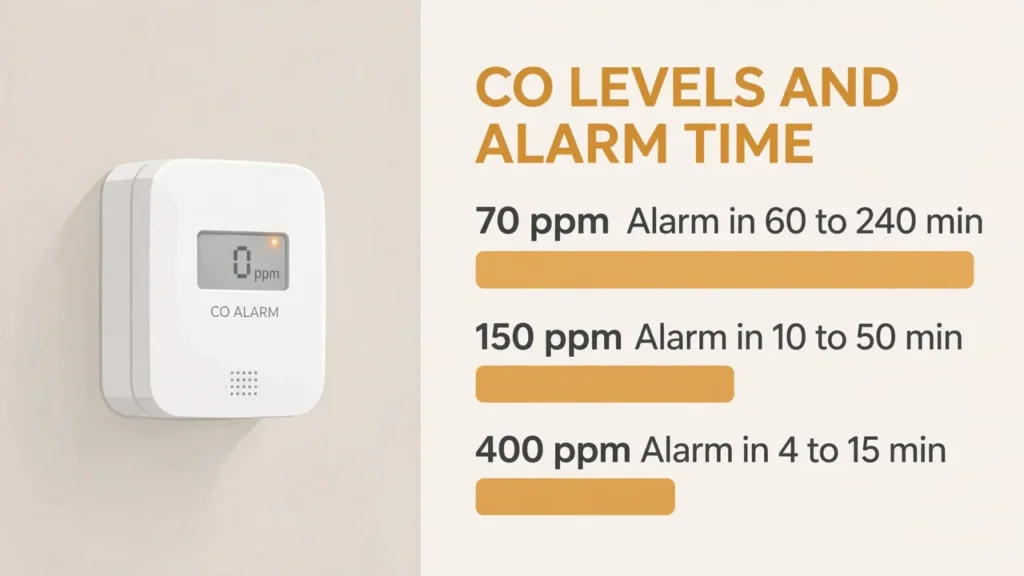
That timing explains two things people often misunderstand. First, an alarm that shows a low number on its display but stays quiet is working as designed. Second, an alarm is a life-safety device, not a health monitor: it warns before danger turns severe, and it cannot protect you if its sensor has passed its replace-by date.
Myth vs. Fact: Oil Heaters and Carbon Monoxide
Myth vs. Fact
Myth: Oil heaters burn oil, so they make carbon monoxide.
Fact: Electric oil-filled radiators never burn their oil. The oil is sealed inside and only carries heat from the electric element to the fins.
Myth: A new-heater smell means carbon monoxide is leaking.
Fact: The first-hours smell on a new heater comes from coatings and dust curing on warm metal. Carbon monoxide has no smell at all, so a smell can neither prove nor rule it out.
Myth: You only need a carbon monoxide alarm if you have a gas heater.
Fact: Any fuel-burning appliance, fireplace, or attached garage can be a source. The CPSC advises alarms on every level and outside each sleeping area, even in homes heated with electricity.
Myth: Opening a window makes a fuel-burning heater safe indoors.
Fact: A cracked window does not guarantee safe air. Fuel-burning heaters need the ventilation their manual specifies, and some, such as unvented models, carry local rules against indoor use.
Troubleshooting: Oil Heater Problems and What to Do
If This Happens, Try This
| If this happens | Try this |
|---|---|
| New heater smells for the first few hours | Run it in a ventilated room for a few hours. The smell should fade. If it stays strong or smells like fuel, unplug it and check for a leak. |
| Dark oil stain under the heater | Stop using the heater. Unplug it, keep it upright, and contact the maker or replace it. Do not try to refill or reseal it yourself. |
| Plug or outlet feels warm | Unplug the heater and try a different outlet on another circuit. If the outlet is loose or scorched, call an electrician. |
| Heater trips the breaker | Move other loads off that circuit. A 1,500-watt heater takes most of a 15-amp circuit, so it should run alone on it. |
| CO alarm chirps once every minute or so | That is usually a low-battery signal. Replace the battery. If the chirp continues with a fresh battery, check the replace-by date. |
| CO alarm sounds its full alarm pattern | Leave the house at once, call 911 from outside, and stay out until firefighters clear the home. |
| Heater is hot on top but the room stays cold | Check that the thermostat is set above room temperature and that no furniture blocks the fins. Oil radiators heat slowly and suit small to medium rooms; a large or drafty room may need a bigger heat source. Our guide to whether oil heaters are efficient covers room sizing and running costs. |
Frequently Asked Questions
Do oil heaters emit carbon monoxide?
No. A working electric oil-filled heater burns no fuel, so it emits no carbon monoxide. The oil inside is sealed and only carries heat. Fuel-burning heaters, such as oil furnaces, gas heaters, and kerosene heaters, can produce carbon monoxide and need ventilation and alarms.
Can I sleep with an oil-filled heater on?
Yes, if the heater is in good shape, stands upright on a hard floor, sits at least 3 feet from bedding and curtains, plugs straight into a wall outlet, and has working tip-over and overheat protection. Check the cord and fins before bed, and keep a working smoke alarm and carbon monoxide alarm in the home.
Why does my new oil heater smell?
New heaters often smell for the first few hours as paint and factory coatings cure on the warm metal. The smell should fade. A strong smell that does not fade, or a smell like fuel, points to a leak or a fault, so unplug the heater and inspect it.
Do I still need a carbon monoxide alarm if I only use electric heaters?
Yes. Your electric heater makes no carbon monoxide, but other parts of your home might: a gas furnace, gas water heater, fireplace, or attached garage. The CPSC advises an alarm on every level and outside each sleeping area.
What should I do if my carbon monoxide alarm goes off?
Leave the house right away, taking everyone with you, and call 911 or your local fire department from outside. Do not open windows, unplug the alarm, or look for the source first. Stay outside until firefighters say it is safe to go back in.
Is a leaking oil-filled heater dangerous?
Yes, a leaking heater is damaged and should not run. The leaked oil is not carbon monoxide, but a broken seal can lead to overheating or fire. Unplug the heater, keep it upright, and contact the maker or replace it.
Quick Reference Card
What you need
- Heater manual or model number
- Flashlight, tape measure, fresh alarm batteries
- UL 2034-listed CO alarm with a display
The 6 checks
- Identify your heater type from its label
- Confirm the power source and rating plate
- Inspect the heater, cord, and plug for damage
- Test your carbon monoxide alarm and fix its placement
- Set the heater up with clear space around it
- Learn the alarm response and rehearse it once
Remember: electric oil heaters make no carbon monoxide. Fuel-burning heaters do. Alarms go on every level and outside each sleeping area.
Conclusion
Oil heaters do not emit carbon monoxide when they are the electric, oil-filled kind. The sealed oil carries heat, nothing burns, and no exhaust leaves the unit. The worry is real for fuel-burning heaters, and that is where your carbon monoxide alarm earns its place.
Run the six checks in this guide once, and you will know which heater you own, whether it is safe to run, and whether your alarms sit where they can wake you. If anything about your heater looks damaged or wrong, unplug it and get help from the maker or a licensed professional.
For your next step, test every carbon monoxide alarm in your home tonight. It takes a minute, and it is the check that guards against the danger you cannot see, smell, or taste.
Sources: U.S. Consumer Product Safety Commission, Carbon Monoxide Information Center (alarm placement and portable heater safety guidance); UL 2034 required alarm points as published by First Alert / BRK Electronics. No statistics were invented for this article; where figures were unavailable, the article says so rather than estimating.