What Size Space Heater Do I Need? A Wattage and Room Size Guide That Gets It Right
A heater that is too small leaves you cold and runs all day without ever catching up. A heater that is too large costs more to run and can trip a breaker. If you have ever asked what size space heater do I need, this guide gives you the answer in about 15 minutes.
Most people pick a size by guessing at the store, then live with the result all winter. You will measure your room, run one short calculation, and know the wattage you need before you shop. It works for any room in the house.
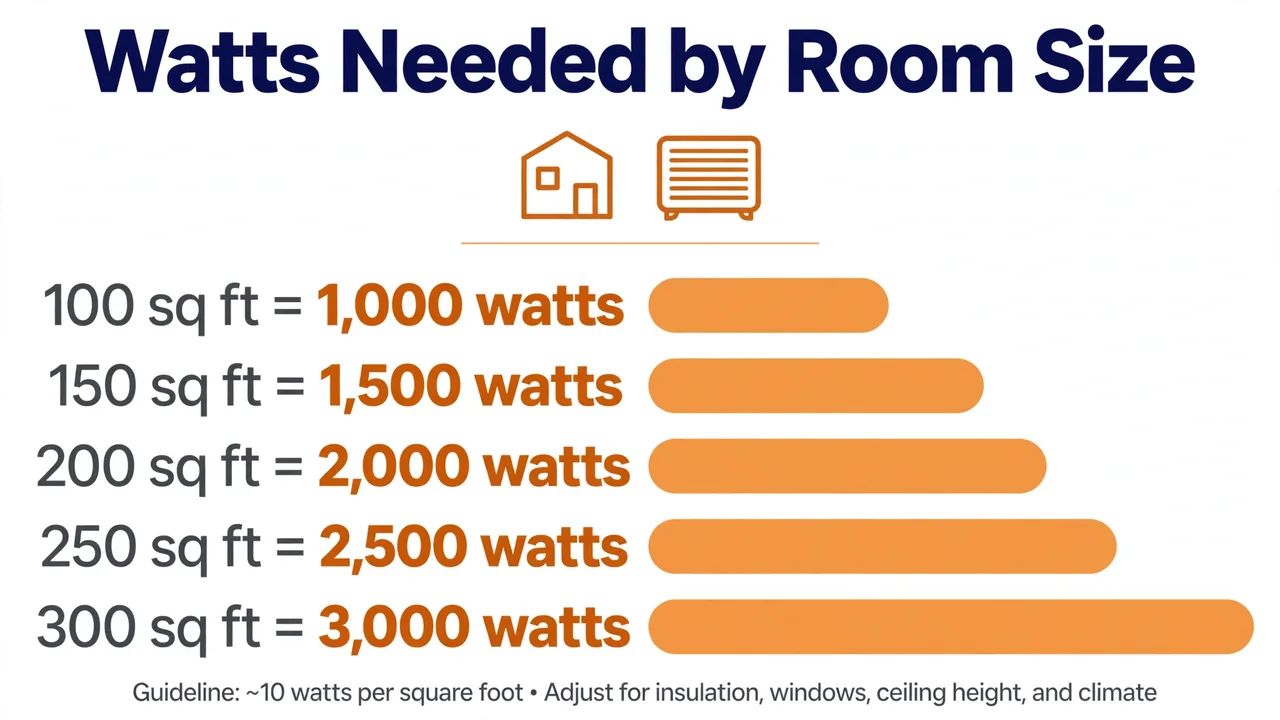
The answer comes from a rule of thumb that heating pros have used for years. Plan on about 10 watts for every square foot of floor space. A 150 square foot bedroom needs about 1,500 watts, and a 100 square foot office needs about 1,000 watts.
The rest of this guide shows you how to measure, how to do the math, and how to adjust the number for drafty windows, tall ceilings, and cold climates. Follow the steps in order and you will buy the right heater the first time.
Heads Up: Read This Before You Plug In a Heater
Space heaters cause a large share of home heating fires. The U.S. Consumer Product Safety Commission (CPSC) estimates that portable heaters were involved in an average of 1,600 fires a year from 2020 to 2022, with about 70 deaths and 150 injuries a year. The National Fire Protection Association reports that space heaters account for 43 percent of home heating fires and 85 percent of home heating fire deaths.
Follow these rules every time you use a space heater:
- Keep at least 3 feet of clear space around the heater on every side, away from beds, curtains, clothes, and papers.
- Plug the heater directly into a wall outlet. Never use an extension cord or a power strip.
- Set the heater on a hard, level floor where it cannot tip over.
- Turn the heater off when you leave the room or go to sleep.
- Buy a heater with tip-over shutoff and overheat protection, and check that it carries a safety certification mark such as UL or ETL.
This article is general guidance, not a substitute for your heater manual or a licensed electrician. If an outlet feels hot, a breaker trips often, or wiring looks damaged, stop using the heater and call a professional.
Total Time
15 minutes
Active Time
15 minutes
Difficulty
Beginner
What You Need
- A tape measure or a laser measure
- A calculator or a phone
- The length and width of the room you want to heat
- Your ceiling height, if it is above 8 feet
- One free wall outlet on its own circuit, for the heater you buy
- Your heater manual or spec sheet, to check its wattage and safety features
At a Glance: The 6 Steps
- Measure the length and width of your room
- Multiply the square footage by 10 watts
- Check your answer against the 1,500-watt ceiling
- Adjust the number for insulation, ceilings, and climate
- Match the heater type to the room
- Place the heater and test the result
Step 1: Measure the Length and Width of Your Room
Walk to the longest wall in the room and measure it from corner to corner with your tape measure. Write the number down in feet. Then measure the wall next to it, the one that runs at a right angle to the first. Those two numbers give you everything the math needs.
Skip the closet, the hallway, and any nook you do not plan to heat. Measure the main floor area where you sit, sleep, or work. For an L-shaped room, split it into two rectangles, measure each one, and add the two areas together at the end of Step 2.
A rough number is fine here. Being off by a foot on one wall changes the answer by a small amount, and the chart in this guide rounds to standard heater sizes anyway.
Step 2: Multiply the Square Footage by 10 Watts
Multiply the length by the width to get square feet. A room that is 12 feet long and 10 feet wide is 120 square feet. Then multiply that number by 10 watts per square foot. That same 120 square foot room needs about 1,200 watts.
This 10 watts per square foot figure is a rule of thumb for supplemental heat in a normal room with 8-foot ceilings and average insulation. It is not an engineering calculation, and it does not replace a heat-loss study for a whole house. It is the number that heater makers and heating guides have used for years, and it lands close enough to pick the right size.
If your math lands between standard heater sizes, round up to the next size. A 1,300-watt need points to a 1,500-watt heater, since 1,500 watts is the most common full-size plug-in model.
Step 3: Check Your Answer Against the 1,500-Watt Ceiling
Most plug-in space heaters top out at 1,500 watts, and the reason is your wiring. A standard 15-amp household circuit at 120 volts can carry 1,800 watts, and electrical rules cap continuous loads at 80 percent of that. Heater makers build to that limit, so 1,500 watts is the ceiling for a heater that plugs into a normal wall outlet.
That ceiling covers rooms up to about 150 square feet. If your room is larger, do not hunt for a plug-in heater with a bigger number on the box, because you will not find a safe one. Buy two smaller heaters and place them on opposite sides of the room, or look at a 240-volt heater installed on its own circuit by an electrician.
Never plug two high-wattage heaters into the same circuit, and never use a power strip to make room for a second heater. To learn how the different designs work before you shop, read our guide on how a space heater works.
Step 4: Adjust the Number for Insulation, Ceilings, and Climate
The 10 watts per square foot rule assumes an average room. Real rooms are not average, so adjust the number before you buy. Add about 10 percent for each foot of ceiling above 8 feet, since taller rooms hold more air to warm.
Add about 10 to 20 percent if the room has drafty windows, thin walls, or no insulation. Subtract about 10 percent if the room is well insulated with new windows and sealed doors.
Climate matters too. The rule of thumb fits a room that needs a lift of 20 to 30 degrees above the outdoor temperature, with the rest of the house already heated. A room in a cold climate, a room over an unheated garage, or a room with three outside walls needs more heat than the base number suggests.
In those cases, round up a full size and expect the heater to run longer. A heater is a room warmer, not a furnace. If you are weighing a heater against a fixed heat source, see our comparison of electric fireplaces vs space heaters for a fuller picture.
Watts by Room Size: The Chart to Shop With
| Room size | Watts needed | Heat output (BTU/hr) | What to buy |
|---|---|---|---|
| 100 sq ft (10 x 10 ft) | 1,000 W | 3,412 | One small or mid-size heater |
| 120 sq ft (10 x 12 ft) | 1,200 W | 4,094 | One mid-size heater |
| 150 sq ft (10 x 15 ft) | 1,500 W | 5,118 | One standard 1,500 W plug-in heater |
| 200 sq ft (10 x 20 ft) | 2,000 W | 6,824 | Two heaters, or one 240 V unit |
| 250 sq ft (12 x 20 ft) | 2,500 W | 8,530 | Two heaters, or one 240 V unit |
| 300 sq ft (15 x 20 ft) | 3,000 W | 10,236 | Two heaters, or a fixed heat source |
To convert watts to BTU per hour, multiply watts by 3.412. A 1,500-watt heater puts out about 5,120 BTU per hour. Figures assume 8-foot ceilings and average insulation. Adjust up or down using Step 4.
Step 5: Match the Heater Type to the Room
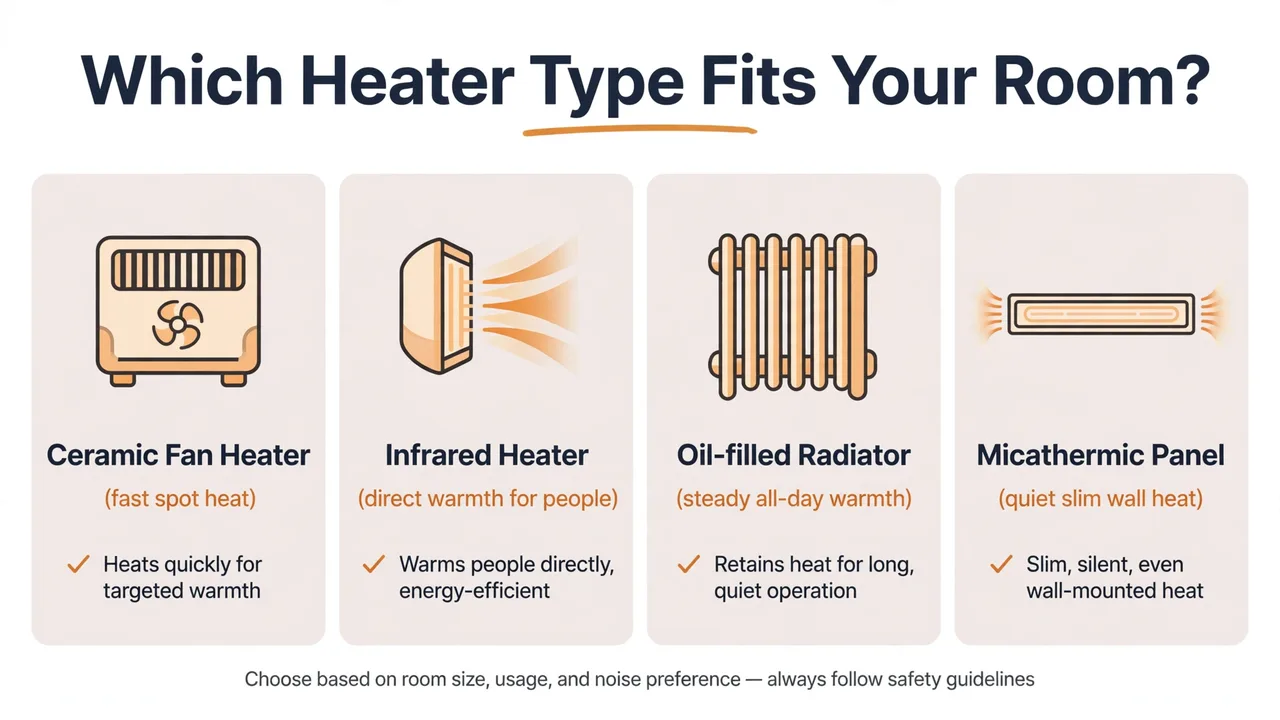
Wattage tells you how much heat you need. Heater type tells you how that heat reaches you. A ceramic fan heater blows warm air fast, so it suits a small room you want warm in minutes.
An infrared heater warms people and objects in its path, so it suits a drafty room or a spot where you sit in one place. An oil-filled radiator warms slowly and holds heat, so it suits a bedroom you heat all evening. A micathermic panel heater is slim, quiet, and mounts low on a wall, so it suits a tight space where a fan would annoy you.
All electric heaters turn nearly all of their electricity into heat, so one type is not more efficient than another at the same wattage. The difference is how the heat feels and how fast it arrives. Pick the type that fits how you use the room, then pick the wattage from the chart. Our guide to the best type of space heater compares each design in more detail, and our infrared space heater guide covers radiant heat room by room.
Step 6: Place the Heater and Test the Result
Set the heater on a hard, level floor with 3 feet of clear space on every side. Plug it directly into a wall outlet, with nothing else sharing that outlet. Point a fan heater toward the center of the room, and set an infrared heater where it faces the chairs or bed you use most. Turn the heater to its highest setting and let it run for 30 minutes with the door closed.
After 30 minutes, check the room with a thermometer or by feel. If the room is warm and the heater cycles off on its thermostat, the size is right. If the room is still cold and the heater never cycles off, the room needs more watts than one heater can give, or it has a draft problem to fix first.
If the room overheats fast and the heater shuts off within minutes, the heater is too large for the space. A heater that runs steady at a medium setting is the sweet spot, and it also costs less to run than one that blasts at full power all day. To keep running costs down, see which models use the least power in our guide to space heaters that use the least electricity.
Pro Tip: One Heater, One Circuit
A 1,500-watt heater draws about 12.5 amps on a 120-volt circuit. That leaves almost no room on a standard 15-amp circuit for anything else. If the lights dim when the heater starts, or the breaker trips, move the heater to a different circuit or unplug other loads from that circuit. A heater that shares a circuit with a microwave or a hair dryer will trip the breaker sooner or later.
What If Your Room Needs More Than 1,500 Watts?
Rooms over 150 square feet are common, and the fix is straightforward. Two 1,000-watt heaters on two separate circuits often heat a large room better than one big heater, because the heat spreads from two points instead of one. Place them on opposite sides of the room, keep 3 feet clear around each, and never plug both into the same outlet or power strip.
A second option is a 240-volt heater, such as a wall-mounted panel or baseboard unit, installed on its own circuit by a licensed electrician. These units come in higher wattages and suit large rooms, garages, and workshops. They cost more up front and need professional installation, but they heat a big space evenly and free up floor space.
A third option is a fixed heat source for the room, such as an electric fireplace, if you want heat plus a focal point. If you are still learning the basics, start with our explainer on what space heaters are and how each kind works.
What Size Space Heater Do I Need for Common Rooms?
Bedrooms run 120 to 150 square feet in most homes, so a 1,200 to 1,500-watt heater fits. A home office of 100 square feet needs about 1,000 watts, and a ceramic fan heater works well there because it warms fast when you sit down to work. A living room of 200 to 300 square feet needs 2,000 to 3,000 watts, which means two heaters or a fixed heat source.
Bathrooms are small, usually 50 to 80 square feet, so 500 to 800 watts is enough on paper. Only use a heater rated for bathroom use in a bathroom, and keep it far from water.
Garages and workshops are a different case. They are poorly insulated, so add 20 percent to the chart number and expect long run times. A garage also needs a heater rated for that space, with no exposed heating element near dust or fumes.
Curious about power draw in general? Our guide to how much electricity a fan heater uses walks through the math.
How Much Does It Cost to Run a Space Heater?
Cost follows the same math as sizing. Divide the watts by 1,000 to get kilowatts, multiply by the hours you run the heater, then multiply by the rate on your electric bill. A 1,500-watt heater run for 8 hours uses 12 kilowatt-hours.
At a rate of 17 cents per kilowatt-hour, that is about 2 dollars a day. Your rate will differ, so check your bill and swap in your own number.
A right-sized heater costs less than an oversized one, because it cycles off on its thermostat once the room is warm. An undersized heater costs more, because it runs at full power all day and never reaches the set temperature. A thermostat, a timer, and a closed door save more money than any heater feature. Heat the room you are in, and turn the heater off when you leave it.
Troubleshooting: When the Size Feels Wrong
| If this happens | Try this |
|---|---|
| The room never gets warm | Check the wattage against the chart. Seal drafts around windows and doors, then add a second heater on a separate circuit if the room is over 150 square feet. |
| The breaker trips when the heater runs | Move the heater to a different circuit. Unplug other loads from the same circuit, and never use an extension cord or power strip. |
| The room heats up, then feels cold again fast | The room is losing heat faster than the heater can add it. Check insulation and drafts. An oil-filled radiator holds heat longer after it cycles off. |
| The heater cycles on and off every few minutes | The heater is likely too large for the room. Turn it to a lower setting, or swap it for a lower-wattage model. |
| One side of the room stays cold | Move the heater toward the cold side, or add a second small heater on the far side of the room on its own circuit. |
Frequently Asked Questions
How many watts do I need for a 150 sq ft room?
About 1,500 watts. Multiply the room size by 10 watts per square foot, so 150 square feet times 10 watts gives 1,500 watts. That is the standard size for a plug-in heater, and it fits a typical bedroom.
Can I use a 1,500-watt heater in any room?
Yes, any room with a standard 120-volt wall outlet can run a 1,500-watt heater. Plug it directly into the wall, keep nothing else on that outlet, and keep 3 feet of clear space around the heater on every side.
What size space heater do I need for a 200 sq ft room?
About 2,000 watts. That is above the 1,500-watt ceiling for plug-in heaters, so use two smaller heaters on separate circuits, or have an electrician install a 240-volt heater on its own circuit.
How do I convert watts to BTUs?
Multiply watts by 3.412 to get BTU per hour. A 1,500-watt heater puts out about 5,120 BTU per hour, and a 1,000-watt heater puts out about 3,412 BTU per hour.
Is a bigger space heater always better?
No. A heater that is too large heats the room fast, shuts off, and lets the room cool before it starts again. That short cycling wastes power and leaves the room uneven. A right-sized heater runs steady and holds a stable temperature.
Can a space heater heat a whole house?
No. A space heater is supplemental heat for one room at a time. Heating a whole house needs a furnace, a heat pump, or a fixed system sized for the full floor area. Use a space heater to warm the room you are in, and let the main system handle the rest.
Quick Reference Card: What Size Space Heater Do I Need?
What you need: tape measure, calculator, room length and width, ceiling height, one free wall outlet.
The rule: 10 watts per square foot. Room area times 10 equals watts needed.
- Measure length and width, multiply for square feet.
- Multiply square feet by 10 watts.
- Check against the 1,500-watt plug-in ceiling.
- Adjust 10 percent per foot of ceiling above 8 feet, and 10 to 20 percent for drafts or poor insulation.
- Pick the heater type that fits how you use the room.
- Place it with 3 feet clear, plug it into the wall, and test for 30 minutes.
Chart: 100 sq ft needs 1,000 W. 150 sq ft needs 1,500 W. 200 sq ft needs 2,000 W. 300 sq ft needs 3,000 W. Safety: no extension cords, no power strips, turn it off when you leave the room or sleep.
Conclusion
You now know what size space heater you need for your room. Measure the floor, multiply by 10 watts per square foot, and check the result against the 1,500-watt ceiling for plug-in heaters. Adjust for tall ceilings, drafts, and cold climates, then pick a heater type that fits how you use the room.
The right size keeps the room warm without tripping breakers or wasting power. Buy the heater, place it with 3 feet of clear space, plug it straight into the wall, and test it for 30 minutes. If the room holds steady at a comfortable temperature, you picked well. Next, read our guide on how a space heater works to get the most from the model you chose.