Why Does My Space Heater Keep Shutting Off? 7 Fixes That Work
Why Does My Space Heater Keep Shutting Off? That question has a habit of showing up on the coldest night of the year, right when you need steady heat the most. The good news is that most shutoffs have a plain cause, and most of those causes take less than half an hour to check. This guide walks you through each one in order, from the most common to the least common, so you can find the fault and get your heat back.
Space heaters shut themselves off for two broad reasons. Either a safety device is doing its job, or a setting is telling the heater to stop. A dusty vent can trip the overheat sensor.
A thermostat can cycle the heater off once the room hits the target temperature. A loose outlet or a shared circuit can starve the heater of power. Each cause leaves its own clues, and this guide shows you what to look for.
Read the safety note below before you start. A heater that smells of burning, has a damaged cord, or trips its overheat sensor again and again after cleaning is telling you to stop and get help. The checks in this guide are safe for a beginner. Anything that involves opening the heater case or rewiring an outlet belongs to a licensed electrician.
⚠ Heads Up: Stop and Unplug If You See These Signs
Unplug the heater at once and do not use it again if you smell burning, see scorch marks on the plug or outlet, notice a melted or frayed cord, or hear buzzing from the outlet. These are fire risks, not annoyances. A heater that keeps shutting off after you have cleaned it and moved it to a clear, open spot may have a failing internal part. In that case, replace the heater or have it checked by a professional.
Space heaters should always plug straight into a wall outlet, never into an extension cord or power strip. Keep at least 3 feet of clear space around the heater on all sides. Never leave a space heater running in a room with no one in it, and never leave one running while you sleep.
Total Time
30 minutes
Active Time
20 minutes
Difficulty
Beginner
What You Need
- Soft brush or a vacuum with a brush attachment
- A dry cloth
- A flashlight
- Your heater’s owner’s manual (the model number is usually on a label on the back or base)
- A wall outlet with nothing else plugged into it
- Pen and paper, to note which checks you have tried
At a Glance: The 7 Checks
- Raise the thermostat and watch one full heating cycle
- Check the timer and auto-off settings
- Clean dust from the vents and filter
- Move the heater away from walls and soft surfaces
- Plug the heater straight into a wall outlet
- Test another outlet and check the breaker
- Watch for warning signs and call a professional
Shutoff Causes at a Glance
The order below runs from the cause repair shops and heater makers report most often to the least often. It is a practical ranking based on how these faults show up in real homes, not a measured statistic. Start at the top and work down.
| Cause | How Often | First Thing to Check |
|---|---|---|
| Thermostat cycling (normal operation) | Very common | Raise the set temperature 5 degrees and watch |
| Timer or auto-off setting | Very common | Look for a timer light or display icon |
| Dust-clogged vents tripping the overheat sensor | Very common | Shine a flashlight into the intake and outlet vents |
| Blocked airflow or tip-over switch | Common | Clear 3 feet around the heater; set it on a flat, hard floor |
| Extension cord or power strip | Common | Plug straight into a wall outlet |
| Overloaded circuit or worn outlet | Common | Try an outlet on a different circuit; feel the plug for heat |
| Failing internal part (sensor, fuse, thermostat) | Less common | Note the pattern and call a professional |
1. Raise the Thermostat and Watch One Full Heating Cycle
A heater that turns off and on by itself is often working exactly as designed. The thermostat measures the air near the heater. Once the room reaches the temperature you set, the heater switches off.
When the room cools a degree or two, it switches back on. That on-and-off rhythm is called cycling, and it is normal.
Set the thermostat 5 degrees higher than the current room temperature and watch the heater for 15 minutes. A heater that runs without stopping at the higher setting was cycling normally. A heater that still cuts out has a different problem, so move on to the next check. To understand the parts behind this behavior, read how a space heater works before you go further.
Pro Tip: A thermostat sensor sits inside or near the heater, so it reads the warm air right beside the unit. That pocket of warm air can read several degrees warmer than the far side of the room, which makes the heater shut off while you still feel cold. Moving the heater a few feet toward the center of the room often fixes the mismatch.
2. Check the Timer and Auto-Off Settings
Many modern heaters ship with a timer, an eco mode, or an auto-off feature, and a stray button press can turn one on without you noticing. A timer set for 1 hour will shut the heater off exactly 60 minutes after you start it, which looks like a fault. Eco mode can also cut the heater to a lower wattage or switch it off once the room feels warm enough.
Look at the control panel or remote for a clock icon, a timer light, or a small display showing a countdown. Press the timer button until the display reads off or 0, and switch eco mode off for this test. Run the heater for 20 minutes.
A heater that now runs without stopping had a setting problem, not a broken part. Keep your manual nearby while you do this, since the button layout varies by brand.
3. Clean Dust from the Vents and Filter
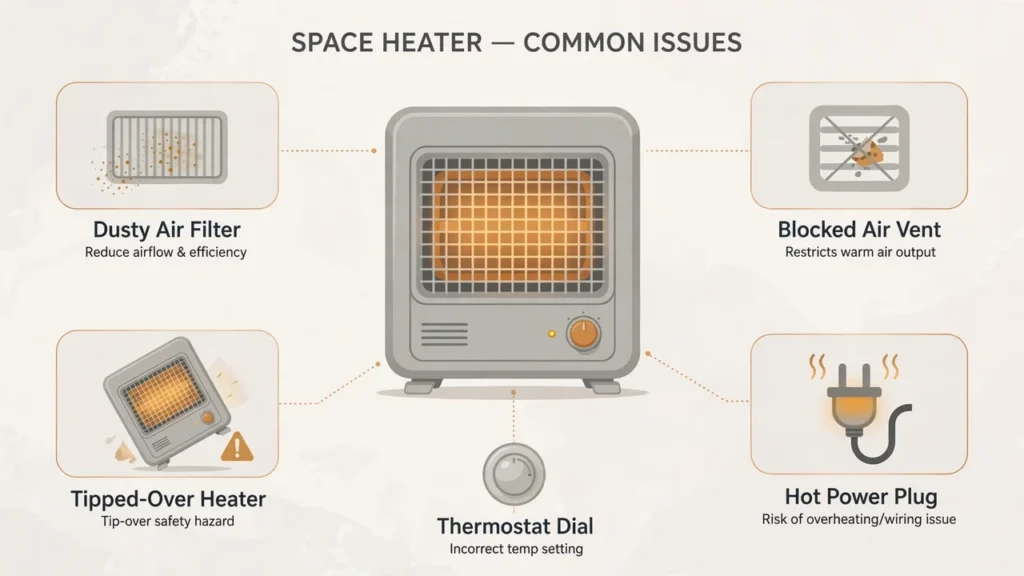
Dust is the most common reason a healthy heater starts shutting off after months of quiet use. Intake vents pull in room air along with dust, pet hair, and lint. That buildup narrows the airflow, heat collects inside the case, and the overheat sensor trips to protect the heater. The shutoff usually happens a few minutes after startup, once the inside of the unit gets hot enough.
Unplug the heater and let it cool for 30 minutes. Shine a flashlight into the intake and outlet vents and look for gray fuzz or matted dust. Vacuum the vents with a brush attachment, then wipe the outer grille with a dry cloth.
Some models have a washable filter behind a rear panel, so check your manual and rinse it if yours does. Plug the heater back in and run it for 20 minutes to see if the shutoff is gone.
4. Move the Heater Away from Walls and Soft Surfaces
A heater needs open air on every side to shed heat. Pushed against a wall, tucked behind a curtain, or sitting on thick carpet, it heats its own trapped air instead of the room. The overheat sensor reads that trapped heat and shuts the unit down. A heater on an uneven rug can also trip its tip-over switch, which cuts power the moment the unit tilts.
Set the heater on a flat, hard floor with at least 3 feet of clear space in front and on both sides. Keep curtains, bedding, papers, and furniture out of that zone. Make sure the heater sits level and does not rock when you press a corner.
Run it for 20 minutes. A heater that stays on in open space was starved of air, not broken.
Heads Up: Never drape clothes, towels, or blankets over a space heater to dry them. The fabric blocks airflow and can catch fire. The 3-foot clear zone is a fire safety rule, not a suggestion, and it applies every time the heater runs.
5. Plug the Heater Straight into a Wall Outlet
Space heaters pull more power than almost any other small appliance in a home. A heater on high can draw the full load of a household circuit, and extension cords and power strips are not built for that kind of steady draw. A thin cord heats up, voltage drops, and the heater’s own safety devices may shut it down. In the worst case, the cord or strip itself can melt or catch fire.
Unplug the heater from any extension cord, power strip, or surge protector. Plug it directly into a wall outlet, pushing the plug in firmly until it sits flat against the plate. Run the heater on high for 10 minutes, then touch the plug.
A plug that feels warm or hot signals a worn outlet, so stop using that outlet and try another one. For the full picture on this risk, read can you plug a space heater into an extension cord or power strip.
6. Test Another Outlet and Check the Breaker
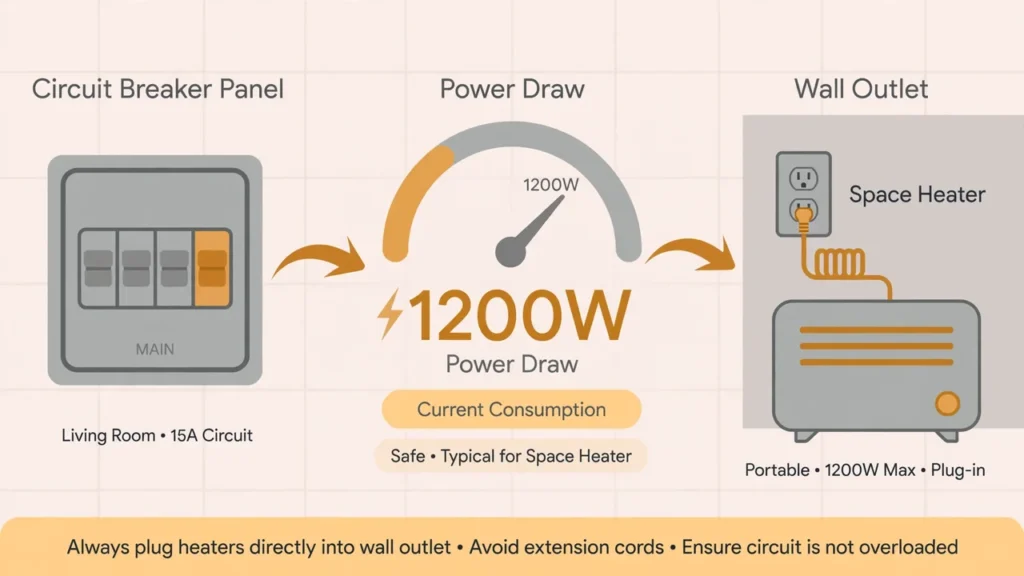
Most portable heaters draw 1,500 watts on high. On a standard 120-volt household circuit, that equals 12.5 amps, which is most of what a 15-amp circuit can carry. Add a television, a lamp, or a phone charger on the same circuit and the breaker trips. A worn outlet can cause the same shutoff in a quieter way: a loose grip on the plug prongs creates heat and an uneven connection, and the heater cuts out.
Move the heater to an outlet in a different room, ideally one you know sits on a different circuit, such as a kitchen or bathroom outlet. Run it on high for 15 minutes. A heater that runs fine there points to an overloaded or worn circuit in the first room.
Check your breaker panel for a tripped switch, and unplug other devices from the first circuit before you try it again. If the breaker trips again with the heater alone on the circuit, call an electrician.
Heater Wattage and Amp Draw on a 120-Volt Circuit
Amps equal watts divided by volts. These figures show why a heater leaves so little room on a standard circuit.
| Heater Setting | Watts | Amps Drawn | Share of a 15-Amp Circuit |
|---|---|---|---|
| Low | 750 | 6.25 | About 42% |
| Medium | 1,000 | 8.3 | About 55% |
| High | 1,500 | 12.5 | About 83% |
If your room feels cold on the low setting, the heater may be too small for the space rather than faulty. See what size space heater do I need to match wattage to room size.
7. Watch for Warning Signs and Call a Professional
A heater that passes every check above and still shuts off is usually telling you about a part inside the case. The overheat sensor itself can wear out and trip at lower and lower temperatures. The thermostat can drift and read the room wrong.
A thermal fuse can weaken after repeated overheating and cut power early. None of these are repairs for a beginner, since opening the case voids the warranty and can expose live parts.
Note the pattern before you call anyone. Write down how many minutes the heater runs before it stops, whether it restarts on its own, and whether any smell or sound comes with the shutoff. That note saves time for the repair shop or the manufacturer.
A heater under warranty should go back to the maker first. A heater out of warranty that trips again and again is usually cheaper to replace than to repair, and a new unit brings fresh safety features with it.
Troubleshooting: If This Happens, Try This
| If This Happens | Try This |
|---|---|
| Heater runs for a few minutes, then stops, then restarts | Clean the vents and filter, then clear 3 feet around the unit |
| Heater stops at the same time every night | Turn the timer off and switch eco mode off |
| Heater stops and the room breaker trips | Move the heater to a different circuit and unplug other devices |
| Plug or outlet feels hot | Stop using that outlet and have an electrician check it |
| Heater stops with a burning smell | Unplug it at once and do not use it again |
| Heater shuts off on carpet but runs on a hard floor | Keep it on a flat, hard surface so the tip-over switch stays level |
| Heater stops after years of steady use | Clean it first; if the shutoffs continue, replace the unit |
Frequently Asked Questions
Questions Readers Ask Most
Is it normal for a space heater to turn off and on by itself?
Yes, in most cases. The thermostat switches the heater off once the room reaches the set temperature and back on when the room cools. That cycling is normal. A shutoff is only a problem when the room is still cold, the heater stops after a few minutes, or it will not restart.
Why does my space heater keep turning off after a few minutes?
The most common cause is dust blocking the vents, which trips the overheat sensor once the inside of the heater gets hot. Clean the intake and outlet vents, clear 3 feet of space around the unit, and run it again. A heater that still stops after cleaning may have a failing sensor and should be checked by a professional.
Can a bad outlet make a space heater shut off?
Yes. A worn outlet grips the plug loosely, which creates heat and an uneven connection. The heater may cut out, or the plug may feel warm. Try a different outlet on another circuit. If the plug feels hot, stop using that outlet and call an electrician.
Why does my space heater trip the breaker?
A 1,500-watt heater draws 12.5 amps, which is about 83 percent of a standard 15-amp circuit. Any other device on the same circuit can push the total over the limit and trip the breaker. Move the heater to its own circuit and keep other devices off that circuit while it runs.
When should I replace a space heater that keeps shutting off?
Replace it when the shutoffs continue after cleaning, clearing space, and testing another outlet, or when you see damage such as a frayed cord, scorch marks, or a cracked case. A heater that smells of burning should be unplugged at once and never used again. Newer models also carry better safety features than older ones.
Quick Reference Card
What you need: soft brush or vacuum, dry cloth, flashlight, manual, a free wall outlet.
Checks in order:
- Raise the thermostat 5 degrees and watch one full cycle.
- Turn the timer and eco mode off.
- Unplug, cool 30 minutes, and clean the vents and filter.
- Clear 3 feet around the heater on a flat, hard floor.
- Plug straight into a wall outlet, no cords or strips.
- Test another outlet on a different circuit and check the breaker.
- Note the pattern and call a professional if shutoffs continue.
Stop at once if: you smell burning, see scorch marks, or the cord is damaged.
Warm Rooms, Steady Heat
You now know the seven checks that solve most space heater shutoffs. A dusty vent, a timer left on, or a shared circuit sits behind the large majority of cases, and each one takes minutes to rule out. Your heater was probably protecting you, not failing you.
Run through the list in order and note which check fixed it. That note helps if the problem ever returns. If your heater passes every check and still stops, trust the warning and replace it.
A new heater costs far less than a fire. For guidance on running a heater safely through the night, read are space heaters safe to leave on overnight.