Can You Plug a Space Heater Into an Extension Cord or Power Strip?
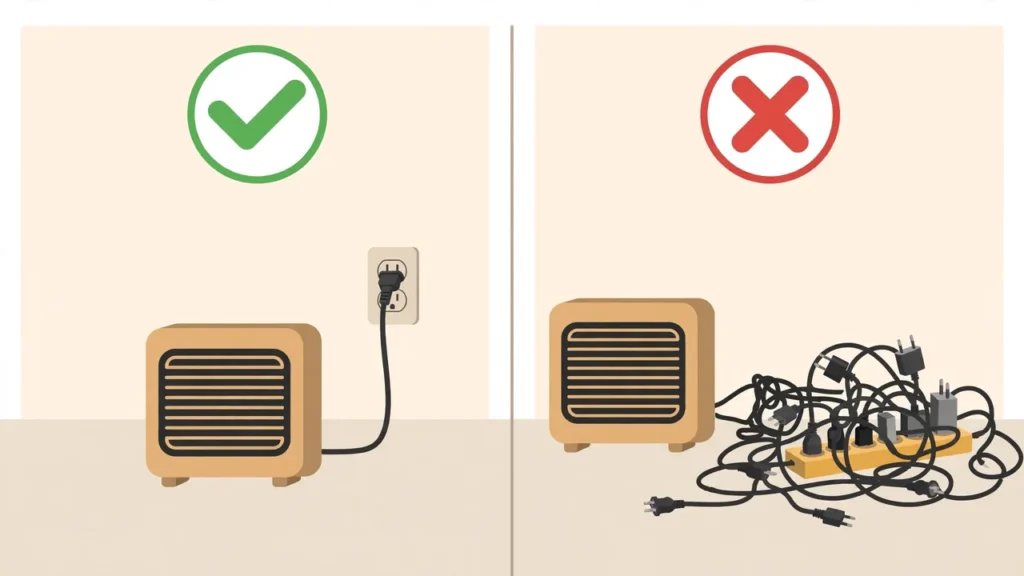
No. Can you plug a space heater into an extension cord or power strip? The short answer is no, and every major safety agency gives the same answer. The U.S. Consumer Product Safety Commission (CPSC) says to plug electric space heaters directly into a wall outlet, never into an extension cord or power strip. That rule holds even for a heavy-duty cord, even for a surge protector, and even for one cold night.
Your heater pulls a lot of power for hours at a time. A typical 1500-watt heater draws about 12.5 amps on a standard 120-volt circuit, which sits close to the limit of a 15-amp circuit. Most extension cords and power strips were not built to carry that load hour after hour. The cord or strip can overheat, melt, and start a fire long before a breaker trips.
This guide walks you through the safe setup in six clear steps. You will check your heater wattage, place the heater where its own cord can reach a wall outlet, inspect the plug and outlet, plug it in right, and test for heat. You will also learn what to do when the outlet is too far away, because moving the heater beats reaching for a cord every time.
Heads Up: Fire Risk
Never plug a space heater into an extension cord or a power strip. Never leave a heater running while you sleep or while you are out of the room. Keep 3 feet of clear space around the heater on every side, away from beds, curtains, clothes, papers, and furniture.
Check the plug, cord, and outlet for heat during use. If the plug or outlet feels hot, or if the breaker trips, switch the heater off, unplug it, and call a licensed electrician. Do not change wiring, remove safety devices, or bypass a breaker. This guide covers plug-in electric heaters only. Read your heater manual and follow its warnings.
Total Time
15 minutes
Active Time
10 minutes
Difficulty
Beginner
What You Need
- Your space heater and its manual
- A wall outlet that is free, tight, and undamaged
- A tape measure or a ruler
- A working smoke alarm in the room
- A flashlight, for a close look at the outlet
- The phone number of a licensed electrician, in case the outlet feels warm
At a Glance
- Read the heater label and note the watts
- Move the heater within reach of a wall outlet
- Inspect the plug, cord, and outlet
- Plug a space heater into a wall outlet, not an extension cord
- Test the outlet and cord for heat after 30 minutes
- Clear the 3-foot zone and switch the heater off when you leave
Why the Answer Is No
A space heater is one of the heaviest loads in a home. It runs at full power for hours, and it keeps pulling current the whole time. Lights, phone chargers, and televisions draw far less power and cycle on and off. A heater does not. That steady, heavy draw is what makes a thin cord or a crowded power strip dangerous.
The CPSC estimates that portable heaters, including electric space heaters, were involved in an average of 1,600 fires per year, with an average of 70 deaths and 150 injuries per year from 2020 to 2022. The National Fire Protection Association (NFPA) reports that home heating equipment fires averaged 37,365 per year from 2020 to 2024, causing about 417 deaths and 1,260 injuries a year, and that space heaters and heating stoves accounted for about 30 percent of those fires but 73 percent of the deaths. These numbers cover all causes, not cords alone, but they show why heater safety rules deserve respect.
Heat builds up in a cord when the current running through it is too high for its size. A thin cord has more resistance than a thick cord, so more of the power turns into heat inside the cord itself. The cord can get soft, the insulation can melt, and the plug can scorch. A power strip adds the same problem at a larger scale, because it can feed several devices from one outlet while its own thin internal parts heat up. A breaker may not trip in time, because the heat is local, in the cord or the strip, and the total current may still sit under the breaker rating.
Heater makers say the same thing in their manuals. Most brands print a warning to plug the heater into a wall outlet and to avoid extension cords and power strips. The UL safety mark on a heater covers the heater as sold, with its own cord and plug. Adding a cord or a strip changes the setup the heater was tested with, so the safety mark no longer covers the full chain.
How Much Power a Space Heater Really Draws
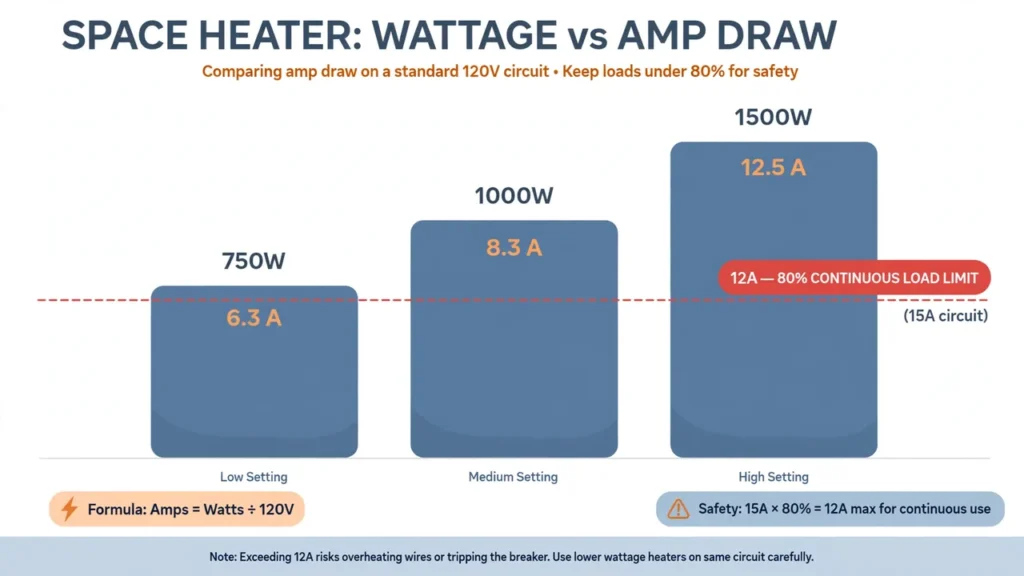
Amps tell the story better than watts alone. Divide watts by volts to find amps. On a standard US 120-volt circuit, a 1500-watt heater draws 12.5 amps. A 1000-watt heater draws about 8.3 amps, and a 750-watt heater draws about 6.3 amps. Electrical codes generally limit a continuous load, one that runs for three hours or more, to 80 percent of a circuit rating. On a 15-amp circuit, that limit is 12 amps. A 1500-watt heater on high already sits above that line.
That leaves no room for anything else on the same circuit. A lamp, a phone charger, or a television on the same circuit pushes the total higher. The breaker may trip, or the wiring may heat up. The table below shows the draw at each common heater size, so you can see why a full-power heater needs a wall outlet all to itself.
| Heater Setting | Watts | Amps at 120 Volts | Share of a 15-Amp Circuit |
|---|---|---|---|
| Low | 750 W | 6.3 A | 42% |
| Medium | 1000 W | 8.3 A | 55% |
| High | 1500 W | 12.5 A | 83% |
| 80% continuous-load limit | 1440 W | 12.0 A | 80% |
Amps = watts divided by 120 volts. Figures are rounded to one decimal place. The 80 percent limit is the usual rule for loads that run three hours or more.
Read the Heater Label and Note the Watts
Turn the heater around and find the label on the back or the bottom. It lists the watts, the volts, and the model number. Write the wattage down. Most portable electric heaters sold in the US top out at 1500 watts, but smaller models run at 750 or 1000 watts. The number sets everything else in this guide, because it fixes how much current the heater will pull.
Check the manual for a cord warning while you have it in hand. Most manuals state the rule in plain words: plug the heater into a wall outlet, and do not use an extension cord or a power strip. If your manual says that, treat it as a rule from the maker, not a suggestion. Keep the manual near the heater for the season, so anyone else in the home can check it too.
Move the Heater Within Reach of a Wall Outlet
Measure the heater cord. Most heater cords run about 6 feet long, and that length is the limit. Set the heater on a hard, flat, level floor where its own cord can reach a wall outlet with slack to spare. A cord pulled tight can loosen the plug, and a loose plug can heat up at the outlet.
When the outlet sits too far away, move the heater, not the outlet. Rearrange the chair, the side table, or the heater itself. Pick a spot with 3 feet of clear space on the front, sides, and back. Keep the heater out of walkways and away from doors, so no one trips on the cord or knocks the heater over. If no spot in the room works, the room needs a different heat source or a new outlet installed by a licensed electrician. A cord is never the fix.
If you need a heater for a room with no nearby outlet, a smaller heater may help. A lower-wattage model still needs a wall outlet, but it gives you more choice about which circuit can carry it. Learn what size space heater you need before you buy, so the heater matches the room and the circuit it will run on.
Inspect the Plug, Cord, and Outlet
Look at the heater plug before it goes near the wall. The prongs should be straight, clean, and free of scorch marks or melted plastic. Run your hand along the full length of the cord and feel for flat spots, cuts, cracks, or stiff sections. A cord that has been pinched under furniture or run under a rug can be damaged inside, where you cannot see it.
Shine a flashlight into the outlet. The faceplate should sit flat against the wall with no cracks, no brown marks, and no smell of burning. Push the faceplate gently. It should not move. Plug the heater in partway and feel the fit. A good outlet grips the plug firmly. A loose outlet that lets the plug sag or fall out needs a licensed electrician before you run a heater on it.
Pro Tip
A plug that feels warm after a few minutes is an early warning, not normal wear. Switch the heater off, unplug it, and have the outlet checked before you run the heater again.
Plug a Space Heater Into a Wall Outlet, Not an Extension Cord
Push the plug all the way into the wall outlet until it sits flat against the faceplate. The heater should be the only heat-producing device on that outlet. Do not plug a second heater, a coffee maker, or a toaster into the other socket of the same outlet. One heat source per outlet keeps the load inside what the outlet was built to carry.
Leave the cord in the open where you can see it. Never run a heater cord under a rug, under carpet, across a doorway, or through a door that closes on it. A cord under a rug traps heat and wears down with foot traffic, and a cord pinched in a door can break inside its insulation. Keep the cord away from water, and never touch a plugged-in heater with wet hands.
Some people ask about a short, thick appliance cord as a one-time fix. The safety agencies do not carve out that exception, and most heater manuals forbid cords outright. A thick cord still adds a connection point that can loosen and heat up, and it still sits between the heater and the wall. The safe setup has no cord in the middle at all. If the heater cord cannot reach, move the heater or call an electrician about a new outlet.
Test the Outlet and Cord for Heat After 30 Minutes
Switch the heater on and set it to the heat level you plan to use. Let it run for 30 minutes, then touch the plug, the cord near the plug, the outlet faceplate, and the wall around the outlet. They should feel cool or barely warm. A plug that is hot to the touch means something is wrong, even when the heater still works fine.
Repeat the check the first few times you run the heater in a new spot. Outlets wear out with age, and a worn outlet can pass this test once and fail later. Test again after the heater has run for a few hours, and test after you change the heat setting. A breaker that trips, a plug that discolors, or a faint burning smell all mean the same thing: switch the heater off, unplug it, and call a licensed electrician.
Clear the 3-Foot Zone and Switch the Heater Off When You Leave
Walk around the heater and clear 3 feet on every side. Move bedding, curtains, clothes, papers, and furniture out of that zone. Keep children and pets out of it too. The NFPA keeps a 3-foot kid-free zone around space heaters and open fires, and the CPSC applies the same distance to beds, sofas, curtains, papers, and clothes on the front, sides, and rear of the heater.
Set the heater on a hard, level floor, never on a bed, a chair, a table, or carpet. A heater on soft ground can tip over or sink into fibers that block airflow. Check that the tip-over switch works by reading the manual, and confirm the heater has an overheat shutoff and a safety mark from a testing lab such as UL. These features help, but they do not replace the rules in this guide.
Switch the heater off and unplug it when you leave the room or go to bed. CPSC and NFPA both give that rule, and it matters most overnight, when no one is awake to notice a smell or a hot plug. For night warmth, set the room temperature with your main heating system and save the space heater for the hours you are awake in the room. Read what temperature to set your heater to at night to plan a warm room without running a portable heater while you sleep.
What to Do When the Outlet Is Too Far Away
A heater cord that cannot reach a wall outlet is a placement problem, not a cord problem. The heater is in the wrong spot. Move it closer to the outlet, or move the furniture that blocks it. In a large room, a heater near the seating area and near an outlet warms the people in the room better than a heater parked against a far wall.
A licensed electrician can add a wall outlet where you need heat. That costs money, and the price varies by home and by region, so ask for a quote before the work starts. Compare that cost with the cost of a fire, and the outlet wins. Never run a cord through a wall, under a floor, or across a room as a stand-in for a real outlet.
Some homes have old wiring that cannot carry a 1500-watt heater at all. Signs of trouble include breakers that trip, lights that dim when the heater starts, outlets that feel warm, and a burning smell near the panel. Stop using the heater and call a licensed electrician. A lower-wattage heater may work on that circuit, but only an electrician can confirm what your wiring can carry. Learn how a space heater works so you can talk through the wattage and the circuit with the electrician.
Power Strips, Surge Protectors, and Heavy-Duty Cords
Power strips are built for low-draw devices such as lamps, chargers, and televisions. A typical strip is rated for 15 amps in total across every socket, and its internal parts are thin. A space heater can use almost all of that rating by itself, for hours, and the strip heats up the whole time. A surge protector does not fix this. Surge protection guards against voltage spikes. It does not raise the current rating of the strip or cool the parts inside it.
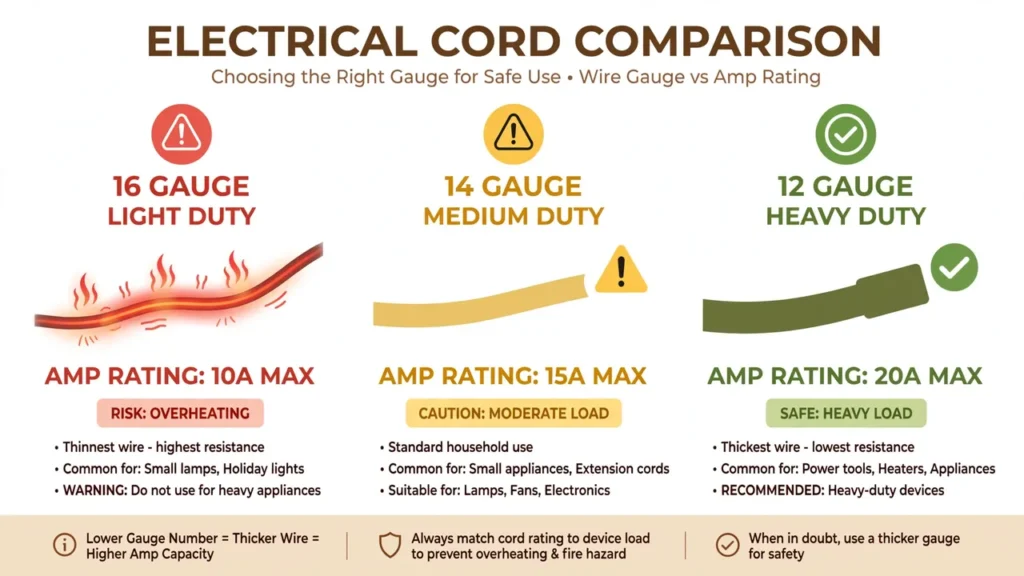
Heavy-duty extension cords look safer because they are thick. A 12-gauge cord can carry more current than a 16-gauge cord, and the gauge chart in this article shows that spread. But a cord still adds two extra connection points, one at the wall and one at the heater, and each point can loosen, arc, and heat up. Cords also run across floors, where feet, chairs, and doors wear them down. The CPSC rule covers every cord, thick or thin, short or long.
Reel cords and multi-outlet adapters are worse. A cord wound on a reel traps heat in the coil. A cube adapter that turns one outlet into three invites a second heater or a second device onto the same outlet. Skip both. One heater, one wall outlet, no parts in between.
Common Mistakes
5 Mistakes That Cause Heater Fires
1. Using a light-duty cord for one night. A thin household cord can overheat in under an hour at 1500 watts. The risk does not wait for a cold snap. Plug the heater into the wall or move it.
2. Sharing an outlet with a second heat source. Two heaters, or a heater plus a coffee maker, on one outlet can push the circuit past its limit. Give the heater its own outlet.
3. Running the cord under a rug. A rug traps heat and hides damage. Foot traffic wears the cord down where you cannot see it. Keep the cord in the open.
4. Leaving the heater on overnight. Fires that start while you sleep are the hardest to catch in time. Switch the heater off and unplug it at bedtime.
5. Ignoring a warm plug. A hot plug or a loose outlet is a warning, not a quirk. Stop using the heater on that outlet and call a licensed electrician.
One more mistake slips past many people: buying the wrong heater for the room. A heater that is too small runs at full power all day and never warms the space, which tempts people to add a second heater or a cord. A heater that is too large cycles hard and trips breakers. Compare the options in our guide to the best type of space heater for your room, and check whether an electric fireplace is safer than a space heater for the spot you want to heat.
Frequently Asked Questions
Can you plug a space heater into an extension cord or power strip?
No. Plug electric space heaters directly into a wall outlet, never into an extension cord or power strip. The CPSC and the NFPA both give this rule, and most heater manuals repeat it.
Can I use a heavy-duty extension cord with a space heater?
No. A thick cord carries more current than a thin cord, but the CPSC rule covers every cord, and heater manuals forbid cords outright. Move the heater to the outlet, or have an electrician add an outlet.
Can I plug a space heater into a surge protector?
No. A surge protector guards against voltage spikes, but it does not raise the current rating of the strip. A heater can still overheat the strip during hours of use.
How many amps does a 1500-watt space heater use?
About 12.5 amps on a standard 120-volt circuit. That is 83 percent of a 15-amp circuit, and it sits above the 12-amp limit that applies to loads running three hours or more.
What should I do if my heater plug feels hot?
Switch the heater off, unplug it, and stop using that outlet for the heater. Call a licensed electrician to check the outlet. Do not keep running the heater and hope the heat goes away.
Can I leave a space heater on while I sleep?
No. The CPSC and the NFPA say to switch portable heaters off when you go to bed or leave the room. Use your main heating system overnight instead.
Quick Reference Card
What you need: heater and manual, a free wall outlet, a tape measure, a working smoke alarm, a flashlight.
Steps:
- Read the heater label and note the watts
- Move the heater within reach of a wall outlet
- Inspect the plug, cord, and outlet
- Plug a space heater into a wall outlet, not an extension cord
- Test the outlet and cord for heat after 30 minutes
- Clear the 3-foot zone and switch the heater off when you leave
Remember: wall outlet only, one heater per outlet, 3 feet of clear space, off at bedtime, hot plug means call an electrician.
Warm Room, Safe Setup
Can you plug a space heater into an extension cord or power strip? No, and now you know why. The heater draws too much current for too long, and a cord or a strip in the middle turns that load into heat where you cannot see it. A wall outlet, a firm plug, and 3 feet of clear space give you the warmth without the risk.
Walk through the six steps each time you set a heater up in a new spot. Check the watts, move the heater to the outlet, inspect the plug and cord, plug it straight into the wall, test for heat after 30 minutes, and clear the zone. That 15-minute routine protects your home all winter.
When the outlet is too far away, move the heater or call a licensed electrician about a new outlet. A new outlet costs less than a fire, and it solves the problem for good. If your heater trips breakers or warms the outlet, stop using it and get the wiring checked before the cold sets in. For more on safe heater use, read whether oil-filled heaters are safe to leave unattended and whether you can use a space heater outside.
Sources
U.S. Consumer Product Safety Commission, Keep Warm and Safe This Winter: Tips for Using Generators, Furnaces and Space Heaters (January 2026): plug electric space heaters directly into a wall outlet, never into an extension cord or power strip; keep portable heaters at least three feet from combustible materials; portable heaters involved in an average of 1,600 fires, 70 deaths, and 150 injuries per year from 2020 to 2022. Read the CPSC winter safety tips.
National Fire Protection Association, heating safety guidance: keep anything that can burn at least three feet from heating equipment, keep a three-foot kid-free zone around space heaters, and turn portable heaters off when leaving a room or going to bed; home heating fires averaged 37,365 per year from 2020 to 2024, with space heaters and heating stoves involved in 30 percent of the fires and 73 percent of the deaths. Read the NFPA heating safety tips.
Disclaimer: This article is general safety guidance, not electrical advice for your home. Wiring, circuits, and local codes vary. When an outlet feels warm, a breaker trips, or lights dim when a heater runs, stop using the heater and call a licensed electrician.