What Temperature Should You Set Your Heater to at Night?
You climb into bed, the room feels cold, and you reach for the heater dial. Turn it too high and you wake up sweaty at 2 a.m. Turn it too low and you shiver under the covers. So what temperature should you set your heater to at night? For most healthy adults, 60 to 67 degrees Fahrenheit gives the best sleep, with many sleep experts pointing to 65 degrees as a solid starting point.
This guide walks you through picking the right number for your room, your heater, and the people sleeping in it. You will learn how to set a thermostat or dial heater for overnight use, how to keep the setup safe while you sleep, and how to fix the common problems that wake people up at night. By the end, your bedroom will hold a steady, comfortable temperature from lights out to morning, without wasting energy or creating a hazard.
The whole process takes about 15 minutes of setup on the first night, and about 2 minutes a night after that. It works with any portable electric heater that has a thermostat or timer, and the safety checks apply to every heater type.
Safety first: a heater running while you sleep needs extra care. Never run a fuel burning heater, such as a propane or kerosene heater, unvented indoors overnight. Those heaters can release carbon monoxide, a colorless and odorless gas that can kill. Use electric heaters only for overnight bedroom heating, keep working smoke and carbon monoxide detectors in the bedroom, keep the heater at least 3 feet from bedding, curtains, and furniture, plug it directly into a wall outlet, and never leave a heater running in a room with children or pets unless it has tip over shutoff and overheat protection. If you smell gas or your CO alarm sounds, leave the house and call emergency services from outside.
What You Need
- A portable electric heater with a thermostat (a timer is a bonus)
- A room thermometer, or a thermostat with a digital display
- Working smoke and carbon monoxide detectors in the bedroom
- A wall outlet the heater can reach without an extension cord
- Extra blankets, warm sleepwear, and warm socks
- A small fan, if your room has cold corners or hot spots
- A tape measure, for checking the 3 foot clearance around the heater
At a Glance
- Pick your target temperature for the people in the room
- Check your heater’s safety features before bedtime
- Place the heater in a safe spot with 3 feet of clearance
- Set the thermostat and timer for the night
- Warm the room before bed, then let the thermostat hold it
- Test the room and adjust the next night
Why Cooler Rooms Help You Sleep
Your body temperature drops as you fall asleep. That drop is part of how sleep starts, and a room that is too warm fights against it. A cool room lets your body cool down on schedule, which helps you fall asleep faster and stay asleep longer.
A room that is too cold causes the opposite problem. You shiver, your muscles tense, and you wake up to pull the covers tighter. The goal is a middle range where your body can stay relaxed all night. For most adults that range is 60 to 67 degrees Fahrenheit. Sleep researchers often name 65 degrees as the sweet spot, but the right number varies with your blankets, your sleepwear, and your own comfort.
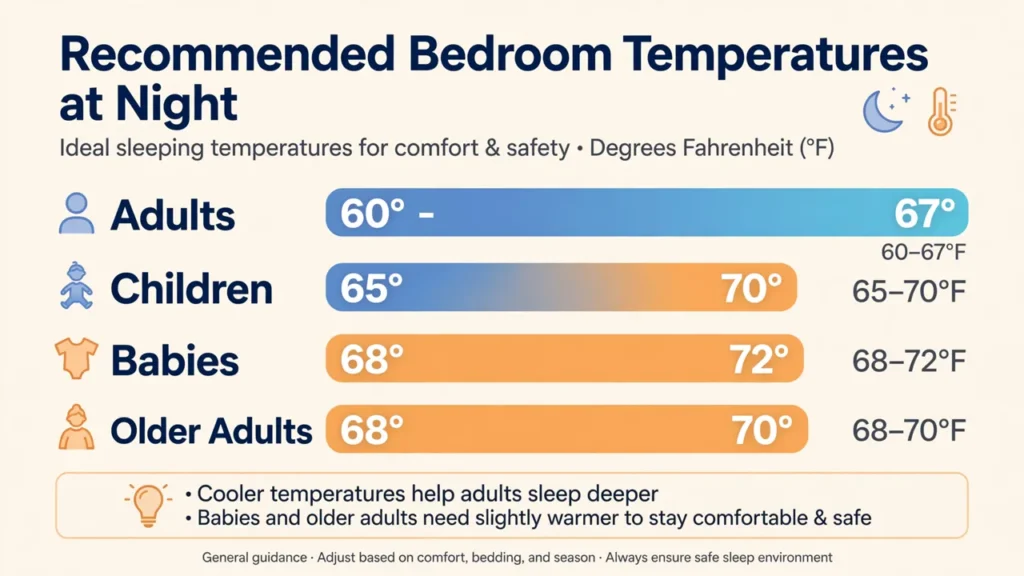
Age and health change the number too. Babies and small children lose heat faster than adults, so their rooms should stay warmer. Older adults often feel cold more easily and may need a warmer room as well. The table below gives a starting point for each group, and the steps that follow show how to dial it in for your own home.
Recommended Night Temperatures by Who Sleeps in the Room
Use this table as a starting point, then adjust by one or two degrees at a time until sleep feels steady. A change of a single degree is hard to notice. A change of three degrees is easy to feel.
| Who sleeps here | Night temperature | Why this range |
|---|---|---|
| Healthy adults | 60 to 67°F | Cool rooms support the natural overnight drop in body temperature |
| Children (ages 2 to 12) | 65 to 70°F | Children lose heat faster and move out from under blankets |
| Babies under 1 year | 68 to 72°F | Babies cannot regulate temperature well; follow your pediatrician’s advice |
| Older adults | 68 to 70°F | Older bodies feel cold more easily and may have circulation or health conditions |
| Anyone with a cold or fever | 68 to 70°F | A slightly warmer room feels more comfortable when you are ill |
These ranges match the guidance most sleep and health sources give, and they line up with the U.S. Department of Energy’s advice to lower the thermostat while sleeping. The Department of Energy suggests 68 degrees while you are awake at home and a lower setting while you sleep or are away. That advice is about energy savings, and it works because most people sleep better a few degrees cooler than their daytime setting.
Pick Your Target Temperature for the People in the Room
Start with the table above and pick one number for tonight. If you are a healthy adult sleeping alone, start at 65 degrees. If a baby or a small child shares the room, start at 68 to 70 degrees and give the child light sleepwear plus a sleep sack instead of loose blankets, which are not safe for babies.
Think about your bedding before you lock in a number. A thick down comforter adds several degrees of warmth around your body, so a room at 62 degrees can feel fine under it. Light sheets alone leave you exposed, so the same room would feel cold. Your target temperature and your bedding work as a pair, and changing one means you can change the other.
Write tonight’s number down on a note by the heater. You will compare it with how you actually slept in the morning, and a written number makes that comparison honest. Guessing from memory the next day leads to random dial turns that never settle.
Check Your Heater’s Safety Features Before Bedtime
Do this check before the first night you run the heater while sleeping, and repeat it once a month. A heater that is safe for daytime use while you watch it is not automatically safe to run for eight hours while you sleep.
Look for three features on your heater. First, tip over shutoff, which cuts power if the heater falls over. Test it by tipping the heater gently while it is off, and listen for the switch to click. Second, overheat protection, which shuts the heater down if its internal temperature climbs too high. Third, a cool touch housing or a guard over the heating element, which matters if children or pets share the room.
- Tip over shutoff: cuts power if the heater tips or falls
- Overheat protection: shuts the heater off before it overheats
- Thermostat: holds a steady temperature instead of running at full power all night
- Timer or auto shutoff: turns the heater off after a set number of hours
- Certification mark from a testing lab such as UL or ETL on the label
If your heater lacks tip over shutoff or overheat protection, do not run it overnight. Use it only while you are awake and in the room, and plan to replace it with a model that has both features. Heaters with these features cost little more than basic models, and the difference matters most when no one is awake to notice a problem. For more on leaving heaters running, read our guide on whether oil-filled heaters are safe to leave unattended.
Heads Up: Fuel Burning Heaters and Sleep Do Not Mix
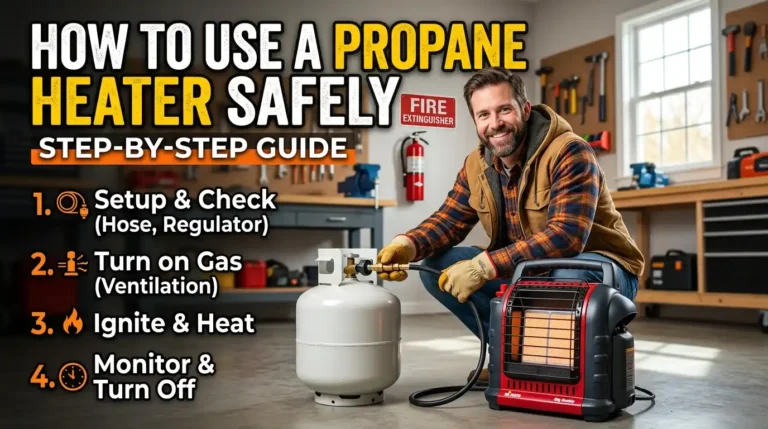
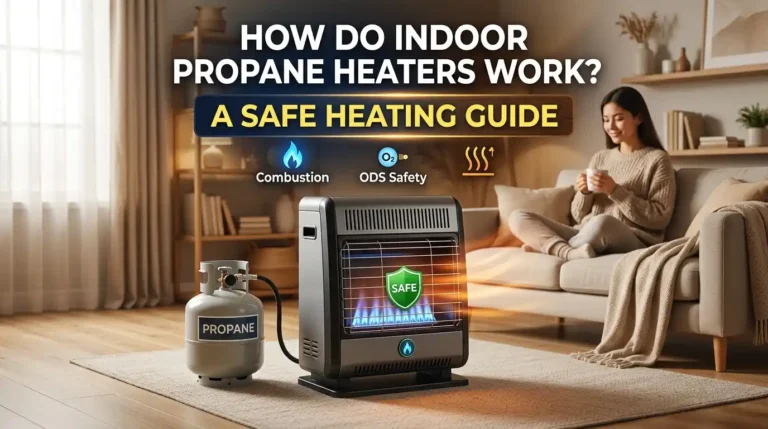
Never sleep with a propane, kerosene, or other fuel burning heater running in an unvented room. These heaters release carbon monoxide, and you cannot smell it or see it. If you heat with propane, learn how to use a propane heater safely during waking hours only, and switch it off before bed. An electric heater is the right tool for overnight bedroom heat.
Place the Heater in a Safe Spot With 3 Feet of Clearance
Put the heater on a flat, hard floor, never on a bed, a rug with a thick pile, or a chair. A hard surface keeps the heater stable and lets air flow around it. Keep at least 3 feet of clear space on every side, and measure it with the tape measure the first time so you know what three feet looks like in your room.
Keep the heater away from the bed, curtains, clothing, paper, and anything else that can catch fire. A heater that sits too close to bedding is the most common overnight heater hazard, and it is also the easiest to prevent. Move the nightstand or the laundry basket if either one sits inside that three foot circle.
Plug the heater directly into a wall outlet. Never use an extension cord or a power strip, because a space heater draws a large amount of current and can overheat a cord. Check that the outlet is not loose and that the plug fits snugly. If the plug feels warm after an hour of use, switch the heater off and have an electrician look at the outlet before you use it again.
Set Your Heater to the Right Temperature at Night
Set the thermostat to tonight’s target number from step one. On a digital heater, type the number in and let the thermostat do the work. The heater will run until the room reaches the target, then cycle on and off to hold it. That cycling is normal, and it is what keeps the room steady instead of swinging hot and cold.
On a heater with a numbered dial instead of a digital display, the numbers are not degrees. Start at the middle setting, wait an hour, and read your room thermometer. Move the dial a small amount, wait another hour, and read again. Two or three evenings of this will teach you which dial position matches which temperature in your room, and then you can set it in seconds.
Set the timer if your heater has one. A timer that switches the heater off an hour before you wake up works well in most homes, because the room holds its warmth for a while and your body warms up as you move around in the morning. A timer that switches the heater on an hour before bedtime works the other way: the room is already warm when you climb in, and the heater holds it from there.
Pro Tip: Warm the Room, Then Hold It
Run the heater on a higher setting for 30 to 60 minutes before bed to warm the walls and bedding, then drop it to your target temperature for the night. A room that starts warm holds its temperature with far less heater run time than a cold room that the heater has to warm from scratch after you are already in bed.
Warm the Room Before Bed, Then Let the Thermostat Hold It
Close the bedroom door and any windows about an hour before bedtime, and switch the heater on. A closed room warms faster than an open one, and closing the door keeps the warm air where you sleep instead of letting it drift down the hall.
Check the room thermometer after 30 minutes. If the room is still below your target, give it another 30 minutes or nudge the setting up by a degree or two. If the room has already passed your target, turn the setting down and let the thermostat settle. The goal is to climb into a bed that is already at the right temperature, not to fall asleep while the room is still warming up.
Pull the covers back while the room warms so the bedding warms too. Cold sheets steal body heat for the first 20 minutes in bed, and that is often when people reach for the heater dial and turn it too high. Warm sheets remove that urge, and the thermostat can then hold a lower, safer temperature all night.
Test the Room and Adjust the Next Night
When you wake up, note two things before you forget them: how you slept, and what the thermometer reads. Did you wake up sweating, or did you wake up cold? Was the room at your target number, or had it drifted? These two notes tell you exactly what to change.
If you woke up hot, lower the target by 2 degrees tonight. If you woke up cold, raise it by 2 degrees or add a blanket before you touch the thermostat. Change only one thing at a time, or you will not know which change helped. Most people find their number within three or four nights.
Keep the note by the heater for a week. Once you have three nights in a row of steady sleep at the same setting, you have found your number. Write it on a small label and stick it on the heater, so anyone in the house can set it the same way.
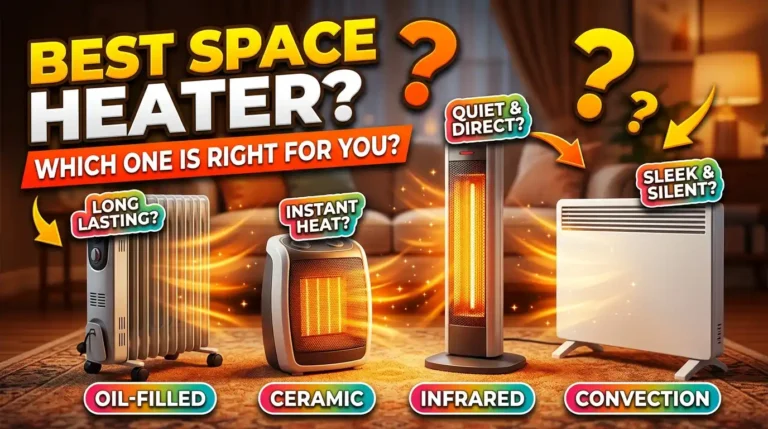
Which Heater Type Works Best Overnight?
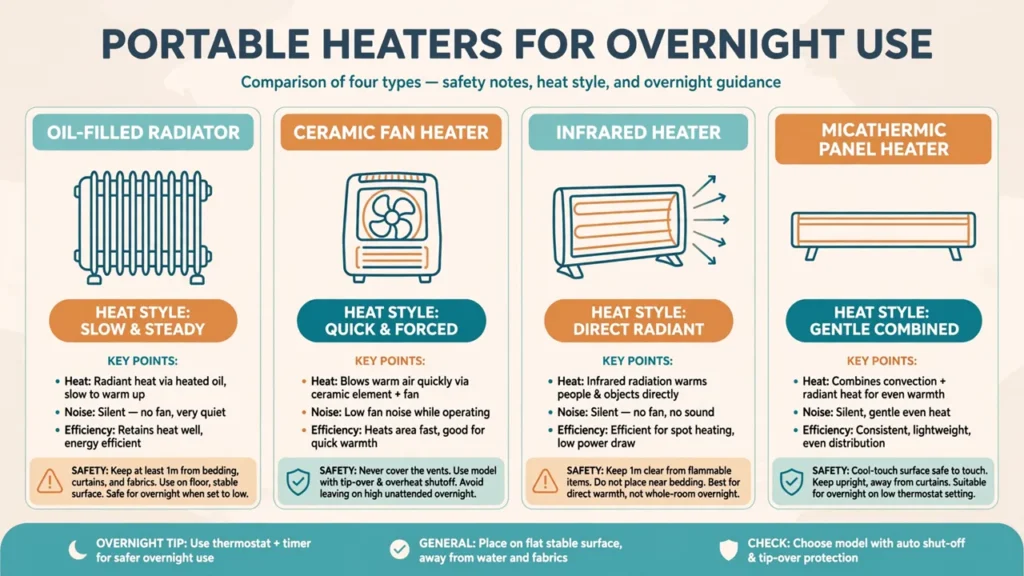
Not every portable heater behaves the same way while you sleep. Some cycle on and off with a loud click, some glow bright enough to disturb sleep, and some keep radiating heat long after they switch off. The right choice depends on how light a sleeper you are and how large the room is.
| Heater type | Overnight strengths | Overnight drawbacks | Best for |
|---|---|---|---|
| Oil-filled radiator | Silent, holds heat after switching off, steady warmth | Slow to warm a cold room, heavy to move | Light sleepers, all night use |
| Ceramic fan heater | Warms a room fast, small and light | Fan noise, clicks as it cycles, dries the air | Quick warm up before bed |
| Infrared heater | Quiet, warms people and objects directly | Heats unevenly, less effect behind furniture | One person, aimed heat |
| Micathermic panel | Silent, thin and light, even heat | Panel surface gets hot, slower than fan heat | Small rooms, quiet nights |
Oil-filled radiators are the most common pick for overnight use, because they run silent and their oil stays warm for a while after the thermostat switches the element off. That slow cool down smooths out the temperature swings that wake light sleepers. If you want to learn more about this type, read our guide to whether oil heaters emit carbon monoxide and our overview of infrared space heaters before you buy.
Common Night Heater Problems and Fixes
Most overnight heater problems come from three causes: the wrong setting, the wrong spot, or a room that loses heat faster than the heater can replace it. The table below matches each symptom to the fix that works most often, so you can sort a bad night without guessing.
| If this happens | Try this |
|---|---|
| You wake up sweating | Lower the target by 2 degrees, or use a lighter blanket |
| You wake up cold | Raise the target by 2 degrees, or add a blanket and warm socks |
| The room is hot near the heater and cold near the bed | Move the heater closer to the center of the room, or run a small fan on low to mix the air |
| The heater clicks on and off all night | Switch to an oil-filled radiator or micathermic panel, which cycle quietly |
| The air feels dry and your throat is sore | Set a bowl of water near the heater, or run a small humidifier |
| The heater never reaches the target | Check for drafts around windows and doors, and close the bedroom door |
Save Energy Without Losing Sleep
Heating only the bedroom instead of the whole house at night saves a real amount of energy, and a portable heater is the tool that makes that possible. Set the central thermostat lower at night, heat the bedroom with the portable heater, and close the bedroom door to keep the warmth in one room.
Each degree you lower the overnight setting saves energy, but comfort comes first. A room set two degrees too cold leads to a restless night and a heater turned up too high the next night, which wipes out the saving. Find your true number first, then let the timer switch the heater off an hour before you wake. That last hour of off time is the saving that costs you the least comfort, because the room stays warm enough while you are already waking up and moving.
Frequently Asked Questions
Is it safe to leave a space heater on all night?
It can be safe if you use an electric heater with tip over shutoff, overheat protection, and a thermostat, placed on a hard floor with 3 feet of clearance, plugged directly into a wall outlet, and with working smoke and carbon monoxide detectors in the room. Never leave a fuel burning heater running overnight indoors.
What is the best temperature to sleep in winter?
Most healthy adults sleep best at 60 to 67 degrees Fahrenheit, with 65 degrees as a good starting point. Children need 65 to 70 degrees, babies need 68 to 72 degrees, and older adults often prefer 68 to 70 degrees.
Should I turn my heater off when I sleep?
You do not have to turn it off if it is a modern electric heater with a thermostat and safety shutoffs, set to a safe temperature with proper clearance. A thermostat lets the heater hold a steady temperature instead of running at full power. If your heater lacks a thermostat or safety shutoffs, turn it off and warm the room before bed instead.
Does a lower night temperature really save money?
Yes, heating a room to a lower temperature uses less energy than heating it to a higher one, and heating only the bedroom at night uses less energy than heating the whole house. The saving depends on your heater, your home insulation, and local energy prices, so treat any exact dollar figure as an estimate. The biggest saving comes from lowering the central thermostat and heating one room only.
Why do I wake up hot even when the room feels cool?
Your blankets and sleepwear trap body heat, so your body can overheat even in a cool room. Try a lighter blanket, lighter sleepwear, or a lower heater setting before you blame the room temperature. Heavy bedding plus a warm room is the most common cause of waking up sweaty.
Can I use a space heater in a baby’s room overnight?
Yes, with care. Keep the room at 68 to 72 degrees, place the heater well away from the crib with 3 feet of clearance, use a model with tip over shutoff and overheat protection, and never aim the heater at the crib. Dress the baby in light sleepwear and a sleep sack, and follow your pediatrician’s advice on room temperature and safe sleep.
Quick Reference Card
Target: adults 60 to 67°F (start at 65°F); children 65 to 70°F; babies 68 to 72°F; older adults 68 to 70°F.
Safety: electric heater only overnight, tip over shutoff and overheat protection, 3 feet of clearance, wall outlet only, smoke and CO detectors working.
- Pick your target temperature
- Check the heater’s safety features
- Place it with 3 feet of clearance
- Set the thermostat and timer
- Warm the room before bed
- Test and adjust the next night
Now you know what temperature should you set your heater to at night, and you have a plan to find your exact number in a few nights. Start at 65 degrees if you are a healthy adult, check your heater’s safety features, give it 3 feet of clearance, and let the thermostat hold the room steady while you sleep.
Tonight, set the heater, close the door, and note how you sleep in the morning. A small change of two degrees is often all it takes to turn a restless night into a good one. If your heater is old or lacks safety shutoffs, replace it before you run it overnight, and keep a working carbon monoxide detector in the bedroom no matter which heater you use.