Why Does My Electric Fireplace Smell Like burning Plastic?
Why does my electric fireplace smell like burning plastic? An electric fireplace can generally be smelling of burning plastic, which can be either an innocent break-in smell of the manufacturing residue burning off or dust burning on the heating element. They both dissipate in a few hours of usage. However, when the odor is intense, persists, or is accompanied by smoke, sparks or a faulty circuit breaker, then it is a wiring or component issue, and the unit must be immediately unplugged.
And this is how to distinguish, and what, in particular, to examine, before you call an electrician.
Key Takeaways
- New unit: The first 1–4 hours of use are normal burn-in of manufacturing coats and lubricants and is marked by a plastic odor.
- Older unit: A sudden plastic odor with months or years of regular use is most probably dusting accumulation, a malfunctioning fan motor, or an electrical problem.
- Safe smells wear off each time they are used, and they do not accompany smoke, sparks or a burning odor that intensifies.
- Unsafe smells smell sharp, chemical, or metallic, worsen with time, or are accompanied by visible smoke, sparking or discoloration or a tripped breaker – stop power to the unit at once.
- Note: Electric fireplaces do not combust any fuel and thus cannot form carbon monoxide. A plastic smell is not a leak of combustion gas but a heat/electrical problem.
Why Does My Electric Fireplace Smell Like burning Plastic?
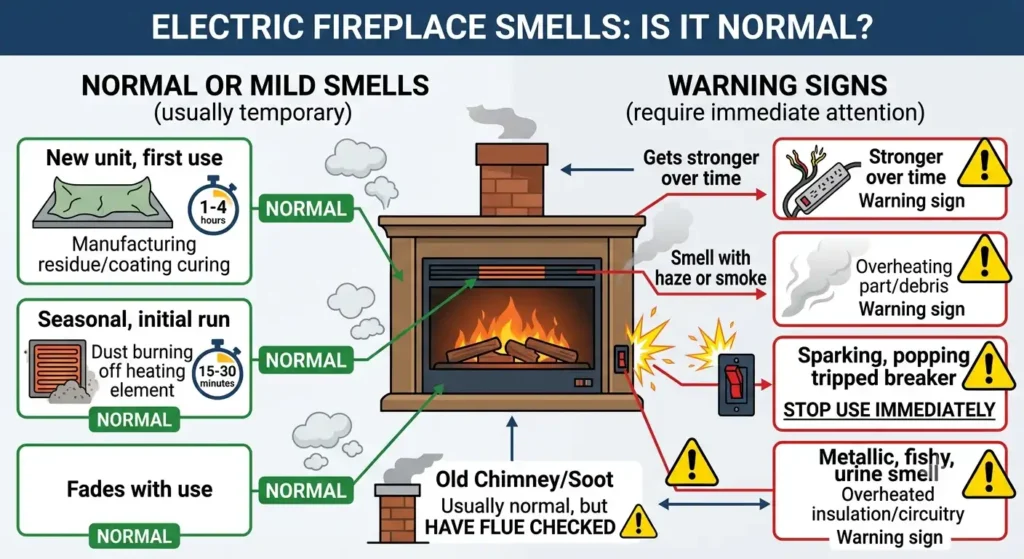
Below are some of the most common reasons for fireplace smell like burning plastic.
| Situation | Likely Cause | Normal or Warning Sign? |
| New unit, first use | Manufacturing residue/coatings curing off | Normal — should fade in 1–4 hours |
| Seasonal, initial run of the year | Dust burning off heating element | Normal — should dissipate in 15–30 minutes |
| Fades a bit with every use | Break-in or dust working itself out | Normal |
| Gets stronger over days or weeks | Wiring, overloading, or component failure | Warning sign |
| Smell coupled with haze or smoke | Overheating part or debris | Warning sign |
| Smell with sparking, popping, or tripped breaker | Electrical short or overload | Warning sign — stop use immediately |
| Metallic, fishy, or urine smell | Overheated insulation or circuitry | Warning sign |
| Smell when converting/installing in an old chimney | Soot or creosote left behind heating up | Usually normal, but have the flue checked |
Normal Causes of a Burning Plastic Smell in Electric Fireplace
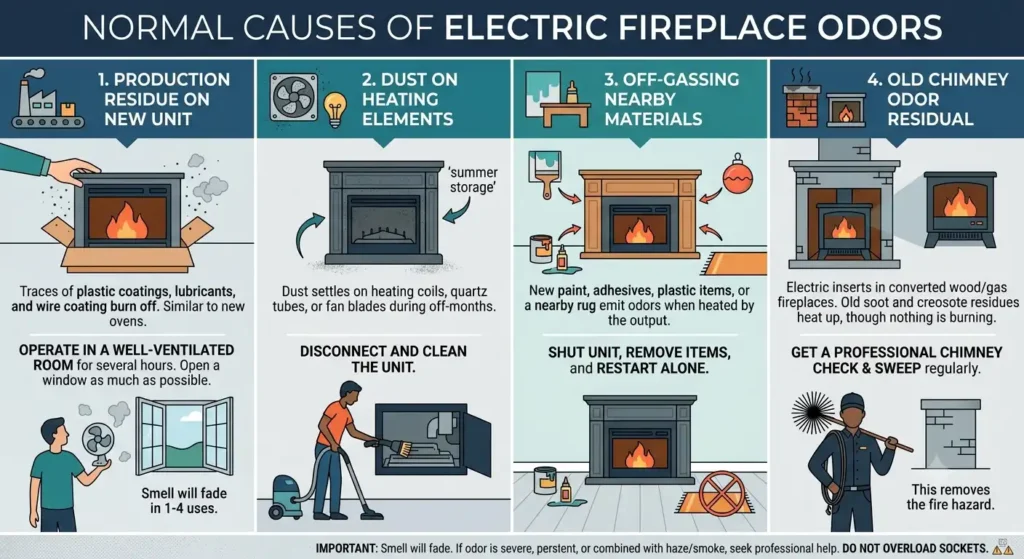
1. Producing Residue on a fresh Unit.
The new electric fireplaces are constructed using plastics, wire coating and lubricants that were never heated during the construction. Those trace coatings are burned off the first time the heating element or infrared bulb reaches its full operating temperature. This is normal in almost all the heated appliances – the same thing occurs with the new furnaces, space heaters and ovens.
What to do: Heat the fireplace with a lot of air in a well-ventilated room (open a window as much as possible) during a few hours. The smell should noticeably fade with each use and disappear completely within one to four uses. Don’t leave pets or birds in the room during this first burn-in, as some species are more sensitive to airborne particles than humans.
2. Burning off the Heating Element.
When the fireplace was not used in months (summer months, say) dust is deposited on the heating coil, quartz infrared tube, or fan blades. The dust burns when you turn it back on and it smells like dust which many people would say is akin to a dusty space heater. It is nasty and not harmful.
Action to take: Disconnect the unit, clean the intake and exhaust vents using a soft brush attachment, wipe the surfaces that are visible. reread it– the odour ought to be far less or disappeared.
3. Off-Gassing Trim, Mantels or Adjacent Materials.
And not the fireplace all the time. New paint, adhesive in a mantel surround, a nearby plastic ornament, or even a new area rug may emit when heated by the heat output of the fireplace.
Action: Shut the fireplace, take all that you have added or close to the mantel and restart the unit alone, to determine whether the odor recurs or not.
4. Old Chimney Conversion odor Residual.
Provided you have an electric insert fitted in one of your converted wood-burning or gas fireplaces, any old soot and creosote remain in the surrounding masonry, or flue may give off an odor as the surrounding area heats up – although nothing is being actually burnt with the electric unit.
What to do: Have chimney or firebox professionally checked and swept. This should be done on a regular basis whether the smell is pleasant or not as old deposits are a source of fire in themselves.
Cases in Which Electric Fireplace Burning Plastic Smell is a Cause of Concern
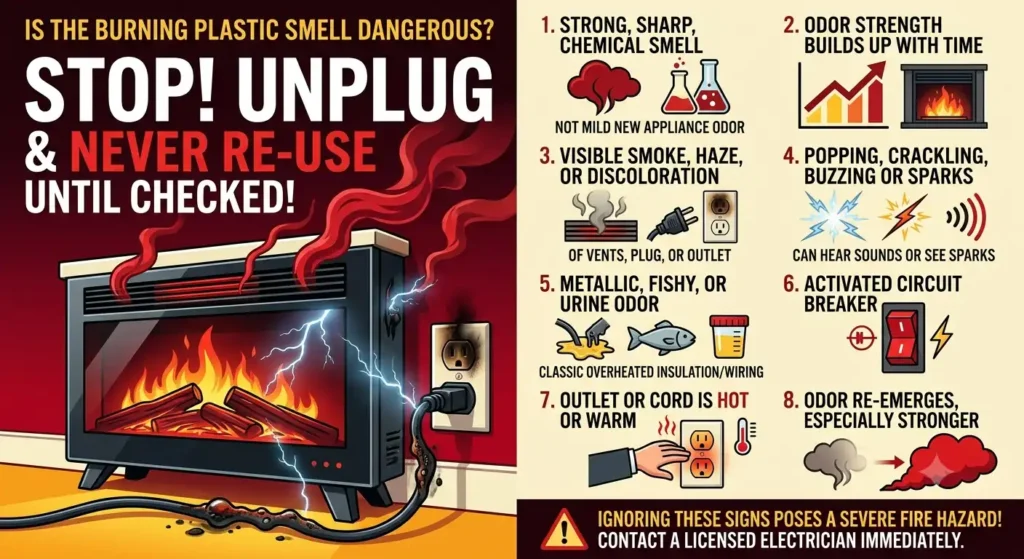
Stop using it and immediately unplug the fireplace and never use again unless it has been checked because of any of the following:
- It has a strong, sharp or chemical smell as opposed to a mild new appliance smell.
- Strength builds up with time of running of the unit, rather than declines.
- You observe smoke, haze or discoloration of vents, the plug or the outlet.
- You can hear popping, crackling, buzzing or see sparks.
- odor is metallic, fishy, or resembling urine – a classic symptom of overheated plastic insulation and wiring.
- A circuit breaker is activated when the fireplace is on.
- The outlet or cord is hot or warm.
- The odor re-emerges when you believed it had gone and especially when it is bigger than last.
What Causes an Electrical Burning Smell?
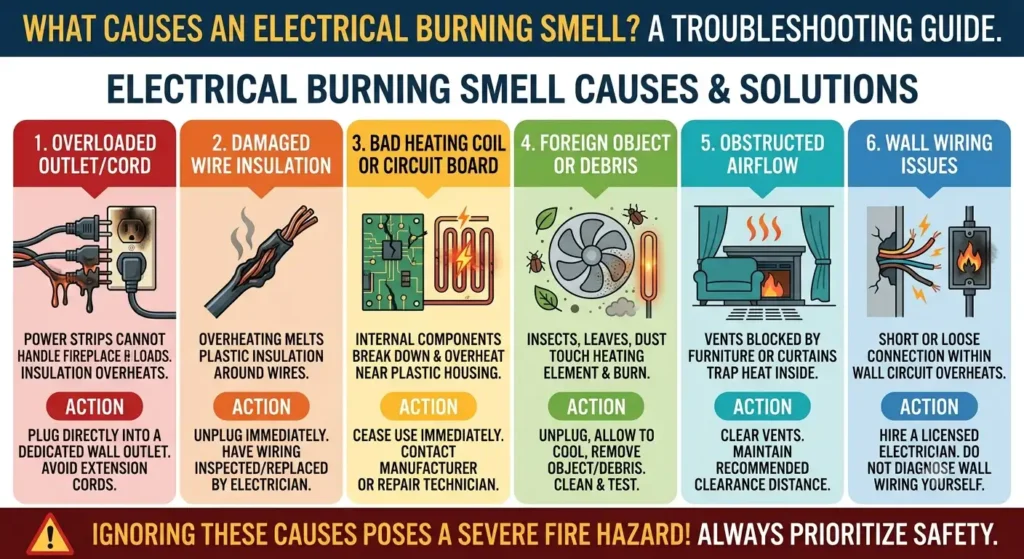
| Cause / Problem | Why It Happens | Fix / Action |
| Overloaded outlet or extension cord | Extension cords and power strips are not designed to handle the full load of a fireplace heater, causing wiring insulation to overheat. | Plug directly into a dedicated wall outlet; avoid using extension cords or power strips. |
| Damaged wire insulation | Overheating melts the plastic insulation around the wires, emitting a burning odor. | Unplug immediately; have wiring inspected and replaced by a licensed electrician. |
| Bad heating coil or circuit board | Internal components break down and heat up excessively near the plastic housing. | Cease use immediately; contact the manufacturer or a qualified repair technician. |
| Foreign object or debris in the unit | Insects, leaves, dust, or fallen items touch the heating element and burn off. | Unplug, allow the unit to cool, remove the object/debris, clean, and test again. |
| Obstructed or constrained airflow | Vents blocked by furniture, curtains, or built-in cabinetry trap heat inside the unit. | Clear vents to maintain at least the manufacturer’s recommended clearance distance. |
| Wall wiring or hardwire issues | A short or loose connection within the wall circuit overheats under load. | Hire a licensed electrician—do not attempt to diagnose or repair household wall wiring yourself. |
Electric Fireplace vs. Gas or Wood Fireplace Smells.
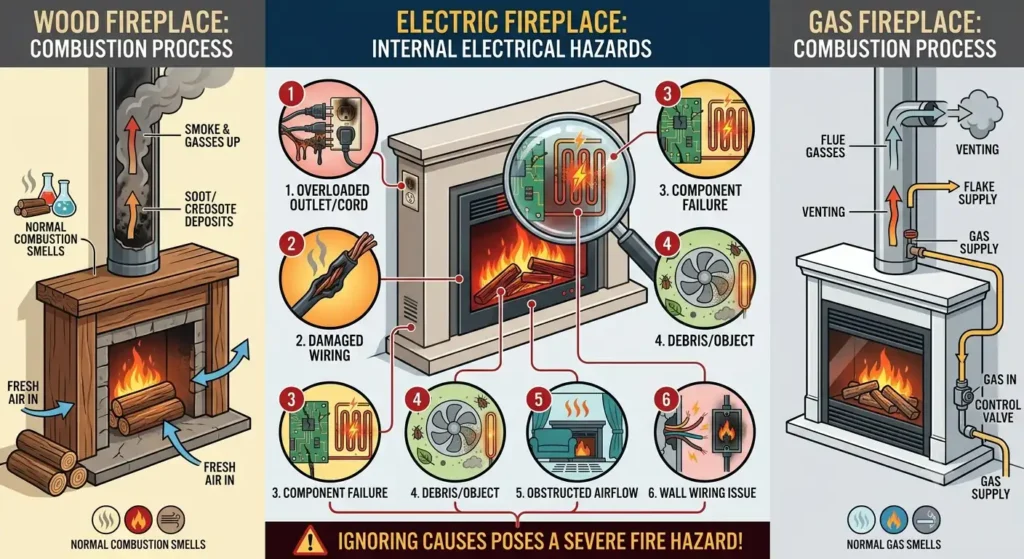
It is useful to realize that electric fireplaces do not operate in the same way as a combustion fireplace and therefore, some of the smells that would be normal in a wood or gas fireplace are going to have a different meaning here.
| Cause / Problem | Why It Happens | Fix / Action |
| Overloaded outlet or extension cord | Extension cords and power strips are not designed to handle the full load of a fireplace heater, causing wiring insulation to overheat. | Plug directly into a dedicated wall outlet; avoid using extension cords or power strips. |
| Damaged wire insulation | Overheating melts the plastic insulation around the wires, emitting a burning odor. | Unplug immediately; have wiring inspected and replaced by a licensed electrician. |
| Bad heating coil or circuit board | Internal components break down and heat up excessively near the plastic housing. | Cease use immediately; contact the manufacturer or a qualified repair technician. |
| Foreign object or debris in the unit | Insects, leaves, dust, or fallen items touch the heating element and burn off. | Unplug, allow the unit to cool, remove the object/debris, clean, and test again. |
| Obstructed or constrained airflow | Vents blocked by furniture, curtains, or built-in cabinetry trap heat inside the unit. | Clear vents to maintain at least the manufacturer’s recommended clearance distance. |
| Wall wiring or hardwire issues | A short or loose connection within the wall circuit overheats under load. | Hire a licensed electrician—do not attempt to diagnose or repair household wall wiring yourself. |
Since electric fireplaces do not burn any fuel, they do not produce carbon monoxide and the odor of a gas is something they do not produce. Whether there is a burning odor or not, it is always heat- or electricity-related, not a byproduct of combustion – and that actually shortens the list of troubleshooting to gas or wood units.
How to Fix Burning Plastic Smell in Electric Fireplace. Step-by-Step Guide
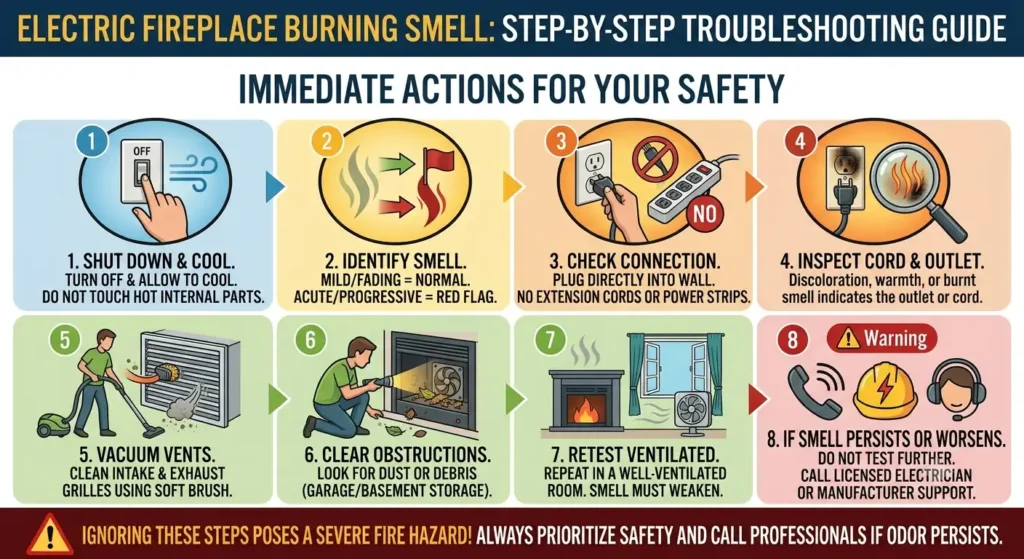
- Turn off the fireplace and allow it to cool down. Do not touch inside parts when hot.
- Determine the type and pattern of smell. Mild and fading = probably normal. Acute, intense or progressive = consider as a red flag.
- Check the power connection. Make sure that it is plugged in a wall outlet, not an extension cord or power strip.
- Inspect the cord and outlet, discoloration, warmth, or burnt smell at the plug itself, indicates the outlet or the cord, not the unit.
- Clean vents. Vacuum dust on intake and exhaust grilles using soft brush attachment.
- Look for obstructions or debris in the firebox, particularly when the unit has not been used recently or when it has been stored in a garage or basement.
- Repeat it in a well-ventilated room. It must be evidently weaker in case it is a break-in or dust smell.
- When the odor recurs, gets worse, or is accompanied by smoke, sparks, or a faulty circuit breaker, then, do not keep testing it yourself but call in a licensed electrician or the manufacturer support line.
How Long Should the Smell Last?
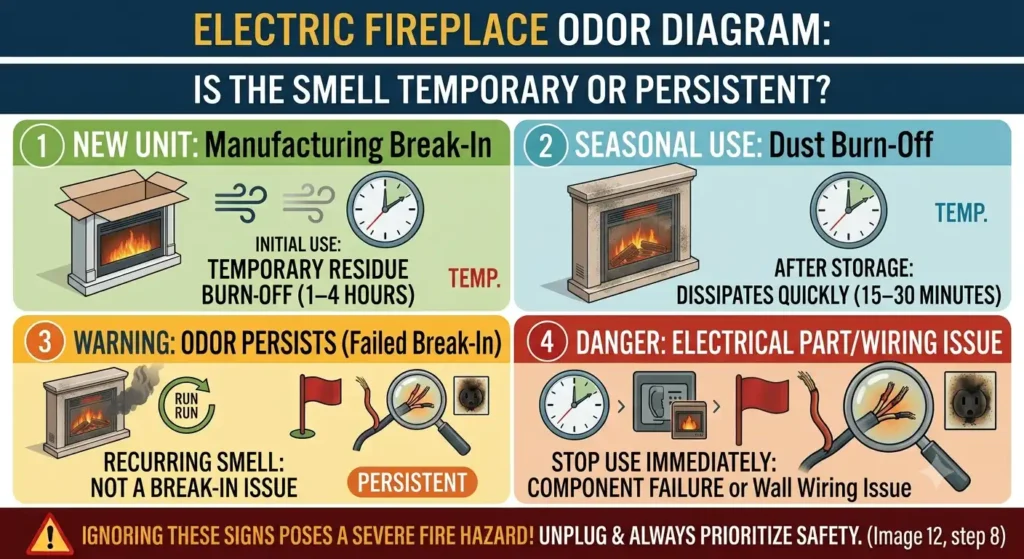
- New unit, first use: most pronounced during the first 15-60 minutes with a significant reduction in the next 1-4 hours of total run time.
- Storage rest start after a season: The dust smell usually dissipates 15-30 minutes after the cleaning of vents and the functioning of the unit.
- Any odor that persists despite multiple complete run cycles, or an odor that recurs after apparently clearing is no longer regarded as a typical break-in odor and must be addressed as a part or wiring problem.
No official industry-wide statistic on the precise number of hours that a break-in smell “ought to” take, as it varies by the size of the unit and the heating element. Now, as a general rule of thumb, when the smell is not evidently weaker after the third or fourth use, then you should no longer assume it is merely break-in residue.
Myth vs. Fact
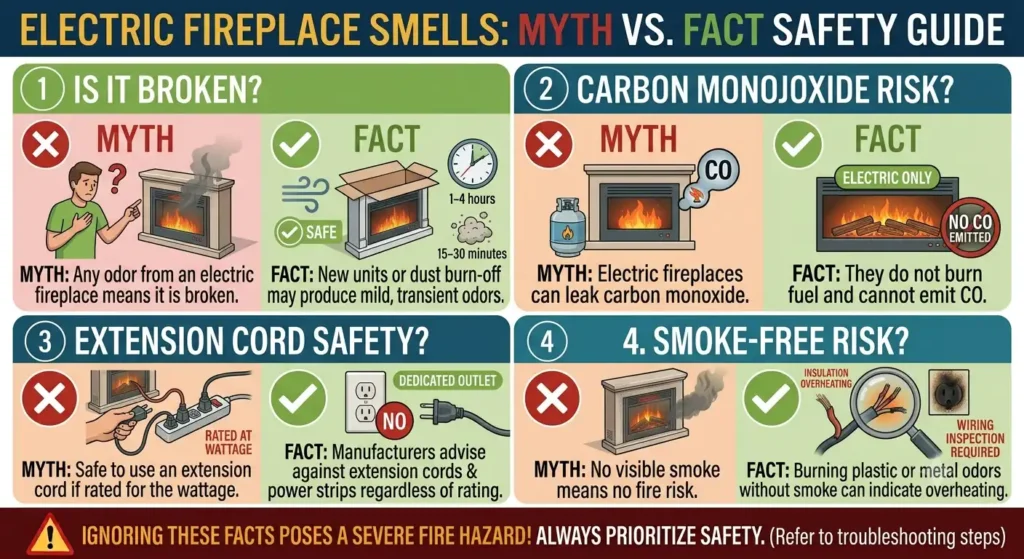
| Myth | Fact |
| Any odor from an electric fireplace means it is broken. | New units or dust burn-off may produce mild, transient odors that are completely normal. |
| Electric fireplaces can leak carbon monoxide. | They do not burn fuel and cannot emit CO. Any smell indicates a heat or electrical issue. |
| It is safe to use an extension cord if rated for the wattage. | Manufacturers advise against extension cords and power strips regardless of rating, as continuous heavy draws pose fire hazards. |
| If there is no visible smoke, there is no fire risk. | Odors of burning plastic or metal without visible smoke can still indicate overheating insulation or wiring that requires inspection. |
Preventing Future Odor Problems:
- Vacuum vents and firebox periodically (i.e. every few months) and never prior to the first use of the heating season.
- Directly into a special wall socket – never a power strip, extension cord or already loaded outlet that is already occupied by other high draw gadgets.
- Leave the clearance around vents suggested by the manufacturer; do not enclose the unit with furniture or decor or tight mantel surround.
- Check the hardwired units and the wall wiring around the fireplace with a licensed electrician in case the fireplace is over a few years old or installed by the former occupant.
- Have the chimney or firebox professionally cleaned on a regular basis, should the unit be installed in an old wood or gas fireplace.
You May Also Read:
FAQs:
The question is, is it normal that a new electric fireplace smells like a burning plastic?
Yes. New units nearly always have a faint smell of plastic or some chemical, which burns off in the first few hours of use. It should fade with each use.
What is the duration of smoke of the new electric fireplace?
The total run time is usually 1-4 hours, distributed over the initial few uses. Provided it has not perceptibly diminished by the third or fourth use, consider it as a possible fault, not as break-in odor.
My electrical fireplace smells of burning plastic yet not new- why?
A sudden smell of plastic in an existing unit is more likely to be dust burning off the heating part after a spell of inactivity, or an indication of an electrical problem, such as a broken wire insulation, or an overloaded outlet.
Will an electric fireplace ignite?
Yes, like any heat-producing appliance, provided that it is overloaded, obstructed or there is a wiring fault. The danger can be mitigated by adhering to clearance guidelines, not using extension cords, and immediate action in eliminating worsening smells.
Do I turn my electric fireplace off when it smells of plastic being burnt?
When the smell is acute, sharp, and getting worse or it is accompanied by smoke, sparking or a tripped breaker, pull the plug out at once. When it is mild and fading away during normal break-in or after dusting vents, then most of the time it is safe to continue running as you observe it.
Can electric fireplaces give out carbon monoxide?
No. They do not use fuel, and, therefore, they cannot produce carbon monoxide. The odor of electric unit burning is never associated with the gasses of combustion, but with heat or electrical elements.
What causes my electric fireplace to smell like it is burning although there is no fire?
The heating component, infrared bulb or fan motor will still generate sufficient heat to burn dust, create residue, or surrounding debris, resulting in a burning odor with no fire present.
Can I use an extension cord to operate my electric fireplace?
No. The manufacturer recommends against extension cords and power strips since constant loads on the heater might cause the wiring to overheat and hence, a frequent source of burning odors and fire risk.
Why is my electric fireplace smelling of fish or urine?
One indicator of overheated plastic and wiring insulation in electrical components is a fishy or urine like smell. Unplug the unit and have the wiring inspected.
My electric fireplace is not going away after cleaning – what do I do now?
In case cleaning the vents and making sure that it is directly plugged into a wall outlet does not solve the problem, cease using the unit and call in the support line of the manufacturer or a licensed electrician, as an ongoing smell is an indication of a problem inside the unit or in the wiring.