What Is an Oil-Filled Radiator Heater? How It Works, What It Costs, and Whether It Is Right for Your Room
You turn on a heater, and in ten minutes there is nothing that appears to take place. Then the room gradually becomes warm, and it remains so, without the fan whining in the corner. In a nutshell, that is the oil-filled radiator heater. It is not rapid, but it is constant, quiet and soft.
This guide defines what an oil-filled radiator heater is, how it operates, the true cost of operating one, and how to determine whether or not one should be in your house.
Quick Answer
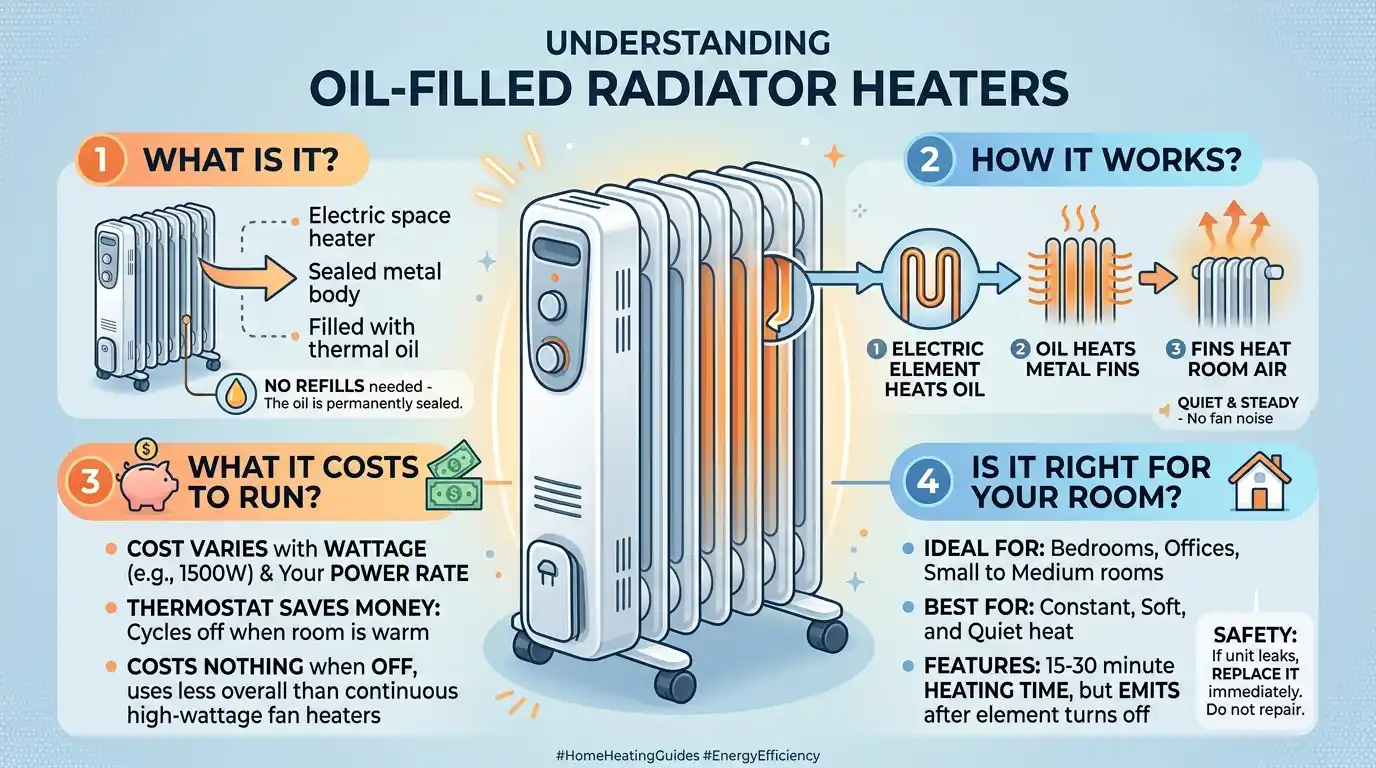
An oil-filled radiator heater is an electric space heater that has a sealed metal body filled with thermal oil. The oil is heated by an electric element, the metal fins are heated by the oil, and the air in your room is heated by the metal fins. The oil does not burn or get used up and thus you never refill it.
Key takeaways
- It warms the room by a gradual, noisy-free convection and a little radiant heat.
- The heating time is between 15 and 30 minutes, and once the element is turned off, it continues to emit heat.
- The running cost varies with the wattage and your power rate, and the thermostat will switch off use after the room has been warm.
- It is applicable in bedrooms, offices and small to medium rooms where quiet heat is important.
- The oil is hermetically sealed. In case of leakage, change the unit.
How an Oil-Filled Radiator Heater Works
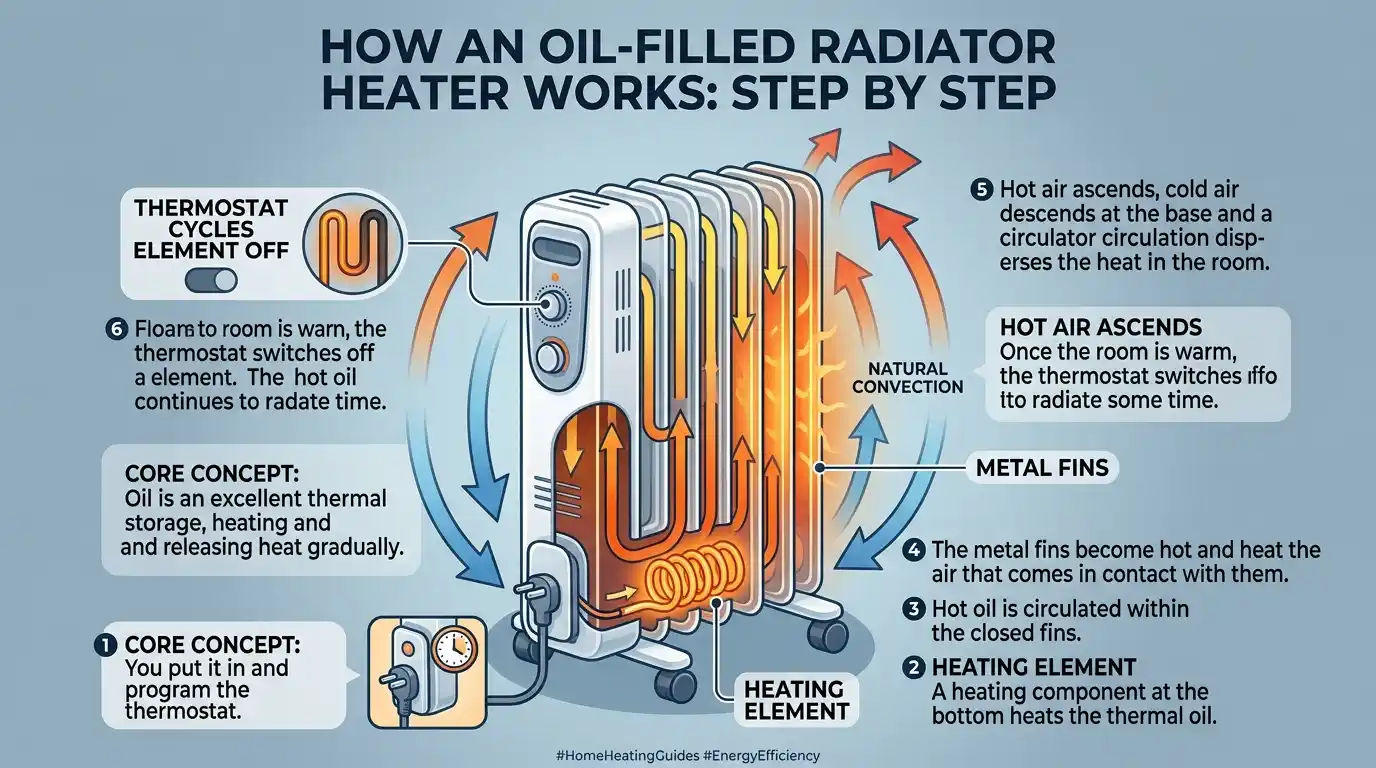
Oil-filled radiators operate on a very simple concept. Oil is a good thermal storage and therefore the unit heats gradually and releases the heat gradually.
Step by step
- You put it in and program the thermostat.
- A heating component at the bottom heats the thermal oil.
- The hot oil is circulated within the closed fins.
- The metal fins become hot and heat the air that comes in contact with them.
- Hot air ascends, cold air descends at the base and a natural air circulation disperses the heat in the room.
- Once the room has reached the temperature that you have set, the thermostat switches off the element. The hot oil continues to radiate some time.
For more on the internals, see our guide on how oil-filled heaters work.
Why it stays warm after you switch it off
Oil has high thermal mass. It retains its heat far longer than bare metal coil. This is why the fins are hot even after the heater is switched off. It is also the reason why radiators that are filled with oil are smooth and even when compared to the heaters that are hot and cold.
What is in an Oil-filled Radiator?
The oil
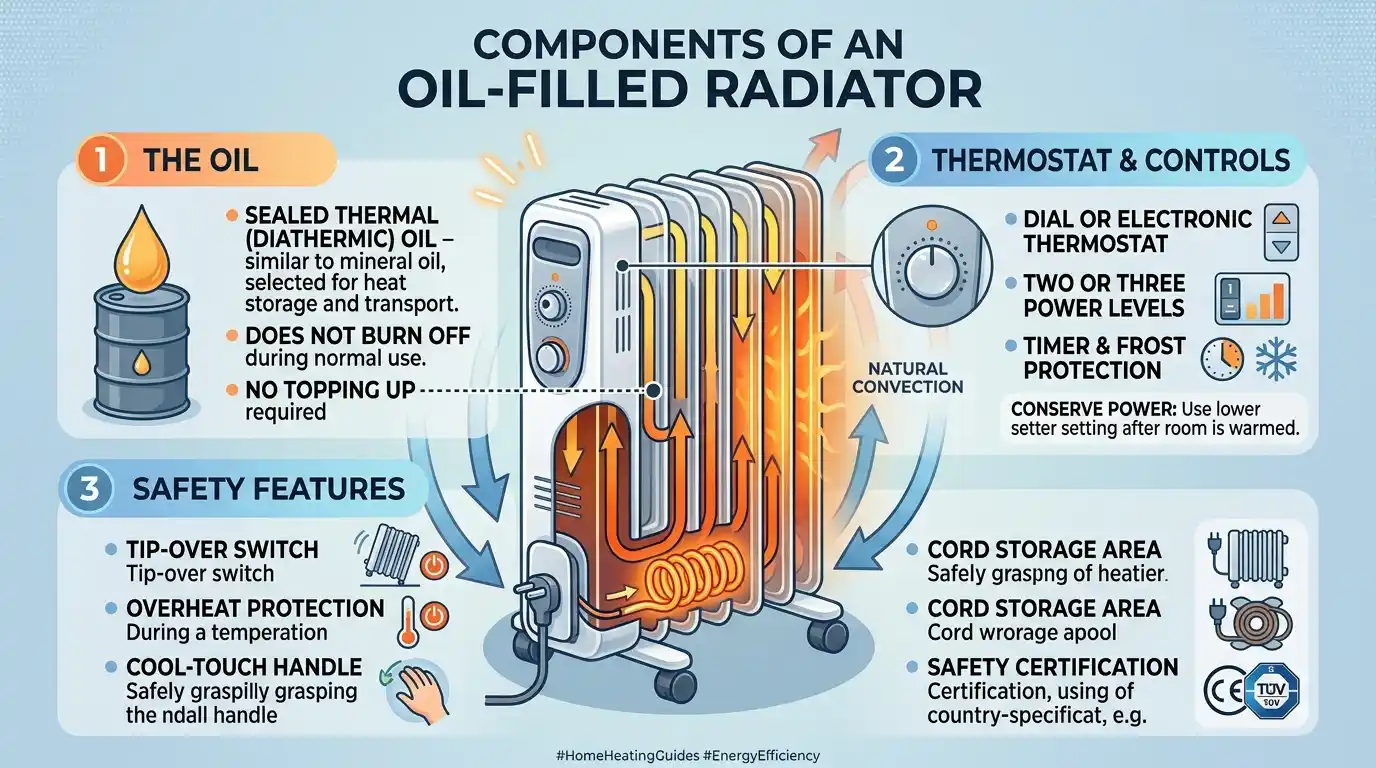
A sealed thermal (diathermic) oil is similar to mineral oil used in most units. It is selected due to its ability to store and transport heat. It does not burn off during normal use, thus it does not require topping up.
Thermostat and controls
The majority of models have a dial or electronic thermostat and two or three power levels. Most of them also have a timer and a frost protection mode. The simplest way to conserve power is to use a lower setting after the room has been warmed. Our oil-filled radiator usage guide covers settings in detail.
Safety features
Look for these on any model you buy:
- A tip over switch that shuts the power in case the heater falls.
- Overheat protection which switches the unit off in case it becomes overheated.
- A cool-touch handle
- A cord storage area
- Safety certification (UL listing (or equivalent in your country).
How Much Does an Oil-Filled Radiator Cost to Run?
Running cost is easy arithmetic.
Formula: watts ÷ 1,000 × hours × your price per kWh = cost
I am taking the rate of $0.17 per kWh as an example. You have your own rate on your utility bill, so replace it. The table indicates full power without the thermostat cycling.
| Heater power | kWh per hour | Cost per hour | Cost for 8 hours |
|---|---|---|---|
| 700 W | 0.7 | about $0.12 | about $0.95 |
| 1,000 W | 1.0 | $0.17 | $1.36 |
| 1,500 W | 1.5 | about $0.26 | about $2.04 |
In practice the thermostat turns off the element when the room has been heated. Assuming that it operates half the time, those numbers are approximately half. Precise savings will be based on your room, insulation and weather.
Another fact to know: almost all the electricity consumed by an electric resistance heater is converted to heat. Oil-filled radiators are not more efficient at converting power than a fan or ceramic heater. Their strong point is the uniform distribution of heat. For a deeper cost breakdown, read how much electricity an oil-filled radiator uses and are oil-filled heaters energy efficient.
What Size Do You Need?
One of the rules of thumb is approximately 10 watts per square foot of a room with normal ceilings and average insulation. Ineffectively insulated rooms might require additional.
| Room size | Suggested wattage |
|---|---|
| Up to 70 sq ft (small bathroom or nook) | 700 W |
| Up to 100 sq ft (small bedroom or home office) | 1,000 W |
| Up to 150 sq ft (average bedroom) | 1,500 W |
The practical maximum of 120 V household outlets is a 1,500 W heater. In bigger areas, it is preferable to install a more centralized heating system or two heaters on different circuits than to overload a single outlet.
Oil-Filled Radiator vs Other Space Heaters
| Feature | Oil-filled radiator | Fan heater | Ceramic heater | Infrared heater |
|---|---|---|---|---|
| Heat-up speed | Slow | Very fast | Fast | Fast (direct) |
| Noise | Silent | Fan noise | Some fan noise | Quiet |
| Heat style | Even, lasting | Quick bursts | Quick | Targeted to objects and people |
| Heat after switch-off | Yes | No | Little | No |
| Best for | Bedrooms, offices | Quick top-up | Small spaces | Spot heating |
If you’re still deciding between types, see our guide on the best type of space heater. If you want the plain overview of this heater class, read what an oil heater is.
Pros and Cons
| Pros | Cons |
|---|---|
| Silent operation | Slow to warm up |
| Even, steady heat | Heavy and bulky |
| Keeps radiating after switch-off | Surface gets very hot |
| No fan, so less dust moving around | Not suited to very large rooms |
| No refilling or fuel needed | Costs more upfront than some heaters |
Is an Oil-Filled Radiator Safe?
When used correctly, it is among the less dangerous types of space heaters since it does not have an exposed glowing component. But the fins do become hot enough to burn the flesh and scald cloth, and any space heater can ignite fire when used improperly.
The National Fire Protection Association (NFPA) reports that space heaters are the causes of a high proportion of home heating fires and the majority of heating fire fatalities, so the fundamentals count.
Can you leave it on overnight?
A lot of individuals do and contemporary units have tip-off and overheat safeguards. Nevertheless, consult your manual, as some manufacturers do not recommend unattended use. A reasonable compromise is a timer or a low thermostat setting.
Safety rules to follow
- Store it at least 3 feet away on the beds, curtains, furniture and other flammable items.
- Insert directly into a wall socket. Avoid extension cords and power strips.
- Put it on a hard, flat surface.
- Don’t drape clothes or towels over it.
- Keep pets and children out of the hot fins.
- Check the cord for damage and never use a heater with a frayed cord.
- Test your smoke alarms.
To be official, visit the NFPA and U.S. Consumer Product Safety Commission heating safety pages.
Common Mistakes to Avoid
- Purchasing an inadequately small unit to fit in the room.
- Leaving it on full blast throughout the day rather than the thermostat.
- Using an extension cord
- Covering the fins with furniture or laundry.
- Expecting instant heat
- Trying to open or repair a leaking unit
How to Choose an Oil-Filled Radiator
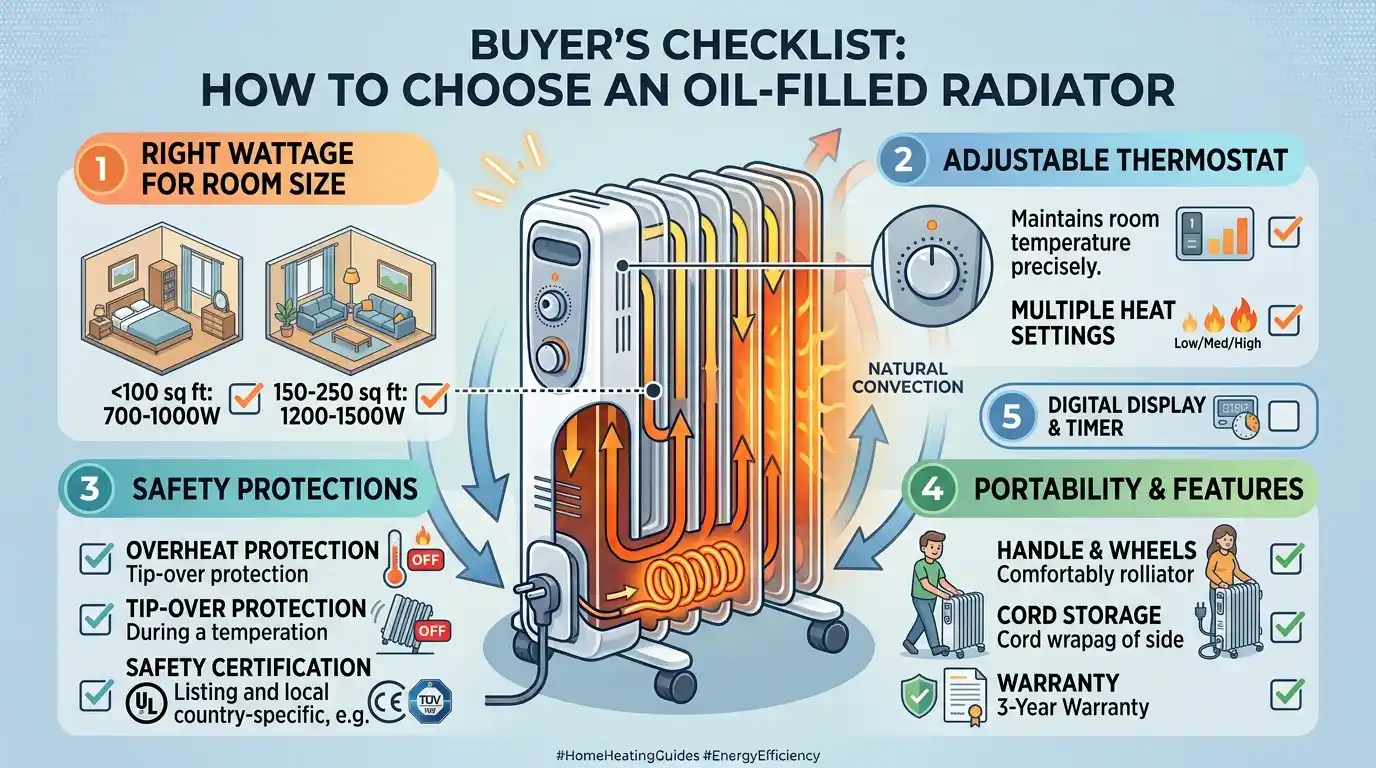
Buyer checklist
- Right wattage for your room size
- Adjustable thermostat
- Multiple heat settings
- Overheat and tip-over protection.
- Safety certification (UL or local equivalent)
- A handle and wheels to move it.
- Digital display or timer, should you desire convenience.
- Cord storage
- A clear warranty
Who Should Skip It
An oil-filled radiator might not be suitable when you require immediate heat, when the room is very large or drafty or when storage and lifting capacity are very limited. In such situations, a ceramic heater, infrared panel or a more superior central heating system can be of better use.
FAQs
What is an oil-filled radiator heater?
It is an electric heater that has a sealed body that is filled with thermal oil. Heat is applied to the oil by a heating element that warms the fins and subsequently the air in your room.
How does an oil-filled radiator heater work?
The element warms the oil, the oil warms the metal fins and the fins warm the air by convection and radiant heat. A thermostat turns the element on and off to maintain your desired temperature.
Do you have to fill an oil-filled radiator?
No. The oil is not used up as it is closed at the factory. In case of leakage, discontinue using the unit.
Which is the time that an oil-filled radiator takes to warm a room?
Typically 15 to 30 minutes to be noticeably warm, based on room size, wattage and initial temperature.
Do oil-filled radiators cost a lot to operate?
They are as expensive per kWh as other electric resistance heaters. Full power at 1,500 W and $0.17/kWh results in about $0.26/h, and the thermostat reduces this in practice.
Is it possible to leave an oil-filled radiator on overnight?
Most individuals do and the safety features can assist, but consult your manual and use a timer or low setting to be even safer.
Which is better, an oil-filled radiator or a fan heater?
It works better with low and slow heat. A fan heater is more suitable for quick and temporary warmth.
Why does my radiator with oil in it remain hot even when turned off?
The oil continues to give up stored heat. This is normal.
What size of oil-filled radiator do I need?
A general rule of thumb is about 10 watts per square foot, so a 1,500 W model will fit about 150 square feet.
Are oil-filled radiators energy efficient?
They transform almost all power into heat, as do other electric heaters. They have the advantage of even heat and good heat retention, rather than reduced wattage.
Can an oil-filled radiator warm an entire house?
No. It is suitable for single rooms. It is possible to use more than one, but it can be expensive.
Can clothes be dried on an oil-filled radiator?
Many manuals caution against it since it may lead to overheating when the unit is covered. Follow the advice of your manufacturer.
Can I use an extension cord with an oil-filled radiator?
It is preferable to plug the heater directly into a wall outlet. Heaters consume a lot of current and cords may overheat.
What happens if an oil-filled radiator leaks?
Unplug it, allow it to cool down and stop using it. Do not try to repair it. Dispose of it according to your local appliance or hazardous waste disposal regulations.
Final Thoughts
Oil filled radiator heater is a quiet, reliable option to anyone who desires a quiet, even warmth in a bedroom, office or small living room. It will not be able to win a speed race, yet it retains heat well and there is no fan noise. Adjust the wattage to your room, thermostat, 3-foot rule, and leave it directly in the wall.
Next: measure your room, find out your electricity rate and compare two or three models with the checklist above. If you’re still comparing options, read how to use an oil-filled radiator heater and our best type of space heater guide.