Will an Electric Fireplace be a Money Saving Appliance?
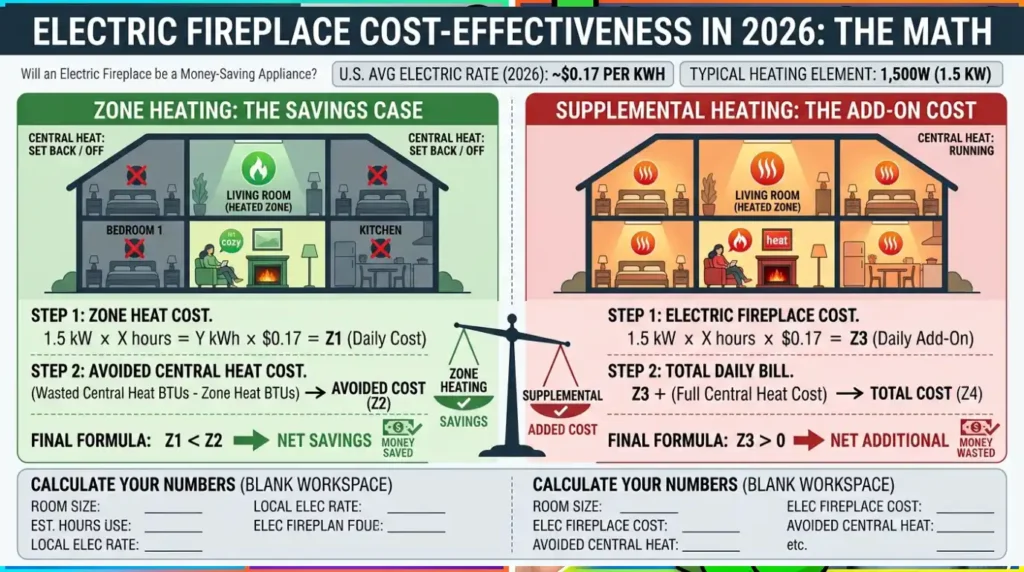
Will an Electric Fireplace Save Me Money? Quick answer: An electric fireplace can help you save money, but only under certain conditions, namely when you are using the fireplace to do so-called zone heating (heating only the room you are in, but not other rooms). When used inappropriately, it will contribute an additional heating bill to your current bill rather than replace it. The actual math is presented below, with the current rate of electricity in the U.S. in 2026, to allow you to calculate your own numbers, rather than guess.
The Short Answer of Will an Electric Fireplace Save Me Money?
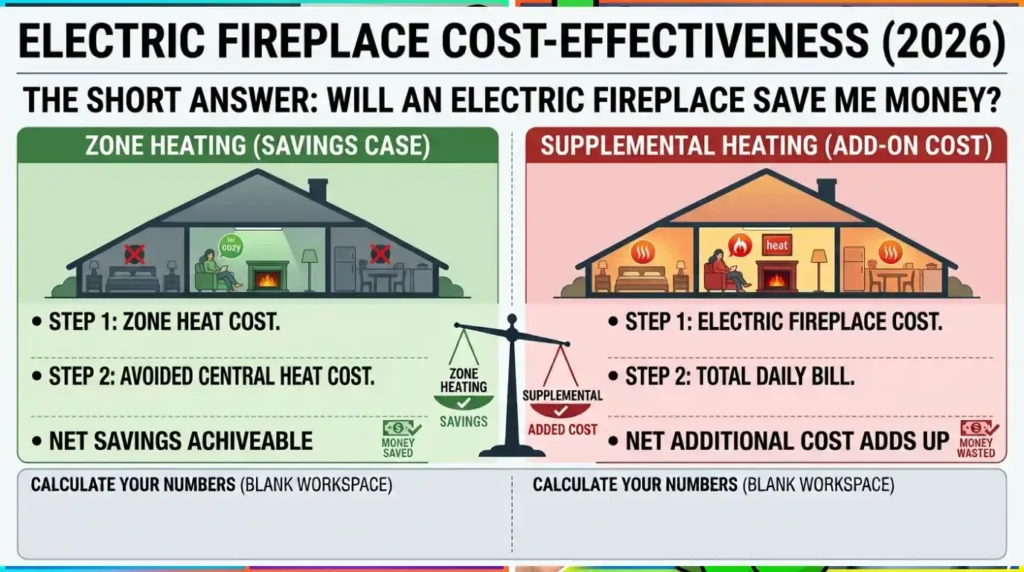
Will an Electric Fireplace Be Money-Saving? A typical electric fireplace with the heater on will use between 0.14 and 0.35 per hour of electricity at your local rate and the wattage of the unit. That, in itself, is cheap sounding and cheap. However, cheap to run and saves you money are two different things.
The following is the rule which in fact will give you your answer:
- It conserves money: when you heat one room with it and switch your central thermostat to down when you are in that room.
- It is an added expense to run it without changing the thermostat in addition to your regular heating system.
In this guide everything tells us how to get on the saving side of that line.
How Electric Fireplaces Actually Use Electricity
Electric fireplaces perform two distinct tasks, of which only one matters in any way about electricity.
The flame effect (the flashing logs, moving “flames” or holographic display) is powered by LED lighting. This pulls a low amount of power – typically 30 to 100 watts – so running only the visual effect with the heater switched off would typically cost approximately 1-2 cents per hour. You might leave the fires on all night at the expense of a few cents.
It is the heater, however, that makes your bill. A typical electric fireplace has a standard resistance heating coil, or fan-forced heater with a rating of between -750 and -1,500 watts, or larger units are available with a rating of up to 2,000 watts. This is virtually the same technology as a space heater, electric fireplaces do not warm better than a space heater, they just appear more attractive doing it.
Wattage and BTU, in plain terms
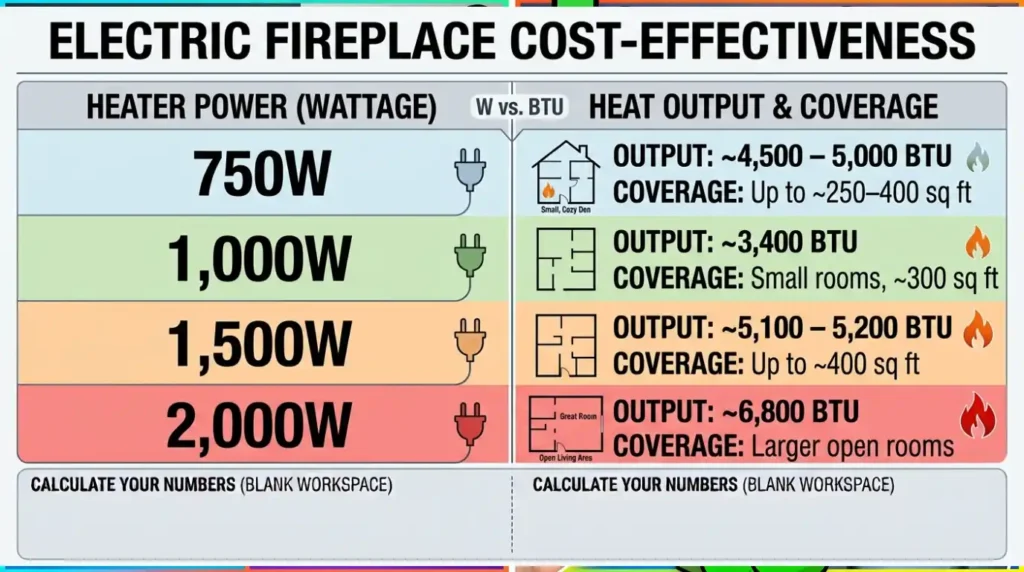
| Wattage | BTU output (Approx.): | Typical Coverage Area: |
|---|---|---|
| 750W | ~4,500–5,000 BTU | Up to ~250–400 sq ft |
| 1,000W | ~3,400 BTU | Small rooms, ~300 sq ft |
| 1,500W | ~5,100–5,200 BTU | Up to ~400 sq ft |
| 2,000W | ~6,800 BTU | Larger open rooms |
It is easy to convert watts to BTU: 1 watt ≈ 3.41 BTU. Almost all the electricity consumed by an electric fireplace can be directly converted to heat – these devices are effectively 100% efficient at the point of consumption, as the resistance heating does not lose heat the way that a furnace loses heat up a flue. That is a true bonus. The thing is that “100% efficient” does not imply cheap fuel, as in most of the country, electricity is more expensive per unit of heat transferred compared to natural gas.
How Much Does an Electric Fireplace Cost to Run?
It is here that most of competing guides will either have obsolete rates or only one national average that is not the same as your real bill. By 2026, the U.S. residential electricity rate is averaged at 18.44 cents per kWh, though it is between 12.35 cents/kWh in Idaho and 52 cents/kWh in Hawaii, with the Northeast region at 26 cents/kWh. Your actual number appears on your utility bill – find price per kWh or energy charge.
Cost per hour, by wattage (at the national average rate)
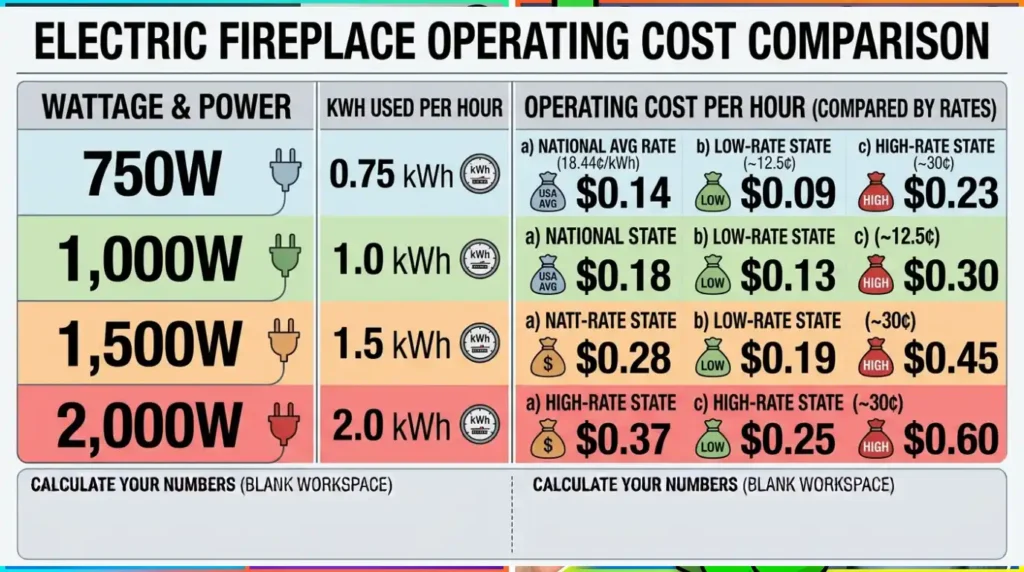
| Wattage | kWh Used per Hour | Cost per Hour (18.44¢/kWh) | Cost per Hour (Low-rate state, ~12.5¢) | Cost per Hour (High-rate state, ~30¢) |
|---|---|---|---|---|
| 750W | 0.75 kWh | $0.14 | $0.09 | $0.23 |
| 1,000W | 1.0 kWh | $0.18 | $0.13 | $0.30 |
| 1,500W | 1.5 kWh | $0.28 | $0.19 | $0.45 |
| 2,000W | 2.0 kWh | $0.37 | $0.25 | $0.60 |
Cost per month, based on daily usage (1,500W unit, national average rate)
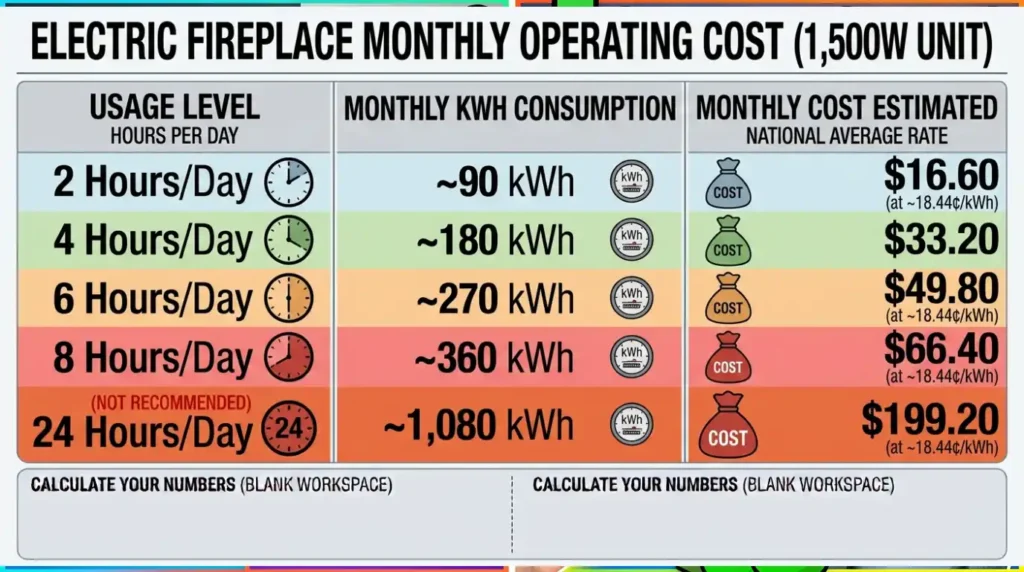
| Hours per Day | Monthly kWh | Monthly Cost Estimated |
|---|---|---|
| 2 hours/day | ~90 kWh | ~$16.60 |
| 4 hours/day | ~180 kWh | ~$33.20 |
| 6 hours/day | ~270 kWh | ~$49.80 |
| 8 hours/day | ~360 kWh | ~$66.40 |
| 24 hours/day (not recommended) | ~1,080 kWh | ~$199.20 |
The bottom line is that an average household with a 1,500W electric fireplace that spends 3-4 evening hours of heat-mode operation a day would contribute approximately to the electric bill: That which becomes a savings or an additional cost is all up to you and what you do with your thermostat, and the following section is that.
Will It Save You Money? It Depends on Zone Heating
This is what most rival articles omit, and this is the real answer to the question.
Zone heating refers to the process of heating up of the space you are in rather than your entire house. An electric fireplace is a zone heater. It is financially only viable when compared to central heat when you combine it with a lower thermostat in the rest of the house.
When zone heating saves money
- You spend the majority of your evening in one of the rooms (living room, home office, bedroom).
- You turn your central thermostat to between 3 and 8oF when you have the fireplace on.
- The room is fairly well insulated and thus the heat does not escape instantly.
- Your house is larger, which implies that your furnace is warming up a lot of unused square space anyway.
One frequently mentioned energy-saving tip: when the area you are heating is less than one-third or one-half of the total area of your home, a space heater (or electric fireplace) while turning down the thermostat in the rest of the house is likely to be cheaper than heating the entire house evenly.
When it backfires and costs more
- You operate the fireplace, but not by turning the thermostat off – now you are paying two systems simultaneously.
- You are attempting to warm a large, open, or poorly insulated room, in which heat is escaping more quickly than a 1,500W unit can replenish it.
- It has a heat pump as its central heat. Existing heat is transferred by heat pumps instead of being produced by resistance, thus they are usually more efficient per dollar than the resistance heater in an electric fireplace. In this instance, scheduling the heat pump typically outmuscles zone heating with an electric fireplace.
- You are warming up more than one room with more than one fireplace or space heating unit – then studies by energy advisors and utility companies always indicate that the central system is typically cheaper to operate than a number of independent units.
Electric Fireplace vs. Other Heating Methods
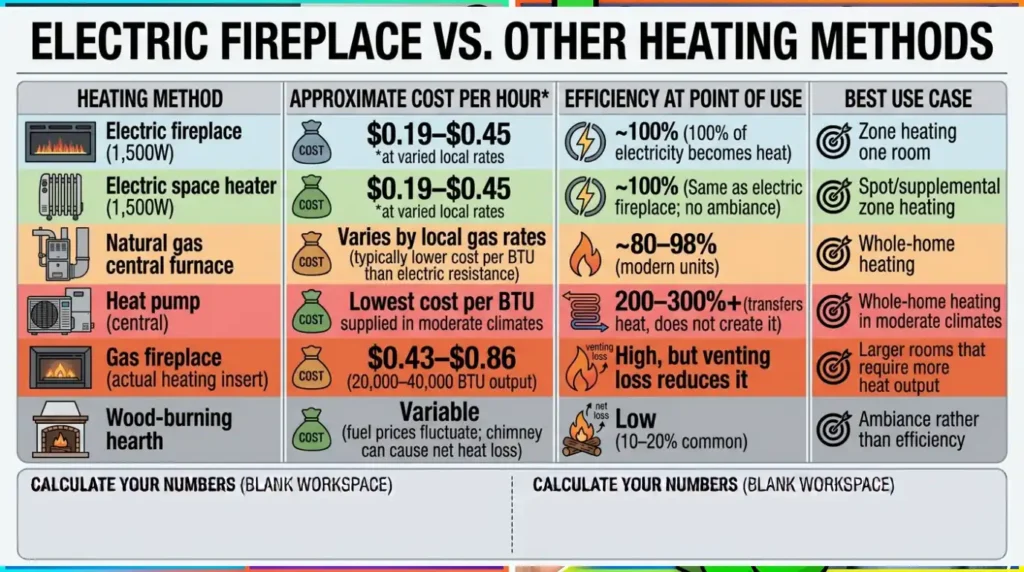
| Heating Method | Approximate Cost per Hour* | Efficiency at Point of Use | Best Use Case |
| Electric fireplace (1,500W) | $0.19–$0.45 | ~100% (100% of electricity becomes heat) | Zone heating one room. |
| Electric space heater (1,500W) | $0.19–$0.45 | ~100% (Same as electric fireplace; no ambiance) | Spot/supplemental zone heating. |
| Natural gas central furnace | Varies by local gas rates (typically lower cost per BTU than electric resistance) | ~80–98% (modern units) | Whole-home heating. |
| Heat pump (central) | Lowest cost per BTU supplied in moderate climates | 200–300%+ (transfers heat, does not create it) | Whole-home heating in a moderate climate. |
| Gas fireplace (actual heating insert) | $0.43–$0.86 (20,000–40,000 BTU output) | High, but venting loss reduces it | Larger rooms that require more heat output. |
| Wood-burning hearth | Variable (fuel prices fluctuate; chimney can cause net heat loss) | Low (10–20% common) | Ambiance rather than efficiency. |
Figures in the cost range indicate the national average electricity rate (1230 cents/kWh) and standard unit sizes; the rate that is actually charged by your local utility determines your rates.
The trend to observe: most parts of the country have an electric fireplace pricier than central heat per unit of warmth, but natural gas and heat pumps typically provide heat at a lower cost. The reason an electric fireplace will save you money does not have to do with better efficiency; it has to do with you heating a smaller area.
Real-World Example: A Month of Zone Heating
An example of a real situation with national averages is as follows:
- Household: 2,000 sq ft house, natural gas furnace, thermostat to 70oF all night.
- Change: Turn the thermostat to 64 F instead of 6 10 p.m. and operate an electric fireplace (1,500W) in the living room (300 sq ft) instead.
- Electric fireplace cost: 4 hours/day × 30 days ≈ $33 for the month (at 18.44¢/kWh).
- Furnace savings: A 6 F/4 hour a day thermostat setting can cut furnace operating time by about 40 minutes a day, saving more than 33/month in most climates, and most home sizes, based on Department of Energy thermostat-setback guidelines, which estimate about 1 percent savings per degree per 8 hours of setback.
Net outcome: small, yet actual monthly savings – usually between $5 and 25, depending on your gas/electric bills, insulation, and climates. It is not a melodramatic savings, but real money, and you get extra atmosphere and comfort in the room you are actually in.
In the event that the same household operated the fireplace without turning down the thermostat, they would merely increase their current bill by $33 without a counterbalancing effect – a net loss.
7 Ways to Maximize Your Electric Fireplace Savings
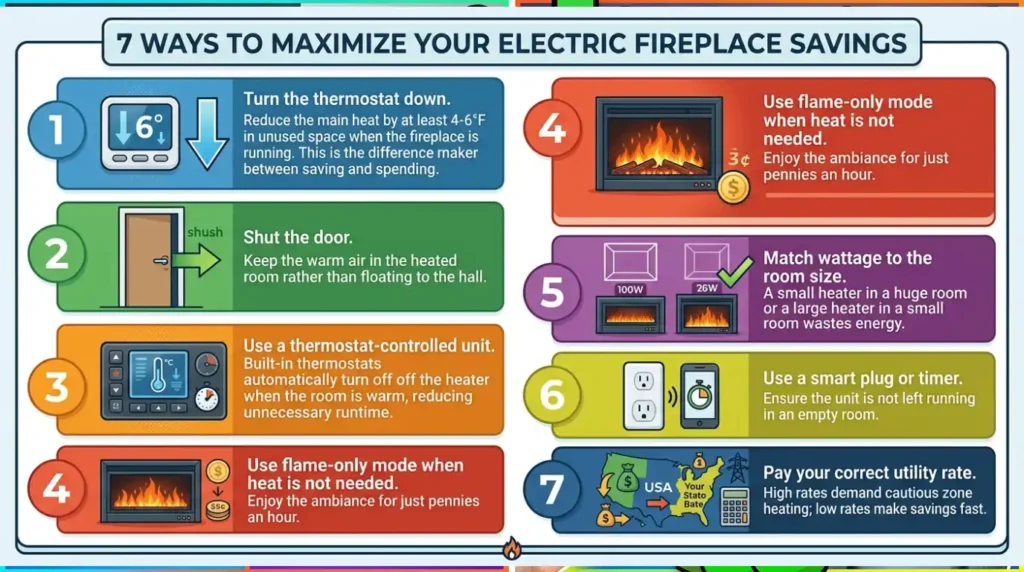
- Turn the thermostat down in fact. This is what makes the difference between saving and spending. When the fireplace is running, turn it down at least 4- 6 degrees Fahrenheit in unused space.
- Shut the door of the room you are heating. This keeps the warm air at the place you require rather than floating to the hall.
- Do not use a fixed on/off switch, use a thermostat-controlled unit. Those that have a built-in thermostat turn off the heater when the room is heated and reduce unnecessary run time.
- Turn flame-only on when you do not need heat. When the room is already warm, then just have the feel of the place a few cents an hour rather than turn on the heating component.
- Select the appropriate amount of wattage of the room not the largest unit. A large heater in a small room is a waste of electricity; a small heater will be on all the time and will never warm up.
- Install a smart plug or an in-built timer to ensure that the unit is not left to run in an empty room.
- Make sure you are paying the correct utility rate, not the national average. When you live in a high-rate state, the calculations shift towards cautious zone heating; when you live in a low-rate state, the cost of the fireplace running is so low that even small changes in the thermostat will pay back in a short time.
Myth vs. Fact
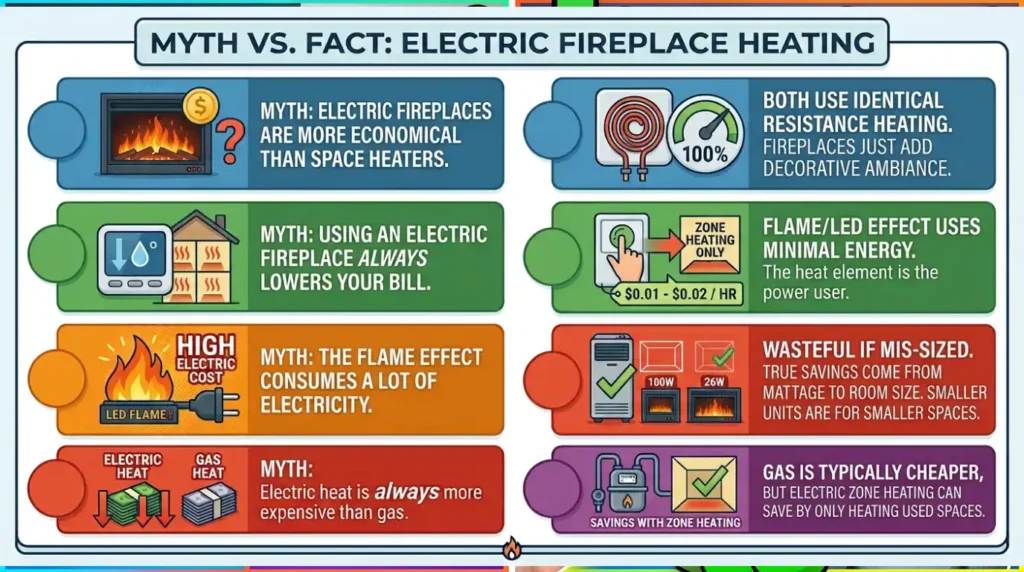
| Myth | Fact |
| Electric fireplaces are more economical than space heaters. | Both employ the exact same technology (electric resistance heating) with ~100% efficiency. The fireplace simply adds a decorative flame effect. |
| Using an electric fireplace will always lower your heating bill. | It only lowers your overall bill if you turn down central heating in the rest of the home (zone heating). Otherwise, it adds to your total energy usage. |
| The flame effect consumes a lot of electricity. | The flame/LED effect alone uses minimal energy, costing roughly $0.01–$0.02 per hour. The heating element accounts for virtually all the power draw. |
| Higher wattage equals bigger savings. | Higher wattage consumes more electricity per hour. True cost savings come from matching the heater’s wattage output to the actual size of the room. |
| Electric heat is always more expensive than gas. | While gas is typically cheaper per unit of heat generated, zone heating with an electric fireplace can still save money overall by heating only the room you’re using. |
Common Mistakes That Erase the Savings
- Leaving the thermostat unchanged. This is by no means the least frequent error and it can by itself cancel out any possible savings.
- It works well in a big or open-office area. A 1,500W unit can barely make a dent in anything larger than 300400 sq ft, and so you tend to run it longer with little benefit.
- Overnight operation in an unoccupied room. The electric fireplace is to be used in occupied room heating, but not in passive whole-house heating.
- Not paying attention to your electricity rate. When you are on a time-of-use plan, it can be significant to run the fireplace when the price is high.
You May Also Read:
FAQs:
Is it true that an electric fireplace can save money on heating?
Yes, but not when it is applied to zone heating – heating the room you are in and reducing the thermostat in other rooms. Combined with unchanged central heating, it does not save but increases costs.
What is the cost per hour to operate an electric fireplace?
It usually costs between 0.14-0.45 per hour when the heater is on, and it depends on the power consumption and the local price of electricity. Flame-only mode is approximately 1-2 cents/hour.
What is the monthly electricity cost of an electric fireplace?
At 3-4 hours of daily use during heat mode, you can expect approximately 25-35 a month at the national average rate of electricity, although this can vary depending on your local power rate and the unit wattage.
Central heating is more expensive than an electric fireplace?
Natural gas furnaces and heat pumps tend to be less expensive than electric resistance heat, per unit of heat delivered. An electric fireplace is not efficient, but that allows you to warm less space.
Are electric fireplaces less expensive than space heaters?
They are similar in price to operate, as most are based on the same technology of resistance-heating. The fireplace is a matter of style; it is not a matter of efficiency.
What is the average power of an electric fireplace?
The average residential unit has a heat mode of 750W to 1,500W (and some larger units up to 2,000W).
Does the flame effect consume much electricity?
No. The LED flame display itself will usually consume 30-100 watts, and with heater off, about 1-2 cents/h.
Will it be cheaper to turn up my thermostat or an electric fireplace?
When you are using a limited space in your house, it is generally less expensive to operate the fireplace and reduce the thermostat. When you can warm up the entire house anyway, thermostat tends to be more cost effective.
Are electric fireplaces effective in big rooms?
Not usually. The majority of units have a rating of approximately 400 sq ft and below. Open-concept or larger rooms might require a more watt unit or will not maintain a comfortable temperature effectively.
Can electric fireplaces be left on all day?
The majority of them have built-in overheat protection and automatic shut-off, although it is costly and unneeded to run the heating component at all times, since in the vast majority of cases it is only needed at times when a house is occupied.
The question is, are electric fireplaces a value addition to the home resale?
This depends on the market, and it is not a question of heating costs, but many consumers perceive an inbuilt or mounted electric fireplace as a comfort amenity and not a cost enhancement.
Key Takeaways
- An electric fireplace is estimated to cost about $0.14 to $0.45/hour to operate in the heat mode and about 1-2 cents/hour in the flame effect alone.
- It will save you money, only by zone heating, that is, by heating a room and reducing your central thermostat in other rooms.
- It is a myth that electric fireplaces are more efficient than a typical space heater; the difference lies in the ambiance, as well as the capability to warm a smaller space.
- Natural gas and heat pumps are generally more cost effective per BTU to provide heat than electric resistance heat, an electric fireplace will not be more efficient than a properly-operating central system.
- The one largest error that wipes out savings is to turn on the fireplace without turning the thermostat.