Who Should Repair an Electric Fireplace? The Ultimate Guide to DIY Repairs and Experts.
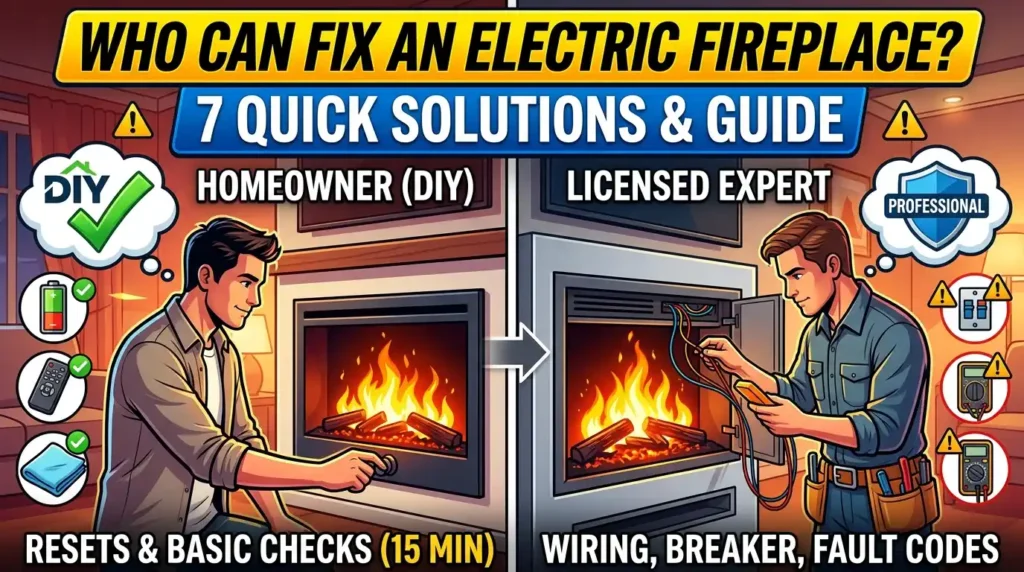
Who Can Fix an Electric Fireplace? Quick Answer: The homeowner can resolve most of the issues in electric fireplace like no heat, no flame effect, a non-functional remote, or a tripped breaker within less than 15 minutes. When it comes to wiring, built-in units, or anything relating to the breaker panel, professional assistance by a licensed electrician or certified fireplace/hearth technician is better than just a guess.
Electric fireplaces are easier than gas or wood-burning models and that is precisely why most users think that whenever anything goes wrong, they have to call in a costly service call. As a matter of fact, most of the issues boil down to five areas, namely power, vents, thermostat settings, batteries, and breakers. This guide takes you step-by-step to the people to call when you have this or that kind of problem, what you can safely do by yourself, and what it usually costs when you have to call a professional.
Key Takeaways
- DIY first. Approximately 70%-80% of the complaints of electric fireplace can be traced back to simple factors: vents blocked, overheated thermostat, dead batteries, or a tripped breaker.
- Hire an electrician to do anything that involves exposed wiring, a burning odor, sparking or a tripping breaker.
- Get a fireplace/hearth expert inbuilt units, replacement of heating element, flame-effect motors, or anything still under a brand warranty.
- Do not open the unit when it is plugged in and do not operate around a safety switch or fuse.
- The cost of average professional repairs is between 100-400 dollars on average, but house calls are less expensive and complete changes of heating elements more expensive.
Who Actually Fixes Electric Fireplaces?
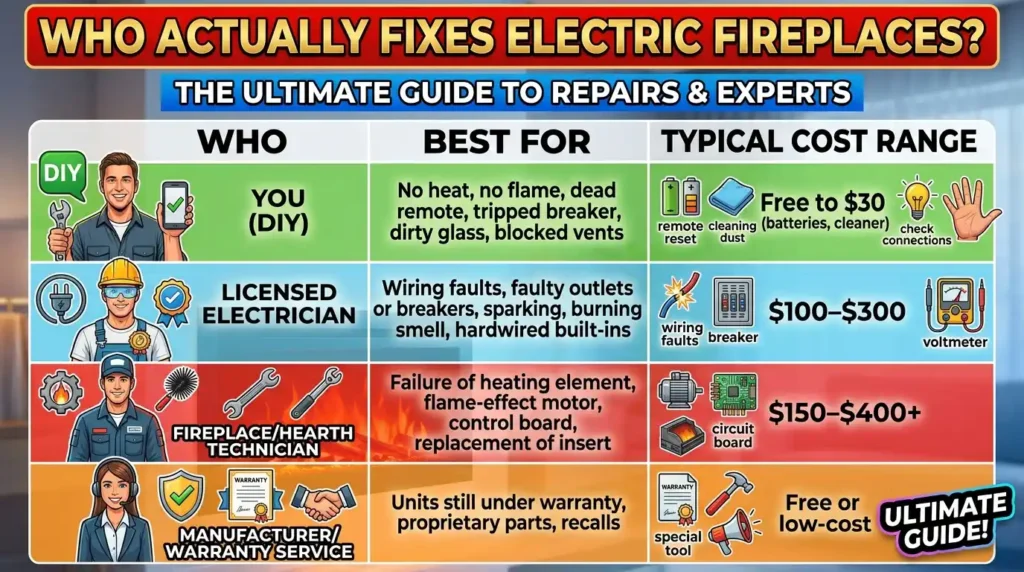
There is no single answer to the question “Who can fix an electric fireplace” as it will depend on what broke. These repairs are normally carried out by four kinds of people and knowing the kind of people you require saves time and money.
| Who | Best For | Typical Cost Range |
| You (DIY) | No heat, no flame, dead remote, tripped breaker, dirty glass, blocked vents | Free to $30 (batteries, cleaner) |
| Licensed Electrician | Wiring faults, faulty outlets or breakers, sparking, burning smell, hardwired built-ins | $100–$300 |
| Fireplace/Hearth Technician | Failure of heating element, flame-effect motor, control board, replacement of insert | $150–$400+ |
| Manufacturer/Warranty Service | Units still under warranty, proprietary parts, recalls | Free or low-cost |
Simple mechanical repairs, such as re-mounting a wall unit, may be done by a general handyman, but electric fireplace repair is legally obligatory using electricians when you are inside the wiring, and manufacturer-training technicians when you are inside the heating or flame-effect assembly.
There are several different types of electric fireplaces (and why the type matters).
Types of Electric Fireplaces (and Why the Type Matters)
- Freestanding/mantel units- Plug-in, portable and the simplest to troubleshoot or replace yourself.
- Wall-mount fireplaces – Plug-in or hardwired; mounting bracket problems are easily handled by DIY, but hardwired models require an electrician to repair wiring faults.
- TV stand/media console fireplaces – Operate like freestanding units, but with additional fireplace airflow issues due to electronic items stored.
- Insert electric fireplaces/built-in electric fireplaces – Typically hardwired into a special circuit; most internal work ought to be done by a hearth mechanic or electrician.
- Linear/architectural electric fireplaces – Custom installations, usually professionally wired; repairs are usually done by the installer or a certified technician.
Being aware of the type of fireplace you have prior to calling a technician will assist a technician in diagnosing the issue more quickly over the phone, and can even save you a visit that is not necessary. An independent device that does not heat may simply require being disconnected and relocated out of a wall, whereas a similar symptom in an insert may indicate a ventilation clearance problem that was built into the initial installation. Whenever you call a repairman, always mention the type, brand, and the method of power (plug-in or hardwired) of the unit.
Common Electric Fireplace Problems and Who Should Fix Them
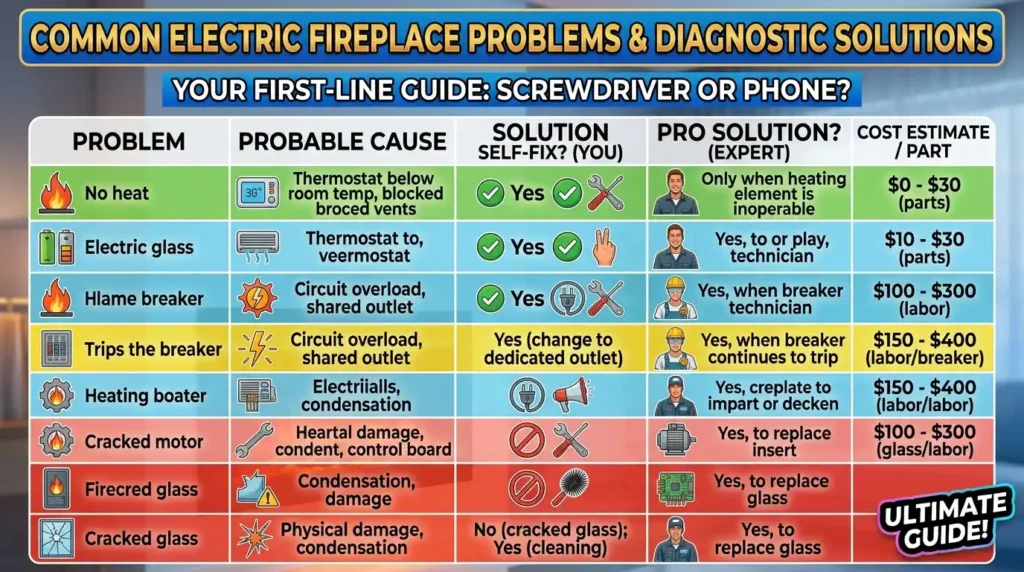
This table is a first-line diagnostic procedure to determine what to pick up either a screwdriver or a phone.
| Problem | Probable Cause | Solution Self-Fix? | Pro Solution? |
| No heat | Thermostat set under room temperature, blocked vents | Yes | Only when heating element is inoperable |
| Dead remote/receiver | Batteries dead, unplugged unit | Yes | If it will not boot up after reset |
| Flame effect not working | Loose flame generator, incorrect settings, loose wiring connection, worn LED | Yes | If the motor or bulb requires replacement |
| Flickering or dim lights | Loose wiring connection | Sometimes | Yes, internal wiring issues |
| Trips the breaker | Circuit overload, shared outlet | Yes (change to dedicated outlet) | Yes, when breaker continues to trip |
| Randomly turns on/off | Timer set, draft triggering sensor, faulty remote | Yes | When sensor or board is faulty |
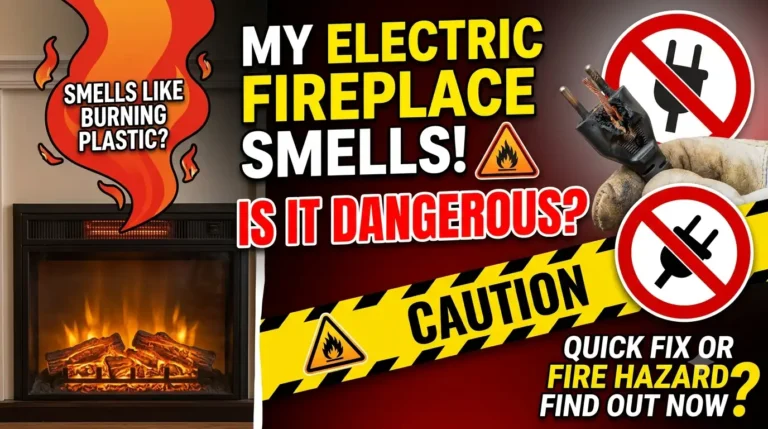
| Burning smell | Dust burning off (usually on first use) or wiring fault | Only when it is dust | Yes, immediately, when the smell persists |
| Loud buzzing or clicking | Fan blade loose, motor bearing worn out | Sometimes | Yes, replacement of motor is required |
| Remote unresponsive | Dead batteries, signal interference | Yes | Rarely required |
| Cracked or fogged glass | Physical damage, condensation | Yes (cleaning); No (cracked glass) | Yes, to replace the glass |
Step-by-Step: DIY Troubleshooting Before You Call Anyone
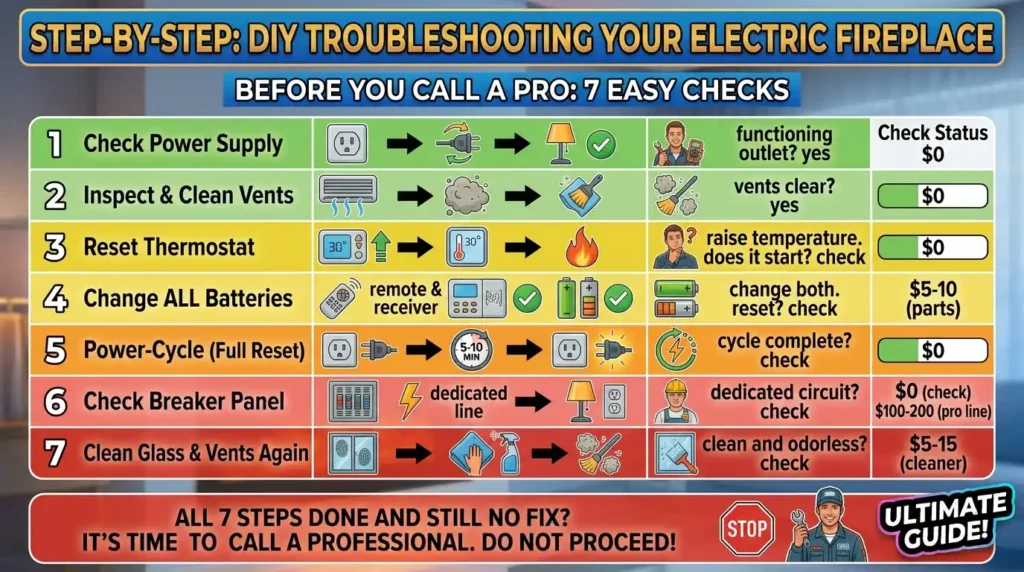
Follow this sequence. By step three, most of the problems are resolved.
- Test the power supply. Make sure that the unit is connected to a functioning outlet and that the outlet is operational (check with another appliance).
- Check the vents. The intake and outlet vents should be free of any debris. The most common cause of no heat is a blocked vent.
- Reset the thermostat. The heater will not start up in a room that is already warmer than the set point of the thermostat. To test, raise the setting a few degrees higher than room temperature.
- Change batteries. Change batteries both in the handheld remote and in the receiver inside the unit – most of the people only change one and think that something went wrong.
- Cycle the unit completely off and on again (power-cycle). Unplug the unit, wait 5 or 10 minutes, and then plug it up again. This eliminates numerous glitches and heating shutdowns of electronics.
- Check the breaker. In case the fireplace has a circuit of other appliances, it can be overloading it. Take it to its own outlet and do not just assume that the unit is faulty.
- Clean the glass and vents. Dust on the heating element and the glass front may lead to a slight burning odor and decreased air circulation.
When all the seven steps have been performed and the problem does not go, then it is your indicator to call a professional and not to open the housing further.
When to Stop and Call a Professional
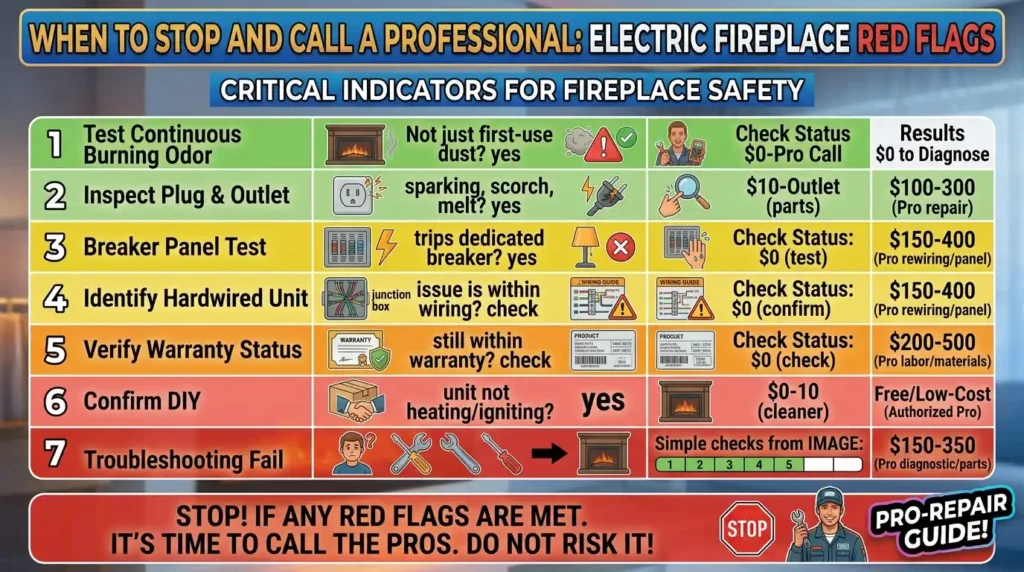
Some common red flags are that it time to quit the troubleshooting and call in a professional, no matter how handy you might be.
- Continuous burning odor not merely first use dust burning off.
- Sparking, scorch marks or melted plastic around the plug or outlet.
- The breaker is going off each time you switch on the unit even on its own circuit.
- It is hardwired and the issue lies within the wiring, not controls.
- Fireplace is within manufacturer warranty (DIY repair will void warranty)
- You have done simple troubleshooting and the unit is not heating and igniting the flame effect.
Safety Precautions Before You Touch Anything
Even basic DIY repairs are somewhat risky when it comes to electrical appliance. Before getting down to troubleshooting, remember the following precautions:
- Never remove any cover, panel or back access plate without first disconnecting the unit – never perform any operation on it when it is under power.
- Use non-contact voltage tester when checking the wiring, even when breaking off the breaker, to ensure that it does not have live current flowing through.
- Do not turn off a safety switch, fuse or overheat sensor to make the unit operate: they are there to stop fires.
- Do not clean the electrical parts in water, dry the cloth, do not spray cleaner on the item.
- Do not make any wiring repairs unless you are a licensed electrician or an apprentice of one, even though the repair may appear easy.
Electrician vs. Fireplace Technician: Which One Do You Need?
The intersection of these two professionals is not as high as it is supposed. Here is a way of distinguishing between them.
Licensed Electrician/Fireplace/Hearth Technician
| Capability / Task | Licensed Electrician | Fireplace / Hearth Technician |
| House wiring, outlets, breakers | Yes | No |
| Operates heating elements, flame motors, control boards | Rarely | Yes |
| Familiar with specific fireplace brands | No | Yes |
| Install new dedicated circuit | Yes | No |
| Can service warranty repairs | No, generally | Often, when authorized |
| Typical call-out cost | $75–$150 | $75–$125 |
When you call, describe the symptom, not what you think might have caused it, and say: the unit trips my breaker when you call: the unit trips my breaker points to an electrician, the flames stopped spinning but the power light is on points to a hearth technician.
What Professional Electric Fireplace Repair Costs?
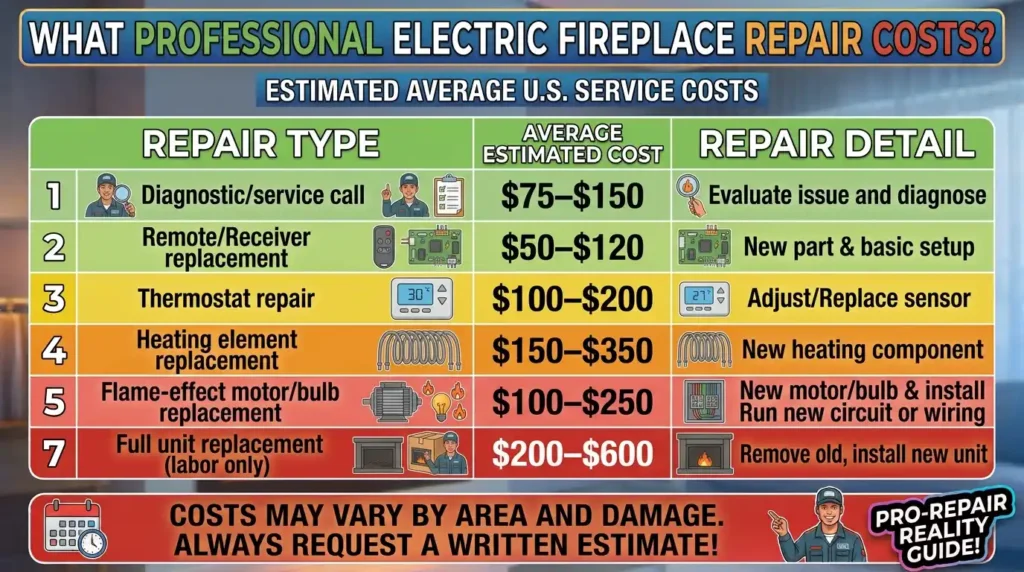
Prices can be different depending on the area and what is actually broken but these prices represent the average U.S. service calls.
| Repair Type | Estimated Cost |
| Diagnostic/service call | $75–$150 |
| Remote/Receiver replacement | $50–$120 |
| Thermostat repair | $100–$200 |
| Heating element replacement | $150–$350 |
| Flame-effect motor or bulb replacements | $100–$250 |
| Rewiring/new dedicated circuit | $150–$400 |
| Full unit replacement (labor only) | $200–$600 |
When a repair estimate is in the vicinity of 50 percent or more than the price of a new item, replacement is often the more economically prudent step, particularly on 8-10-year-old items.
Understanding Your Warranty Before You Call Anyone
The majority of electric fireplaces have a manufacturer warranty of one to five years, and occasionally on the heating element itself. Prior to hiring a person, make sure that you examine your paperwork or that of the manufacturer to verify three items; the duration of the warranty, Parts only or Parts and labor, and the need to use an authorized technician to maintain the warranty. Self-repair is also a voiding coverage, and even successful repair by an uncertified handyman. When the unit remains under warranty, the most economical and risk-averse thing to do is typically to call the manufacturer or retailer initially which may send a spare part or send a qualified technician at no cost.
How to Find a Qualified Fireplace Repair Professional?
- Licensing and insurance. Electricians are required to have a state license; at least hearth technicians must have liability insurance.
- Enquire about brand certification. Proprietary parts and warranties are available to manufacturer-trained technicians that general handymen cannot.
- Obtain a written quote prior to the commencement of work and not a phone quote.
- Look at the latest reviews, not the average number of stars — seek out reference to electric fireplace work, not any other.
- Check on the warranty of your unit before employing anyone, as unauthorized repairs may cancel the remaining warranty.
How Long Does a Repair Take?
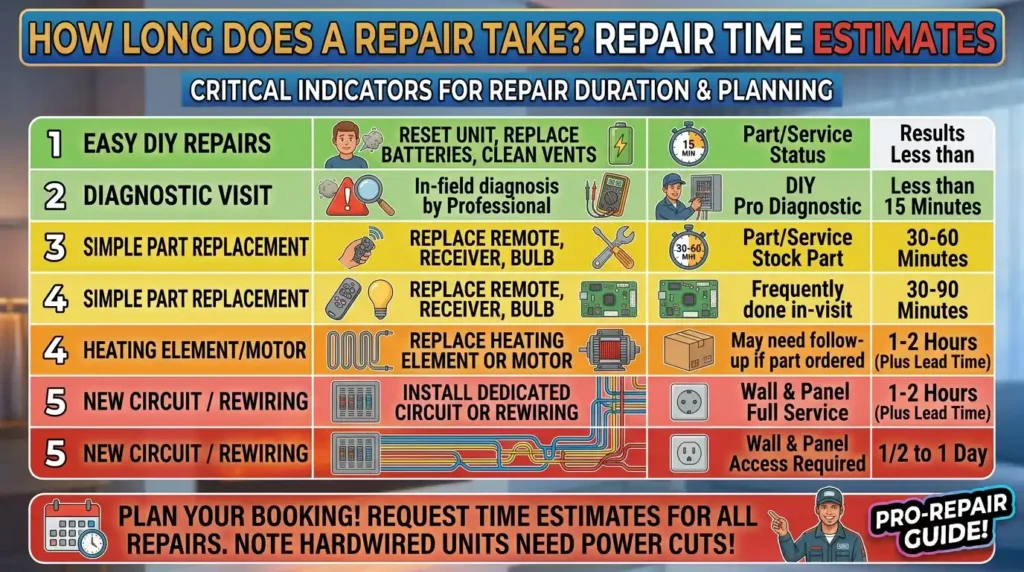
The majority of easy repairs, such as resetting the unit, replacing batteries, cleaning out vents, and so on, can be completed in less than 15 minutes. Professional repairs are more different:
- Diagnostic visit: 30 to 60 minutes in-field.
- Part replacement (remote, receiver, bulb): Frequently done in-visit, 30-90 minutes.
- Change of heating element or motor: 122 hours, may need a follow-up visit, when the part has to be ordered.
- Installation of new circuit or rewiring: 1/2 to 1 day, wall and panel access.
When making a booking request a time estimate, to be able to plan around it, particularly hardwired units that might need to have the power cut off to a long period.
Preventive Maintenance Checklist
Most of the problems mentioned above can be prevented by taking proper care of them before they occur.
- Monthly Clean the glass and exterior with a soft lint-free cloth.
- To clean dust gently vacate vents and heating component after every few months.
- Change remote and receiver batteries at least once per year, even when they appear to be functioning.
- Move furniture, rugs and toys at least a few inches away at all times (around the vents).
- Have built-in or hardwired units professionally inspected at least once every 1-2 years.
- Do not use harsh chemical cleaners on the glass front which may damage the coatings.
Myth vs. Fact
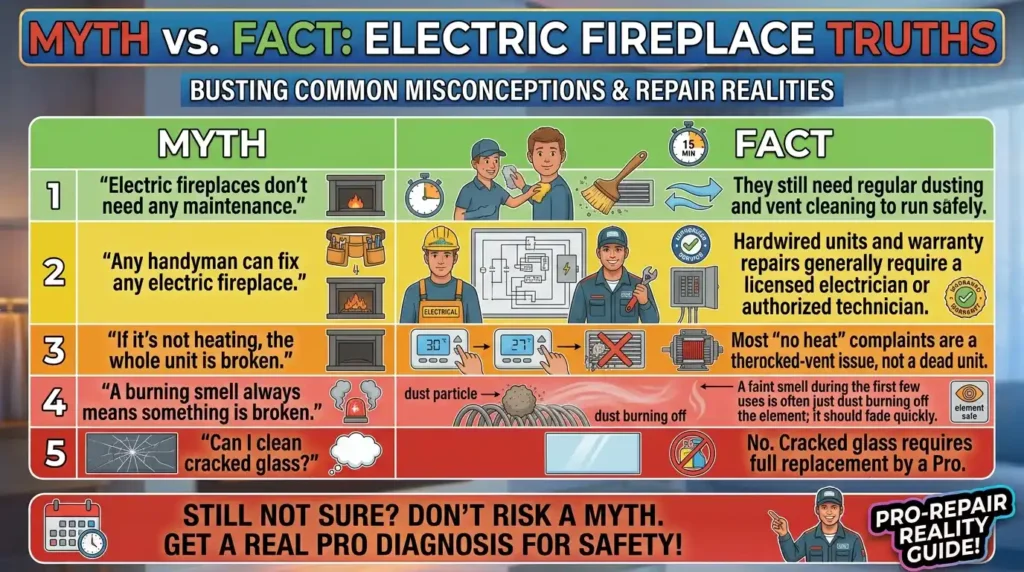
| Myth | Fact |
| “Electric fireplaces don’t need any maintenance.” | They still need regular dusting and vent cleaning to run efficiently and safely. |
| “Any handyman can fix any electric fireplace.” | Hardwired units and warranty repairs generally require a licensed electrician or authorized technician. |
| “If it’s not heating, the whole unit is broken.” | Most “no heat” complaints are a thermostat or blocked-vent issue, not a dead unit. |
| “A burning smell always means something is broken.” | A faint smell during the first few uses is often just dust burning off the element; it should fade quickly. |
You May Also Read:
FAQs:
Would I be able to repair my electric fireplace?
Yes, to simple problems such as no heat or a dead remote control, blocked vents, or a tripped breaker. Anything that deals with internal wiring, heating component, or hardwired connection should be left to a professional.
Who do I call to repair an electric fireplace?
Wiring or breaker issues, heating elements, flame-effect motors or control boards, call a licensed electrician, fireplace/hearth technician. See your warranty, and in the event that the unit is less than two years old.
Are electricians able to fix electric fireplaces?
Electricians work on the electrical side – wiring, outlets, dedicated circuits and breaker problems. They do not normally fix the heating element or flame-effect components, which are a part of hearth technicians.
How do I reset an electric fireplace?
Switch the unit off, remove it out of the outlet, wait 5-10 minutes and re-insert it back to the outlet and turn the unit on. This cleans up the majority of electronic glitches and safety shutoffs.
Why does my electric fireplace not heat up yet the flames are on?
This normally indicates to the thermostat, a plugged vent, or a malfunctioning heating element. Before deciding that the element is dead, check the thermostat setting, and clear the vents.
Why does my electric fireplace keep on breaking the breaker?
Probably the unit is sharing the circuit with other heavy draws. Install it in its own circuit; it may still open the breaker, so the wiring or the heating element in the unit may be defective and this should be checked by an electrician.
Is it natural to have a new electric fireplace smell the first time it is used?
Yes, some burning smell in the early few uses is normal because during the production, there are manufacturing residue that burnt the heating component. It ought to dissipate in an hour or two of application.
What is the price of repairing an electric fireplace?
Repairs are usually between $75 and $400, with a part replacement (such as a remote or other minor replacement) or a more complex process such as a heating element or rewiring. Repairs are usually between $75 and $400, with a part replacement (such as a remote or other minor replacement) or a more complex process such as a heating element or rewiring.
Can an electric fireplace be left on overnight?
The majority of manufacturers do not suggest leaving any heating device unattended even overnight. The manual of your particular model will tell you, as some models can be used continuously and others cannot.
My Final Thought:
Prior to scheduling a repair, test the follow-ups: power, vents, thermostat, batteries and breaker. The five things will end most complaints about electric fireplaces without a dollar. Call a licensed electrician when the problem is wiring related; call a fireplace/hearth technician or your manufacturers authorized service network when the problem is in the heating or flame effect assembly; and call especially when the unit is still under warranty.