What is Electric Fireplace Lifespan? How Long They Last and How to Extend the Lifespan of Yours.
What is Electric Fireplace Lifespan? How Long They Last and How to Get More Years Out of Yours
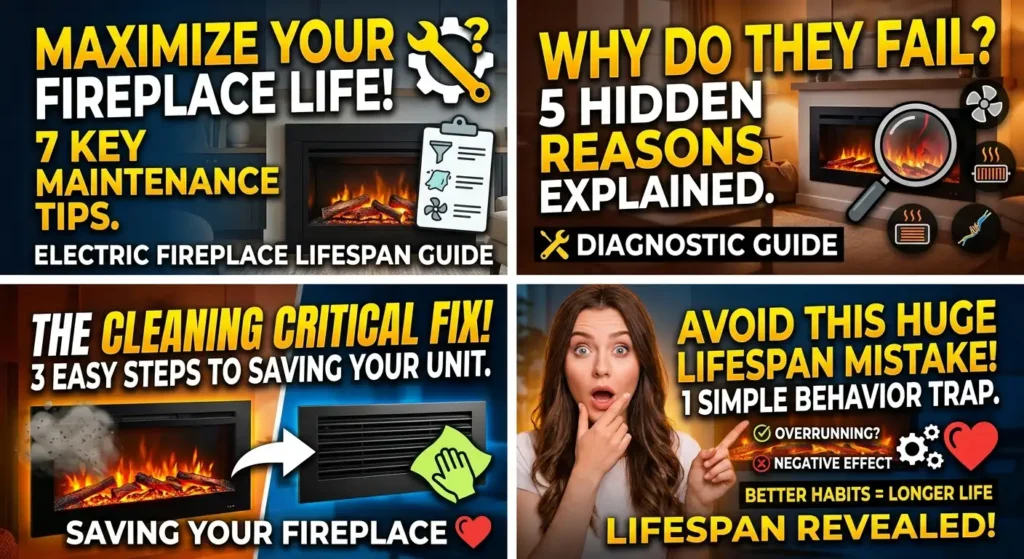
What is Electric Fireplace Lifespan? The average lifespan of most electric fireplaces is 10-20 years, yet it contains more secrets than it tells. Two same looking units may age at entirely different rates based on the amount of the parts to wear off, the amount of time they run each day and whether anybody takes the time to clean the intake vents.
The answer to the 10 to 20 years question is not sufficient should you be in a dilemma whether to purchase one, repair one or buy a new one. You must understand what parts really go wrong, what lengthens or shortens that window and how to distinguish between a fireplace that requires a $15 part and one that requires a trip to the curb.
This guide subdivides the lifespan question by part, by brand level, by use behavior, and by price – thus you can come up with a decision that is informed by your particular unit rather than an approximate average.
Quick Facts
- Life expectancy: 10-20 years, and premium units that are well maintained can be as high as 25-35.
- LED flame effects have a life of 30,000- 50,000 hours.
- Under normal operation, heating elements last 10-15 years.
- Resistive coil or infrared quartz heat is used by most units, not a flame, so wear due to fuel is never a problem.
- Electric fireplaces have a longer maintenance-free life span than gas units, although the gas and wood-burning fireboxes can be even longer than an electric fireplace in the unistructural maintenance life.
How Long Do Electric Fireplaces Last, exactly?
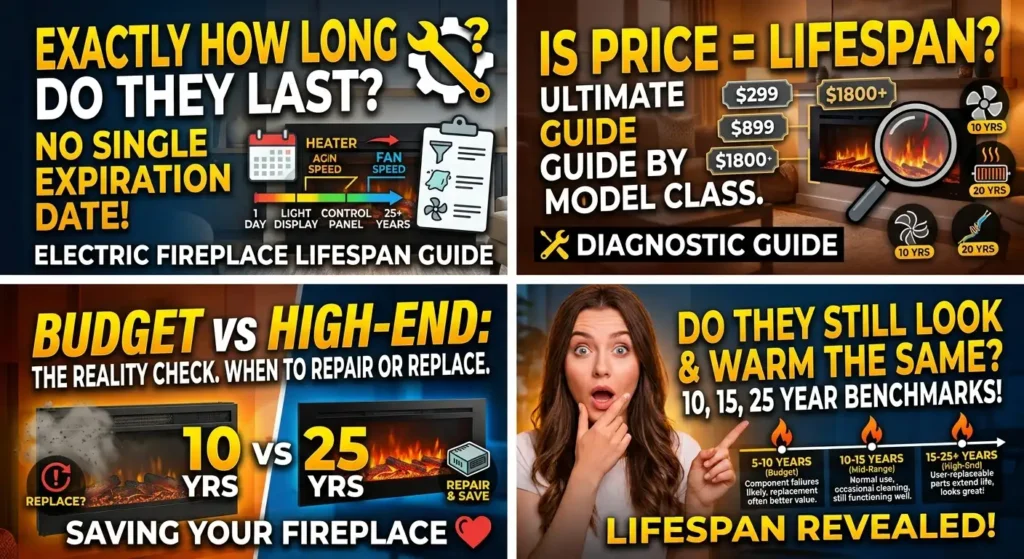
There is no realistic single date of expiration of an electric fireplace since it is actually a collection of distinct systems, namely, a heater, a light display, a control panel, a fan and a cabinet, all of which age at a different rate. When individuals inquire about the length of life of an electric fireplace, they are really inquiring how long it will appear and warm as it did on the initial day, and that figure is lesser than the structural life of shell.
As a working rule:
- Budget models (below 300): 5-10 years prior to a component failing so severely to make replacement more cost-effective than repair.
- Mid-range models ($300-$1,200): 10-15 years with normal use and occasional cleaning
- High-end models (more than 1,200) of well-known brands: 15-25+ years old, particularly when the heating element or flame module is replaceable by the user.
That is within the range of most manufacturers, which design their heating elements and flame engines to last 10,000-50,000 hours of use, and a home operating its fireplace a few hours at a time during cold weather can hardly reach those hours in ten years.
Electric Fireplace Lifespan by Component
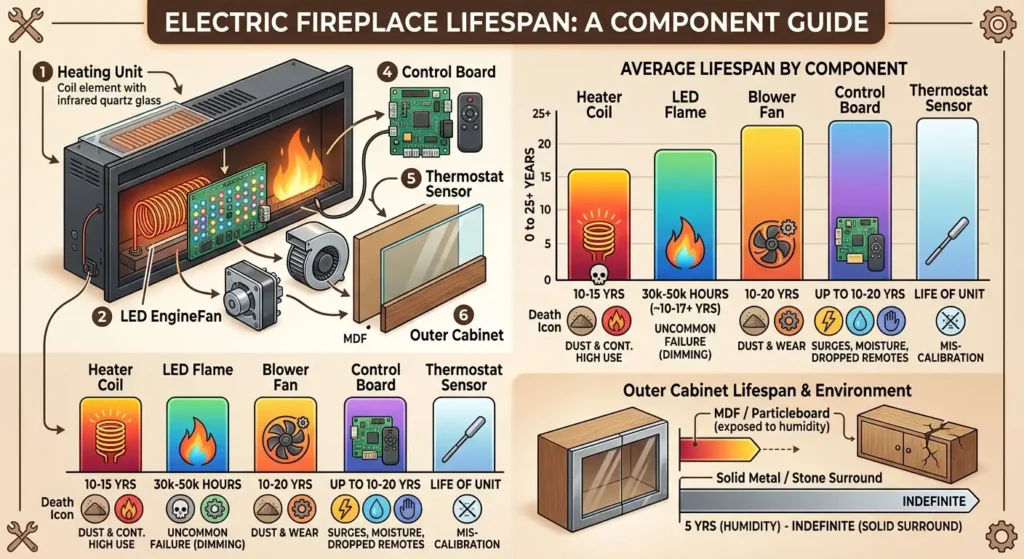
Rather than considering your fireplace to be one object with a single lifetime, it is useful to consider that it is five failure parts. The average lifespan of each of these is as follows, and what most commonly causes its untimely death.
| Component | Typical Lifespan | most common cause of early failure |
|---|---|---|
| Coil or infrared quartz heating element | 10-15 years old | Dust accumulation that limits airflow, running at high continuously. |
| LED flame effect / light engine | 30,000-50,000 hours (approximately 10-17+ years with daily use) | Uncommon outright failure; brightness diminishes over time. |
| Blower/fan motor | 10-20 years old | Dust in the motor housing, wear of the bearings |
| Control board and remote | Up to 10-20 years as long as the unit, power surges, moisture, dropped remotes, and so on. | Power surges, moisture, dropped remotes |
| Thermostat sensor | Life of the unit | Miscalibration over time (inexpensive repair, infrequent complete failure) |
| Outer cabinet (MDF, wood, metal, glass) | 5 years (particleboard exposed to humid conditions) – indefinite (solid metal or stone surround) | Humidity swelling, heat warping of cheap MDF |
Heating Element
The heating part is the component that actually performs the task of heating your room and it is usually the first to wear out. The majority of electric fireplaces have a metal coil element or an infrared quartz tube, and both have a design life of about 10-15 years of seasonal, intermittent use. Operating the heater at high power 8+ hours/day, every day will reduce that window since the element will be subjected to a sustained thermal load, as opposed to on/off loading it was intended to operate at.
A heating component that is coming to the end of its life does not tend to fail immediately, but rather becomes weak. You will find that the room will take more time to warm, the airflow will be less warm even when on the highest setting, or will switch off and on more frequently than before.
LED Flame Effect
This is the section that has the highest rated life span. Electric fireplaces of the present day can be built by using LED arrays behind a reflective or holographic display to make the fireplace look like it is on fire, and the LEDs can last between 30,000 and 50,000 hours before they become significantly less bright. Three hours a day will bring you to more than 27 years; at eight hours a day, it will be upwards of a decade.
Prior to the year 2015, older units constructed before then have sometimes a spinning mechanical flame wheel with a halogen or incandescent bulb, rather than LEDs. Such mechanical systems have much lower lifespans – generally in the 5-8 year range – since they use a physical motor and a bulb that fades and burns out, rather than a solid-state light source.
Blower Fan and Motor
When your model has a fan to circulate warm air (most of them do) that motor is a mechanical component that has bearings that wear through time. A good fan motor should last between 10-20 years, less so when covered with dust. A fan that begins to rattle, whine, or grind will be warning you that the bearings are drying out – and that with a little lubricant or a 20-40 dollar replacement motor you can usually fix the problem before it makes it worthwhile to replace the entire unit.
Control Panel, Remote, and Thermostat
These electronics are typically designed to last longer than the fireplace itself, as they bear very little physical load compared to the heating element or fan. They do not actually have simple age as their adversary, but power surges, humidity and physical damage. The most useful thing you can do to protect this part of the unit is to use a cheap surge protector, as just one spike of a storm or a grid vagary can destroy a control board that would otherwise have lasted 20 years.
Cabinet, Frame, and Housing
This is the bit that the competitors articles will brush over and has more significant importance than one would imagine, particularly in fireplace TV stands and mantel-style units. A strong metal or stone-clad cabinet can truly become timeless. Even when the electronics inside is functioning perfectly, a particleboard or MDF cabinet in a damp basement or in a room with inadequate climate control may swell, delaminate or warp within as little as 5-8 years. Unless you are in a dry area, this usually becomes the real limiting factor to the usefulness of your fireplace, not the heater.
What Determines How Long Your Electric Fireplace Will Last
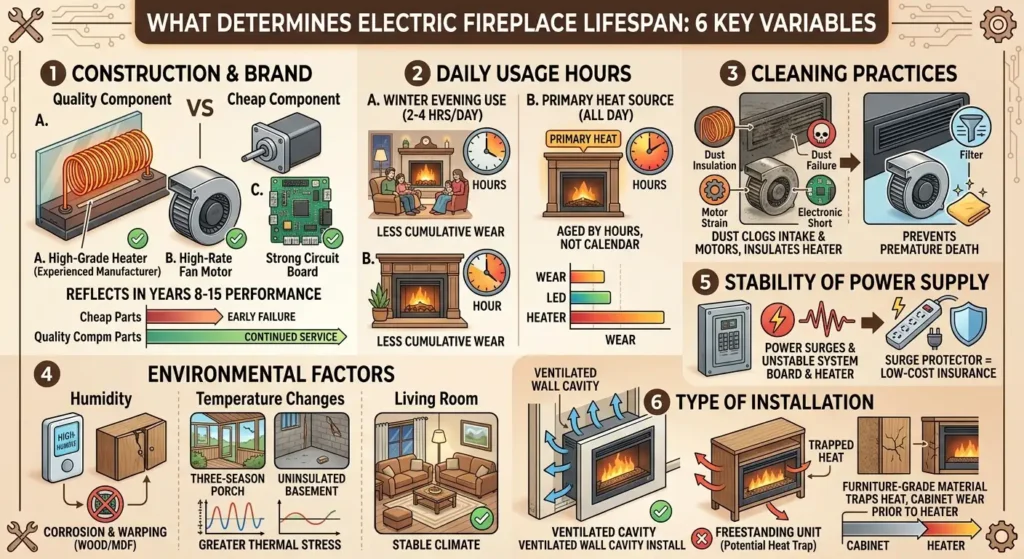
There are six variables that nearly capture the difference between a fireplace that goes dead in year 6 and that which is still burning in year 22.
1. Construction and brand. Experienced manufacturers install heating elements of a higher grade, fan motors of higher rate, and a stronger circuit board. This reflects in less day-one performance and more in the year 8-15 performance, when the less expensive parts have already begun to fail.
2. Daily usage hours. A fireplace operated 2-4 hours a day on the winter evenings will wear much less cumulatively compared to one that was left to run throughout the day as a primary heat source. The components with hours (such as the heating component and LED array) are not subject to the calendar years, rather they get older according to the hours of operation.
3. Cleaning practices. Dust is the largest avoidable cause of death of electric fireplace parts. It not only insulates the heating element (compelling it to strain more), but it also clogs the fan intake (strains the motor) and may even short electronics when mixed with humidity.
4.Environmental factors. Humidity increases corrosion in electronics and warping in wood/MDF cabinets. Big temperature changes, such as three-season-porch or uninsulated basement rooms exert greater thermal stress on components than a stable, climate-controlled living room.
5.Stability of power supply. Homes that experience frequent power surges or have an older and unstable electrical system impose additional stress on the control board and heating element over time. A surge protector is low-cost insurance against an unwarranted and impromptu replacement.
6.Type of installation. Built-in and recessed units are installed in ventilated wall cavity. Combinations of portable freestanding units and fireplace TV stands may trap heat against furniture grade material not intended to undergo thermal cycling, which is one of the reasons furniture-style units may exhibit cabinet wear prior to the heater failing.
Electric Fireplace Lifespan vs. Gas and Wood-Burning Fireplaces
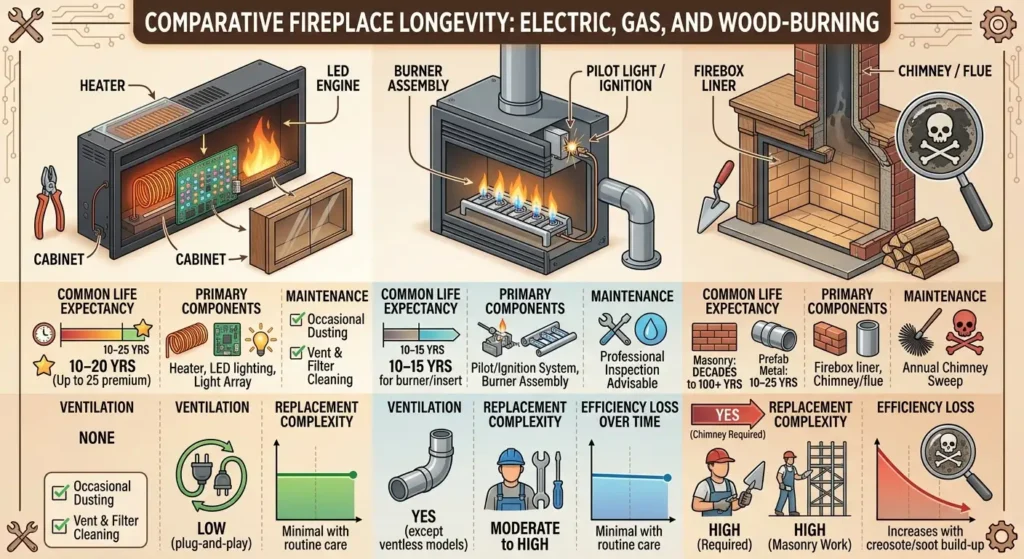
The following is a comparison of the three primary types of fireplaces in terms of their longevity, maintenance load and what actually makes them limit their usefulness.
| Factor | Electric Fireplace | Gas Fireplace | Wood-Burning Fireplace |
| Common Life Expectancy | 10–20 years (up to 25 for premium models) | 10–15 years for the burner/insert | • Masonry: Decades to 100+ years • Prefab Metal: 10–25 years |
| Ventilation Needed | None | Yes (except ventless models) | Yes (chimney required) |
| Primary Components | Heater, LED lighting, light array | Pilot/ignition system, burner assembly | Firebox liner, chimney/flue |
| Annual Maintenance | Occasional dusting, vent and filter cleaning | Professional inspection advisable | Annual chimney sweep |
| Replacement Complexity | Low (plug-and-play or basic swap) | Moderate to High | High (often requires masonry work) |
| Efficiency Loss Over Time | Minimal with routine care | Minimal with routine care | Increases as creosote and soot build up |
The moral of the story: a properly constructed masonry wood fireplace may literally last decades longer than an electric one, but it also requires a lot more maintenance, is vulnerable to chimney fire, and is less efficient to soot. Electric fireplaces also sacrifice some of the lifetime of the raw structure in favor of a much-reduced maintenance cost, no need to vent, and much less expensive and easier replacement should the moment arrive.
Signs Your Electric Fireplace Is Nearing the End of Its Life
Be alert to these telltales instead of changing at a predetermined period a well-maintained unit can easily be years younger than its average life.
- Fluctuating or poor heat. The room is also much slower to heat up, or you notice cold spots despite having the unit on high an indicator that the heating element is wearing out.
- Dark flickering or irregular flame effect. When it is impossible to clean the flame screen and make sure that the settings are correct, the light engine or its wiring becomes exhausted.
- Abnormal sounds. Buzzing, grinding or clicking indicates a bad fan motor or a loose internal connection not normal.
- Regular reboots or error messages. A control board which is approaching failure may also randomly trip breakers or reset, particularly when loaded.
- Smell of burning that does not go away after the initial few uses of the season. It is normal to have a short dust-burn smell on the initial use every year; a lasting or increasing smell is abnormal.
- Mechanical damage to the cabinet. Warping, swelling, or cracking of the housing, even when the electronics may be operational.
How to Extend Your Electric Fireplace’s Lifespan?
Some regular practices can have a significant effect in lengthening the unit life range at the low end to the high end.
- Have the vents and intake cleaned at least once each month during the heating season. A vacuum can be easily fitted with a soft brush attachment there is no need to take the unit apart.
- Do not run it on high in long periods of time. Moderate settings exert less cumulative stress on the heating element and less wear per hour of comfort.
- Use a surge protector. This one $15-20 purchase insulates the control board the costliest part to replace – against the power spikes that reduce its usefulness.
- Store in a cool, dry place. Damp basements or three-season rooms have a dehumidifier that safeguards the electronics and any wood-based cabinet.
- Do not overlook minor problems. A somewhat low fire or a slight rattle now is an inexpensive repair; neglected two winters more will do away a larger and more costly part.
- When it is away, dis-plug it. This cushions against overloads and allows internal parts a complete rest period between applications.
- Adhere to the duty-cycle instructions of the manufacturer. There are those rated to be used continuously and some with intermittent cycles. One of the quickest methods of reducing the life of a cycle-rated unit is to operate it continuously.
Repair vs. Replace: A Simple Cost Framework
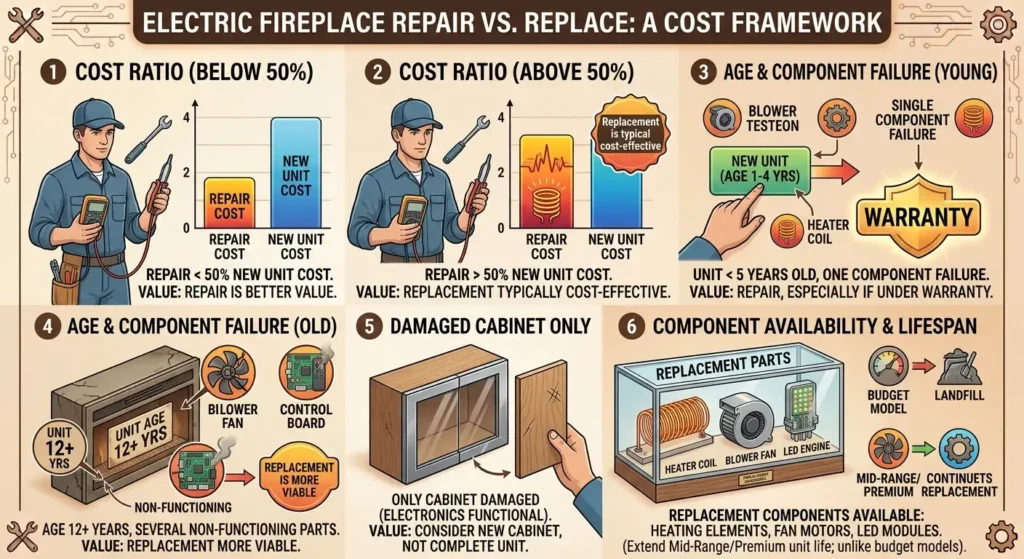
In case of any component failure, the calculations about whether to repair it or take the entire unit are normally reduced to a single comparison.
| Situation | General Guidance |
| Repair cost is less than half the cost of a similar new unit | Repair is of a better value. |
| Repair cost is over 50% of a new unit’s price | Replacement is typically more cost-effective. |
| Unit is less than 5 years old with one component failure | Repair, particularly when within warranty. |
| Age is 12+ years with several non-functioning parts | Replacement is more viable. |
| Only the cabinet is damaged (electronics are functioning fine) | Consider replacing only the surround/cabinet, not the complete unit. |
The replacement heating elements, fan motors, and LED modules are available as separate components by the majority of manufacturers, and thus the reason why many mid-range and premium electric fireplaces can remain operational long after a budget model would already be buried in a landfill.
You May Also Read:
FAQs:
What is the average life of an electric fireplace?
The average life of most electric fireplaces is 10-20 years, and high-end models of reputable brands can last beyond 25 years when properly taken care of.
Do electric fireplaces become less heating power?
Yes, gradually. With age (particularly when not cleaned regularly), the heating element will require more time to heat a room, or it will generate significantly weaker heat.
LED flame effects in electric fireplaces last how long?
The average life of flame engines is 30,000-50,000 hours or more than 10 years of daily operation, before the brightness begins to fade significantly.
Has the electric fireplace a strange odor the first time it is on every season?
The initial several minutes of initial use every season will have a transient dusty smell, as dust burns the element off. An odor that does not fade or gets worse is abnormal and should be examined.
Is it safe to leave my electric fireplace on overnight?
It is not recommended by most manufacturers. Long continuous operation causes the heating element and fan to wear faster, and unattended heaters are not recommended at night as a precaution.
Does it require an electric fireplace to be serviced every year?
Yes, but that is not so much like gas or wood units monthly dusting in season and a check of cords, vents, and connections annually is usually all that is needed.
What is the best guess as to why electric fireplaces fail prematurely?
The most frequent reason of components failing long before their nominal life is the accumulation of dust which blocks airflow and the constant high-heat operation.
Do costly electric fireplaces prove to last?
Generally, yes. Better heating elements, more robust fan motors and replaceable parts are used in higher-tier units, extending the lifespan of these units far beyond the budget models.
What do I do when I am not sure whether to mend or dismantle my electric fireplace?
Generally speaking, a rule of thumb is that, when the cost of repairing a unit is more than about half of the cost of a similar new unit, or the unit is more than 12-15 years old with several problems, replacement is the more economical option.
Would electric fireplaces be longer lasting than gas fireplaces?
Their average life is similar, and electric units need less maintenance to reach their full life, and electric units do not have the ventilation and ignition-system hazards that gas units possess.
Key Takeaways
- Electric fireplaces have a lifespan of about 10-20 years, with most of the difference being related to quality, maintenance and the amount of time they are used daily.
- The aging of various parts varies – LED flame effect typically lasts much longer than heating element and fan motor.
Two causes of early failure that can be prevented are dust accumulation and constant intensive use of heat. - A surge suppressor, cleaning once a month, and handling minor problems early can take a unit toward the end of its life span spectrum.
- Replacement is more realistic when the cost of a replacement is less than half of the cost of a new unit.