A Thermal cutoff in an electric fireplace is what? (And Why It Just Saved You a Bigger Problem
What is Thermal Cutoff in Electric Fireplace?
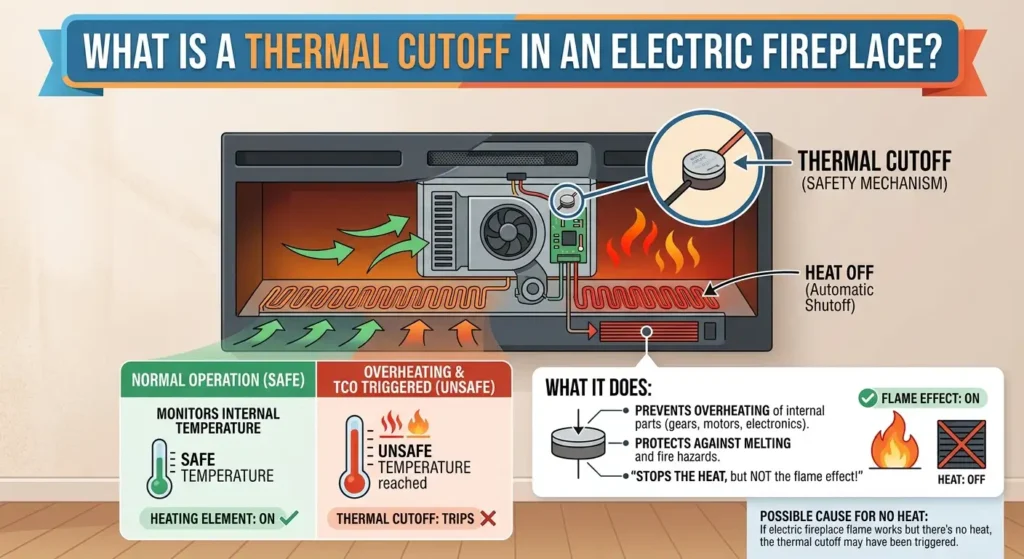
What is Thermal Cutoff in Electric Fireplace? Short answer: A thermal cutoff is a little safety mechanism installed in the heating component of your electric fireplace that will automatically turn off the heat source when the inside temperature has reached an unsafe level. It does not prevent the flame effect, however, it prevents the heat and it is there to make sure that the parts do not become overheated, melted or to prevent fire. When your electric fireplace just stops heating you and the lights or flame effect do not turn off, one of the most probable causes is that a thermal cutoff has been triggered.
Key Takeaways
- A thermal cutoff is a heat-activated safety switch, rather than an ornament or a fault indicator.
- It is not like a thermostat: a thermostat is a comfort controller, a thermal cutoff a risk controller.
- The majority of trips are due to obstruction of the airflow, the accumulation of dust, or sitting too near a wall or a piece of furniture.
- Certain thermal cutoffs will restart themselves when the unit cools down; some are single-use fuses which have to be replaced.
- Tripping on a well-ventilated unit on several occasions is a pointer to a more serious fault and is worth checking.
What Is a Thermal Cutoff, exactly?
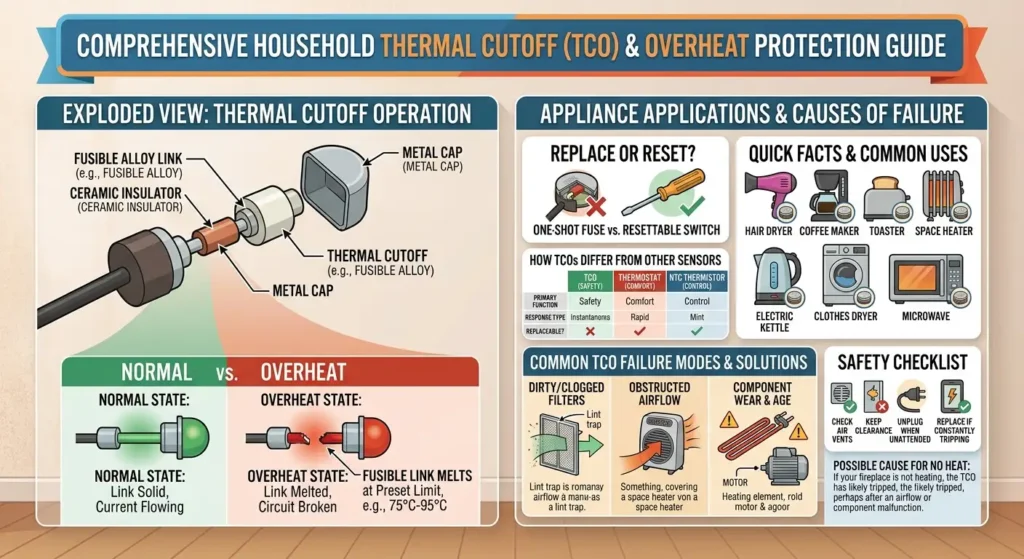
A thermal cutoff also known as a thermal fuse, thermal cut-off (TCO) or overheat protection switch – is a small electrical device that is hard-wired directly into the heating circuit of an electric fireplace. Its sole purpose is to feel when it is excessively hot and cut off the electrical connection before the heat can become dangerous.
Imagine a guardian to your heating element. It may be running normally, but as soon as the internal temperature exceeds a preset limit, usually in the 75 C to 95 C (167 F to 203 F) range, depending on the model, the thermal cutoff physically breaks the circuit. When power to the heater is turned off, the unit turns off the power immediately, irrespective of what the thermostat or remote control is instructing the unit to perform.
This is important since a thermostat is sensitive to room (only) temperature, which is slow to change. A thermal cutoff is a means of responding to the temperature of an internal component, which may rapidly spike in response to something bad happening. The two devices operate at entirely different speeds and for entirely different reasons, this is the reason why fireplaces have both.
Quick fact: Fireplaces are not the only thermal cutoffs. The same simple technology shields hair dryers, coffee makers, toasters and space heaters – anywhere that a heating element could theoretically become hot should airflow or parts malfunction.
How Does a Thermal Cutoff Work?
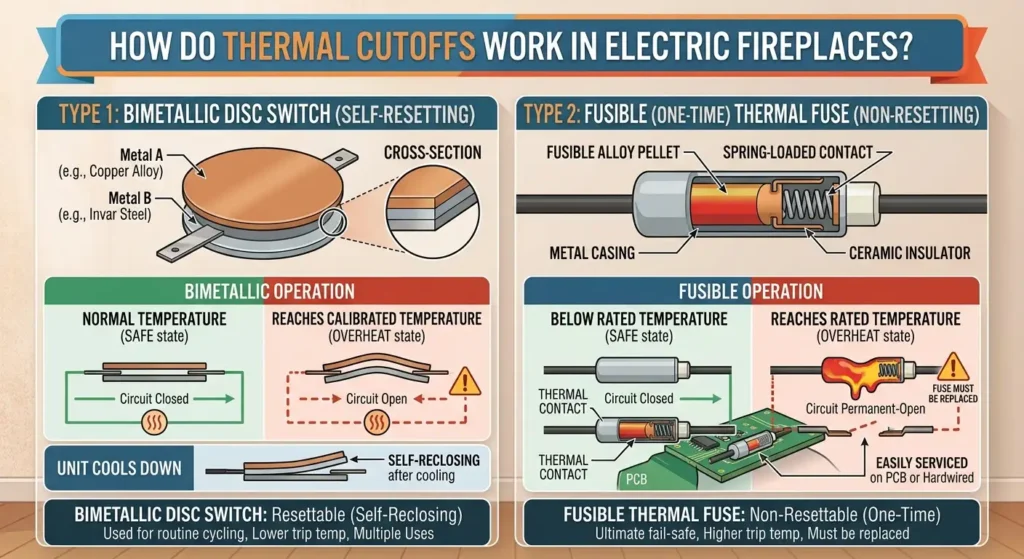
The majority of thermal cutoffs in electric fireplaces are based on one of two principles:
Bimetallic Disc Switches
The bimetallic disc switches are made of two different metals. Since the various metals will expand at varying rates upon heating, the disc bends or snaps once it reaches its calibrated temperature and physically opens or closes the circuit. Most of them are self-reclosing: as soon as the unit cools down, the disc bends back and the power may be conducted again.
Fusible (One-Time) Thermal Fuses Fusible
Fusible (one-time) thermal fuses have a small pellet of material (usually a metal alloy) that contains a spring-loaded contact. When the ambient temperature reaches the rated point of the fuse, the pellet melts, the spring opens and the circuit is closed permanently. These are not self-blastomating – the fuse must be replaced, and that is why they are often left on the printed circuit board (PCB) or simply hardwired to the heater element so that they can be easily serviced.
Comparison: Resettable vs. Non-Resettable Thermal Cutoffs
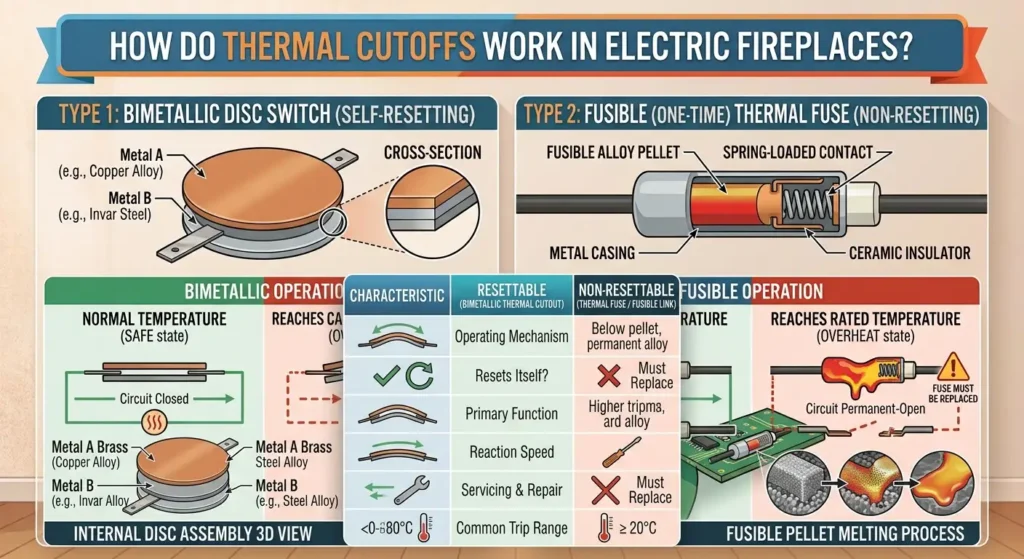
Here is the cleaned and properly structured comparison table:
What is Thermal Cutoff in Electric Fireplace
| Characteristic | Resettable (Bimetallic Thermal Cutout) | Non-Resettable (Thermal Fuse / Fusible Link) |
| Operating Mechanism | Bimetallic disc bends at target temperature to open circuit | Internal thermal pellet/wire melts to open circuit |
| Resets Itself? | Yes, resets automatically when cooled | No, permanently blown and requires replacement |
| Primary Function | General overheat protection | Backup protection against severe fault conditions |
| Reaction Speed | Moderate | Fast |
| Servicing & Repair | Requires no routine maintenance | Normally requires replacement by a qualified technician |
| Common Trip Range | ~75–95°C (167–203°F) | Higher temperature threshold (last-resort safety backup) |
It is actually quite common to have many electric fireplaces employing a combination of the two, a resettable cutoff in case of normal overheat scenarios (such as a blocked vent) and a non-resettable fuse as a last resort in case the resettable one fails or the fault is more serious enough to require professional intervention.
Thermal Cutoff vs. Thermostat: What’s the Difference?
This is probably the most ambiguous aspect, and it is worth clarifying.
| Characteristic | Thermostat | Thermal Cutoff |
| Measured Quantity | Room air temperature | Internal component temperature |
| Purpose | Convenience, comfort, and energy saving | Safety and fire prevention |
| Normal Behavior | Cycles heater on and off to maintain a set temperature | Remains passive/closed unless an overheat occurs |
| User-Adjustable? | Yes (via dial, remote, or app) | No (factory-set and sealed) |
| Upon Activation | Heating element turns off, flame/fan effects usually continue | Shuts down heating element completely (may disable full unit) |
| Indicates a Fault? | No, normal operational cycling | Often yes (indicates airflow block or component failure) |
When you have your fireplace flame effect on and the room is approaching your desired temperature, then you know your thermostat is doing its job. When the unit becomes hot to touch, or completely shuts off, or does not start immediately, then that is more compatible with a thermal cutoff event.
Why Did My Thermal Cutoff Trip? Common Causes
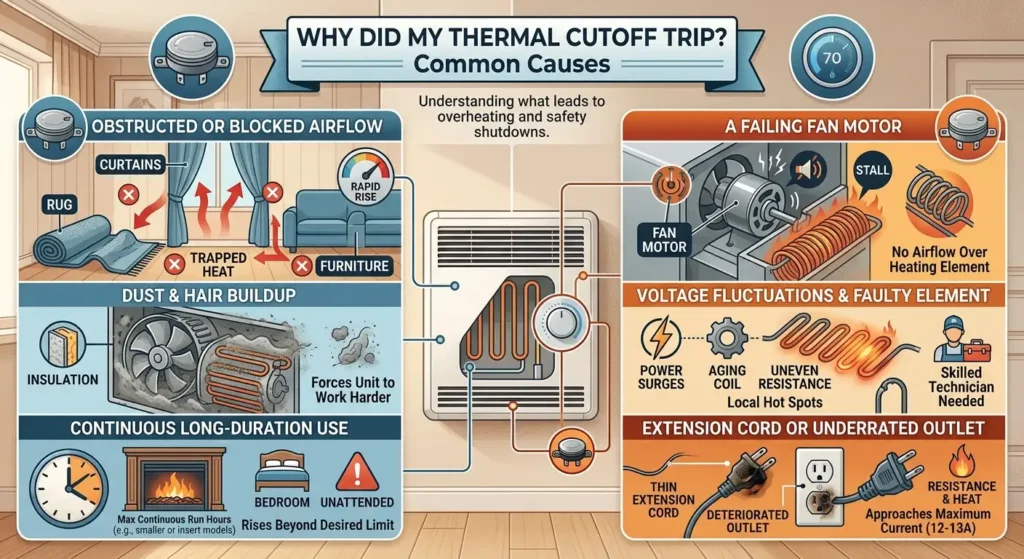
The symptom rather than the problem is a thermal cutoff tripping. The most common underlying causes, approximately ranked in descending order of prevalence, are given below.
1. Obstructed or Obstructed Airflow.
Electric fireplace heaters operate by pulling room air through the system, over a heating coil, and expelling warm air. Anything that blocks such airflow – a rug bunched up against the intake, curtains over the front, furniture too near, the unit pushed too close to a wall – traps heat in the housing and causes the internal temperature to rise rapidly.
2. Dust and Hair Buildup.
In months of usage, fire places attract dust and pet hair in the air similar to a vacuum. This debris accumulates on blades of the fans, heating coils, and internal sensors, insulating them and compelling the unit to work harder to force air through. This is an easily avoided problem, and one of the most frequent causes of a sudden fault.
3. Continuous Long-Duration Use
There are models which have a maximum number of continuous running hours, particularly smaller portable models or insert models. A fireplace that is left unattended and kept running all night in a room that is not well ventilated may cause internal temperatures to rise beyond the desired limit, even in the absence of a noticeable obstruction.
4. A Failing Fan Motor
Air is pulled over the heating part by its fan. When the fan slows down, stalls or even fails completely, there is no way to get the heat away, and it accumulates in the unit leading to the thermal cutoff as a natural extension of the fan issue, not as the initial issue.
5. Voltage Fluctuations or a Defective heating element.
Local hot spots within the unit can occur due to power surges or an aging heating coil with uneven resistance, or a wiring fault, even when the outer case is merely warm. This is the most probable category that may need a skilled technician as opposed to a DIY solution.
6. Extension Cord or Underrated Outlet.
Electric fireplaces will normally approach the maximum rated current of the circuit (usually 1213 amps on 120 V/1500 W unit). In certain designs, a thin extension cord, a multi-plug adapter, or a deteriorated outlet may cause resistance and heat at the connection point, which is in turn guarded by the designation protective circuit.
Diagnostic Table: Match the Symptom to the Cause
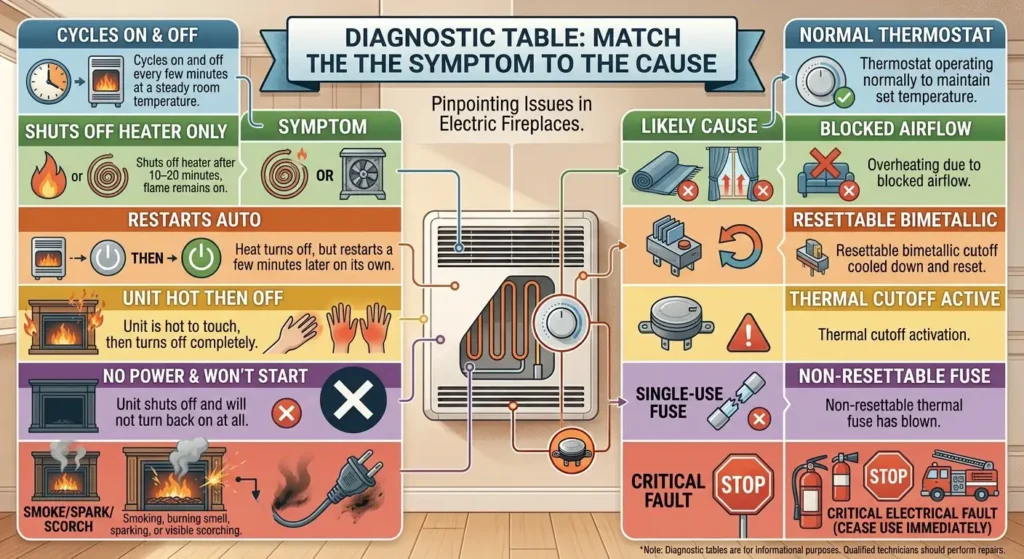
| Symptom | Likely Cause |
| Shuts off heater after 10–20 minutes, flame remains on | Overheating due to blocked airflow |
| Unit is hot to touch, then turns off completely | Thermal cutoff activation |
| Heat turns off, but restarts a few minutes later on its own | Resettable bimetallic cutoff cooled down and reset |
| Unit shuts off and will not turn back on at all | Non-resettable thermal fuse has blown |
| Cycles on and off every few minutes at a steady room temperature | Thermostat operating normally to maintain set temperature |
| Smoking, burning smell, sparking, or visible scorching | Critical electrical fault (cease use immediately) |
How to Troubleshoot a Tripped Thermal Cutoff?
Whether you have a faulty electric fireplace that no longer heats, follow these steps sequentially.
- Turn it off and pull the plug. Deliberately do not inspect or clean a fireplace when it is attached to electric power.
- Allow to cool down. Allow the unit at least 30-45 minutes. Resettable thermal cutoffs require the internal temperature to fall far below the trip point before they will re-open the circuit.
- Clean the airway. Clean the air intake and the heat outlet of dust, pet hair or blockages. This can be done with a vacuum having a soft brush attachment.
- Check clearance around the unit. Adjust position as necessary, consult your manual on the minimum recommended distance between the wall, furniture, curtains, and rugs.
- Plug in directly to a wall socket, and do not use extension leads or multi-socket adapters, which are not intended to be used with a full-time current consumption of a heater.
- Try it again. Provided that the unit booted up and behaved normally, the resettable thermal cutoff did not do anything out of the ordinary.
- Still will not heat. The thermal fuse can be a non-resettable fuse that has been blown, but there can be underlying fault. Now, quit troubleshooting electrical parts on your own and call the manufacturer or a professional technician.
Can You Reset a Thermal Cutoff?
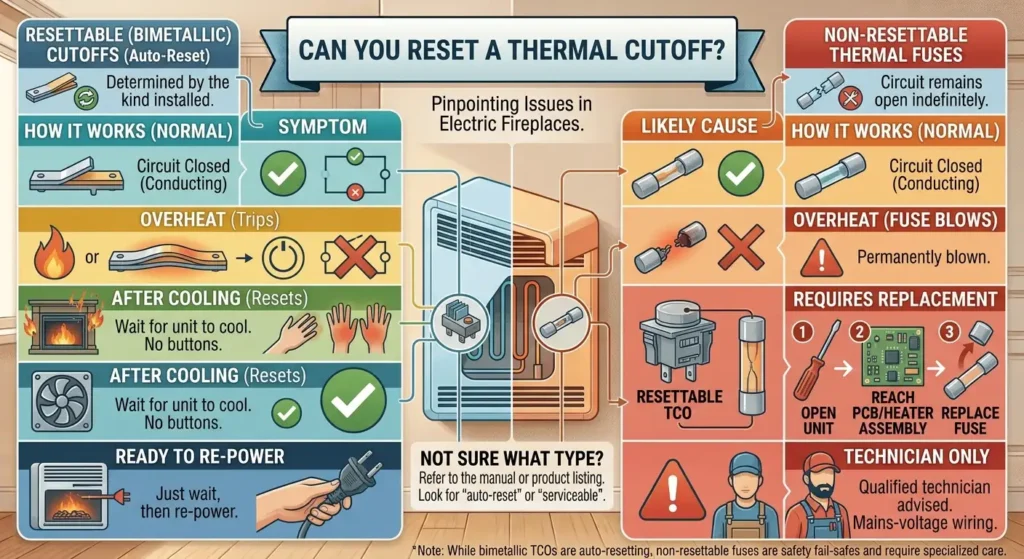
It is determined by the kind that is installed in your model.
- Resettable (bimetallic) cutoffs: These cutoffs automatically reset after the unit cools down. No button to press, just wait, and re-power the unit.
- Non-resettable thermal fuses are not resettable: When the circuit is open circuit, the circuit remains open indefinitely. It requires replacement of the fuse itself, which usually involves opening up the unit and reaching the PCB or heater assembly – something that manufacturers generally advise leave to a qualified technician, as it would involve working with mains-voltage wiring.
Not sure what type your fireplace operates, refer to the manual or product listing; many manufacturers indicate that overheat protection is an auto-reset or serviceable.
When Repeated Tripping Means It’s Time to Stop and Call a Professional
Sometimes tripping on dusty summer or a rug that is moved too far is common and can be easily corrected. Tripping regularly and without any explanations is different. Do not continue troubleshooting, consult a professional in case you observe any of the following:
- The unit trips in and out even with free air and correct positioning.
- You are getting the smell of burning plastic or you can feel the lingering electrical smell.
- There is popping, crackling or buzzing within the housing.
- The power cord or plug is hot, discolored or frayed.
- The fireplace keeps blowing the circuit breaker of your home, rather than the circuit breaker that is built into it.
The presence of any of these points to a real electrical fault as opposed to routine dust or airflow problems and using the unit presents a real fire hazard.
Why This Safety Feature Matters More Than It Seems
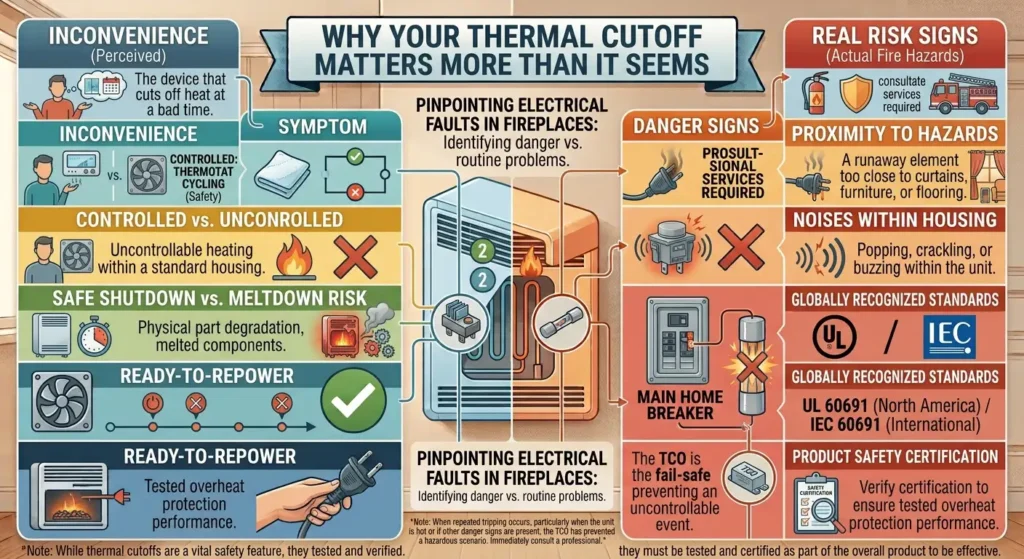
It is not hard to think of a thermal cutoff as an inconvenience – the thing that puts you out of heat at a bad time. However, we should keep in mind what it is actually stopping: an electric heating element that is going to operate uncontrollably within a housing that is becoming overheated, and that may be close to furniture, curtains or flooring.
Accepted electric fireplaces are certified relative to accepted standard (including UL 60691 in North America or IEC 60691 internationally) particularly of thermal cutoff performance, and of wider product safety certification. When buying a new unit, it is normal to verify that it has accepted safety certification to make sure it has tested overheat protection, though whatever the listing says regarding features.
You May Also Read:
- What is Electric Fireplace Lifespan? 7 Amazing Facts You Need to Know
- How to Convert a Wood Burning Fireplace to Electric
FAQs:
What does a thermal cutoff mean in an electric fireplace?
It is a safety switch connected to the heating loop which turns the heater off when the inside temperatures get excessive and prevents overheating or a fire hazard.
Does a thermal cutoff mean thermal fuse?
They are two closely related terms that are used interchangeably. Technically, a one-time, non-resettable version is commonly called a thermal fuse, whereas the resettable or non-resettable one can be called a thermal cutoff.
Why does my electric fireplace turn off after some time?
The thermal cutoff due to heat accumulation as a consequence of blocked vents, dust, or close proximity to a wall or furniture is the most prevalent cause.
Is it possible to reset a thermal cutoff?
Resettable (bimetallic) thermal cutoffs are automatic, and they are set to be reset after cooling the unit. Non-resettable thermal fuses do not have the ability to be reset and need to be replaced.
When the thermal cutoff trips are activated, does the flame effect switch off too?
Usually not. The thermal cutoff is hard-wired into the heating circuit, such that the flame effect and lights are usually left on, but the heat is turned off.
How will I know when it is long enough to attempt to start my fireplace?
Allow at least 30-45 minutes to allow it to fully cool before attempting to switch back on.
Should a frequently tripping fireplace be used?
No. Tripping repeatedly and with no apparent reason implies that there is something wrong with it and is not to be repeatedly set back.
What is the thermal cutoff temperature?
Depending on the model and manufacturer, a large number of household heating appliances have cutoffs of about 75°C (167°F) to 95°C (203°F) at a component level.
Is it possible that dust can cause a thermal cutoff to go off?
Yes. Internal components are insulated with dust and pet hair and limit airflow, increasing internal temperatures and causing the safety switch to be activated.
Does it have a thermal cutoff on all electric fireplaces?
Oversized, safety certified electric fireplaces have overheated protection as a feature of good quality. It is always good to check this on the product listing or in the manual prior to purchase.
Is it possible to replace a blown thermal fuse?
It can be done technically on certain models, but would require opening the unit, and working close to mains wiring, most manufacturers advise it to be done by a qualified technician.
Why is my unit hot on the outside but the casing is cool touch?
Cool-Touch surfaces have lower surface temperatures to make them safe to the user, but internal components may be hot enough to cause the thermal cutoff to be triggered even though the exterior of the case feels warm.
Is there an effect on thermal cutoff when an extension cord is used?
It can. Extension cords and adapters are not designed to run a continuous current of a heater, and may generate heat at the connection, which some circuits check as total protection.
Key Takeaway
- Thermal cutoff: a special safety switch, independent of the thermostat, that prevents overheating.
- The majority of trips are related to blocked airflow, dust, or positioning problems – that can be fixed within minutes.
- Cutoffs that are resettable self-blast after cooling off; non-resettable fuses must be replaced.
- Tripping frequently, strange odors, or visible damage are problems that should prevent trouble-shooting and seek professional assistance.
- To ensure that tested overheat protection is provided, a good method of purchasing a new unit is by certifying it as safe.