What Does EC Mean on an Electric Fireplace?
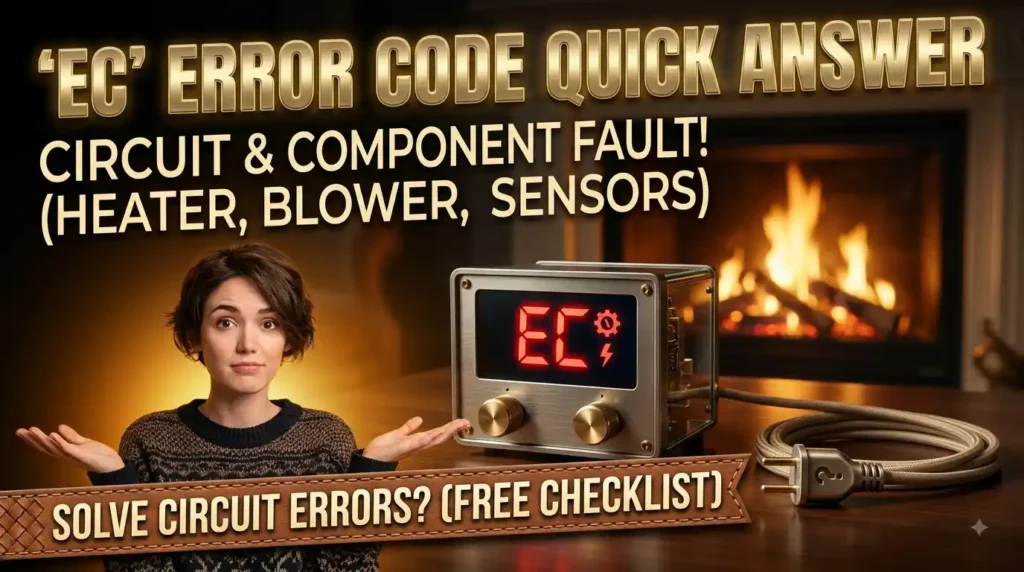
What Does EC Mean on an Electric Fireplace? Quick Answer: An electric fireplace will often have an EC code indicating an interruption or fault somewhere in the electrical circuit in the unit, the connection between the control board and the power source and the components it controls (heater, blower, sensors or remote receiver).
It cannot be equated with a smoke or a gas alarm, as the fuel does not burn in electric fireplaces. In most real-life scenarios documented by owners and retailers, the EC code resets following a complete power outage, test of the wall socket or a cleared airflow blockage.
Lesson learned:
consider EC your fireplace whispering, “I do not think something is right in my electrical loop,” and not, something is on fire.
What Does EC Mean on an Electric Fireplace?
Your electric fireplace was working, and you have a blinking EC on the screen and no fire, no heat or both. Before you jump to the worst, here is the short story: EC is nearly always due to a fault in an electrical connection or power, not a gas leak or a fire risk that is in the back of your wall. It can be repaired within 15 minutes in most cases, without the assistance of a technician.
This guide outlines what the EC code actually refers to, why the various brands do not constantly agree on the code, the most common reasons and a clear step by step procedure to clear it. It also includes when it is smart to cease troubleshooting and employ an expert.
Key Takeaways
- EC is usually due to electrical fault or circuit fault, but not fire or gas.
- The precise definition is not universally agreed upon by all manufacturers – consult your model manual where you can.
- Most cases are solved by a complete power cycle, outlet check, and vent cleaning.
- Do not attempt to repair hard-wired items, control boards or internal wiring.
- Constant EC code following the simple troubleshooting should be followed by calling manufacturer support or licensed electrician.
Is EC a Standardized Error Code Across All Brands?
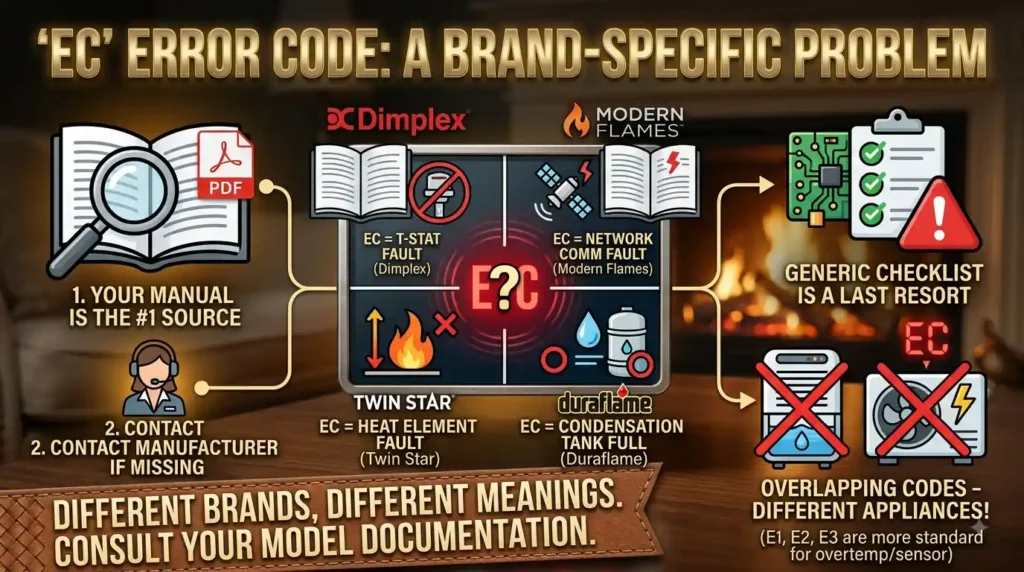
What most articles on this subject omit, however, is that there is no single industry standard that identifies the term EC uniformly across all electric fireplace manufacturers: unlike numeric codes like E1, E2, or E3, which are more consistently documented by manufacturers of products like Twin Star and Duraflame as overheat or sensor-related issues.
EC appears less frequently in the manuals of many manufacturers and in brand support literature related to lines such as Dimplex and Modern Flames.
That difference is important because of one practical reason: whatever your model has as printed in its manual, or on the official support page provided by its manufacturer, will always be the most reliable source of information on what your particular EC code means, since two units of two different factories could have the same letters representing different circuits.
Unless you have lost your owners manual or box, consult the troubleshooting table first before thinking that a generic description fits the specific model you have.
Most manufacturers include PDFs of the manual on their model-number support pages, in case you do not have the manual.
It is also interesting to note that EC is a relatively common acronym in small appliances in general – dehumidifiers, portable air conditioners, and mini-split units may sometimes use EC-style codes to mean completely different things, such as a full water tank or a communication error between indoor and outdoor units.
In case you have typed the code of your fireplace and have found yourself on a dehumidifier or AC troubleshooting site, it is because of the letters which overlap but the systems under the two are not the same.
Always ensure that you are reading documentation on a heater/fireplace, rather than a cooling appliance, before implementing a fix.
In cases where a manual truly does not mention EC at all – as is commonplace, as many low-end and entry-level electric fireplaces do provide fairly bare-bones documentation – the safest bet is to treat that documentation as though it were protective, rather than cosmetic, and go through the general electrical-fault checklist below and go straight to the manufacturer in case it does not pass.
6 Common Causes of the EC Error Code
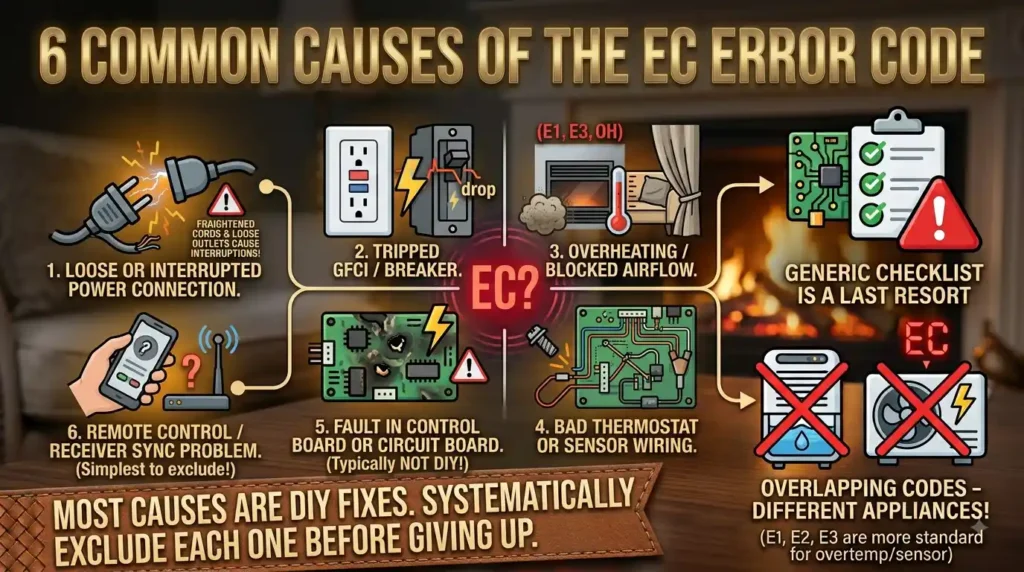
1. Loose or Interrupted Power Connection.
The most common trigger. Partially seated plug, a frayed extension cord (this should clearly be cautioned against by the manufacturer), or a loose connection to the wall-outlet may produce micro-interruptions in the power flow that the control board interprets as a fault.
2. Tripped GFCI/ Breaker.
There are numerous living room and built-in fireplace circuits fed by a GFCI outlet or a special breaker. When the GFCI is tripping partially or the breaker is becoming weak, there is still a possibility of the fireplace receiving power but not enough to operate cleanly, causing EC.
3. Overheating / Blocked Airflow
Electric fireplaces draw in room air, heat it, and blow it out of the room via vents. When that airflow is blocked by dust, furniture or curtains, the inside temperature is raised and the internal safety system can issue an error – this may be EC, or E1/E3/OH depending on the internal logic of the brand.
4. Bad Thermostat or Sensor Wiring.
The thermostat and internal temperature sensors are in constant communication with the control board. Inconsistent signals may be sent to the board by a loose sensor wire or a failed sensor that is interpreted as an electrical fault.
5. Fault in Control Board or Circuit Board.
In the case the unit is older or has experienced a power surge (lightning storm or grid fluctuation or spike of another appliance on the same circuit), the control board itself may be destroyed. This is the only reason on this list that is typically not a DIY solution.
6. Remote Control/Receiver Sync Problem.
On certain models, when the wireless receiver goes out of sync with the remote an EC-type code is displayed, particularly after a battery change or a factory reset. This is the simplest cause to exclude and least probable to be a symptom of an actual electrical issue.
A Note on Seasonal and Environmental Factors
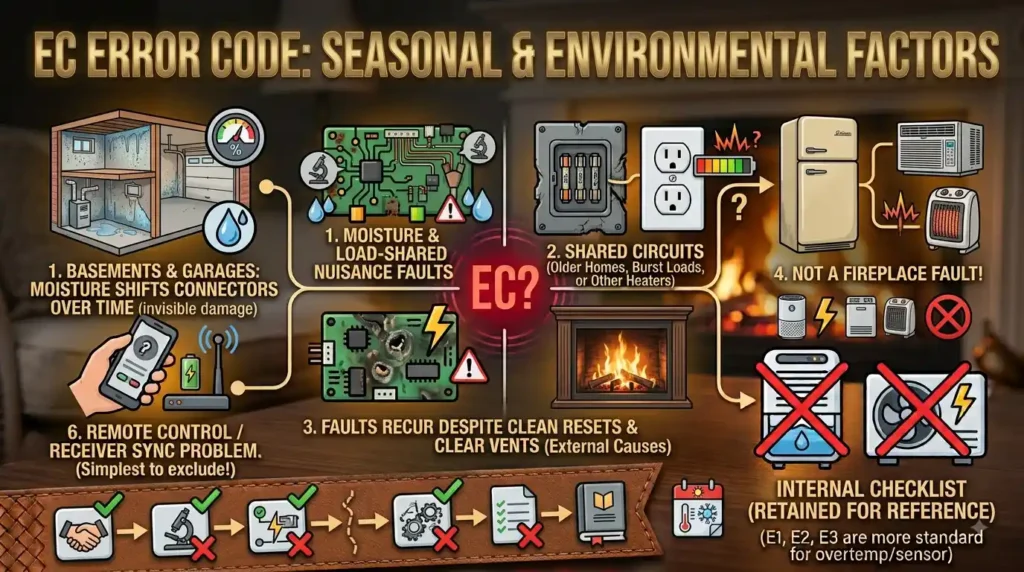
In addition to the six causes mentioned above, there are some environmental trends that have been recurrently observed in owner reports. Electrical-type codes are occasionally more frequent in areas with fireplaces in basements, converted garages or rooms with large variations in humidity, as moisture can cause connector contacts and circuit boards to shift over time even without anything apparent to the eye.
Likewise, older wiring homes or homes that also use a shared circuit with a refrigerator, a window air conditioner or a space heater may experience more frequent nuisance faults, since these appliances act as burst loads that can overload a shared breaker. Neither is a fault of the fireplace itself, but both are worth eliminating in case the EC code continues to recur even following a clean reset and a clear set of vents.
How to Fix the EC Code: Step-by-Step?
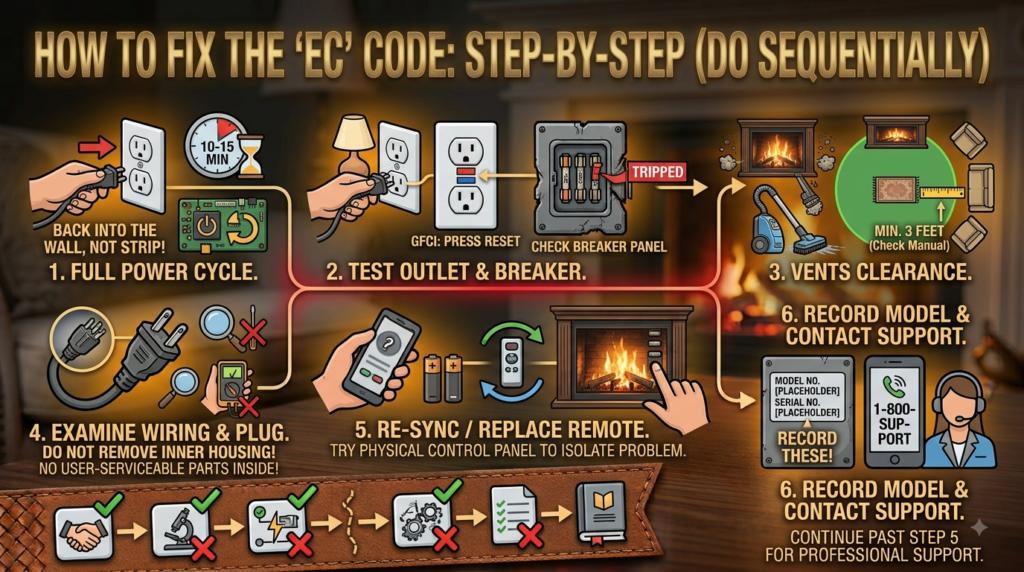
These steps should be done sequentially. The majority of owners clear the code to step 3.
Step 1: Full power cycle.
Switch off the fireplace, then unplug it (or close the breaker of hardwired models). Allow 10-15 minutes to pass – this is important, as it allows some time to clear the memory of the control board and all thermal sensors to fully rest. Always back into the wall, not a power strip or extension cord.
Step 2: Test the outlet and breaker.
Check outlet with another appliance (lamp is sufficient). With a GFCI outlet, press the middle button of the outlet that is the reset button. Check your breaker panel there should be a tripped switch.
Step 3: Vents clearance.
Unplug the unit. Clean the dust out of the intake and exhaust vents, front, back, and underneath using a vacuum with a brush attachment. Ensure that all items (furniture, rugs, curtains) are not located in the clearance space as indicated in your manual – usually minimum of a few feet in front and sides.
Step 4: Examine exposed wiring and the plug.
When the unit is not plugged in, examine the power cord, and make sure the plug is not fraying, or discolored (an indication of previous overheating at the outlet). Do not remove the inner housing of the fireplace most manuals specifically state that there are no parts that can be serviced by the user inside.
Step 5: Re-sync/replace remote batteries.
Change out new batteries and attempt to use the unit with the physical control panel, rather than the remote to determine whether the problem is only with the remote.
Step 6: Record the model number and support.
When EC continues past steps 15-5, record your model and serial number (typically on a label on the back or bottom) and call the customer support line of the manufacturer. Most brands can inform you in a few minutes whether EC on your particular model points to a board issue and whether it is a warranty issue.
EC vs Other Electric Fireplace Error Codes
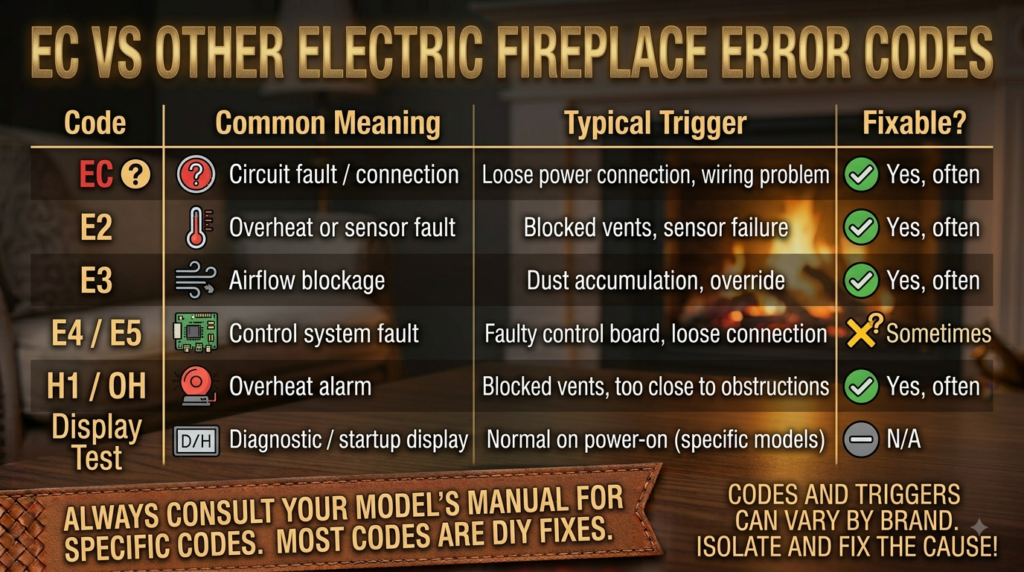
Here is the cleaned and properly structured table based on your data:
| Code | Common Meaning | Typical Trigger | Fixable? |
| EC | Circuit fault / electrical connection | Loose power connection, outlet, wiring problem | Yes, often |
| E2 | Overheat or sensor communication fault | Blocked vents, sensor failure | Yes, often |
| E3 | Airflow blockage, dust accumulation | Overheat override | Yes, often |
| E4 / E5 | Faults in electronic control system | Faulty control board, loose connection | Sometimes |
| H1 / OH | Overheat alarm activated | Blocked vents, too close to obstructions | Yes, often |
| Display Test | Diagnostic / startup display, not an error | Normal on power-on on certain models | N/A |
Codes and meanings depend on the manufacturer. Use this table as a guide, not a replacement to the manual of your model.
Other error code manuals (also in the EC format)
No heat / No flame troubleshooting
- Electric Fireplace Not Heating But Flame Still Works: Causes & Fixes
- Fireplace Electric and flame is not working but heat is on.
- Electric Fireplace Is Not Starting: Complete Troubleshooting Checklist.
- Electric Fireplace Remote No Longer Works: troubleshooting.
Noise / smell / physical problems.
- Electric Fireplace Produces Buzzing/Clicking Sound: Diagnoses.
- Electric Fireplace Smells Like It Burns: Is it dangerous?
- Electric Fireplace Blowing Cold Air Not Heat.
- Fix Electric Fireplace Flickering or Dim Flame Effect.
Installation & electrical
- Is an Electric Fireplace Pluggable?
- Does an Electric Fireplace Require Circuit Breaker?
- Electric Fireplace Trips Breaker Why and What to Do.
- What is the Amperage of an Electric Fireplace?
Maintenance & lifespan
- Cleaning Electric Fireplace (Glass, Interior, Vents).
- What is the life expectancy of electric fireplaces?
- Symptoms of your Electric Fireplace Heater Element Malfunctioning.
- Electric Fireplace Maintenance Checklist (Seasonal)
Warranty / support
- Where to locate your Electric Fireplace Model and Serial Number.
- Do I Have a Warranty on My Electric Fireplace? How to Check
- Calling Customer Support of Electric Fireplace.
Is It Safe to Keep Using the Fireplace While EC Is Displayed?
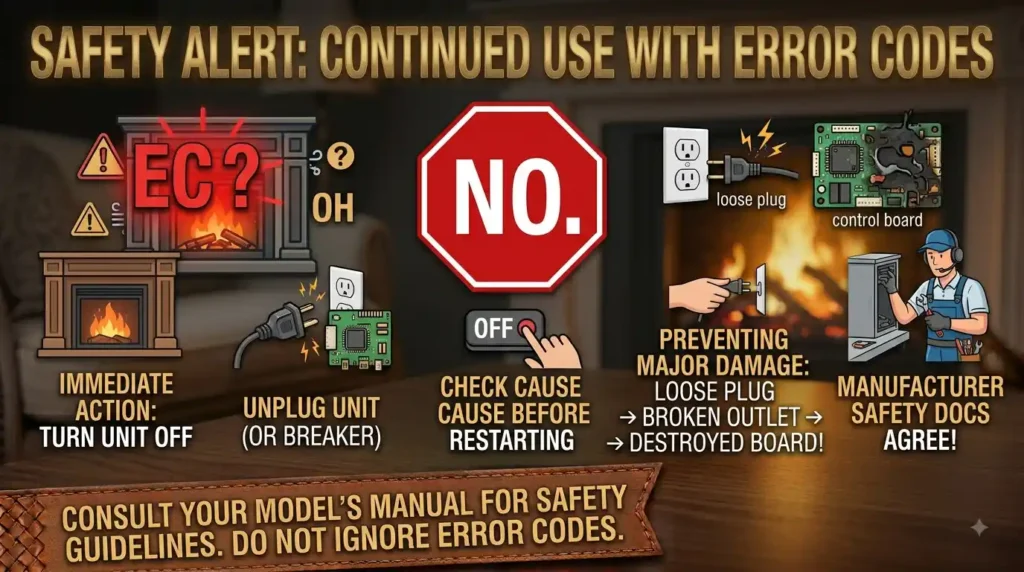
No. The safety documentation of every large manufacturer states the same but in other words: turn a heater off as soon as it indicates a fault code, disconnect it, and check it before starting to use it again. This is not exclusive to EC but can be used in any error code. Keeping a unit that is indicating an electrical fault on will cause a small, easily resolved problem (loose plug) into a larger one (broken outlet or control board).
It is also a good time to test your plug and outlet manually, as sometimes, a problem cannot be spotted by just looking at it. When the unit is not plugged in, test the prongs on pitting or discoloration, and observe the outlet face itself on the possibility of some browning around the slots – an indication of arcing in the past. Looking at either, unplug it until an electrician has inspected it, whether the EC code clears on a different outlet or not.
A fault code that disappears merely because you changed socket should be mentioned to an electrician, as it will inform you that it probably isn’t the fireplace that is at fault but the original socket.
When to Call a Professional
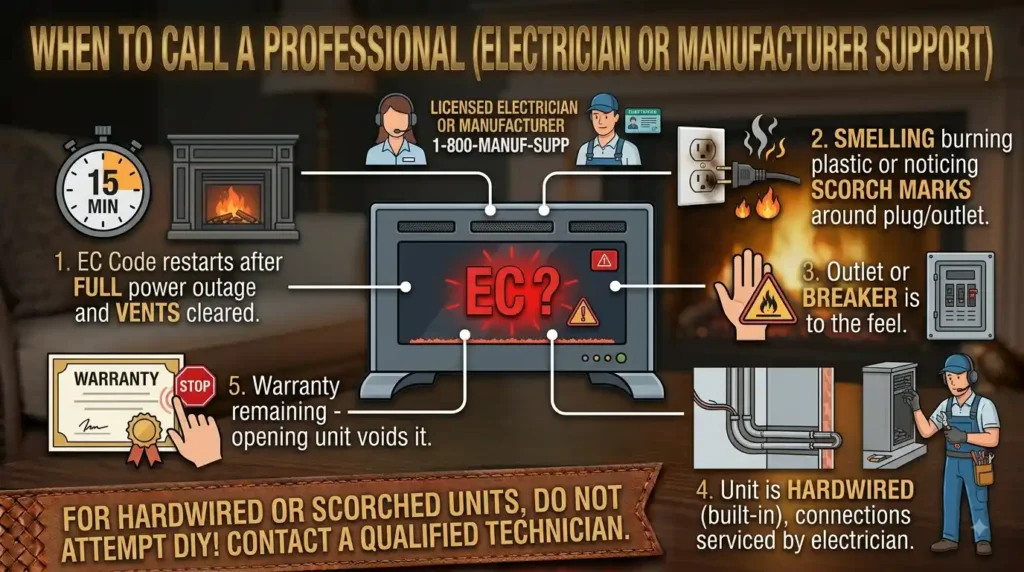
Contact a licensed electrician or the service line of the manufacturer in case:
- EC code restarts after a complete power outage and cleared vents.
- You are smelling of burning plastic or can notice any scorch marks around the plug or outlet.
- The outlet or breaker is hot to the feel.
- It is hardwired (built-in) not plug-in, as hardwired connections can only be serviced by a qualified electrician.
- The fireplace has a warranty remaining on it- opening it yourself would be counterproductive to the warranty.
A phone call to the support line of the manufacturer is usually quicker than it may seem. Before you make a call, have your model number, the specific code on the display and a brief summary of what you have already tried so far, most support departments can tell in a few minutes whether your problem is a known issue with that model, whether your issue is covered, and whether a replacement part or a complete unit would be more appropriate.
How to Prevent the EC Code from Coming Back?
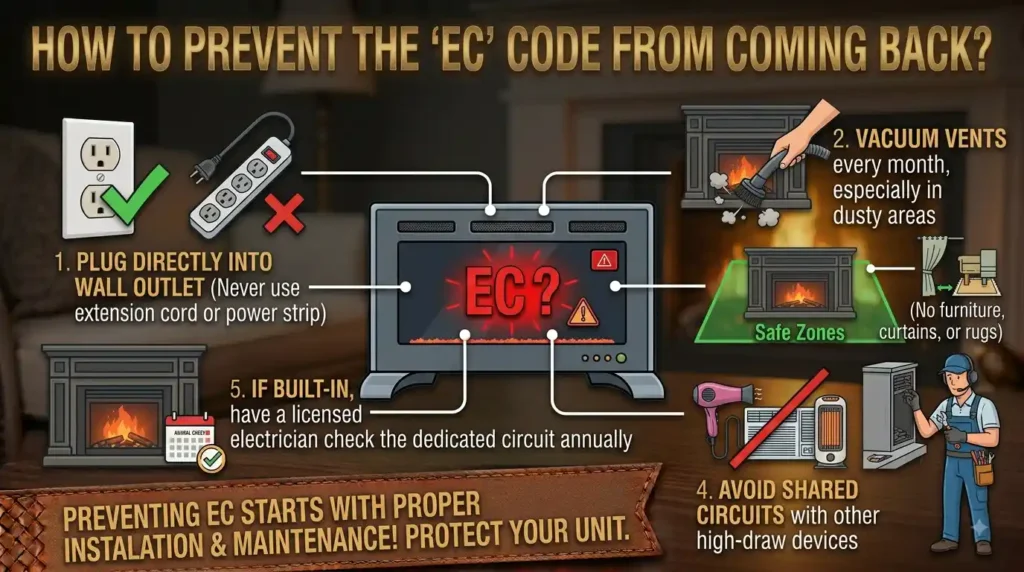
- You can simply plug it directly into a wall outlet of the proper amperage of the fireplace; never use an extension cord or power strip.
- Have the vents vacuumed every month, especially in dusty areas.
- Maintain clearance distance mentioned by the manufacturer without furniture, curtains, and rugs.
- Do not use other high-draw devices on the same circuit.
- If the unit is built-in and is a permanent installation, then have a licensed electrician check the dedicated circuit every year.
You May Also Read:
FAQs:
What is EC on an electric fireplace?
It usually means that there is something wrong in the electrical circuit of the unit- most commonly it is a connection, power-supply, or sensor-wiring problem, but not a fire or gas risk.
Does the EC code differ on each brand of electric fireplace?
No. No industry standard exists to this particular code and as such, you should always refer to the manual of your model or the support page of its manufacturer.
Will my fireplace be able to provide heat when it indicates EC?
The heater (and in some cases the flame effect) is turned off automatically by most units when the fault code is displayed, as a precaution.
Will disconnection of my fireplace at night correct the EC code?
Full power cycle typically takes 10-15 minutes. The longer time taken out of the plug is not of any additional value unless you are also dealing with the cause of the issue (vents, outlet, wiring).
Does EC code imply that my fireplace is permanently defective?
Not necessarily. It is usually solved by a reset, an outlet check, or vent cleaning, in most cases that are reported. An ongoing code following those steps indicates an element that might require replacement.
Is it possible that dust can even lead to such an electrical error code as EC?
Yes, indirectly. Obstructed airflow increases internal temperature, which may influence sensor values and, depending on the model, show up as an electrical-like fault instead of an actual overheat code.
Is EC something to be afraid of?
It is not advisable to keep using any heater with a fault code on it. It does not have to be an emergency, but it ought to be dealt with prior to additional utilization.
Why does my fireplace not display EC until I move it?
Any motion of the unit may cause the connection between the power cord and internal wiring to be disturbed. Always recheck the plug and cord when moved.
Is there a power surge to the EC code?
It can. The control board can be influenced by a voltage spike caused by a storm or even the grid and cause a fault code even once power has been restored.
Would a surge protector be a good idea using my electric fireplace?
Many surge protectors are used with power strips or extension cords, but manufacturers typically instruct users to hardwire the heater to a wall outlet, because of the current draw of the heater. Verify your manual and place one.