What Does CO Mean on an Electric Fireplace?
What Does CO Means on an Electric Fireplace? The short answer to the question What CO Means on an Electric Fireplace is that CO is a measurement unit of the concentration of oxygen in the atmosphere (0x).
On most electric fireplace models, a safety error code of “CO” means that the internal carbon monoxide or gas-detection sensor of the unit has been activated and this is an extra safety measure provided by the manufacturers in case the unit is installed too close to another combustion-producing device (such as a gas stove, furnace, or an attached garage) where the CO produced by a different source may enter the room.
Shortly: the code is factual, and the threat it is warning about is almost never the source of electric fireplace.
What Does CO Mean on an Electric Fireplace? Quick facts before we dive in:
- Instead of an open flame, the electric fireplaces run with a heating component and a fan with no combustion, and, as a result, no carbon monoxide byproduct.
- What you see on the display is a manufacturer-programmed error code and not a live gas reading.
- The majority of the CO codes can be cleared with a simple reset button press, unplug-and-plug, or sensor clean.
- When the code fails to clear, or there is a smell of smoke, or you feel there is excessive heating, do not continue using the unit and contact the manufacturer or a certified electrician.
Does an Electric Fireplace Actually Produce Carbon Monoxide?
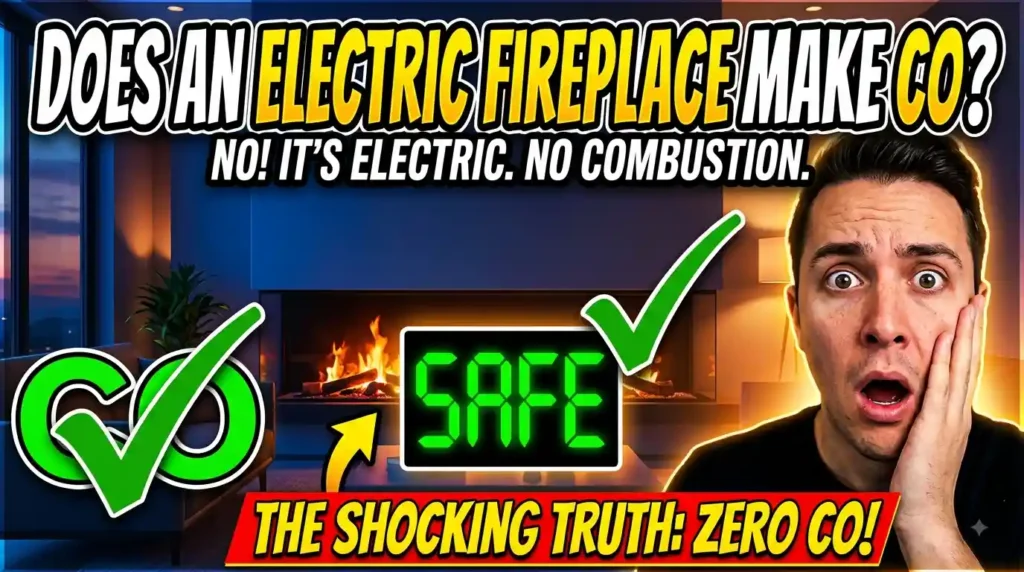
No. Carbon monoxide is a byproduct of incomplete combustion it occurs when fuels, such as wood, natural gas, propane, oil or kerosene, are burned without sufficient oxygen. Electric fireplaces don’t burn anything. They make the look of flame with LED lights, mirrors or holographic projection and they make heat with a resistive heating element, like a toaster or space heater. No chemical process is able to generate CO without a flame.
Why Electric Fireplaces Can’t Create CO
You require three things to make carbon monoxide; a source of fuel, an ignition source, and a reaction that combusts. None of the three applies to electric fireplaces. They are connected to a typical wall socket and change electricity into both light and heat. It is among the principal safety benefits that manufacturers boast of, and it is factual in nature, as any significant fireplace manufacturer does not issue an EPA or CPSC-registered case of CO poisoning by an actually electric (non-combustion) fireplace.
CO2 vs CO Why People Mix Them Up
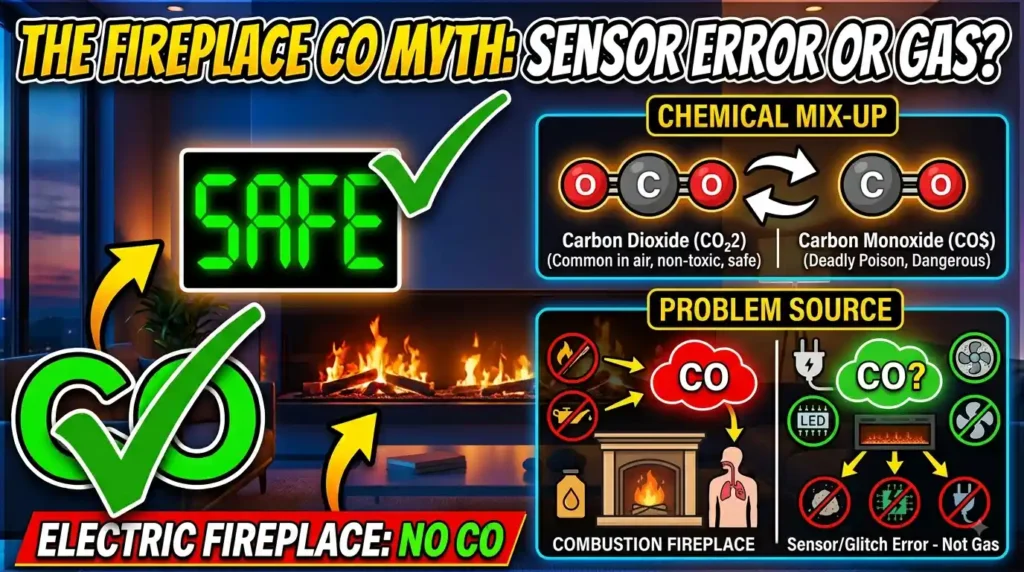
Part of the confusion is confusing carbon dioxide (CO2) and carbon monoxide (CO). People and animals breathe out CO2, and it is found in the normal room air at low levels it is not the same hazard. CO, however, is colorless, odorless and can be deadly in large amounts as it attaches itself to red blood cells more easily than oxygen, depriving the body of oxygen. None of the gases is produced by an electric heating element but CO is the one that should be considered seriously in any house where there are gas appliances, a furnace, or even an attached garage.
Common Reasons the CO Code Appears
When your electric fireplace indicates CO one of the following is nearly always the case.
1. False Trigger Due to an In-built Safety Sensor.
To avoid the chance of creating a false positive, some more expensive electric fireplace inserts will have an ambient air sensor on it even though the device itself cannot generate CO. Dust accumulation on the sensor, a momentary change in power, or natural room humidity can trigger a false alarm.
2. Electronic or Circuit Board Glitch.
Similar to any appliance that has a control board, electric fireplaces may display the wrong code because of a software hiccup. This is particularly prevalent following a power outage or a voltage spike, or immediately following installation before the board has settled.
3. Dust, Debris, or Clogged Vents.
Fireplaces which are not used during months (which is usual at the end of winter) may get dust on the sensor housing and inside vents. This accumulation may affect airflow sensors and cause a false alarm, such as CO.
4. Power Surge/Loose Wiring
A loose connection in the outlet, an extension cord not rated to the wattage of the fireplace, or a nearby surge (as with a storm, or a large appliance switching on the same circuit) can confuse the control board, and result in an error code.
5. Firmware or Sensor Calibration Problem.
Smart fireplaces and digital thermostats that are newer may require a firmware update or sensor re-calibration. Manufacturers occasionally release updates to correct incorrect error code reports by customers.
How to Fix the CO Code, Step by Step?
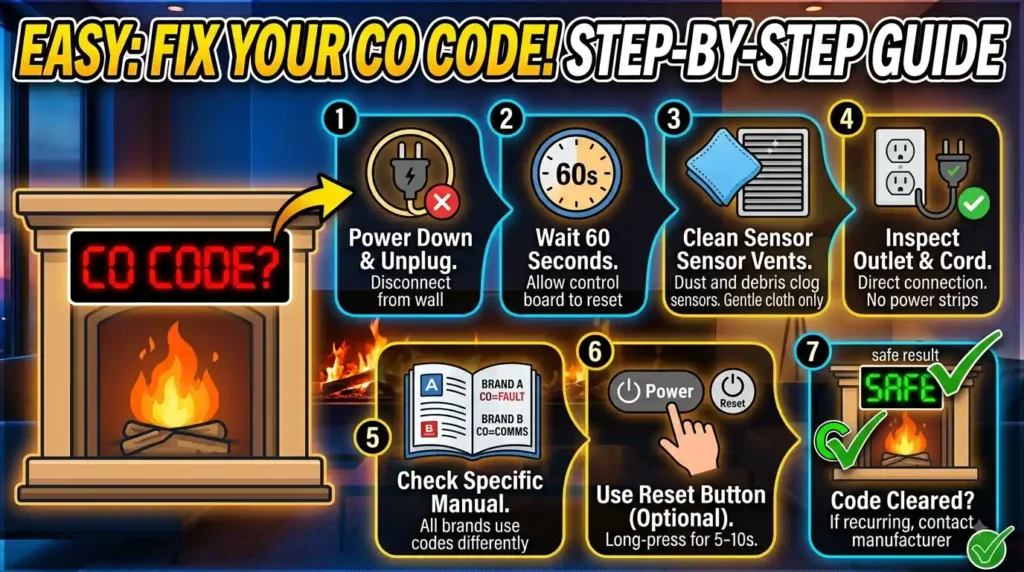
These are the steps to be worked out. Majority of CO codes clear in less than two or three steps.
- Switch off and disconnect the fireplace. It is always important to cut off the power then check any electric appliance.
- Wait 60 seconds, and re-plug it. This causes the control board to restart and removes most temporary glitches.
- Check the sensor housing and vents. Use a soft cloth that is dry and gentle to remove dust. Do not spray liquid cleaner into vents.
- Inspect outlet and cord. Ensure that the fireplace is hardwired into a wall outlet (no longer than a shared power strip or extension cord) and that the plug is working properly.
- Use the code list particular to your model, which is found in your owner manual. All brands do not use “CO” in the same manner as others may use it to mean Communication Overload or a wiring fault rather than a gas sensor. The manual will verify which of these applies to your model.
- Find a reset button or reset combination. A large number of units can be cleared by a long press of the power button (5-10 seconds) instead of a plain unplug.
- In case the code comes out at once, discontinue use and contact the manufacturer. A repeat code following a clean reset indicates a hardware problem which requires warranty or professional repair.
Electric Fireplace Error Codes You Might See
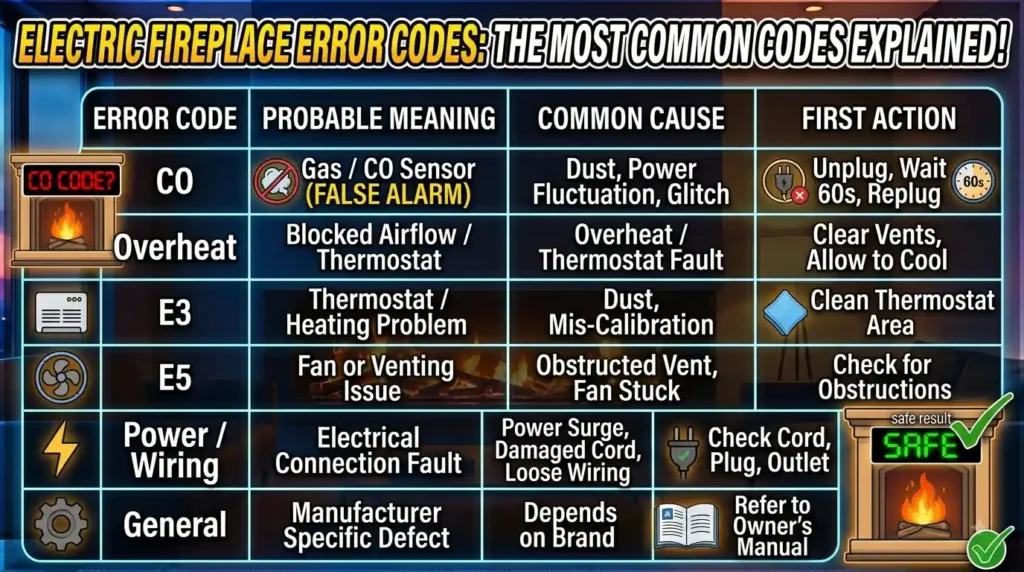
Codes Electric fireplaces can have different codes depending on the brand, but these are the most widely reported codes among the leading manufacturers.
| Error Code | Probable Meaning | Common Cause | First Action |
| CO | Gas/CO sensor triggered (false alarm in almost all cases) | Dust, power fluctuation, sensor glitch | Unplug, wait 60 sec, replug |
| Overheat | Overheat / thermostat problem | Blocked airflow, faulty thermostat | Clear vents, allow unit to cool completely |
| E3 | Thermostat / heating element problem | Dust, sensor incorrect calibration | Clean and check thermostat area |
| E5 | Fan or venting issue | Obstructed vent, fan blade stuck together | Check for obstructions |
| Power / Wiring | Electrical connection fault | Power surge, damaged cord, loose wiring | Check cord, plug, and outlet |
| General | General / manufacturer-specific defect | Depends on the brand | Refer to owner’s manual |
Note Codes are not standardized throughout the industry. Check against your own model manual before making a guess.
CO Code vs Other Safety Labels You’ll See Around the House
There are a few other situations when CO may be observed, and it is not difficult to mix them up.
CO on an Electrical Panel
When you have seen C.O. marked on a breaker in your home electrical panel, that is not what this is all about, nor is it a carbon monoxide reading, but is usually a label written by an electrician (such as cut-off or some special label designating a particular circuit), not a carbon monoxide reading. Labeling is not a standard, and thus when a label is not clear, an electrician may identify what is being controlled.
CO on a Gas Fireplace
Unlike electric fireplaces, gas fireplaces actually use fuel and they can indeed generate actual carbon monoxide when they are not well ventilated or maintained. When you observe a CO warning (particularly on a plug-in CO detector, not the fireplace display itself) and you have a gas or ventless gas fireplace, consider it to be a real emergency: evacuate the space, get some air, and call your gas utility or fire department outside the home. This is the guide on electric fireplaces in particular; the CO risk with gas fireplaces is an independent and more serious issue.
When the CO Code Means, You Should Stop Using the Fireplace
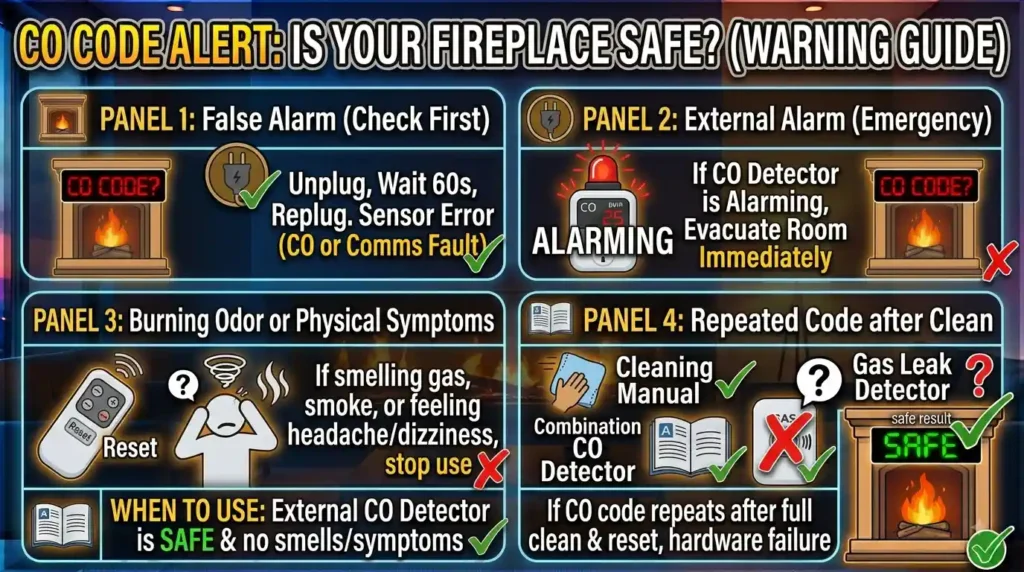
Although the code is nearly always a false alarm due to the sensor on the unit itself, consider it a real warning in case any of the following are also true:
- There is a stand alone CO detector in the room which is also alarming.
- smell: gas, smoke or electrical/burning odor.
- Headache, dizziness or nausea, which gets better after leaving the room, is reported by anyone in the home.
- The fireplace seems abnormally hot to feel or is producing abnormal sounds.
- The code repeats itself again and again after complete reset and cleaning.
Under any of them, disconnect the unit, open the space and do not use the fireplace until it is examined by a certified technician.
Do Electric Fireplaces Need a Carbon Monoxide Detector?
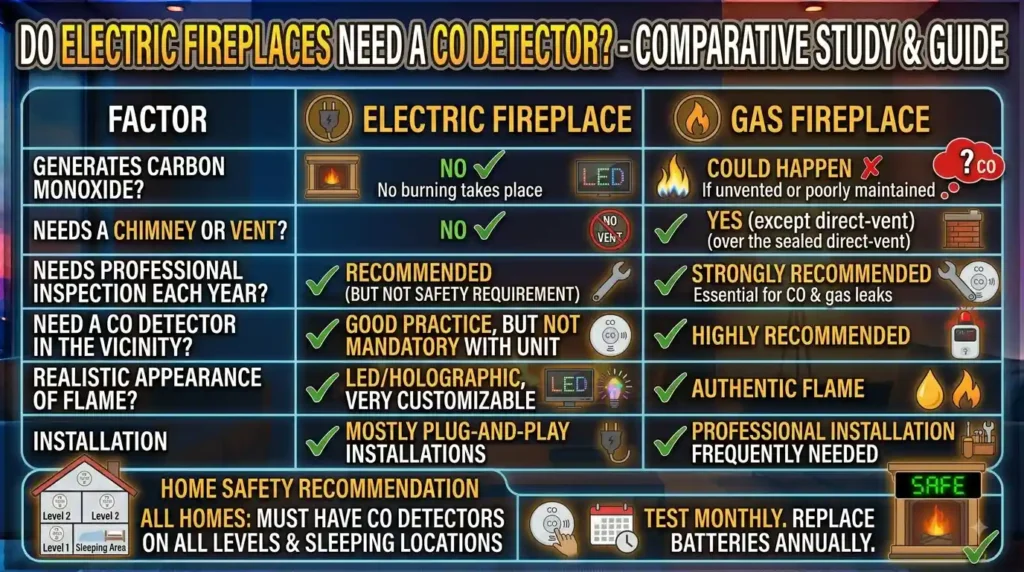
Even an electric fireplace does not generate the necessity of a CO detector, as it is not able to produce the gas. Nonetheless, all homes are still required to have functioning CO detectors on all levels and in or near sleeping locations since the majority of all homes have additional sources of combustion, such as a gas furnace, gas water heater, gas stove, an attached garage or a wood-burning fireplace in another part of the building. Fire safety agencies suggest CO detector testing every month and battery replacement at least once annually, as per the recommendations of the manufacturer of the particular model of CO detector.
This is a comparative study of the risk of CO on electric and gas fireplaces.
| Factor | Electric Fireplace | Gas Fireplace |
|---|---|---|
| Generates carbon monoxide | No – no burning takes place | Could happen, not vented or maintained properly |
| Needs a chimney or vent | No | Yes (except sealed direct-vent units, which do not vent outside) |
| Needs professional inspection each year | Recommended but not a safety requirement Strongly recommended because essential to the safety of CO and gas leaks | |
| Need a CO detector in the vicinity | Good practice, but not mandatory with the unit itself | Highly recommended |
| Realistic appearance of flame | LED/holographic, very customizable | Authentic flame |
| Mostly plug-and-play installations | Professional installation frequently needed |
Myth vs Fact
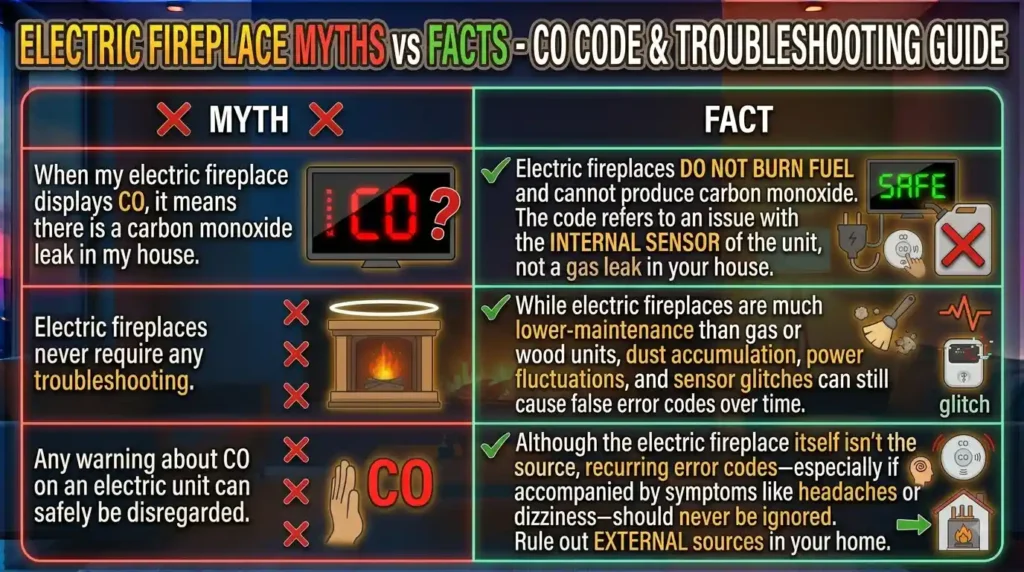
| Myth | Fact |
| When my electric fireplace displays CO, it means there is a carbon monoxide leak in my house. | Electric fireplaces do not burn fuel and cannot produce carbon monoxide. The code refers to an issue with the internal sensor of the unit, not a gas leak in your house. |
| Electric fireplaces never require any troubleshooting. | While electric fireplaces are much lower-maintenance than gas or wood units, dust accumulation, power fluctuations, and sensor glitches can still cause false error codes over time. |
| Any warning about CO on an electric unit can safely be disregarded. | Although the electric fireplace itself isn’t the source, recurring error codes—especially if accompanied by symptoms like headaches or dizziness—should never be ignored. It is always worth investigating to rule out an external source of CO in your home rather than taking unnecessary risks. |
How to Prevent the CO Code from Coming Back?
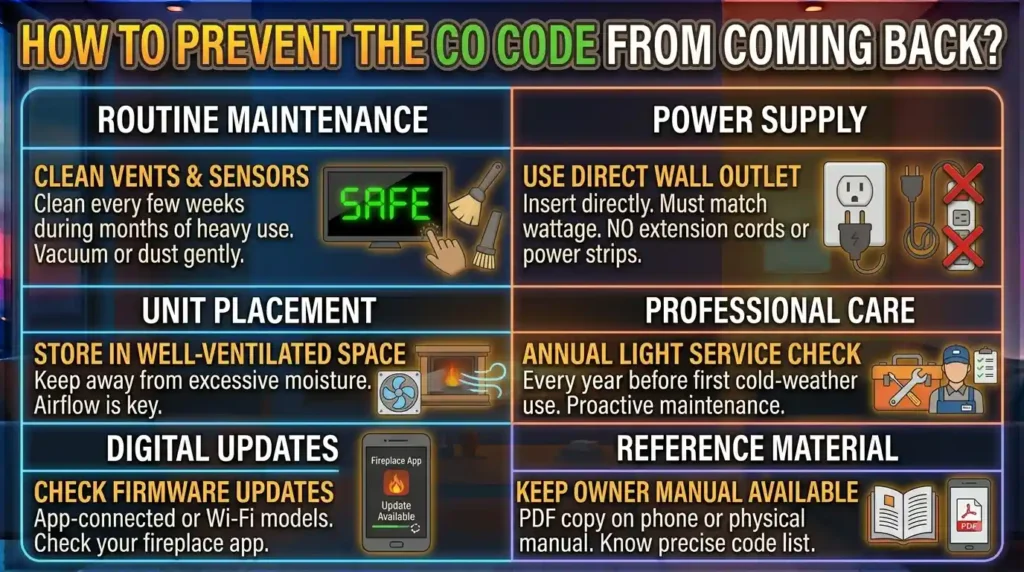
- Clean the vents and sensor every few weeks in months of heavy use with vacuum or dust.
- Directly insert the fireplace into a wall outlet that matches the wattage of the fireplace – do not use extension cords and power strips.
- Store the unit in a well-ventilated place, not where there is too much moisture.
- Check the firmware update in case your model is app-connected or Wi-Fi enabled.
- Have a light service check every year, particularly at the beginning of the first cold-weather use of the year.
- Have the owner manual (or a copy in PDF) available to you so that you can refer to the precise code list on your model.
Key Takeaways
- CO on an electric fireplace display is an error code activated by a sensor, not an indication of a real carbon monoxide leak.
- Electric fireplaces do not physically generate CO since they do not use fuel.
- CO codes are generally cleared by just an unplug-reset-clean procedure.
- The presence of a persistent code, with physical symptoms or a dedicated CO detector alarm, should not be seen as a joke and should be examined by a professional.
- CO detectors in all homes that possess a fireplace should not be disconnected irrespective of the type of fireplace due to other combustion appliances in the house.
You May Also Read:
FAQs:
What is the meaning of CO on an electric fireplace?
It is an error code in the safety programmed by a manufacturer and is usually related to a gas/CO sensor that is mounted in the unit. This does not imply that the fireplace is on its own emitting carbon monoxide, as electric units do not burn fuel.
Will an electric fireplace produce carbon monoxide?
No. It is only during combustion that carbon monoxide forms. Electric fireplaces are not heated by a flame or fuel source and have an electric element that heats the fireplace; thus, CO cannot be produced regardless of the situation.
My electric fireplace continuously shows an error code?
Multiple codes are typically due to dust on sensor, loose power connection, underpowered outlet or extension cord or a firmware problem on smart models. Most repeat errors can be resolved by cleaning the unit and simply plugging it into a wall outlet.
What is the way to turn off and turn on the CO code on my electric fireplace?
Disconnect the unit and wait about 60 seconds and again connect it. On certain models, a manual reset is initiated by pressing the power button 5-10 seconds. See your manual, as not all brands have the same reset procedure.
Can I continue to use my electric fireplace when it displays CO several times?
After cleaning the sensor area, ascertainment of the outlet and cord in good conditions and elimination of any actual source of gas in the house. In case the code continues to reappear after these checks, then stop using the unit and call the manufacturer or a technician.
Is there a carbon monoxide detector in the vicinity of an electric fireplace?
It is not necessary due to the fireplace, but all homes should have functioning CO detectors anyway, as other appliances (furnaces, gas stoves, attached garages) also have the potential to produce CO.
What is the difference between the CO code and an E1, E3, or E5 code?
The most common causes of E1 are overheating or faults with thermostats, E3 is thermostat or heating-element problems and E5 is fan or venting blockages. CO is particularly associated with the gas-detection sensor of the unit. The manufacturers have different codes, and therefore, always check with your owner manual.
Is it possible that dust would give a false reading of CO?
Yes. One of the most frequent reasons of false error codes on electric appliances such as fireplaces is the dusty sensor as it may cause an interruption with the sensor readings or airflow.
Should I call the electricians or manufacturer of the fireplace first?
Begin with the customer service of the manufacturer, as they might be able to answer whether the code is an existing problem with your model, and whether it falls under warranty. Contact a licensed electrician in case you think the underlying issue is the outlet, wiring, or circuit.
Does an electric fireplace have a flashing CO code which is an emergency?
On its own, no – it is a machine level error, not a live gas reading. Only when combined with an independent CO detector alarm, a gas smell, or such symptoms as dizziness or headache, it becomes urgent to ventilate the area and leave until it is checked out.
Final Thoughts
The appearance of the CO on your electric fireplace can be disturbing, and it can be most of the concern removed by knowing what the code really means. Electric fireplaces do not burn fuel and thus physically cannot produce carbon monoxide, the code is your unit’s built-in sensor doing its job, even when it is sometimes caused by dust, a power glitch or a slight glitch, rather than a genuine danger.
Simple reset and cleaning out is always a good place to start, consult the manual of your particular model to be sure, and only resort to professional intervention when the code does not clear or is accompanied by other alerts. And whatever type of a fireplace you have, have a carbon monoxide detector that works in your house – it is the only protection that every home should have anyway.