Electric Fireplace Making Noise? Here’s Why & How to Fix It
Electric Fireplace Making Noise? You are nestled in bed for the night, the flame plays its dance and then you hear it: a buzz, a rattle or a beep that should not be there. When an electric fireplace starts to make a noise, it is not typically an emergency, but it also shouldn’t be overlooked.
Most of the time the fix is simple and takes less than an hour and requires absolutely no money and just a screwdriver and patience.
This guide will help you to understand each of the common noises you may encounter with an electric fireplace, what is causing them, and exactly how to solve the issue and how to determine if it’s a harmless feature or something more serious that requires the assistance of a professional.
Key Takeaways
- Most electric fireplace noise is generated by three elements: the blower fan, the flame-effect motor or by loose hardware.
- A constant, low level hum or regular click when starting up is normal. Not grinding, rattling loudly or repeatedly beeping.
- Approximately 80% of all noise complaints can be addressed by cleaning, tightening screws and/or realigning the flame rod without requiring replacement parts.
- When your unit beeps and stops, unplug it, allow it to cool for 15 minutes and then troubleshoot it further.
- Units that are under warranty should be inspected by the manufacturer prior to attempting to open the housing.
Is It Normal for an Electric Fireplace to Make Noise
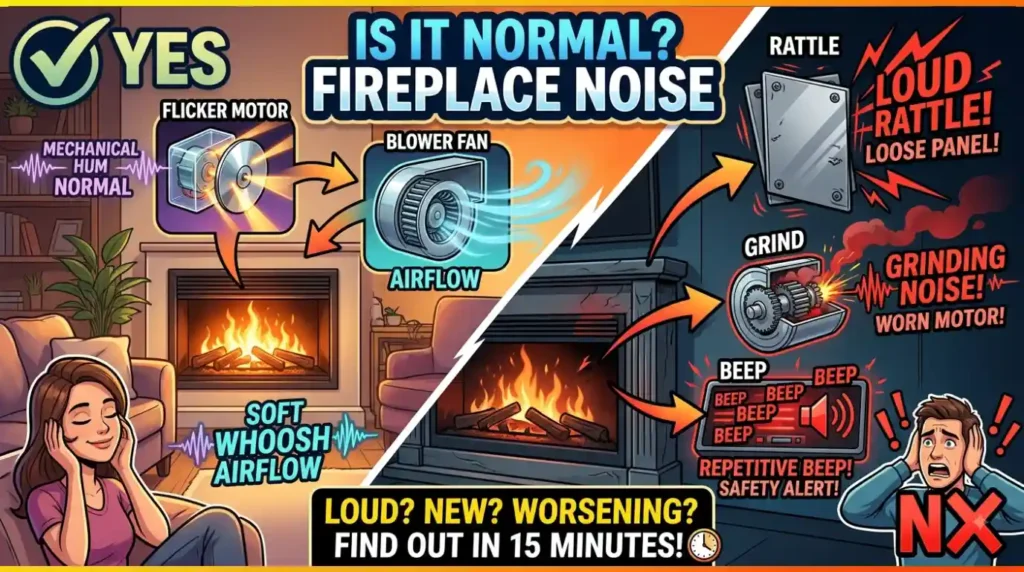
Yes, to a point. Electric fireplaces spin a light wheel or rotate reflective panels to give the impression of flickering. When the heater operates, warm air is blown into the room by a separate blower fan. Both parts are always moving and a slight mechanical hum or a soft whoosh when the air is moved is perfectly normal and not a fault.
Anything loud, new or worsening is not normal. When a fireplace that has been operating quietly begins to rattle, grind or beep repetitively, then there has been a change, a loosening or a wear in this unit, and it’s worth 15 minutes to find out before it gets to be a larger problem.
Quick Reference: Noise Type, Cause & Fix
| Sound / Symptom | Possible Cause | Solution / Recommended Action | Difficulty |
| “Huh”, “Hm”, or “Uh” | Unsure about something | Clarify or discuss | Easy |
| Rattle / Vibrating | Loose screws, panels, or fan housing | Tighten hardware | Easy |
| Buzzing / Humming | Worn flame speed control or loose wiring | Replace Flame Speed Control Module | Moderate |
| Clicking (on/off) | Thermal expansion or loose connection | Usually normal; inspect wiring if constant | Easy–Moderate |
| Grinding / Squeaking | Bent/dry flame rod or worn motor bearing | Realign, lubricate, or replace rod/motor | Moderate |
| Whirring / Whooshing | Dust or debris in blower fan | Clean fan and vents | Easy |
| Smoke / Fire Alarm | Smoke/heat detection or sensor failure | Press reset button, clear smoke alarm vents, check thermostat | Easy–Moderate |
| Popping / Crackling | Deliberate sound effect (some models) | Nothing to be done | N/A |
7 Common Electric Fireplace Noises and What They Mean
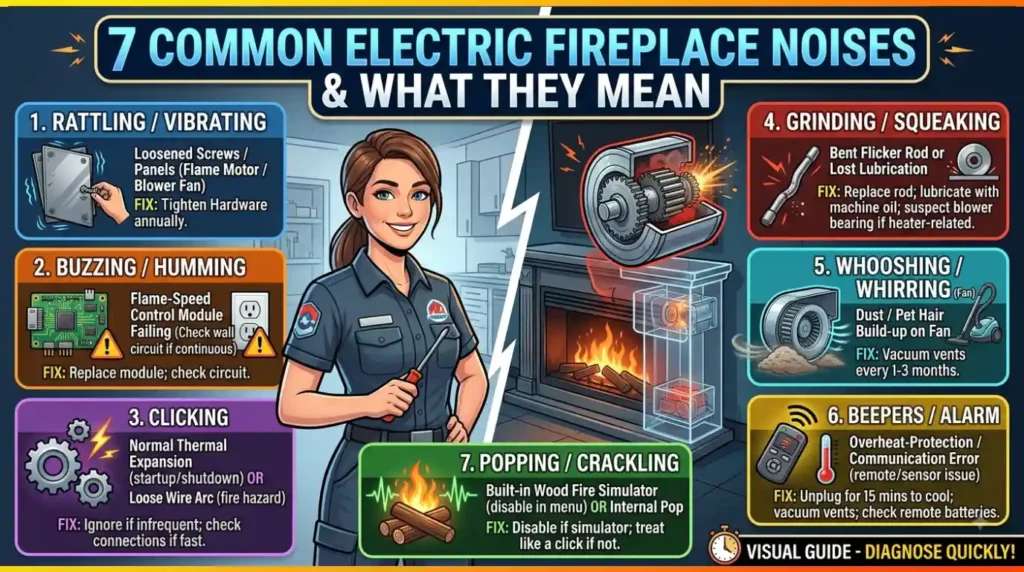
1.Rattling or Vibrating Noise:
A rattle will almost always indicate that something has come loose. While the unit is operating, the flame motor and blower fan vibrate continuously, and over months of operation gradually loosens screws, brackets, and side panels. The glass panels, log sets and decorative media (crystals or stones) may also move and shake around housing.
How to Fix:
Take out the front and back access panels and use a screwdriver to tighten all visible screws. Ensure log set or media bed is even and does not come in contact with the glass. The full hardware check is usually recommended by the manufacturer every one year, preferably at the beginning of the heating season.
2.Buzzing or Humming sounds:
If the buzz is only from the control panel, and not from the fan, then it is likely that the flame-speed control module is failing. This little circuit board controls the increased speed of the flame-effect motor and can begin to hum or buzz when it goes bad, even at lower settings.
How to fix:
If it only happens at specific flame-speed settings, the control module is probably to blame and will usually require a factory replaceable part. If the buzzing is continuous and it seems to be from the wall or outlet, not the unit, discontinue use of the fireplace and have an electrician check the circuit (this may signify a wiring problem and not a fireplace problem).
3.Clicking Noise
Clicking is one of the most common and most misunderstood electric fireplace sounds. Normal thermal expansion during a few clicks on the unit when it powers on or off is metal components being heated, which causes them to expand slightly and click when they are being cooled after powering off (like a car engine ticking after you start it).
How to Fix:
If clicking is infrequent and related to startup/shutdown, then no action should be taken. If the other type is fast and repetitive, or if it occurs when the unit is not in use, disconnect the fireplace and examine the area near the control board for a loose wire connection—a loose wire can arc or click on and off, and is a fire hazard that you should correct immediately.
4.Grinding or squeaking sound:
This is typically done mechanically. Most electric fireplaces contain a flame rod (also referred to as a flicker rod) that’s linked to a tiny motor which spins the rod to produce the flickering effect. When that rod is bent, warped or it has lost its factory lubrication, it can rub on other parts causing a squeak or grinding sound, sometimes changing pitch as the flame speed is adjusted.
How to Fix:
Visually inspect the rod for contact with other parts by opening the rear panel. A small amount of light machine oil is sometimes a solution for a dry rod; a bent or cracked rod must be replaced. When the grinding follows the heater, rather than the flame effect, suspect the blower motor bearing rather it’s a part replacement, not a lubrication job.
5.Whooshing or whirring (fan) Noise.
As the blower fan pulls room air through the vents, warms it, and pushes it back out, it is continually drawing in dust and pet hair. When the fan makes a whirring or a whooshing sound that increases over time, it is most likely that the fan starts running harder because of the buildup of debris, or that a fan blade has become slightly unbalanced.
How to Fix:
Vacuum the intake and exhaust vents and wipe slightly with a dry or damp cloth (with the unit unplugged). Manufacturers say it should be done every one to three months, or more frequently if you have pets or during high-pollen seasons.
6.Beepers/Alarm sounds
It is not a random beep; an electric fireplace is communicating an internal error. To protect your home and the unit, most units have an overheat-protection system that notifies you with a beep and automatically turns the heater off if the internal temperature gets too high. A stuck remote-control button, dead remote-control batteries or thermostat sensor reading the wrong room temperature also can cause beeping.
How to Fix:
Unplug unit for at least 15 minutes to allow it to reset and cool. Vacuum the vents to eliminate the air flow problem. Remove batteries from remote to eliminate ghost signal. If the beeping persists after a clean reset, there is a possibility that the circuit board or temperature sensor is damaged and should be assessed by the manufacturer or a qualified technician.
7.A popping or crackling sound.
The higher-end electric fireplaces will have a crackling system to simulate a wood fire, which is designed on purpose and can typically be disabled in the setting or remote menu if it is a nuisance. If your model does not have that and you hear the actual pop from inside the housing, treat it like a click check an electrical connection.
How to Fix a Noisy Electric Fireplace: Step-by-Step?
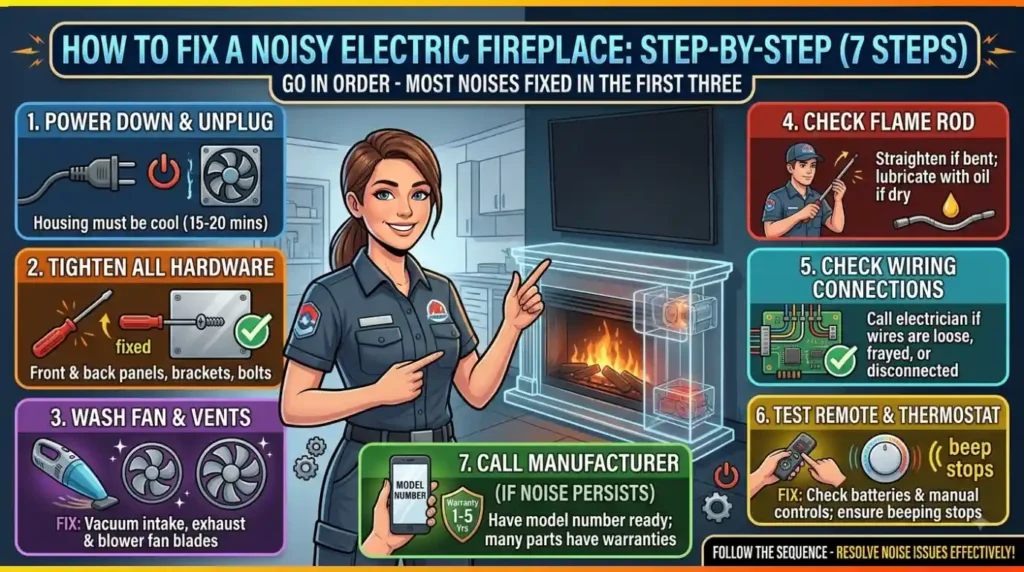
To solve a noisy electric fireplace, follow these steps:
Go through these in order most noise complaints are taken care of in the first three.
- Power down and unplug. Do not open the housing when the unit is powered on. If running, allow to cool for 15-20 minutes.
- Place all exposed hardware in a tight condition. Take off the front and back panels and use a screwdriver to inspect all screws, brackets and bolts.
- Wash fan and vents. Clean off intake, exhaust and blower fan blades of dust and debris with a vacuum.
- Check Flame Rod. Inspect for bending, warping or touching of adjacent parts. If dry, lubricate with a drop of light oil, otherwise straighten gently.
- Check wiring connections. If anything looks wrong, stop and call an electrician in the vicinity of the control board for any loose, frayed or disconnected wires.
- Test Remote and Thermostat. Check remote batteries and manual controls; check if beep stops when thermostat is turned down.
- Plug in and test on low. Operate the unit on minimum flame and minimum heat first to be sure that no noise is present before using it in its normal operating mode.
- Call the manufacturer if it persists. If the noise persists after the above, record the model number and call the manufacturer as many component parts (motors, control boards) have warranties of between one and five years depending on the make.
Normal vs Abnormal Noise , How to Tell the Difference
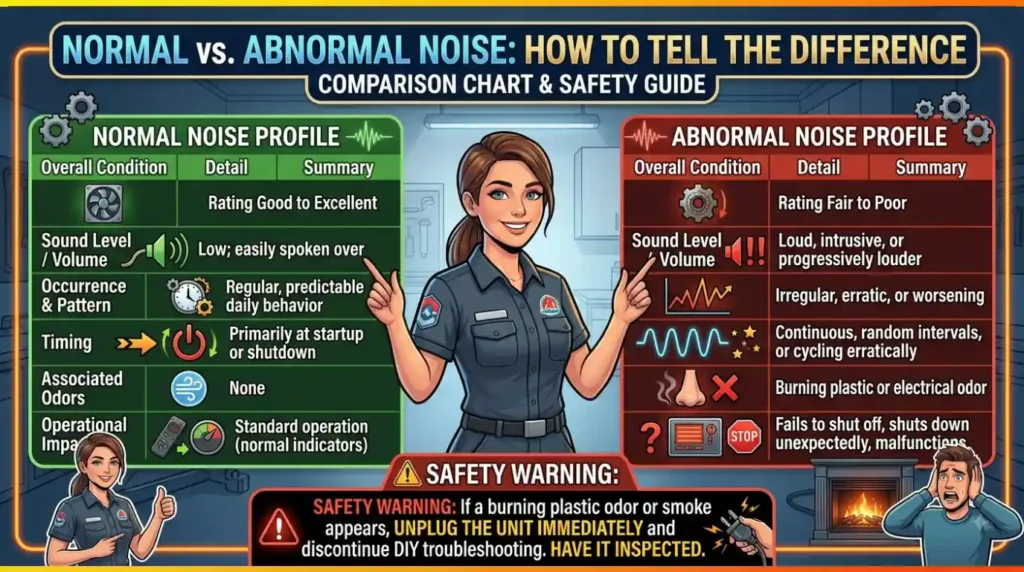
Normal vs Abnormal Noise:
| Characteristic | Normal Noise Profile | Abnormal Noise Profile |
| Overall Condition Rating | Good to Excellent | Fair to Poor |
| Sound Level / Volume | Low; easily spoken over without strain | Loud, intrusive, or progressively louder |
| Occurrence & Pattern | Regular, predictable, or consistent daily behavior | Irregular, erratic, or worsening over time |
| Timing | Primarily at startup or shutdown | Continuous, cycling erratically, or occurring at random intervals |
| Associated Odors | None | Burning plastic or electrical burning smell |
| Operational Impact | Standard operation (normal indicator flickers/beeps) | Unit fails to shut off as intended, shuts down unexpectedly, or malfunctions |
Safety Warning: If a burning plastic odor is detected or smoke appears, unplug the unit immediately and discontinue DIY troubleshooting. Have the unit inspected by a certified professional before attempting to operate it again.
Preventive Maintenance Checklist
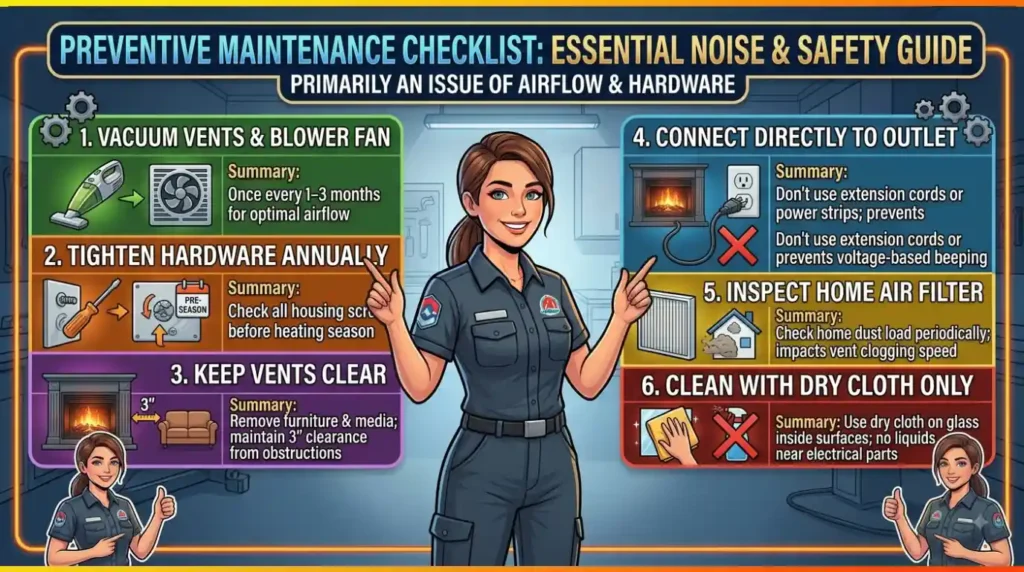
- There’s a lot more to it than that, but noise prevention is primarily an issue of airflow and hardware:
- Vacuum vents & blower fan once every 1-3 months.
- All housing screws should be tightened annually, preferably before the heating season begins.
- Vents should remain clear of furniture and media, and at least 3″ away from obstructions.
- Connect directly to a wall outlet (not to an extension cord or power strip, which can cause beeping and buzzing due to voltage issues)
- Be sure to inspect the filter in your home periodically as your home’s dust load can impact how fast the fireplace vents become clogged
- Use a dry cloth to clean glass and inside surfaces, don’t use liquids near electrical parts
Repair vs Replace: What Does It Cost?
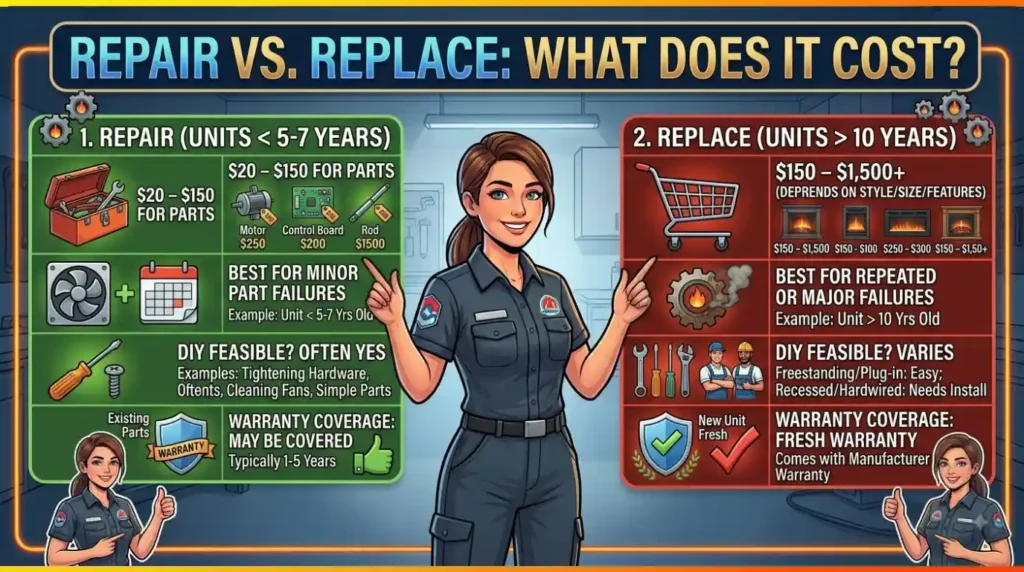
| Factor | Repair | Replace |
| Typical Price | $20 – $150 for parts (motor, control board, rod) | $150 – $1,500+ (depending on style, size, and features) |
| Best For | Units less than 5–7 years old; minor part failures | Units more than 10 years old; repeated or major failures |
| DIY Feasible? | Often yes (tightening hardware, cleaning fans, replacing simple parts) | Varies (freestanding/plug-in is easy; recessed or hardwired may need installation) |
| Warranty Coverage | Existing parts may be covered (typically 1–5 years) | Comes with a fresh manufacturer warranty |
Myth vs Fact
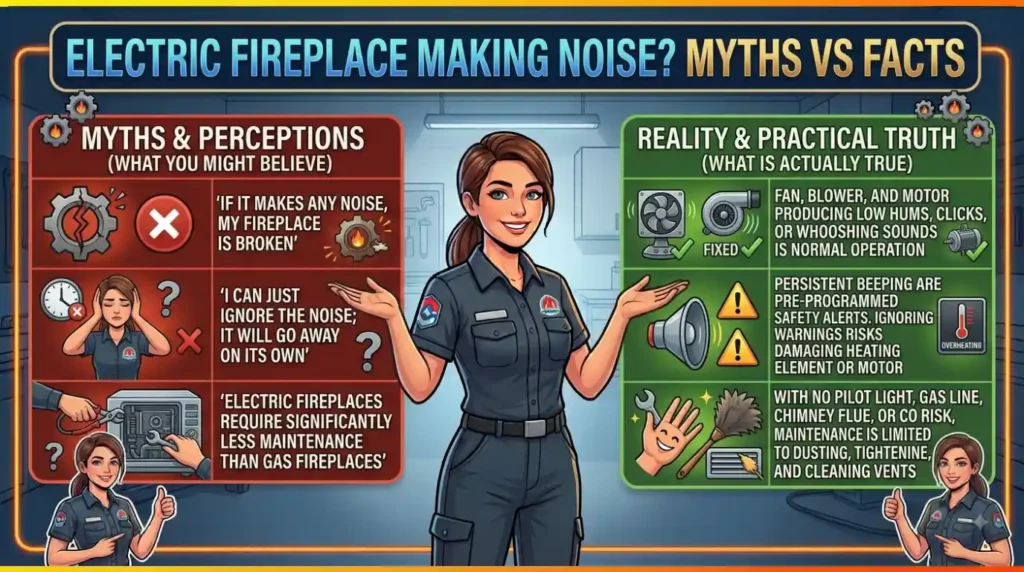
Electric Fireplace Making Noise? Myths vs Facts
| Belief / Perception | Reality & Practical Truth |
| Myth: “If it makes any noise, my electric fireplace is broken.” | Fact: Components like the fan, blower, and flame-effect motor naturally produce low hums, clicks, or whooshing sounds during normal operation. |
| Myth: “I can just ignore the noise; it will go away on its own.” | Fact: Sounds like persistent beeping are pre-programmed safety alerts (often overheat protection). Ignoring repeated warnings risks permanently damaging the heating element or motor. |
| Fact: “Electric fireplaces require significantly less maintenance than gas fireplaces.” | Truth: With no pilot light, gas line, chimney flue, or carbon monoxide risk, routine maintenance is limited to dusting, tightening hardware, and cleaning vents. |
You May Also Read:
FAQs:
Why is my electric fireplace making a rattling noise?
Loose screws, side panels or a log set shifting in the housing are almost always the cause of rattling. It can be fixed in most cases by tightening the hardware.
What is the hum or buzz that my electric fire throws?
If a buzz is heard from the control panel, it is likely that the flame-speed control module is beginning to malfunction. If there is a buzz from the wall outlet, there is an electrical problem outside of the fireplace and a licensed electrician should be used for the repair.
Does an electric fireplace click?
Thermal expansion at startup and shutdown is normal a few clicks. If the clicking occurs quickly or continuously, it may be a loose wire connection and should be investigated.
My electric fireplace starts beeping but won’t turn on.
Typically, this means that the overheat-protection system has tripped. Disconnect the unit for 15-20 minutes and clear the vents of dust; then attempt to operate the unit.
Is it possible that the dust can make my electric fireplace loud?
Yes. The fan and vents can accumulate dust, causing the blower motor to run harder and making the air drier, hotter and louder and possibly causing the overheat alarm to activate.
My electric fireplace is grinding, what’s going on?
Grinding usually indicates a bent flame rod or a rubbing flame rod or a worn-out blower motor bearing. Either can be repaired using simple tools or a replacement.
Should I unplug my electric fireplace if it’s beeping?
Yes. Unplug it, wait at least 15 minutes, and then plug it back in and check to see if it works after clearing the vents.
What is the frequency of cleaning the electric fireplace to avoid noises?
Once every 1-3 months for fan and vents and once a year for entire hardware check-up.
Is it safe to use my electric fireplace while it’s making noise?
It can be used through with a mild humming or clicking. If it grinds, beeps constantly or gives off a burning odor, discontinue use until it is checked.
If the power cord is too long, will the electric fireplace be noisy?
Yes. An extension cord or power strip may not provide adequate power to the high wattage heater, causing it to buzz or beep. Do not use a power strip or extension cord.
My Final Thoughts:
When the electric fireplace sounds loud, it is not necessarily the end of the world, as it may be dusty in the fan, a few loose screws or just the end of its life. Click through the noise types listed above, follow the step-by-step fix, and perform a quick seasonal cleaning to stay quiet in the future. Once you have done all the steps mentioned here and the noise, beep or smell persists, it’s time to call the manufacturer or a qualified technician and not keep troubleshooting the issue yourself.