Can I Safely Install an Electric Fireplace in a Mobile Home? Here’s What the Rules Really Say
Quick Answer
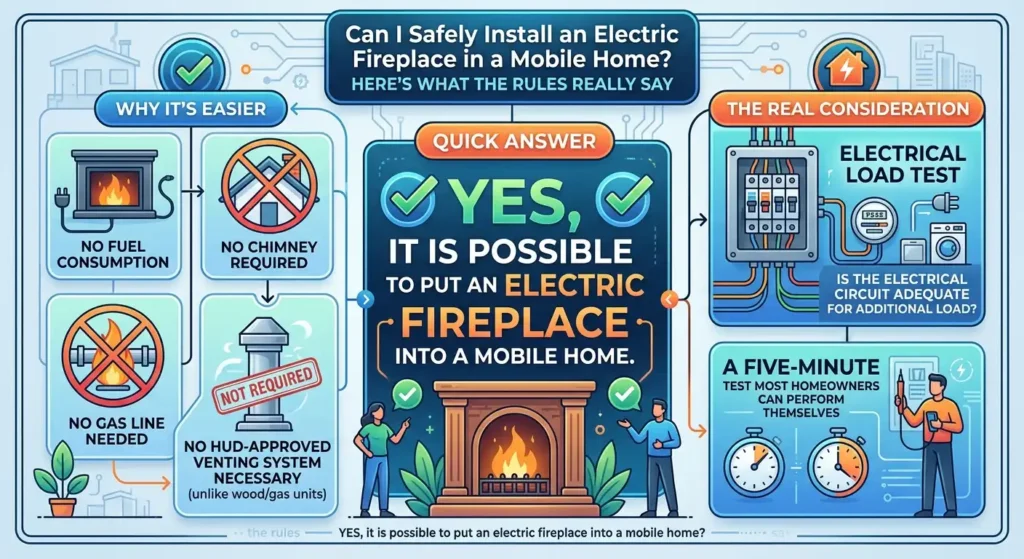
Can I Safely Install an Electric Fireplace in a Mobile Home? Yes, it is possible to put an electric fireplace into a mobile home. Electric fireplaces do not consume fuel; therefore, they do not require a chimney, a gas line, or the so-called HUD-approved venting system that units which run on wood and gas need. Whether or not it is allowed is not the question but whether your electrical circuit can support the additional load in your home and that is a five-minute test that most homeowners can perform themselves.
That single difference makes all the difference concerning this project, so it is worth taking the time to figure out why.
Why Electric Is Different from Wood or Gas in a Mobile Home
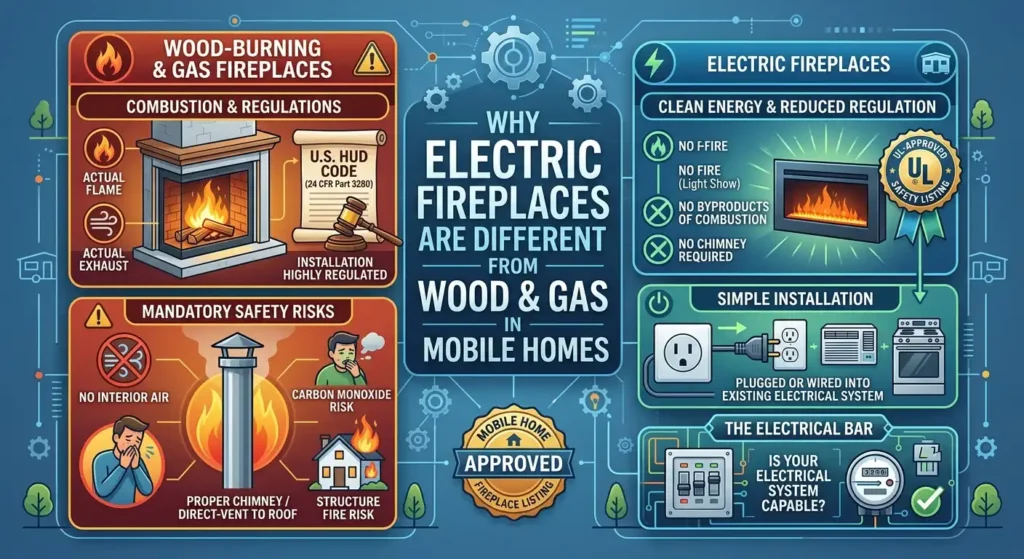
Enter mobile home approved fireplace and the majority of results are on wood-burning and gas units. The reason is that those appliances are combustion appliances, i.e. it is actual flame, actual exhaust and the installation of manufactured housing with combustion appliances is regulated by the U.S. Department of Housing and Urban Development under the federal manufactured home construction and safety standards, 24 CFR Part 3280 the HUD Code.
Wood stoves and gas fireplaces installed in a mobile home must be listed specifically to be used in manufactured housing, closed off to the interior air of the home and must be vented through a proper chimney or direct-vent system to the roof. Any of that and you will run the risk of carbon monoxide or of a fire in the structure, and that is why manufacturers, insurers and building departments are so concerned about it.
Electric fireplaces avoid virtually all of that. No fire, no byproduct of combustion, no chimney. A UL-approved electric fireplace is nothing but a space heater that has a light show it is plugged into or wired into your existing electrical system like a window air conditioner, or an electric range. That is to say the regulatory bar is significantly reduced, but on the flipside the electrical bar is what you really have to pass.
Do You Need HUD Approval for an Electric Fireplace?
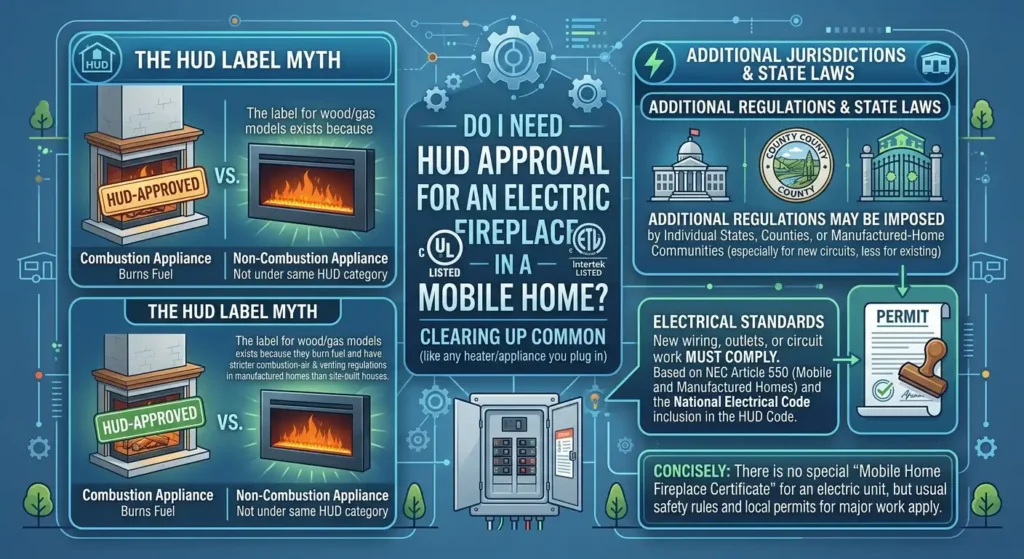
Not in the meaning people tend to have. That “mobile home approved” or “HUD-approved” fireplace label that you see on wood and gas models are there because such an appliance burns fuel in a building with more restrictive combustion-air and venting regulations than a site-built house. Electric fireplaces are not combustion appliances, and thus are not listed under the same category.
Whatever applies to your electric fireplace, regardless of your location:
- it should have a safety listing, such as the UL (Underwriters Laboratories) or any other electric heater or appliance you would be plugging in.
- New wiring, outlets, or circuit work must comply with the electrical standards that are required of manufactured homes, which go back to NEG Article 550 (Mobile and Manufactured Homes) and the inclusion of the National Electrical Code in the HUD Code.
- Individual states, counties or manufactured-home communities impose additional permit regulations over the federal minimum, particularly where you are creating a new circuit and not using an existing one.
Concisely: there is no special certificate of mobile home fireplace of an electric unit, but the usual electrical-safety rules of course apply.
The Electrical Question: Can Your Mobile Home’s Panel Handle It?
This is what is worth taking time over as it is the only place that an electric fireplace installation can seriously fail.
How much power does an electric fireplace actually draw?
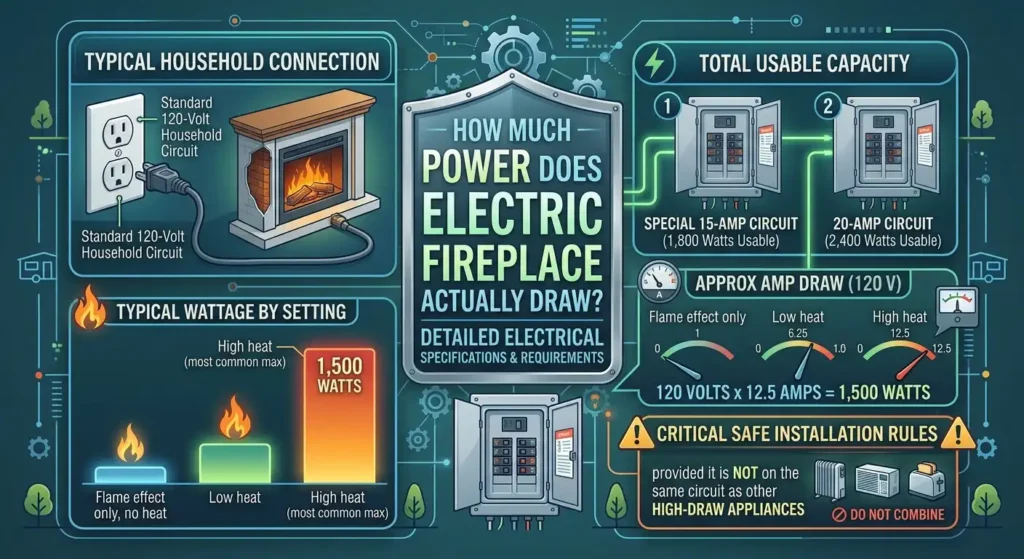
Almost all of the electric fireplaces sold to be plugged into a household power supply – inserts, wall-mounts, mantel packages, TV-stand combos – operate on a standard 120-volt household circuit and reach a top power output of around 1500 watts on the highest heat setting (the flame-only setting uses much less, usually less than 100 watts). At 120 volts, 1,500 watts works out to roughly 12.5 amps.
| Fireplace Setting | Typical Wattage | Approx Amp Draw (120 V) |
|---|---|---|
| Flame effect only, no heat | 30–100W | Under 1 amp |
| Low heat | 750W | ~6.25 amps |
| High heat (most common max) | 1,500W | ~12.5 amps |
A special 15-amp circuit has usable capacity of 1,800 watts; a 20-amp circuit has 2,400 watts. A 1,500-watt fireplace can be easily fitted on either one – provided it is not on the same circuit as a space heater, window air conditioner or other high-draw appliance.
Dedicated circuit vs. plugging into an existing outlet
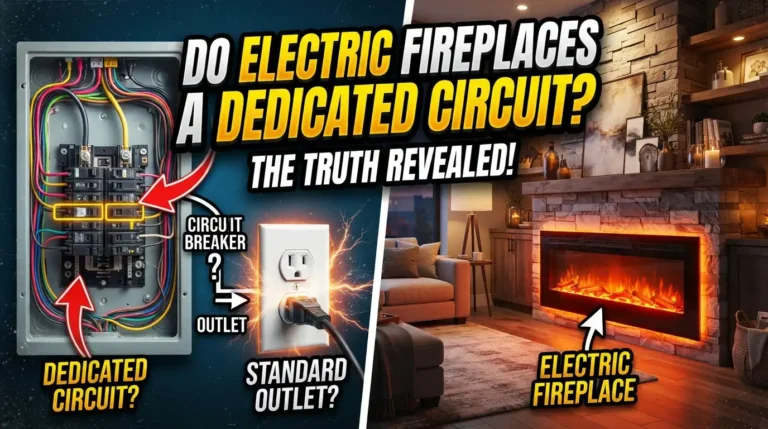
Electrical service on manufactured homes must be at least 100 amps (NEC 550.32(C)) although in the past few decades most homes are supplied with 150 or 200 amp service. That capacity normally is not the bottleneck, the circuit you are plugging into is.
- When you are inserting a plug-in electric fireplace insert or mantel unit into a pre-existing 15- or 20-amp outlet, verify what is on the circuit with that outlet. Passing by a lamp and a TV, you can be all right. Provided it is already operating a microwave, a space heater or a window unit, you will blow the breaker the first time you switch the fireplace to high heat.
- When hardwiring an installed electric fireplace in place of a wall insert or linear unit (most built-in systems are of this type) you must plan on a dedicated circuit sized to the specifications of the manufacturer’s spec sheet – nearly all built-in electric fireplaces use 15 or 20 amps at 120 V, but some larger built-in units use 240 V like a water heater.
- Manufactured homes have a limit of overcurrent protection of no more than 150 per cent of the rated draw of the appliance as per the electrical standards of the HUD, thus an electrician determining the size of a new breaker to fit your fireplace does not go on a hunch, they are working within a specific limit.
Any of this that includes opening the panel, new wire, or additional breaker is a task a licensed electrician should do, who is knowledgeable about manufactured housing, the wiring layout, wall cavities, and belly-wrap construction of a mobile home, which is not comparable to a site-built house.
Types of Electric Fireplaces That Work Well in Mobile Homes
Not all types of electric fireplace will fit all mobile home designs. The following are the common options ranked.
| Type | Installation Effort | Best For | Watch Out For |
| Plug-in insert (fits an existing fireplace opening) | Low — no wiring changes | Homes with an existing (unused) fireplace box or hearth cutout | Insert must match the opening’s exact dimensions |
| Wall-mounted/recessed unit | Medium — often needs a wall cutout and sometimes hardwiring | Living rooms with a load-bearing-free interior wall | Interior walls in mobile homes are thinner; confirm stud spacing before cutting |
| Mantel package (freestanding) | Low — plug-and-play, no cutting | Renters, or anyone who wants a zero-modification option | Takes up floor space; needs 12+ inches clearance per manufacturer instructions |
| Electric fireplace + TV stand combo | Low — plug-and-play | Living rooms doubling as a media wall | Heavier units may need floor load consideration in older single-wides |
| Built-in linear/wide-format unit | High — usually hardwired, sometimes framed in | New construction or full remodels | Best planned with an electrician and a carpenter together, not as a weekend DIY project |
To the majority of mobile home customers, a plug-in insert, or a mantel package, strikes the right chord: no rewiring, no wall cutting, and full adherence to the truth of the matter: no special mobile home listing needed, electric units.
Electric vs. Gas vs. Wood in a Mobile Home
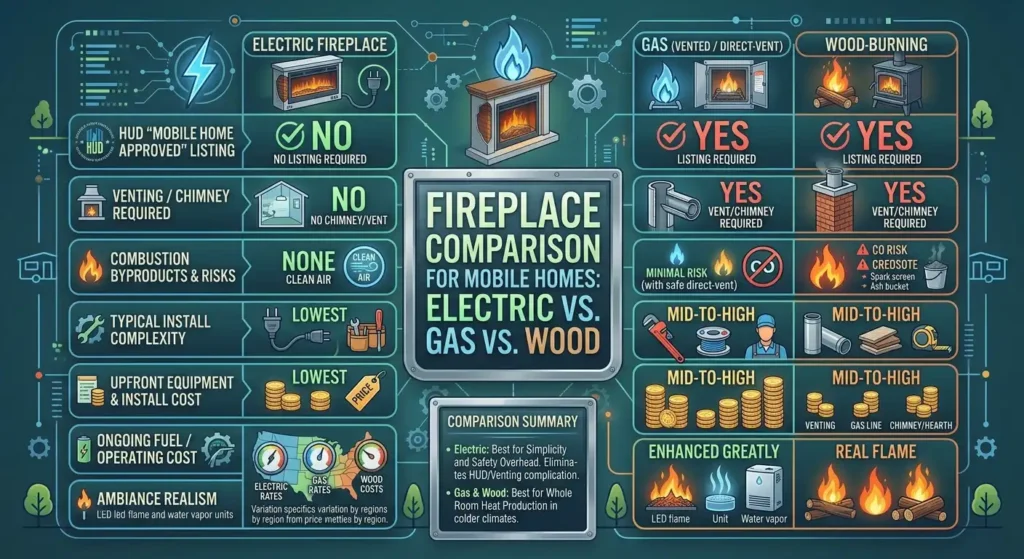
| Feature | Electric | Gas (Vented / Direct-Vent) | Wood-Burning |
| Needs HUD “Mobile Home Approved” Listing | No | Yes | Yes |
| Venting / Chimney Required | No | Yes | Yes |
| Combustion Byproducts (CO Risk) | None | Minimal (safe with proper direct-vent installation) | Present (requires spark screen, hearth pad, & ash removal) |
| Typical Install Complexity | Lowest • Plug-in • Simple dedicated circuit | Mid to High • Requires gas line • Requires proper venting • Professional installation needed | Mid to High • Requires chimney & flue • Hearth pad required • 36″ clearance to combustibles |
| Upfront Equipment & Install Cost | Lowest | Mid to High (plus venting/gas line costs) | Mid to High (plus chimney & hearth materials) |
| Ongoing Fuel / Operating Cost | Rates depend on local electricity; higher in regions with expensive electric power | Lower operating cost in gas-heavy areas compared to electricity | Wood cost varies significantly by region (cheapest if harvested locally) |
| Ambiance Realism | Enhanced greatly in recent years (LED flame, water-vapor units) | Real flame | Real flame |
Electric is victorious in terms of simplicity and safety overhead; the gas and wood are victorious in terms of heat production in entire room heating in colder climates. A large number of mobile home owners come to the electric platform precisely since it eliminates the venting and HUD-listing complication altogether.
Installing an electric fireplace in a mobile home is a project that is undertaken step-by-step.
- Check that the unit is UL-Listed and check the clearance requirements of the manufacturer (side, top, front clearances depending on model).
- Determine your type of installation — plug-in insert, mantel package, or hardwired wall unit — because it affects all actions that follow this step.
- Test the circuit the unit will operate with. Check what else operates on it and ensure that the breaker rating (15A or 20A on almost all residential electric fireplaces) is at least equal to the draw in the fireplace with plenty of fishroom.
- Measure space, and the clearance needed by the manufacturer on all sides, not size of the visible unit.
- On plug-in models: set the unit in place, insert into an appropriate outlet, and test the flame and heat settings individually before sliding it completely into the outlet.
- In hardwired/recessed models: use a licensed electrician to run any new circuit, install the box or the hole in the wall according to the template provided by the manufacturer, and complete the final connection – it is not a DIY project to cut interior walls of a manufactured home.
- Load test. Run the fireplace on full blast (high setting) 15-20 minutes with the rest of the appliances in the house running normally and make sure that the breaker does not trip.
- Register the warranty and have the manufacturing manual on installation of the unit with you – sometimes insurers require this should you make any claim on the unit.
What It Costs
The prices depend on brand, size and features, though these are just an average price the homeowner can expect to pay when planning this project.
| Category / Item | Cost Range | Key Details |
| Plug-in electric fireplace insert | $150 – $600 | Standard replacement insert for existing hearths |
| Wall-mounted / recessed unit | $250 – $1,200 | Unit cost only; requires wall cutout for recessed styles |
| Electric fireplace + TV stand combo | $300 – $900 | Integrated media console unit |
| Mantel package (fireplace + surround) | $400 – $1,800 | Complete freestanding mantel assembly |
| Dedicated circuit installation | $150 – $500 | Installed by a licensed electrician; price depends on wire run length and panel accessibility |
| Wall-cutting & framing labor | $200 – $600 | Optional framing/cutout labor for recessed units |
Plug-in insert or mantel unit is nearly always the cheaper route because it avoids the visit of the electricians altogether.
Common Mistakes to Avoid
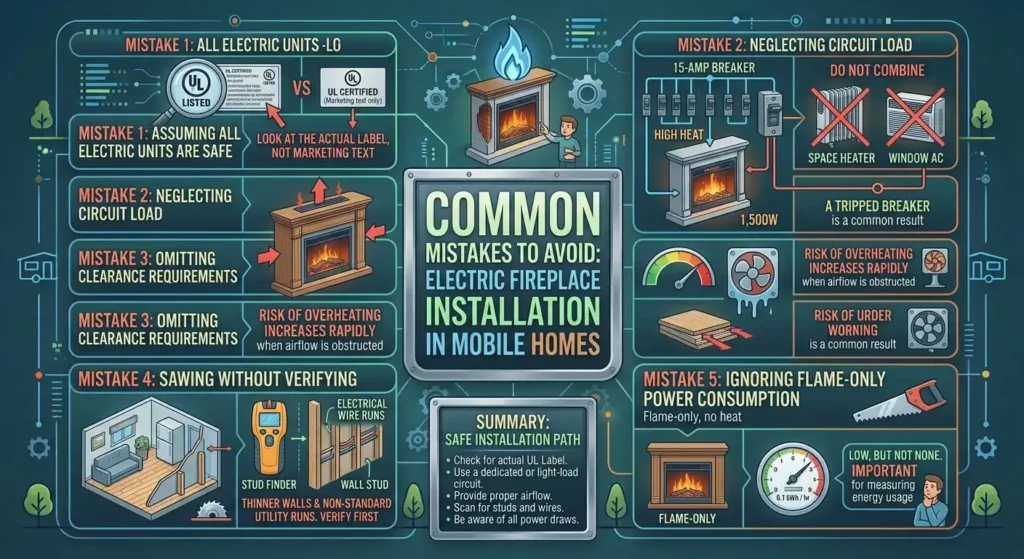
- Thinking that any electric fireplace is a priori mobile home safe. UL listing is only one thing; look at it on the label, not on the marketing text.
- Not noticing what is on the circuit. The most common cause of a tripped breaker following installation is a fireplace on high heat sharing a circuit with a space heater or window AC.
- Omitting clearance requirements due to the appearance of the unit being compact. Risk of overheating increases rapidly when an airflow around the unit is obstructed.
- Sawing through a wall before verifying the location of the stud and the wire. Manufactured home interior walls are generally thinner than site-built walls and utility runs do not necessarily run where you think they ought.
- Even in the flame-only mode the power is consumed. It is low, but not none, and you may want to know about it when you are concerned with measuring energy consumption.
Ongoing use safety tips.
- Do NOT operate an electric fireplace on an extension cord permanently; make the connection to a wall socket.
- Never leave furniture, curtains or bedding in the minimum clearance space of the manufacturer.
- Immediately unplug or turn off the unit when you detect a burning odor, strange noises or a tripping breaker.
- Have the vents vacuumed after a certain period (see maintenance checklist) to ensure it is not obstructed by dust.
- When the unit is installed in a bedroom, make sure it has an automatic overheat shutoff, which is a standard equipment of UL-listed units.
Maintenance Checklist
- Monthly: Clean the glass front and clean the vent grilles.
- After every 3 months: Make sure that the power cord and the plug are not worn out, and that the outlet or the breaker does not feel hot to touch (discolored, warm, buzzing).
- Annually: Have an electrician test the dedicated circuit (especially in houses more than 1015 years old) when the unit is hardwired.
- As needed: Only manufacturer-approved parts should be used to replace the heating element or blower.
Key Takeaways
- Electric fireplaces can be used in mobile and manufactured homes since they do not burn fuel, and they do not have to undergo the HUD combustion-venting approval process.
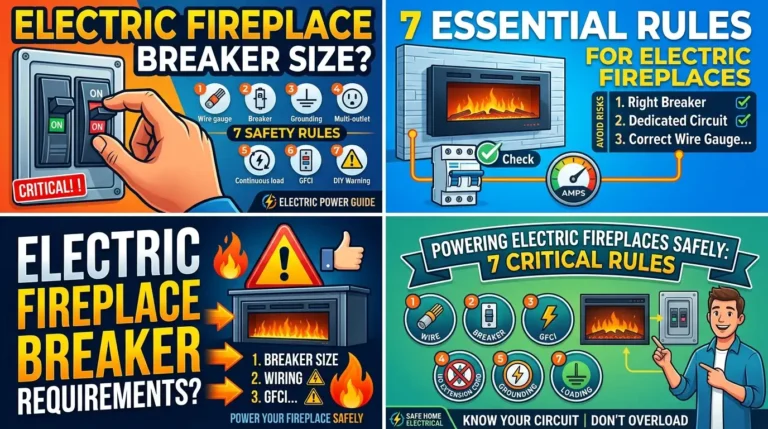
- The actual planning activity is electrical: verify the amperage of the circuit, verify what other circuits share it with, and use a special circuit on hardwired or higher-powered built-in units.
- These are the least effort and the most cost-effective solutions to installing an electric fireplace with no connection to the wiring of your house.
- The construction of any new circuit is to be done by a licensed electrician since there are differences between manufactured-home wall and wiring construction.
You May Also Read:
- Can You Put an Electric Fireplace in a Cabinet? 7 Essential Safety Tips
- What Does Green Fire Mean? 7 Crucial Facts & Safety Tips
FAQs:
Is it possible to install an electric fireplace in a mobile home?
Yes. Electric fireplaces do not require the HUD mobile-home combustion permit as it does not involve a flame or venting mechanism, the only thing to ensure is that your electrical circuit is capable of accepting the wattage of the unit.
Should electric fireplaces be mobile home approved as are wood or gas units?
No. Such a designation is used on combustion appliances. Electric fireplaces only require a normal UL or other similar safety listing.
What is the size of a breaker that an electric fireplace requires?
The 1,500-watt electric fireplaces can operate on a regular 15-amp or 20-amp, 120-volt circuit. Always compare with the spec sheet of a definite model.
Would I be able to simply plug in an electric fireplace anywhere?
Yes, typically, when the circuit is not already occupied by other high draw appliances, in low-wattage plug-in models. Hardwired or larger built-in units normally require a dedicated circuit.
Should I have a permit to install a manufactured home electric fireplace?
It will vary depending on the area you are in and the addition of new wiring. It is often not necessary to have a permit to use an existing outlet with a plug-in unit; and sometimes a new circuit is required.
Will an electric fireplace break the circuit?
It can, if it shares a circuit with other high-wattage appliances like a space heater or window air conditioner. The unit can be tested by putting it on high heat with all other things running normally before you have to commit to a spot.
Are electric fireplaces safe in bedrooms of a mobile home?
Yes, in general, as it does not involve any combustion or carbon monoxide. Make sure that the model includes an automatic overheat shutoff, which is a standard feature on UL listed models.
Will an electric fireplace warm a mobile home room?
A 1,500-watt unit can have a significant effect on warming a single room as an addition, but it isn’t intended to substitute your home heating.
What is the difference between an electric fireplace insert and built in?
An insert is made to fit into an existing fireplace aperture, without modification of wiring; a built-in or recessed unit is installed into a cutout in a wall and usually involves hardwiring by an electrician.
Should electric fireplaces have a chimney or venting in a mobile home?
No. Electric fireplaces do not generate any byproducts of combustion, which is why no chimney, flue, or vent pipe will be necessary.
What would the price of installing an electric fireplace in a mobile home be?
Plug-in inserts cost as little as $150 and as much as $1,800 depending on size and style, and an additional $150-500 may be necessary to install when an electrician needs to run a dedicated circuit.
Is it possible to install an electric fireplace independently?
DIY Plug-in insert and mantel-style units are typically DIY-friendly. New circuits must be installed in hardwired or recessed units on the wall, with a licensed electrician knowledgeable of manufactured-home wiring.
Are older single-wide mobile homes electrically wide enough to have an electric fireplace?
The majority of them do, as manufactured homes must have at least 100-amp service. What counts more than the overall size of the service of the home is the amperage of the individual circuit and what is operating on it.
What do I want to know when purchasing the fireplace label?
Find a UL (or other) safety listing, the rated wattage/voltage, and the minimum clearance requirements of the manufacturer – all three influence whether the unit can fit your circuit and your space safely.