Why Electric Fireplace Flames Not Working?
Why Electric Fireplace Flames Not Working? Quick Answer When your electric fireplace flames no longer work, but the heater is still on, it is likely due to one of four situations: a burnt out flame bulb or LED strip, a stalled flicker motor, a loose wire behind the flame panel, or a control setting that was turned off. The majority of them are $10-60 DIY fixes that can be completed in less than 30 minutes. When plastic burning is smelled, sparks are seen or the unit is shorting your breaker, cease and call a technician.
Diagnose Your Exact Symptom First
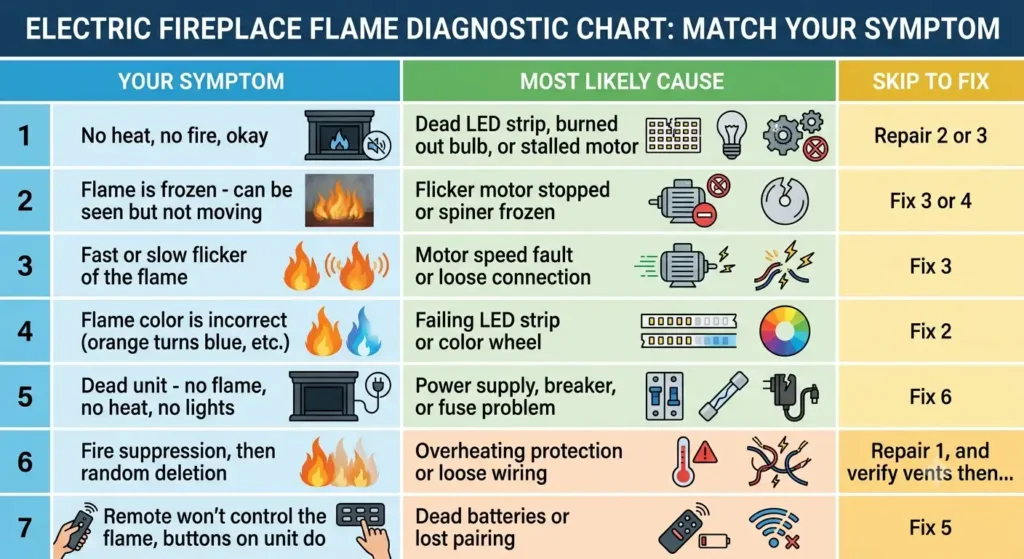
Not working flame problems are not all the same problem. Before you begin stripping the unit apart, match your symptom below to help you save time and money by not replacing the incorrect part.
| Your Symptom | Most Likely Cause | Skip to Fix |
|---|---|---|
| No heat, no fire, okay | Dead LED strip, burned out bulb, or stalled motor | Repair 2 or 3 |
| Flame is frozen – can be seen but not moving | Flicker motor stopped or spiner frozen | Fix 3 or 4 |
| Fast or slow flicker of the flame | Motor speed fault or loose connection | Fix 3 |
| Flame color is incorrect (orange turns blue, etc.) | Failing LED strip or color wheel | Fix 2 |
| Dead unit – no flame, no heat, no lights | Power supply, breaker, or fuse problem | Fix 6 |
| Fire suppression, then random deletion | Overheating protection or loose wiring | Repair 1, and verify vents then |
| Remote won’t control the flame, buttons on unit do | Dead batteries or lost pairing | Fix 5 |
Quick Troubleshooting Checklist
Go through this list. The unit opens fewer than one-third of cases.
- Unit is directly inserted into an operational outlet (not a faulty power strip)
- Breaker or GFCI outlet hasn’t tripped
- Flame brightness dial or setting isn’t turned down to zero
- Remote contains new batteries and has clear line of sight to sensor.
- Furniture, curtains, or a rug are not blocking the vents.
- Unit was disconnected 10-15 minutes to reset the unit fully.
- No odor or smoke or apparent sparking (yes, turn off and unplug)
The 3 Types of Flame Technology & Why It Matters
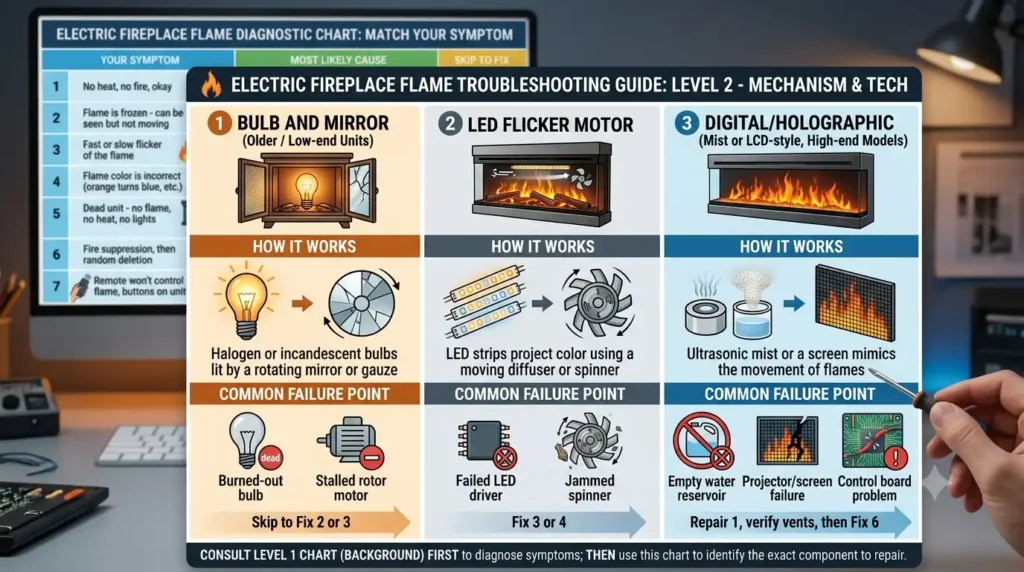
The way your model produces the flame image is crucial to your fix. This is omitted in most troubleshooting manuals, but it transforms what component you are seeking.
Here is the cleaned and formatted table:
| Flame Technology | How It Works | Common Failure Point |
| Bulb and mirror (older/low-end units) | Halogen or incandescent bulbs are lit by a rotating mirror or gauze | Burned-out bulb, stalled rotor motor |
| LED flicker motor | LED strips project color using a moving diffuser or spinner | Failed LED driver, jammed spinner |
| Digital/holographic (mist or LCD-style, high-end models) | Ultrasonic mist or a screen mimics the movement of flames | Empty water reservoir, projector/screen failure, control board problem |
If you are unsure about what type you have, refer to your owner manual model number or a small water reservoir (mist units) or a spinning rod in full view behind the glass (motor units).
Why Electric Fireplace Flames Stop Working Causes by Category
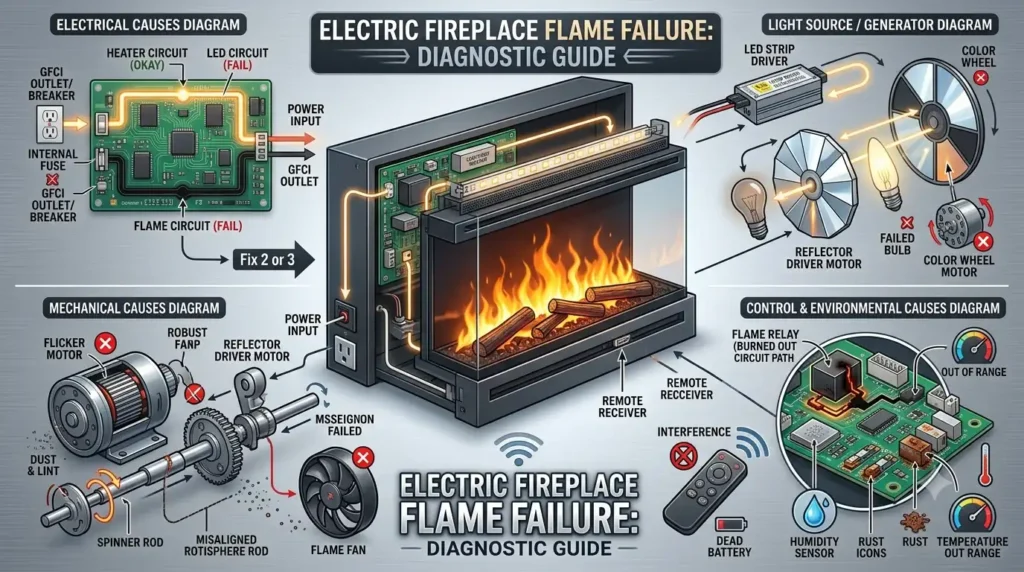
Electrical Causes
When the flame does not proceed in spite of the heater being turned on, electrical problems are the cause of a significant portion of sudden flame failures. Common culprits:
- Damaged or loose power cord.
- GFCI outlet or tripped circuit breaker.
- Blown internal fuse
- Voltage drop of an overloaded circuit or extension cord.
The main lesson: When the heater and the lights are on, but the flame is off it is not typically a whole-unit power problem, it is confined to the flame circuit and so indicates Fix 2 or Fix 3 below.
Light Source / Flame Generator Cause.
This is the most prevalent type of flame not working with heat still fine.
- Dimmer bulb with a shorter lifespan (halogen or LED).
- Malfunctioning LED strip or LED driver board.
- Soiled or fogged reflector/mirror minimizing visible flames.
- Color wheel that remains fixed.
Mechanical causes (Motor and Spinner)
When your flame is in sight but either frozen or moving unusually, the motor is the most likely suspect.
- Flicker motor is no longer rotating (dead motor)
- Knocked out of alignment spinner or rotisphere rod.
- Accumulation of dust in the mechanism.
- Fan that spreads the flame picture has failed.
Control board & Remote Causes
- Relay failure of the control board (flame circuit in particular)
- Remote is out of synchronization with the receiver.
- Dead remote batteries
- Interference of electronics nearby which go wireless.
Environmental Causes
- Build-up of dust and lint within the unit.
- Moist weather that leads to corrosion of contacts.
- Using beyond the temperature range of the manufacturer.
Why Electric Fireplace Flames Not Working? Step-by-Step Fixes
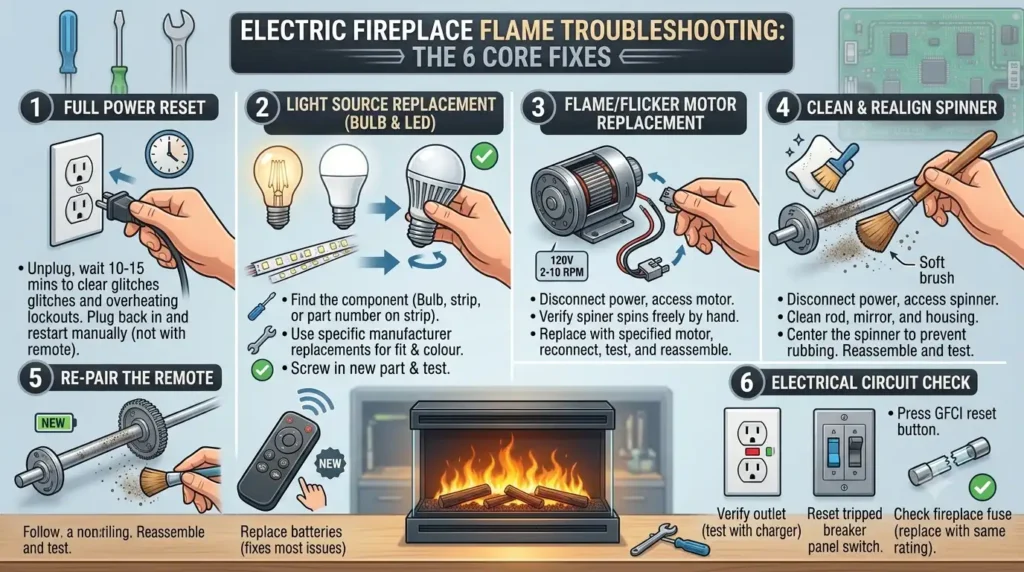
Fix 1 — Full Power Reset
- Turn off the fireplace and unplug it from the wall.
- Wait 10–15 minutes. This clears the majority of overheating-protection lockouts and trivial control glitches.
- Reinsert and start it again manually (not using the remote) to eliminate remote problems.
- In case the fire returns, no more to be done. Otherwise, go to Fix 2.
Replace the Flame Bulb or LED Strip
1) Unscrew the flame bulb or LED strip,
2) insert the new bulb, LED, or strip,
3) screw it back in.
Fix 2 — Replace the Flame Bulb or LED Strip
- Turn off the unit.
- Take off the front or rear access panel (see your manual – the location of the panel will differ depending on the brand).
- Find the bulb or LED strip; the part number is imprinted on the strip or in your manual.
- Have the replacement ordered directly with the manufacturer – universal bulbs usually do not fit the socket or do not give the correct colour temperature.
- Replace the panel, install the new bulb/strip and test.
Fix 3 — Replace the Flicker/Flame Motor
- Unplug the unit.
- Take off the back panel to get access to the motor and spinner assembly.
- Check that the motor is not turning by turning the spiner rod by hand, and making sure that it spins freely without the motor struggling to turn it.
- Get the specific flicker motor component (voltage and RPM are important – most are 120 V, 2-10 RPM) of the manufacturer.
- Unscrew or unclip the wire connector of the old motor, and remove it.
- Set in the new motor, re-connect the wire connector and position the spinner to spin freely.
- Test and plug in and then reassemble completely.
Fix 4 — Clean and Realign the Spinner
- Disconnect the unit and take off the back panel.
- Clean dust off the spiner rod, mirror and motor housing using a dry cloth or soft brush.
- Make sure that the spinner is in the middle of its mount and not rubbing on the housing.
- Reassemble and test.
Fix 5 — Re-Pair the Remote
- Change batteries first – this solves most of the remote problems.
- Position close to the unit (within a few feet) with a clear view of the sensor.
- Use your manual pairing order (typically press a button on the unit and remote at the same time 3-5 seconds).
- Test using the manual controls in the meantime.
Fix 6 — Check the Breaker, GFCI, and Fuse
- Check the outlet by trying it with another appliance (such as phone charger) to make sure it has power.
- Turn on your breaker panel and verify that a tripped switch is present and reset.
- Press a GFCI outlet, with a GFCI reset button.
- Check the inside fuse of your fireplace (check the manual) and ensure that you see the break and replace with the same-rated fuse.
Cost to Fix an Electric Fireplace Flame
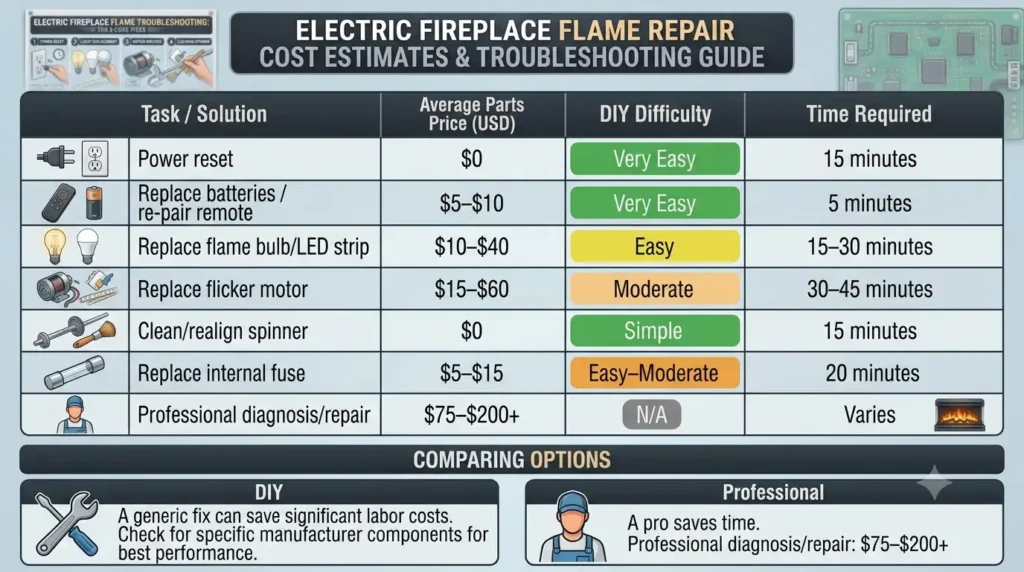
| Task / Solution | Average Parts Price (USD) | DIY Difficulty | Time Required |
| Power reset | $0 | Very easy | 15 minutes |
| Replace batteries / re-pair remote | $5–$10 | Very easy | 5 minutes |
| Replace flame bulb/LED strip | $10–$40 | Easy | 15–30 minutes |
| Replace flicker motor | $15–$60 | Moderate | 30–45 minutes |
| Clean/realign spinner | $0 | Simple | 15 minutes |
| Replace internal fuse | $5–$15 | Easy–Moderate | 20 minutes |
| Professional diagnosis/repair | $75–$200+ | N/A | Varies |
Note: pricing may also be brand and model specific, always confirm the part number of a particular part with your manufacturer before ordering – universal parts often do not fit.
Common Mistakes That Make It Worse
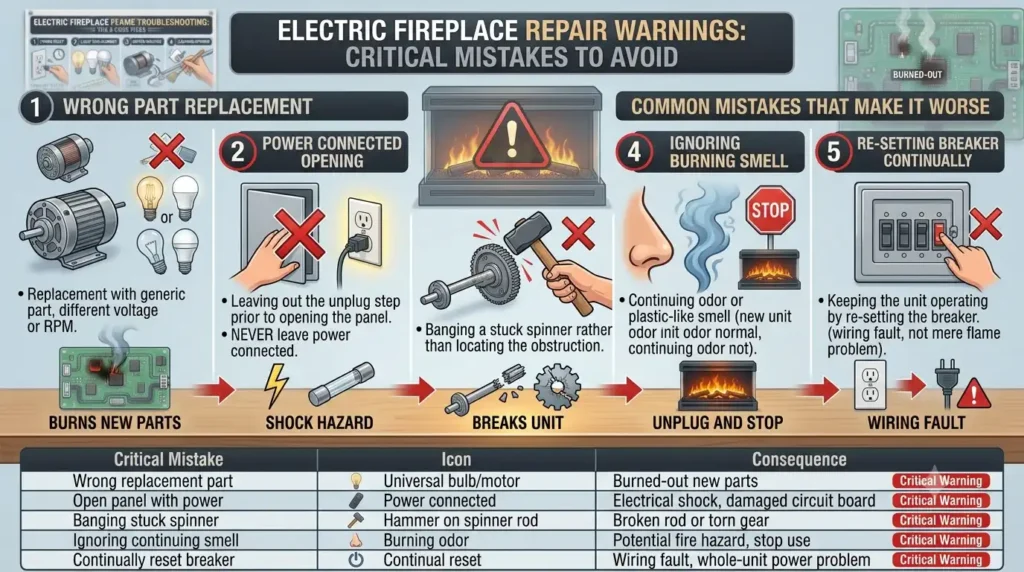
- Replacement of the part with a universal bulb or motor with a different voltage or RPM can burn out new parts or break the unit.
- Leaving out the unplug step prior to opening the panel. never leave power connected.
- Banging a stuck spinner rather than locating the obstruction. Banging it may break the rod or tear the motor gear.
- Leaving a burning smell which was ignored. A faint odor at the beginning of the use of a new unit is normal, but a continuing odor or plastic-like odor is not normal – unplug and stop troubleshooting.
- To keep the unit operating without re-setting the breaker. This is generally an indication of a wiring fault, and not a mere flame problem.
Myth vs. Fact
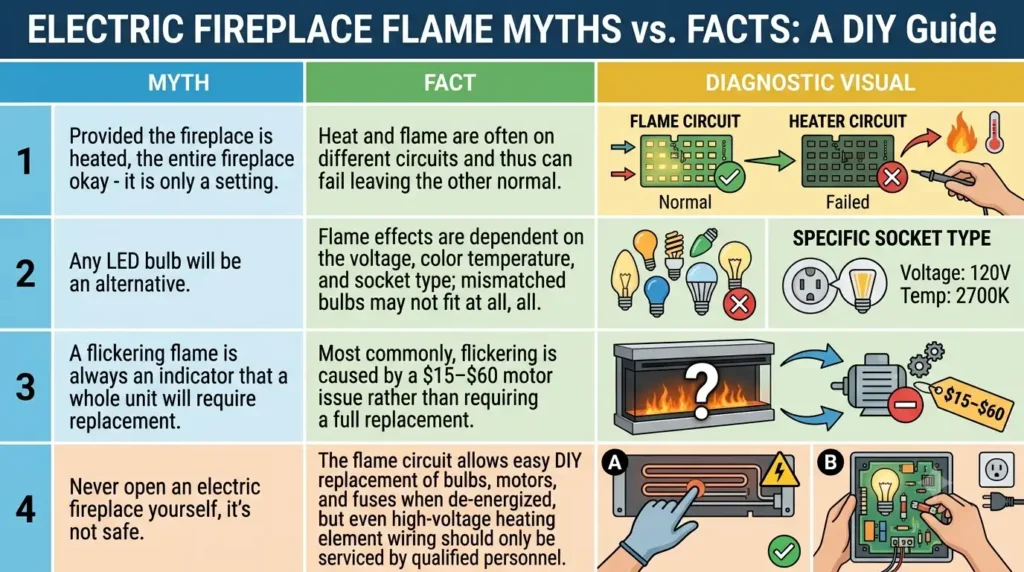
| Myth | Fact |
| Provided the fireplace is heated, the entire fireplace is okay – it is only a setting. | Heat and flame are often on different circuits and thus can fail leaving the other normal. |
| Any LED bulb will be an alternative. | Flame effects are dependent on the voltage, color temperature, and socket type; mismatched bulbs may not fit at all, or may burn out quickly. |
| A flickering flame is always an indicator that a whole unit will require replacement. | Most commonly, flickering is caused by a $15–$60 motor issue rather than requiring a full replacement. |
| Never open an electric fireplace yourself, it’s not safe. | The flame circuit allows easy DIY replacement of bulbs, motors, and fuses when de-energized, but high-voltage heating element wiring should only be serviced by qualified personnel. |
When to Call a Professional vs. DIY
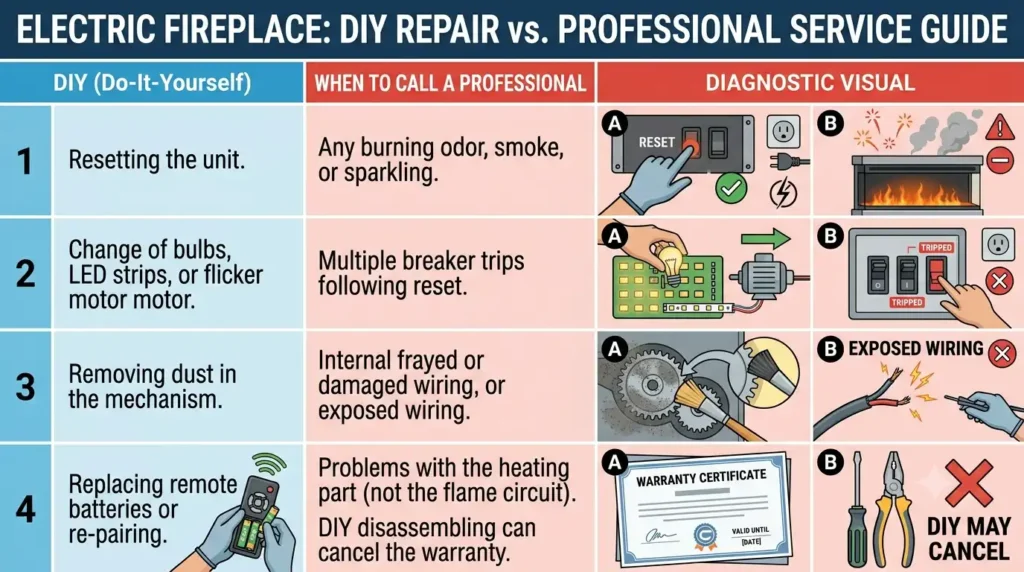
DIY can be used with:
- Resetting the unit
- Change of bulbs, LED strips, or flicker motor.
- Removing dust in the mechanism.
- Replacing remote batteries or re-pairing.
Call a professional about:
- Any burning odor, smokes or sparkling.
- Multiple breaker trips following reset.
- Internal frayed or damaged wiring, or exposed wiring.
- Problems with the heating part (not the flame circuit)
- Still in warranty period – DIY disassembling can cancel the warranty.
How to Prevent Flame Problems Going Forward?
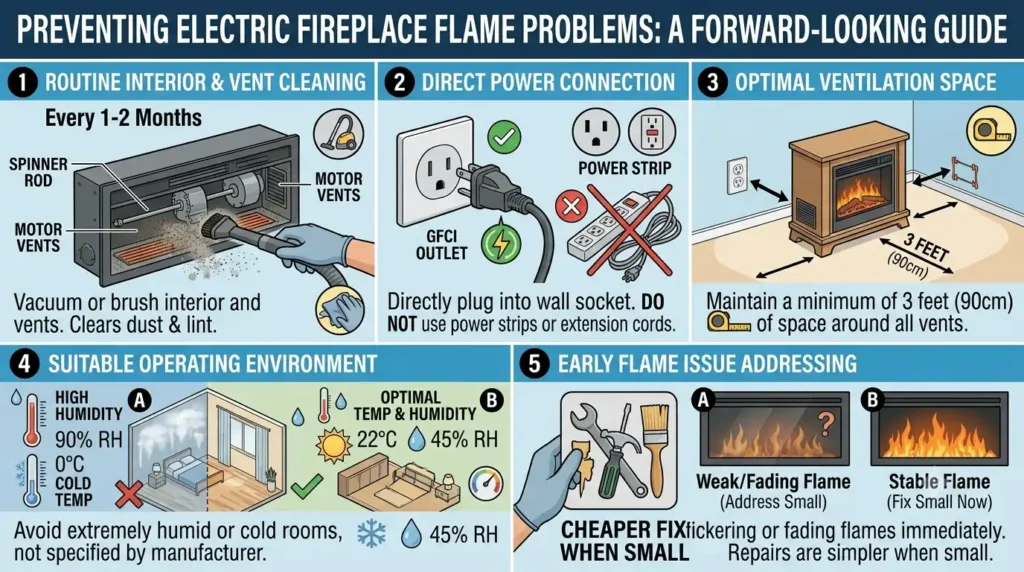
- Vacuum or brush of a small diameter should be used to clean the interior and vents after every 1-2 months.
- Directly plug into a wall socket instead of using a power strip or extension cord.
- Maintain a minimum of 3 feet of space around vents.
- Do not operate the unit in extremely humid or cold rooms not specified by the manufacturer.
- Suppress a flickering or fading flame immediately and not until it goes out completely – it is normally cheaper and simpler to repair when small.
You May Also Read:
FAQs:
Why did my electric fireplace flame turn off?
A flicker motor that has stalled or a burned-out bulb/LED strip is the most frequent sudden cause. Sudden, complete stop also may be caused by a tripped breaker or lose power connection.
Why is my electric fireplace heating, yet no flame?
The heat and flame are usually on separate circuits or components. A faulty LED strip, broken motor or a dead bulb can cut the flame, and the heater will continue to operate normally.
What do I do to turn on the flame effect to my electric fireplace?
Turn off the unit by unplugging it 10-15 minutes, then re-plugging the unit and using the manual controls to turn the unit on.
Am I able to change the flame bulb myself?
Yes. Disconnect the unit, take off the access panel, and replace it with the specific replacement bulb or LED strip offered by the manufacturer.
Is danger of a frozen flame effect?
The presence of a frozen (non-moving) flame in itself is not a safety risk, but it is a mechanical problem of the motor or spinner. Only in combination with a burning smell, sparking, or overheating, it becomes a safety concern.
Why is my flame dancing so fast or sporadically?
This normally indicates a motor that is running at the incorrect frequency or a loose internal connection, as opposed to a normal flicker setting.
Why is my fire the wrong color?
The most probable reason is a broken LED strip or a broken color wheel that gets stuck.
Why will my remote-control the lights, but not the flame?
It is normally a lost pairing or a dead battery problem, not a flame hardware problem – check the manual controls to verify.
My electric fireplace won’t turn back on after a power outage.
Some units feature a safety lock-out system inside that must be reset if there is an abrupt power loss and not automatically like other electronics in your home. Disconnect the unit for several minutes before reconnecting it, but only via the manual controls and not the remote.
Why is it my flame will only light on low heat and not on high heat?
Typically, this is due to a flame and heat being on the same circuit, and the heating element under high load is enough to trip a thermal safety cut-off that also trips the flame. It has nothing to do with the flame components, but points to a wiring or relay problem.
My flame seems weak rather than out.My flame seems only weak and not off?
A dim or washed out flame usually is a warning sign but not indicator of failure; aging bulbs will dim over time, LED strips can dim unevenly as they age, and a foggy mirror will decrease the amount of light that can pass through the glass. It is typically easier and less expensive to take care of this now than to do it when it fails completely.
Why does the flame work but the crackling sound doesn’t (or vice versa)?
On the higher end models, sound effects, flame and heat are sometimes a separate feature. It allows the other modules to continue operating if one stops, thus pinpointing the problem to the particular module, not the entire unit.
How do I know what is my model and serial number so that I can order the correct part?
Look on the back panel, the base of the unit or a label just inside the glass frame. The most frequently cited error for not getting the correct replacement part is ordering a bulb, LED strip or motor without this number.
Why doesn’t my flame work after I relocating or reinstalling the fireplace?
Internal connections can become loose during the move, or the new outlet or circuit may be different, resulting in a voltage mismatch. This is not for the same reason as a flame that does not start during normal, undisturbed use.
Does opening my fireplace to work on the flame cancel out my warranty?
This varies from manufacturer to manufacturer and if the unit is still within the cover window. Review your warranty terms first, some manufacturers will mandate repair be done through authorized service to maintain parts and labor coverage.
What are the differences between the ember bed light and the flame effect?
Some units feature two lighting systems; a moving flame and a bed of stationary glowing embers below. Sometimes, what appears to be “the flame isn’t working” is actually a problem with the ember bed, which uses a separate bulb and a separate solution.