Why Does Firewood Pop? Causes, Fixes & When to Worry
Why Does Firewood Pop? The Science Behind Crackling Fires & When to Worry. The short answer is here that firewood pops when there are water and resin in the wood, which boils and vaporizes very quickly because of the heat generated by combustion, but the wood’s grain cannot keep up in releasing the water and resin. Until the pressure reaches a critical level in small pockets within the wood, it will simply rupture the surface which causes that pop, crackle, or snap you hear and it will often be the sparks and embers that are the catalyst.
Key Takeaways
- Popping occurs when the moisture becomes steam and vaporizes the resin/sap, creating pressure that causes the wood to pop.
- The poppers are softwoods that have high resin (pine, fir, spruce, cedar) and unseasoned “green” wood.
- Hardwoods (oak, maple, ash) that are dry and dense, if dried properly, will burn the quietest.
- Freshly cut wood can be up to 50-100% moist; firewood should be dried to 15-20%.
- Popping is typically not a fire or burn hazard, but flying embers can be a fire and burn hazard NFPA recommends a fire screen on any open flame.
- There’s no seasoning resin away, but there is seasoning moisture away, and that’s the one of the greatest levers you have.
Why Does Firewood Pop? The Two Real Causes
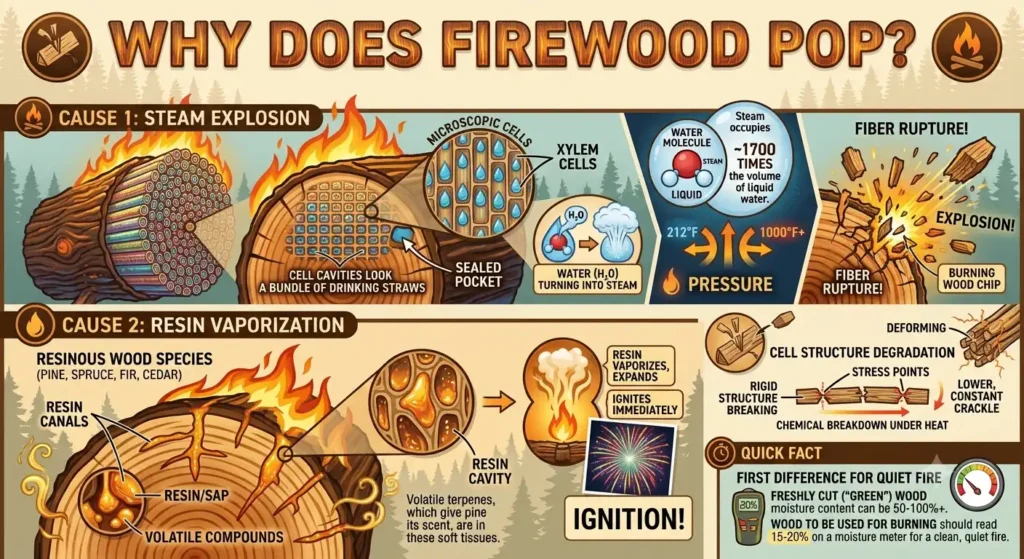
Wood is NOT one uniform material; it looks more like a bundle of drinking straws tied together under the microscope. The straws (called xylem cells) are the ones that carry water and sap up a live tree, and even after the tree is cut, they still contain a mixture of water and resinous compounds deep within the grain.
When you burn a log, the heat travels from the outside to the inside of the log. As you can see in those cell cavities, two things occur that account for nearly all the pops you hear:
1. Water that is trapped turns into steam.
The water in the wood is not only boiling at 212°F (100°C), the water on the surface of the burning wood is generally well over 1,000°F. Steam occupies about 1700 times the volume of liquid water. The expansion has to find somewhere to go. Will not work fast enough through the pores of the wood and eventually pressure will build up inside a sealed pocket until the wood fiber around it ruptures, and that rupture is a pop or crack, sometimes loud enough to throw a chip of burning wood several feet.
2. The resin and sap vaporize and burn where they are.
Resin canals filled with volatile terpenes (the same compounds that give pine its scent) are found in the soft tissues of pine trees and other softwoods, such as spruce, fir and cedar. When the heat reaches these pockets, the resin vaporizes, expands, and is highly flammable, so it may ignite immediately as it emerges, making the “fireworks” pops people see when they see a pine or fir fire. This is an unrelated process to steam, and that is why resinous wood pops when it has been dried for months.
The third, lesser is the degradation of the cell structure of the wood. During pyrolysis (chemical breakdown of wood under heat before actual combustion) the wood’s rigid structure fractures at stress points, creating a lower more constant crackle under the sharper crackle from the steam/resin.
Quick Fact: Moisture content in freshly cut (‘green’) wood can range up to 50–100%+ weight basis of the timber. The first and biggest difference between a quiet fire and a popping fire is that wood to be used for burning should read 15-20% on a moisture meter.
Moisture Content: Why It Matters More Than Anything Else
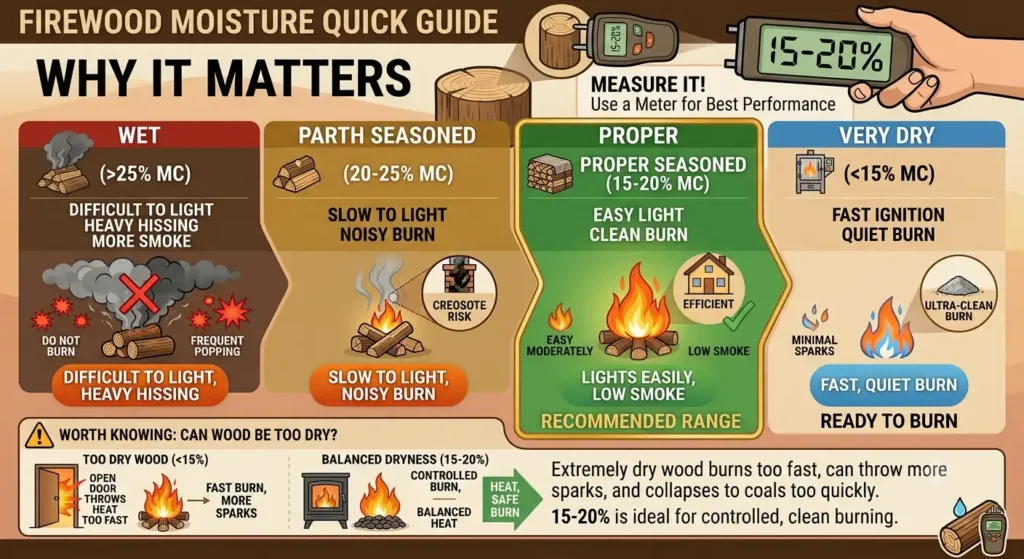
Moisture content is expressed in percentage of moisture in the wood, based on the dry weight of the wood. The lower the number, the more that the vapor generation within the log can be reduced and the quieter and more efficient the burn.
Here is the cleaned and organized table based on your data:
Firewood Moisture & Performance Guide
| Firewood Type / Seasoning Stage | Moisture Content | Moisture Category | Burning Characteristics & Performance |
| Green (Freshly cut) | 50% – 100%+ | Wet / Unseasoned (> 25%) | Difficult to light, heavy hissing, lots of smoke, frequent popping |
| Partially Seasoned (1–4 months drying) | ~25% – 50% | High Moisture (> 25%) | Slow to light, noisy burn, high risk of creosote buildup |
| Properly Seasoned (6–24 months, covered & raised) | 15% – 20% | Normal (10% – 25%) | Lights easily, crackles moderately, burns efficiently with low smoke |
| Kiln-Dried | < 15% (Usually < 10%) | Very Dry (< 10%) | Fast, quiet, and ultra-clean burn; generates minimal sparks |
Ranges are based on information from various university extension and firewood industry sources and will vary with species, split size and local humidity; the only way to be sure of what you’re burning is to use a moisture meter.
Worth knowing: But wood can be too dry too: Extremely low-moisture wood (well under 10%) will catch fire much more rapidly and can throw more sparks (not fewer) and will burn down to coals much faster. The most that is recommended is 15–20%, for a wood stove or fireplace, dry enough for clean and quiet burning but wet enough to burn in a controlled manner.
Which Firewood Pops the Most (and least)?
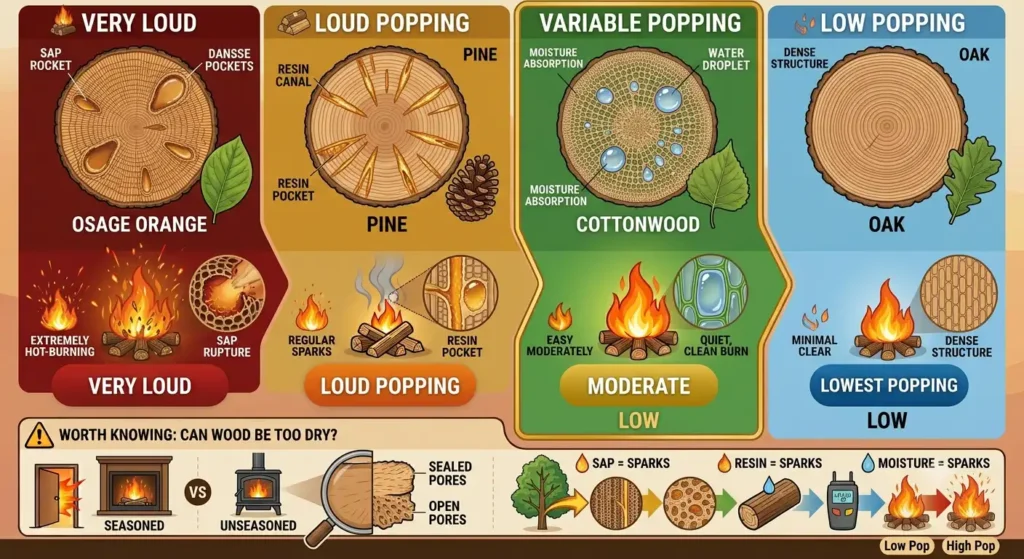
Not all wood is created equal. The amount of noise a species produces is greatly influenced by the amount of resin and density.
Here is a structured comparison table showing which types of wood pop the highest and lowest based on your data:
Firewood Popping Comparison by Wood Species
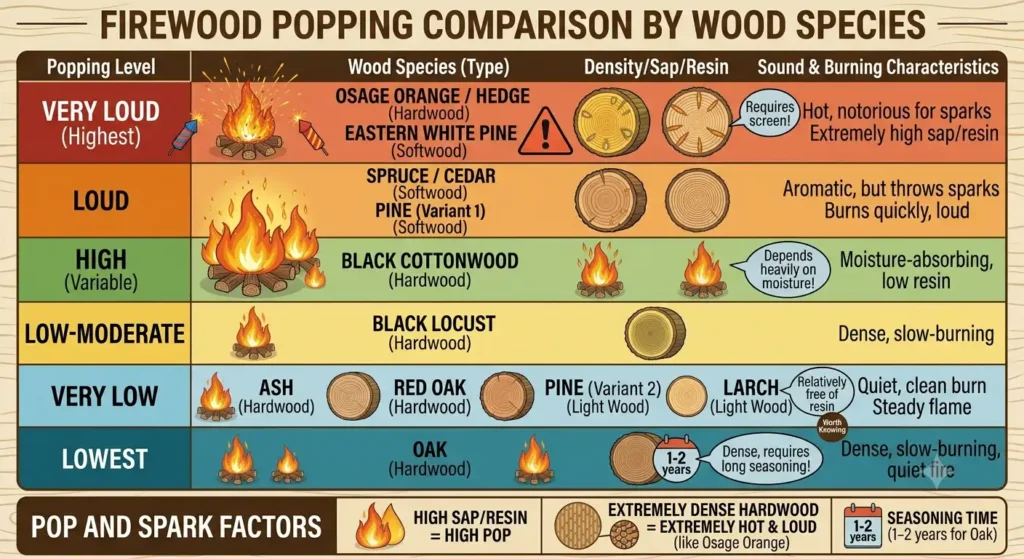
| Wood Species | Wood Type | Density / Sap / Resin Level | Popping Level | Burning & Sound Characteristics |
| Osage Orange / Hedge | Hardwood | Very high sap, extremely dense | Very Loud (Highest) | Extremely hot-burning; notorious for popping and throwing sparks |
| Eastern White Pine | Softwood | Very high resin content | Very Loud (Highest) | Frequent spitting of sparks; requires a fireplace screen |
| Spruce / Cedar | Softwood | High resin content | Loud | Pleasant aroma, but regularly pops and throws sparks |
| Black Cottonwood | Hardwood | Low resin, moisture-absorbing | High (if unseasoned) / High (if well-seasoned) | Sound depends heavily on moisture level |
| Pine (Variant 1) | Softwood | Low resin (denser than Douglas fir) | Loud | Burns quickly with a loud sound |
| Black Locust | Hardwood | Low sap/resin | Low – Moderate | Dense and slow-burning with a mild crackle |
| Ash | Hardwood | Very low sap/resin | Low | Quiet, clean burn when properly seasoned |
| Red Oak | Hardwood | Hardwood structure | Very Low | Steady, quiet flame once dried |
| Pine (Variant 2) | Light Wood | Very low resin/sap | Very Low | Relatively free of resin/sap; minimal noise |
| Larch | Light Wood | Very low resin/sap | Very Low | Not very resinous; minimal noise |
| Oak | Hardwood | Very low sap/resin | Lowest | Dense, slow-burning; requires 1–2 years seasoning for a quiet fire |
- Pops the Highest: Softwoods with high resin content (Eastern White Pine, Spruce, Cedar) and dense hardwoods with high sap (Osage Orange).
- Pops the Lowest: Dense, low-resin hardwoods (Oak, Red Oak, Ash, Black Locust) and low-resin soft/light woods (Larch, low-sap Pine).
- Rule of Thumb: Resinous softwoods and sap-heavy hardwoods pop the most. For dense hardwoods, higher density generally means less popping once the wood is properly seasoned.
Is Popping Firewood Dangerous?
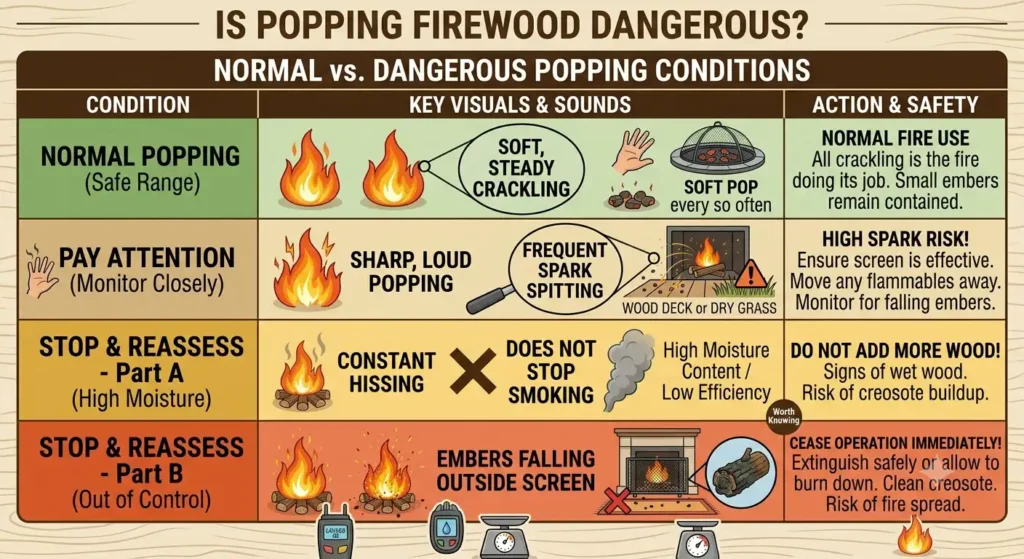
Almost all crackling and popping is normal it is the sound of fire doing its job. But there is a true safety set:
Normal: steady, moderate crackling, soft popping sound every so often, small embers that remain within the firebox or fire pit ring.
Pay attention: If the pop is sharp and creates visible sparks or glowing embers outside the fireplace opening or beyond the wood deck edge of a fire pit particularly onto a wood deck, dry grass, or rug.
Stop and reassess: Constant hissing of wood and not stopping smoking (signs of high moisture content and creosote production) or embers falling on the ground outside a screened area are signs of the need to stop and reassess.
One reason embers are a leading cause of small structure and clothing fires is the reason the National Fire Protection Association says to use a metal mesh fire screen over any open fireplace or fire pit. The screen does not prevent popping; it prevents the popping from being a problem.
Another thing to be aware of is that creosote is formed when you burn wet or unseasoned wood and this will create more smoke and unburned particulate that will condense within the chimney flue, creating creosote which is a major cause of chimney fires. Dry and well-seasoned wood burns hotter and more thoroughly, as it spontaneously produces less creosote as a by-product of less popping.
Myth vs. Fact
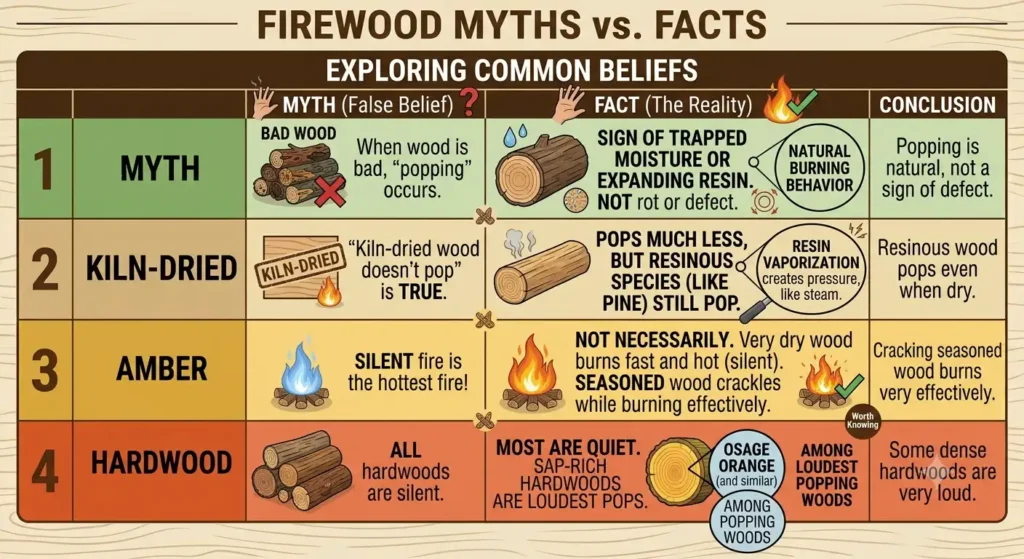
Here is the organized Myth vs. Fact table based on your data:
Firewood Myths vs. Facts
| Myth | Fact |
| When wood is bad, “popping” occurs. | Popping is usually a sign of trapped moisture or resin expanding, not rot or structural defects. It is a natural burning behavior across many wood species. |
| “Kiln-dried wood doesn’t pop” is true. | While kiln-dried wood pops much less, resinous species (like pine) will still spit and crackle even at low moisture levels because resin vaporization creates pressure, just like steam does. |
| Silent fire is the hottest fire! | Not necessarily. Very dry firewood can burn rapidly and intensely, while properly seasoned firewood may crackle slightly while burning very effectively and efficiently. |
| All hardwoods are silent. | While most hardwoods burn quietly, sap-rich hardwoods (such as Osage orange) are among the loudest popping woods you can burn. |
How to Get a Quieter, Safer Fire: 5 Steps?
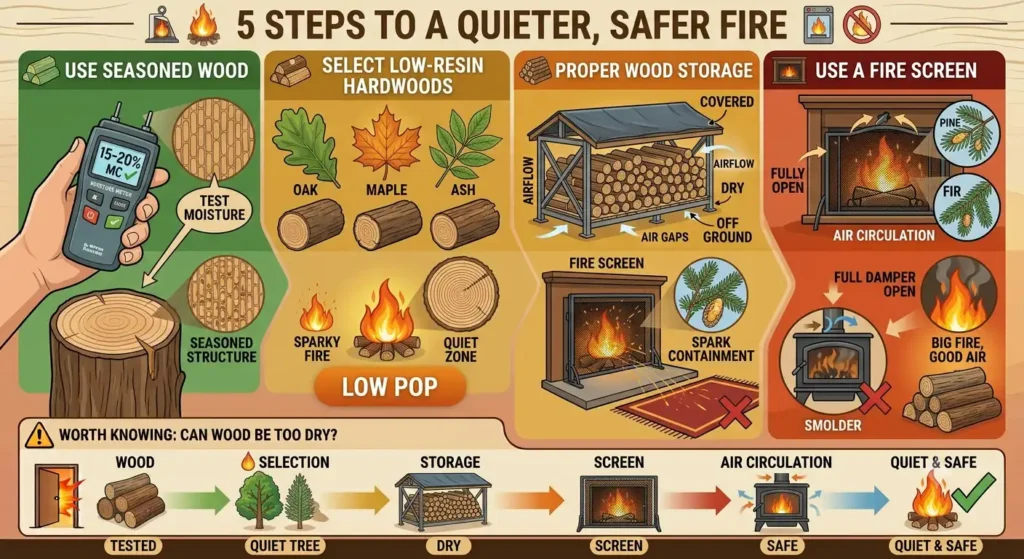
There are five steps to follow to achieve a quieter, safer fire. The following five steps can help you have a quieter, safer fire.
1.Use seasoned or kiln dried wood. Use a $15-$20 pin-type moisture meter to determine the correct moisture content at 15-20%.
2.If a quiet fire is more important to you than a crackling fire, select low-resin hardwoods such as oak, maple and ash.
3.Wood storage – covered, off the ground, with air gaps. – Wet storage is the undoing of the months of seasoning in one week of rain.
4.Use a fire screen, particularly when using pine, fir, cedar, or any wood that is not personally dried and tested.
5.Create a good sized fire with good air circulation (damper fully open in a fireplace) — smoldering, smoking and “popping” fires are produced with small, smothered fires or a fire that simply isn’t getting enough air.
Firewood Popping: Quick Decision Guide
- Occasional fire pops, embers remain contained. Normal. No action needed.
- Wood continually popping and hissing with fire: It means that wood is too damp. Savor longer, or use a kiln-dried batch.
- Add or move a fire screen, use smaller screens or a different type of fire screen (sparks thrown past the screen/hearth).
- If the smoke from the fire is heavy and pops, it is a high moisture fire: Do not continue to burn in a stove with a catalytic combustor without the assistance of a trained professional.
- If wood is bone dry, screened and still catching fire, it is probably a softwood with high resin content (pine, fir, cedar). This is not a defect; it is a normal response.
You May Also Read
- Why Gas Fireplace Gas fireplace shuts off by itself
- Why Is My Gas Fireplace Beeping? Here’s Why & How to Fix It
FAQs:
Why does firewood pop and crackle when it burns?
The trapped water turns to steam, and the resin turns to gas faster than it can escape from the wood, creating pressure which is released when the surface of the wood bursts with a pop or crackle.
Why some firewood pops more than others?
It is driven by resin and water content. The resinous softwoods (pines, firs, cedars) and the sap-rich hardwoods (such as Osage orange) will pop the most, and dense hardwoods, low in resin (such as oak, maple, ash) the least after they have had a seasoning.
Does firewood “pop” a lot?
Yes, that’s completely normal for many common species, particularly pine, fir and cedar, even if the wood is properly dried.
Wet firewood pops louder than dry firewood, why?
When wood is wet, there is a lot more water in there, and a lot more steam and pressure generated inside the wood as it burns, resulting in a louder, more frequent popping sound.
Does kiln dried firewood catch fire?
Yes, but less. Most moisture that causes steam pops is removed by kiln drying but resin will not be removed, therefore resinous species will crackle and pinhole.
What is the best way to determine whether the wood is dry enough?
Typical standards are moisture level 15-20% or lower. Older wood is discolored, grayish and has a cracked end, and is distinctly lighter in weight than green wood.
Is the popping firewood a fire hazard?
It can be. The pop itself is not harmful but the embers and sparks that are thrown may strike flammable materials. The risk is reduced to a minimum by the use of a fire screen.
What type of wood is quieter to burn?
Oak, maple and ash are always considered to be among the quietest woods when properly seasoned and have a low resin content which makes them dense.
Which of the wood types is the loudest?
Osage orange (hedge) and high-resin pines, such as the Eastern white pine, are frequently said to be the loudest and to spark the most.
Does the larger log pop as much as the smaller log? Does the pop size vary depending on the size of the log?
Yes. Uncut rounds will hold more moisture inside and will pop more, while smaller split pieces will dry faster and release steam more uniformly.