What Are the Dimensions of a Cord of Wood? The Complete Size Guide
Have you ever received a delivery of firewood, and wondered whether you had received what you paid, you are not alone. Firewood is among the few remaining goods in America that are still sold in centuries-old language, and such terms as rick, face cord, and cord are used so loosely that the customers are often left at a loss, or cheated.
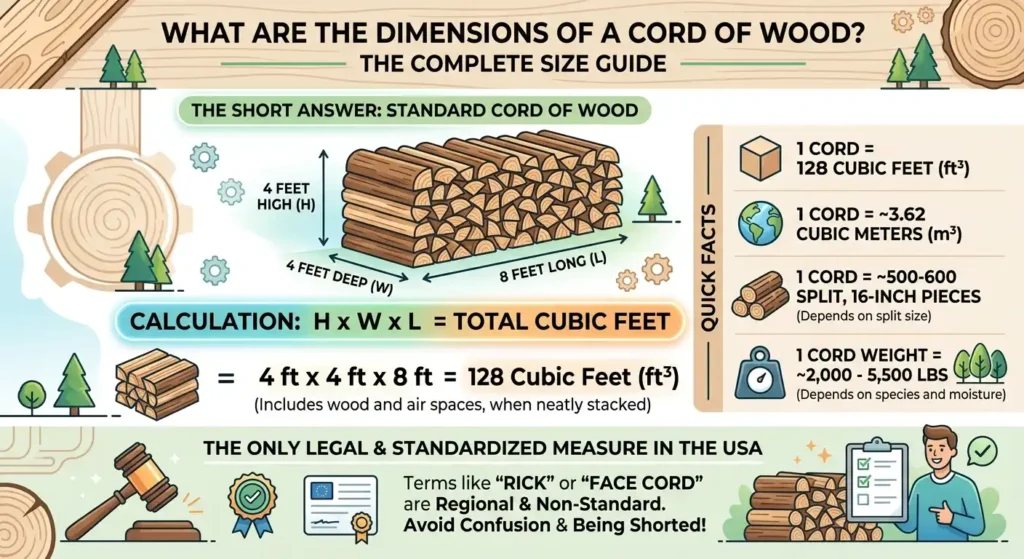
The brief version of this is as follows: a cord of wood is 4 feet wide, 4 feet high, and 8 feet long or 128 cubic feet. It is the only standardized firewood measure in the United States that is legally standardized. All the rest, such as a “rick” or a “face cord” are regionalisms that may have different meanings when speaking to different people.
The breakdown is given in detail below, with the precise numbers, a rough method of measuring your own stack, and what to look at to avoid being shorted on your next delivery.
The Short Answer: A Cord Is 4 x 4 x 8 Feet
A stack of wood is a complete cord and measures:
- 4 feet high
- 4 feet deep
- 8 feet long
Multiply them by each other (4 x 4 x 8) and you have 128 cubic feet. That number is the total of the wood and the little air spaces between the pieces when the wood is piled up, not tossed in a pile.
Quick facts:
- 1 cord = 128 cubic feet
- 1 cord = approximately 3.62 cubic meters.
- 1 cord = approximately 500-600 split, 16-inch firewood, but again, this depends on the size of the split.
- 1 cord has an approximate weight of 2,000 to 5,500 pounds based on the wood species and moisture.
Why 128 Cubic Feet? The Math Behind the Cord
The 4x4x8 stack is no accident. It was a result of a practical requirement: a size that could be stacked by hand by one or two people, that would fit a typical wagon bed (and then a pickup truck bed), and that would be checked by a tape measure. Divide length by width by height in feet and when you get 128 you have a full cord, no matter what the shape of the stack is.
Other Dimensions That Still Equal a Full Cord
This is the aspect that most guides leave out and it is important whether you are piling wood in a smaller area. Any stack which expands to 128 cubic feet is a full cord, not merely the traditional 4x4x8 size. For example:
- 2 ft high x 4 ft deep x 16 ft long = 128 cu ft
- 4 ft high x 2 ft deep x 16 ft long = 128 cu ft
- 8 ft high x 4 ft deep x 4 ft long = 128 cu ft
- 4 ft high x 4 ft deep x 8 ft long = 128 cu ft (the standard)
Practically, nearly all people use the 4x4x8 layout since it can be stacked safely (a taller, thinner stack is more likely to tip over) and is the shape that the buyer anticipates. However, when the seller appears with a stack that is not 4x4x8, do not think that you are being shorted. Calculate it and figure it out on your own.
Cord vs. Face Cord vs. Rick vs. Half Cord
This is the point of the greatest confusion, as the term cord has a legal definition, and the other do not.
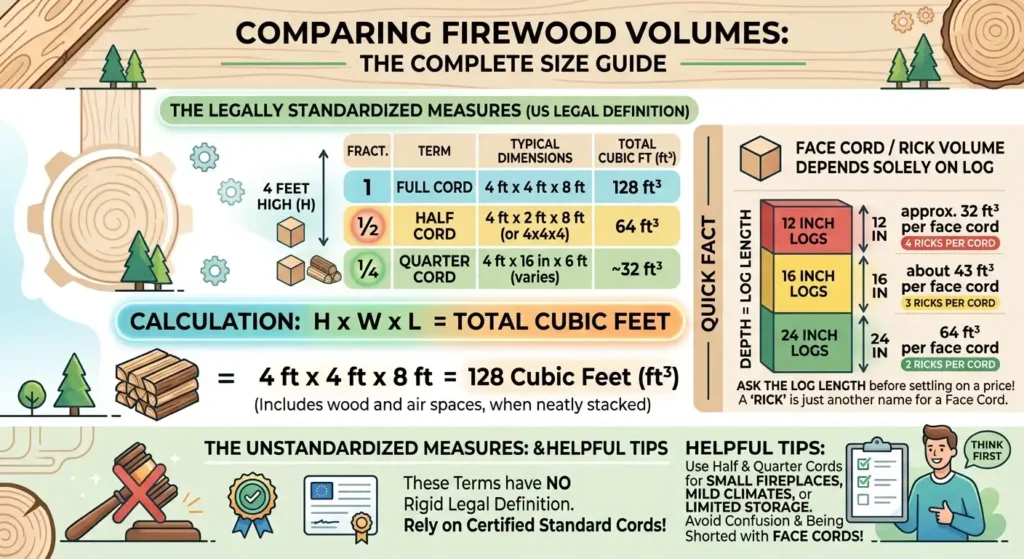
| Term | Typical Dimensions | Cubic Feet | Fraction of a Full Cord |
| Full cord | 4 ft x 4 ft x 8 ft | 128 cu ft | 1 (whole cord) |
| Half cord | 4 ft x 2 ft x 8 ft (or 4x4x4) | 64 cu ft | 1/2 |
| Quarter cord | 4 ft x 16 in x 6 ft (varies) | ~32 cu ft | 1/4 |
| Face cord / rick (16″ logs) | 4 ft x 8 ft x 16 in deep | ~43 cu ft | ~1/3 |
What Is a Face Cord?
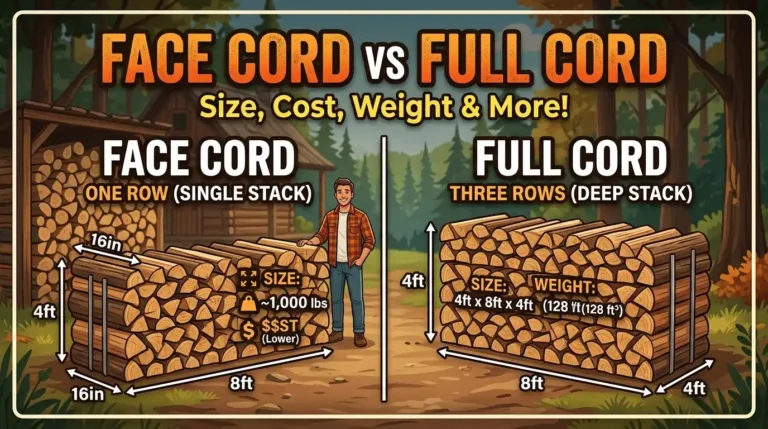
A face cord (also known as a rick, rank or rack depending on the area) is a stack of the same height and length as a full cord, but with only a single log deep. Its true volume is completely dependent on the length of the individual logs, since the depth of the stack is the length of the log.
- 12 inch logs: approximately 32 cubic feet per face cord (4 ricks per cord)
- 16-inch logs: about 43 cubic feet per face cord (3 ricks make a full cord)
- 24-inch logs: 64 cubic feet per face cord (2 ricks to the cord)
This is the only biggest source of confusion by the buyer. Two vendors may each sell a “face cord” and deliver to you a piece of wood which is distinctively different, simply because their logs are of different lengths. When one quotes you a face cord or rick, always ask him the length of the log.
What Is a Rick of Wood?
A face cord is just known as a Rick, in another part of the world. It is not a distinct, standardized measurement and it has no rigid legal definition as a full cord does. When a seller calls it the word rick, then do just as with a face cord, and make sure that you get the length of the log before you settle on a price.
What Is a Half Cord and a Quarter Cord?
A half cord is just half 128 cubic feet or 64 cubic feet. It is usually piled 4 ft high x 4 ft long x 2 ft deep, or 4 ft high x 8 ft long x 2 ft deep, depending on the seller. A quarter cord measures approximately 32 cubic feet and is frequently piled in the form of 4 ft high x 6 ft long x 16 inches deep.
They are both handy when you have a small fireplace, in a mild climate, or when you have little storage space and do not require a full cord of wood at once.
How Much Solid Wood Is Actually in a Cord?
Here is a fact that hardly anyone ever tells you: the space that the stack occupies is 128 cubic feet, not the amount of solid wood in it. Split firewood is irregular and hence air gaps always exist between the pieces. The average volume of those gaps in a well-packed cord is 30 to 40 percent of the total volume. That means the actual solid wood in a “full cord” is closer to 75 to 90 cubic feet, with the rest being air.
This is important since a loose pile of wood, thrown loosely, requires a great deal more of outer volume to be equal to one true cord. A crude estimate: a loose, unpiled pile should be nearer to 180 cubic feet to hold as much wood as a cord 128 cubic feet in length. When a seller delivers wood that is dumped, not stacked, then you cannot determine the amount by merely looking at the height of the pile.
How to Measure a Cord of Wood Yourself
No special instruments are required, just a few minutes and a tape measure. This is the way to verify a delivery or a stack that you have made yourself.
- Pile up the wood. The gaps must not be too large but just big enough that a chipmunk can squeeze through. Even loosely thrown wood will always be bigger than its cord counterpart.
- Determine the height of the stack in feet, ground to top.
- Find the length of stack, feet to feet.
- Determine the depth of the stack (length of the logs in front to back).
- Multiply height (length) x depth. That makes you cubic feet all.
- Divide by 128. The outcome informs you of the number of cords, or of a proportion of a cord, with which you are dealing.
Example: A stack that is 4 ft high x 4 ft deep x 6 ft long = 96 cubic feet. Divide 96 by 128 and you have 0.75 or three-quarters of a cord.
In case the stack is not flat at the top or is sloping at the ends, measure several height values along the length and average them to get a more realistic value.
How Many Pieces of Firewood Are in a Cord?
This will depend a lot upon the splitting of the wood and the size of each piece, but as a rough point of reference, a full cord of 16-inch splits will normally include between 500 and 700 pieces. The bigger, thicker the split, the fewer pieces to the cord; the smaller, the thinner the split, the more.
How Much Does a Cord of Wood Weigh?
Weight is not a sure method of purchasing firewood, since the same 128-cubic-foot cord can weigh radically different weights based on the type of wood and the moisture content of the wood. As a general guide:
- Seasoned softwood (pine, fir, spruce): about 2,000 to 3,000 lbs per cord.
- Seasoned hardwood (oak, maple, ash, hickory): approximately 3,000 to 5,000 + lbs per cord.
- Fresh (cut) wood of any kind: fresh wood is usually 1.5 times heavier than the same seasoned wood, because of water content.
The heavy hardwoods such as oak and hickory are found at the apex of that range and they also burn longer and hotter, which is one of the reasons why they are so desirable as firewood. A cord of green red oak, e.g., may weigh more than 5,000 pounds, whereas the same cord seasoned to a lower moisture content may weigh nearer to 4,000 pounds or less.
Since weight varies so much depending on species and moisture, it is always important to verify purchases of firewood on a volume basis (cord, half cord, face cord) rather than on a weight basis.
Cord of Wood vs. Truck Bed: Visual Comparisons
Paper numbers are helpful, but the majority of individuals find it simpler to visualize a cord beside something they are familiar with.
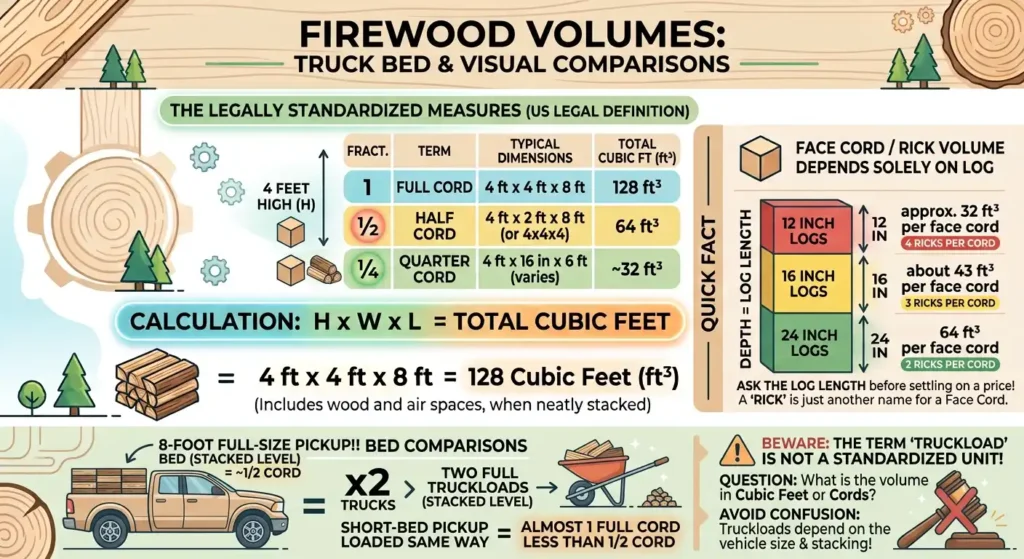
- A conventional full-size pickup bed (8-foot bed) with the top of the bed rails stacked, has a capacity of approximately half a cord.
- A short-bed pickup, which is loaded in the same manner, generally carries significantly less than half a cord due to the shorter length of the bed.
- 2 full pickup loads (stacked level) of an 8-foot bed truck will bring you to almost one full cord.
- A typical wheelbarrow load of split wood is a tiny fraction of a cord, which is primarily useful in determining the number of trips it will require to carry a stack of wood between delivery point and storage.
When a seller tells you that a delivery is a truckload, inquire what that is in cubic feet or cords. The term “truckload” is not a standardized unit and depends on the vehicle.
Where Does the Word “Cord” Come From?
The term has its origins in the days when the piles of firewood were literally measured and tied with a length of cord or rope. Sellers would tie a stack of wood to a length of a length of a cord (the string, not the length of wood) and the bundle would be called by the instrument by which it was measured.
With time, a cord came to mean the size of the stack rather than the rope, and came to be standardized at the 4x4x8, 128-cubic-foot size that is still in use today.
Is a Cord of Wood a Legal Standard?
Yes. In the United States, the cord is the standard unit of sale of firewood, and in most states, sellers of firewood must indicate the amount sold in cords or a specified fraction of a cord (like a half cord) on the receipt or advertising. The origin of this standard is in national weights-and-measures guidance used by state regulators to maintain a fair and consistent sale of firewood.
Rick, face cord, truckload, or pile are not legally standardized and it is precisely because of this that they create so much confusion among buyers. When a seller offers you a price in anything but cords or in any definite fraction of a cord, insist that he convert it to cubic feet, or a cord-equivalent, before you accept.
Common Mistakes When Buying or Measuring Firewood
- Suppose that rick is always the same. It is all a matter of log length, and ask.
- Estimating the volume based on the pile height but not considering depth and length.
- Taking a loosely tossed pile and accepting it as a cord without rearranging or checking that it is the right size.
- Mixed up weight and volume. A light load does not necessarily mean a lesser amount of wood; it may simply be a lighter species of wood or more seasoned wood.
- Failure to receive a receipt indicating the amount in cords or a definite fraction. This is mandatory in most states and your safeguard in case a dispute arises in future.
How Many Cords Do You Need for Winter?
This is greatly dependent on your climate, the level of insulation of your home, whether your main source of heat is firewood or a supplement, and the efficiency of your stove or fireplace.
Home wood heat: Roughly speaking, houses which rely on wood as their main source of heat in a cold climate typically consume three to five cords of wood in a complete winter, and houses which burn wood for supplemental heat or atmosphere may consume less than one cord in a season.
When you are new to heating with wood, it is worth keeping a record of your actual use during one winter, so that you can order more accurately the next year.
Myth vs. Fact
Myth: A cord of wood is always piled up at a 4 feet 4 feet 8 feet.
Fact: A stack of 128 cubic feet is a full cord, but the shape of 4x4x8 is by far the most popular, as it is stable and can be measured.
Myth: A cord and a rick are one.
Fact: With standard 16-inch logs a rick (face cord) is usually approximately one-third the volume of a full cord, although the fraction varies with log length.
Myth: The heavier the load of firewood, the more the wood.
Fact: Volume does not determine weight, but rather moisture content and species. A lighter, well-seasoned hardwood load can have the same amount of usable wood as a heavier, wet load.
You May Also Like to Read:
- How Much Wood Is in a Cord? A Complete Size, Weight, and Buying Guide
- How Big Is a Cord of Wood? Exact Dimensions, Volume, and What It Looks Like
FAQs
What are the exact dimensions of a cord of wood?
The size of a full cord is 4 feet high, 4 feet deep, and 8 feet long, which is 128 cubic feet.
Is there a cord of wood identical with a face cord?
No. The face cord is only a row deep (the same as the length of the log, which is typically 16 inches) and not a complete 4 feet deep, thus it is about one-third the volume of a full cord of standard 16-inch logs.
How many cubic feet of wood is a cord of wood?
A full cord contains 128 cubic feet. A half cord is 64 cubic feet and a quarter cord is approximately 32 cubic feet.
What is the weight of a cord of wood?
It depends on species and moisture, and is usually 2,000 to 3,000 pounds of seasoned softwood and 3,000 to 5,500 pounds of hardwood. Green (unseasoned) wood weighs much more because of the presence of water.
How many are the pieces of firewood in a cord?
A cord of standard 16-inch splits typically contains 500 to 700 pieces, but the exact number depends on the size and shape of the splits.
What proportion of a cord is solid wood?
Approximately 75 to 90 cubic feet of a 128-cubic-foot cord is solid wood, with the remaining space consisting of air gaps between the stacked pieces.
Is a rick the same as a half cord?
No. A rick, often used to describe a face cord, is about one-third of a full cord when the logs are 16 inches long, not one-half. The terms should not be considered interchangeable.
What is the storage size of a full cord?
The standard 4-by-4-by-8-foot stack occupies a 4-foot by 8-foot footprint and is 4 feet high. Consider storing the wood in a covered area or on a raised platform to help keep it dry.
How do I know if I’m getting a full cord?
Stack the wood and measure the height, depth, and length in feet, then multiply these measurements. A full cord equals 128 cubic feet. If the wood is delivered loose, ask the seller to stack it or account for the additional bulk caused by the spaces between loose pieces.
Is it possible that a cord of wood can be of other dimensions than 4x4x8?
Yes. As long as the stacked wood measures 128 cubic feet, it is technically a full cord regardless of the exact dimensions or shape. The 4-by-4-by-8-foot configuration is the standard reference because it is easy to stack and measure.
Final Thoughts
A cord of wood is reduced to a single sure number, 128 cubic feet, usually piled in 4 feet high by 4 feet deep by 8 feet long. That is the amount that is legally standardized in the firewood world, and thus the safest thing to base your purchasing decisions on. All the rest, rick, face cord, truckload, pile, is regional shorthand, and may mean various things to different people.
The best habit you can develop is the simple one of measuring the stack yourself before you buy firewood, of checking the length of the logs when you are purchasing a face cord or a rick of wood, and of obtaining a receipt which states how many cords, or a definite fraction of a cord, you have purchased.
That single move will save you the ambiguous wording that leads to most of the firewood arguments, and you will be aware of what you are taking home before the winter season sets in.