Ash Tree Firewood: The Complete Burning Guide to Heat Output, Seasoning, and Getting the Most From Every Log
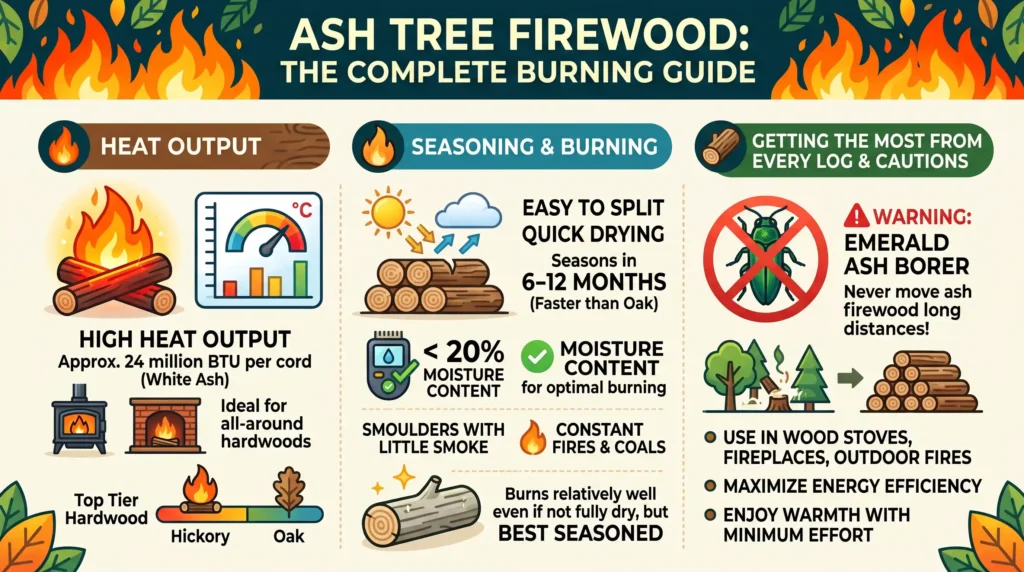
Ash would make a good choice of firewood, easy to split, quick to dry, and hot with minimum effort. The Ash tree firewood has proved to be among the best all round hardwoods in terms of wood stoves, fireplaces and even outdoor fires.
This guide includes information on how hot ash burns, how it dries up, comparisons with other woods, and what you should understand about emerald ash borer before you cut, move, or purchase it.
Key Takeaways
- Ash is a high quality firewood with an approximate of 24 million BTU per cord (white ash).
- It is easy to split, and seasons quicker than most hardwoods, usually in 6-12 months.
- It smoulders with little smoke, constant fires and coals.
- Never move ash firewood long distances. Emerald ash borer is a serious threat.
- Always check moisture. Before burning, aim at less than 20%.
Is Ash Tree Firewood Good? (Quick Answer)
Yes, ash is good firewood. It is a heavy hard wood, which is very warm, burns well when dry, and cleaves readily, and dries quicker than oak. It is one of the most popular burners with many who have tried it, and is second only to denser woods such as hickory and white oak.
It is also among the few woods which will burn fairly well, even when not quite dry, but it is best seasoned.
Ash Firewood Heat Output and BTU Ratings
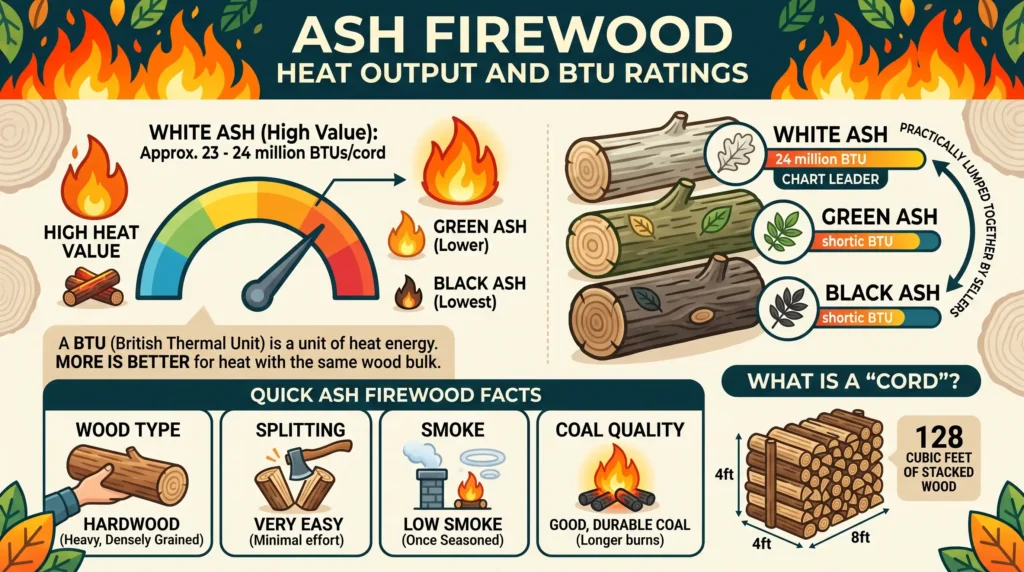
Typical Forest Service based charts suggest that white ash generates approximately 23 to 24 million BTUs per cord. A BTU (British Thermal Unit) is a unit of heat energy. The more the better the amount of heat you obtain with the same bulk of wood.
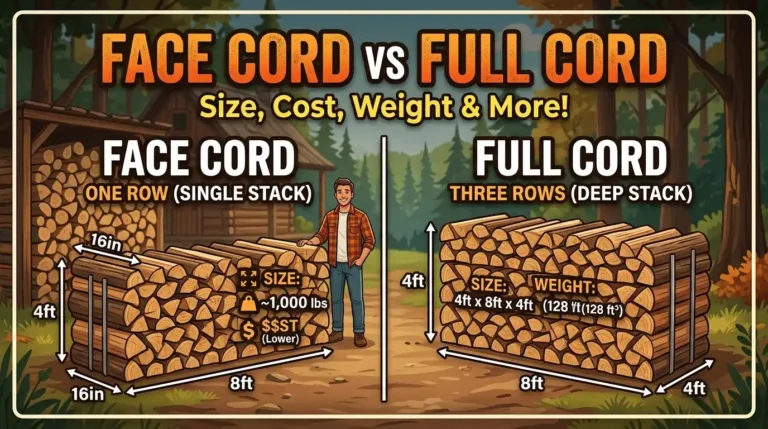
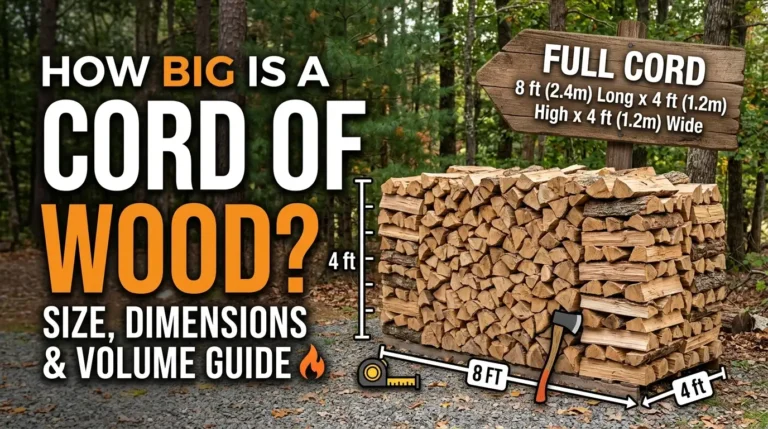
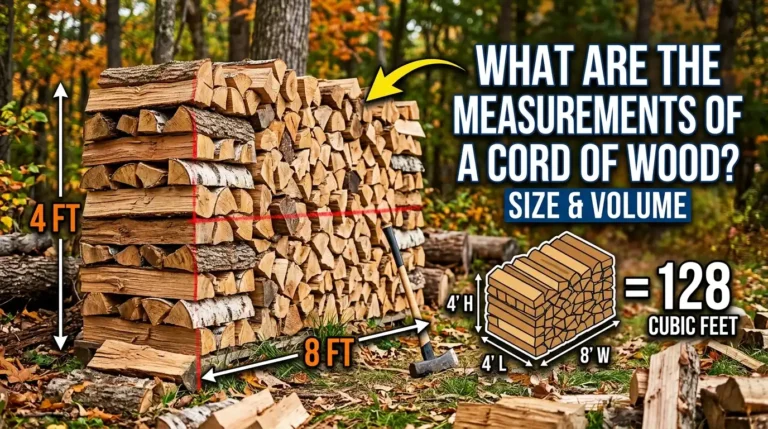
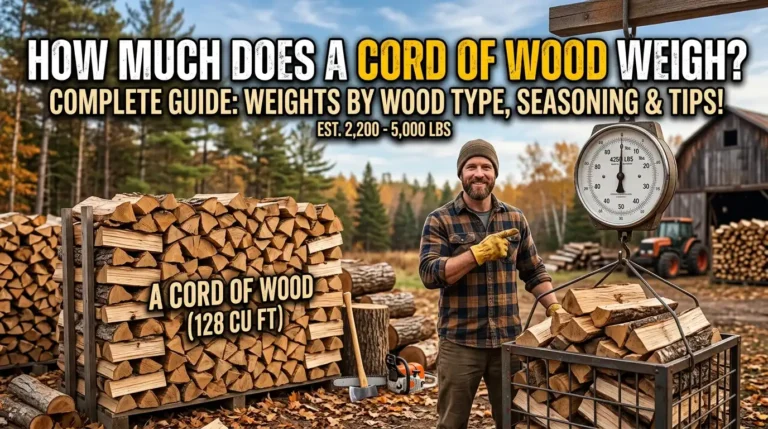
A cord is a stack measuring 4 feet by 4 feet by 8 feet, or 128 cubic feet of stacked wood. Since seasoned wood is lighter than green, it also helps to know what a full cord actually weighs when you plan hauling or storage
A related species, green ash, is rated a little lower than white ash, and black ash even lower. Practically, the majority of sellers lump them together as ash.
Quick facts
- Wood type: Hardwood
- Heat value: High (approximately 20 to 24 million BTUs per cord in different species)
- Splitting: very easy.
- Smoke: Low seasoned.
- Quality of coal: Good, durable.
- Spark tendency: Low The Comparisons of Ash with other Woods.
Numbers are approximate, and are rounded to the nearest tenth based on general reference charts.
How Ash Compares to Other Woods
| Wood | Approx. BTUs per Cord (millions) | Notes |
|---|---|---|
| Hickory | 27 to 28 | Among the hottest, very dense |
| White oak | 26 to 29 | Very dense, slow to season |
| Sugar maple | 24 to 25 | Excellent all-around |
| White ash | 23 to 24 | Easy to split, fast to dry |
| Red oak | 23 to 25 | Long seasoning time |
| Yellow birch | 20 to 21 | Good, burns fast |
| Cherry | About 20 | Pleasant aroma |
| Poplar / pine | 15 to 18 | Lower heat, faster burn |
Curious about birch? It is a common question, and it helps to see why birch counts as a hardwood despite its quick burn.
Why Burners Love Ash
The popularity of ash is due to its ability to cook with great heat and little effort. This is what makes it special:
- Splits easily. The grain is frequently cut in a straight line with a single stroke of a maul, and this spares your back.
- Seasons fast. Ash is naturally dry compared to most of the hardwoods and therefore it dries fast after splitting.
- Burns cleanly. Experienced ash burns constant fires and minimal smoke.
- Good coals. It burns a bed of long lasting coals which can be used in overnight burns.
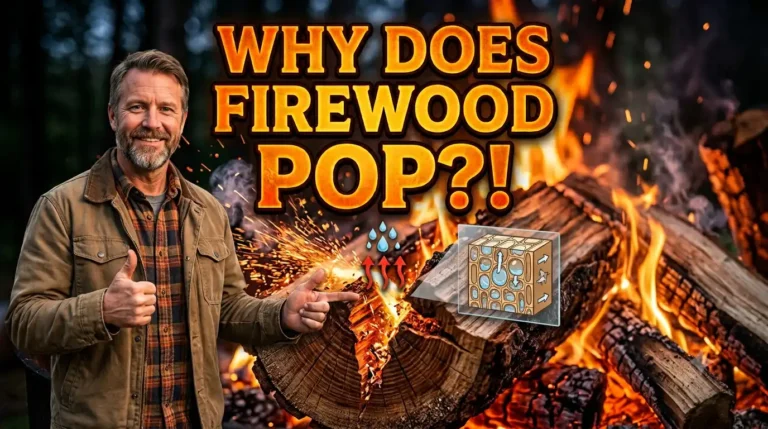
- Low sparking. It does not pop or spit embers, so it is suitable to open fireplaces.
- Can be used when slightly wet. When not quite dry, ash burns better than most hardwoods. This does not justify not seasoning, but it comes in handy.
Downsides of Ash Firewood
No wood is perfect. Consider these limits:
- Not the heaviest hardwood. Hickory and white oak produce more heat per cord.
- Emerald ash borer. The supply in certain areas can be constrained by restrictions on the movement of ash wood.
- Standing ash is dead. Borer kills trees and makes them brittle and when you cut a tree, the branch or trunk can collapse unexpectedly.
- Less aroma. Cherry or apple might be better suited to you in case you want a unique smell to cook or to create an ambiance.
Ash Firewood vs Oak, Maple, and Hickory
| Factor | Ash | Oak | Maple | Hickory |
|---|---|---|---|---|
| Heat output | High | High to very high | High | Very high |
| Season time | Short (6 to 12 months) | Long (1.5 to 2+ years) | Medium | Medium to long |
| Splitting | Very easy | Moderate to hard | Moderate | Hard |
| Smoke when seasoned | Low | Low | Low | Low |
| Best for | Everyday heating, fast turnaround | Overnight, cold snaps | All-purpose | Coldest weather |
Bottom line: If you need firewood ready sooner, ash beats oak. Oak needs a much longer drying period, which you can read about in this breakdown of oak’s BTU output and seasoning needs. If you want maximum heat and can wait, oak or hickory wins.
Sugar maple is another dense option worth a look. This guide on whether maple burns well in a stove shows how it stacks up against ash for heat and burn quality.
How Long Does Ash Take to Season?
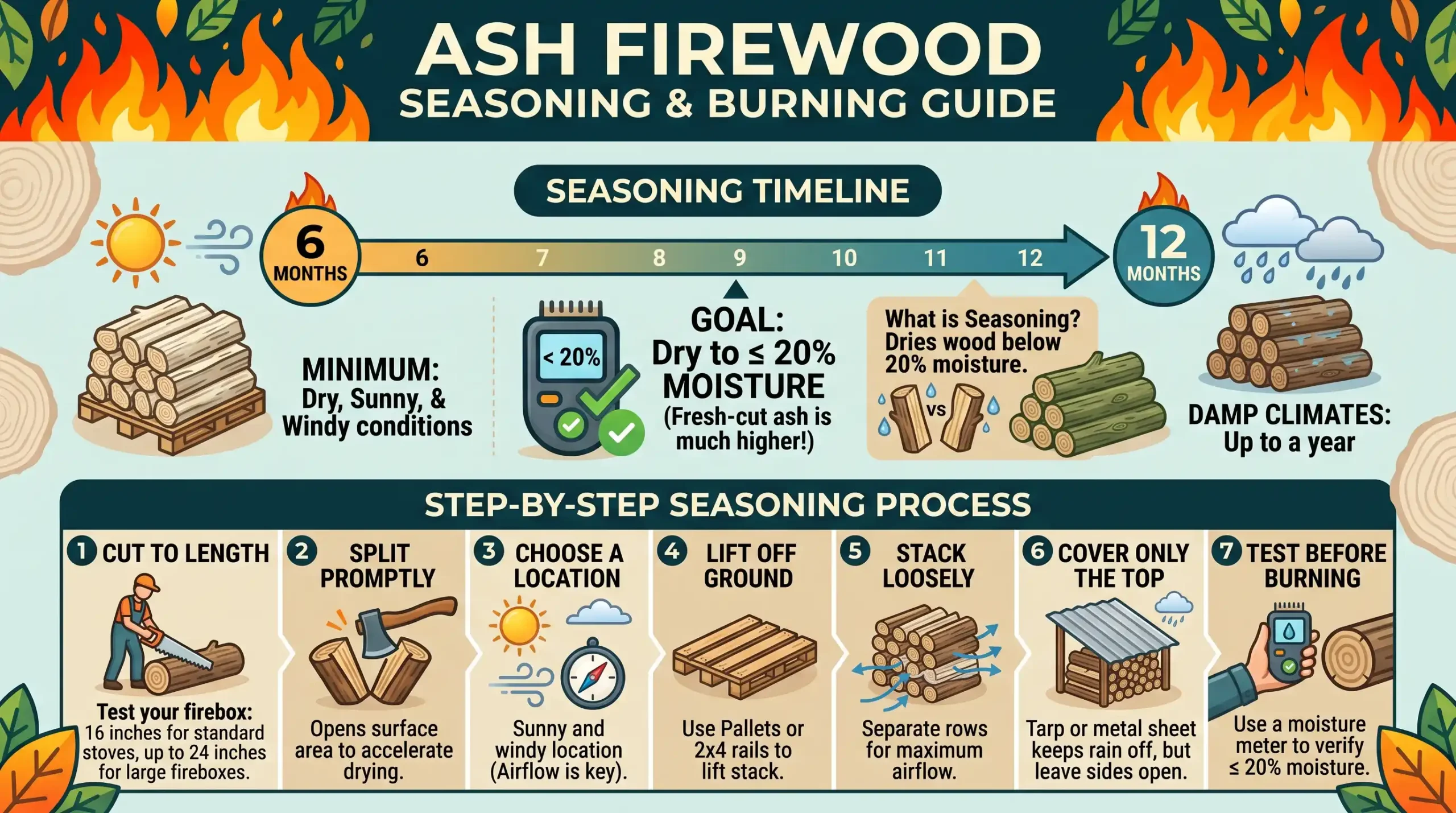
Split ash usually requires 6 to 12 months to season, based on weather, stacking technique and size of logs. It can be prepared in six months in dry, windy, sunny conditions. In damp climates, count on nearer to a year.
Seasoning means drying wood until it holds around 20% moisture or less. Much more can be in fresh-cut ash.
Step-by-Step Seasoning
- Cut to length. Stoves are 16 inches and large fireboxes are up to 24 inches. Test your firebox.
- Split promptly. Cracking opens up a greater surface area, accelerating drying.
- Select a sunny and windy location. Heat is not as important as airflow.
- Lift the stack off the ground. Pallets or 2×4 rails.
- Stack loosely. Separate rows to allow air to pass through.
- Only cover the top. A metal sheet or tarp is used to keep rain out. Leave the sides open.
- Test before burning. Measure with a moisture meter.
How to Test If Ash Is Dry
- Moisture meter: Cut a piece in half, and test the newly exposed inner surface. The target is less than 20%.
- Sound: Two dry pieces struck together sound hollowly and sharp. Wet wood thuds.
- Weight: Experienced wood is much lighter.
- Appearance: It is dry when the ends have cracks (checks) on them and the darker, dull ends.
How to Split and Stack Ash
Ash is among the more amiable woods to cut. It is normally done with a maul or splitting axe and a hydraulic splitter makes it simple on large rounds.
Tips
- Cut across the grain, trying to hit the natural cracks.
- Use eye protection and steel-toe shoes.
- Cut rounds when still green, as they may be more easily cut than completely dry timber.
- Stack bark-side up on top layer to lose water.
Burning Ash in Stoves, Fireplaces, and Fire Pits
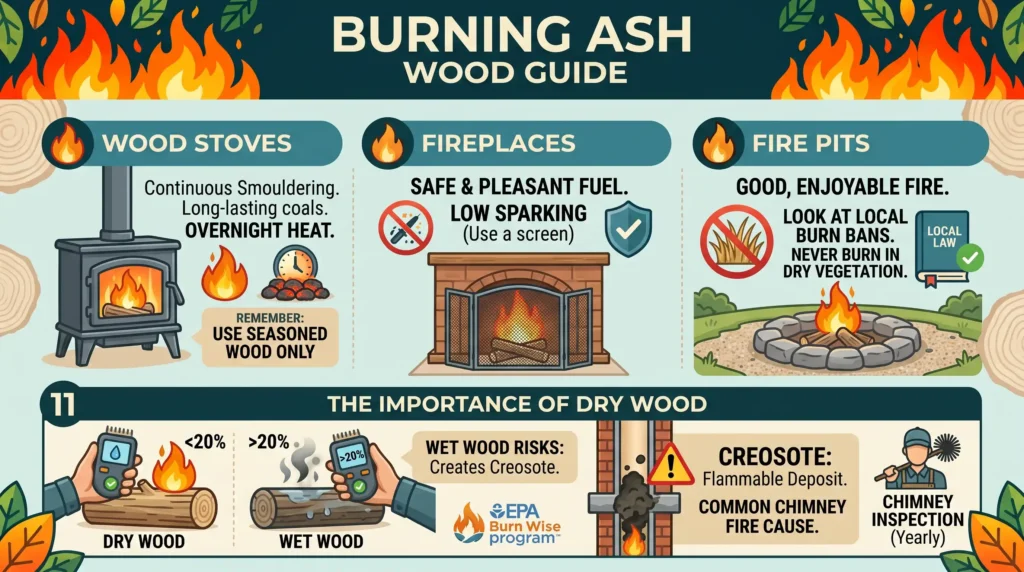
Wood stoves: Ash is a good stove fuel. It smoulders continuously and forms long-lasting coals to keep the heat overnight. To cover your stove and chimney, use only seasoned wood.
Fireplaces: Ash is a safe and pleasant fuel in open hearths due to low sparking. Have a screen at any rate.
Fire pits: Ash is a good fire. Look at local burn bans and never burn in dry vegetation.
The importance of dry wood: Wet wood burns more, and may leave creosote in your chimney. Creosote is a flammable deposit that is a common cause of chimney fires. According to the Burn Wise program by EPA, it is advisable to burn dry and seasoned wood. Have your chimney inspected yearly.
Emerald Ash Borer and Firewood Safety
Emerald ash borer (EAB) is an Asian beetle that has invaded and killed hundreds of millions of ash trees in North America. It was initially discovered in Michigan in 2002 and has since become common.
This has 3 impacts on you:
- Do not move firewood long distances. The larvae are able to survive under the bark and relocation of wood can transmit infestations. Many states and provinces restrict transport.
- Purchase local or certified. Purchase firewood locally or buy kiln-dried or heat-treated wood that is certified as pest-free.
- Be wary of dead trees. EAB kills ash and dries it up and makes it brittle. When a big tree appears dead, do not cut it but call a certified arborist.
It is ok to burn ash that has been killed by EAB. The wood can still be used when it has not begun to rot. It is not the fuel that is spreading the insect, but the concern. Burn it in the same place it was cut.
Buying Ash Firewood
Buyer checklist
- Inquire whether it is seasoned or kiln-dried.
- Check the cord measure. A “face cord” or “rick” is not a full cord.
- Take a moisture meter and measure some pieces.
- Examine presence of mold, deep rot or excess bugs.
- Inquire about its place of cut, particularly when you are living in an EAB quarantine area.
- Affirm delivery and stacking services.
Cost: Prices fluctuate widely according to the region, time of year and whether the wood is seasoned or kiln-dried. Precise averages are not always available on a national basis, so make comparisons among at least three local suppliers.
Common Mistakes
- Use of unseasoned wood and neglect of the moisture test.
- Piling on the ground.
- Sealing the entire stack, which seals moisture.
- Moving ash within areas.
- Cutting down big dead ash trees without assistance.
- Making an assumption of a cord without measuring.
FAQs
Is ash good firewood?
Yes. It burns hot, splits readily, seasons quickly, and when dry, it does not produce much smoke.
How many BTUs does ash firewood have?
White ash is rated at an average of 23-24 million BTUs per cord. Other ash species can be a little bit lower.
Will ash wood green burn?
You may, and it burns better than most hardwoods, but it smokes more and burns less. Still, it is advisable to season.
What is the time of ash firewood drying?
Typically 6-12 months when divided and stacked correctly.
Which is better firewood, ash or oak?
Oak is a little heavier and provides more heat, but ash dries much quicker and is more easily split.
Is ash firewood sparky or poppy?
Very little. It is generally a low-spark wood.
Does ash work with wood stoves?
Yes. Its constant fire and permanency of coals are befitting stoves.
Can ash be used as firewood to cook with?
It is clean-burning and occasionally used, but has little character. Hickory and fruitwoods are more favored to taste.
Is it possible to burn ash that has been killed by emerald ash borer?
Yes, if the wood is sound. Burn it at home and carry it not.
Can ash firewood be transported?
Regulations are state, provincial, and county-specific. Transport beforehand, check your local agriculture department or USDA APHIS.
When is ash firewood ready?
Measure with a moisture meter. The target is less than 20% moisture.
Will ash firewood leave much ash behind?
It yields a small quantity, and it is simple to wash out. The quantities depend on the dryness of the wood and the airflow in the stove.
Is ash good for overnight burns?
Yes. Its coals are good heat retentive especially in an efficient stove.
What is the best way to store ash firewood?
High, carelessly piled, and top-covered, and in a cool place not close to your house walls.
Final Thoughts
Ash tree firewood is a good heat producer, splits easily and turns around quickly, making it one of the most viable firewoods you can burn. It might not be as dense as hickory or white oak, but there are few woods as convenient and performance-balanced as it is.