How to Run a Gas Line to an Outdoor Fire Pit: Plan It Right and Let a Licensed Pro Do the Gas Work
A gas fire pit turns a plain backyard into the place everyone gathers after dark. No hauling wood, no smoke in your eyes, and a flame that starts with the turn of a valve. Learning how to run a gas line to an outdoor fire pit starts with one honest fact: the gas work itself is not a homeowner job. The pipe, the connections, the pressure test, and the final hookup belong to a licensed gas professional.
That does not mean you sit on the sidelines. You choose the fuel, pick the spot, measure the route, check permits, and prepare the site. Those choices shape the cost and the result. This guide walks you through each part in order, shows what the professional does step by step, and flags the lines you must never cross on your own.
⚠ Heads Up: Read This Before You Touch Anything Gas-Related
Gas work can kill. Carbon monoxide (CO) is colourless and odourless, so you cannot see or smell it. Fit CO alarms on every level of your home and near sleeping areas, and test them monthly. If you ever smell gas — a rotten-egg odour — do not touch light switches, flames, or appliances. Leave the home right away with everyone, including pets, then call your gas utility’s emergency line or 911 from outside. Never try to find or fix a leak, open a gas line, or relight anything yourself.
Never open gas lines, adjust the regulator, bypass safety devices such as the thermocouple or oxygen-depletion sensor, block vents, or disable a CO alarm. Gas-line, installation, and conversion work goes to a licensed gas professional only. If your fire pit is a ventless design, know that combustion byproducts enter the room, and local codes may restrict or ban ventless appliances — check before you buy.
Pets are more sensitive to gas and CO than people are, and birds especially so. If a pet acts confused, wobbly, or short of breath near a gas appliance, get everyone into fresh air and call for help.
Disclaimer: This article is general guidance, not a substitute for local codes or a licensed professional’s advice. Gas codes, permit rules, and burial depths vary by area. Always check your local rules and hire a licensed gas professional for all gas-line work.
Total Time
1–3 weeks
permits + scheduling
Your Active Time
3–5 hours
planning + site prep
Difficulty
Pro install
homeowner plans, pro pipes
What You Need
Your planning kit (homeowner):
- Tape measure (at least 25 ft) and a garden hose or rope to mark the route
- Fire pit model picked out, with its gas inlet size and fuel type from the manual
- Your gas bill or meter details, so the gas company can check capacity
- Permit application details from your local building department
- Phone number for 811 (US) or your local before-you-dig service
- Quotes from two or three licensed gas professionals
What the licensed pro brings (you do not buy these):
- Approved gas pipe, fittings, shutoff valve, and regulator
- Pipe thread sealant rated for gas, pressure-test gauge, and leak-detection fluid
- Trenching tools or a trencher, plus backfill and compaction gear
At a Glance
- Choose your fuel: natural gas or propane
- Pick the fire pit spot and measure the route
- Check permits and call 811 before anyone digs
- Ask your gas company about meter capacity
- Hire a licensed gas professional
- Prepare the site while the pro works
- Watch the pressure test and inspection
- Light the fire pit for the first time
Start With the Big Picture
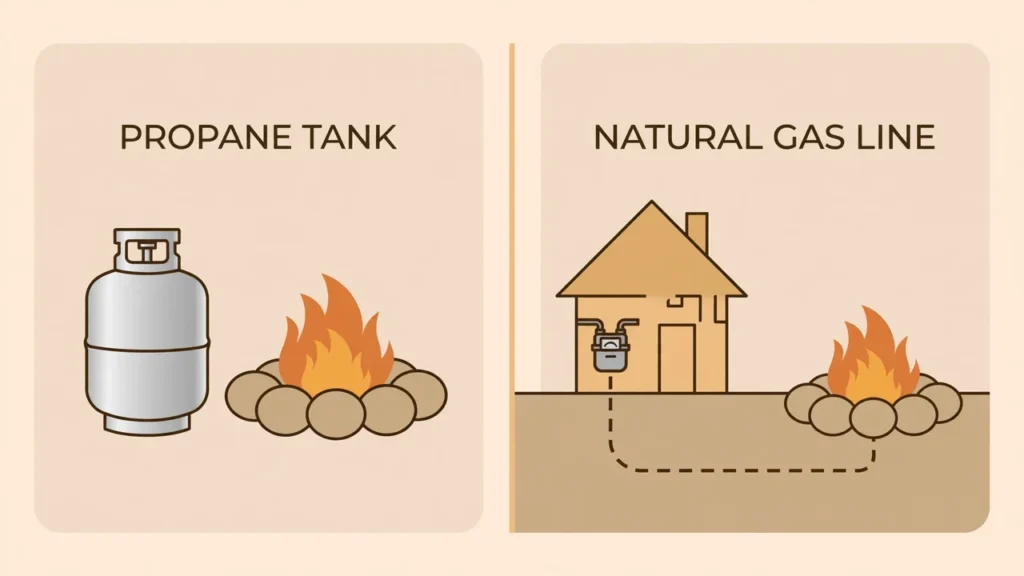
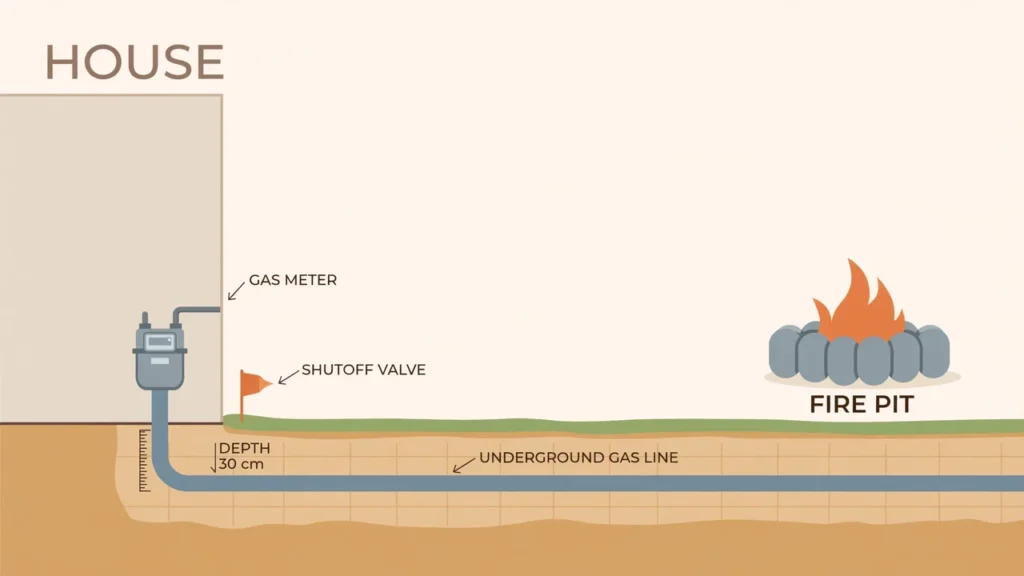
A gas line to a fire pit is a short branch off your home’s gas supply. For natural gas, the line runs from your house meter, underground through the yard, and up into the fire pit base. For propane, the line runs from a tank to the pit, and the tank can sit above ground or be buried by a pro. Either way, the pipe stays buried or protected, a shutoff valve sits within reach, and every joint gets tested before the first flame.
Most of the calendar time goes to permits and scheduling, not digging. A short, straight run across open lawn can be trenched and piped in a day once the pro is on site. A long run under a patio or driveway takes longer and costs more. Your job is to make the pro’s day smooth: a clear route, a firm fire pit choice, and permits already in hand.
Choose Your Fuel: Natural Gas or Propane
Your fuel choice shapes the whole project, so settle it first. Natural gas comes from your home’s utility line, so it never runs out and you never swap a tank. Propane comes from a tank you own or lease, which suits homes without a gas meter or yards far from the house.
Check what your home already has. A house with a gas furnace or gas water heater likely has a meter the pro can tap into. A house with no gas service at all will need a propane tank, and the tank placement becomes part of the plan. Your fire pit must match the fuel — a natural gas burner and a propane burner are not interchangeable, and converting a propane fire pit to natural gas is a separate job with its own parts.
| Factor | Natural Gas | Propane |
|---|---|---|
| Supply | Utility line, endless | Tank, needs refills |
| Best for | Homes with a gas meter, pits near the house | Homes without gas service, pits far from the house |
| Up-front work | Trench from meter to pit | Tank placement + line to pit |
| Running cost | Usually lower per hour of flame | Usually higher, plus delivery fees |
| Ongoing chores | None — always on tap | Watch the tank level, schedule refills |
| Flexibility | Fixed — the pit stays put | Tank can move with a new line run |
Running costs vary by region and utility rates. Ask your gas company for a local estimate before you commit.
If you are torn, read our full breakdown of propane vs natural gas fire pits before you buy anything. The wrong fuel choice is the most expensive mistake in this project, because the burner, regulator, and line all change with it.
Pick the Fire Pit Spot and Measure the Route
Walk your yard with the fire pit in mind and the tape measure in hand. The spot needs level ground, clear space above it, and a sensible path back to the gas source. Keep the pit at least 10 feet from the house, fences, sheds, and low tree branches, and check your fire pit manual — some models ask for more clearance.
Lay a garden hose along the route the pipe would take from the meter or tank to the pit. A straight, short run costs less and fails less often than a long run with bends around patios and beds. Measure the hose, then add 10 percent for bends and the rise into the pit base. Write the number down — every pro you call will ask for it.
Think about the shutoff valve while you walk. It should sit close to the pit and within reach, not buried behind furniture or under deck boards. Many owners put a valve post or a small access box beside the pit. Ask your pro where they would place it and mark the spot with a flag.
Check Permits and Call 811 Before Anyone Digs
Most towns require a permit for new gas piping, and many require an inspection before the line goes live. Call or visit your local building department early, before you book a pro. Ask three things: whether a gas permit is needed, what the inspection covers, and how long approval takes. In some areas the answer comes back in days; in others it takes weeks.
Before any digging starts, call 811 (in the US) or your local before-you-dig service at least a few business days ahead. The service marks buried electric, water, sewer, and gas lines with paint or flags, free of charge in most areas. Digging blind risks cutting a live utility line, and that is a danger to the crew and the whole street.
Heads Up: Never Skip the 811 Call
Even a shallow trench can hit a buried cable or pipe. The marks from 811 expire after a set number of days, so time the call close to the dig date. If the marks fade or the work slips, call again. Outside the US, use your country’s equivalent locate service and follow its timing rules.
Ask Your Gas Company About Meter Capacity
Your gas meter and the pipe feeding your house were sized for the appliances you already own. A fire pit adds demand, and a big burner can push the system past what it can deliver. Call your gas utility with the fire pit’s gas input rating from its manual — the pro can help you find that number if the manual is unclear.
The utility will tell you whether the meter can handle the extra load or needs an upgrade. A meter upgrade is routine work for the utility, but it adds time and sometimes a fee, so find out early. This is also the moment to ask about the gas pressure at your meter, since the pro sizes the new pipe from that number.
Hire a Licensed Gas Professional
Get quotes from two or three licensed gas fitters or plumbers who do outdoor gas work. Ask each one the same questions: Are you licensed for gas piping in this area? Will you pull the permit and book the inspection? What pipe material will you use, and why? What does the quote cover — trenching, backfill, the shutoff valve, the pressure test?
A clear written quote protects both sides. It should list the route, the pipe size and material, the valve location, the permit, and the inspection. Be wary of a quote that is far below the others or that skips the permit — corners cut on gas work do not stay hidden, and they can void your home insurance.
Ask for proof of license and insurance before work starts, and check the license number with your local authority if you can. A real pro expects that question and answers it without fuss.
Prepare the Site While the Pro Works
Your safe contribution is everything around the pipe, not the pipe itself. Clear the route of furniture, planters, and garden hoses. Mark sprinkler heads and shallow irrigation lines with flags so the crew can work around them. If the route crosses a lawn you care about, ask the pro whether the turf can be cut in strips and laid back after backfill.
Build or place the fire pit base if the model calls for a paver or stone pad, and keep the pit itself nearby but out of the trench path. Leave the gas connection point open and within reach — the pro needs clear access to the burner inlet and the valve. Do not cut, drill, or fit any gas part yourself while you wait.
Watch the Pressure Test and Inspection
Once the pipe is in place, the pro caps the ends and fills the line with air to a set pressure, then watches the gauge. A steady gauge means the joints hold. A dropping gauge means a leak somewhere, and the pro finds it and fixes it before moving on. This test is the single most important safety step in the whole job — never let anyone skip it or rush it.
After the test passes, the local inspector checks the work against code: pipe depth, materials, valve placement, and protection where the pipe rises out of the ground. Stay nearby and ask questions. A good inspector will point out anything that needs a tweak while the trench is still open, which beats finding it later.
Only after the inspection passes does the pro connect the line to the live gas supply and the fire pit burner. If your area requires a final sign-off, get the paperwork and keep it with your house records — it matters for insurance and for a future home sale.
Light the Fire Pit for the First Time
Have the pro present for the first light. They will purge air from the line, check each joint with leak-detection fluid, and light the burner while watching the flame pattern. A healthy gas flame burns mostly blue with steady yellow tips, and it should spread evenly across the burner ring.
If the flame is weak, uneven, or yellow and lazy, say so on the spot. Low flame often points to a sizing or pressure issue, and it is far easier to fix while the pro is standing there. Learn where the shutoff valve is and how it turns, and practice closing it once so the motion is familiar before you ever need it in a hurry.
Read the fire pit manual’s lighting steps before your first solo light. The exact sequence varies by model — some use a push-button igniter, others a key valve — and following the manual beats guessing. Our guide on how to light a gas fire pit covers the common ignition types and the habits that keep lighting safe.
What a Gas Line to a Fire Pit Costs
Costs swing widely with distance, soil, and local labour rates, so treat every number here as a rough 2026 estimate and get local quotes. A short natural gas run across open lawn often lands in the $500–$1,500 range for the pro’s labour and materials, while a long run under a patio or driveway can pass $2,000. Permits commonly add $50–$250, and a meter upgrade, if needed, is priced by your utility.
Propane adds the tank to the bill. A small above-ground tank and its line can run $400–$1,200 installed, while a buried tank costs more and needs its own permits. The fire pit itself is separate — burners, bases, and finishes range from a few hundred dollars to several thousand.
Two choices keep the bill down without cutting safety: a short, straight route, and a fire pit placed close to the gas source. Moving the pit 20 feet closer to the meter can save more than any haggling over the hourly rate.
| Cost Item | Rough 2026 Estimate | What Moves It |
|---|---|---|
| Pro install, short natural gas run | $500–$1,500 | Distance, soil, pipe size |
| Pro install, long or obstructed run | $1,500–$2,500+ | Patio, driveway, rock, trees |
| Permit + inspection | $50–$250 | Town fee schedule |
| Propane tank + line | $400–$1,200 | Tank size, above vs buried |
| Meter upgrade (if needed) | Priced by utility | Meter size, utility policy |
Rough 2026 estimates only — actual prices vary widely by region. Get two or three written quotes from licensed pros in your area.
Keep the Line Safe Year After Year
A buried gas line needs little attention, but it still deserves a yearly look. Walk the route each spring and look for sinking soil, new cracks in the patio above it, or plants dying in a straight line — any of those can hint at a problem below. Keep the shutoff valve clear and working, and never pave over the valve access or bury it under a deck.
Book a gas pro for a check if the flame changes, the pit smells of gas when off, or the valve sticks. Gas appliances and CO alarms belong together: if you have not yet fitted CO alarms, read whether gas fireplaces need a carbon monoxide detector and apply the same thinking to any gas appliance in your home. Pets share your yard, so keep them clear of the pit while it burns — see our notes on fire pit safety around dogs and pets.
Common Mistakes to Avoid
5 Mistakes That Cost Money or Create Danger
- Buying the fire pit before choosing the fuel. A propane burner cannot run on natural gas without a conversion kit, and the wrong burner wastes the whole purchase.
- Skipping the permit. Unpermitted gas work can void insurance and stall a home sale. The permit costs little next to the risk.
- Digging without calling 811. A cut utility line is dangerous and expensive, and the locate service is free in most areas.
- Letting anyone but a licensed pro touch the pipe. A friend who is handy with water plumbing is not qualified for gas. Joints, sizing, and testing are specialist work.
- Burying the shutoff valve or the line too shallow. The valve must stay reachable, and depth is set by local code — ask the inspector, not a guess.
Troubleshooting: If This Happens, Try This
| If This Happens | Try This |
|---|---|
| Flame is weak or uneven | Check that the valve is fully open, then call the pro — low flame can mean a sizing or pressure problem. |
| You smell gas near the pit | Turn the valve off if you can do so safely, leave the area, and call your gas utility’s emergency line from outside. Never relight it. |
| Burner will not light | Confirm the gas supply is on and the igniter sparks. If it sparks but will not catch, stop and call the pro. |
| Flame is tall, yellow, and sooty | Turn the pit off and call the pro. A lazy yellow flame can mean the wrong fuel, a blocked burner, or an air-mixture problem. |
| Valve is stiff or stuck | Do not force it. Call the pro to service or replace it — a forced valve can snap and leak. |
| Soil sinks along the line route | Call the pro. Settling is common after backfill, but a deep or growing dip deserves a check. |
Frequently Asked Questions
Frequently Asked Questions
Can I run a gas line to a fire pit myself?
No. Gas piping, connections, pressure testing, and the final hookup must be done by a licensed gas professional. You can plan the route, pick the fire pit, clear the site, and handle permits — the pipe itself is pro-only work.
How much does it cost to run a gas line to an outdoor fire pit?
Rough 2026 estimates put a short natural gas run at $500–$1,500 installed, and a long or obstructed run at $1,500–$2,500 or more. Permits commonly add $50–$250. Prices vary widely by region, so get two or three written quotes from licensed pros.
Do I need a permit to run a gas line to a fire pit?
In most areas, yes. A gas permit and an inspection are usually required for new gas piping. Check with your local building department before work starts, and ask your pro to pull the permit as part of the job.
How deep should a gas line to a fire pit be buried?
Burial depth is set by your local code and the pipe material — there is no single depth that fits everywhere. Ask your licensed pro and your local inspector for the depth that applies in your area, and never guess.
Is natural gas or propane better for a fire pit?
Natural gas suits homes with a gas meter and pits near the house, since it never runs out. Propane suits homes without gas service or pits far from the house, but the tank needs refills. Match the burner to the fuel — they are not interchangeable.
What should I do if I smell gas near my fire pit?
Turn the valve off only if you can do so safely, leave the area with everyone including pets, and call your gas utility’s emergency line or 911 from outside. Never try to find the leak, relight the pit, or touch light switches or appliances.
Quick Reference Card
You handle:
- Pick fuel (natural gas or propane) and the fire pit model
- Measure the route and mark the valve spot
- Check permits and call 811 before digging
- Confirm meter capacity with your gas company
- Clear the site and keep valve access open
The licensed pro handles:
- Pipe sizing, trenching, and installation
- Shutoff valve and regulator fitting
- Pressure test and leak check
- Inspection booking and final hookup
- First light and flame check
Remember: if you smell gas, leave with everyone including pets and call for help from outside. Never hunt for a leak yourself.
Your Fire Pit, Lit the Safe Way
You now know how to run a gas line to an outdoor fire pit the right way: choose the fuel, walk the route, sort the permit, check the meter, and hire a licensed pro for every inch of pipe. Your part of the job is real work, and it is the part that keeps the cost down and the result right.
Book the pro, keep the paperwork, and enjoy the first evening flame knowing the line under your lawn was tested and inspected. Your next step is a pleasant one: pick the seating, plan the first gathering, and read our guide on building a fire pit area in your backyard to finish the space around the pit.