Are Smokeless Fire Pits Worth It? An Honest Answer Before You Buy
Smokeless fire pits promise the warmth and glow of a wood fire without the usual cloud of smoke drifting into your face, your clothes, and your neighbour’s yard. They look great in photos, and the idea of sitting around a fire without constantly shifting your chair is appealing. The honest answer is that these pits really do cut smoke a lot — but they do not remove it completely, and they are not the right pick for every backyard.
This guide explains how smokeless fire pits work, when they earn their higher price, and when a standard wood pit or a gas pit would serve you better. It also covers the fuel, upkeep, and safety rules that matter before you light the first fire.
⚠️ Heads Up: Fire Pit Safety Comes First
Smokeless pits are still open wood fires. Use them outdoors only, never inside a garage, on a covered porch, or under a low roof. Keep the pit clear of your house, trees, fences, and anything that can catch fire — see our guide to fire pit clearance from your house, trees, and fence. Check local burn bans and air-quality rules before every fire, burn only dry untreated wood, and never burn treated or painted wood, trash, or yard waste. Never leave a fire unattended, keep children and pets well back, and put the fire fully out with water, stir the ashes, and check again before you go inside.
Smokeless Fire Pits at a Glance
🔥
Best for
Smoke-sensitive seating, close neighbours, campfire feel
🪵
Fuel
Dry, seasoned hardwood only — damp wood means smoke
💰
Cost
Higher than a basic steel pit; stainless models cost more
🧹
Upkeep
Regular ash removal and airflow-hole cleaning
⚠️
Key limit
Much less smoke, not zero smoke — wind and wet wood change that
What “Smokeless” Really Means
The word smokeless is marketing shorthand, and it sets up a false expectation. A better description is “low-smoke.” When a smokeless pit is hot, well-fed with dry wood, and burning steadily, the visible smoke drops to a thin wisp or nothing at all for long stretches. During lighting, when you add a fresh log, or when the fire dies down, smoke returns.
Wind matters too. A steady breeze can push heat and flames sideways, which disrupts the burn pattern and lets more smoke escape. So does wood that is damp, green, or painted. If you buy one of these pits expecting a smoke-free fire in all conditions, you will be disappointed. If you expect a fire that is far more pleasant to sit around than a standard pit, you will probably be pleased.
How Secondary Combustion Works, in Plain Terms
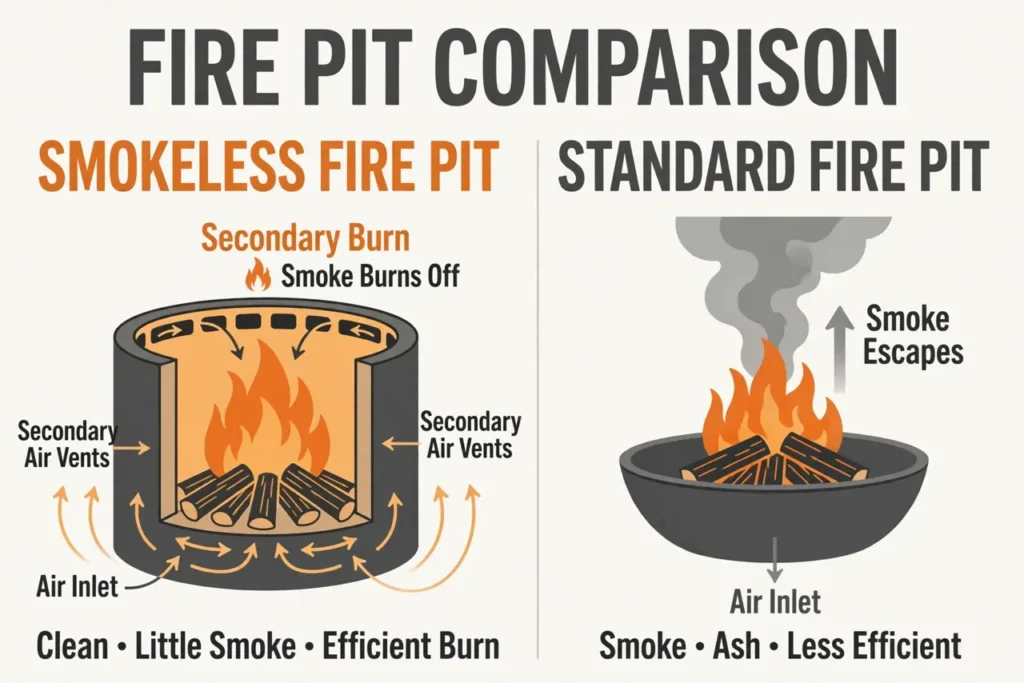
A normal wood fire burns from the bottom up. The wood releases gases as it heats, and in a basic pit many of those gases escape unburned — that is the smoke you see and smell. A smokeless pit is built with a double wall and a ring of small holes near the top of the fire chamber.
Here is the sequence, step by step. Air enters through holes near the base and feeds the main fire. As that air travels up between the two walls, it heats up. The hot air then exits through the upper holes and mixes with the gases rising from the fire. Because the air is already hot, those gases catch fire a second time. That second burn is what cuts the smoke.
Think of it as the pit giving the fire a second chance to burn its own smoke. The design only works well when the fire is hot enough and the air can move freely. A small, struggling fire will not reach the temperatures the second burn needs, which is why lighting technique and dry wood matter so much.
Smokeless vs. Standard Wood Pit vs. Gas Pit
| Feature | Smokeless wood pit | Standard wood pit | Gas pit |
|---|---|---|---|
| Smoke level | Low once hot; some at lighting and refuelling | High, shifts with the wind | None from the fuel itself |
| Real fire feel | Yes — real wood, crackle, and glow | Yes — the classic campfire experience | Flame without wood, smell, or crackle |
| Ease of starting | Needs a proper build-up; a weak start means smoke | Forgiving; lights with less care | Push-button or match-lit, instant |
| Fuel cost and effort | Dry hardwood, stored dry; regular supply needed | Any dry wood; more tolerant of mixed wood | Propane refills or a gas line; no wood storage |
| Upfront cost | Higher than a basic pit | Lowest of the three | Higher, plus gas hookup costs for plumbed models |
| Cleaning | Ash out, airflow holes kept clear | Ash out, occasional scrub | Least cleaning; burner and media checks |
| Best for | Wood-fire lovers who hate smoke | Budget buyers and occasional fires | Frequent, quick fires with no smoke or ash |
If your main complaint about wood fires is the smoke itself rather than the work, a smokeless pit addresses the exact problem. If your main complaint is the work — hauling wood, lighting, cleaning ash — a gas pit solves more of your problems. Our comparison of propane vs. natural gas fire pits can help if you lean toward gas.
The Honest Verdict
Smokeless fire pits are worth it for a specific kind of buyer: someone who loves a real wood fire, sits close to it, and is bothered by smoke on clothes, hair, and eyes, or who has neighbours close by. For that buyer, the difference is real and noticeable from the first well-built fire.
They are not worth it if you only light a fire a few times a year, if you do not want to source and store dry hardwood, or if you want instant, smoke-free heat at the push of a button. In those cases, a cheaper standard pit — or a gas pit — is the better spend. The technology works, but it asks more of you than a basic pit does, and it rewards good fuel and good technique.
When a Smokeless Pit Is Worth It
- Close neighbours. In a small yard, smoke drifting over a fence can end a good evening fast. A low-smoke burn keeps the peace.
- Smoke-sensitive guests. People with asthma or smoke sensitivity, and anyone who hates going inside smelling of campfire, will notice the difference most.
- Fixed seating. Around a table or a built-in bench, you cannot keep moving your chair out of the smoke. A smokeless pit lets everyone stay put.
- Frequent fires. The more often you burn, the more the smoke reduction pays off over a season.
When a Standard Pit or Gas Pit Is Better
- Rare use. A few fires a year will not repay the price gap over a basic steel pit.
- No dry wood supply. If you cannot store wood under cover, the pit will smoke anyway, and the extra cost buys little.
- You want instant heat. Gas wins for weeknight fires with no lighting ritual and no ash. See our guide to whether you can put a fire pit on a wood deck if placement is part of your decision — surface rules apply to every pit type.
- Big cooking plans. Some smokeless models accept grill grates, but a wide, open standard pit is often more forgiving for cooking over coals.
Fuel and Wood Requirements
Dry wood is not a nice-to-have for these pits; it is the whole system. Wood that has been split, stacked under cover, and seasoned until it feels light and sounds hollow when knocked together burns hot and clean. Damp wood hisses, steams, and smokes, and it will defeat the secondary burn entirely.
Hardwoods such as oak, maple, and ash are the usual recommendation because they burn longer and steadier than softwoods. Softwoods light fast and can help get a fire going, but they burn through quickly and throw more sparks. Whatever species you choose, the wood must be untreated and unpainted. Burning treated, painted, or stained wood releases chemicals you do not want to breathe, and it can damage the pit.
Start the fire with small kindling and a few small splits, and let it build to a strong flame before adding larger logs. Piling on big logs too early smothers the fire, drops the temperature, and produces the smoke you paid to avoid. Keep a dry stash close at hand so you are not tempted to grab damp wood mid-evening.
Cost and Maintenance Trade-Offs
Smokeless pits cost more than basic steel pits of a similar size. Stainless steel models sit at the higher end of the range, while coated steel versions cost less but may need more care to prevent rust. Prices vary widely by size, brand, and material, so compare like for like rather than trusting a single advertised figure.
Maintenance is a little more involved than with a standard pit. Ash must come out regularly, and the small airflow holes need to stay clear — blocked holes starve the second burn and bring the smoke back. A stiff brush and a quick check each time you empty the ash is usually enough. Our guide on how to clean a fire pit covers the routine in detail, and most of it applies directly to smokeless models.
Weight is another practical point. Double-wall construction makes these pits heavier than a single-wall pit of the same size. If you plan to move the pit around the yard or store it each winter, check the weight and whether it has handles or a stand. Many owners leave the pit in one spot with a cover, which also protects the steel.
Decision Checklist: Should You Buy One?
✅ Before You Buy — Quick Checklist
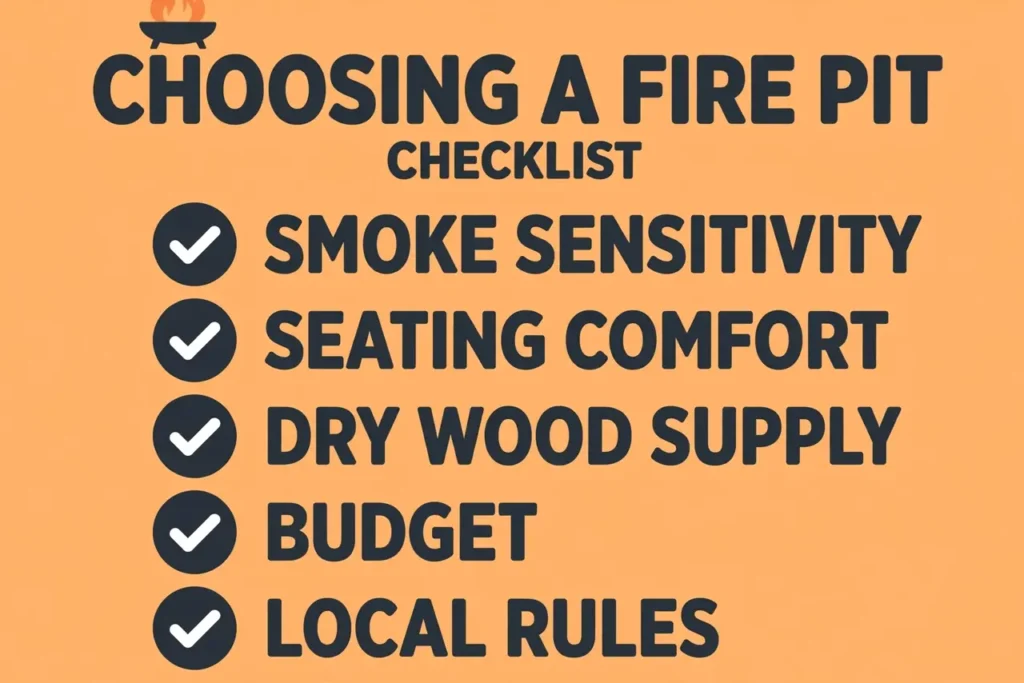
- Do you have a reliable supply of dry, seasoned hardwood — and a dry place to store it?
- Is smoke your main complaint, rather than the effort of lighting and cleaning?
- Will you use the pit often enough to justify the higher price?
- Do local rules allow wood fires in your area, and have you checked burn bans?
- Is your spot clear of the house, trees, fences, and overhead cover?
- Can you lift or move the pit, or will it live in one spot with a cover?
- Have you compared a gas pit honestly — is instant, smoke-free heat what you actually want?
If you answered yes to most of these, a smokeless pit is a strong buy. If several answers are no, a standard pit or a gas pit will likely make you happier.
Common Mistakes and Troubleshooting
🔧 Still Getting Smoke? Check These First
- Wet or green wood. The most common cause. Switch to fully seasoned hardwood and store it under cover.
- Fire too small or too new. The second burn needs heat. Build the fire up properly before judging the smoke.
- Logs added too early. Big logs on a young fire cool it down. Add fuel once flames are strong.
- Blocked airflow holes. Ash or debris in the upper or lower holes stops the second burn. Brush them clear.
- Strong wind. Gusts disrupt the burn pattern. A windbreak or a calmer evening helps more than any accessory.
- Overloading the pit. Too much wood at once chokes airflow. Feed the fire in smaller amounts.
A related mistake is placement. Even a low-smoke pit is still an open flame, so the same clearance rules apply as for any fire pit. If you are building a permanent spot, our guide on how to build a stone fire pit walks through siting and construction, and the clearance guide linked at the top covers the distances to keep from your house, trees, and fence.
Frequently Asked Questions
Are smokeless fire pits truly smokeless?
No. They produce much less smoke than a standard pit once the fire is hot and burning dry wood, but they still smoke during lighting, when adding logs, and when the fire dies down.
Do smokeless fire pits work with any wood?
They work best with dry, seasoned hardwood. Damp, green, treated, or painted wood will smoke heavily and can damage the pit, so it should never be burned.
Can I use a smokeless fire pit on a wood deck?
Most makers advise against placing any wood-burning pit directly on a wood deck because of heat and embers. A heat shield, a non-combustible pad, and the maker’s own guidance are needed, and many owners keep wood pits on stone or concrete instead.
Are smokeless fire pits safer than standard pits?
Less smoke does not mean less danger. They are still open fires with hot surfaces and embers, so the same clearance, supervision, and full-extinguishing rules apply.
Do smokeless fire pits need more cleaning?
Slightly more. Ash removal is the same, but the airflow holes must also be kept clear, or the low-smoke burn stops working.
Quick Reference Card
🔥 Smokeless Fire Pit — Quick Reference
- What it does: Reburns fire gases for a much lower-smoke wood fire.
- What it does not do: Remove smoke entirely, or make an open fire safe indoors.
- Fuel: Dry, seasoned, untreated hardwood only.
- Best buyer: Frequent wood-fire lover bothered by smoke or close neighbours.
- Better alternatives: Standard pit for rare use; gas pit for instant, smoke-free fires.
- Upkeep: Empty ash often; keep airflow holes clear; cover when not in use.
- Safety: Outdoors only, clear of house and trees, never unattended, fully extinguished.
The bottom line is simple: smokeless fire pits deliver on their main promise, with honest limits. If you love wood fires and smoke is the part you hate, they are worth the extra cost. If you burn rarely, cannot keep wood dry, or would rather press a button than build a fire, spend your money elsewhere — and enjoy the fire you actually use.