Best Firewood Rack for Indoor and Outdoor Use: How to Pick the Right One for Your Home
A good rack keeps your wood dry, your floor clean, and your evenings warm. The best firewood rack for indoor and outdoor use does all three without taking over your living room or falling apart after one wet winter. This guide walks you through the types, the sizes, and the setup, so you can buy once and buy right.
Most people buy a rack after a bad experience. Wood stacked on the ground turns damp and draws insects. A pile by the back door sheds bark across the floor. A cheap rack bends under a full load and dumps logs across the patio. All three problems have the same fix: a rack that fits your space, holds your wood off the ground, and lets air move around the stack.
Heads Up: Firewood Storage Safety
Keep any rack stable and level, and keep stored wood away from open flame and heat sources. Check stored logs for insects and mold before you carry them inside, and shake off loose bark outdoors. Respect local firewood transport and quarantine rules, since moving wood can spread pests. Never burn treated, painted, or stained wood. If you are unsure about local rules, check with your local fire or forestry office before you move wood across county or state lines.
This guide covers storage and setup only. It is general guidance, not a substitute for local fire codes or the rack maker’s instructions.
Time to Choose
30 to 60 min
Setup Time
20 to 45 min
Difficulty
Beginner
What You Need
- A tape measure
- A level (a phone level app works in a pinch)
- A pencil and paper for your measurements
- Your chosen rack, with all parts and hardware
- A wrench or socket set, if the rack bolts together
- A tarp or rack cover, for outdoor storage
- Work gloves for handling rough split wood
- A broom or dustpan for bark and debris
How to Pick the Best Firewood Rack for Indoor and Outdoor Use
Start with the job, not the product page. A rack has three jobs: hold wood off the ground, keep the stack stable, and let air flow through it. Every rack on the market does these three things to a different degree. Your space, your climate, and how much wood you burn decide which one fits.
Think about where the wood lives most of the year. If you burn two or three fires a week, you need a small indoor holder for a few days of wood and a larger outdoor rack for the main supply. If you burn every night through winter, the outdoor rack becomes the main event, and the indoor holder is a refill station. Match the rack to the habit, not the other way around.
Weight Capacity and Build Quality
Firewood is heavy. A single cubic foot of dry split hardwood weighs roughly 30 to 40 pounds, so even a modest 4-foot rack can hold several hundred pounds when full. Look for thick steel tubing, welded joints, and a stated weight limit from the maker. Thin wire frames and snap-together plastic parts bend under a real load.
Check how the rack connects at the corners. Welded joints hold up better than slip-fit tubes over time, and bolts beat plastic clips. If a listing gives no weight limit at all, treat that as a warning sign and keep looking.
Material and Weather Resistance
Outdoor racks face rain, snow, and sun. Powder-coated steel resists rust well and handles heavy loads. Stainless steel costs more and resists rust even better. Wrought iron looks great indoors but needs a dry spot or regular care outdoors. Wooden racks suit covered porches, while bare untreated metal will rust in its first season outside.
For indoor use, material matters less, and looks matter more. A black steel log holder or a canvas sling carrier fits a living room better than a galvanized yard rack. Pick a finish that matches the room, since you will see it every day.
Size, Footprint, and Log Length
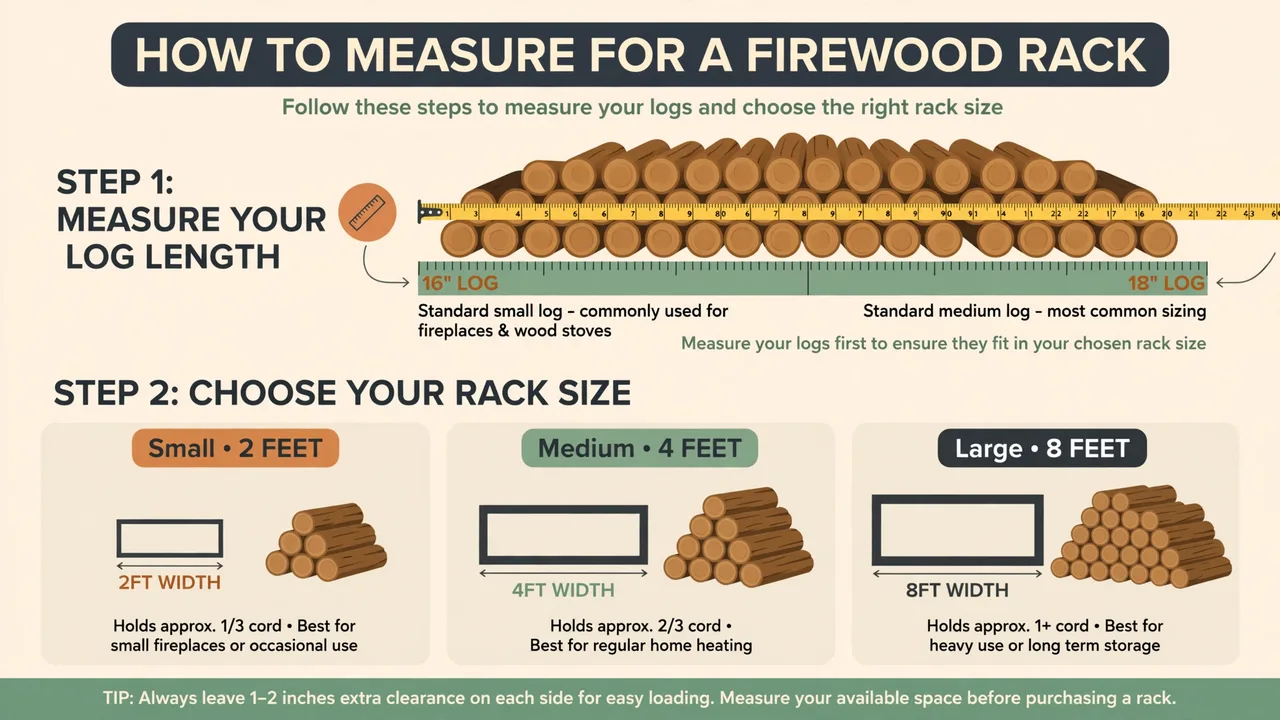
Measure your logs before you measure your space. Most split firewood runs 16 to 18 inches long, and the rack must be at least that deep, with a little room to spare. A rack that is 12 inches deep will leave log ends sticking out, which looks messy and invites tipping.
Measure the spot where the rack will sit, including the height. A tall rack against a wall holds more wood in less floor space, but it also needs a wall or a wide base to stay stable. Leave at least a few inches of clearance on each side for airflow and for your hands when you load and unload.
Airflow and Ground Clearance
Wood dries and stays dry when air moves around it. A good rack lifts logs at least 4 to 6 inches off the ground and leaves gaps between the side rails. Solid-bottom racks trap moisture underneath, which invites mold and rot on the bottom layer.
This matters indoors too. A rack that sits flat on a wood floor traps dampness and bark dust against the finish. Small feet or a raised base protect the floor and keep air moving under the stack.
Cover and Protection
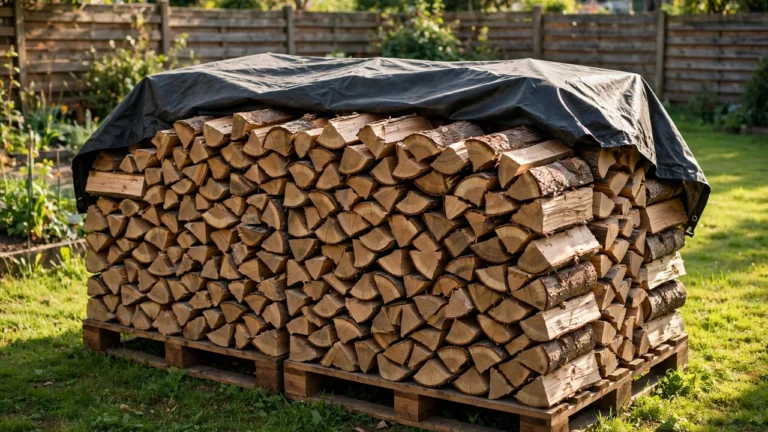
Outdoor wood needs a cover, and the rack decides how well that cover works. Some racks ship with a fitted cover that drapes over the top and fastens at the sides. Others leave you to drape a tarp, which works fine if the rack has a frame or a top bar to shed rain.
Cover only the top of the stack, never the sides. A tarp wrapped tight around the whole pile traps moisture and slows drying. If you want the full picture on covering, read our guide on whether you should cover firewood before you buy a cover.
Firewood Rack Types Compared
Five designs cover nearly every home. The table below gives honest, typical ranges for each type, based on common sizes sold by major makers. Exact capacity depends on log length, stack height, and how tightly you pack the wood, so treat these numbers as a starting point, not a guarantee.
| Rack Type | Typical Length | Typical Capacity | Best Use |
|---|---|---|---|
| Indoor log holder | 16 to 24 in | A few days of fires | Beside the fireplace or stove |
| Covered outdoor rack | 4 to 8 ft | About 1/6 to 1/2 cord | Main wood supply, all seasons |
| Open outdoor rack | 4 to 8 ft | About 1/6 to 1/2 cord | Covered porches and dry climates |
| Wall-mounted rack | 2 to 4 ft | One to two days of fires | Small rooms, patios, and garages |
| Heavy-duty log rack | 8 ft and longer | About 1/2 cord and up | Full-season wood heating |
Capacity ranges are typical for common rack sizes. A full cord measures 128 cubic feet stacked, so a 4-foot rack holds a small fraction of a cord. Check the maker’s stated capacity before you buy.
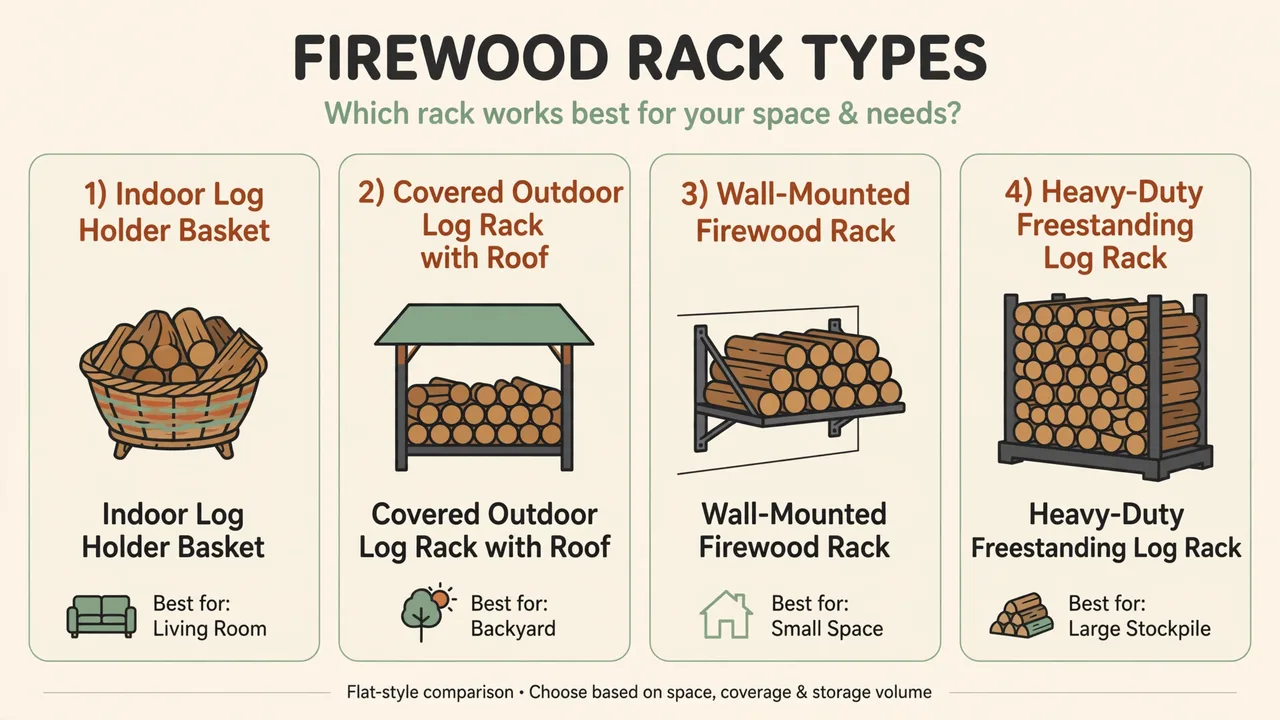
Indoor Log Holders
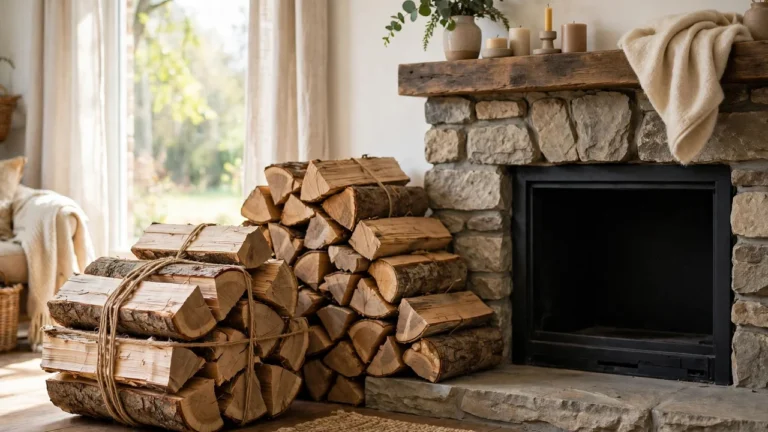
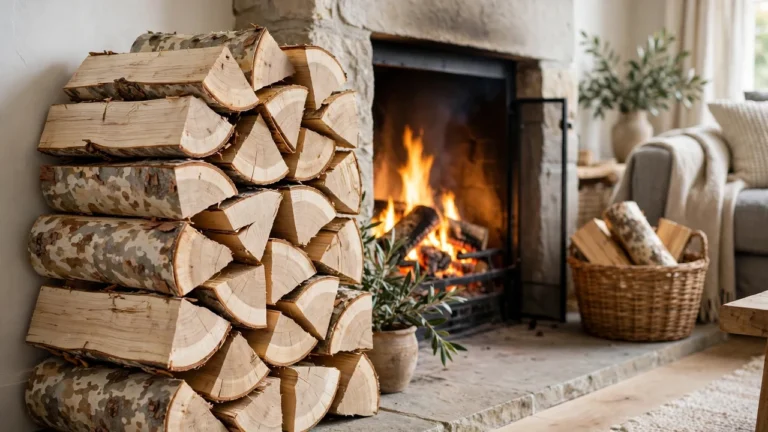
An indoor holder sits next to the fireplace and holds enough wood for a few fires. Most hold 10 to 20 logs, and many include a canvas carrier or a sling so you can bring wood in from outside without dropping bark on the floor. They are light, simple to move, and built to look good in a living room.
Keep indoor holders small on purpose. A big indoor pile brings insects, dust, and moisture into the house, and it eats floor space. Refill from the outdoor rack every day or two instead of stocking a week of wood indoors. If you store extra wood in the garage, see our guide on storing firewood in the garage for the setup that works best there.
Covered Outdoor Racks
A covered outdoor rack is the workhorse for most homes. It has a roof or a fitted cover, raised feet, and open sides for airflow. A 4-foot model holds roughly a sixth of a cord, while an 8-foot model holds close to half a cord, depending on log length and stack height.
Buy this type if you burn regularly and your wood sits outside for months. The cover keeps rain and snow off the top layer, which is the layer that gets wet first and dries last. For more on keeping outdoor wood dry, read our guide on how to store firewood outside.
Open Outdoor Racks
An open rack is the same frame without a roof or cover. It costs less and works well under a porch roof, in a carport, or in a dry climate where rain is rare. Pair it with a loose tarp over the top in wet weather, and leave the sides open so air can move through the stack.
Skip the open rack if your wood sits in the open with no roof above it. Rain will soak the top rows, and you will burn damp wood all winter. In that case, a covered rack pays for itself in dry wood alone.
Wall-Mounted Racks
A wall-mounted rack bolts to a wall or fence and holds a small stack off the floor. It suits apartments, small patios, and garages where floor space is tight. Most hold one or two days of wood, which makes them a good refill station rather than a main supply.
Mount into studs or solid masonry, never into drywall alone. A full rack is heavy, and drywall anchors will pull out under the load. Check the maker’s mounting instructions and use the hardware it calls for.
Heavy-Duty Log Racks
Heavy-duty racks run 8 feet or longer and hold half a cord or more. They use thick steel, welded joints, and wide feet that spread the load. Some are modular, so you can bolt two 4-foot sections together into one long run.
Buy this type if you heat with wood all winter or buy wood by the cord. One long rack beats three small ones, since it is easier to load, easier to cover, and easier to keep level. Place it where a delivery truck or wheelbarrow can reach it, so you are not carrying logs across the yard all season.
Indoor vs Outdoor: What Changes
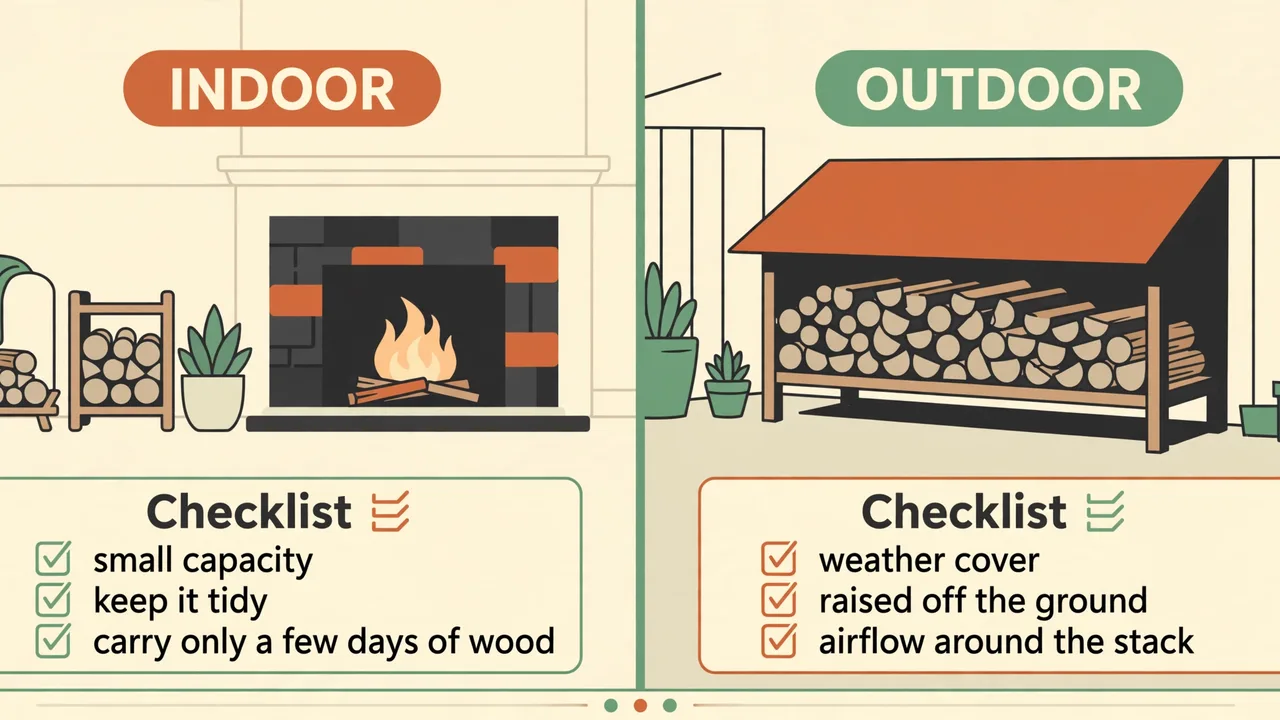
Indoor and outdoor racks solve different problems, and the features that matter flip between the two. Outdoors, weather resistance and capacity rule. Indoors, size, looks, and floor protection rule. A rack built for one job rarely does the other well.
What an Indoor Rack Needs
An indoor rack needs a small footprint, a tidy look, and feet that protect the floor. It should hold two to three days of wood, no more. Anything larger brings dust, bark, and insects into the living space for no real gain, since the outdoor rack is only a short walk away.
Pick a holder with a solid or lined base to catch bark and dirt. Open slat bases look nice but let debris fall through onto the floor. A canvas carrier bundled with the holder makes refills far less messy, since you can load it outside and carry it in.
What an Outdoor Rack Needs
An outdoor rack needs a weatherproof finish, a raised base, and a cover or roof. It should sit on level ground, away from the house wall, with air flowing around all four sides. Keep at least a few inches between the rack and any wall so damp air does not collect behind the stack.
Place the outdoor rack where you can reach it in bad weather. A rack at the far end of a muddy yard will not get used on a cold, rainy night. A spot near the back door, on a patio or gravel pad, gets used every time. If you are setting up outdoor storage from scratch, our guide on how to store firewood outside covers ground prep and placement in more detail.
Using One Rack for Both
Some racks claim to work indoors and outdoors, and a few genuinely do. A compact powder-coated steel rack with a fitted cover can live on a patio in summer and move into a mudroom or garage in winter. Check the finish first: if the maker rates it for outdoor use, it will handle a dry indoor spot without trouble.
Even so, most homes do better with two racks: a large covered rack outside and a small holder inside. The pair costs more than one rack, but it keeps the bulk of the wood outside, where it belongs, and keeps the living room clean.
Sizing and Capacity: Pick the Right Size
Size is the mistake most buyers make. Too small, and you refill it every day. Too big, and it crowds the room or the yard. The fix is simple math you can do with a tape measure in five minutes.
Measure Your Logs
Measure five or six logs from your usual supply and note the longest one. Most firewood runs 16 to 18 inches, but some suppliers cut 20-inch or 24-inch pieces. Your rack must be at least as deep as your longest log, plus an inch or two of clearance. If you are unsure what length to buy next time, our guide on firewood sizes and what length to buy explains the common cuts.
Work Out How Much Wood You Burn
Count how many logs you burn on a typical evening, then multiply by the number of evenings you burn each week. A casual burner who lights two fires a week might use 10 to 15 logs a week. A household that burns every night can use 40 or more. That weekly number tells you how big the outdoor rack needs to be and how often the indoor holder needs refilling.
A full cord is 128 cubic feet of stacked wood. A 4-foot rack, stacked about 3 feet high with 16-inch logs, holds roughly 16 cubic feet, or about one-eighth of a cord. That is enough for a few weeks of casual fires, but only a week or so of nightly burning. Size up if you burn every night.
Match the Rack to Your Space
Measure the spot, not the rack alone. Leave room to walk past it with an armful of wood, and leave a gap behind it for airflow. A rack that fits the wall exactly will trap moisture and make loading awkward. Give it a few inches on every side.
Check the height too. A 4-foot-tall rack holds a lot of wood in a small footprint, but a stack that tall can lean or topple if the base is narrow. Wider feet, a low center of gravity, and a wall behind the rack all add stability. If you have kids or pets, keep tall stacks braced and out of play areas.
Set Up Your Rack in Six Steps
Setting up a rack takes less than an hour, and most of that time goes to measuring and loading. Work through the steps in order. Each one builds on the last, and skipping the measuring step is how racks end up in the wrong spot.
At a Glance: The Six Steps
- Measure your space and your logs
- Pick a level spot with airflow
- Assemble the rack on flat ground
- Raise the rack off the ground
- Load the first layer flat and tight
- Stack upward and cover the top
Measure Your Space and Your Logs
Grab the tape measure and the pencil. Measure the width, depth, and height of the spot where the rack will sit, and write the numbers down. Then measure five or six logs from your current supply and note the longest one. These two sets of numbers decide which rack size to buy, so do this before you order anything.
Leave at least 4 inches of clearance on each side of the rack for airflow and for your hands. If the spot is tight, a shorter rack with a second row works better than one long rack jammed against the wall.
Pick a Level Spot With Airflow
Walk the yard or the room and look for a flat patch with air moving around it. Outdoors, a gravel pad, a patio, or a concrete slab beats bare soil, which holds moisture under the rack. Indoors, pick a spot near the fireplace but at least 3 feet from the firebox opening, with no rug underneath that will trap dampness.
Set the level on the ground and check it in both directions. A rack that leans even a little will lean more as you load it, and a leaning stack is a falling stack. Move to a flatter spot or shim the low side with a flat stone or a paving slab.
Heads Up: Keep Wood Away From Heat
Never place a rack against a hot stove pipe, a furnace, or an open fireplace. Stored wood is fuel, and a rack full of dry logs next to a heat source is a fire risk. Keep at least 3 feet between stored wood and any hot surface, and follow the clearance distances in your stove or fireplace manual.
Assemble the Rack on Flat Ground
Lay out every part and every bolt before you start. Count the pieces against the parts list in the instructions, and check that nothing is bent or missing. Most racks go together with a wrench and take 15 to 30 minutes.
Tighten bolts in stages rather than cranking each one fully tight as you go. Snug them all first, check that the frame is square, then tighten each one in turn. A frame that goes together crooked will stay crooked under load, so check the corners with the level before the final tightening.
Raise the Rack Off the Ground
Place the rack on its feet and confirm the bottom rails sit at least 4 to 6 inches above the ground. Most racks build this in with raised feet, but a rack on soft soil can sink after rain. A pair of paving slabs or a gravel pad under the feet stops sinking and keeps the bottom layer dry.
Outdoors, keep the rack a few inches away from the house wall. Air needs to flow behind the stack, and wood stacked tight against siding traps moisture against the house. Indoors, the same gap protects the wall from scuffs and bark dust.
Load the First Layer Flat and Tight
Start with the longest, straightest logs and lay them side by side across the bottom rails, bark side down where possible. Pack them close together so they cannot roll, and keep the ends flush. The first layer carries the whole stack, so a sloppy base means a wobbly pile.
If your logs are mixed lengths, put the longest pieces on the bottom and save the short pieces for the top. Short logs on the bottom leave gaps that let the stack shift. For the full stacking method, see our guide on how to stack firewood.
Stack Upward and Cover the Top
Build upward in even layers, alternating the direction of each row if your rack allows it. Cross-stacking the ends of each row locks the pile together and stops it leaning outward. Stop stacking at the top rail or a few inches below it, so no log can roll off the top.
Drape the cover or tarp over the top of the stack only, and fasten it so wind cannot lift it. Leave the sides open for airflow. Check the stack after the first heavy rain: if the top layer is wet, the cover needs adjusting. Well-seasoned wood stays dry this way for months, and if you want to know how long that lasts, read our guide on how long firewood lasts in storage.
Pro Tip: Season Before You Stack
A rack cannot dry green wood on its own. It can only protect wood that is already dry or still drying. If your wood is fresh-cut, give it time to season in the rack with the cover off on dry days. Our guide on how to season firewood explains the drying timeline, and our guide on what seasoned firewood is tells you how to tell when it is ready to burn.
Mistakes to Avoid With a Firewood Rack
Five Mistakes That Cause Most Rack Problems
1. Buying before measuring
A rack that does not fit your logs or your space ends up returned or unused. Measure both first, then order.
2. Stacking wood on bare ground
Logs on soil soak up ground moisture and draw insects. Always raise the stack at least 4 inches off the ground.
3. Wrapping the whole pile in a tarp
A tarp sealed around the sides traps moisture and grows mold. Cover the top only and leave the sides open.
4. Overloading a light rack
A rack rated for light loads will bend or collapse under a full cord of hardwood. Match the rack’s weight limit to the wood you plan to store.
5. Storing a week’s wood indoors
Large indoor piles bring insects and dust inside. Keep the indoor holder small and refill it from the outdoor rack.
One more habit to build: check the rack twice a year. Tighten any loose bolts in spring, and check for rust or bent rails before the burning season starts. A five-minute check catches small problems before they become a collapsed stack. And when you restock, pick wood that burns well in your stove or fireplace. Our guide to the best firewood to burn ranks common species by heat and ease of use.
Frequently Asked Questions
Frequently Asked Questions
How big should a firewood rack be?
For most homes, a 4-foot outdoor rack holds about one-eighth of a cord and covers a few weeks of casual fires. If you burn every night, choose an 8-foot rack or two 4-foot racks. Measure your logs first, since the rack must be at least as deep as your longest log.
Can I use the same rack indoors and outdoors?
Yes, if the maker rates it for outdoor use. A powder-coated steel rack can move between a patio and a mudroom. Even so, most homes work better with two racks: a large covered rack outside and a small holder inside.
How far should a firewood rack be from the house?
Leave at least a few inches between the rack and any wall so air can flow behind the stack. Keep stored wood at least 3 feet from open flames, hot stove pipes, and other heat sources.
Do I need a cover for my firewood rack?
Yes, for any rack that sits in the open. A fitted cover or a tarp over the top keeps rain and snow off the top layer. Cover only the top and leave the sides open so air can move through the stack.
How much weight can a firewood rack hold?
It depends on the rack. Light indoor holders may hold only 50 to 100 pounds, while heavy-duty steel racks can hold 500 pounds or more. Check the maker’s stated weight limit and do not overload it.
Quick Reference Card
What you need: tape measure, level, pencil and paper, rack and hardware, wrench, tarp or cover, work gloves, broom.
Steps:
- Measure your space and your logs
- Pick a level spot with airflow
- Assemble the rack on flat ground
- Raise the rack off the ground
- Load the first layer flat and tight
- Stack upward and cover the top
Remember: keep wood off the ground, cover the top only, keep 3 feet from heat sources, and refill the indoor holder from the outdoor rack.
Your Wood, Dry and Ready
The best firewood rack for indoor and outdoor use is the one that fits your logs, fits your space, and holds up through wet winters. Measure first, buy a rack built for the load, and set it up on level ground with air flowing around the stack.
Once it is up, your evenings get easier. Dry wood lights faster, burns cleaner, and leaves less mess behind. Load the indoor holder, light the fire, and enjoy the warmth. Your next step is to check your wood supply and season any green logs now, so the rack is full of dry wood when the cold nights arrive.