What Is Seasoned Firewood? A Beginner’s Plain-English Guide
You have probably seen the word “seasoned” stamped on every firewood listing, cord ad, and garden-center bag. Most sellers use it, few explain it, and some stretch it. The result is a confusing pile of wood and a simple question nobody answers: what does seasoned firewood actually mean?
By the end of this guide you will know exactly what seasoned firewood is, why the number 20% matters more than any label, how wood reaches that state, what it looks like, and how to avoid the five most common traps when you buy it. You will be able to walk up to any woodpile and read it like a label.
Safety note: burn wood only in a vented fireplace or wood stove with a working flue. Fit carbon monoxide detectors on every floor of your home and test them monthly. Wet, unseasoned wood burns cool and smoky, which builds creosote — the leading cause of chimney fires — so have the chimney inspected and swept every year by a certified chimney sweep.
- A pin-type moisture meter (the only way to verify “seasoned” on the spot)
- Gloves for handling rough splits at the seller’s pile
- A notebook or phone to record readings from different parts of the load
- Basic knowledge of how wood is stacked so you can spot a honest seller
The Definition, in Plain English
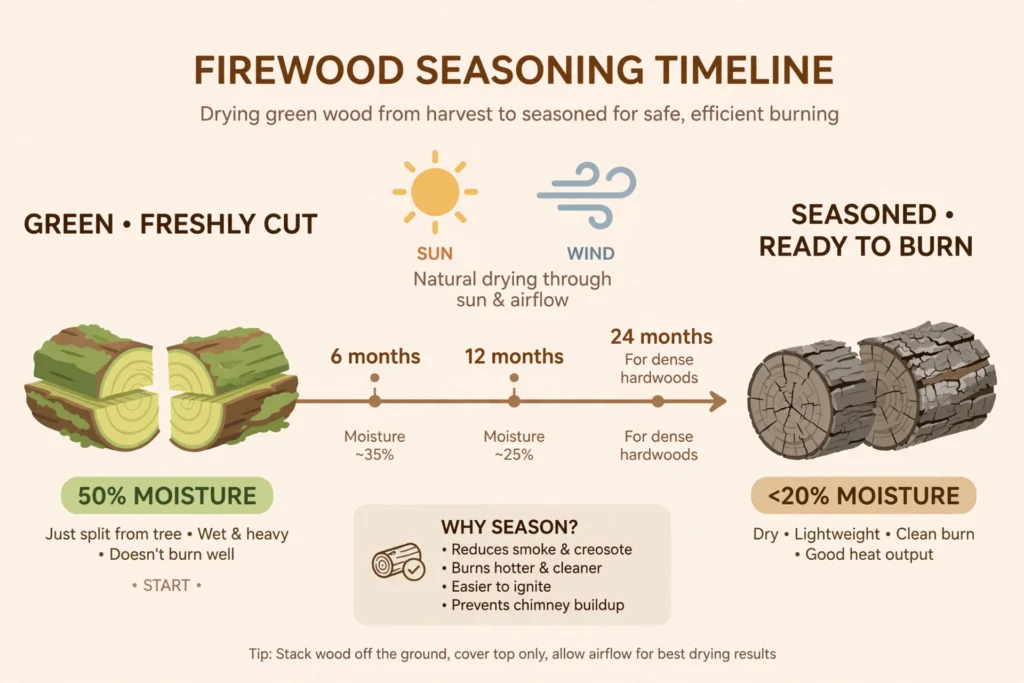
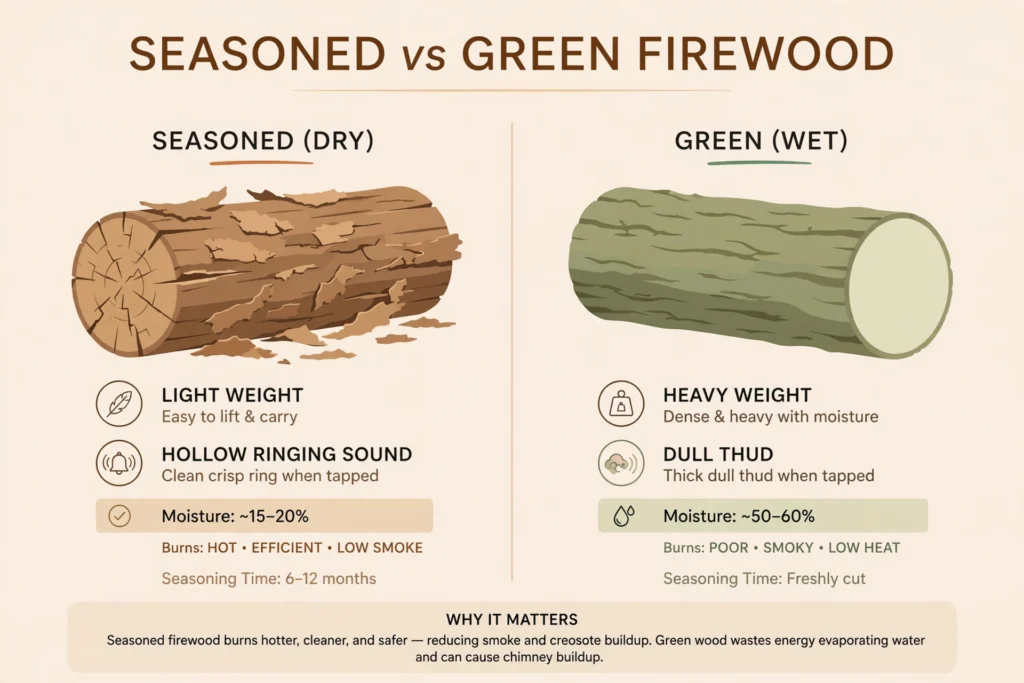
Seasoned firewood is wood that has been cut, split, and air-dried until its moisture content falls to 20% or below. That single number is the whole definition. Nothing about the word means a specific species, a set drying time, or a certification — it means dry enough to burn well.
Freshly cut wood, called green wood, can hold close to half its weight in water. The U.S. Environmental Protection Agency recommends firewood at below 20% moisture for clean, efficient burning. The gap between “freshly cut” and “ready to burn” is exactly what seasoning closes.
This is also why “seasoned” is the most abused word in firewood sales. One seller’s seasoned pile dried for two years; another’s sat under a tarp for three months. The word means nothing without a moisture reading to back it up.
Why That 20% Number Matters
A fire cannot heat your room and boil water at the same time — at least, not well. When wood with 40% or 50% moisture burns, a large share of the fire’s energy goes into turning that water into steam before any heat reaches the room. Dry wood sends that energy where you want it instead.
Wet wood also burns cooler, and cool, smoky combustion is what lays creosote down inside a chimney. Creosote is a tar-like residue, and it is the main fuel in chimney fires. This is why seasoned wood is not just a comfort choice — it is a safety choice. Learn the hands-on checks in our guide to how to tell if firewood is seasoned.
The visible signs are hard to miss once you know them: green wood hisses and spits in the fire, struggles to catch, and throws up thick smoke that blacks out glass doors. Seasoned wood lights quickly, burns with lively flames, and leaves the flue much cleaner.
How Firewood Becomes “Seasoned”
Seasoning is drying, and drying is mostly time plus airflow. It starts when a log is cut to stove length, because a shorter piece gives water a shorter path out through the end grain. End grain is the wood’s main exit route for moisture.
Next comes splitting. Bark is a waterproof jacket: it keeps water in as stubbornly as it once kept rain out. Split wood exposes the inner grain to air and dries many times faster than whole rounds. A six-inch round may take two years to dry unsplit; split it and it can be ready in months.
Then the splits are stacked off the ground with small gaps between rows, in a spot that gets sun and wind. Covering just the top of the stack keeps rain off while leaving the sides open to moving air. Wood stacked tight against a wall or under a full tarp traps damp air and can sit wet for a year.
Our full walkthrough covers this process in detail: how to season firewood, plus how to stack firewood so it actually dries instead of just sitting there.
How Long Does Seasoning Actually Take?
There is no single answer, because wood density, climate, and stacking all change the timeline. These are realistic ranges for properly split and stacked wood in a sunny, breezy spot:
- Softer woods (pine, spruce): about 6 months
- Most hardwoods (ash, cherry, birch, maple): 6–12 months
- Dense hardwoods (oak, hickory): 12–24 months
The wide range is why calendars are a weak test. Wood cut last spring might be ready — or it might not, depending on the species and the stack. A moisture meter reading below 20% is the only finish line that counts.
What Seasoned Firewood Looks Like
Once you have seen a properly seasoned pile next to a green one, the difference is obvious. Check the ends first: seasoned splits develop radial cracks and checks across the end grain as the wood shrinks while drying. Smooth, unblemished end faces usually mean wet wood.
Pick up two similar-sized pieces and compare. Seasoned wood is noticeably lighter — it has lost its water weight. Knock them together: seasoned wood rings with a sharp, hollow crack, while green wood answers with a dull thud.
Color and bark tell the story too. Seasoned wood fades to gray or silver, and the bark loosens, peels, or falls off. Green wood keeps bright, tight bark and pale fresh-cut faces. None of these signs alone is proof, but three or four together are a strong read.
Seasoned vs. Green vs. Kiln-Dried: What’s the Difference?
Three terms cover nearly all the firewood you will meet. Here is how they compare:
5 Traps to Avoid When Buying “Seasoned” Wood
- Trusting the label alone. “Seasoned” is not a regulated term. Carry a moisture meter and split one piece open to test the fresh face, not the weathered outside.
- Testing only the driest piece. Sellers stack dry pieces where you look. Test splits from the middle and bottom of the load, where moisture hides.
- Paying seasoned prices for green wood. Green wood sold as seasoned is the oldest trick in the trade. If the ends are smooth, the bark is tight, and the meter reads above 20%, walk away or pay green prices.
- Buying more than you can store dry. Even perfectly seasoned wood reabsorbs moisture if you pile it on bare ground under a full tarp. Stack it off the ground with the sides open to air.
- Bringing wood home across regions. Many areas restrict firewood transport to slow the spread of pests and diseases. Buy local and check your area’s rules before hauling a load across county or state lines.
Frequently Asked Questions
Now you know what seasoned firewood really is: not a label, not a brand promise, just wood dried to 20% moisture or below through cutting, splitting, stacking, and waiting. That one number explains the heat, the clean burn, and the safe chimney.
Your next move is small. Next time you face a woodpile, split one piece and press a moisture meter into the fresh face. If you want the full hands-on routine, read our guide to how to tell if firewood is seasoned — and never pay seasoned prices for green wood again.