Is Maple Good Firewood? A Complete Guide to Heat Output, Seasoning, and Burn Quality
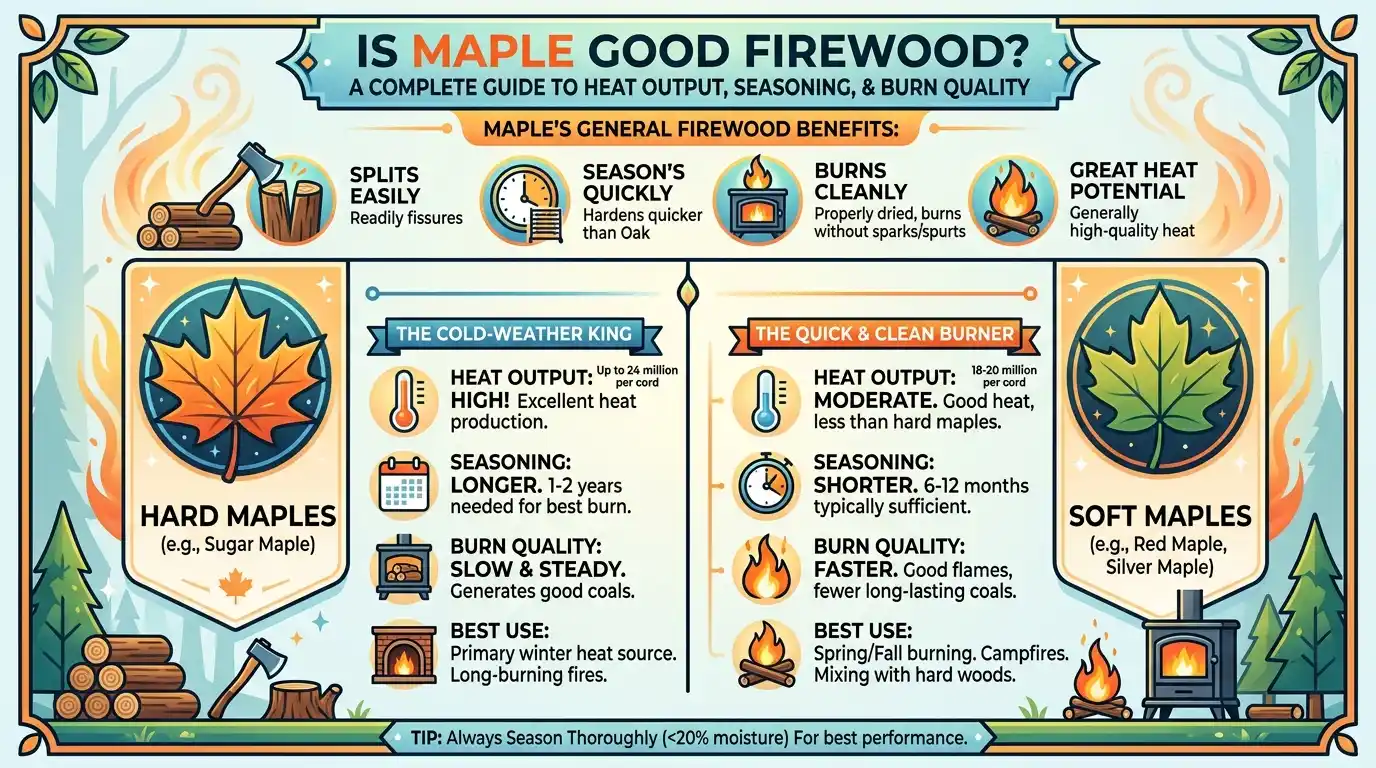
You have a truck-load of maple, or a tree fell in your yard, and now you are looking at a load of rounds and you are asking yourself whether it is worth the trouble. Good news: maple is one of the more amenable firewoods available. It readily fissures, hardens quicker than oak, and when properly dried, burns without spurts. The only snag is that maple is not a single wood.
The sugar maple, the red maple and the silver maple all burn differently and knowing which one you have will alter how you season it, how much heat you will get and whether it can carry you through a full winter by itself. This is what each of them will give you.
Is Maple Good Firewood? The Short Answer
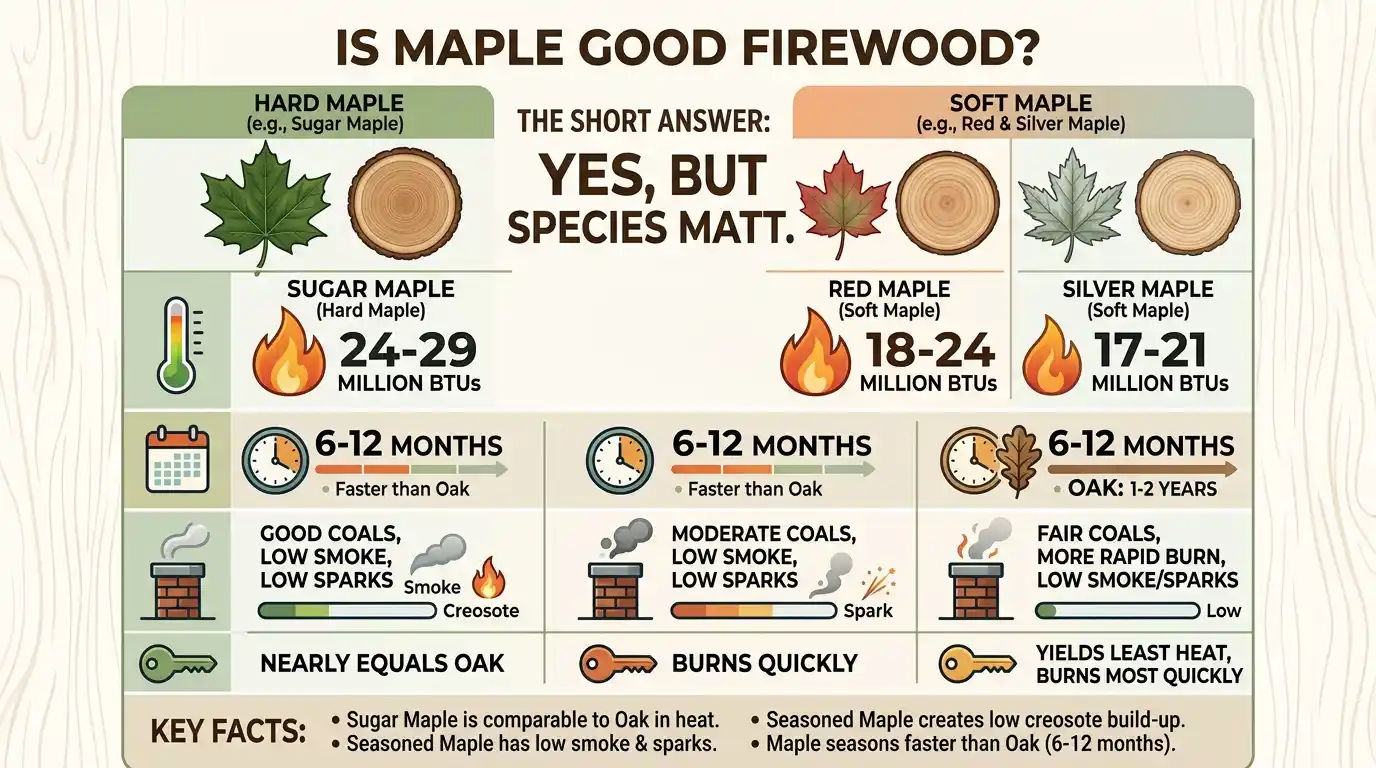
Yes, maple is good firewood, but which maple you have is the question. Hard maple, primarily sugar maple, burns hot, forms good coals, and nearly equals oak in heating value. Soft maple, principally red maple and silver maple, is also a good burner, but yields much less heat and burns more quickly.
When one gives you a load of “maple” without specifying the species, then you are not being told the whole story. That one word includes the trees of meaningfully varying density, moisture content, and heat production. This guide separates maple by species so you may know precisely what you are burning and how to obtain the maximum out of it.
Quick facts:
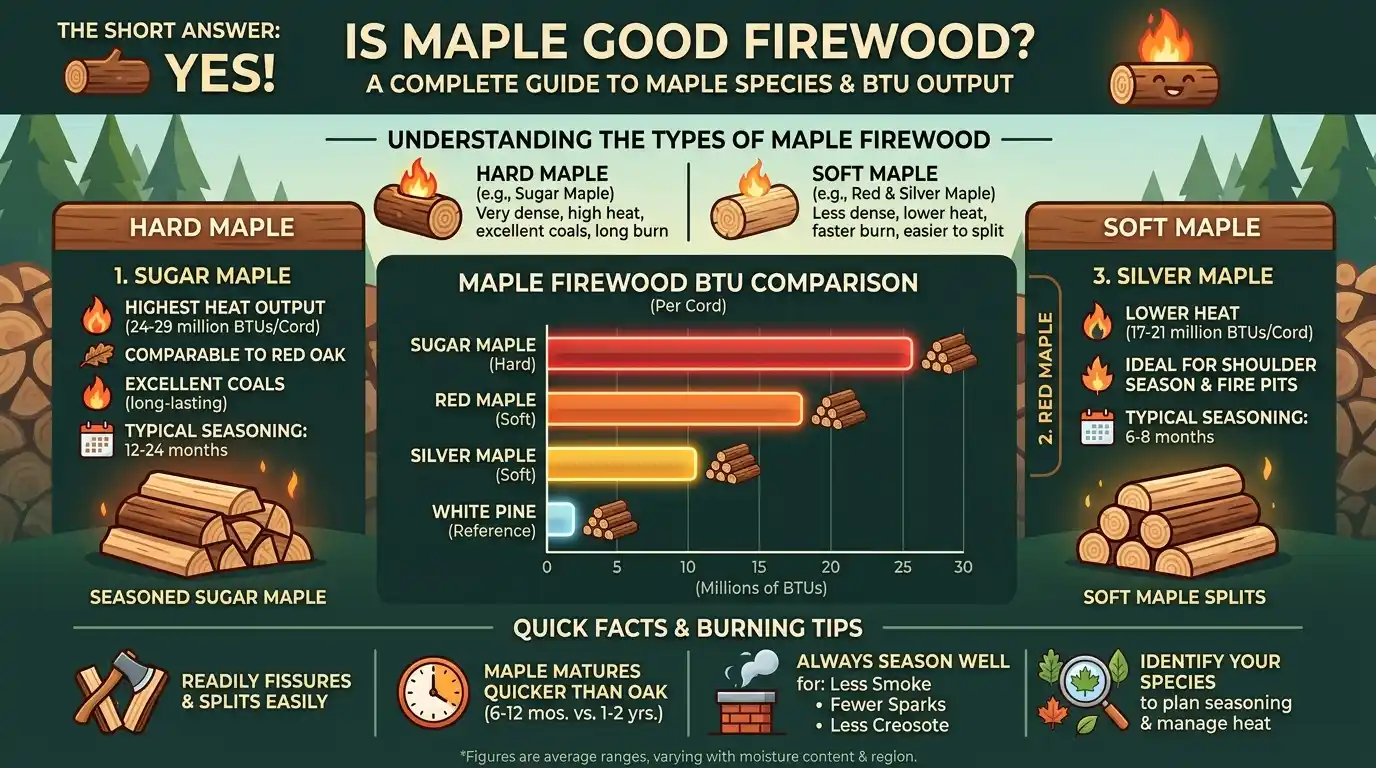
- Sugar maple yields approximately 24-29 million BTUs per cord, similar to oak.
- Red maple yields approximately 18-24 million BTUs per cord.
- Silver maple yields about 17-21 million BTUs per cord.
- Maple species mature quicker than oak, which is normally 6-12 months compared to 1-2 years in oak.
- Maple should be well seasoned to create less smoke, fewer sparks and less creosote.
Not All Maple Is the Same: Hard Maple vs. Soft Maple
Firewood sellers and colloquial use generally consider maple to be a single group, however, botanically and in practice it divides into two groups.
Hard maple comprises of sugar maple (Acer saccharum) and black maple. It is the same tree which is used in the production of maple syrup and the wood is heavy, dense and slow to dry. The maple is also one that you should seek out in case you are concerned with the amount of heat produced.
Soft maple consists of red maple (Acer rubrum), silver maple (Acer saccharinum) and boxelder. These trees are quicker growing, the wood grain is looser and they generate less heat per cord. They remain valid firewood, only not at the same level of performance as hard maple or oak.
This difference is important since much of the firewood sold in truckloads or cords is a blend of what species were cut this season. When you want to be sure that you are getting the type that will provide maximum heat during cold winter nights, you would like to know what type you are buying.
How to Tell Hard Maple From Soft Maple in a Stack
These are not difficult to distinguish without a lab. Apply these practical hints:
- Weight: Take two splits, of similar size, each. Hard maple is much heavier and denser.
- Bark: The bark of sugar maple is thick and has coarse and irregular plates. Silver maple bark is shed off in long, shaggy strips.
- End grain: Hard maple is tight with a fine grain. Soft maple appears more porous.
- Splitting: Soft maple can be split by hand. Hard maple is more difficult to push, and particularly so with large rounds.
In case a seller is unable to inform you about the species you are purchasing, then assume it contains a mixture of loads and charge it as such.
Maple Firewood BTU Output by Species
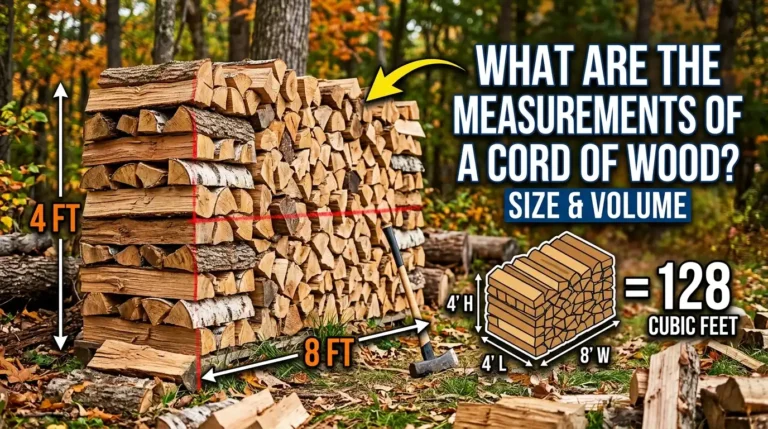
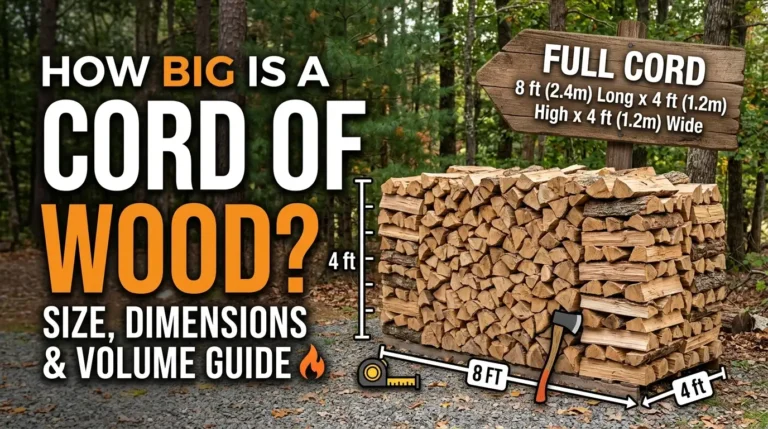
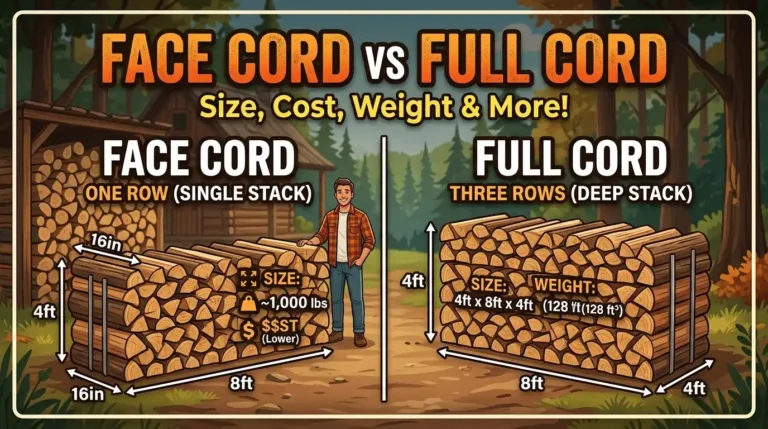
BTU (British Thermal Unit) per cord is the standard measure of how much heat a wood produces when fully seasoned and burned efficiently. If you’re not sure what a cord actually looks like once it’s stacked, it helps to see the exact size and volume broken down before you compare heat output.
Higher BTU means more heat from the same volume of wood. Figures vary somewhat by source depending on moisture content and testing method, so treat these as reliable ranges rather than exact lab numbers.
Sugar Maple Firewood BTU
The maple family has a heavyweight member, sugar maple. The majority of published estimates range it between 24 and 29 million BTUs per cord, putting it near red oak, and far above average hardwood. It also burns long after it is made, usually 6 to 8 hours of constant heat and leaves thick, long-lived coals that cause it to be easy to resume a fire in the morning.
Seasoning time is a tradeoff. Since sugar maple has a high sap content it requires at least 12 months to perform optimally and some sources suggest up to 2 years to perform optimally.
Red Maple Firewood BTU
The red maple is the center of the pack, and has a usual output of 18 to 24 million BTUs per cord, depending on the source. It is among the most widespread species of maple in the eastern United States, and thus it is frequently found in mixed firewood loads. It dries quicker than sugar maple and can still provide solid, reliable heat to the majority of heating requirements in the home.
Silver Maple Firewood BTU
Silver maple is the least productive of the three which produces an average of 17 to 21 million BTUs per cord. It ignites easily, burns in a short period (usually 6 to 8 months), and can be used in shoulder-season fires, fire pits and casual burning, where peak heat is not a concern. Silver maple is not a very dense wood, and alone is not sufficient as a primary heat source in a severe winter, but it burns well in combination with a heavier wood.
Maple Firewood BTU Comparison Table
| Species | BTU per Cord (millions) | Density | Typical Seasoning Time | Best Use |
|---|---|---|---|---|
| Sugar maple (hard) | 24 to 29 | High | 12 to 24 months | Primary winter heat, wood stoves, overnight burns |
| Red maple (soft) | 18 to 24 | Medium | 6 to 12 months | General home heating, mixed loads |
| Silver maple (soft) | 17 to 21 | Low to medium | 6 to 8 months | Shoulder season, fire pits, mixed with denser wood |
| Red oak (for reference) | 24 to 31 | High | 12 to 24 months | Primary winter heat |
| White pine (for reference) | 14 to 17 | Low | 6 to 12 months | Kindling, shoulder season |
Figures are average ranges obtained by combining various sources of firewood and are different depending on moisture content, climate and method of measurement.
How Long Does Maple Firewood Take to Season?
The process of drying freshly cut wood to a safe moisture content usually less than 20 percent before you burn it is known as seasoning. Green maple can be lit at 50 percent moisture or more, and is difficult to light, smoky, and apt to leave creosote in your chimney.
As a general rule:
- Silver maple: 6 to 8 months.
- Red maple: 6 to 12 months
- Sugar maple: 12 to 24 months, as its more sap content is slower to dry.
These schedules presuppose that the wood is cut and stacked off the ground and that it is exposed to sun and wind. Uncut rounds are very slow to season as moisture can only be lost by the bark and cut ends.
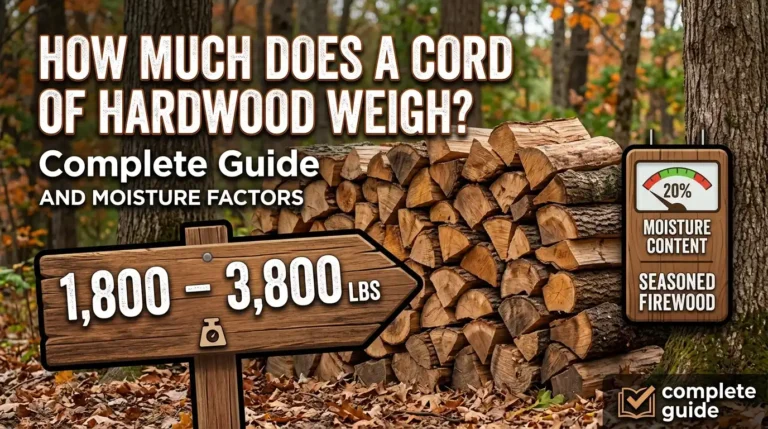
The surest method of knowing that your wood is ready is by measuring it with a moisture meter. The target should be a reading of less than 20 percent prior to burning indoors. As a rough shortcut, well-seasoned wood also feels noticeably lighter than green wood, since moisture loss changes how much a load actually weighs once it’s dried.
How to Speed Up Maple Seasoning
- Splitting: Splitting wood immediately after cutting. The more surface area that is exposed, the quicker it dries.
- Place it off the ground on pallets or a rack to avoid wicking up of moisture by the soil.
- Do not stack the rows closely but leave some space in between to allow air to pass through.
- Just cover the stack top. Leaving the sides open allows the wind and the sun to do the drying.
- Locate the stack in an open, sunny area and not in a shaded area of the yard.
Does Maple Firewood Smoke or Spark a Lot?
Well seasoned maple is regarded as a low-spark, low-smoke wood, which is one of the reasons why it is used in open fireplaces where flying embers are a genuine safety issue. It does not pop like pine, cedar or other resinous softwoods.
However, the true variable in this case is moisture, rather than species. Any wood, even maple, will smoke excessively and ignite more when not properly dried. When your maple firewood is smouldering a lot, it is most likely that it was burnt before it had seasoned.
Does Maple Firewood Cause Creosote Buildup?
Maple when seasoned to less than 20 percent moisture is a relatively clean-burning hardwood, with little creosote produced. Creosote is the result of the condensation of smoke incomplete combustion, which is condensed in a cooler chimney, and wet wood gives off much more of it than dry wood.
In brief: the type of wood species is not as important as the moisture content. The true secrets of keeping creosote in check, with whatever you are burning, are well-seasoned maple, hot fires and frequent chimney inspections.
Maple Firewood in a Wood Stove vs. an Open Fireplace vs. a Fire Pit
Wood stove: Hard maple is a great stove wood. Its lengthy burn time and excellent coaling ensure that it can be loaded at night, and you have live coals to continue the fire at the morning rather than to light one cold.
Open fireplace: Maple is a safe, low-smoke burn with low spark that is very pleasant to use in open fire hearths, where you desire a clean, steady flame without embers spilling onto the carpet.
Fire pit: Silver maple, especially, burns quickly and at a medium intensity, which is suitable to casual outdoor fires and even cooking on coals, as it is hot enough without being too hot.
Maple Firewood vs. Other Common Firewoods
Maple vs. Oak
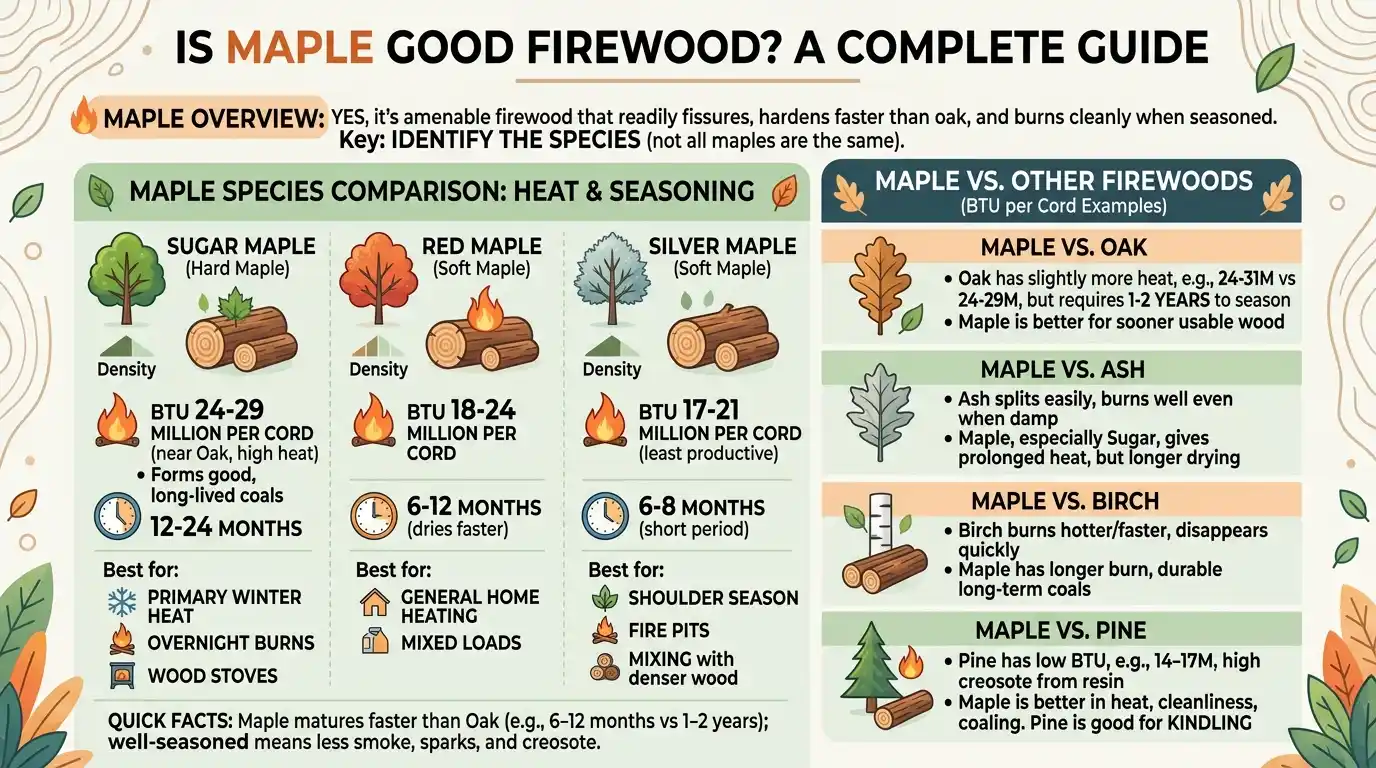
Oak typically outcompetes even sugar maple in heat production and burn time, although it requires much longer to season, typically 1 to 2 years. Maple will be a better option when you require usable firewood sooner and can accept a loss of heat production in order to wait less. For a full breakdown of what makes oak such a heavyweight, see this species-by-species look at BTU and drying time.
Maple vs. Ash
Ash is valued to burn well even at a slightly higher moisture content and easy splitting. Maple, particularly sugar maple, will give a more prolonged heat than ash but will usually require more time to reach the drying stage.
Maple vs. Birch
Birch burns quickly and hotly, but burns away faster than maple. Maple has a longer burn time per load and produces more durable long-term coals, so it is more suitable to long burns. Curious whether birch even qualifies as a true hardwood in the first place? Here’s how it stacks up.
Maple vs. Pine
Pine and softwoods contain a much lower range of BTU, usually 14-17 million per cord, and produce a greater amount of creosote that is related to resin. Maple is better than pine in heat, cleanliness and coaling, but pine still has its use as a quick-starting kindling.
Pros and Cons of Burning Maple Firewood
| Pros | Cons |
|---|---|
| Hard maple rivals oak in heat output | Species must be identified to know real BTU value |
| Seasons faster than oak (especially soft maple) | Sugar maple needs 12 to 24 months to fully season |
| Low sparking, safe for open fireplaces | Soft maple alone may not sustain a home through peak winter |
| Splits relatively easily | Mixed “maple” loads can hide lower-quality wood |
| Produces strong, long-lasting coals (hard maple) | Green or wet maple smokes heavily like any unseasoned wood |
| Widely available across North America | Silver maple burns faster and needs more frequent reloading |
How to Season and Store Maple Firewood the Right Way
- Cut and split immediately. Do immediately after felling to begin the clock on drying.
- Pile up on the ground. Pallets, rails, or firewood rack can be used to keep the bottom layer out of the soil moisture.
- Have the sides open. Keep a tarp or roof only over the top of the stack, to keep out rain and snow, and leave the remainder to be done by air.
- Select a sunny windy location. Full sun and cross-breeze reduced the seasoning time by a large margin, in comparison with shady, still areas of the yard.
- Check moisture prior to burning. An ordinary moisture meter, which costs about 15 to 25 dollars, eliminates the guessing of when the wood is ready.
- Separate, as far as possible. Separating the sugar maple and red or silver maple allows you to burn the wood that seasons faster and allow the hard maple time to season.
Common Mistakes When Burning Maple Firewood
- Burning it prematurely. This is the one and the biggest cause of smoky, low-heat maple fires. Sugar maple particularly requires time.
- Equal treatment of all maple. When a mixed load is assumed to be all hard maple, disappointing heat output and burn time is obtained.
- Leaving it in a dark, stuffy area. This may increase the time to be seasoned by two times.
- Omission of moisture check. Visual indicators such as the appearance of the bark that appears dry may be deceptive. A moisture meter provides an actual response.
- Including the sides and all the way up. This traps moisture and slows rather than accelerates drying.
FAQs
Is maple good wood to a wood stove?
Yes, hard maple, particularly. It fires well, makes good coals and retains heat well overnight when well seasoned.
What is the length of time of maple firewood to season?
Depending on splitting, stacking, and climate, generally 6 to 12 months in the case of soft maple and 12 to 24 months in the case of sugar maple.
Does maple firewood produce a lot of smoke?
Not when duly seasoned. The smoke of maple is very heavy, and is nearly always evidence of wood which had been burnt before it was quite dry.
Is silver maple good for firewood?
Yes, casual fire, fire pits and shoulder-season fires. It is not thick enough to depend on as a heat source during a severe winter.
Is maple sugar a good firewood?
It is one of the better hardwoods, all right, and it is nearly as hot as oak when it is thoroughly seasoned.
What is the BTU of maple firewood?
It depends on species. The sugar maple yields about 24-29 million BTUs per cord, red maple about 18-24 million and silver maple about 17-21 million.
Is it possible to burn green (unseasoned) maple?
You may, but it smoulders, and smokes a lot, and adds creosote. Wait till it is less than 20 percent moisture.
Will the maple firewood spurt?
In most cases no. Maple is a low-spark, low-calm-burning wood, and thus a safer wood to use in open fireplaces than resinous softwoods.
What can I do to know whether I have hard or soft maple firewood?
Weight of check, texture of the bark, and grain pattern. Hard maple is heavier with rough and plated bark and tight grain. Soft maple is lighter and has shaggy and peeling bark and more open grain.
Is oak better than maple firewood?
It does not heat as well raw, but seasons quicker. In case you require firewood that can be used sooner, maple can be a more convenient option.
Is pine better than maple firewood?
Yes, almost in all the categories. Maple generates heat, smoke and creosote less than pine or other softwoods.
Is it possible to combine maple with other firewoods?
Yes, and most of the experienced burners do. Combining soft maple with a heavier wood such as oak or hickory will offset easy lighting and extend the burn times.
What is the price of a cord of maple firewood?
The prices can be quite different depending on the region and season, but maple is not a premium species, and is priced like other common regional hardwoods. Enquire with local vendors on the prevailing prices.
Should maple firewood be used to cook or in a fire pit?
Yes, particularly silver maple. It is hot enough to cook, but not too hot, and burns even.
Is there any influence of the type of maple on creosote accumulation?
Not directly. The main factor in the formation of creosote in all the maple species is the moisture content.
Final Thoughts
Maple is reputed to be a good, dependable firewood, yet the true response to the question of whether maple is good firewood or not, lies in the knowledge of the kind of maple you possess. Hard maple is mostly sugar maple, and competes well with oak, and it is a great primary source of heat when it has been allowed to dry out properly. Soft maple, such as red and silver maple, will not be as efficient as that amount of heat production, but it is easy to light, seasons quickly, and can be used in day-to-day fires, shoulder-season heating, and outdoor burning.
The lesson learned: know what you are burning, provide it time to season, inspect moisture levels before burning, and blend soft maple with a heavier wood in case you require more time at night to burn. When so treated, maple is a timber that you can depend upon all but the greater part of the burning season.