How Long Does a Cord of Wood Last? A Practical Burning Guide for Stoves, Inserts, and Fireplaces
You piled a new cord of wood on the house. You are now wondering whether it will last you till January or vanish by Thanksgiving.
The truthful response is that it depends. But it does not need to be a conjecture. When you have a few figures you can estimate the duration of a cord of wood in your house, with your stove and your wood, in your climate.
Quick Answer
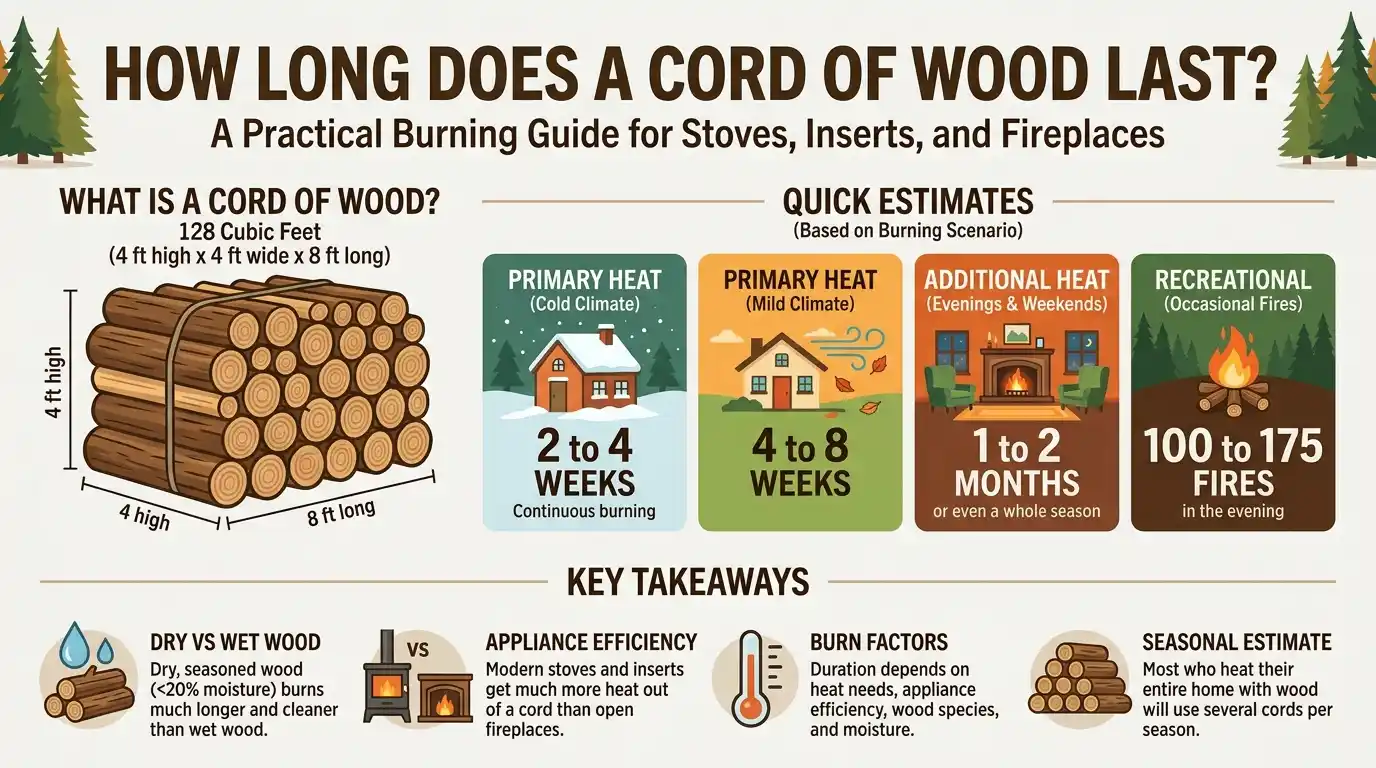
A cord of hardwood that is seasoned will last between approximately 3 weeks to a complete winter, depending on how you burn.
- Primary heat in cold climate: Approximately 2-4 weeks of continuous burning.
- Primary heat in a mild climate: Approximately 4-8 weeks.
- Additional heat (evenings and weekends): One or two months or even a season.
- Recreational fires (occasionally): Approximately 100 to 175 fires in the evening (my estimate; see below).
These are approximations of the math in this article. There will be a difference in your findings depending on your stove, your wood, and your home.
Key Takeaways
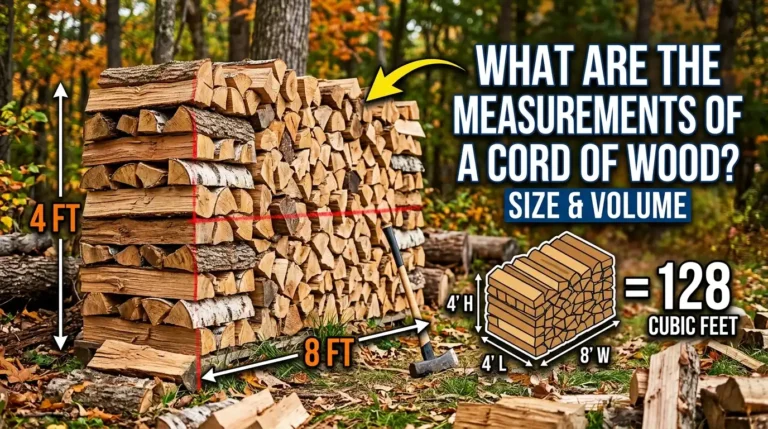
- 128 cubic feet of piled wood: 4 ft high x 4 ft wide x 8 ft long.
- The duration of burn is mainly influenced by the heat requirement, efficiency of the appliance, wood species, and moisture.
- A cord provides much more heat to modern stoves and inserts than an open fireplace.
- Wet wood has a shorter life and burns more dirtily than dry wood (less than 20% moisture).
- The majority of individuals who warm their entire house by wood anticipate a few cords every season.
What Is a Cord of Wood?
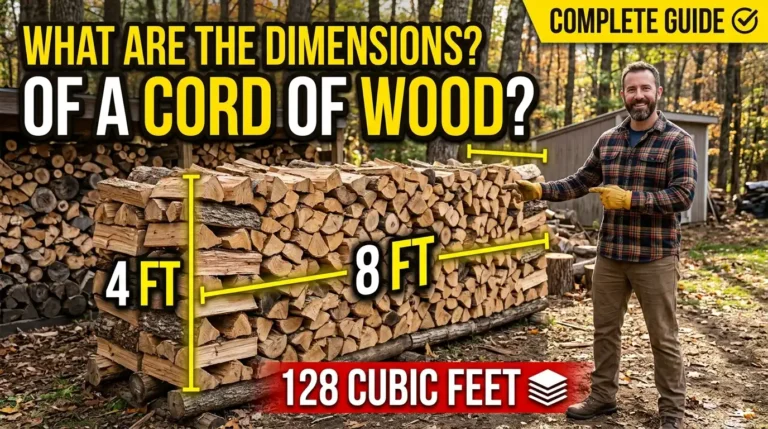
A cord of wood is a piled volume of firewood that is 128 cubic feet, which is usually 4 feet high, 4 feet wide, and 8 feet long. The air gaps between logs are included in the measurement. The actual wood is about 80 cubic feet in a cord, but this depends on the shape of the logs and the way in which you stack. If you want to see how a cord is measured in real terms, including volume and weight, this guide breaks it down.
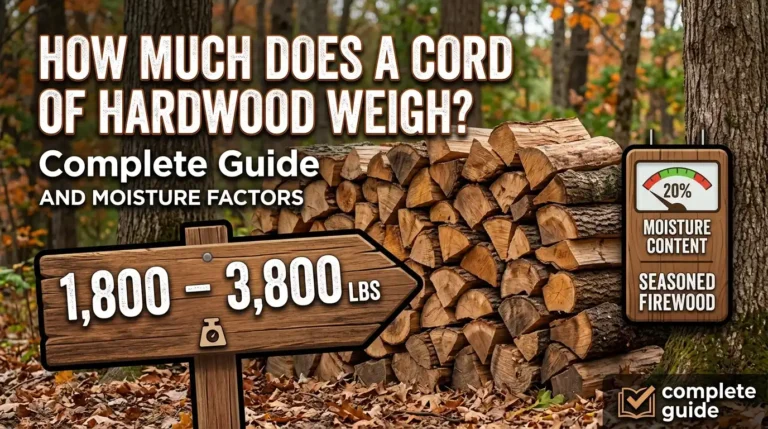
A cord of seasoned hardwood often weighs somewhere around 3,000 to 4,500 pounds, and softwoods weigh less. For specifics, see what a cord weighs by species and moisture level. If you burn mostly dense woods, these hardwood weight figures will help you plan hauling and stacking.
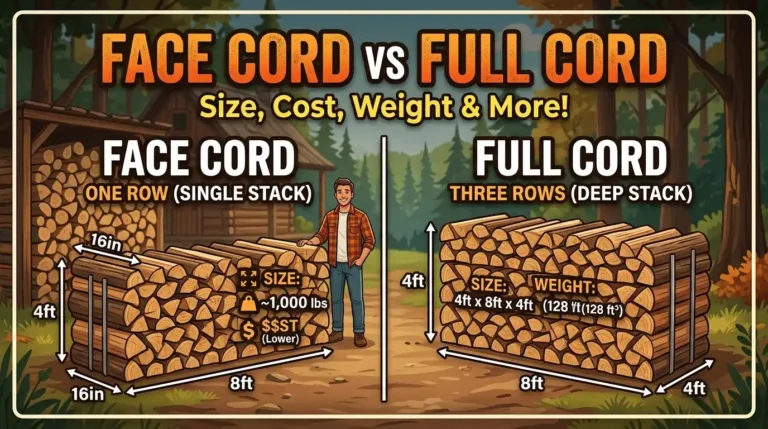
Cord vs. Face Cord vs. “Rick”
Sellers have various words to describe various amounts. The following is a comparison of them.
| Term | Typical size | Share of a full cord |
|---|---|---|
| Full cord | 4 x 4 x 8 ft (128 cu ft) | 100% |
| Face cord (16-inch logs) | 4 x 8 ft face, 16 in deep | About 1/3 |
| Face cord (12-inch logs) | 4 x 8 ft face, 12 in deep | About 1/4 |
| “Rick,” “stove cord,” “pile” | No standard meaning | Varies |
Terms like “rick” and “face cord” are not consistent standards. If a seller offers a face cord, this comparison of face cords and full cords explains how to tell them apart and what each should cost. If someone quotes you a “rick,” read up on what that word usually means when you’re buying before you pay. In many places, selling by the cord is regulated, so check your local rules and ask sellers exactly how deep the stack is.
How to Check You Got a Full Cord
- Pile it up in a row.
- Measure the length, height, and depth.
- Multiply the three numbers in feet. You ought to receive approximately 128.
Suppose your stack is 8 ft long, and 4 ft high, the logs must be approximately 4 ft deep in total (such as three rows of 16-inch logs). Not sure what that should look like? This page shows what a properly stacked cord looks like, and what you actually get in a cord covers buying tips.
How Long Does a Cord of Wood Last? The Formula
Simple math can be used to estimate burn time.
Days a cord lasts = (Heat in the cord x Appliance efficiency) ÷ Heat you need per day
This is driven by three inputs:
- Heat in the cord (BTU): Species-dependent. Experienced hardwoods have a range of 20 to 27 million BTU per cord (see the chart below).
- Appliance efficiency: EPA-certified stoves and inserts typically use around 60 to 80 percent of that energy to produce usable heat. Open fireplaces usually provide 10% or lower.
- Heat demand: The size of your home, insulation, and outside temperature. Step-by-Step Example
We will take a mixed hardwood cord and a modern stove.
- Heat in the cord: 24 million BTU
- Stove efficiency: 70%
- Usable heat: 24,000,000 x 0.70 = 16.8 million BTU
Now multiply that to the demand of your home:
| Average heat required | Usable heat/day | Days one cord lasts |
|---|---|---|
| 15,000 BTU/hr (mild weather, well-insulated home) | 360,000 BTU | about 47 days |
| 25,000 BTU/hr (typical cold stretch) | 600,000 BTU | about 28 days |
| 40,000 BTU/hr (severe cold, larger or leaky home) | 960,000 BTU | about 17 days |
Makes the assumption of 24/7 burning, 24M BTU/cord, and 70 percent efficiency. These are examples and not measurements of your house.
Not certain of your heat requirement? Measure the number of armloads you burn in a normal week, weigh or count them one time and compare them to the weight of a cord. In a season you will have your own real number, more dependable than any chart.
Burn Time by Heating Situation
Wood Stove
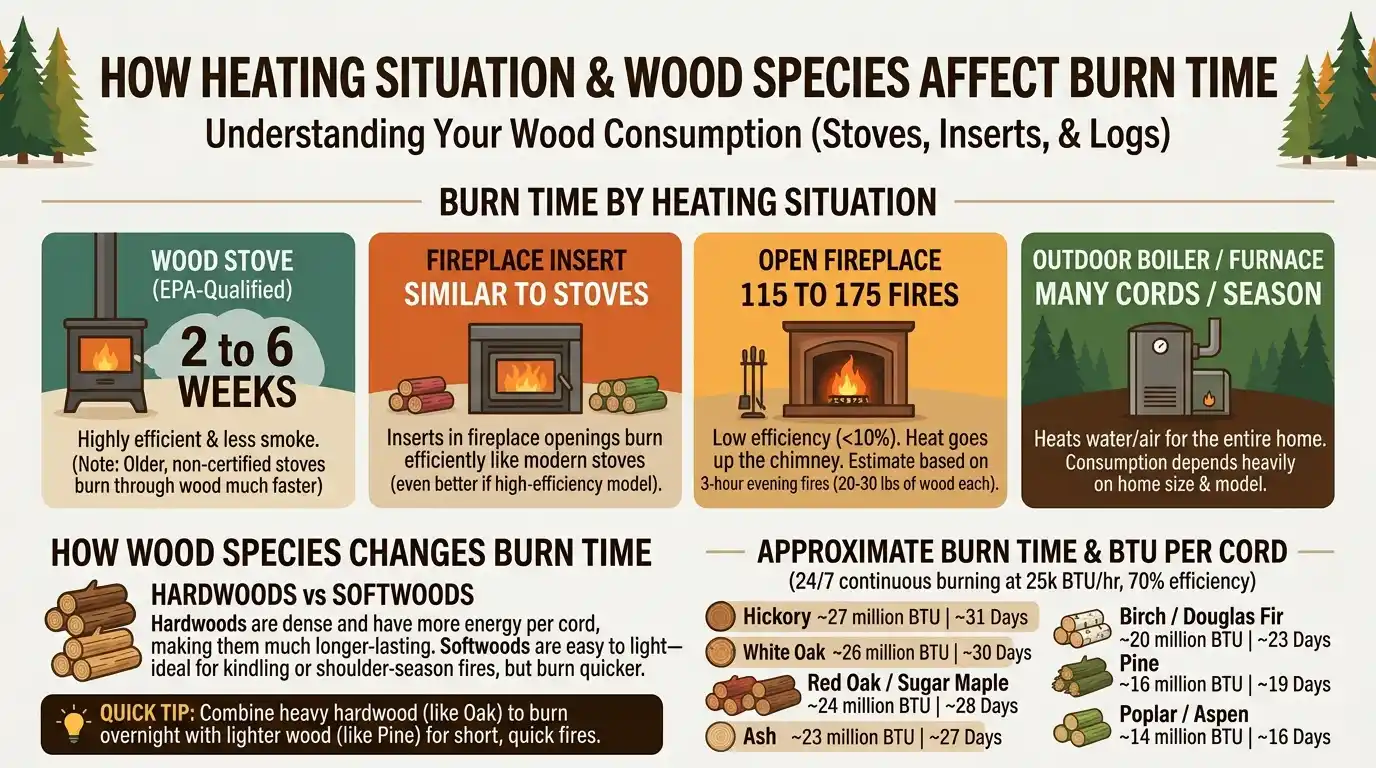
A new EPA-qualified wood stove burns wood efficiently, and thus a cord of wood can last 2 to 6 weeks of full-time operation. Non-certified stoves that are older are less efficient and need more wood to produce the same amount of heat. There is also much less smoke produced by EPA-certified stoves, and EPA Burn Wise provides information on their selection and use.
Fireplace Insert
An insert is a closed container, which is inserted into your fireplace opening, and it burns like a stove. Anticipate similar cord life to a modern stove, which can be better than a stove of the same power, should it be a high-efficiency model.
Open Fireplace
A wood-burning fireplace is quick to burn and radiates the majority of the heat up the chimney. Efficiency is usually 10 per cent or lower, and a cord will do you little warmer than in a stove.
Suppose you make a 3-hour evening fire with approximately 20 to 30 pounds of wood, a 3,500-pound cord would provide you with approximately 115 to 175 fires. That’s my estimate, not a lab figure. The real results are dependent on the size of the fire and weight of logs.
Outdoor Wood Boiler or Central Furnace
These systems warm water or air to serve an entire home, and may burn a number of cords in a season. The consumption is greatly dependent on the model and the size of the heated space. Request the manufacturer to provide published fuel-use figures of your set-up.
How Wood Species Changes Burn Time
Hardwoods are dense and have more energy per cord, thus they are also long-lasting compared to softwoods.
The following are rough estimates. Published BTU charts are dependent on both source and moisture assumptions, therefore, these are ballpark figures.
| Wood | Approx. million BTU per cord | Approx. days (24/7 at 25,000 BTU/hr, 70% efficiency) |
|---|---|---|
| Hickory | ~27 | ~31 |
| White oak | ~26 | ~30 |
| Sugar maple | ~24 | ~28 |
| Red oak | ~24 | ~28 |
| Ash | ~23 | ~27 |
| Birch | ~20 | ~23 |
| Douglas fir | ~20 | ~23 |
| Pine | ~16 | ~19 |
| Poplar/aspen | ~14 | ~16 |
Softwoods aren’t bad. They are easy to light and can be used in kindling or shoulder-season fires. You simply read through them quicker.
Tip: It is a good idea to combine heavy hardwood to burn overnight with lighter wood to burn in a short period of time.
How Moisture Content Changes Everything
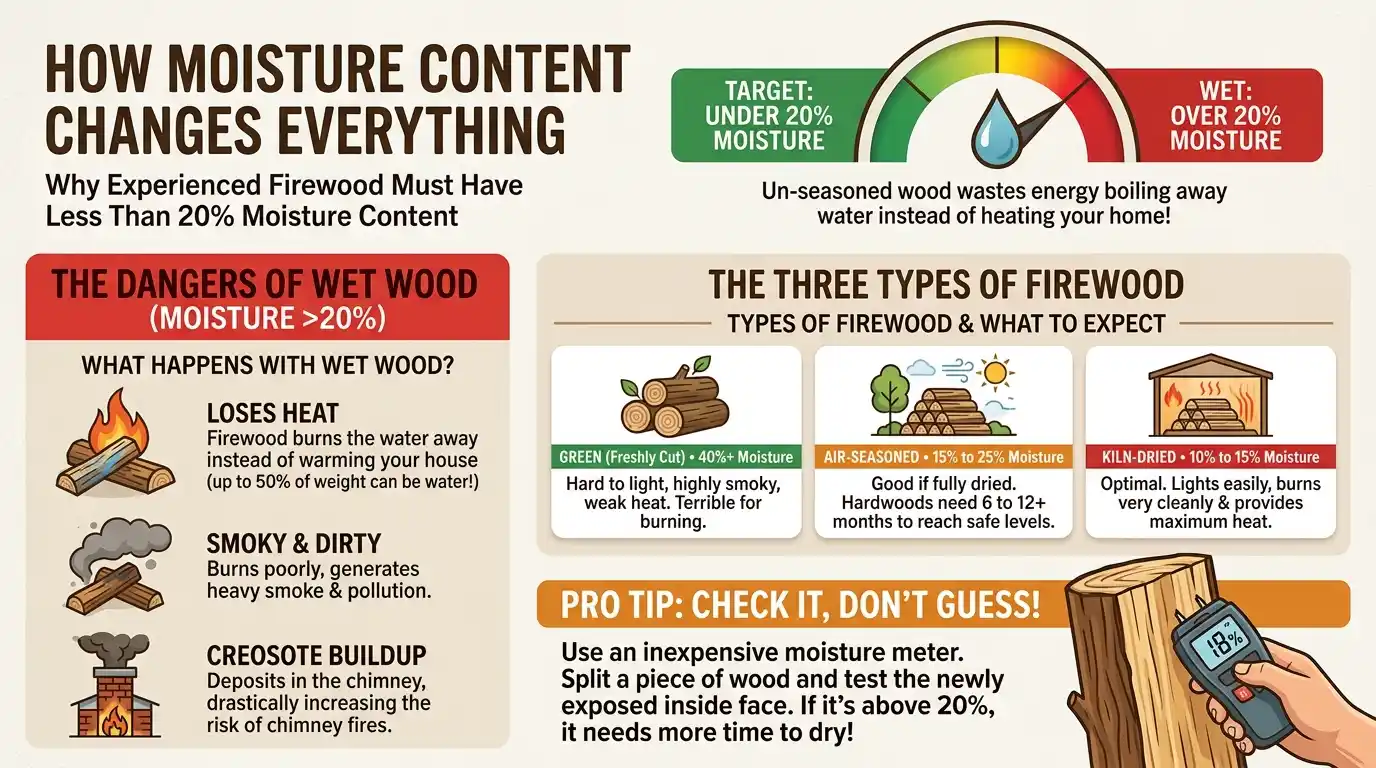
Experienced firewood must have less than 20% moisture content. This is the level suggested by EPA Burn Wise since wet wood burns poorly, generates more smoke, and yields less usable heat.
Un-dried wood is capable of retaining approximately half its weight of water. Your fire burns that water away, not warming your house. Creosote is also deposited in the chimney by wet wood which increases the chances of a chimney fire.
| Type | Typical moisture | What to expect |
|---|---|---|
| Green (freshly cut) | Often 40% or higher | Hard to light, smoky, weak heat |
| Air-seasoned | Usually 15% to 25% | Good if fully dried; hardwoods often need 6 to 12+ months, oak longer |
| Kiln-dried | Often about 10% to 15% | Lights easily, burns cleanly |
Check it, don’t guess. A moisture meter is inexpensive. Divide a piece, and test the new inside face. A reading of above 20% indicates that it requires more time to dry.
How Many Cords Do You Need for a Winter?
There is no standard amount, and I would be speculating to tell you. This is a useful way to consider it.
| Situation | Typical planning range* |
|---|---|
| Occasional recreational fires | Well under 1 cord |
| Supplemental heat (evenings, weekends) | About 1 to 3 cords |
| Primary heat, mild to moderate climate | About 2 to 5 cords |
| Primary heat, cold climate or larger home | About 4 to 8 cords or more |
Typical planning ranges, not assurances. These numbers can be shifted quite a bit by insulation in your home, the efficiency of your stove, and the length of the winter.
How to plan: Plan to order at least one full cord of more than you think you will need in your first year. Then, after that winter, record how much you had left or when you ran out, and make amends.
9 Ways to Make a Cord of Wood Last Longer
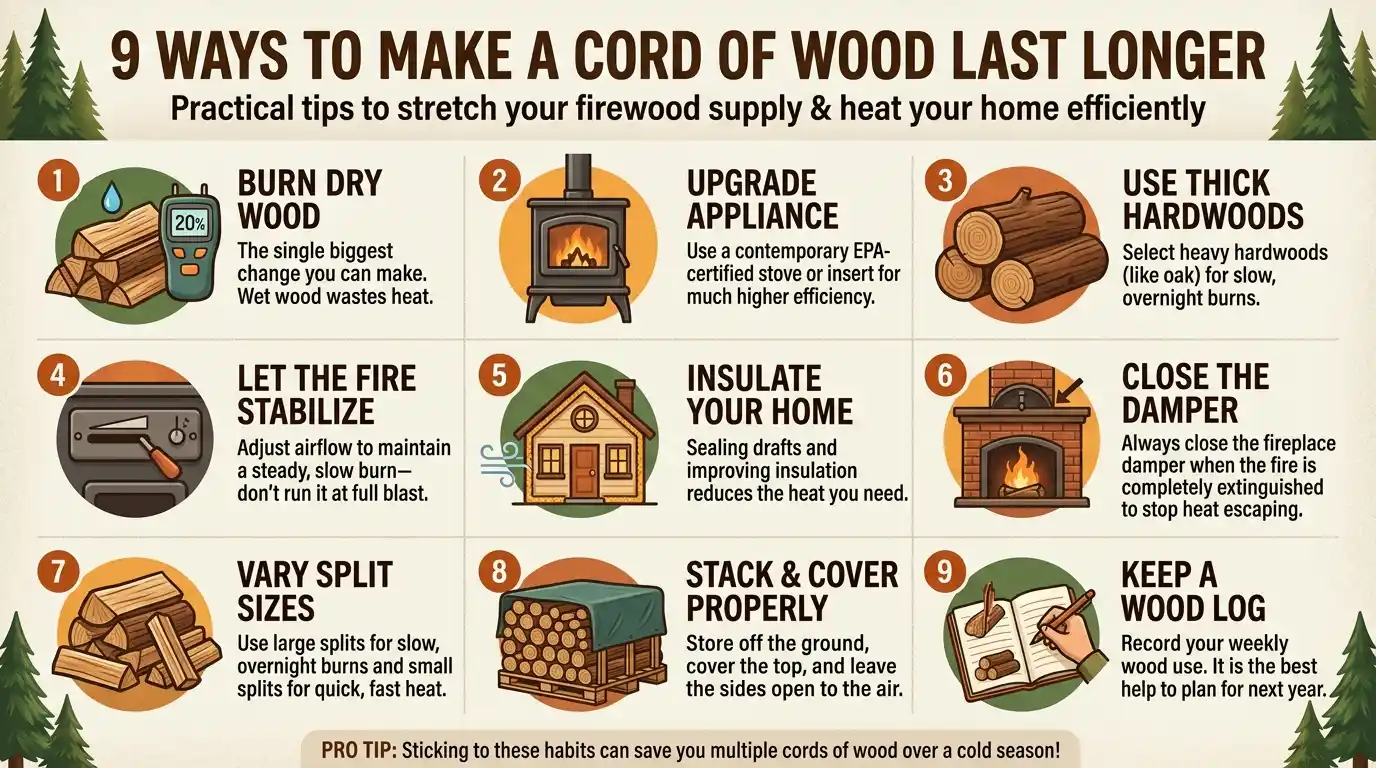
- Burn dry wood. It is the one largest change you can make.
- Use a contemporary stove or insert. Efficiency is more than most individuals anticipate.
- Select thick hardwoods to burn overnight.
- Allow the fire to stabilize. Do not run it to full blast when it is not necessary.
- Enhance insulation and draft closures. A house that does not lose as much heat requires less wood.
- When the fire is extinguished, close the damper. An open flue allows the escape of warm room air.
- Long burns should be split with large splits and fast heat with small splits.
- Stack and cover properly. Store the pile on the floor, with the top covered and the sides open to the air.
- Keep a log. Record the amount of burning you do in a week. It is the most useful aid to the planning of next year.
Common Mistakes
- Purchasing a cord without measuring it.
- Burning timber that is not long-seasoned.
- Keeping wooden wrapping on the ground or completely covered with plastic.
- Operating the stove too low over a long period, increasing creosote.
- Supposing that you have an open fireplace that can warm your house.
- Not having the chimney inspected annually.
FAQs
What is the duration of a cord of wood?
Anywhere from about 2 to 3 weeks (cold climate, primary heat) to a whole season (occasional fires). The above formula will assist you in reducing it to your house.
What is the number of days a cord of firewood will burn in a wood stove?
In full-time burning with a modern stove and seasoned hardwood, an approximate estimate of between 17 to 47 days is realistic, depending on the heat demand.
Will a cord of wood suffice the winter?
Just in case of wood as occasional or light supplemental heat. A lot of individuals who use wood as the main heating fuel will budget a number of cords.
How many cords of wood do I need to heat a house?
It depends on climate, size of the house, insulation and the efficiency of the stove. Primary heat is typically planned to be between 2 and 8 cords or higher.
How many years does a cord of wood burn in a fire place?
About 100 to 175 fires are reasonable estimates in the case of evening recreational fires. The cord can be burned out in an open fireplace in less time than you might think.
What is the difference between a cord and a face cord?
A cord is 128 cubic feet. A face cord: 4 x 8 feet, or one log length, typically a quarter to a third of a cord.
Is hardwood more durable than softwood?
Yes. Hardwoods such as oak and hickory are more dense and contain more energy per cord.
Will wet wood burn more quickly?
Damp timber does not burn very well. It burns, smokes and produces less useful heat, therefore more wood is used to keep warm.
What should be the moisture content of firewood?
Less than 20 percent moisture content, by EPA Burn Wise.
How much does a cord of wood weigh?
Approximately 3,000 to 4,500 pounds of seasoned hardwood. It varies by species and moisture.
Does firewood that is dried in the kiln matter?
It is more expensive but dry, clean-burning and ready to use. It can be a good option in case of a wet season or convenience. Wood which is well-seasoned also works.
What is the shelf life of firewood?
Dry firewood kept properly will last a couple of years, and even longer in dry climates. Wet wood lying on the ground may rot or develop mould.
How can I tell if I got shorted on a cord?
Measure it and stack it. Length x height x depth in feet. You require approximately 128 cubic feet.
Final Thoughts
A cord of wood is not a one-life cord. It is ranged, and you can reduce it to three questions: How dry is my wood? What is the efficiency of my appliance? What is the amount of heat required in my home?
Begin with the formula in this guide, and compare it with your actual burning practices. You will know your own number after one winter as well as any chart.