How Much Does a Cord of Hardwood Weigh? The Complete Weight Guide by Species
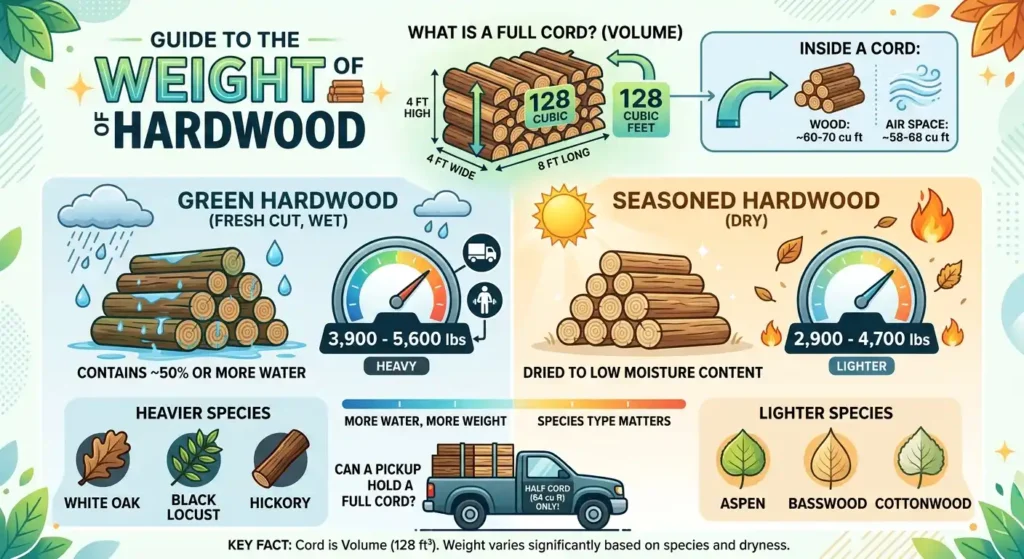
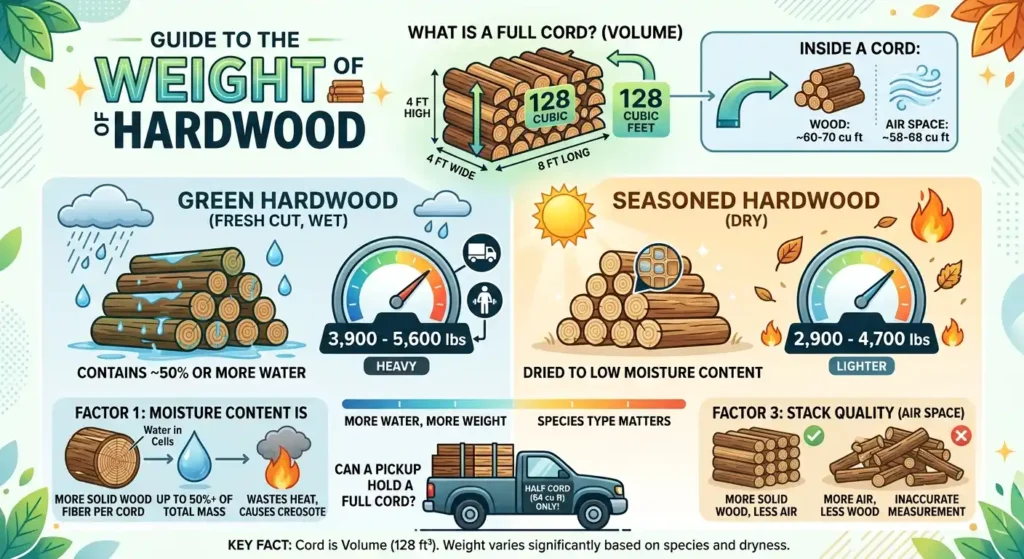
Quick Answer: The weight of a full cord of seasoned (dry) hardwood is usually between 2,900 and 4,700 pounds, depending on the species. Green fresh cut hardwood is heavier, typically 3,900 to 5,600 pounds, as it is still retaining a huge quantity of water. Thicker species such as white oak, black locust and hickory are located at the heavy end of that range. At the lighter end are the lighter hardwoods such as aspen, basswood and cottonwood.
There’s no single “correct” number, because a cord is a measurement of volume, not weight. Two cords of wood can look identical and still be a thousand pounds apart depending on the species and how dry it is. If you want the full breakdown of what actually fits inside that volume, that’s worth a look too. The rest of this guide breaks down exactly why weight varies, and gives you real numbers so you’re not stuck guessing.
Quick facts:
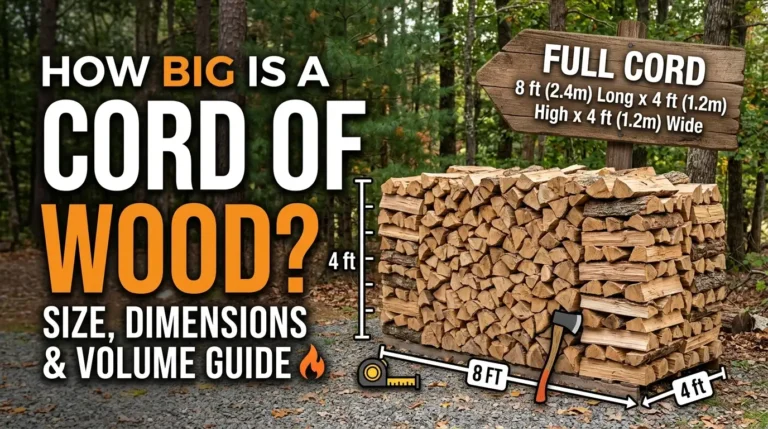
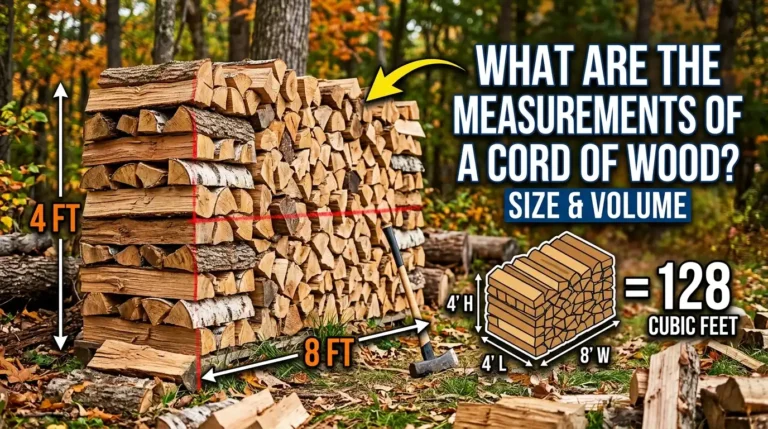
- A typical full cord is 4 feet high, 4 feet wide and 8 feet long, or 128 cubic feet of stacked wood and air space.
- There is about 60-70 cubic feet of that 128 which is real wood; the rest is air between the logs.
- Green wood may contain 50 per cent or more water.
- A full size pickup bed can only hold approximately half a cord, or 64 cubic feet, when it is loaded to the top of the bed rails.
What Counts as a “Cord” of Wood
A cord is a measure of volume, not weight. It is officially described as a pile of wood 4 feet high, 4 feet deep, and 8 feet long, or a total of 128 cubic feet. That amount is the weight of the wood itself, as well as the spaces and air between the pieces, and this is why weight can change so much even at a full cord.
Because of those air gaps, the actual solid wood in a cord is usually closer to 60 to 70 cubic feet rather than the full 128. Tighter, straighter stacking leaves less air and more wood, which is one reason two “full cords” can weigh differently even from the same species. For a closer look at the stack dimensions themselves, see our breakdown of exact cord sizing.
Full Cord vs. Face Cord vs. Rick
No other terms in the firewood world are as confusing (or as subject to disagreement with the firewood sellers) as these three terms.
| Term | Dimensions | Volume | How It Compares to a Full Cord |
| Full cord | 4 ft x 4 ft x 8 ft | 128 cubic feet | 100% (this is the standard) |
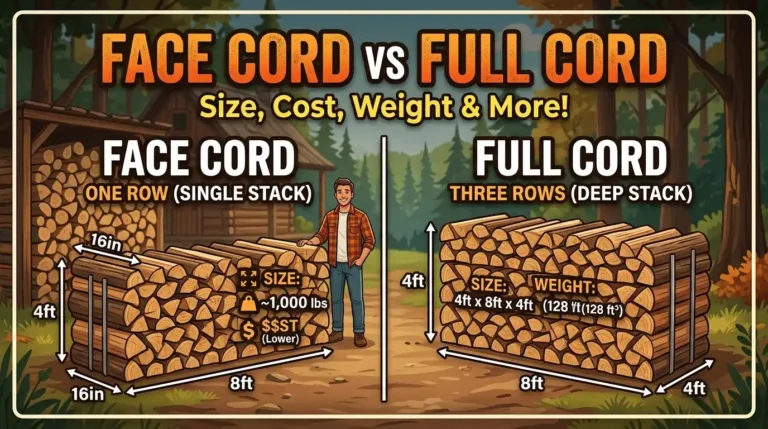
| Face cord (rick) | 4 ft x 8 ft x length of the pieces | 32 to 48 cubic feet, depending on piece length | Roughly 1/4 to 1/3 of a full cord |
| Pickup load | Bed loaded level | About 64 cubic feet | Roughly 1/2 of a full cord |
If a seller advertises a “cord” but the wood pieces are only 16 inches long stacked 4 feet by 8 feet, you’re actually looking at a face cord, not a full cord. Always ask for the exact dimensions of what you’re buying, not just the word “cord.” Our guide comparing face cords and full cords side by side walks through the pricing and sizing differences in more detail, and if a seller calls it a “rick,” our rick of firewood breakdown covers exactly what that term means too.
Recommended image alt text: Diagram of a comparison between a full cord of firewood and a face cord and a pickup truck load.
Why a Cord of Hardwood Doesn’t Have One Fixed Weight
Moisture Content Is the Biggest Factor
Green (freshly cut) wood contains an enormous quantity of water in its cells, up to 50% or more of its total mass. During the drying of wood (seasoning, or air drying) over 6 to 12 months, or during kiln drying in a few days, that water evaporates and the wood becomes significantly lighter, without losing any of the heat energy it will later give up on burning.
It is the most important thing that sellers do not necessarily tell you: a light, well-seasoned cord is not a bad thing to buy. It’s actually the better fuel. Wet wood also wastes power boiling off water before it burns effectively and it also causes more smoke and creosote accumulation in your chimney.
The Second-Largest Factor Is Species Density
At the same moisture content, tree species will stuff more or less solid wood fiber into the same volume. Hardwoods such as oak, hickory, and black locust are much heavier per cord than other types of hardwoods such as aspen, basswood, or cottonwood. This is also the reason why dense hardwoods have a longer burn time and give more heat per cord, they are just burning more fuel in the same space.
The Wood is Stacked So Tight
A straight, neatly stacked cord, with less wasted air space, is compared to a loosely thrown or crooked, knotty pile. That is, two cords of the same species and of the same amount of moisture may yet weigh differently, simply because of the quality of stacking. This is most important when you are comparing a delivery to a chart such as the one shown below: the chart is of a properly stacked cord not of a loose dump pile.
How Much Does a Cord of Hardwood Weigh, on Average?
According to the data on the weights of species prepared by the Forestry Extension program of Utah State University, the majority of common firewood hardwoods are within the following ranges:
| Condition | Typical Weight Range per Cord |
| Seasoned (air dried) hardwood | 2,900 to 4,700 lbs |
| Green (freshly cut) hardwood | 3,900 to 5,600 lbs |
| Kiln dried hardwood | Similar to or slightly lighter than seasoned, depending on final moisture target |
White oak, black locust, apple and honey locust are some of the dense species that inhabit the top of that range. At the bottom are lighter hardwoods such as aspen, basswood and cottonwood. When a seller offers you one number, but no species, take it as an average, not as a promise.
Cord of Hardwood Weight by Species (Chart)
The following table is based on the weight data of the Forestry Extension program at the University of Nebraska, and was used at the University of Utah, State Forestry. Pounds per full cord (128 cubic feet stacked) are weights.
| Species | Green Weight (lbs/cord) | Seasoned/Dry Weight (lbs/cord) |
| White Oak | 5,573 | 4,200 |
| Black Locust | 4,616 | 4,016 |
| Apple | 4,850 | 3,888 |
| Honey Locust | 4,640 | 3,832 |
| Bur Oak | 4,960 | 3,768 |
| Mulberry | 4,712 | 3,712 |
| Beech | not listed | 3,760 |
| Sugar/Hard Maple (listed as “Maple, Other”) | 4,685 | 3,680 |
| Red Oak | 4,888 | 3,528 |
| White Ash | 3,952 | 3,472 |
| Black Walnut | 4,584 | 3,192 |
| Kentucky Coffeetree | 3,872 | 3,112 |
| Siberian Elm | 3,800 | 3,020 |
| Birch | 4,312 | 2,992 |
| Cherry | 3,696 | 2,928 |
| Hackberry | 3,984 | 3,048 |
| American Elm | 4,456 | 2,872 |
| Green Ash | 4,184 | 2,880 |
| Silver Maple | 3,904 | 2,752 |
| Sycamore | 5,096 | 2,808 |
| Boxelder | 3,589 | 2,632 |
| Willow | 4,320 | 2,540 |
| Alder | not listed | 2,540 |
| Basswood (Linden) | 4,404 | 1,984 |
| Cottonwood | 4,640 | 2,272 |
| Aspen (Quaking) | not listed | 2,160 |
Hickory isn’t in this particular dataset, but based on its wood density, it burns and weighs in a range similar to white oak, generally near the heavier end of common firewood hardwoods. If oak is what you’re burning, our full breakdown of oak’s heat output and seasoning time goes deeper than the numbers here, and for anyone comparing lighter species, our piece on whether birch qualifies as a true hardwood is a useful companion read.
Important lesson: When you encounter a large difference between two sets of numbers on the internet that represent the weight of cord, it is more likely that one of them is giving you the price of green wood and the other the price of seasoned wood. Always make sure which one you are comparing.
Recommended image alt text: Chart of the weight in pounds of a cord of hardwood by species, green versus seasoned.
Hardwood vs. Softwood: Weight Comparison
The softwoods (pine, spruce, fir, cedar) tend to be less dense than hardwoods, and hence they weigh less per cord, as well as why they are not a good choice to make long, hot fires.
| Category | Typical Seasoned Weight per Cord | Typical Use |
| Dense hardwood (oak, hickory, locust) | 3,700 to 4,700 lbs | Overnight burns, wood stoves, cold climates |
| Medium hardwood (maple, ash, birch, cherry) | 2,900 to 3,700 lbs | General purpose firewood |
| Light hardwood (aspen, basswood, cottonwood) | 2,000 to 2,700 lbs | Kindling, shoulder season fires |
| Softwood (pine, spruce, fir, cedar) | 2,100 to 3,000 lbs | Quick starts, outdoor fire pits, less ideal for indoor heating |
Softwoods are more readily burnt and yield more resin and spark, and this is one of the reasons why chimney sweeps and stove manufacturers typically encourage dense hardwood as your first fuel and softwood as a starting fire fuel.
How to Estimate the Weight of a Cord Yourself
To get a real number rather than a chart estimate, here is a simple way:
- Weigh a small, representative sample. Place just a cubic foot (or weigh a few pieces and determine the volume) of the wood you are considering on a bathroom or luggage scale.
- Multiply by 128. A full cord is 128 cubic feet, so multiply your one cubic foot weight by 128 to determine the total.
- Adjust to air space. Since only about half of a stacked cord is not solid wood, but air, this method is an approximation, not an absolute value. It is best in comparison of does this feel about right to the chart above.
- A moisture meter is more accurate. An inexpensive pin type moisture meter (readily available at a price of between $20 and 40) would inform you the actual percentage moisture content of your wood which would allow you to determine its position on the chart between the green and seasoned figures.
Can Your Truck or Trailer Handle a Cord of Hardwood?
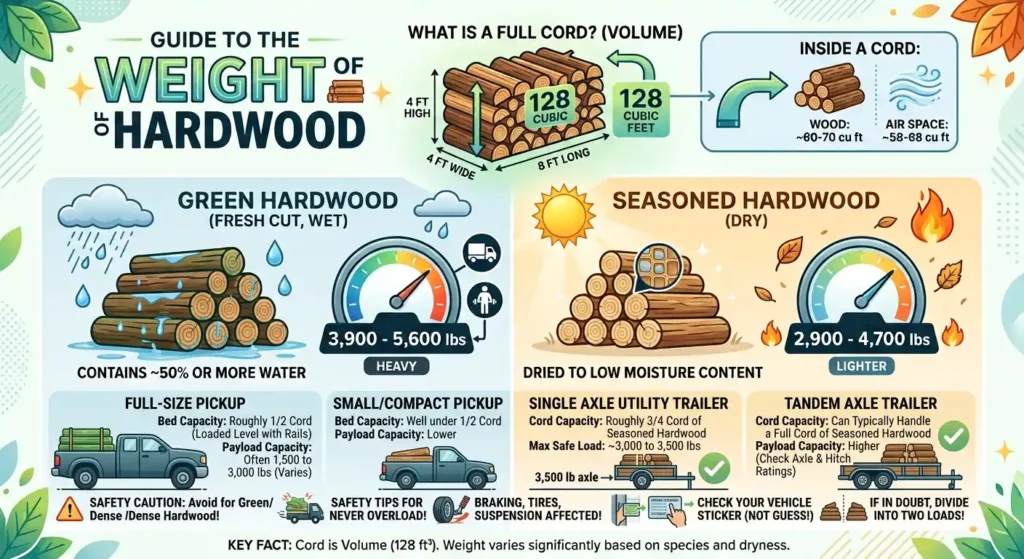
This is where the weight of the cord ceases to be trivia and becomes a safety question.
| Vehicle/Trailer | Typical Payload Capacity | Cord Capacity |
| Full size pickup bed (loaded level with rails) | Varies by truck, often 1,500 to 3,000 lbs payload | Roughly 1/2 cord, and often less if the wood is green or dense |
| Small/compact pickup | Lower payload capacity | Well under 1/2 cord |
| Single axle utility trailer (3,500 lb axle) | Around 3,000 to 3,500 lbs safely | Roughly 3/4 of a cord of seasoned hardwood, less if green |
| Tandem axle trailer | Higher capacity, check axle and hitch ratings | Can typically handle a full cord of seasoned hardwood |
Some useful safety tips:
- A full cord of hardwood cannot be safely transported in a typical, full-size pickup truck on a single trip, particularly when the wood is green or is a dense species such as oak.
- When a truck or small trailer is loaded to or exceeding its rated payload, the braking distance, tire wear, and suspension are impacted, and it may be a legal problem on the public road.
- When you are not sure what the payload rating of your vehicle is, refer to the sticker on the driver doorjamb and not guess.
- In case of any doubt, divide a full cord into two loads instead of overloading.
How to Tell If You’re Getting a Full Cord
One of the most common firewood complaints is short cording (selling less than a full cord at full cord prices). Checks: a few ways:
- Measure the stack. Supposed to be a full cord, it ought to be about 4 ft x 4 ft x 8 ft (128 cubic feet) when stacked up again.
- Request the term to be written. Full cord, face cord, and truckload are not synonymous, and a valid seller must be particular.
- Compare weight with the chart above. When a load of so-called seasoned oak weighs far less than 3,500 to 4,200 pounds, then it is not a full cord, it is not oak, or it is not seasoned.
- Be familiar with local regulations. The weights and measures laws of many states in the United States specifically address the sale of firewood, and a local weights and measures office may assist in case you think short cording is involved.
Myth vs. Fact
| Myth | Fact |
| “A cord of wood always weighs about the same.” | Weight depends heavily on species and moisture. It can vary by more than 2,000 pounds between species. |
| “Heavier wood is always better firewood.” | Heavier usually means denser and more energy dense, but heavy green wood is actually worse firewood than a lighter, well seasoned log because of the water content. |
| “Kiln dried and seasoned wood weigh the same.” | They’re close, but final weight depends on the specific moisture target each method reaches. |
| “A face cord and a full cord are the same thing.” | A face cord is typically only about a third of a full cord’s volume. |
FAQs
How much does a cord of oak weigh?
Seasoned red oak is about 3,500 pounds per cord and seasoned white oak is about 4,200 pounds. The weight of green oak is 4,900 to 5,600 pounds due to its high moisture level when freshly cut.
What is the weight of a cord of maple?
Experienced hard maple weighs about 3,700 pounds per cord, and light silver maple weighs more like 2,750 pounds seasoned.
What is the weight of a cord of hickory?
Hickory is not found in most published university collections, but it is generally similar to white oak, and is usually among the heavier common firewood species, due to its wood density.
Will a cord of hardwood weigh more than a cord of pine?
Yes. The average weight of seasoned hardwood is 2,900-4,700 pounds per cord and seasoned softwood such as pine is between 2,100 and 3,000 pounds per cord.
Why is green wood so much heavier than seasoned wood?
Freshly cut wood can be 50% or more water by weight. When it is air dried or dried in the kiln that water evaporates, and the wood is deprived of a great proportion of its weight, without being deprived of its fuel value.
What is the time taken by hardwood to turn green to seasoned?
The majority of hardwood requires 6-12 months of air drying (piled off the ground, in the sun and wind) to achieve a reasonable moisture content in the burning. This is accelerated to a few days in kiln drying.
Would I be able to carry a full cord of hardwood in my pickup truck?
Typically not on a single load. A typical pickup bed can carry about half a cord and a full cord of seasoned hardwood may weigh as much as 3,000 to 4,500 pounds or more, which is more than the payload capacity of many trucks.
What’s the difference between a cord and a face cord?
A full cord is 128 cubic feet (4 ft x 4 ft x 8 ft). A face cord is not more than 4 ft x 8 ft deep by the length of the pieces, which is generally 32 to 48 cubic feet, about a quarter to a third of a full cord.
What can I do to verify whether I got a full cord?
Neatly restack the wood delivered and measure it. It ought to be about 128 cubic feet in total in case it is a full cord.
Does tightness in the stacking influence the weight of a cord?
Yes. A stack of a cord is tighter and more compact than a loose or crooked stack, and therefore it can be heavier than a stack of the same species and moisture, due to its reduced wasted air space.
Is more heavy firewood the best firewood?
Not necessarily. Dense species are good as they generate more heat per cord but heavy green wood is not really efficient to burn as compared to lighter properly seasoned wood due to water content.
What is the price of a cord of firewood?
The prices differ greatly depending on the area, the species and whether it is experienced or not, and hence it is always better to ask local sellers to get the latest rates in your locality instead of using a national average.
Which is the heaviest common species of firewood?
White oak, black locust, and apple are some of the most common species, and are typically the heaviest seasoned hardwoods, in the 3,900 to 4,200 pound per cord range.
Final Thoughts
There is no real answer to the question of how much a cord of hardwood weighs, and that is the best thing to know before you purchase, carry, or burn any. The work in that last number is done practically by species and moisture content, and is swung by 2,000 pounds or more between a light, seasoned hardwood and a dense, freshly cut one.
When purchasing firewood, verify a delivery with the species chart above. When you are carrying it, do not load up and then check the payload rating of your vehicle. And when you are making your mind up about what to burn, it is always better to remember that a lighter, well seasoned log will make a better fire, though it will weigh less than the green one.