Sugar Maple Firewood: BTU Ratings, Seasoning Time, and How to Burn It for Long, Steady Heat
You already know what good hardwood is, when you have ever loaded a stove at night, and found glowing coals at breakfast. One of the most dependable woods in that task is sugar maple firewood. It is thick, burns well when dry and remains warm hours. It also has quirks. It dries slowly, burns slower than pine and becomes costly when you purchase it wet.
This guide will discuss the extent of heat needed to make sugar maple, the seasoning time, the time to determine when it is ready, and how to burn it effectively.
Key takeaways
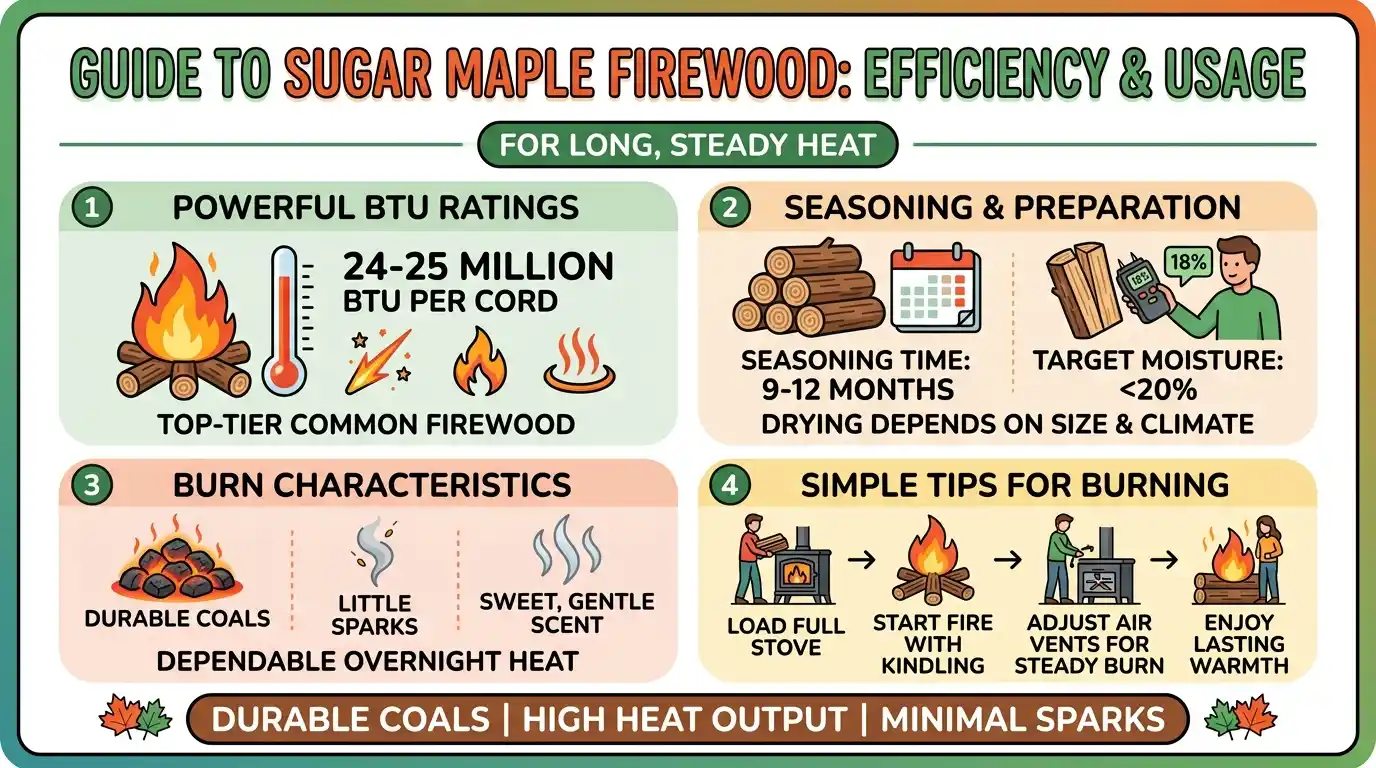
- Sugar maple yields about 24 to 25 million BTU per cord, which makes it one of the better common firewoods in North America.
- Split wood will take approximately 9 to 12 months to season, and longer in large pieces or in wet climates.
- Burn it with 20 percent moisture or less. Check using a moisture meter, not the calendar.
- It produces durable coals, little sparks and a sweet gentle scent.
- It can be beaten on raw heat with oak, hickory and beech, but maple is frequently more readily available and less expensive.
What Is Sugar Maple Firewood?
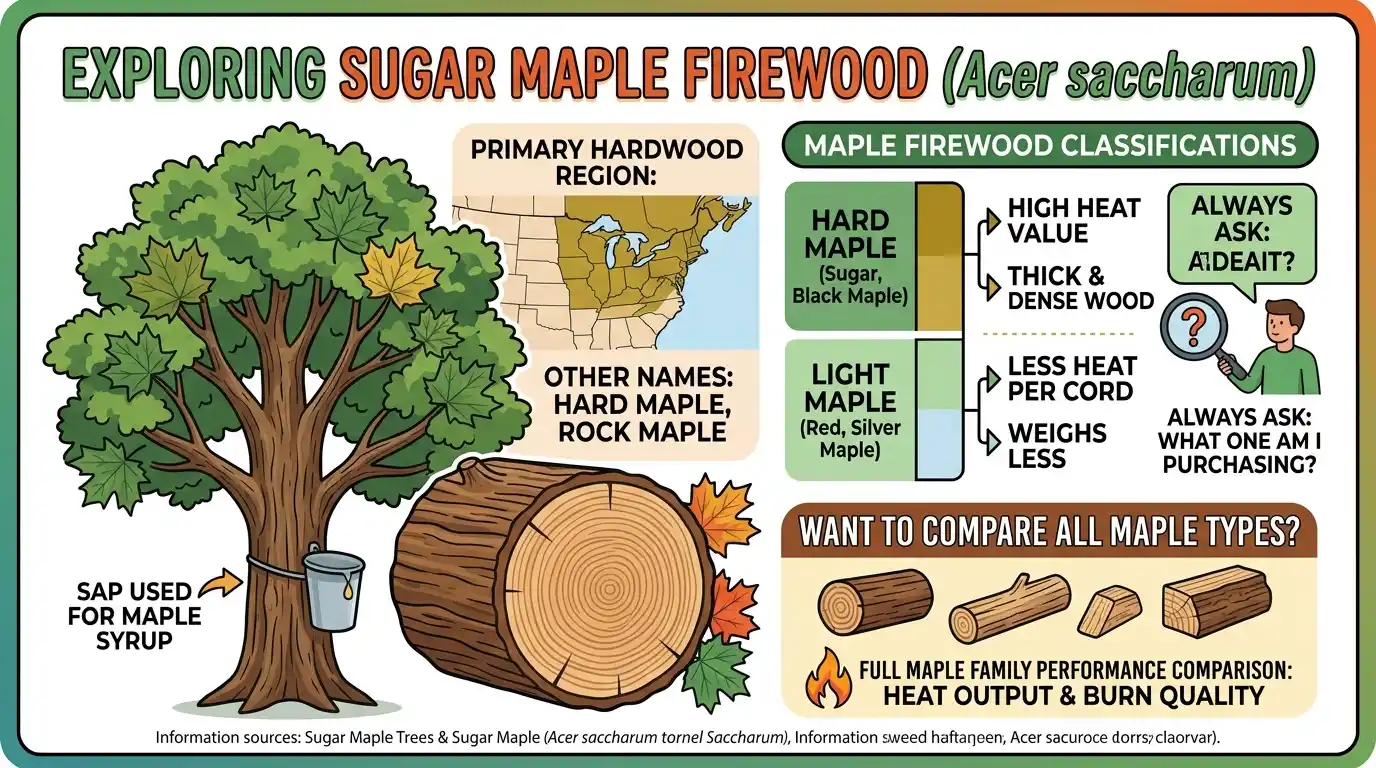
Sugar maple firewood is made of Acer saccharum, a native hardwood tree of the northeastern United States, the Great Lakes region, and south-eastern Canada. It is also sold in hard maple or rock maple. It is the tree that is used to extract maple syrup.
On a firewood list, “Maple” can refer to various species. Hard maple (sugar maple and black maple) is thick and has high heat value. The light maples like red and silver maple weigh less and provide less heat per cord. Always be sure to ask what one you are purchasing.
If you want to see how the whole maple family performs as a heating wood, this breakdown of heat output and burn quality across maple types covers both hard and soft maple.
How Many BTUs Does Sugar Maple Firewood Produce?
When properly seasoned, sugar maple yields about 24 to 25 million BTU per cord. The slightly different figures published by extension services and forestry sources are due to the assumptions of moisture and variation in wood, and therefore any figure is an approximation.
Most species have similar heat per pound. Density is different. A cord of heavy wood contains more pounds of fuel than a cord of light wood, and that is why the amount of heat per cord is so different. Dense wood also weighs more, which matters for hauling and stacking, and this species and moisture weight chart for a full cord helps you estimate your load.
Approximate heat value by species (million BTU per cord, seasoned)
| Species | Approximate range | Notes |
|---|---|---|
| Hickory | 27 to 28 | Very dense, long burn |
| White oak | 26 to 29 | Slow to dry |
| American beech | 26 to 27 | Excellent, less common |
| Sugar maple | 24 to 25 | Balanced, cleaner burn |
| Red oak | 23 to 25 | Very common |
| White ash | 23 to 24 | Dries quicker than most |
| Red (soft) maple | 18 to 19 | Lighter, faster burn |
| White pine | 15 to 17 | Quick, hot, short lived |
Values are estimated and based on published extension ranges that are commonly available. Check them with a reference like your state extension office before citing them as verbatim.
Is Sugar Maple Good Firewood?
Yes. Sugar maple is an excellent firewood to use in wood stoves, fireplaces and to burn outdoors. It is hot and long lasting and leaves solid coals. The primary disadvantages are slow drying, slower start compared to softer woods and high prices in certain areas.
Pros and cons
| Pros | Cons |
|---|---|
| High heat output per cord | Slow to season |
| Long, steady burn | Slower to ignite |
| Strong coal bed | Heavy to move and stack |
| Low smoke when dry | Knotty pieces can be hard to split |
| Few sparks | Costs more than softwood or soft maple |
| Mild, pleasant aroma | Rots quickly if stored wet on the ground |
Sugar Maple vs Oak: Which Is Better?
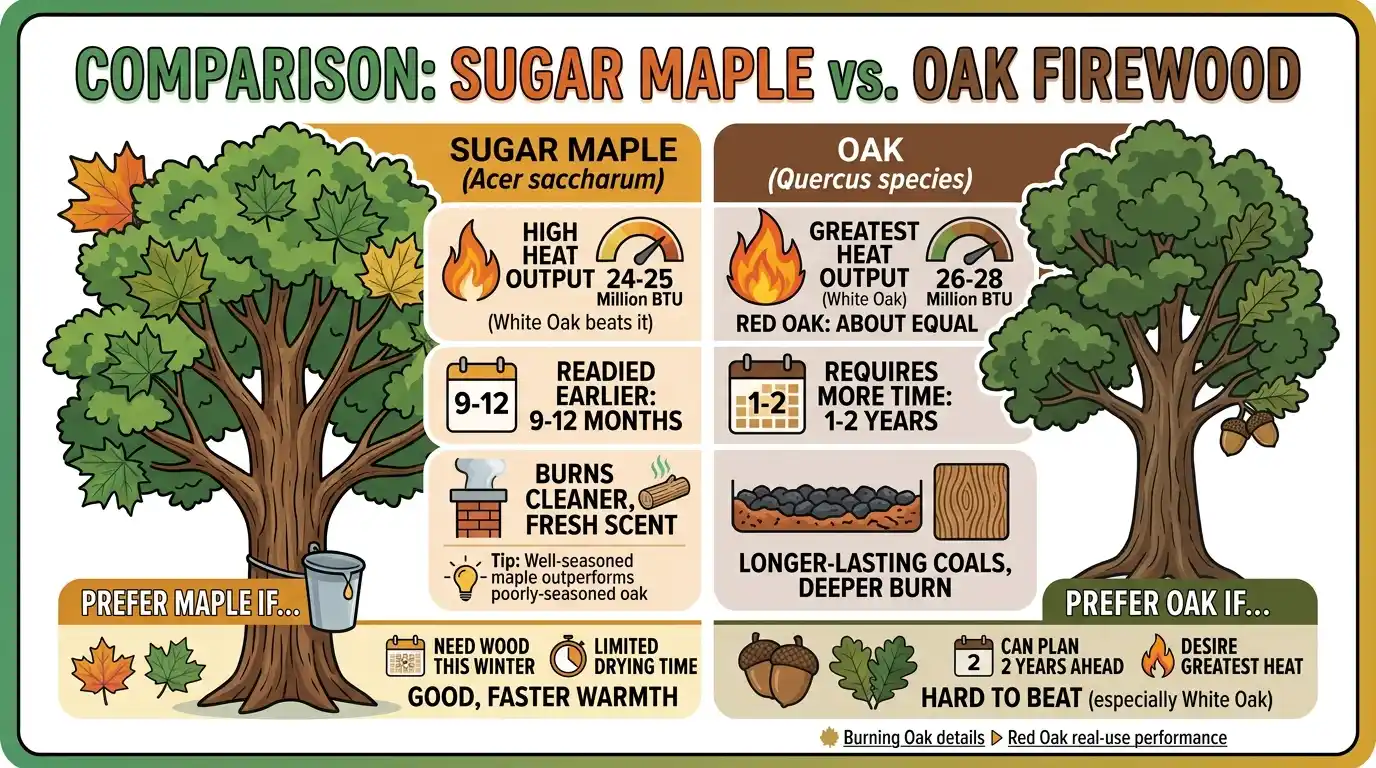
White oak can beat sugar maple as much as a single cord of heat, and red oak is about equal. But oak generally requires more time to dry, one or two years. Sugar maple is generally readied earlier and burns a little cleaner, and a well-seasoned load of maple can perform better than a poorly seasoned load of oak.
An easy method of selection: when you require wood this winter, and have but little time to dry it, the maple is to be preferred. White oak can hardly be beaten, provided you can plan two years in advance and desire the greatest amount of heat. white oak is hard to beat.
For the full picture on oak, read about burning oak in a stove or fireplace, and see how red oak performs in real use if that is the type sold near you.
How Long Does Sugar Maple Take to Season?
When split and stacked in a sunny, breezy location, most sugar maple takes approximately 9 to 12 months to season. That can be stretched to more than a year by large rounds, stained stacks and wet climates. Firewood is prepared at approximately 20 percent moisture or less, irrespective of the length of time it was kept.
Seasoning timeline
| Stage | Time from cutting | What is happening |
|---|---|---|
| Green | 0 months | Moisture can be 50 percent or more |
| Early drying | 3 to 4 months | Surface dries, ends begin to crack |
| Mid drying | 6 to 8 months | Weight drops noticeably |
| Ready to test | 9 to 12 months | Often near or below 20 percent |
| Extended | 12 to 18 months | For large splits or damp regions |
What speeds up drying
- Split it. Bark helps to reduce the loss of moisture, and tearing opens up the interiors.
- Pile it on pallets or rails off the ground.
- Select an exposed location where there is a wind.
- On the top of the stack cover, but not the sides.
- Cut smaller. Large splits dry quicker than small ones.
How to Tell If Sugar Maple Firewood Is Seasoned
Apply a moisture meter. Divide a piece and push the meter pins into the new face and read the number. Goal of 20 percent or less.
If you have no meter, look for these clues:
- End grain cracks (checks)
- Darker, grayish ends
- Noticeably lighter weight
- When two splits are struck together there is a clear, hollow clack.
- Bark loosening
Hissing, sizzling or steam when burning indicates that the wood remains moist.
Kiln Dried vs Seasoned Sugar Maple
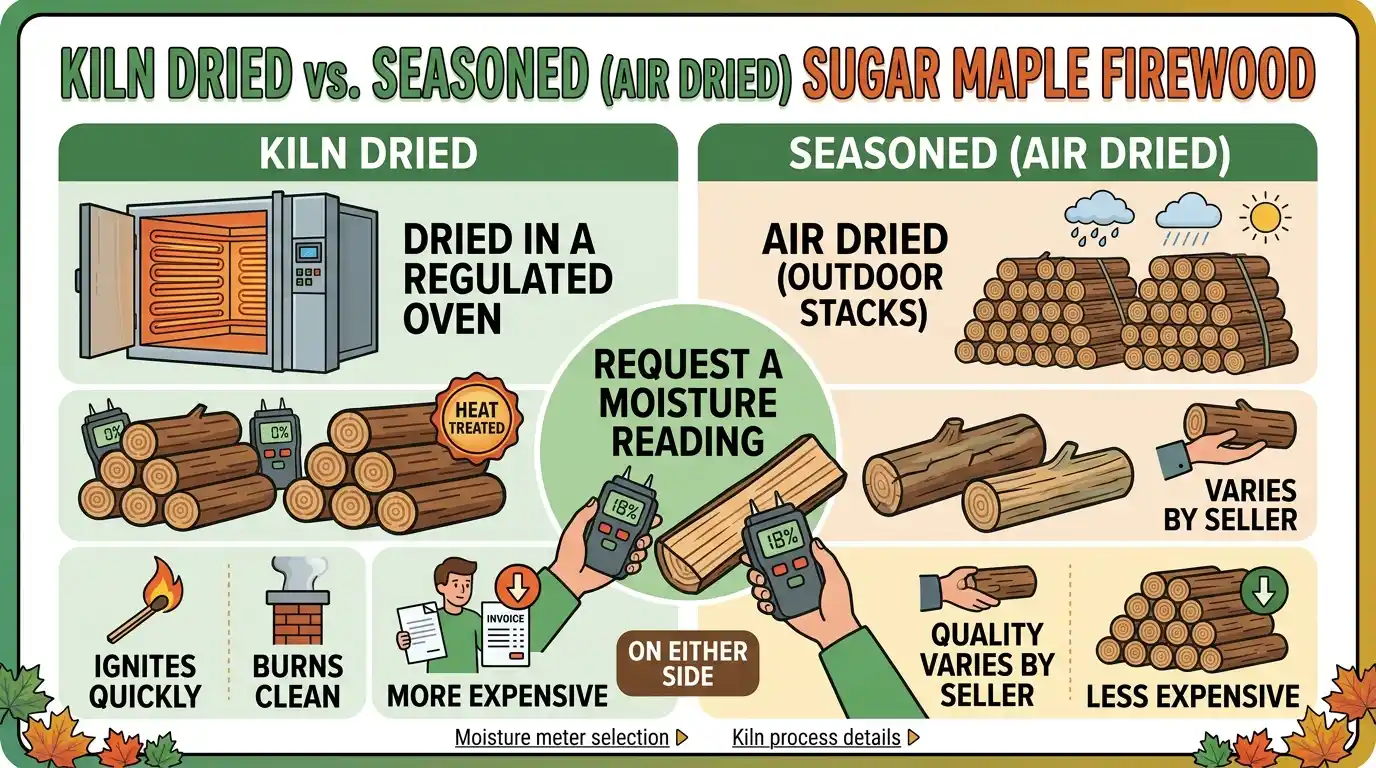
Kiln dried firewood is dried in a regulated oven, typically to a low and steady moisture content and often heat treated. It ignites quickly and burns clean, but is more expensive. Experienced (air dried) wood is less expensive, but the quality varies depending on the seller. Request a moisture reading either side.
How to Split and Stack Sugar Maple
Straight-grained sugar maple generally splits quite well, particularly when cut to length shortly after cutting. Forked or knotty pieces are more difficult, and a hydraulic splitter is helpful.
- Cut circles to the length of your stove, usually 16 inches.
- Divide now, when the wood is the less hard.
- Pile in single layers with air vents.
- Do not put the stack on the ground.
- Seal the top and leave the sides open.
- Stack or turn old wood round to the front.
How to Burn Sugar Maple Firewood
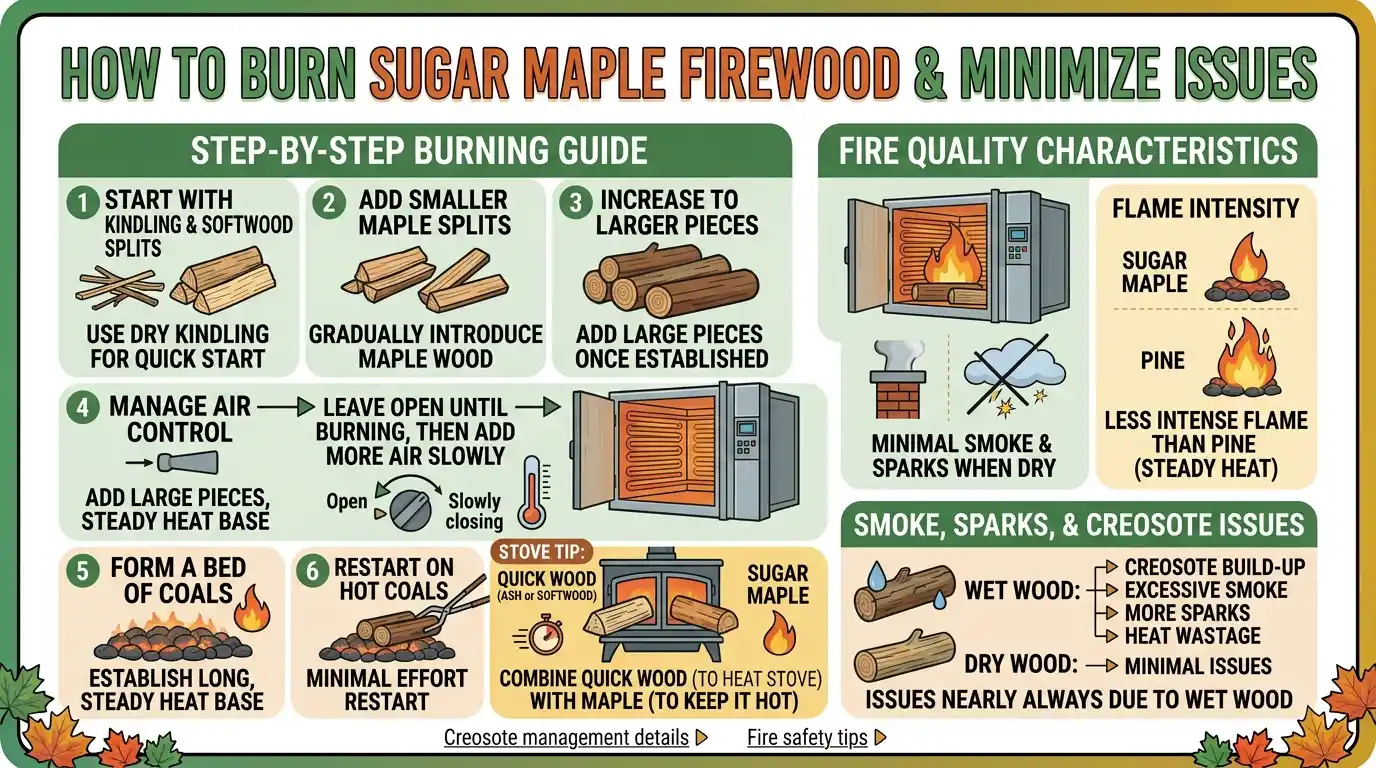
Thick wood requires sufficient air to start. When heated it subsides into a long, smooth burn.
- Begin with dry kindling and some small splits of soft wood.
- Place smaller maple splits in initially, then larger pieces.
- Air control should be left open until the wood burns out.
- Add more air slowly as a bed of coals is formed.
- Restart on hot coals with the least effort.
Stove tip: A lot of people combine sugar maple with a more rapid burning wood like ash or a small quantity of softwood. The quick wood heats the stove and the maple keeps it hot.
Good in the fire? Yes. It gives a minimum of sparks and nice, steady fires. Due to its density, the flames will be less intense than pine.
Does Sugar Maple Smoke or Spark?
Sugar maple can be dried with minimal smoke and sparks when it is dry. The issues of smoke and creosote are nearly always due to wet wood rather than the species. Wet wood is also a heat wastage.
How Much Does Sugar Maple Firewood Cost?
Prices are dependent on the region, season and whether the wood is green, seasoned or kiln dried. I lack trustworthy national price data to quote, compare local quotes. For typical price ranges and ways to lower your bill, see this look at what a cord of firewood really costs.
Buying checklist
- Inquire whether it is hard (sugar) maple or soft maple.
- Request a moisture reading or check with your meter.
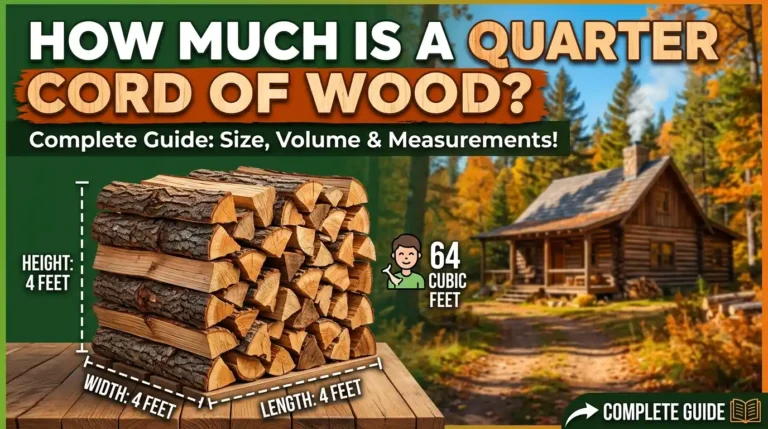
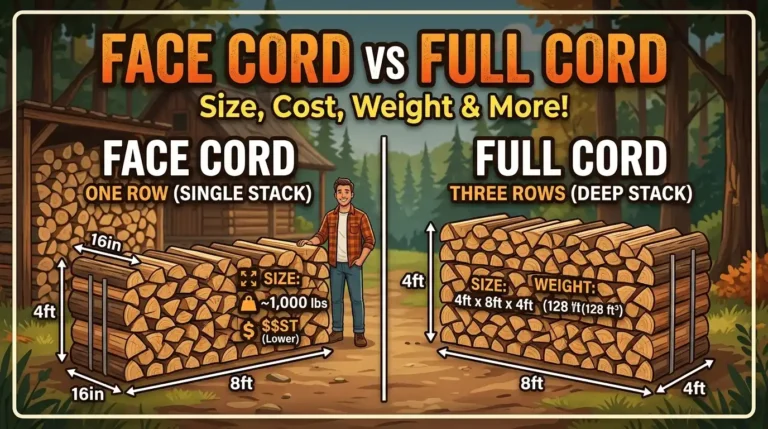
- Confirm the unit. A full cord is 128 cubic feet when stacked (4 by 4 by 8 feet). A face cord or rick is usually much smaller, and this side-by-side comparison of face cords and full cords shows how to tell them apart before you pay.
- Test rot, mould and dirt.
- Buy locally. The transportation of firewood may propagate invasive pests.
Safety, Storage, and Pest Notes
Burn well-dried wood in a well-maintained, properly installed appliance, and have the chimney swept by a certified sweep. Wet fuel forms creosote that may lead to chimney fires.
Maple has a special pest problem. Asian longhorned beetle is a maple and other hardwoods predator and one of its means of spreading is through firewood. Store or cut wood close to where you burn it, and adhere to local quarantine restrictions.
Common Mistakes
- Burning unseasoned maple due to its appearance of dryness.
- Piling on the ground.
- Sealing the whole stack, and which seals moisture.
- Supposing that all the maple is sugar maple.
- Evaluating wood by age and not moisture.
- Turning off air control prematurely in a cold stove.
Which Wood Should You Choose? A Simple Decision Guide
- Have to get firewood this winter and you have limited time to dry it? Choose sugar maple or ash. If ash is on your list, learn how it seasons and heats compared with other hardwoods.
- Desire the highest amount of heat and can wait two years? Choose white oak or hickory.
- Fast start required on a tight budget? Shoulder seasons can be considered using red maple or softwood mix.
- Operating an EPA-rated stove? Any mature hardwood is good, and it is more about dryness than species.
Want a wider comparison? Browse these top wood picks for long, safe fires.
FAQs
Is maple sugar good firewood?
Yes. Sugar maple is dense, burns well, lasts a long time, and leaves good coals.
How many BTUs does sugar maple have?
Sugar maple has approximately 24 to 25 million BTUs per cord when seasoned, although published values vary slightly.
How long does sugar maple take to season?
Sugar maple usually takes 9 to 12 months to season when properly stacked in the sun and wind. Larger pieces may require more time.
Can you burn green sugar maple?
It is not advisable to burn green sugar maple. It produces more smoke, burns poorly, and can contribute to creosote buildup.
Which is better, sugar maple or oak?
White oak generally contains more heat per cord, while sugar maple burns cleanly and provides a steady fire. Red oak has similar characteristics.
Which is better firewood, hard maple or soft maple?
Hard maple is generally better for heating because it is denser and provides more heat per cord than soft maple.
Does sugar maple spark or pop when burned?
Sugar maple does not usually spark or pop much when it is properly seasoned and dry.
What is the correct moisture level for sugar maple firewood?
Properly seasoned sugar maple firewood should have a moisture content of approximately 20 percent or less.
Is sugar maple good for wood stoves?
Yes. Sugar maple produces good coals and a long-lasting fire, making it suitable for wood stoves and overnight heating.
Can sugar maple be used for outdoor fires and cooking?
Yes. Sugar maple can be used for outdoor fires and cooking. It burns with a mild smell, although its dense wood may take longer to ignite.
Why is my sugar maple difficult to light?
Dense sugar maple may need small, dry kindling and good airflow when starting. If it is difficult to light, the wood may also be too wet.
What is the best way to store sugar maple firewood?
Split the wood and stack it off the ground. Cover the top to protect it from rain while leaving the sides open for good airflow.
Is it okay to use sugar maple immediately after cutting?
No. Freshly cut sugar maple contains too much moisture for efficient heating and should be properly seasoned before burning.
Does sugar maple rot quickly?
Sugar maple can rot relatively quickly when left in wet contact with soil. Store it off the ground in a dry, well-ventilated stack.
Final Thoughts
Sugar maple is a reliable and valuable firewood. It is not the hottest wood on the market, but it has a better balance of heat, burn time and cleanliness than most. Get the drying right and it pays off with a stable supply of heat and coals that will last overnight.
Early buy or cut, cut it in half, pile it up in the wind and check it with a moisture meter before you burn. Begin now, in case you are stocking up next winter.