Red Oak Firewood: Burning Guide, Heat Output & Seasoning Tips
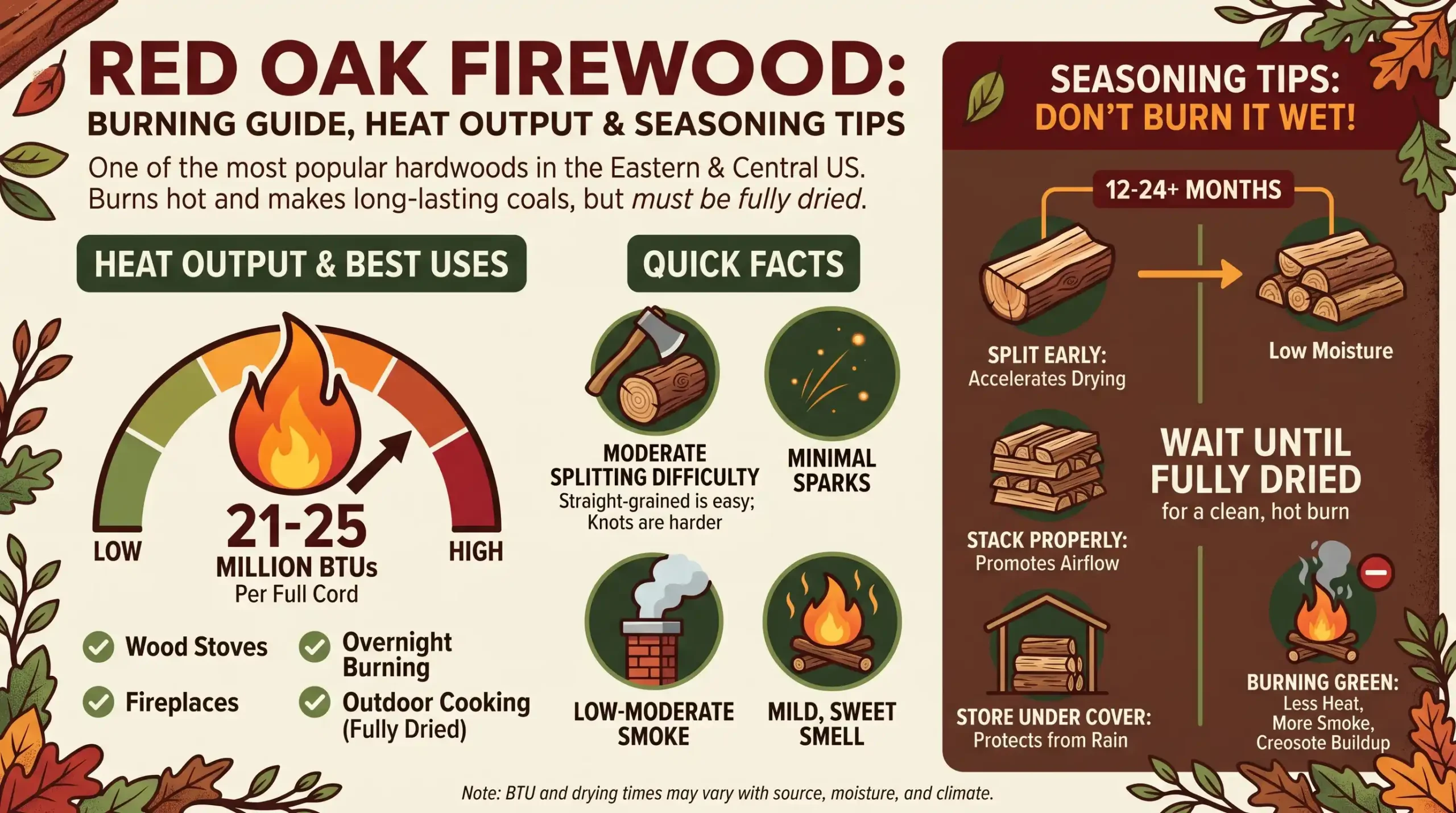
One of the most popular hardwoods sold as firewood in the eastern and central United States and rightfully so is red oak. It is hot, cuts fairly well, once you learn how, and makes good, long-lasting coals. But it too is reputed to be obstinate when burned too soon.
This guide includes what red oak firewood is, how much heat it extinguishes, how long it requires to dry, and the most common error that people make with it: burning it wet.
Quick Facts: Red Oak Firewood at a Glance
- Heat production: Approximately 21-25 million BTUs per full cord (values can be different depending on source and moisture content)
- Seasoning period 12-24 months following splitting, climate, and stacking process.
- Splitting difficulty: Moderate. Straight-grained rounds are easy to split; the knotty portions are more difficult.
- Smoke when experienced: Low to moderate.
- Sparks: Minimal
- Smell: Mild, faintly sweet.
- Suited: Wood stoves, fireplaces, overnight burning, outdoor cooking after complete drying.
What Is Red Oak Firewood?
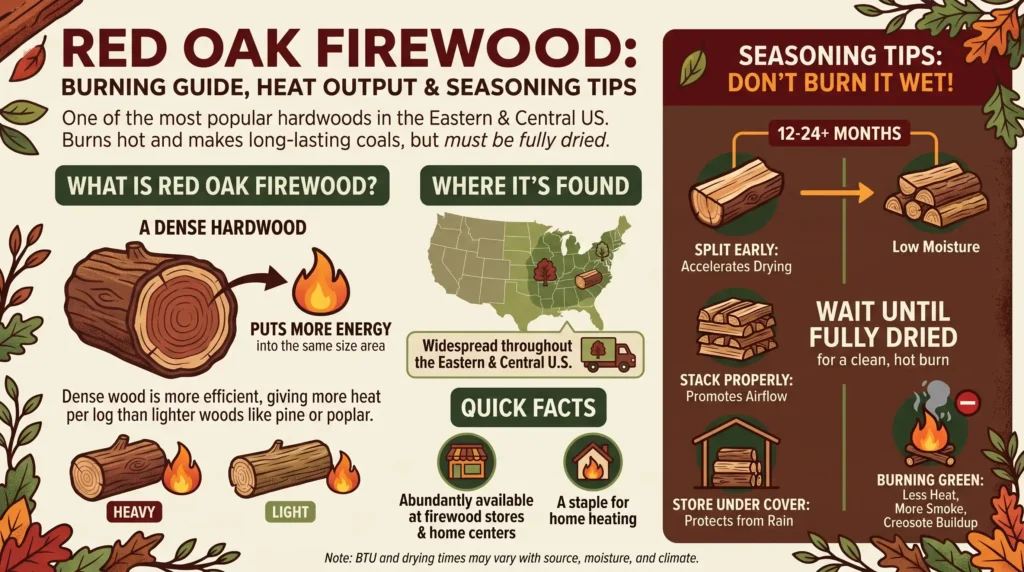
Red oak firewood is made of the Northern red oak (Quercus rubra), and its immediate relatives, often marketed as red oak in general, even though it may contain other species such as black oak or pin oak. It is a thick hardwood and that is precisely the reason why it makes a good firewood. Dense wood is more efficient in putting energy into the same size area, thus you get more heat per log and per cord than you would with lighter woods such as pine or poplar.
Red oak is found throughout the eastern and central U.S. and this is one of the reasons why it is so frequently found at firewood stores, home improvement stores and in the backyard wood piles.
Red Oak Firewood BTU Output and Heat Value
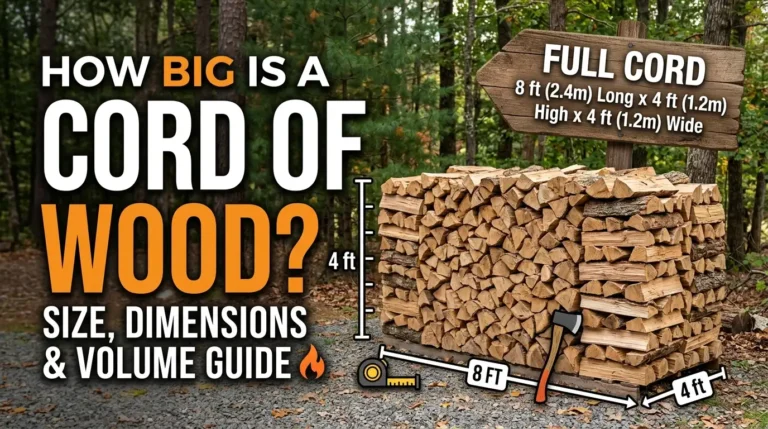
The amount of heat produced by a fuel is measured in BTU (British thermal unit). Firewood BTU ratings are usually provided per cord, a pile of 4 feet by 4 feet by 8 feet or 128 cubic feet in total (approximately 85 cubic feet of solid wood after the air spaces between splits are counted). If you want to see exactly how that stack breaks down in real-world measurements, it’s worth a closer look before you order.
The BTU values of red oak are not consistently the same, based on the source, the subspecies of red oak and the moisture content that was used to calculate the value. The majority of reliable estimates put red oak in the range of 21.7 to 25 million BTUs per full cord, most sources in the extension and firewood-industry coming up with 24 million BTUs. That places it squarely in the excellent range of heat-output, just under white oak and hickory.
Why the range? BTU testing presupposes a certain moisture level, which is typically approximately 20%. Wetter wood is also less likely to burn since the energy is consumed in boiling off water before it can be converted to usable heat. Such is the practical explanation why seasoning is so much with a heavy wood as red oak.
BTU Comparison Table: Red Oak vs. Common Firewoods
| Wood Species | Approx. BTU per Cord (millions) | Heat Rating |
|---|---|---|
| Shagbark Hickory | 27.7 | Excellent |
| White Oak | 25.7–26.5 | Excellent |
| Black Locust | 26.8 | Excellent |
| Red Oak | 21.7–25 | Excellent |
| Sugar Maple | 24.0 | Excellent |
| White Ash | 23.6 | Excellent |
| Douglas Fir | 17.4–26.6 | Good |
| Red Maple | 18–19 | Good |
| Eastern White Pine | 14–15 | Fair |
Numbers are common industry averages and will fluctuate depending on the region, age of the trees and moisture content. Use them as a guide and not a measurement.
Important lesson: Red oak is only second to white oak and hickory in the amount of heat it produces, but far ahead of softwoods, such as pine. In the case of most households, there is not much difference in the real-world warmth of red oak and white oak that either one would be an excellent primary heating wood.
How to Identify Red Oak
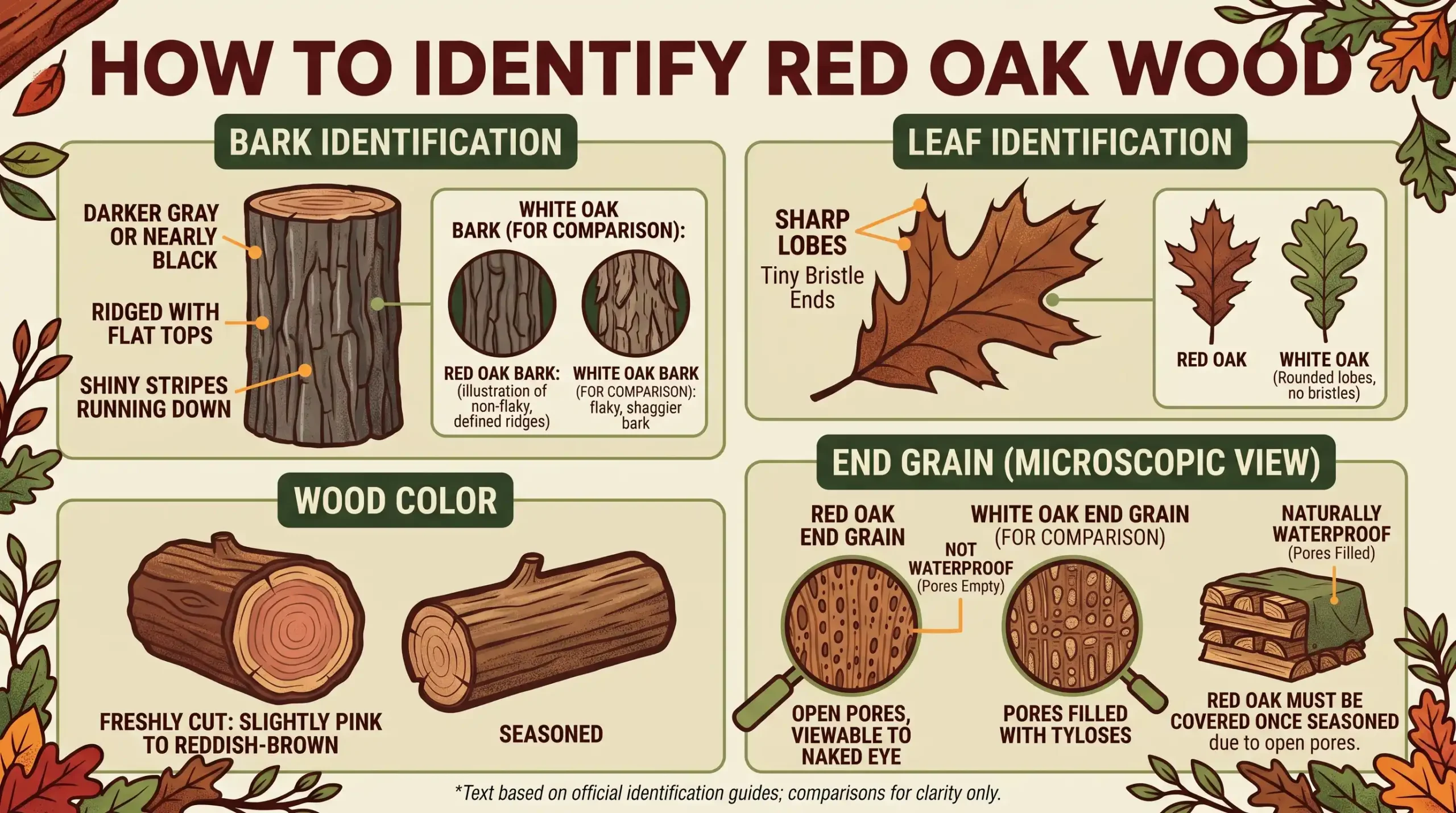
When you are cutting your own wood, or some one who has mixed the species, it is well to know what it is you are looking at.
- Bark: darker gray or nearly black, ridged like shiny stripes with flat tops, running down them. Not so flaky as white oak bark.
- Leaves: Sharp lobes that have tiny ends of the bristles on them.
- Wood color: Freshly cut is slightly pink to reddish-brown.
- End grain: Open pores that can be viewed using the naked eye as opposed to white oak that has pores filled with a substance known as tyloses. This is another reason why red oak is not naturally waterproof like white oak, and thus it should be covered once it is seasoned.
Red Oak vs. White Oak Firewood: What’s the Real Difference?
It is probably one of the most frequently posed questions by firewood purchasers, and it is a frequent topic of discussion in forums such as the Firewood Hoarders Club. The brief answer is this: they are both great firewood, and the variations are not as significant as some might believe.
| Feature | Red Oak | White Oak |
|---|---|---|
| BTU per cord | ~21.7–25 million | ~25.7–26.5 million |
| Bark | Darker, tighter, less flaky | Lighter gray, flakier |
| Water resistance | Lower (open pores) | Higher (pores clogged with tyloses) |
| Splitting | Moderate, knots can be tricky | Slightly easier when straight-grained |
| Seasoning time | 12–24 months | 12–24 months, sometimes a bit longer |
| Smell when burning | Mild, sweet | Mild, slightly nutty |
| Availability | Very common in eastern/central U.S. | Common, often mixed with red oak commercially |
Summary: White oak is a little less efficient than red oak when it comes to heat production, but red oak is more readily available in most areas and cuts a little more consistently once you become accustomed to its grain. When a supplier is selling mixed oak, then you are highly likely to have a mixture of both, and that is not an issue. For a broader look at oak as a heating fuel beyond just red and white, this deeper breakdown of oak firewood performance covers the wider category in more detail.
How Long Does Red Oak Firewood Need to Season?
It is in this area that the majority of individuals fail with red oak. It is a thick wood, and has much water locked in it when fresh cut (green), and it dries slowly, unlike other species such as ash or cherry.
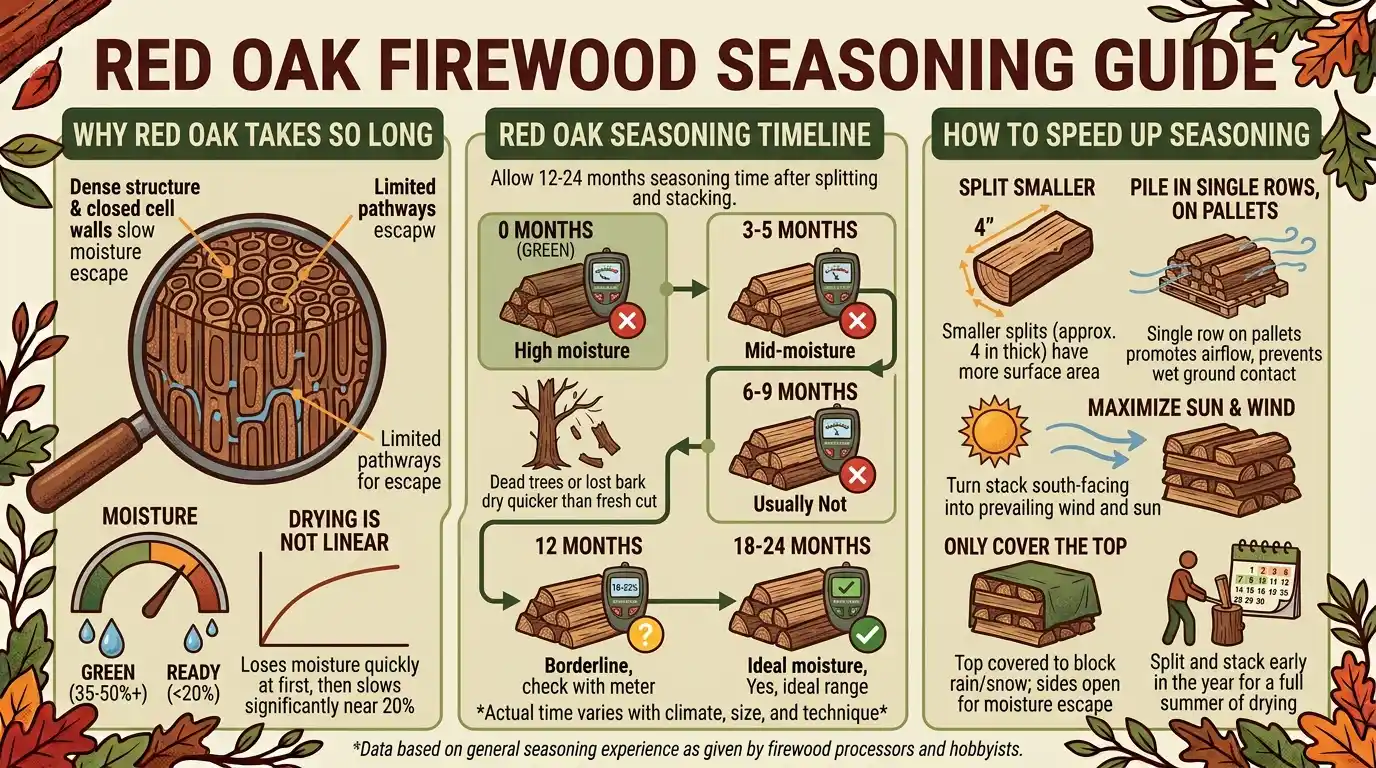
Allow 12-24 months seasoning time after splitting and stacking it, not after cutting the tree. A dead tree or wood that has already lost its bark will dry out quicker than a freshly cut tree.
Why Red Oak Takes So Long
Green red oak can start out at 35% to 50% moisture content or higher. Firewood is usually regarded as being ready to burn when it has a moisture content of less than 20 percent, as indicated by a moisture meter on a freshly split face. The dense structure and closed cell walls of red oak result in a slow escape of water, particularly during the first few months.
Neither is drying linear. The moisture is usually lost quickly in the first few months, after which the rate becomes much slower as the moisture content nears 20 percent. The final one, between about 25% and 20% can be more time-consuming than people anticipate.
Red Oak Seasoning Timeline
| Time Since Splitting | Typical Moisture Content | Ready to Burn? |
|---|---|---|
| 0 months (green) | 35–50%+ | No |
| 3–5 months | 24–28% | No |
| 6–9 months | 22–25% | Usually not |
| 12 months | 18–22% | Borderline, check with a meter |
| 18–24 months | 12–18% | Yes, ideal burning range |
Time scale according to general seasoning experience as given by firewood processors and hobbyists; actual performance varies greatly depending on climate, split size, and stacking technique.
How to Speed Up Seasoning
You can never hurry red oak along, but you can save months:
- Split it smaller. Smaller splits (approximately 4 inches thick) have more surface area and dry quicker than large rounds do.
- Pile in single rows, on the ground. Store wood on pallets or rails so that it is not in contact with the wet ground and place it in a single row instead of a broad stack so that air can pass through it.
- Turn the stack into the prevailing wind and sun. Stacks that are south facing and open to the wind dry much quicker.
- Only cover the top. Moisture is absorbed by wrapping the sides as it dries the top of the stack more slowly by rain and snow. Cover only top, sides open.
- Split and stack early of the year. Splits of wood made at the end of winter or the beginning of spring enjoy a complete summer of heat and air before the next heating season.
How to Tell If Red Oak Is Actually Seasoned
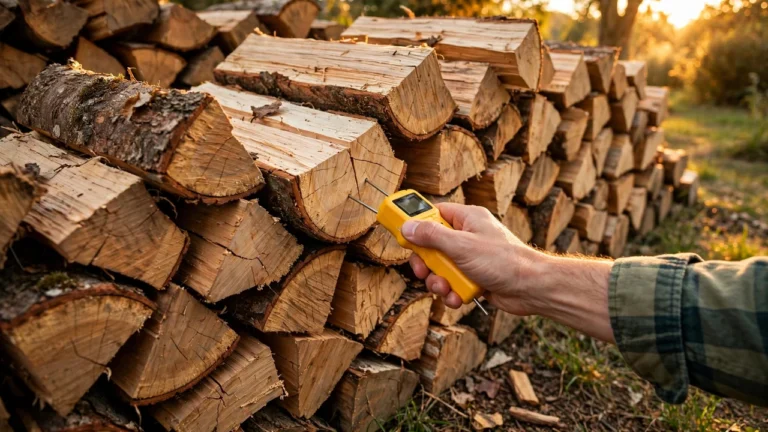
Don’t guess. The most reliable is a cheap moisture meter which eliminates the guesswork altogether.
- Moisture meter test: Divide a piece fresh and test the newly exposed inside not the outside. Goal: 20% or less.
- Color check: Experienced splits tend to appear grayer and more faded than reddish-tan shade of green wood.
- Check of weight: Green wood of the same size weighs much more than seasoned wood.
- Sound test: Knock two experienced pieces against each other and hear a more hollow crack. Green wood is apt to sound dull.
- End checking: Radiating cracks around the cut ends are an excellent indication of drying, but not evidence in themselves.
Always avoid counting on the length of time it has been sitting. Wood stored in large rounds, or overloaded, may take two years to be dry inside.
How to Split and Stack Red Oak
Red oak is easy to split. Straight, knotless rounds can be cut apart with a maul or hydraulic splitter. Parts that have forks, knots, or crotch wood are very difficult and usually better reserved to a hydraulic splitter than handwork.
Some useful hints:
- Divide rounds when still fresh. The drier the wood the harder it becomes to split.
- Splits – Splits should be about 4 to 6 inches deep to provide a good balance between the drying speed and burn time.
- Stacking in single rows with small air gaps instead of a single block.
- Store the stack off the ground on pallets, rails or concrete blocks.
What to Expect When Burning Red Oak
When well seasoned, red oak is a reliable, well-mannered firewood.
- Ignition: A little more effort is required to start than softer woods. Start it with a hot bed of coals or dry kindling, instead of attempting to light a cold stove with oak only.
- Smoke: Low to moderate seasoned. Young or immature red oak, however, burns heavily white, and may hiss or sizzle at the ends, both of which are indications it is not ready.
- Sparks: Low, and thus it is a good option in open fireplaces and fire pits.
- Coals: This is the largest strength of red oak. It leaves long-lasting thick beds of coal that retain heat throughout the night and allow one to start a fire in the morning easily.
- Creosote: Well-seasoned red oak is a fairly low producer of creosote. One of the most frequent reasons of heavy creosote accumulation and chimney fires is burning it wet, as unburned moisture and incomplete combustion releases more particulates up the flue.
Is Red Oak Good for Cooking and Smoking?
Yes, red oak is good grilling, smoking, and pizza oven wood, and that is why you will find it being sold as cooking wood by a number of vendors. It smokes clean and hot and has a light, slightly sweet flavor of smoke, not as overwhelming as mesquite and less so than hickory, and is a good all-purpose meat smoker, whether beef, pork, or poultry.
A couple of tips when cooking with it:
- Should use wood that is fully seasoned. Wet or green wood smokes acridly and bitterly and can spoil food.
- Red oak is a good finish to smokers, or can be mixed with a fruit wood such as apple or cherry to make it smoother.
- Do not use any wood that has been treated with any chemicals, paint, or stain and should never cook on reclaimed construction lumber.
Red Oak Firewood: Pros and Cons
| Pros | Cons |
|---|---|
| High heat output (21–25 million BTU/cord) | Long seasoning time (12–24 months) |
| Long-lasting coals, good for overnight burns | Harder to split when knotty |
| Low smoke and sparks once seasoned | Not naturally rot-resistant, needs cover once split |
| Widely available in most of the U.S. | Heavy to move and stack compared to softer woods |
| Good for cooking and smoking when seasoned | Frustrating to burn if used too soon |
How Much Red Oak Firewood Do You Need?
Approach to rough planning of a complete winter of heating with a wood stove as the main source of heat:
| Home Size / Climate | Estimated Cords Needed per Season |
|---|---|
| Small home, mild climate | 2–3 cords |
| Medium home, moderate winter | 3–5 cords |
| Large home, cold climate | 5–8 cords |
These values are based on experienced hardwood such as red oak that is used as a primary or major secondary source of heat. When you are adding to an existing heating system, you probably won’t need as much. For help estimating how far a single cord will actually stretch through burn nights, this practical burn-time breakdown is a good next stop.
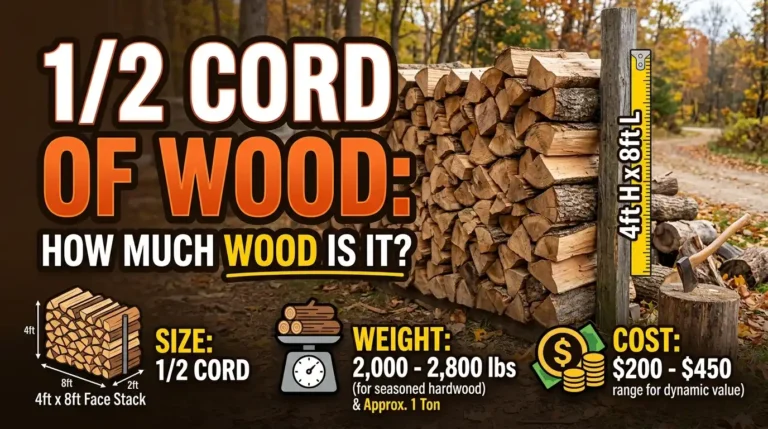
A note on terminology: A “full cord” is 4′ x 4′ x 8′ (128 cubic feet). One row of the same stack is commonly referred to as a face cord or a rick, and is usually 16 to 18 inches deep, about a third the depth of a full cord. One of the most frequent causes of confusion (and complaints) in the firewood market is always to ensure that the measurement a seller is selling is accurate, before you make a purchase. If the terms still feel murky, this side-by-side explainer on the two measurements clears up the pricing and sizing differences.
Buying Red Oak Firewood: What to Look For
When you are purchasing as opposed to making your own, a couple of tests will save you paying more than you need to in order to burn wood that is not ready:
- Inquire of how long it has been split and stacked, not cut. The beginning of seasoning is at splitting, not felling.
- Require or carry a moisture meter. Respectable peddlers will not object to your examining some splits.
- Examine the color and examine cracked ends. Checked wood is a good sign, grayer.
- Clarify cord size. Check whether you are purchasing a full cord, face cord or a particular weight (when purchasing bagged or boxed items).
- Look at kiln-dried alternatives in case you require wood urgently. Kiln-dried red oak is dried in a heat-treater to get the moisture out fast, and is burnable immediately, but is usually more expensive than air-seasoned wood.
Storage Tips to Keep Red Oak Seasoned
When red oak is dry, insure that investment of time:
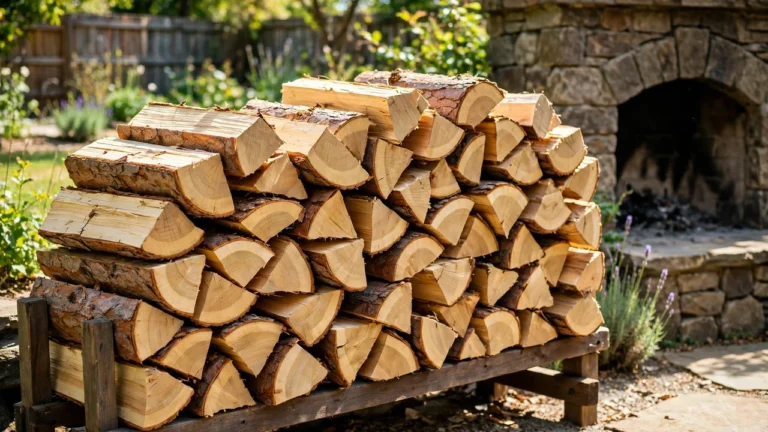
- Store it on a rack, pallets or rails.
- Top only: cover with tarp or roof, but leave sides open to air.
- Keep wood outside of your house or other buildings at least a few feet away to minimize pest problems.
- Turn over the stock so that the older and drier wood is first burnt.
Common Mistakes to Avoid With Red Oak Firewood
- Burning it prematurely. This is the number one issue. Wet red oak burns a lot, is difficult to start, and burns less intensely than seasoned.
- Stacking too tightly. Heavy piles obstruct the airflow and considerably slow the drying.
- Plastic wrap of the entire stack. This keeps moisture in as opposed to escaping.
- Criterion of time. Where possible, always check using a moisture meter, particularly with a slow-drying wood such as red oak.
- Intermingling seasoned and green wood. You can easily forget what splits are prepared.
FAQs
Is red oak firewood?
Yes. Red oak is regarded as one of the superior hardwood firewoods in North America with an approximate of 21 to 25 million BTUs per cord and low smoke and long-lasting coals when properly seasoned.
What is the time taken to season red oak firewood?
Usually 12-24 months after splitting and stacking, depending on your climate, the size of your split and the airflow and sun exposure of the stack.
What can I do to determine whether my red oak firewood is dry enough to burn?
Test a recently split face with a moisture meter and target 20% or less. Lighter weight, grayer color and cracked ends are also supporting signs to check, but the most reliable test is a meter reading.
Will green (unseasoned) red oak burn?
You can, but it’s not recommended. Green red oak burns slowly, smolders, and smokes a lot, as well as helps to accumulate creosote in your chimney or flue.
How many BTUs does red oak firewood produce?
The majority of sources give red oak a range of 21.7-25 million BTUs per full cord, with most settling at 24 million. Precise values depend on the particular red oak subspecies and moisture level during testing.
Which is a better firewood red oak or white oak?
Both are excellent. White oak has a slightly higher BTU output and natural water resistance and red oak is frequently more available and splits more predictably. There is a small difference between the two in practice.
Does red oak firewood produce a lot of smoke?
Not when well seasoned. Red oak is low to moderate burning and well-dried. The wood is nearly always too wet as indicated by heavy smoke.
Can red oak be smoked or grilled meat?
Yes, so long as it is all seasoned. The smoke flavor of red oak is mild with a slight sweetness and is good with beef, pork and poultry, and is often sold as cooking wood.
What is the price of a cord of red oak firewood?
Regional prices are different, but hardwood such as oak usually fetches a higher price compared to mixed softwood. Call local suppliers to get the current pricing in your area and always make sure that it is a full cord, or a face cord.
Why is my red oak firewood hissing or sizzling when I burn it?
That is a definite indication that the wood is not dry enough. The water in the wood boils and evaporates in the form of steam and makes the hissing sound. Allow it to dry further and then burn.
What’s the difference between a cord and a face cord of red oak?
A complete cord is 4 feet by 4 feet by 8 feet (128 cubic feet). One row of that stack is typically a face cord (also known as a rick), typically one-third of a full cord. A seller may be quoting either one of these. It is always good to clarify which one they are quoting.
Will red oak firewood be rained on during seasoning?
A little exposure is all right, and will not spoil the wood, but it is best to cover the top of the stack after it is split. Do not seal the sides to allow moisture trapped to escape.
Does red oak firewood make a lot of sparks?
No. Red oak is reputed to generate comparatively few sparks when mature, and is a fairly safe option in open fireplaces and fire pits.
What can I do to quicken the drying of red oak firewood?
Divide it into smaller (about 4 inches thick) pieces, pile it in one row, not on the ground, and be sure it is facing the sun and the wind and only the top of the pile is covered.
Should red oak firewood be kiln-dried or not?
When you need to have dry firewood now, and you have no year or two to season your own, kiln-dried red oak can be a good choice. It is heat-treated to dry fast, and can be burnt immediately, but it tends to be more expensive than air-seasoned wood.
Key Takeaways
- Red oak firewood has an average of 21 to 25 million BTUs per cord, which makes it one of the more desirable heating hardwoods.
- It requires 12-24 months to season well after splitting, and thus longer than most common firewoods.
- The surest method to tell that it is ready to burn is by checking the moisture meter to less than 20%.
- Experienced red oak burns with a low smoke and sparks and burns to produce excellent long lasting coals.
- It is a good, food-safe grill/smoke after being completely seasoned.
Final Thoughts
Red oak is a high quality firewood and it deserves the status of premium firewood, but only when it is provided time to do so. A patient wood it is. Hurry it and you will have a smoky, difficult to start fire, which will leave creosote in your chimney. A full season, or better still two, will give you a hot, long burning fire with coals that retain the heat overnight and a smell that is really pleasant to be around.
When you are purchasing red oak, do not assume that someone is telling you that it is seasoned. Ask questions, examine the wood yourself where possible, and a moisture meter where necessary. When you are working your own, cut it small, pile it high, and get it early enough so that when you really need it the wood will be available next winter.
Next step: To determine whether you are stocked up or not, take a cheap moisture meter and measure a couple of splits before your next fire. It consumes half a minute and tells you more than you will ever guess.