How Many Square Feet Will an 8kW Diesel Heater Heat? The Real Numbers
Quick Answer: A 27,000 to 27,300 BTU/h is extinguished by an 8kW diesel heater. Most manufacturers estimate it to be 215 to 270 square feet in a small, well-sealed area such as a van or cabin. However, in a typical garage or workshop with average insulation, most people will feel comfortable at 600 to 900 square feet, and even further in an insulated environment with a lower target temperature at 1,000 square feet and above.
The truthful spectrum is broad since the area of the square is not the sole factor influencing the quantity of heat produced. The insulation, ceiling height, and outside temperature are equally important.
What Does 8kW Mean in BTU?

The rating of diesel air heaters is in kilowatts (kW), the amount of energy they generate in an hour, not the amount of space they warm. A conversion is required to compare them to the BTU ratings that are applied to most US heaters.
One kilowatt is approximately 3,412 BTU/hr. Therefore, an 8kW diesel heater generates approximately 27,296 BTU per hour and this matches with the specifications of the large retailers of these units. That is the actual starting point of any coverage estimate as square footage claims are actually merely BTU output divided by the number of BTU each square foot requires.
The Formula That Actually Predicts Coverage
The BTU-per-Square-Foot Rule of Thumb
A simple range is employed by HVAC professionals: a space usually requires between 20 and 60 BTU per square foot per hour, based on insulation, ceiling height, and climate. The following is how that works out in the case of an 8kW heater with a BTU of 27,296:
- Insulated, moderate climate, 8 foot ceilings: 27,296/25 BTU/ sq ft, approximately 1,090 sq ft.
- Average insulation, cold climate: 27,296/35 BTU/per sq ft, approximately 780 sq ft.
- Poor insulation, very cold climate: 27,296 divided by 50 to 60 BTU per sq ft, about 450 to 545 sq ft
This is the reason why you will find outrageously varying square footage figures in product listing and forum posts. They do not lie, they just describe various conditions.
Why Manufacturer Numbers Look So Small
The majority of 8kW diesel heater listings boast a range of 215-270 square feet. This figure is typically obtained by testing in a small, well-sealed enclosure, such as a van, cabin of a boat, or an ice fishing shanty, where the target is a large and rapid change in temperature (say, 20F outside to 70F inside) in an environment with nearly no heat exchange. Not an average garage, that is a worst-case, best-performance scenario.
Lesson learned: The 269 sq ft number on the box is a low, extreme-cold estimate. Your real garage or shop coverage is quite probably larger, particularly when you are merely attempting to reach 50 to 60 o C and not the full room temperature.
8kW Diesel Heater Coverage by Scenario
| Space Type | Insulation | Target Temp Rise | Realistic Coverage |
|---|---|---|---|
| Van, boat cabin, ice shanty | Minimal to none | Large (cold to warm fast) | 150-270 sq ft |
| Detached garage, uninsulated | Poor | Moderate, cold climate | 400-550 sq ft |
| Detached garage, insulated | Average | Moderate | 600-800 sq ft |
| Workshop or barn, insulated | Good | Moderate, mild climate | 800-1,000 sq ft |
| Insulated shop, mild climate, modest target | Good to excellent | Small (just take the chill off) | 1,000-1,200 sq ft |
These are not promises, but planning ranges. Having a ceiling more than 8 feet above the floor decreases all the values in this table since you are heating more air, not more area.
Real-World Example: Will 8kW Heat an 800 Sq Ft Garage?
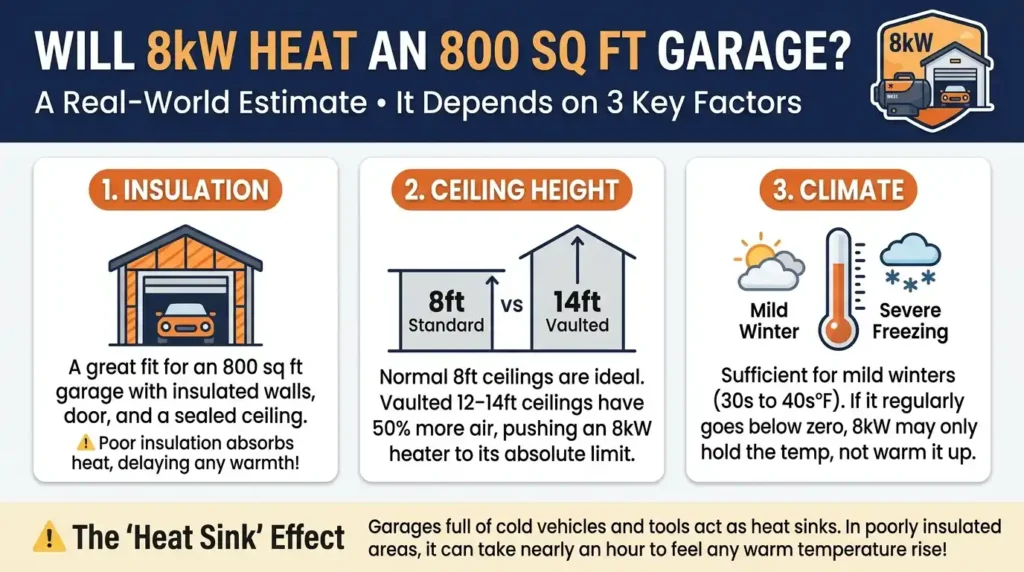
This is one of the most frequent real questions which people ask, and the truthful answer is: it depends on three things.
- Insulation. A realistic fit of an 800 sq ft garage with insulated walls, insulated garage door, and a reasonably sealed ceiling with an 8kW heater is a realistic fit in most climates of the US.
- Ceiling height. Normal 8 foot ceilings are on your side. A garage with vaulted ceiling that is 12 to 14 feet has approximately 50 percent higher air volume and this forces an 8kW unit to its limit.
- Climate. During a mild winter (30s to 40s°F overnight lows), 8kW is normally sufficient to heat an 800 sq ft insulated garage to a comfortable working temperature. In a severe climate where it gets below zero regularly, 8kW will be on at all times and can only hold and not warm the same space.
A number of garage owners with 8kW units claim it takes them nearly an hour to achieve any significant temperature increase in a poorly insulated area full of vehicles and equipment, as they are also heat sinks. That is equal to the above math: uninsulated space consumes BTU.
How Many Square Feet Will an 8kW Diesel Heater Heat? 4 Factors That Change Your Actual Coverage
Insulation Quality
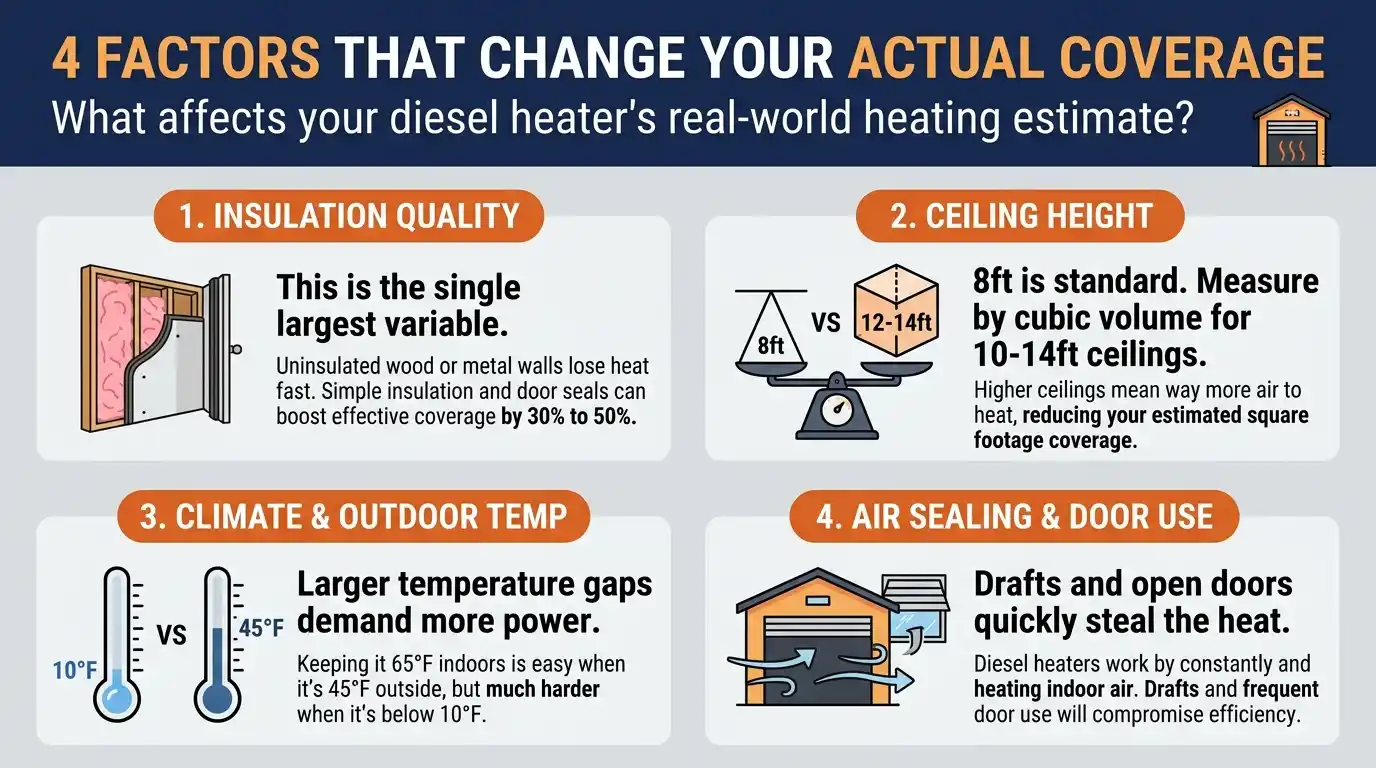
This is the only largest variable. Single-layer wood or uninsulated sheet metal walls dissipate heat nearly as quickly as the heater heats it. Even simple fiberglass batt insulation and weatherstripping around the doors can add up to 30 to 50 percent to the effective coverage with no alteration of the heater itself.
Ceiling Height
The coverage estimates are based on about 8 foot ceilings. When you have 10, 12 or 14 foot ceilings, figure by cubic volume rather than square feet, and reduce your projected square footage coverage accordingly.
Climate and Outdoor Temperature
The larger the difference between the temperature outside and your desired indoor temperature, the more work the heater must do. A 8kW unit that keeps 65oF at 45oF outside will serve a lot more square feet than the same unit that attempts to achieve 65oF at 10oF outside.
Air Sealing and Door Use
Even a well-insulated area will be compromised by a garage door that is opened and closed many times, or by window and vent openings. The principle of diesel air heaters is to constantly recirculate and heat air, and therefore all drafts are opposed.
8kW vs Other Common Diesel Heater Sizes
| Heater Size | Approx. BTU/hr | Manufacturer Coverage | Realistic Garage/Shop Coverage |
|---|---|---|---|
| 2kW | ~6,800 BTU | 65-100 sq ft | 150-250 sq ft |
| 5kW | ~17,000 BTU | 130-170 sq ft | 400-500 sq ft |
| 8kW | ~27,300 BTU | 215-270 sq ft | 600-1,000 sq ft |
| 12kW | ~41,000 BTU | 320-400 sq ft | 900-1,400 sq ft |
When deciding between sizes, make an error on the bigger side when your room is poorly insulated, has a high ceiling, or when the climate is cold. Running a properly sized heater on low is cheaper in fuel and wear than to run an undersized one to capacity every night. Not sold on diesel specifically? Our breakdown of the different space heater types and which one fits your situation covers propane, oil-filled, and electric alternatives side by side.
Signs Your 8kW Heater Is Undersized
- It is always on high and does not appear to be cycling down.
- More than an hour is required to perceive a change in temperature in the space.
- The temperature decreases quickly when the heater is turned off.
- Corners and floor level are cold and the space immediately surrounding the heater is okay.
- You are emptying a full tank in way less time than the rated run time.
When two or more of these are used your space is probably larger than can be comfortably heated with 8kW due to your insulation and climate, not merely your square feet.
Before assuming you need a bigger diesel unit, rule out ventilation and combustion safety issues first. Our step-by-step propane heater safety guide covers warning signs that apply to any fuel-burning heater, not just propane models.
How to Get More Heat Out of an 8kW Unit
- Before increasing the size of the heater, add insulation to walls, ceiling, and particularly the garage door.
- Close cracks around the windows, vents, and the door bottom.
- Have the heater so that the air is drawn to the coldest and furthest end, not in a straight line with the nearest wall.
- Have a small circulating fan to blow the warm air into corners rather than accumulate at the ceiling.
- Seal or wrap up single-pane windows when heating.
- Have the fuel filter and combustion chamber clean, as a dirty heater is inefficient.
If you’re weighing diesel against other portable options for the same space, it’s worth comparing running costs first. See how much it actually costs to run a kerosene heater and what the science says about oil-filled radiator efficiency before deciding.
FAQs
How many BTU is an 8kW diesel heater?
The 8kW diesel heater generates about 27,296 BTU per hour, assuming that 1 kW is converted to about 3,412 BTU as a standard.
Will a 1,000 sq ft garage be heated with an 8kW diesel heater?
It will, when the garage is well insulated, is of standard ceiling height, and you are heating in a mild to moderate climate. One 8kW unit is probably insufficient in poorly insulated or very cold environments (1,000 sq ft).
Is 8kW sufficient to power a two-car garage?
The majority of two-car garages are 400 to 600 sq ft. That size typically only needs an 8kW heater, particularly with minimal insulation and a closed garage door.
Is it possible to heat a house with an 8kW diesel heater?
Not consistently as a primary system. Diesel air heaters are effective at heating single connected space, but to evenly distribute the heat into several rooms of a house, ducting is typically needed, and a larger or dedicated system.
What is the maximum time that an 8kW diesel heater can last one tank?
There are numerous 8kW units with a 5 liter tank that operate about 16 to 20 hours on low to moderate settings, as diesel air heaters are also known to use very little fuel, sometimes less than one gallon per night.
Are diesel heaters inefficient in high altitude?
Yes, the efficiency of combustion decreases with altitude unless the unit is altitude-compensated. Certain 8kW models have automatic altitude adjustment to operate to about 18,000 feet.
What’s the difference between an 8kW and a 5kW diesel heater?
A 8kW unit generates about 60 percent heat output than a 5kW unit, which generally corresponds to a significant increase in usable square footage, particularly in a colder or larger room.
Is it better to oversize a diesel heater than undersize it?
Generally yes. A heater that is slightly bigger and is set at a low level is more efficient and comfortable than a smaller heater that is operating at full capacity at all times.
Does the height of the ceiling influence the coverage of square feet?
Yes, significantly. The coverage ratings are based on about 8 foot ceilings. Higher ceilings mean that the heater must heat a larger amount of air, decreasing the area it can cover.
Will a tiny home or cabin with good insulation allow me to use an 8kW diesel heater?
Yes, and in such a case coverage can often be higher than the conservative manufacturer figure, as small houses and cabins are usually more airtight than garages.
Why are there product listings that promote varying square footage of the same 8kW heater?
Since there is no single industry standard regarding the test conditions to be used, listings are different depending on presumed insulation, ceiling height, and desired temperature increase.
Do I need a bigger heater if I frequently open the garage door?
If constant door traffic is the real issue, a supplemental radiant option might help bridge the gap. Here’s how oil-filled radiator heaters handle drafty spaces as a backup.
Is 8kW too much for a small workshop?
Not necessarily. Most diesel heaters are adjustable, meaning that you can use an 8kW heater at a lower power output in a smaller area instead of having to purchase a smaller heater.
What is the accuracy of the BTU claims on low cost diesel heaters?
Real performance may be different in terms of brand and unit quality. It is worth checking verified buyer reviews and independent testing where possible before assuming full rated output.
Final Thoughts
The truthful response to the question of how many square feet an 8kW diesel heater will heat is: it depends not so much on the heater, but on your space. Most product listings have a 215 to 270 sq ft figure which is a conservative standard in a small, tightly sealed test chamber, not a strict limit to what the heater is capable of. Most people can easily heat up 600 to 1,000 square feet in a normal insulated garage or workshop.
There are three things you should do a quick gut check on before purchasing: your insulation, your ceiling height, and your climate. When two out of three are against you (poor insulation and a cold climate, e.g.) size up or consider improving insulation first. When you have two working on your side, then an 8kW heater can afford the real space.