Are Oil Heaters Expensive to Run? The Real Cost Breakdown (By Wattage)
You plug it in, it heats gradually and somewhere in the back of your mind is a question that keeps on nagging you; is this device going to appear in your electric bill as an ugly surprise? That worry is fair. Electric heaters are known to quietly rob you, and oil heaters should be more so, as being larger and heavier than a simple fan heater.
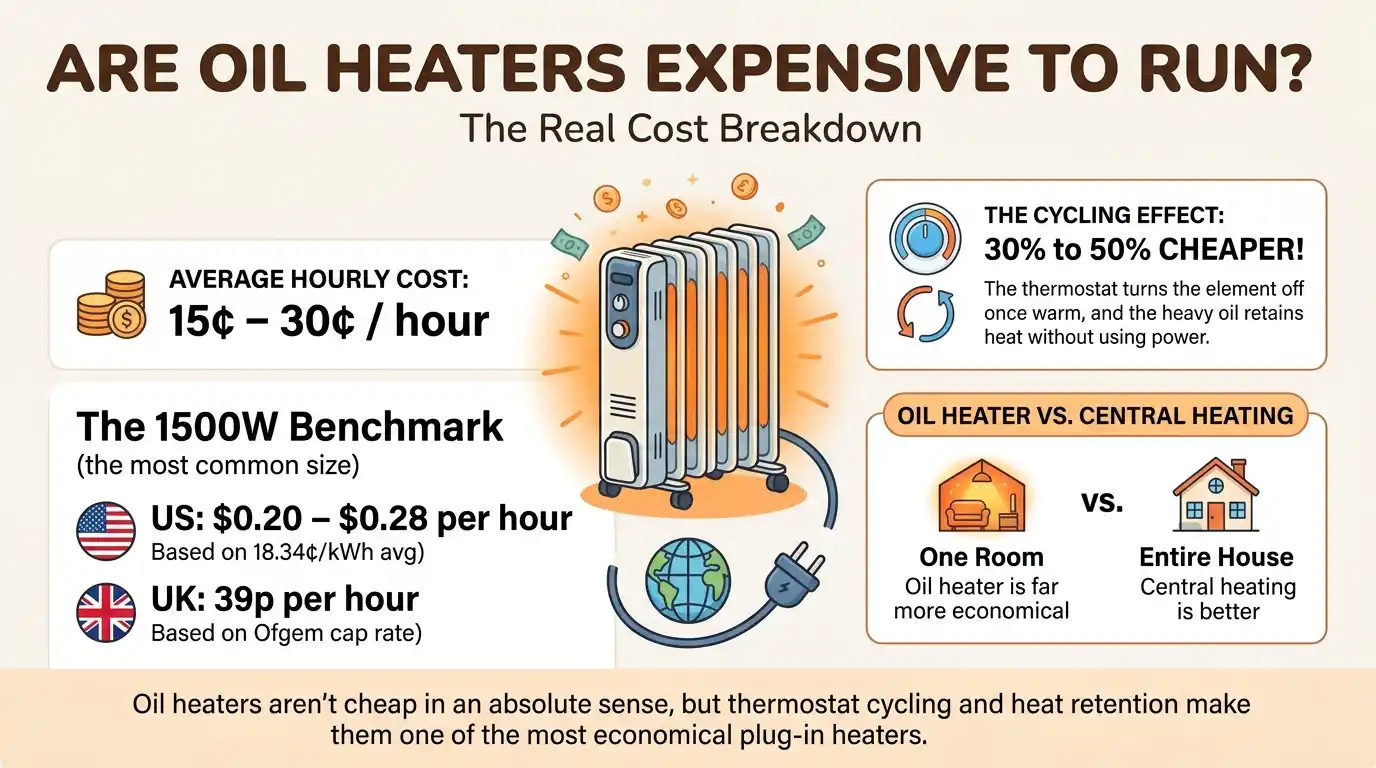
This is the comforting bit. An average oil heater costs 15 to 30 cents an hour to operate, and with the manner in which the thermostat operates, you generally spend less than that during an evening. The precise calculations are below, a cost table by wattage, the straightforward comparisons with fan heaters and central heating and the habits that make the bill low.
Key Takeaways
- An average 1,500-watt oil heater will burn about 0.20 -0.28/hour in the US (at the 18.34-cent national average electricity rate) and 39p per hour in the UK (at the Ofgem cap rate).
- Since oil heaters have a thermostat that switches on and off the element after the room has heated, your actual cost is typically 30 to 50% less than the full power amount.
- Oil heaters are not cheap in an absolute sense (any 1,500W heater uses real electricity), but one of the less expensive plug-in heaters due to that cycling effect and the fact that the heat is retained even when switched off.
- To heat one room a few hours a day, an oil heater will often be more economical than running your entire central heating system. Central heating tends to prevail when it comes to heating a number of rooms during the day.
Are Oil Heaters Expensive to Run? The Short Answer
No, not when compared to most other portable electric heaters, but yes, they do use real money since they use electricity, which is one of the more expensive methods of heat generation. In the US, an average 1,500-watt oil heater will burn between 20 and 28 cents per hour, depending on the electricity rate in your area. You run it 8 hours a day and you are looking at an approximate of $1.60 to 2.25 a day or 50 to 65 a month on that one heater.
What keeps the actual cost lower than that “worst case” number is the thermostat. As soon as an oil heater reaches the temperature you set, it does not remain at full power. It switches the heating device on and off to maintain that temperature, and thus in a day may only be drawing power half of the day.
That is the point that most cost guides overlook, and it is the cause that two individuals with an identical heater may report vastly different electric bills.
How Oil Heaters Actually Use Electricity
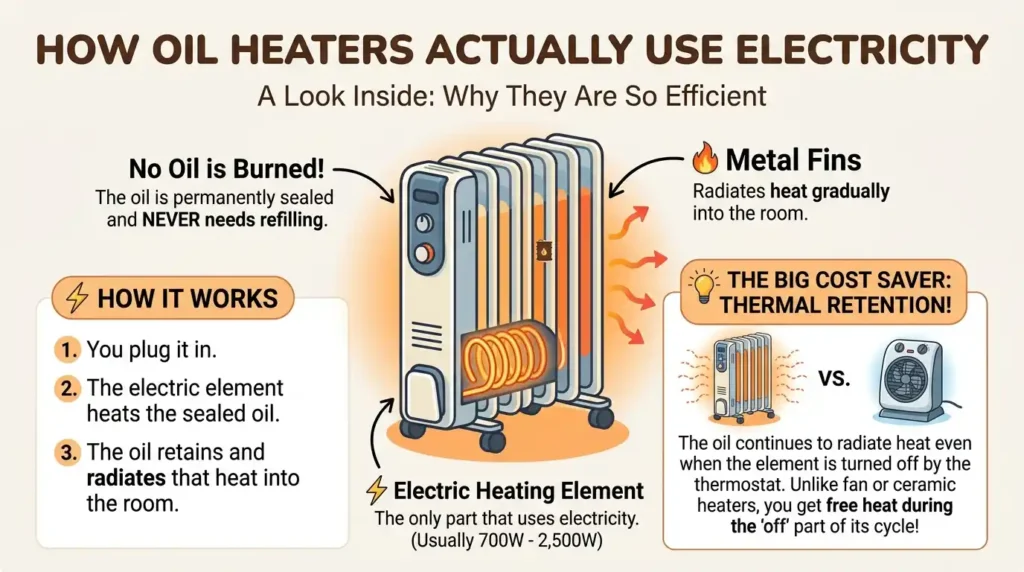
An oil-filled radiator (also known as an oil-filled heater or column heater) does not burn oil. The oil contained is permanently sealed and does not require filling. It is merely a heat-transfer medium: an electric element heats the oil, the oil retains that heat and it radiates gradually out through the metal fins into the room.
That is cost effective in two respects:
- It is the heating element that uses the electric power, not the oil. The wattage that is printed on the heater (typically 700W to 2,500W) indicates the highest rate of electricity consumption when the element is in full operation. If you want the full mechanics of how that heat gets from the element into your room, this breakdown of the internal workings of an oil heater walks through it step by step.
- The oil continues to radiate heat when the element is turned off. Since the oil remains warm, the heater continues to add heat to the room even during the off portion of its cycle, which is one of the reasons why oil heaters will consume less total energy than heaters that cease to generate heat the moment they are turned off, such as fan heaters or ceramic heaters.
How to Calculate Your Oil Heater’s Running Cost
All you need are three numbers: the wattage of the heater, your electric rate, and the number of hours you use it.
The formula:
Hourly cost = (Wattage ÷ 1,000) × Electricity rate per kWhExample: A 1,500-watt heater on a rate of 18 cents per kWh:
1,500 ÷ 1,000 = 1.5 kW 1.5 kW × $0.18 = $0.27 per hour at full power
Your ceiling cost is the price assuming the element had been running continuously during an hour. In practice, when the room is heated, the thermostat usually maintains a duty cycle of about 40 percent to 60 percent, so your effective hourly cost is usually in the range of $0.11 to $0.16 that same heater.
Your electricity rate can be located on a recent utility bill (find price per kWh or energy charge). In the US, where you do not have a bill in hand, the national average residential rate was approximately 18.34 cents per kWh in September 2026, but this ranges enormously, with the lowest rates of about 13 cents in Nevada and the highest at over 50 cents in Hawaii.
If you’re in the UK, the Ofgem price cap set the average direct debit electricity rate at 26.32p per kWh for October to December 2026. For a deeper dive into how wattage translates into your actual power draw, this guide on oil-filled radiator electricity use breaks it down by model size.
Oil Heater Running Cost by Wattage (US and UK)
The complete cost of full power is indicated in the table below. Don’t forget to use the duty-cycle discount (about 40-60 percent of this amount) to make realistic all-day use of a room after it has been heated.
| Wattage | Typical Room Size | Cost per Hour (US, $0.18/kWh) | Cost per Hour (UK, 26p/kWh) | Cost for 8 Hours (US) |
|---|---|---|---|---|
| 700W | Small bedroom/office | $0.13 | £0.18 | $1.01 |
| 1,000W | Bedroom | $0.18 | £0.26 | $1.44 |
| 1,500W | Medium living room | $0.27 | £0.39 | $2.16 |
| 2,000W | Large living room | $0.36 | £0.52 | $2.88 |
| 2,500W | Open-plan/large room | $0.45 | £0.65 | $3.60 |
Figures are full power estimates based on rounded national averages. Your real bill will be reduced when the thermostat begins to cycle, and will depend upon your local electricity rate.
Monthly and Seasonal Cost Estimates
With a typical 1,500W heater operated 8 hours a day at full blast, the following is what a month and a heating season might be like in the US:
- Daily (8 hrs): ~$2.16
- Weekly: ~$15.10
- Monthly (30 days): ~$64.80
- Full winter season (4 months, ~120 days): ~$259.20
When realistic thermostat cycling is considered (with a 50% duty cycle following the initial warm-up), the same numbers would be reduced by a factor of about two:
- Daily: ~$1.10
- Monthly: ~$32
- Full winter season: ~$130
They are single-heater, single-room figures. When you are heating more than one room in this manner, multiply, and then at that point you will want to compare this to your central heating cost per room (more below).
What Actually Drives the Cost Up or Down
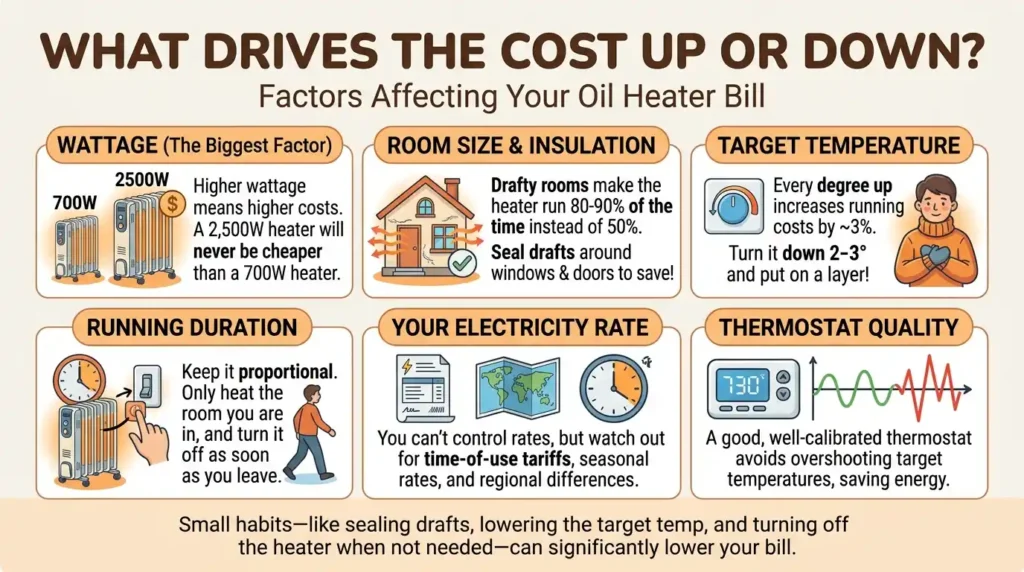
Wattage. This is the only largest factor. At the same rate of electricity, a 2,500W heater will never be cheaper per hour than a 700W heater, full stop.
Room size and insulation. A room with a low insulation level will lose heat quickly hence the thermostat will demand power more frequently and the duty cycle will rise to 80% or 90% rather than 50%. One of the most cost-effective methods of reducing the real-world cost of an oil heater is to seal drafts around windows and doors.
Your target temperature. Every degree you turn up the thermostat will increase your running expenses by about 3 percent, as per the average energy-efficiency calculations. A real saving in a season is to set it 2 to 3 degrees down and have a layer.
The duration of its running. Needless to say, but must be mentioned: cost is proportional to the number of hours consumed. The quickest way to control the bill is to turn on the heater in the room you are in, and turn it off as soon as you are in the room.
Your electricity rate. It is the one that you cannot control in daily life, but it is worth checking. Rates depend on the state, nation, time of the day (when you are on a time-of-use tariff), and season.
Thermostat quality. A heater that has a good, well-calibrated thermostat is more efficient than a cheap heater that may overrun the target temperature before it turns off.
Oil Heater vs Fan Heater: Which Costs More?
They are both typical portable electric heaters, yet they act in very different ways, and that makes the actual price, not the window dressing wattage.
| Factor | Oil Heater | Fan Heater |
|---|---|---|
| Typical wattage | 700W to 2,500W | 1,000W to 2,000W |
| Heat-up speed | Slow | Fast |
| Heat after switch-off | Continues radiating heat for a while | Stops almost immediately |
| Noise | Silent | Audible fan noise |
| Effect on air | Doesn’t dry out the air as much | Can dry the air faster |
| Typical cost per hour (1,500W) | ~$0.20 to $0.28 | ~$0.20 to $0.30 (but less efficient overall) |
| Best for | Steady, all-evening warmth in one room | Quick blasts of heat, short periods |
When operating at the same power, the raw electricity expense per hour is almost the same between an oil heater and a fan heater. The difference is evident over a full evening of operation: since, with an oil heater, the heater continues to produce heat even after the element is turned off, it usually costs less to heat the same room and to the same level of comfort, as the heater does not need to operate as long. If a fan heater is still on your shortlist, this hour-by-hour fan heater cost comparison is worth reading side by side with the numbers above.
Oil Heater vs Central Heating: When Is Each Cheaper?
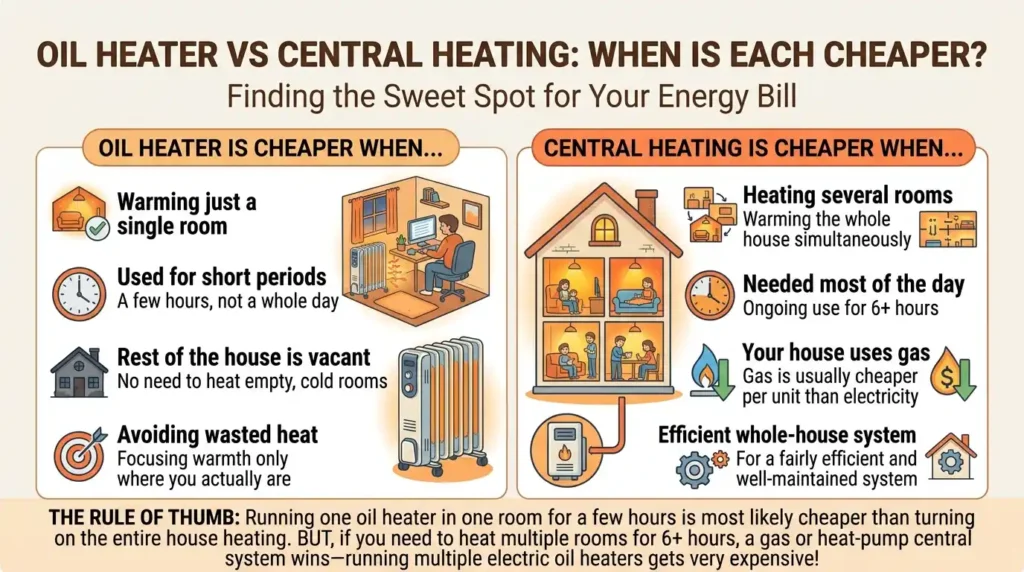
This is the comparison that really counts to the decision of most people.
An oil heater is likely to be less expensive where:
- You need to warm up just a single room.
- You spend a few hours in that room not a whole day.
- The remainder of the house is vacant, or already cold.
- You do not want to heat rooms that are not in use central heating.
Central heating is more affordable when:
- You are heating several rooms simultaneously.
- You require heat most of the day.
- Your house uses gas, that is generally less expensive per unit of heat than electricity in most markets.
- You have a fairly efficient and well-maintained central heating system.
An imprecise calculation: one oil heater in a room a few hours a night is most likely to be cheaper than turning on the entire central heating system a few hours a night. However, when you otherwise would have had the heating running at least six or more hours in a whole house, the oil heaters in all the rooms tend to be more expensive than gas or heat-pump heating, since electricity is typically more expensive per unit of heat input than gas.
7 Ways to Cut Your Oil Heater’s Running Cost
- Operate the inbuilt thermostat rather than operating on full heat. Adjust it to a comfortable temperature and allow it to run, instead of keeping it on the highest setting at all times.
- Close the door of the room you’re heating. This prevents warm air being forced out and cold air taking its place and thus the heater does not have to work as hard.
- Install a smart plug or timer. Have the heater turned off when you are normally asleep or out of the room rather than keeping it on all the time.
- Check for drafts. The cost of weatherstripping around a window or door can be less than a week of additional heating.
- Select the appropriate wattage of the room. A heater that is over-sized in a small room wastes energy by heating up and over-heating; an undersized one in a large room keeps running and never really catches up. Sizing questions come up a lot when weighing oil heaters against other options too; this comparison of common heater categories can help narrow down what actually fits your space.
- Reduce the target temperature to 2-3 degrees. Combine it with a blanket or a warmer. The savings accumulate within a season.
- Do not operate it in a room that is not in use. This is a no-brainer, yet one of the most popular methods of people wasting money on portable heaters is to warm a room when there is no one in it.
Are Oil Heaters Safe to Leave On?
Oil heaters are commonly believed to be one of the less dangerous types of portable heaters since the heating element is fully contained within the sealed oil tank as opposed to being exposed, which reduces the risk of fire as opposed to heaters with an exposed glowing part. With that said, no plug-in heater can be considered a set and forget. Regular safety protocols of any electric space heater, oil-filled or not, include:
- Storing it at least 3 feet away from curtains, bedding, furniture and anything flammable.
- When possible, plug it directly into a wall outlet instead of using an extension cord.
- Do not leave it running overnight unless it is specifically rated to do so.
- Ensuring that it has an operating tip-off shutoff and overheat protection, which is provided on most modern models.
Whether your particular heater is unattended or overnight, it is better to look in the manual of the manufacturer than to guess.
FAQs
Are gas central heating more cost-effective than oil heaters?
Yes, in general, in the case of whole-home heating, since electricity is generally more expensive per unit of heat delivered than gas. An oil heater may be inexpensive compared to central heating of a house in the same time frame to heat a single room just a few hours.
What would be the cost of operating an oil heater on 24 hours?
A 1,500W heater operating 24 hours at full power will cost about 6.50 in the US at the national average rate. Practically, when the thermostat is used to cycle after the room has been warmed the actual cost is normally nearer to $3 to $4.
Are oil heaters very high-consumption of electricity?
An average oil heater consumes 700 to 2,500 watts, like a hairdryer or a microwave. It does not draw much electricity, but since it turns on and off when it reaches temperature, it consumes less electricity over time than the wattage would indicate.
Would it be cheaper to leave an oil heater on low throughout the day or to turn it on and off?
In most rooms, letting the heater run in its thermostat at your desired temperature is often less expensive than turning it off and on since it consumes less energy to heat a cold room back to temperature than it does to keep the temperature constant. The only exception is when you are leaving a room unoccupied over a long duration of time, then it is more appropriate to turn it off.
What is the time taken by an oil heater to warm a room?
The speed of warming a room also depends on wattage and room size, though oil heaters tend to be slower to heat a room than fan heaters, typically taking 20 to 40 minutes to heat a medium room to a comfortable temperature. This is the compromise to their more stable, long-term heat.
Do oil heaters dehumidify the air?
Less than most other types of heaters. Oil heaters are less likely to cause a significant drying effect on room air than fan or ceramic heaters because they warm more slowly and produce a warmer air mass instead of blowing hot air, but any source of heat will cause a relative humidity to drop a bit.
Which size oil heater do I require in my room?
An approximate calculation that most manufacturers go by is approximately 10 watts per square foot in an average insulated room with average ceiling height. A 150 square foot bedroom would indicate approximately 1,500W heater, but poor insulation, tall ceilings, or a colder climate can increase this estimate.
Would it be costly to use an oil heater all winter long?
It will be based on how much time you use it and your electricity bill. To give a crude estimate, it would cost between 130 and 260 in the US to run one 1,500W oil heater 8 hours a day all 4 months of winter, depending on your rate and how often the thermostat switches.
Are more costly oil heaters less expensive to operate?
Not necessarily. The wattage and efficiency with which the thermostat cycles are the primary factors influencing running cost, rather than price or brand. A pricier model could have a more precise thermostat or additional capabilities such as a timer or eco mode, which can lower the real-world cost, but the wattage on the label is what ultimately limits the ceiling.
Is an oil heater more cost-effective to operate than a heat pump?
No. A heat pump does not create heat through electrical resistance, but transfers it, so it can generally produce two or three times as much heat per unit of electricity as an oil heater. Heat pumps are more expensive and not portable room heaters but in whole home heating, they tend to be much cheaper to operate.
Are oil heaters using less electricity than they were before?
The basic technology (a sealed oil reservoir and a resistive heating element) has not radically changed. The addition of thermostat accuracy, timer functions, and eco settings have improved in newer models, which help minimize real-world running costs despite the fact that the maximum wattage draw is approximately the same as older models.
Final Thoughts
Oil heaters are not costly to operate as some may fear but neither are they free. The candid truth is that an average unit would cost between 15 and 30 cents an hour in the US and this figure reduces when the thermostat begins to cycle. It all depends on what you compare it to whether it is expensive or not. An oil heater will often prevail against the idea of heating an entire house using central heating to warm only one room. It is more expensive than not doing anything and wearing a sweater.
The best thing you can do is to adjust the wattage to your room, turn on the thermostat rather than operating at full capacity and heat only the area you are in. Do so, and one of the more foreseeable and controllable methods of staying warm that does not touch your central heating bill is an oil heater.