Electric Fireplace Safety? 7 Essential Tips You Need to Know

Electric Fireplace Safety? 7 Essential Tips to Know Quick Answer: Electric fireplaces are among the safest types of home heating systems in the market since they do not use fuel and do not produce an open flame. Nevertheless, they consume a lot of electrical power and produce actual heat, so fires may occur when you plug one into the incorrect outlet, obstruct its vents, or place it too near furniture or cloth. The vast majority of incidents are prevented by following seven basic safety habits, including: proper outlets, clearance, supervision, certification, cord checks, child/pet safety, and working smoke detectors.
One of the most popular home heating upgrades in the past decade has been the electric fireplaces. They are easy to install in minutes, do not require a chimney, and provide that cozy-flame look without dragging firewood or having to fret about gas lines. But that does not make it electric, which is risk-free. Electrical heating appliances initiate thousands of home fires annually and an electric fireplace remains an appliance that draws serious power through your walls.
Are Electric Fireplaces Actually Safe?

Yes, electric fireplaces are often regarded as one of the less dangerous options of home heating, yet less dangerous is not equal to risk-free.
Electric fireplaces do not produce embers, sparks or creosote deposits in a chimney like wood-burning fireplaces do. They do not burn fuel as opposed to gas fireplaces, which implies that there is no risk of gas leakage and carbon monoxide generation. Most of the models do not have a burning flame, instead, it is a mix of LEDs, mirrors, or mist to give the effect of flickering flames, with a separate heating element (typically resistance coils or infrared quartz) generating the actual warmth.
That notwithstanding, an electric fireplace is still drawing between 750 and 1,500 watts of power through the wiring of your house, and it is still capable of getting hot enough to burn nearby clothing or even burn flesh in contact. The remaining risks are not combustion but electrical: overloaded circuits, faulty cords, blocked vents, and units that are too near the curtains, bedding, or upholstered furniture.
How Electric Fireplaces Work (And Why That Matters for Safety)

The majority of electric fireplaces have two autonomous systems:
- The flame-effect system light-emitting diodes (LEDs), rotating reflectors, or a water-vapor mister produce the effect of flickering flames. This component consumes minimal power and produces minimal heat.
- The heating system – fan-forced heating coil or infrared quartz element which draws in room temperature air, warms it and forces it out.
Due to the fact that these two systems are independent, you can typically operate the flame effect with ambiance without the heater – a fact worth noting should you wish the appearance without the electrical consumption. It also describes the reason why a flickering flame is not a fire risk per se; it is the heating element that requires the safety measures in this guide.
Electric Fireplace vs. Gas vs. Wood: A Safety Comparison

| Risk Factor | Electric Fireplace | Gas Fireplace | Wood-Burning Fireplace |
| Open flame | No (light-simulated) | Yes | Yes |
| Carbon monoxide risk | None | Yes, if unvented or poorly maintained | Yes, if flue is blocked |
| Chimney/venting required | No | Usually yes | Yes |
| Creosote/soot buildup | No | Minimal | Yes — requires annual sweeping |
| Surface gets dangerously hot | Housing can warm; glass usually stays cool | Glass can reach 400°F+ | Yes, extensively |
| Main fire risk | Electrical (cords, outlets, clearance) | Gas leak, hot glass burns, CO | Sparks, embers, chimney fires |
| Ongoing maintenance | Dust vents, check cords | Annual professional inspection | Annual chimney sweep required |
The Real Numbers: What Fire Safety Data Says About Home Heating
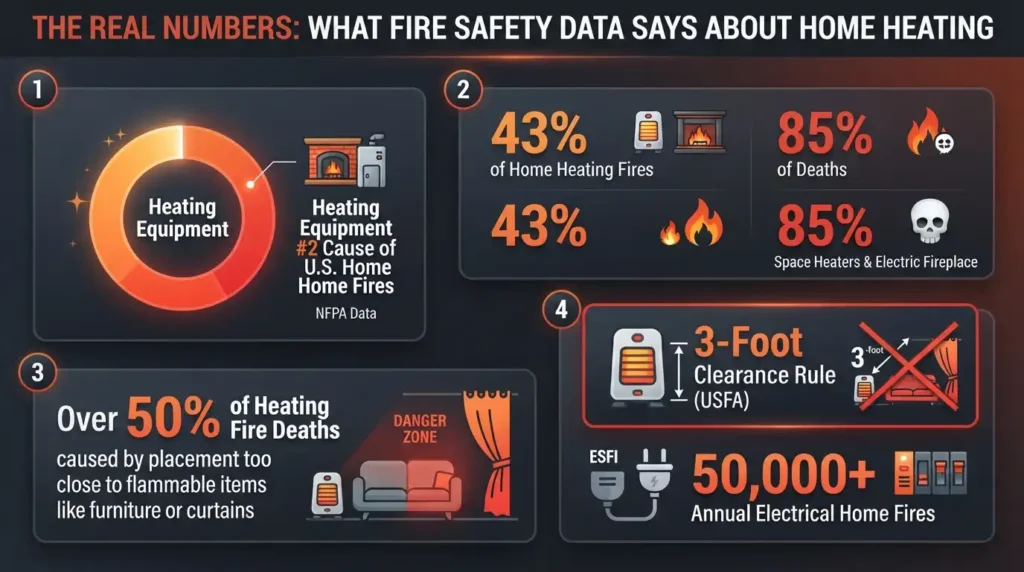
Mysteriously vague assertions such as fires are rare can be found easily without actual sourcing. The data actually shows the following:
- According to the National Fire Protection Association (NFPA), heating equipment is always the second-most common cause of U.S. home fires, after cooking.
- NFPA, in their report titled U.S. Home Fires Involving Heating Equipment, found that portable and stationary space heaters (the larger category of appliances are electric fireplaces) caused approximately 43 percent of home heating fires and approximately 85 percent of deaths in home heating fires in a recent multi-year study period.
- Over fifty percent of deaths caused by fire in home heating were related to equipment that was too close to combustible material, including furniture, bedding, or curtains – the very reason why the 3-foot clearance rule exists.
- According to the Electrical Safety Foundation International (ESFI) annual electrical fire incidents in the U.S. are estimated to be over 50,000 fires in homes.
- U.S. Fire Administration (USFA) is quite specific that anything that can be flammable should be at least three feet away from any source of heat, including electric fireplaces.
The moral is never to think that electric fireplaces are unsafe, but when the simple precautions outlined below are not followed, any electric heating device poses real, well-documented danger.
7 Essential Electric Fireplace Safety Tips

1. Plug Directly into a Dedicated Wall Outlet
Do not plug an electric fireplace into an extension cord, power strip or surge protector. These heaters consume much more current than most household cords are rated at and the stress may result in the cord overheating, melting or sparking. Either plug directly into a grounded wall outlet, or do not use other high-wattage devices (microwaves, space heaters, hair dryers) on the same circuit at the same time – the combined load is a frequent cause of tripped breakers and, with older wiring, overheated outlets.
2. Keep a 3-Foot Clearance from Anything That Can Burn
This is the one most-quoted rule of all the major fire safety agencies, and with reason: more than half of all home heating fire fatalities can be linked to equipment that has been installed too closely to combustible material. Store curtains, bedding, upholstered furniture, rugs, holiday decorations and paper at least three feet on all sides. In the case of recessed or wall-mounted units, also be sure to look at the floor and rear clearance requirements of the manufacturer – some need a few inches of airflow behind the unit, which is easy to lose during installation.
3.Never Leave It Running Unattended or Overnight
The majority of contemporary units have auto-shutoff and overheat protection, although no device can replace supervision. When you are leaving the room or going to bed, be sure to switch off your electric fireplace. To have ambient light at night, most models allow you to operate the flame effect independently with the heater turned off – see the manual of your unit to find out how to use the flame only mode.
4. Choose a UL- or ETL-Certified Unit
Prior to purchase- or to verify a fireplace you already have- seek a UL (Underwriters Laboratories) or ETL/Intertek certification label on the rating plate. These third-party safety certifications assure that the unit has been subjected to U.S. electrical and fire-safety standards. Electric heater fire incidents are disproportionately represented by uncertified or off-brand units, in part due to not including such features as automatic tip-over shutoff and overheat cutoffs.
5. Inspect the Cord and Housing Regularly
After every month, disconnect the unit and physically inspect the power cord to ensure that it is not fraying, cracking, discoloured, or has exposed wire. Examine the scorch marks on the plugs, which means that arcing occurs inside the outlet. In case you notice any of these signs, cease using the unit and have it checked or repaired by a certified electrician, instead of using it temporarily.
6. Keep Kids, Pets, and Water Away
Although the glass face of the majority of electric fireplaces remains cooler than a gas or wood fireplace, the casing and vents may become hot enough to scald inquisitive hands or paws. Monitor children and pets near a running unit and think about a hearth gate with toddlers. Individually, do not install or operate an electric fireplace in a bathroom, near a pool, or any other location where it may come in contact with water or high humidity unless the particular model is designed to be used in wet locations – water and household electrical current are never a good mix.
7. Install and Test Smoke Detectors
The final defense in case anything does go wrong is a working smoke detector. Place detectors on all levels of your house, such as around sleeping areas, and check them once a month. Change batteries at least once a year, and change the whole detector after every 8-10 years according to the manufacturer recommendations.
Electric Fireplace Safety Checklist (Quick Reference Table)
| Task | Frequency | Why It Matters |
| Plug into a dedicated wall outlet only | Every use | Prevents overheated cords and circuit overload |
| Maintain 3-ft clearance from combustibles | Every use | Leading cause of heating-fire deaths is proximity to fuel |
| Turn off when leaving the room or sleeping | Every use | Prevents unmonitored overheating |
| Check for UL/ETL certification | Before purchase | Confirms independent safety testing |
| Inspect power cord for fraying/damage | Monthly | Damaged cords are a top cause of electrical fires |
| Dust or vacuum vents | Monthly | Blocked airflow can cause internal overheating |
| Test smoke detectors | Monthly | Ensures early warning if a fire does start |
| Schedule professional inspection | Annually (or if 5+ years old) | Catches internal wear before it becomes dangerous |
| Unplug during extended non-use | Seasonal | Removes standby electrical risk entirely |
Warning Signs Your Electric Fireplace Needs Attention
Discontinue using your unit and unplug it (unless it is safe to do so) when you observe any of the following:
- Continuous smoldering smell or smoke.
- The plug or outlet is hot or has scorch marks.
- Turning lights on and off in other parts of the room when the fireplace is on.
- The circuit breaker keeps on tripping as long as it is in use.
- Strange buzzing, crackling, or popping of the unit.
- Glass panel is broken or the housing is too hot to touch.
- The flame effect is flickering or the unit is simply switching off.
When you notice sparks, burning plastic, or active smoke, get out of the house, dial 911, and do not go back until emergency service personnel can confirm that it is safe.
Electric Fireplace Maintenance Schedule
| Interval | Maintenance Task |
| Weekly | Wipe down glass panel with a non-abrasive glass cleaner |
| Monthly | Dust or vacuum intake and exhaust vents; inspect cord |
| Every 3–6 months | Check and replace flame-effect bulbs if dim or flickering |
| Annually | Have a qualified electrician inspect wiring and outlet if the unit is 5+ years old |
| Seasonally | Unplug and store safely if not in use for extended periods |
What to Do If Something Goes Wrong

- Turn off the unit right away, but only when it is safe to do so without coming into contact with visible flames or open wiring.
- Leave and dial 911 when there is smoke or fire present, or a growing electrical fire, do not attempt to combat it on your own.
- Do not apply water to an electrical fire, except when you have an electrical fire extinguisher (Class C) which should be applied only to a small and confined fire.
- Do not re-enter your house until emergency responders confirm that it is safe.
- It is not okay to think that it is okay after the fact because smoke has vanished and the house is no longer on fire; smoke leftovers can influence the quality of indoor air and building materials; a professional assessment of fire and smoke damage is recommended in case of anything bigger than a small, completely contained fire.
Common Mistakes to Avoid
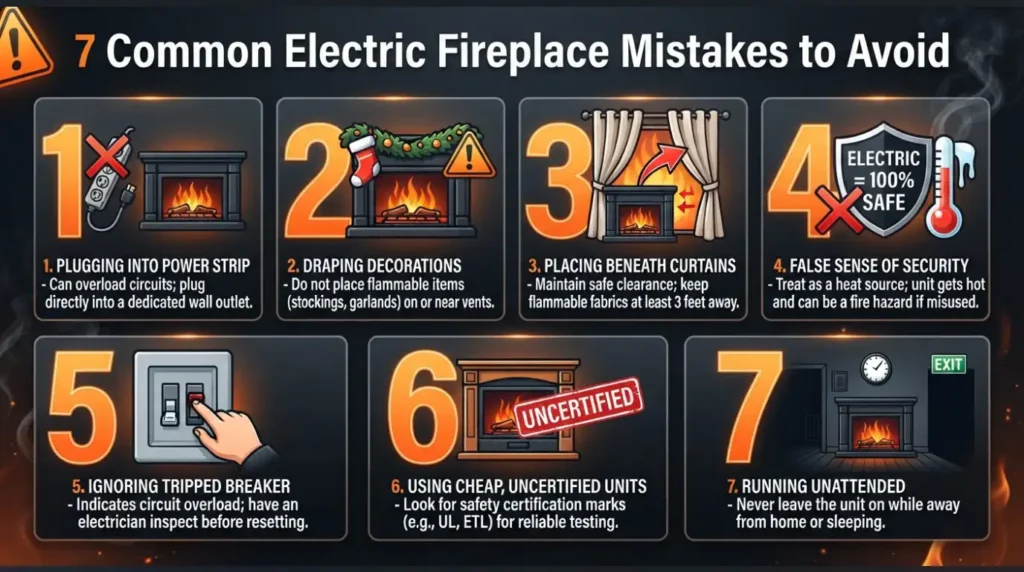
- Turning on the fireplace using a power strip “once only”
- Cloaking a stocking, garland, or blanket over or around the unit.
- Having the fireplace directly below the curtains or upholstered furniture.
- to suppose it is electric is to suppose it can never start a fire.
- Leaving a tripped breaker uninvestigated.
- Purchasing a unit that is not certified due to low prices.
- Leaving it running while out of the house for the day.
You May Also Read:
- Why Do Background Lights Stop Working on an Electric Fireplace?
- Why Is My Electric Fireplace Making the Cord Hot?
FAQs:
Is it possible to use an electric fireplace on a power strip?
No. Electric fireplaces require too much continuous power to be used safely by a typical power strip or extension cord. Always use a special, grounded wall outlet.
Can electric fireplaces be left unattended?
It’s not recommended. Although most models come with auto-shutoff features, it is dangerous to leave any heating appliance unattended overnight. Switch it off at night, or switch to flame-only mode if your model has this feature.
Are electric fireplaces sources of carbon monoxide?
No. Electric fireplaces produce zero carbon monoxide since they do not utilize any fuel, unlike gas or wood-burning fireplaces.
Are electric fireplaces vented?
They do not need any chimney or outside venting, as they are not combustible. Internal air vents on the unit itself must also remain free of dust and obstructions to allow air to flow.
What is the distance that an electric fireplace should have to furniture?
Minimum of three feet on each side, which corresponds to the general clearance of heating equipment suggested by the U.S. Fire Administration and NFPA.
Is it possible to have an electric fireplace in a bathroom?
Only when the particular model is wet/damp-rated. Near water, pools, or high humidity, standard units should not be used.
Are electric fireplaces safer than space heaters?
Generally, yes. Electric fireplaces have lower external surface temperatures and may have additional safety features, like tip-over and overheat switches, than simple portable space heaters.
What can I do to determine whether my electric fireplace is UL certified?
Look on the back or bottom of the unit for the rating plate or label, which may contain a UL, ETL, or Intertek mark along with model and voltage information.
Is it possible to leave the electric fireplaces on when I am not at home?
No. Do as you would with any other heating device and switch it off when you are not in the room, even when you are going out on a quick mission.
Is it natural that an electric fireplace smells when it is first used?
The initial few times of use, burning off manufacturing residues, may cause a faint odor. An incessant or intense burning odor that follows is not normal and should be inspected immediately.
When should I change an electric fireplace?
With proper maintenance, most units have a life of 8-10 years. If yours is older and exhibiting performance problems, a professional check-up can tell whether it is safe to use or not.
Will electric fireplaces increase my electric bill?
The cost of usage is determined by the wattage and frequency of using the heater option. The flame-only option consumes very little energy, while the heating coil is the main factor in energy expenses.
Will I be able to install an electric fireplace on my own?
Plug-in models are usually not particularly difficult to install. A licensed electrician should install built-in or wall-recessed models with new wiring or a dedicated circuit.
What is the difference between an electric fireplace and electric insert?
An insert can be installed into an existing fireplace, whereas a standalone electric fireplace or a wall-mounted unit does not need a fireplace structure.
Should I turn off my electric fireplace when I go on vacation?
Yes. Unplugging eliminates any standby risk of electricity when you are away and is a very easy habit to develop into your pre-trip checklist.
Key Takeaways
- Electric fireplaces are one of the less dangerous types of home heating systems since they do not contain an open flame, do not use any fuel, and do not produce carbon monoxide.
- The actual hazards are electrical: broken cords, overloaded circuits, and units being too close to combustible material.
- It is important to plug in directly to a wall outlet, keep a 3-foot clearance, and never leave the unit unattended overnight.
- Select a UL- or ETL-approved model, and check the cord and housing at least once a month to detect early warning signs.
- There should be smoke detectors working on all levels of your house, which is a backup measure, no matter how safe your heating devices are.