Why Is My Electric Fireplace Making the Cord Hot? 7 Things that Work to fix.
A hot cord isn’t something to shrug off. When you have passed in front of your electric fireplace and you realize that the cord, plug or outlet is warm or even too hot to touch, then you are correct in your instinct to investigate this. Electric fireplaces use the same energy as a space heater and that energy must be delivered by a cord, a plug, and an outlet which all have a limit. When one of those parts is worn, loose or overloaded, the heat accumulates in the same place that you can feel.
The seven most common reasons why this occurs and what to do about each one are listed below but the most urgent question must be addressed first.
Is It Normal for an Electric Fireplace Cord to Get Warm?
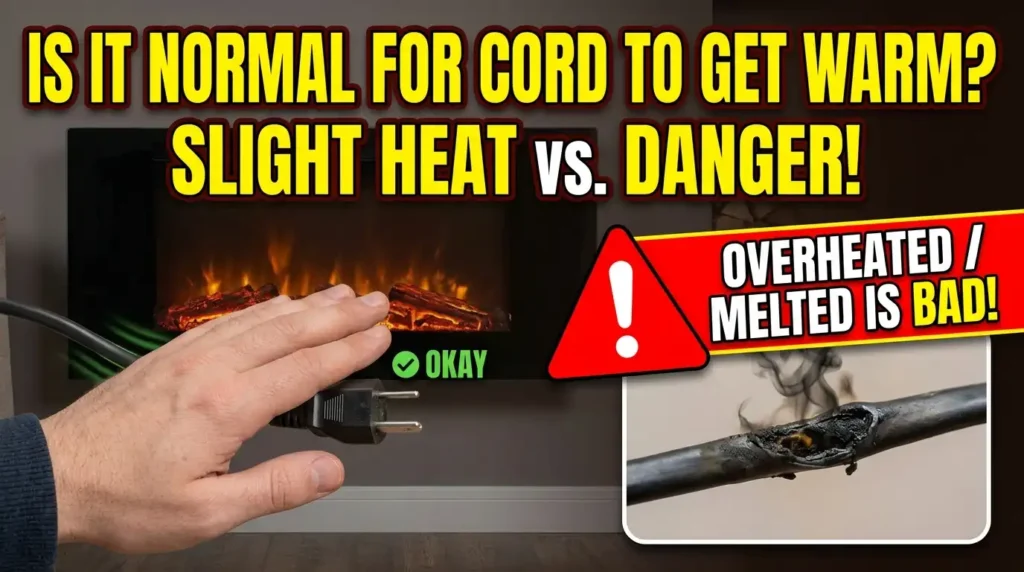
A little warming is okay. The flow of electric current always produces a certain amount of heat, as it flows through a wire–that is simple physics, not a fault. A cord that becomes slightly warm to the back of your hand, after a few hours of use, particularly around the plug, is not necessarily a problem in itself.
Not normal is a cord, plug or outlet that is hot enough to make you want to withdraw your hand, that smells like burnt plastic or that is discolored, softened or melted. Your fireplace is talking to you in the electrical circuit that something is overstressed in the circuit that it was not designed to carry.
Normal Warmth vs. Dangerous Heat
Why Is My Electric Fireplace Making the Cord Hot
| Sign | Normal | Needs Action |
| Temperature to the touch | Slightly warm, comfortable to hold | Hot, uncomfortable, or painful to touch |
| Smell | None | Burning plastic or “hot electrical” odor |
| Cord appearance | Unchanged | Discolored, darkened, soft, or melted near the plug |
| Plug prongs | Cool, firmly seated | Warm, loose, bent, or scorched |
| Outlet cover | Room temperature | Warm or hot to the touch |
| Sound | Silent | Buzzing, crackling, or popping |
| Breaker behavior | Stays on | Trips repeatedly or flickers lights |
When you see something on the right hand column, plug out the fireplace and never use the same outlet again without checking it. Read on to find out what to do next.
Why Electric Fireplace Cords Overheat: The Real Cause
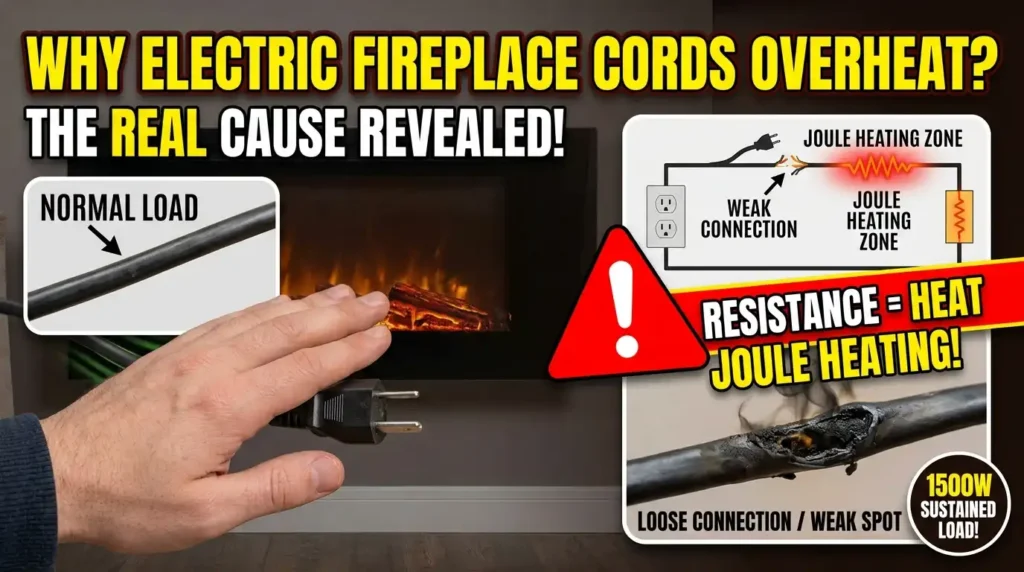
Any instance of a hot fireplace cord all boils down to the same principle: resistance produces heat, and heat must be dissipated.
Electric fireplaces are resistive heaters, meaning that almost all the electricity that they consume is converted directly into heat – that is how they heat a room. An average plug-in electric fireplace consumes approximately 1,500 watts, or about 12.5 amps on a standard 120-volt household circuit. A heavy, sustained load -a space heater-like load -hours at a time.
When this much current is passed through a connection that is not up to the task, a loose outlet, a frayed plug, a cheap power strip, a coiled-up cord, the electrical resistance across that weak spot shoots up, and so does the heat. This is what engineers refer to as Joule heating, and is the same physics as a toaster heating component, but occurring in an undesirable location.
How Much Power an Electric Fireplace Actually Draws
| Fireplace Setting | Typical Wattage | Typical Amperage (120V) | Share of a 15-Amp Circuit |
| Flame effect only (no heat) | 30–150W | 0.25–1.25A | Under 10% |
| Low heat | 750W | 6.25A | ~42% |
| High heat | 1,500W | 12.5A | ~83% |
Rapid fact: According to the National Electrical Code, any load that is supposed to operate at least three hours or longer must be reduced to 80 per cent of the rating of a circuit. A high setting 1,500-watt fireplace already consumes approximately 83% of a typical 15-amp circuit – before any other device on that circuit is switched on. This is why fireplaces are particularly susceptible to overheating cords, tripped circuit breakers, and hot outlets when not dedicated their own circuit.
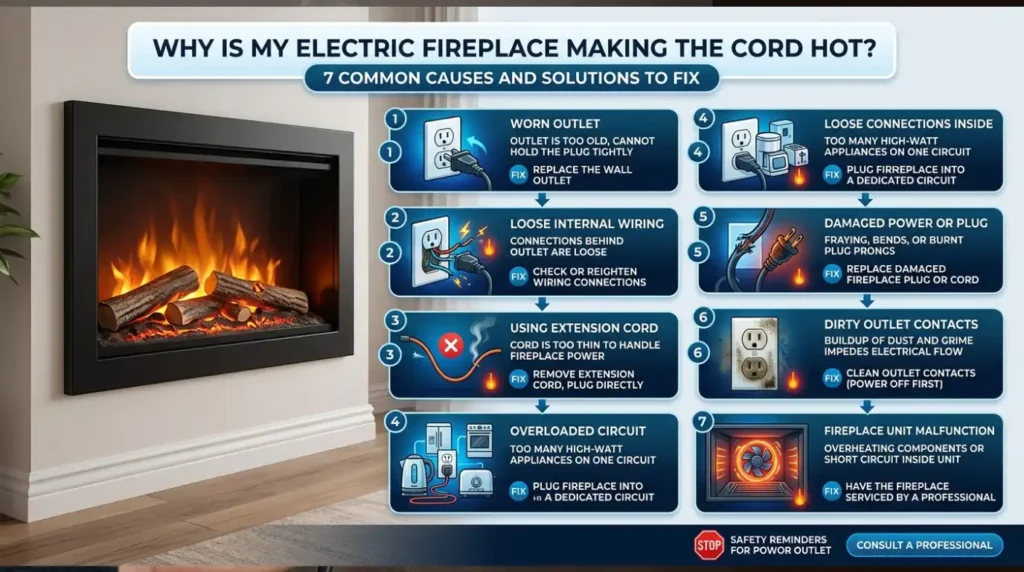
7 Fixes for a Hot Electric Fireplace Cord
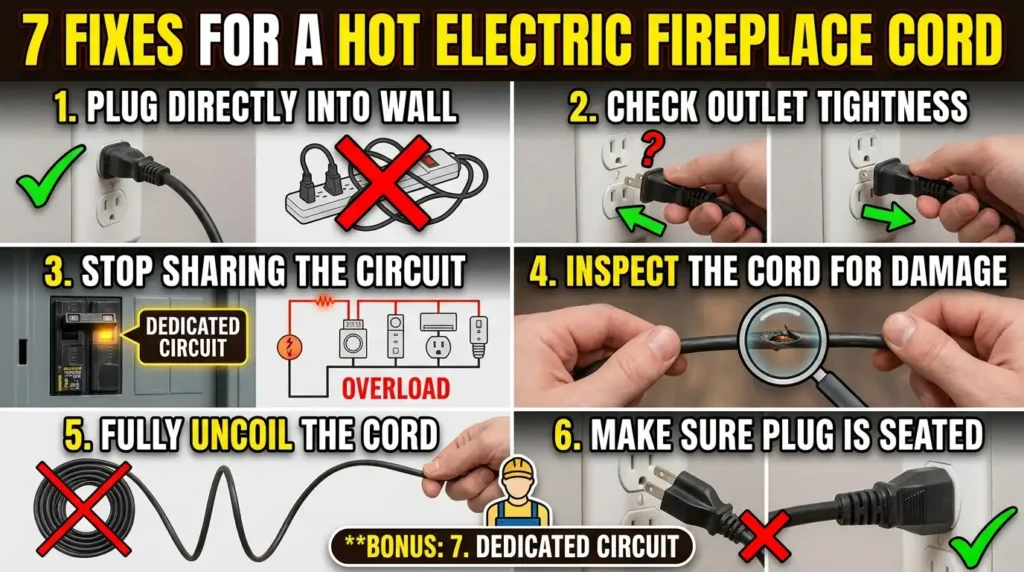
1. Plug Directly into the Wall — Never a Power Strip or Extension Cord
This is the most widespread reason of a hot fireplace cord, and it is the simplest to repair.
Standard extension cords and power strips are designed to support lightweight electronics, such as lamps, chargers, routers, and not a continuous 12.5-amp heating load. Their internal metal contacts are thinner and clamp not as tight as a wall receptacle thus they build up more resistance at the connection point. Run the full draw of a fireplace on that weak connection a few hours and the plastic housing may become hot enough to bend, discolour or worst of all, catch fire.
The solution: Directly plug the fireplace into a wall socket. When the cord is not long enough, bring the fireplace nearer to an outlet, or have an electrician install one – do not use a strip or a cord to bridge the gap. Should you need to extend the run, be sure you use a single-outlet heavy-duty appliance extension cord with a minimum of 15 amps (12- or 14-gauge, as short as possible), and never a multi-outlet extension or one with an inbuilt surge protector.
2. Check the Outlet for a Loose or Worn Connection
Outlets wear out. With each insertion and removal of a plug, the internal spring-loaded contacts (which are referred to as the wipers) lose some little tension. An outlet may loosen over years of use to the point that a plug wiggles or falls out of its own accord – and such a loose connection is precisely the type of high-resistance connection that produces heat.
The solution: Turn off the fireplace and check the tightness of the plug when you put it back in. When it is loose, wobbles, or fails to hold the prongs, then cease using that outlet. Also test the outlet or the cover plate of the fireplace when the fireplace is on – is it hot, or does it feel hot, that indicates internal arcing or a loose wire connection behind the wall, not a worn socket. Both problems require an electrician to install a new receptacle, and not a home repair, as it can involve wiring behind the wall.
3. Stop Sharing the Circuit with Other Appliances
Since a fireplace on high power may consume more than 80 percent of a typical 15-amp circuit, anything else that is plugged into that same circuit a lamp, a TV, a phone charger, another space heater, etc. puts the total load nearer to, or exceeding, its maximum capacity. Although the breaker may not be operating, the continuous operation at or near maximum current in the circuit keeps all of the connection points on the circuit hotter than they should be.
The solution: Trace out which outlets are on a circuit with your fireplace (a circuit breaker map or a trial-and-error with the breaker panel will tell you) and unplug other devices on the circuit when the fireplace is on. When you see lights flickering in other parts of the house when the fireplace turns on, it is a good indication that the circuit is overloaded.
4. Inspect the Cord Itself for Damage
Not always is the heat coming out of the outlet or the wall, it may be coming out of inside the cord. Pinned under furniture, running under a carpet, making a sharp turn around corners or chewed by pets, cords may develop internal fraying that cannot be seen externally. A wire that is frayed in an otherwise-appearing jacket forms a high-resistance hot spot just like a loose outlet, but you cannot see it form.
The fix: When not plugged in, carefully run the cord through your fingers, feeling any soft spots, stiff spots, kinks, or bulges. Take a closer inspection of the places around the plug and around the point of entry of the cord into the fireplace housing these flex points are the first to fail. Any cracking, discoloration, exposed wire or brittleness implies that the cord (and often the entire unit, as cords on built-in heaters are often not user-replaceable) must be repaired or replaced by a qualified technician and not reused.
5. Fully Uncoil the Cord While the Fireplace Is Running
When you have more cord length, and it is neatly wound up or tied in a zip behind the fireplace, that habit can trap heat. A coiled cord is somewhat a heating coil in its own right, the loops are so close together that the heat that would otherwise escape into the open air is trapped within the bundle.
The fix:Lay out any surplus cord in loose, open loops instead of tight coils, or even better, use a shorter cord or simply rearrange the fireplace so that there is less of it to deal with initially.
6. Make Sure the Plug Is Fully Seated
A plug that is partially inserted into the outlet leaving any portion of the metal prongs exposed forms an air gap at the point of connection. Arcing between those two points produces a lot of localized heat and it is a frequent reason that plug faces are scalded or melted.
The fix: Once inserted, make sure that the plug is pushed in all the way and that no metal is protruding outside the outlet. When the plug does not fit into the socket on its own, it is an outlet issue (see Fix 2) and not a plug issue, and should be inspected, not forced or taped.
7. Install a Dedicated Circuit
When you have been plugged directly into the wall, you have checked that the outlet is tight, you have cleared the circuit of other devices, and the cord is still hot, then the outlet itself may be just undersized to sustain a continuous 1,500-watt load, particularly in older houses where outlets are on lighter-gauge wiring shared over a room.
The fix: Have a licensed electrician put in a special 15- or 20-amp circuit to the fireplace, and nothing else on the same circuit. It is the same advice that electricians offer to window air conditioners and space heaters, and the most lasting solution to the long-term issue of overheating that is not related to a faulty cord or a faulty outlet.
What to Do Right Now If the Cord Is Hot
Should you have felt heat where the fireplace is running, do not wait until you have finished reading, but follow these steps in the order:
- Unplug the fireplace immediately, using the plug, not by pulling the cord.
- Do not touch the outlet or the cord when you observe sparking or smell burning or smoke – simply turn off the circuit breaker on that circuit.
- Allow all to cool down and then examine the plug, cord and outlet as per the signs in the table above.
- Do not plug the outlet or cord again without determining the cause and repairing it using the above steps.
- Contact a licensed electrician in case of an outlet or wiring or breaker, or the manufacturer of the fireplace itself in case the cord or unit itself seems to be the problem. When to Call an Electrician vs. When to call Fireplace Support.
When to Call an Electrician vs. When to Call Fireplace Support
| Situation | Who to Call |
| Outlet or wall plate is hot | Electrician |
| Breaker trips repeatedly | Electrician |
| Lights flicker when fireplace turns on | Electrician |
| Cord is frayed, cracked, or scorched near the fireplace housing | Fireplace manufacturer or a qualified appliance repair tech |
| Plug prongs are bent, loose, or discolored | Fireplace manufacturer (for a cord/plug replacement) |
| Everything electrical checks out but heat persists | Electrician (likely needs a dedicated circuit) |
How to Prevent This from Happening Again.
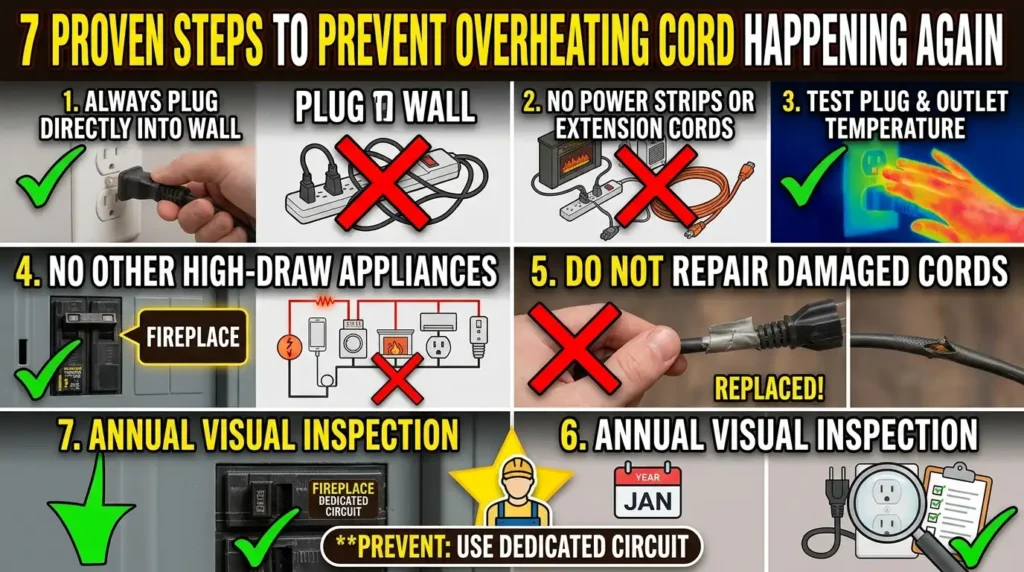
- Directly into a wall outlet at all times, never a power strip, surge protector or typical extension cord.
- Hand test plug and outlet temperature every few weeks during heavy-use season.
- Store the cord in a coiled form and out of the way of the rugs, furniture and foot traffic.
- Do not use other high-draw appliances on the same circuit when using the fireplace.
- Check receptacles more than 1520 years, as tension of springs in receptacles decreases with age.
- Do not repair, replace a damaged cord – heat-damaged insulation does not completely heal even when the outer jacket appears normal again.
- Have the plug, cord, and outlet visually inspected each heating season at the beginning of the year.
Key Takeaways
- It is normal to have a little warmth in an electric fireplace cord, but not hot-to-the-touch, discolored, or a burning odor.
- Electric fireplaces consume approximately the same amount of power as a space heater, 1,500 watts, or 12.5 amps, a heavy and continuous load that a cord and outlet would have to support.
- The most frequent reason of a hot cord is putting a plug in a power strip or extension cord rather than a wall outlet.
The other most common causes are loose outlets, shared circuits, coiled cords, and damaged insulation. - In case the cord, plug or outlet is really hot, disconnect the fireplace and fix the problem and then use it again.
You May Also Read:
- 7 Best Electric Fireplace Log Inserts With Heater
- How an Electric Fireplace Performs in Different Winter Climates?
FAQs:
Is it unsafe when my electric fireplace power cord is hot?
Mild warmth following several hours of use is normal. When the cord is hot to touch, discolored or accompanied by a burning odor, it becomes an issue, as this indicates a loose or damaged connection, which should be addressed.
Is it possible to use my electric fireplace on a power strip?
No. Electric fireplaces require too much continuous current to the internal contacts and wiring within most power strips and surge protectors, which are designed to support lighter electronic loads. Always directly into a wall socket.
Why does my electric fireplace blow the circuit and heat up simultaneously?
This normally implies that the fireplace is sharing a circuit, already near its capacity. The cumulative load causes current to be pushed to the threshold of the breaker and the same surplus current is heating any weak connection point along the path.
Is it typical that the plug should be hotter than the rest of the cord?
Some warmth at the plug is common since that’s where the connection to the outlet happens. But when the plug is significantly hotter than the cord, or the prongs have a discolored appearance, then it is an indication of a loose or worn-out outlet connection.
Will a coiled extension cord overheat my fireplace?
Yes, assuming you are using one at all – but the solution to this is not to use an extension cord with an electric fireplace at all. When current-heavy appliances are used, coiling any cord captures heat that would otherwise be lost to the air.
How much electricity does an electric fireplace use?
The typical plug-in electric fireplace consumes approximately 1,500 watts on high heat (approximately 12.5 amps at 120 volts) and much less when the flame effect is operating alone and without heating, typically less than 150 watts.
Should an electric fireplace be on its own circuit?
It is not necessarily a legal requirement, yet it is highly suggested. A 1,500-watt fireplace can consume about 83 per cent of a typical 15-amp circuit all by itself, and there is little room to add more or the breakers will be tripped or the fireplace will overheat.
What is it that my fireplace has burnt or discolored prongs of the plug?
Prongs discoloured mean that arcing has already taken place, typically due to a loose outlet connection. Discontinue the use of that plug and outlet and have the outlet checked or replaced and then reconnect the fireplace anywhere.
Is it true that a hot cord can start a fire?
Yes. Overheat of cords and connections is a proven cause of domestic electrical fires, and thus fire and consumer safety agencies specifically caution against overloading cords and using extension cords or power strips with high-draw heating devices.
Can I leave my electric fireplace on overnight with a cord that is a little warm?
Leaving any heating device unattended is not advisable and a cord that feels warm is another reason to shut off the fireplace when you are not around to watch it, even when it has an auto-shutoff device.
Are overheat protection and all electric fireplaces?
The majority of contemporary units have a thermal cutoff that disables the unit in case internal components overheat, but this does not guard against external accumulation of heat in the cord, plug or outlet.
What do I do to know whether my outlet is old or deteriorated to take my fireplace?
When the plug does not fit into the socket, does not fit snugly, or pops out when there is a slight amount of tension, the internal contacts of the outlet have probably deteriorated and should be replaced by an electrician, irrespective of the age of the outlet.
Is it possible to repair a hot outlet?
It is also a job that requires working with live household wiring, and unless you are an experienced and comfortable worker with electrical circuits, it should be left to a licensed electrician, particularly because a hot outlet may also indicate a loose connection further up the wiring.
Which gauge extension cord can be used in an electric fireplace when I have no other choice?
When a wall outlet is actually inaccessible, a single-outlet, heavy-duty 12-gauge appliance extension cord with a minimum current carrying capacity of 15 amps and kept as short as possible and not fully coiled is the best option, but a wall outlet or a new receptacle can always be installed at a closer distance to the fireplace.
Why does my cord only heat up on the high heat option?
Since the current doubles between low and high heat on most units (approximately 6.25 amps to 12.5 amps), any weak area in the connection – a loose outlet, a worn plug – will produce disproportionately more heat at the higher current, which is why the problem usually only becomes apparent on high.