The Performance of an Electric Fireplace in varying winter climates (Real heating data)
How an Electric Fireplace Performs in Different Winter Climates? When you have ever typed in the query of whether an electric fireplace is going to make you stay warm, the truthful response is it all depends on where you reside. A fireplace powered by electricity that would warm a living room in North Carolina in the coastal area, would hardly remove the chill in a drafty room in Minneapolis. The unit itself does not change; however, everything changes with the climate around it.
This guide dissects precisely how electric fireplaces work in four realistic winter climate zones, with real BTU output, real wattage and real room-coverage figures rather than some vague marketing statements. You’ll see where electric fireplaces shine, where they fall short, and how to get the most heat for your money no matter how cold it gets outside.
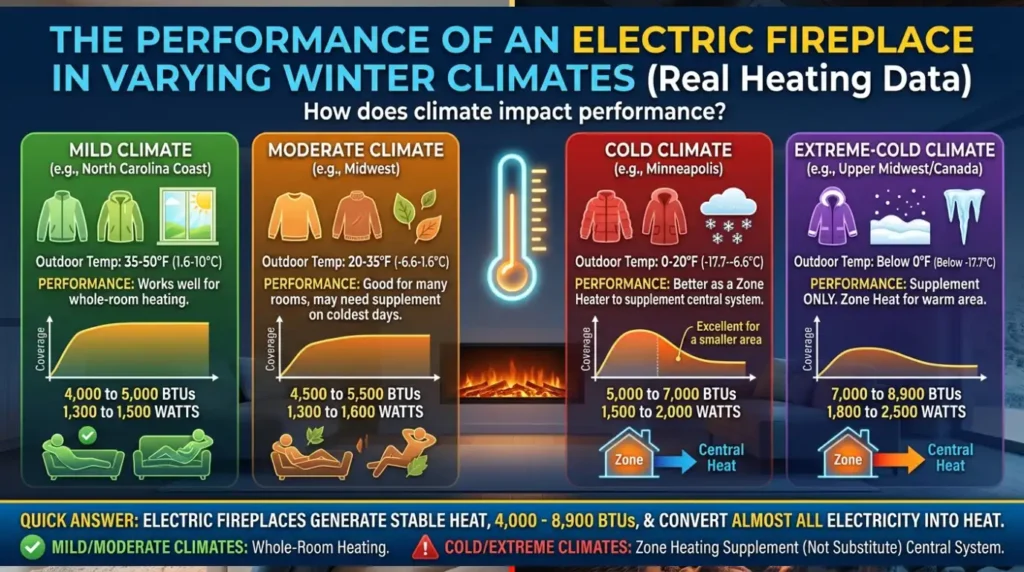
Quick Answer: Electric fireplaces generate actual, stable heat, 4,000 to 8,900 BTUs, and turn almost all the electricity they consume into heat. In the mild and moderate climates that will do you well in the whole room. They are better in cold and extreme-cold climate as a zone heater to supplement your central system and not to substitute it.
Key Takeaways
- Electric fireplaces use nearly all the electricity as heat as opposed to wood fires which dissipate the heat up the chimney.
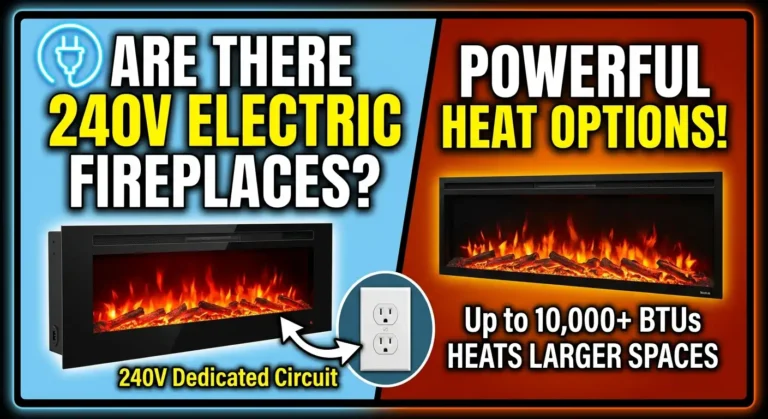
- Standard 120V units produce 4,000–5,100 BTUs; hardwired 240V units can reach 8,900 BTUs.
- The warmth of the room is not only defined by the fireplace, but also by climate, insulation, height of the ceiling, and size of the room.
- A single electric fireplace can frequently warm up a small-to-medium sized room in mild and moderate climates.
- In cold and extreme-cold climates, consider electric fireplaces as zone heaters, and not entire-room or entire-home.
- Running cost is 15-25 cents per hour at 2026 U.S. average electricity price of approximately 18.3 cents/kWh.
What Actually Determines Winter Heating Performance
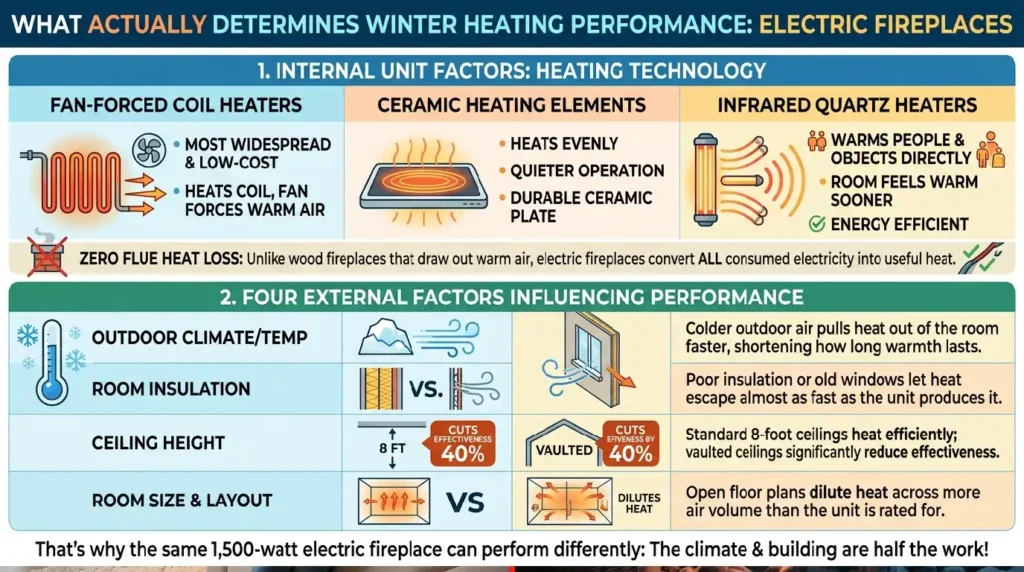
It is best to know what is going on in the unit before making a comparison between climates. Electric fireplaces have one of three heating options:
- Fan-forced coil heaters – a metal coil is heated and a fan forces the warm air into the room. This is the most widespread and low-cost one.
- Ceramic heating elements – Ceramic plate is more evenly heated and can be much quieter than a coil.
- Infrared quartz heaters – infrared light is used to warm people and objects directly and not only air, thus, the room will feel warm sooner than the temperature of the air.
None of these ways lose heat in the manner that a fireplace made of wood does via a chimney. A conventional fireplace will literally draw warm air out of your home, whereas an electric fireplace does not have a flue, and therefore all of the electrical power it consumes is useful heat in the room.
However, the extent to which that heat goes is determined by four external factors:
| Factor | Effect on Performance |
| Outdoor climate/temperature | Colder outdoor air pulls heat out of the room faster, shortening how long warmth lasts |
| Room insulation | Poor insulation or old windows let heat escape almost as fast as the unit produces it |
| Ceiling height | Standard 8-foot ceilings heat efficiently; vaulted ceilings can cut effectiveness by up to 40% |
| Room size & layout | Open floor plans dilute heat across more air volume than the unit is rated for |
That is why the same 1,500-watt electric fireplace can seem like a lot of heat in one house and a letdown in another – the climate and the building are half the work.
Electric Fireplace Performance by Winter Climate Zone
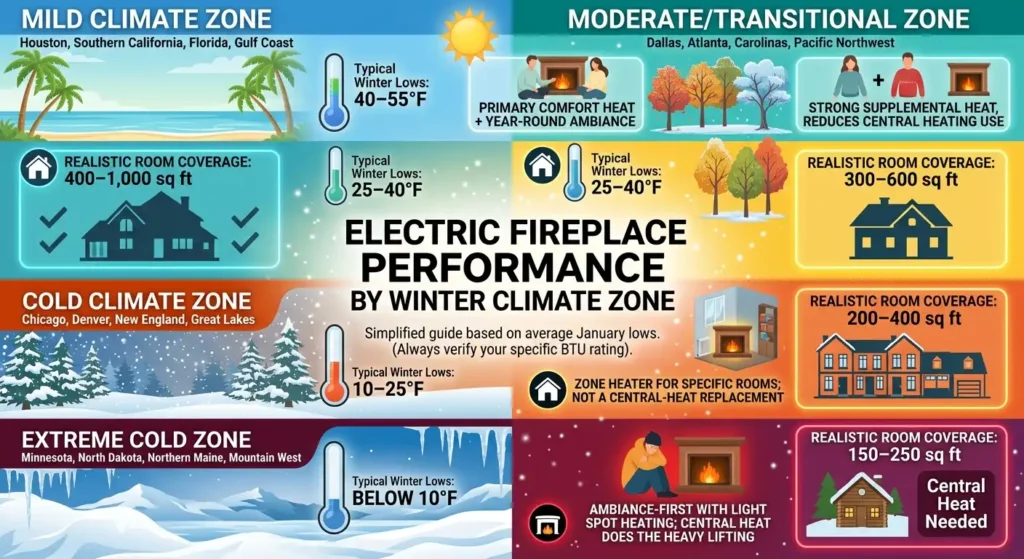
To simplify this, we have divided U.S. winter climates into four regions, according to average January lows. This is a rough guide, but you should always verify the BTU rating of your particular model.
| Climate Zone | Example Regions | Typical Winter Lows | Electric Fireplace Role | Realistic Room Coverage |
| Mild | Houston, Southern California, Florida, Gulf Coast | 40–55°F | Primary comfort heat + year-round ambiance | 400–1,000 sq ft |
| Moderate/Transitional | Dallas, Atlanta, Carolinas, Pacific Northwest | 25–40°F | Strong supplemental heat, reduces central heating use | 300–600 sq ft |
| Cold | Chicago, Denver, New England, Great Lakes | 10–25°F | Zone heater for specific rooms; not a central-heat replacement | 200–400 sq ft |
| Extreme Cold | Minnesota, North Dakota, Northern Maine, Mountain West | Below 10°F | Ambiance-first with light spot heating; central heat does the heavy lifting | 150–250 sq ft |
The following are list? How an Electric Fireplace Performs in Different Winter Climates?
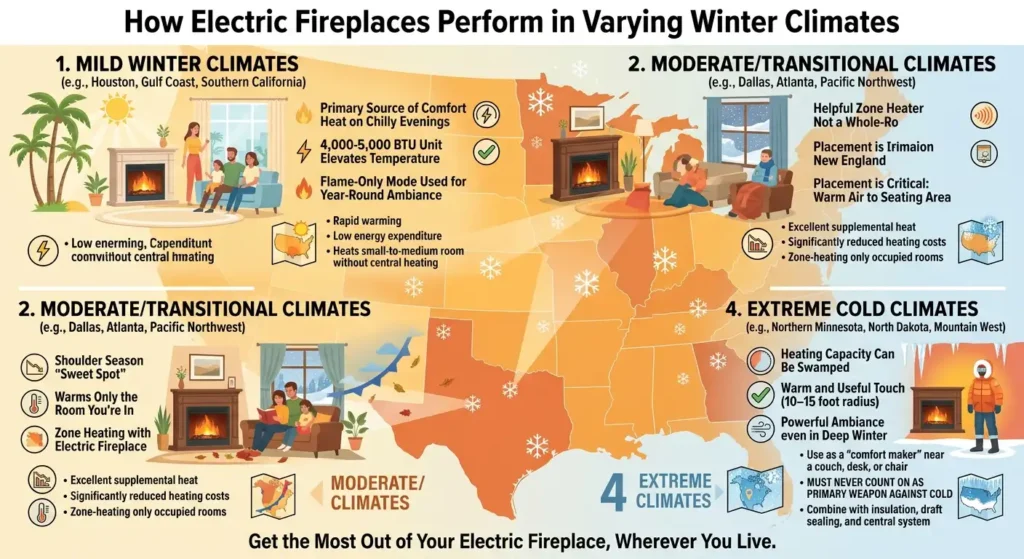
Mild Winter Climates (Houston, Gulf Coast, Southern California)
Electric fireplaces can really serve as a main source of comfort heat on chilly evenings in mild climates. In these areas, winter temperatures do not go much below zero, and thus even a typical 4,000-5,000 BTU unit can easily elevate and maintain room temperature. It is also the place where the flame-only mode is used the most throughout the year, as homeowners can have a visual effect without the need to heat most of the year.
What to expect: Rapid warming, low energy expenditure and heating of a small-to-medium living room without assistance of central heating.
Moderate/Transitional Climates (Dallas, Atlanta, Pacific Northwest)
This is the “shoulder season” sweet spot. In these areas, houses can go weeks without using the central furnace, yet single rooms become cold – particularly in early mornings or following a cold front. The electric fireplace allows you to warm only the room you are in rather than turn on a full-house system to have a two-hour drop in temperature.
What to expect: Excellent performance as a supplemental heat; lots of homes report significantly reduced heating costs when they begin zone-heating with an electric fireplace rather than central heating one room.
Cold Climates (Chicago, Denver, New England)
In this case, an electric fireplace ceases to be a whole-room solution and turns into a truly helpful zone heater. The heat is drawn out of a room more easily by outdoor temperatures, so what would have heated 400 square feet in Dallas could only comfortably heat 200-250 square feet in a home in a cold climate, particularly with old-fashioned windows or tall ceilings.
What to expect: Trustworthy, concentrated warmth in the immediate seating area; it must be in cooperation with your furnace or heat pump, not rather than it. Here, placement is much more important – place the unit in such a place that the warm air can get to the area that you are actually in, not in the draft, and not behind the furniture.
Extreme Cold Climates (Northern Minnesota, North Dakota, Mountain West)
In truly cold climates, the heating capacity of an electric fireplace may be swamped by the heat loss over the building envelope, especially in older houses. It will still bring a warm and useful touch within a 10–15-foot radius, and the effect of a flame is still a powerful ambiance feature even in the long winter, but it must never be counted on to be your primary weapon against the cold below zero.
What to expect: Use it as a comfort maker on a couch, reading chair or home office desk. Combine it with good insulation, draft sealing and your main heating system to be truly winter safe and comfortable.
Room Size vs. Climate: How Much Space Can You Actually Heat?
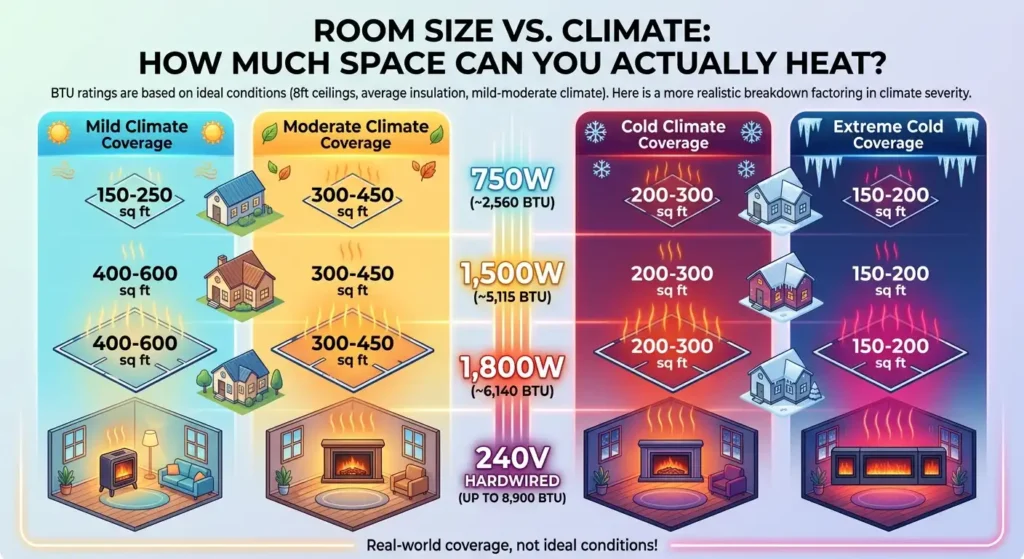
BTU ratings on the box are based on ideal conditions 8-foot ceilings, average insulation, and a mild-moderate climate. The following is a more realistic breakdown that factors in climate severity.
| Unit Output | Mild Climate coverage | Moderate climate coverage | Cold climate coverage | Extreme cold coverage |
|---|---|---|---|---|
| 750W (~2,560 BTU) | 150–250 sq ft | 100–175 sq ft | 75–125 sq ft | 50–100 sq ft |
| 1,500W (~5,115 BTU) | 400–600 sq ft | 300–450 sq ft | 200–300 sq ft | 150–200 sq ft |
| 1,800W (~6,140 BTU) | 500–750 sq ft | 375–550 sq ft | 250–375 sq ft | 175–250 sq ft |
| 240V hardwired (up to 8,900 BTU) | 700–1,000 sq ft | 550–750 sq ft | 350–500 sq ft | 250–350 sq ft |
Rule of thumb: Often a popular formula is 10 watts per square foot under ideal conditions. In colder regions, double that, about 20 watts per square foot, is a safer amount to plan on, to allow of quicker heat loss.
Electric vs. Gas vs. Wood: Winter Climate Comparison
| Feature | Electric Fireplace | Gas Fireplace | Wood-Burning Fireplace |
| Heat efficiency | Near 100% (no venting loss) | 70–90% depending on venting | Often 10–30%; loses heat up chimney |
| Installation | Plug-in or simple hardwire, no venting | Requires gas line and/or venting | Requires chimney and clearance |
| Performance in extreme cold | Good zone heat, not primary | Strong primary heat option | Strong heat, but inconsistent and labor-intensive |
| Startup time | Instant | Fast, near-instant | Slow; requires building and tending a fire |
| Works during power outage | No, unless on backup power | Often yes (battery-start models) | Yes |
| Maintenance | Minimal, no cleaning | Annual inspection recommended | Regular cleaning, ash removal, chimney sweeping |
| Ambiance-only use | Yes, flame without heat | Limited | No |
What It Costs to Run an Electric Fireplace This Winter
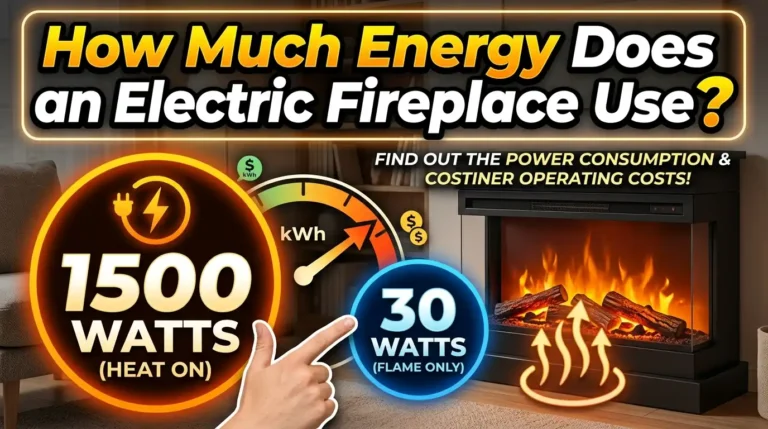
The running costs will be determined by your local electricity rate and the number of hours per day you are using the heater. In 2026, the average residential electricity rate in the U.S. is approximately 18.3 cents per kilowatt hour, but this ranges between 13 cents in the low-cost states to more than 40 cents in the high-cost states, such as Hawaii.
| Wattage | Cost per Hour (avg. 18.3¢/kWh) | Cost for 5 Hrs/Day | Cost for a 30-Day Month |
| 750W | ~$0.14 | ~$0.69 | ~$20.60 |
| 1,500W | ~$0.27 | ~$1.37 | ~$41.20 |
| 1,800W | ~$0.33 | ~$1.65 | ~$49.40 |
Flame-only mode (no heater on) consumes a small percentage of this – usually only a few cents an hour – so there is no additional cost to your bill to leave the visual effect on during evening ambiance.
Cold-climate cost note: The colder the room, the quicker it loses heat, so the heating element switches on more frequently to keep the temperature constant, potentially driving actual costs to the upper end of these ranges in northern climates relative to mild climates.
Tips to Maximize Performance in Any Winter Climate
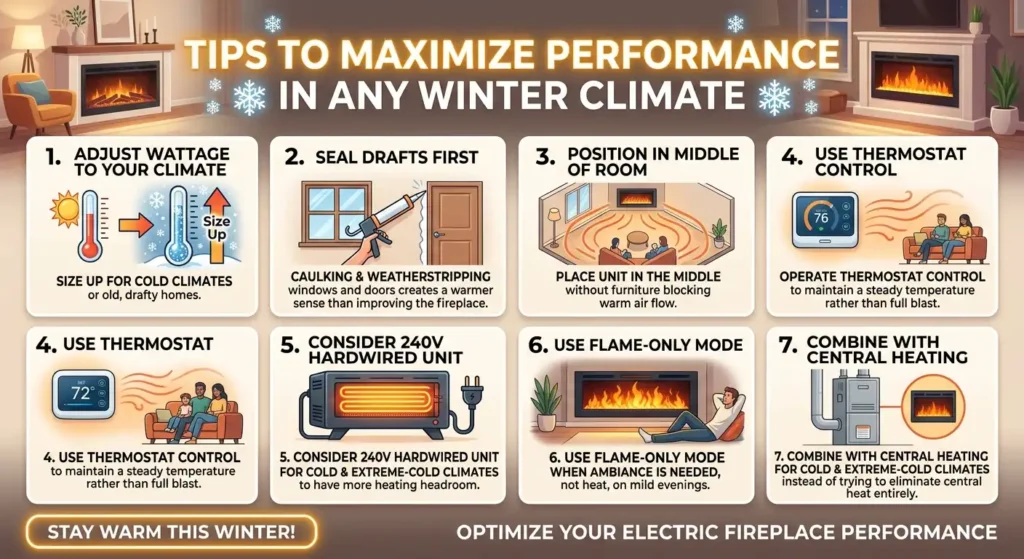
- Adjust the wattage to your real climate, not just the square feet – size up in case you live somewhere cold or your house is old/drafty.
- Seal drafts first. Sealing windows and stripping doors with caulking and weathering is more likely to create a sense of warmth than improving the actual fireplace.
- Have the unit in the middle of the room without any furniture that prevents the movement of warm air, as this will make warm air circulate.
- Operate the thermostat control rather than operating the unit at full blast all the time – most thermostats maintain a set temperature more effectively than when operated manually on/off.
- Think about a 240 V hardwired unit when you live in a cold or extreme-cold climate and you want to have more heating headroom.
- Use flame-only mode when you need ambiance but not heat added – can be helpful in the winter on mild evenings.
- Combine with central heating in cold and extreme-cold climates instead of attempting to eliminate it completely.
Common Mistakes to Avoid
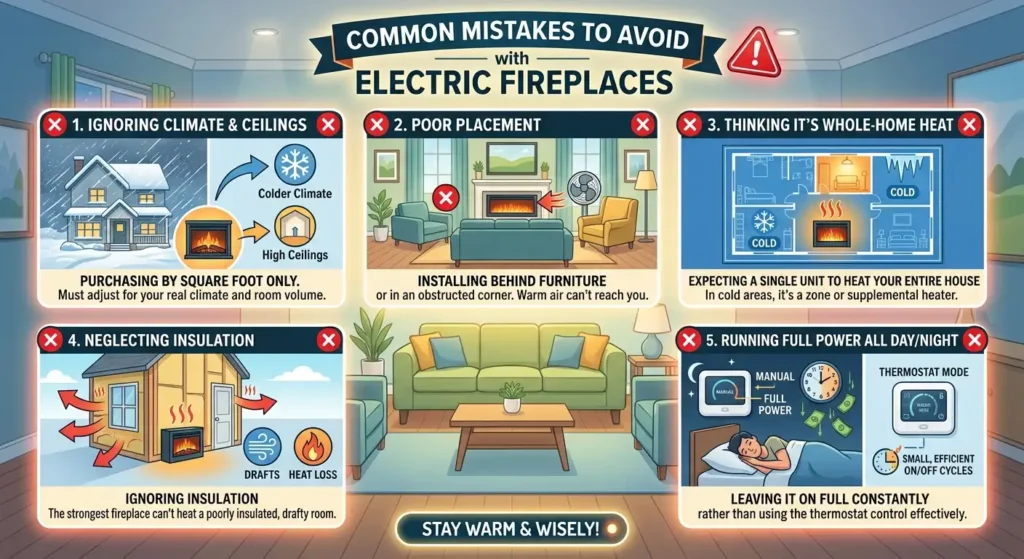
- Purchasing by square foot without modifying to your climate or ceiling height.
- Installing behind furniture or in a corner where warm air can’t reach the main seating area.
- Thinking that a single unit can provide whole-home heating in a cold or extreme-cold area.
- Ignoring insulation. The strongest electric fireplace will not be able to heat up a poorly insulated room with a draft.
- Leaving it on all day and all night at full power rather than using the thermostat to turn on and off effectively.
Humidity, Air Quality, and Comfort in Cold Winter Climates
The temperature is not the only thing that varies by climate, indoor humidity changes as well, and it determines the real experience of warmth. Cold-climate houses are more likely to operate drier air during winter since heating systems (such as electric fireplaces) heat existing air and do not add moisture to it. This is, in fact, a slight benefit of electric fireplaces over combustion-based ones: there is no flame burning oxygen and releasing exhaust gases, which means that they do not have the same impact on indoor air quality as wood or gas fireplaces do.
Nevertheless, even in extreme-cold climates, when both furnaces and electric heaters are on long durations, a room may become dry, even when the temperature gauge indicates a comfortable temperature. The easiest method of doing this is to place an electric fireplace in the same room as a small humidifier and have the same air temperature seem significantly warmer and cozier, a trick that is more important in Minnesota than in Houston.
Choosing the Right Electric Fireplace Type for Your Climate
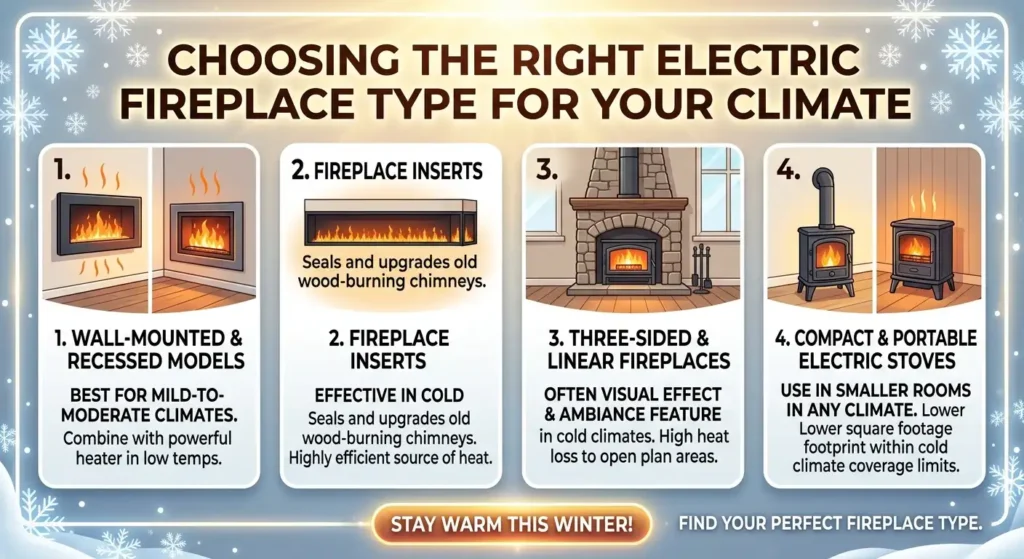
Not all types of electric fireplaces work equally well after taking climate into consideration:
- Wall-mounted and recessed models are useful in mild-to-moderate climates where the room already has a good amount of heat. In low temperature areas combine them with a more powerful heating element.
- Fireplace inserts are particularly effective in cold climates, as they substitute the heat-losing chimney of an old wood-burning fireplace with a sealed, efficient source of heat – the one upgrade most often made to an existing fireplace in cold climates.
Three-sided and linear fireplaces are more frequently visual effect and may lose more heat to open plan areas, so in cold climates they are often more of a feature of ambiance than of primary warmth in a room. - Smaller rooms in any climate can use compact and portable electric stoves, which have the benefit of having a lower square footage footprint than the coverage limits of cold climates.
Adapting the format to your climate area, not just your taste in decor, will make a greater difference in winter comfort than most of the purchasers anticipate.
You May Also Read:
- How to Decorate an Electric Fireplace: 7 Stylish Ideas
- Electric Fireplace Installation in Small Apartments
FAQs:
Will electric fireplaces heat or just give the illusion of a flame?
Yes. The flame effect and the heater are separate systems. A fan-forced, ceramic or infrared heating element is used in most units which generates real BTU, regardless of the visual flame.
What is the BTUs of an electric fireplace?
The typical output of standard 120 V units is 4,000-5,100 BTUs. Hardwired 240 V models have a capacity of up to 8,900 BTUs.
Is an electric fireplace the sole source of heat in the winter of a home?
No, not usually, particularly in cold or extreme-cold weather. It is best used as a zone heater in combination with a central heating system.
What is the size of the area that an electric fireplace can warm?
Up to 1,000 square feet in mild climates in larger units. In cold climates, realistic coverage can be as low as 200-300 square feet of the same unit.
Do electric fireplaces work well in very cold climates like Minnesota or North Dakota?
They continue to offer true, localized warmth, although must be used as a comfort enhancer in the area around the seat you are sitting in, rather than the central heat.
Why does a smaller space get heated by the same fireplace in winter than in the fall?
Lower outdoor temperatures expand the rate at which heat is lost out of a room, particularly via windows and lowly insulated walls, reducing the effective coverage area.
Do electric fireplaces cost a lot to run in winter?
No. A 1,500-watt device would cost approximately 27 cents per hour to operate on heat mode at the 2026 U.S. average rate of approximately 18.3 cents/kWh.
Should an electric fireplace be used instead of a space heater to heat the winter zone?
They operate in a similar manner in regards to the amount of heat produced, but electric fireplaces provide a decorative, ambiance-driven flame effect not available in standalone space heaters.
Are electric fireplaces operational in case of power outage?
No, unless they are related to a battery backup or generator, as they are fully electric.
Is ceiling height a factor of winter heating performance?
Yes. Regular 8-foot ceilings are efficient to heat; vaulted or high ceilings may decrease effective heating performance by half.
Do infrared electric fireplaces work better in cold climates?
People and objects are warmed directly by infrared models, allowing them to feel warmer sooner in the immediate vicinity, but leaving colder spots off the direct infrared path than fan-forced models that spread air more uniformly.
Would I oversize my electric fireplace in case I live in a cold climate?
Yes. The cold climate has more rapid heat loss thus higher wattage or 240 V hardwired model will provide more headroom to keep comfort.
Will my old wood-burning fireplace be replaced by an electric fireplace insert during the winter?
Yes, lots of homeowners replace old wood-burning fireplaces with electric inserts, which prevents the loss of heat up the chimney, and usually increases the overall warmth of the room.
Are electric fireplaces as drying as wood or gas fireplaces?
Electric fireplaces do not use oxygen, and they do not produce byproducts of combustion, so they are less likely to dry indoor air compared to wood or gas fireplaces.
My Final Thought:
An electric fireplace works differently, based on your location – and that is not a fault of the technology, it is simple physics. Even in mild and moderate winter climates a well-selected unit can realistically heat a whole room. In cold and extreme-cold climates, the most intelligent solution is to have it as a focused, efficient zone heater that complements your central heating system instead of substituting it.