Electric Fireplace in Small Apartments: A Step-by-step Guide to Fireplace Installation (as a Renter).
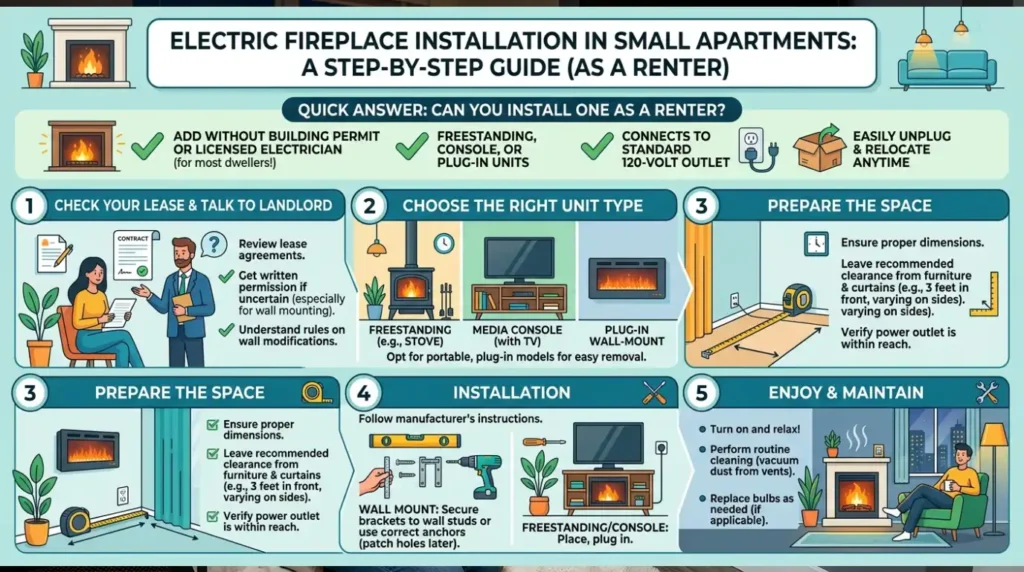
Electric Fireplace Installation in Small Apartments. Working fireplace is not commonly found in small apartments, but it does not mean you need to lose the glow. Plugging electric fireplaces in a typical wall socket, they do not need a chimney, line of gas, nor do most buildings need a permit at all. Construction is not the real work, the work is to pick the right type to your space, size it to fit, and to wire it safely.
This guide will take you through all components of that process: the types of fireplaces that can work in an apartment, how to fit one in a small room, the electrical considerations that ensure your safety, a step-by-step installation, and the questions that everyone should ask the lease or insurance companies.
Quick answer: Adding an electric fireplace does not require a building permit or a licensed electrician, most apartment dwellers. The unit is a freestanding, console, or plug-in wall-mounted unit that is connected to a standard 120-volt outlet and can be unplugged and relocated any time you wish. Professional installation and landlord sign-off is often required only with hardwired units, recessed units, or 240-volt units.
Key Takeaways
- Electric fireplaces do not emit smoke, soot or flame, therefore most do not require venting, chimney or permit.
- Standard units consume up to 1,500 watts on a 120-volt circuit – about 12.5 amps – and should preferably have their own circuit.
The most renter-friendly models include the freestanding, console/TV-stand and plug-in wall-mounted models since they have minimal or no damage to the wall. - Recessed or hardwired units typically require landlord approval and certified electrician.
- The majority of the models can be operated in a flame-only mode with the heater switch off to provide yourself with the appearance all year long with no heat added to a small room.
Why Electric Fireplaces Work So Well in Small Apartments
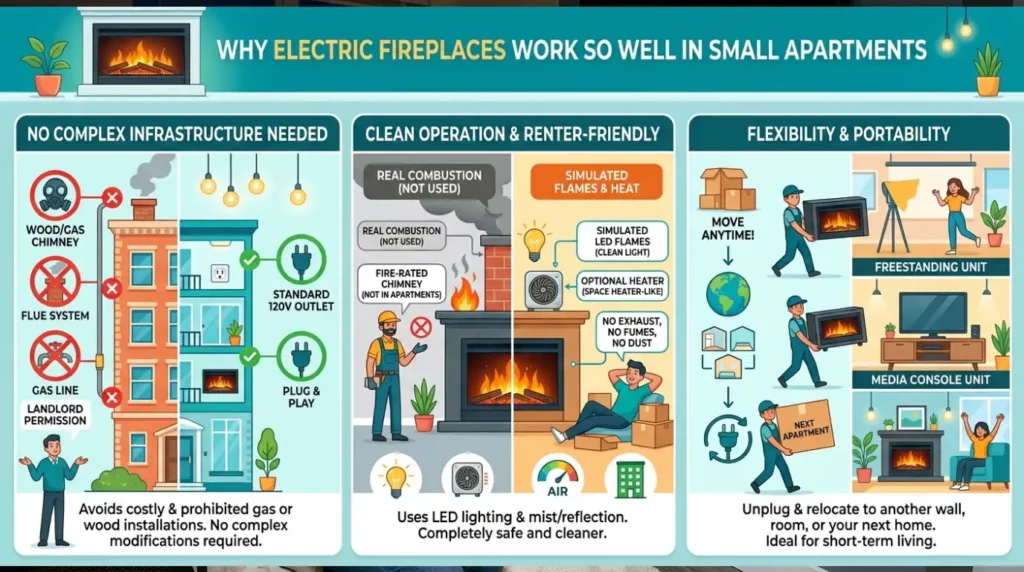
A gas fireplace or a wood fireplace requires a chimney, a flu or a gas line – none of which a normal apartment has, and none of which a landlord will permit you to install. All that is avoided with an electric fireplace. It simulates the appearance of flames with LED lighting and in most models, mist or reflection effects, and the optional heater is like a standard space heater.
Since no one is burning it, no exhaust to move out and no one burning that requires a fire-rated chimney. This is the primary reason why electric fireplaces can be installed in buildings with no wood and gas units, and why it is popular among renters, who cannot change the design of their unit.
They are also a solution to a small-space-specific issue: flexibility. You can have a freestanding or console unit that can be unplugged and relocated to another wall, another room, or even your next apartment altogether, which cannot be done with a built-in gas fireplace.
Check Your Lease Before You Buy Anything
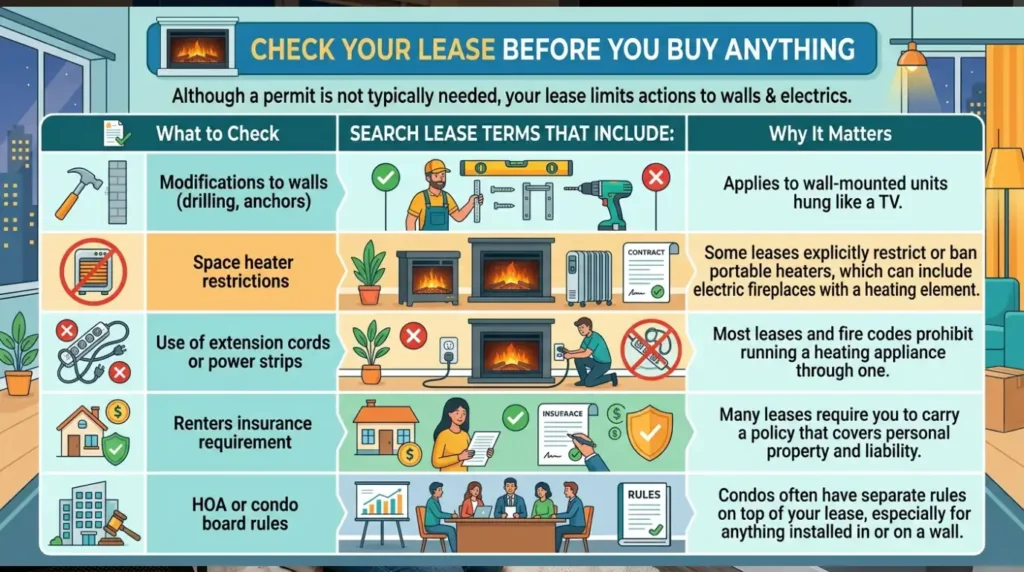
Although a permit is not typically needed when electric fireplace is used, your lease limits what you are allowed to do to the walls and the electrical system. Search Lease terms that include:
| What to Check | Why It Matters |
| Modifications to walls (drilling, anchors) | Applies to wall-mounted units hung like a TV. |
| Space heater restrictions | Some leases explicitly restrict or ban portable heaters, which can include electric fireplaces with a heating element. |
| Use of extension cords or power strips | Most leases and fire codes prohibit running a heating appliance through one. |
| Renters insurance requirement | Many leases require you to carry a policy that covers personal property and liability. |
| HOA or condo board rules | Condos often have separate rules on top of your lease, especially for anything installed in or on a wall. |
Even in a silent part of your lease, you might want to send a quick message to your property manager or landlord, particularly when you have plans of drilling anything into the wall. You can save your security deposit with a five minute email.
Types of Electric Fireplaces for Apartments
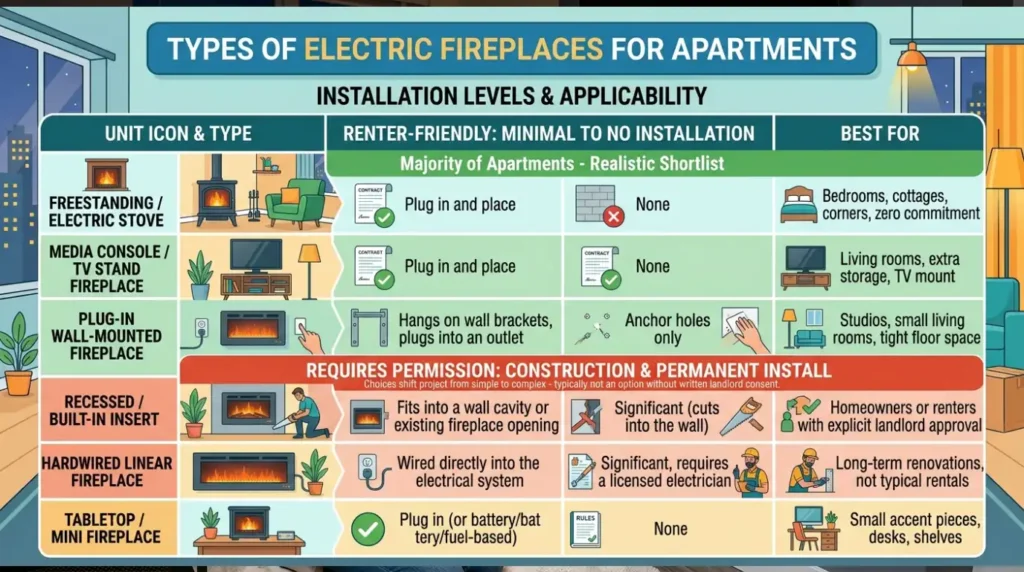
Not every electric fireplace is constructed identically and the type that you actually purchase will determine the amount (or none) of installation that is required.
Electric Fireplace Installation in Small Apartments
| Type | Installation | Wall Damage | Best For |
| Freestanding / electric stove | Plug in and place | None | Bedrooms, cottages, corners, renters who want zero commitment |
| Media console / TV stand fireplace | Plug in and place | None | Living rooms that need extra storage and a TV mount |
| Plug-in wall-mounted fireplace | Hangs on wall brackets, plugs into an outlet | Anchor holes only | Studios and small living rooms where floor space is tight |
| Recessed / built-in insert | Fits into a wall cavity or existing fireplace opening | Significant (cuts into the wall) | Homeowners or renters with explicit landlord approval |
| Hardwired linear fireplace | Wired directly into the electrical system | Significant, requires a licensed electrician | Long-term renovations, not typical apartment rentals |
| Tabletop / mini fireplace | Plug in (or battery/fuel-based) | None | Small accent pieces, desks, shelves |
In the majority of apartments, realistic shortlist is freestanding, media console or plug-in wall-mounted. The three remaining choices shift the project into this phase of renter-friendly weekend project, to construction project, which typically is not an option without written landlord consent.
How to Size an Electric Fireplace for a Small Room?
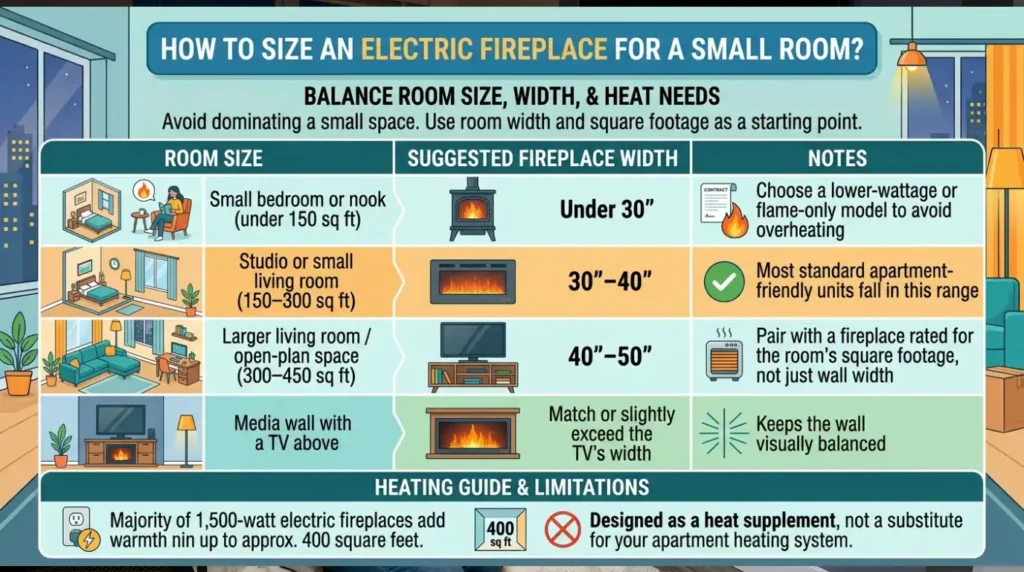
A large fireplace dominates a small room with eye appeal and may radiate more heat into the room than you may desire. Use room width and square footage as your starting point.
| Room Size | Suggested Fireplace Width | Notes |
| Small bedroom or nook (under 150 sq ft) | Under 30″ | Choose a lower-wattage or flame-only model to avoid overheating |
| Studio or small living room (150–300 sq ft) | 30″–40″ | Most standard apartment-friendly units fall in this range |
| Larger living room / open-plan space (300–450 sq ft) | 40″–50″ | Pair with a fireplace rated for the room’s square footage, not just wall width |
| Media wall with a TV above | Match or slightly exceed the TV’s width | Keeps the wall visually balanced |
As a heating guide, the majority of 1,500-watt electric fireplaces are designed to add warmth to rooms up to approximately 400 square feet – they are designed as a heat supplement, not a substitute of the heating system in your apartment.
Electrical Requirements: What You Actually Need to Know
This is the aspect of the project renters that most commonly go astray, and it is where they get it wrong that actually poses a fire hazard.
The core numbers:
- Traditional electric fireplaces operate on 120-volt current and consume up to 1,500 watts on the high power setting of the heater.
- Using Ohm’s Law (amps = watts ÷ volts), 1,500 watts on 120 volts works out to about 12.5 amps.
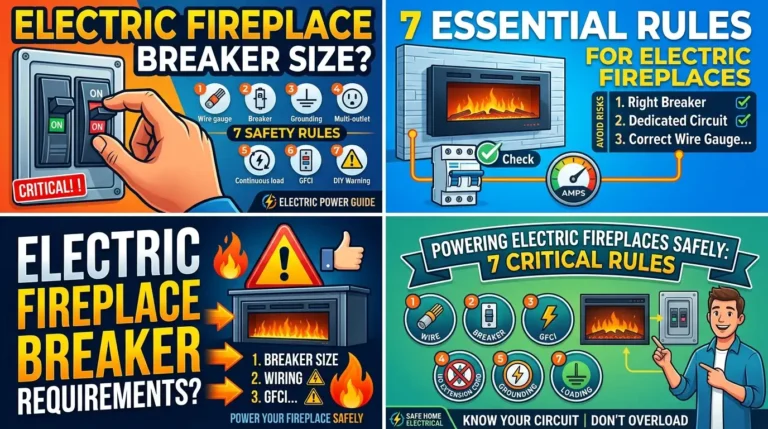
- The National Electric Code suggests a safety factor that ensures a continuous load such as a fireplace heater does not operate a circuit at its full capacity – that is why a special circuit is highly encouraged even though many fireplaces are marketed as being able to work on a standard circuit.
What “Dedicated Circuit” Actually Means
It is an outlet that has its own breaker and nothing else, no lamps, no TV, no other outlets, shares that circuit. This can be tested by turning off the breaker which powers the fireplace outlet: when something else in the room shuts off at the same time, it is not a dedicated circuit.
| Electrical Rule of Thumb | Detail |
| Standard wattage | Up to 1,500W on a 120V circuit (≈12.5 amps) |
| Recommended breaker | 15–20 amp, ideally dedicated |
| Extension cords | Never use one for an electric fireplace |
| Power strips | Avoid — plug directly into the wall outlet |
| GFCI outlets | Recommended in bathrooms, kitchens, or any area near moisture |
| 240V / hardwired units | Require a licensed electrician; not typical for rentals |
When you are not sure about your apartment breaker panel, it is good to give a quick phone call to the maintenance department of your building or a certified electrician before you use a large appliance, particularly in the old structures where the wires were not originally installed with consideration of the loads of modern appliances.
Step-by-Step: Installing a Plug-In Electric Fireplace
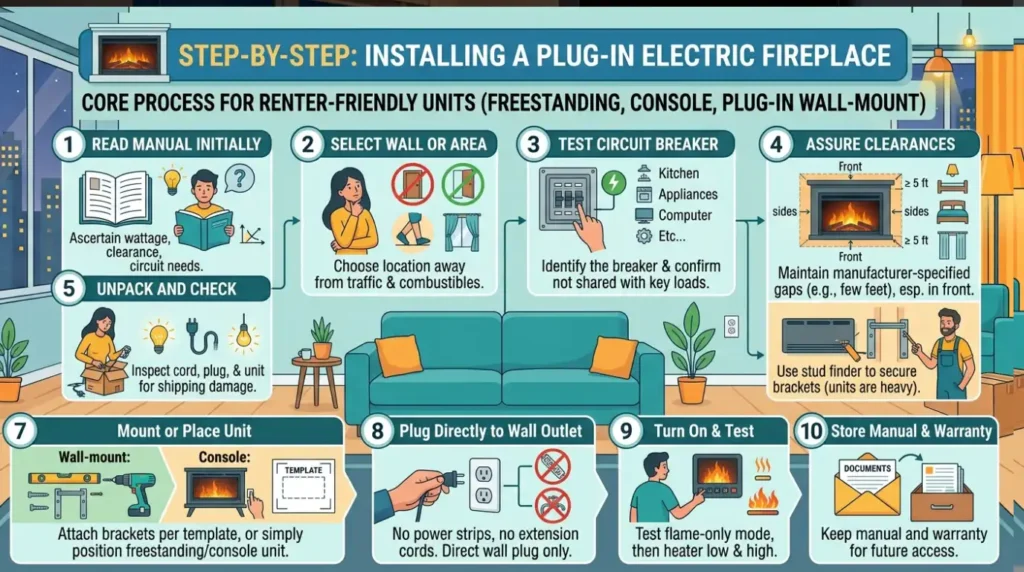
Most of the apartment installations are the same basic order, regardless of whether you have selected a freestanding stove, a media console, or a plug-in wall-mounted unit.
- Read the manual initially. Ascertain the actual wattage, clearance and whether the manufacturer needs a dedicated circuit or not.
- Select your wall or area. Select a space that is not in doorways, foot traffic, or anything that is combustible such as curtain or bedding.
- Test the circuit breaker. Determine who the breaker controls it and ensure that it is not shared with anything important.
- Assure clearances. Do not close the gap that the manufacturer specifies (usually a few feet) on all sides, particularly in front where the heat is being exhausted.
- Unpack and check. Inspect the cord, plug, and housing to confirm its shipping has no damage and then plug in.
- Find studs, on wall mounted units. Install anchor holes only after a stud finder has been used to ensure that the bracket is attached – most of the units are heavier than they appear when assembled.
- Mount or place the unit. attaching wall brackets according to the template provided by the manufacturer or just place a freestanding/console unit where you intended.
- Plug in directly to the wall outlet. No power strips, no extension cords.
- Turn on test flame-only mode and then test the heater in the lowest setting and then run at full power.
- Store the manual and warranty documentation in an accessible place in case you require it to troubleshoot or make a warranty claim.
Placement and Clearance Guidelines
The electric fireplaces produce actual heat through the in-built heater, even without the presence of an open flame, and the manufacturers do not put clearance minimums on paper without a reason.
| Clearance Zone | General Guideline |
| Front of unit | Several feet of open space, free of furniture and foot traffic |
| Sides and top | Follow the manufacturer’s spec sheet — varies by model |
| Curtains, bedding, paper | Keep well away from any heat vent |
| Rugs | Avoid placing directly in front of the heat outlet |
| Walls near the unit (wall-mounted) | Confirm the wall material can handle mounting hardware and heat exposure per the manual |
Always consult the numbers in your model manual that are referred to as clearance numbers, as they differ depending on the wattage, design and a few feet is just that, a guide, not a replacement of the instructions of the manufacturer.
Running Cost: Flame-Only vs. Heat Mode
The fact that the heater and the flame effect of electric fireplaces are distinct systems is one of the undervalued features. The visual flame might be operated with the heater off (consuming minimal electricity) or it can be turned on together to provide some additional warmth.
| Mode | Approximate Power Draw | Typical Use Case |
| Flame-only (LED lights) | A small fraction of a standard light bulb’s wattage | Year-round ambiance, summer evenings |
| Low heat | Roughly half of the max wattage | Taking the chill off a small room |
| High heat | Up to 1,500 watts | Supplemental heat on cold days |
Real price per hour will vary depending on your local power rate but since flame-only mode consumes very little power, most renters leave it on during the evening and do not see the difference on their bill. Leaving the heater on high to run all day costs about the same per hour as having a regular space heater on high run all day – look up your utility rate per kilowatt-hour to see what your cost will be.
Common Mistakes to Avoid
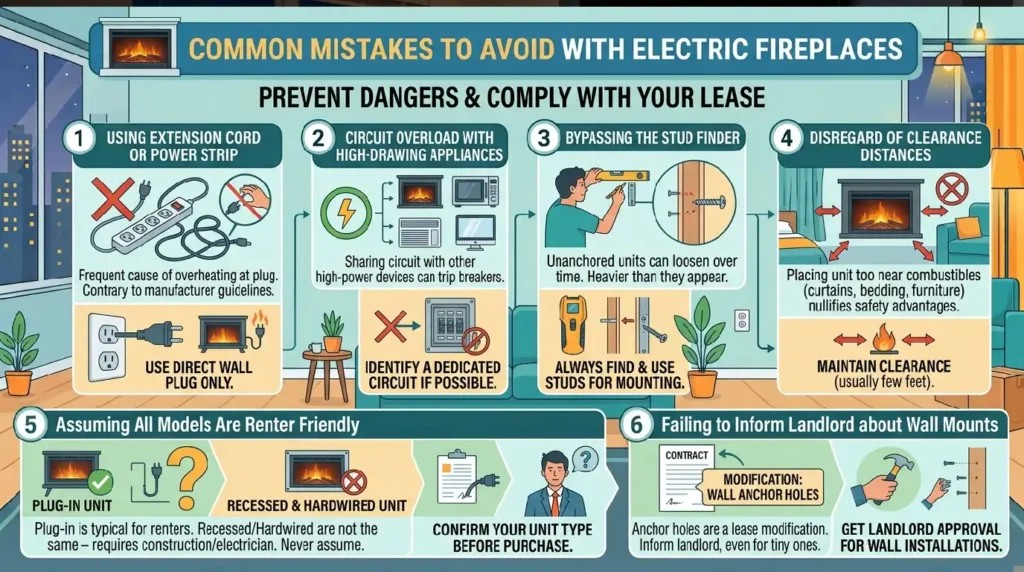
- Using an extension cord or power strip. This is among the most frequent causes of overheating at the plug, and it is also directly contrary to the majority of manufacturer guidelines.
- Use on a circuit with other high-drawing appliances. A personal computer can be a common cause of tripping breakers (or worse) with a fireplace, a window air conditioner, and a microwave on the same circuit.
- Bypassing the stud finder. An unanchored wall-mounted unit may loosen over the years.
- Disregard of clearance distances. Locating a unit excessively near curtains, bedding, or furniture nullifies the safety advantage of no open flame.
- All models are renter friendly; recessed and hardwired units are not the same as plug-in units – never assume your purchase.
- Failing to inform the landlord about installations that are mounted on the wall. This is a modification in the majority of leases, even the tiniest holes that are anchors.
Renters Insurance and Liability
Most leases put the damage of their own appliances on the tenants, and have renters insurance as a condition of the lease. A typical renters insurance policy will cover your personal property and liability in case one of your own items (such as an electric fireplace) damages the property, but the building is covered by the policy of your landlord. In the case that your lease mandates that you show you have renters insurance, it is best to verify that your policy does not exclude the use of space heater-type appliances before you go up to plug one in.
Since a space heater is functionally comparable to a fireplace with a heating element, it is also good to make sure that your lease contains a particular space heater provision – they do exist and it might affect the appliance even though the device was sold as a fireplace.
Maintenance Tips for Small-Space Units
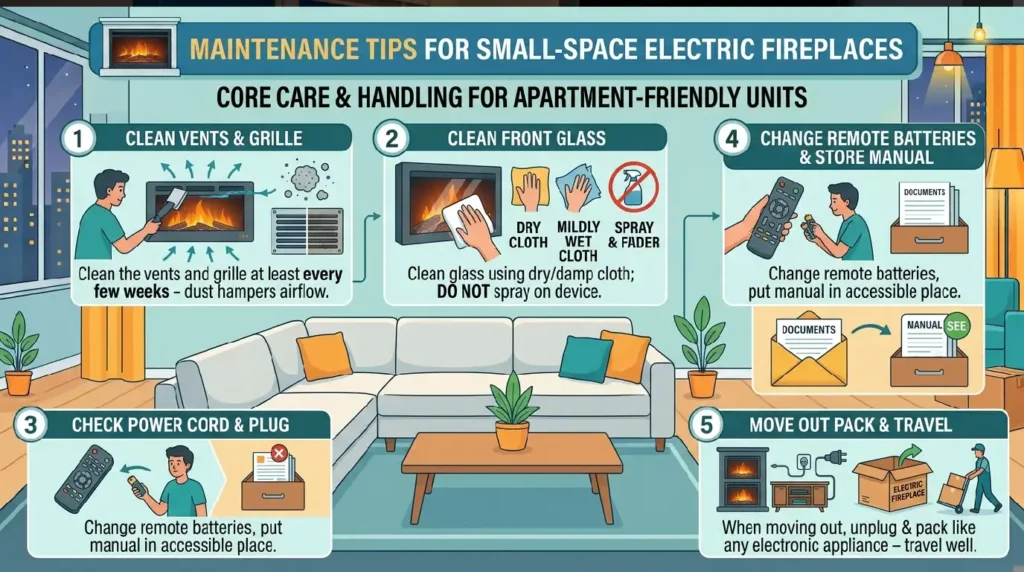
- Clean the vents and grille at least every few weeks – dust in the vents and grille hamperes airflow and may influence the heating.
- Clean the front of the glass using a dry cloth or a slightly wet cloth; do not spray anything on the device.
- Periodically check the cord to ensure that it is not frayed, particularly when it is frequently moved around.
- Change the batteries of the remote, and put the manual somewhere you are going to see it.
- When you are moving out, unplug and pack the unit like any other electronic appliance – most freestanding and console units will travel well.
You May Also Read:
- Is it Safe to Put an Electric Fireplace in the Bathroom?
- Where to Place an Electric Fireplace in Your Home?
FAQs:
Can I install an electric fireplace in my apartment without permission?
For freestanding, console, or plug-in wall-mounted units, most apartments don’t require special permission since there’s no permanent modification beyond small anchor holes. Recessed or hardwired units are a different story and typically need landlord sign-off.
Do electric fireplaces need a permit?
Plug-in models generally don’t. Hardwired or built-in installations sometimes require an electrical permit depending on your local code — check with your city’s building department if you’re going that route.
How many amps does an electric fireplace draw?
A standard 1,500-watt, 120-volt electric fireplace draws about 12.5 amps on its highest heat setting.
Does an electric fireplace need its own outlet?
It doesn’t strictly need a dedicated outlet to operate, but manufacturers and electricians commonly recommend a dedicated circuit, so the fireplace isn’t sharing power with other high-draw devices.
Can I plug an electric fireplace into an extension cord?
No. Manufacturers advise against this because it increases the risk of overheating at the connection point.
Will an electric fireplace heat my whole apartment?
No. Most units are designed as supplemental heat for a single room, typically rated up to around 400 square feet, not as a replacement for central heating.
Can I run an electric fireplace without heat?
Yes. Most models have a flame-only setting that runs the LED light effect without engaging the heater.
Is it safe to leave an electric fireplace on overnight?
Always follow the specific manufacturer guidance for your model. Many units include an auto shut-off timer, but you should never leave any heating appliance running unattended for extended periods without checking the manual’s recommendations.
What size electric fireplace fits a studio apartment?
Units under 30–40 inches wide typically suit a studio or small living room without overwhelming the space.
Do wall-mounted electric fireplaces damage walls?
Only in the sense of the anchor or bracket holes needed to mount them securely there’s no cutting into the wall like a recessed unit requires.
Can renters get their security deposit back after installing one?
In most cases yes, since anchor holes from a wall-mounted unit are minor and commonly considered normal wear, though this varies by landlord and lease. Confirm your specific lease terms.
What’s the difference between a freestanding and a recessed electric fireplace?
A freestanding unit sits on the floor or a stand and plugs into a standard outlet with zero wall modification. A recessed unit is built into a wall cavity and usually requires professional installation.
Do electric fireplaces produce smoke or need a chimney?
No. They use LED lighting to simulate flames, so there’s no combustion, smoke, or need for venting.
Can I move my electric fireplace to a new apartment later?
Freestanding, console, and plug-in wall-mounted units can be unplugged, unmounted, and taken with you. Recessed and hardwired units are built into the space and generally can’t move with you.
Do I need a GFCI outlet for an electric fireplace?
It depends on the room. GFCI protection is commonly recommended in bathrooms, kitchens, or anywhere near moisture, following standard electrical safety practice.
My Final Thought:
To a large majority of apartment tenants, the process of adding an electric fireplace is a plug-in project, not a remodeling. Select a free-standing, console or plug-in wall-mounted one, make it fit your room, remember electrical load constraints and always make sure that anything concerning your walls is first confirmed with your landlord. Do so, and you get authentic atmosphere and authentic added warmth without going to a permit office or a contractor.