Is it Safe to Put an Electric Fireplace in the Bathroom?
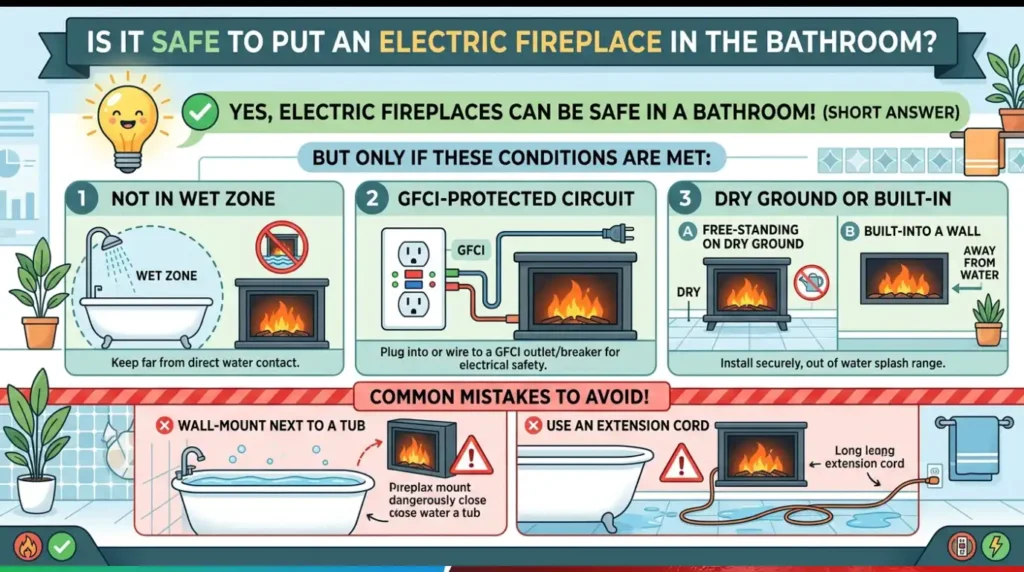
Is it Safe to Put an Electric Fireplace in the Bathroom? Short answer: Yes, electric fireplaces can be safe in a bathroom, but only when they are not located in the so-called wet zone around the tub or shower, are plugged into (or wired) a GFCI-protected circuit, and are either free-standing on dry ground or built into a wall far away and out of range of any water source. The tricky part is to wall-mount one next to a tub or to use an extension cord to supply power to one.
The remainder of this guide will discuss the actual figures, such as how far is far enough, what a GFCI is, what fireplace styles truly fit in a bathroom and what a safe installation will cost.
Key Takeaways
- Electric fireplaces are not necessarily waterproof – the vast majority of fireplaces are only certified to be used in dry or damp conditions, but not in direct water.
- U.S. electrical code maintains 3 ft. horizontal / 8 ft. vertical non-go area around any tub or shower rim associated with any such cord-connected tub or receptacle.
- All outlets in the bathroom including the one that supplies your fireplace should be GFCI-protected.
- Wall-inset units that are recessed are usually safer than the bathroom units that are directly over a tub and are suspended.
- A running exhaust fan is as important as the fireplace itself – humidity is the silent menace to electrical parts.
Why the Bathroom Is a Special Case
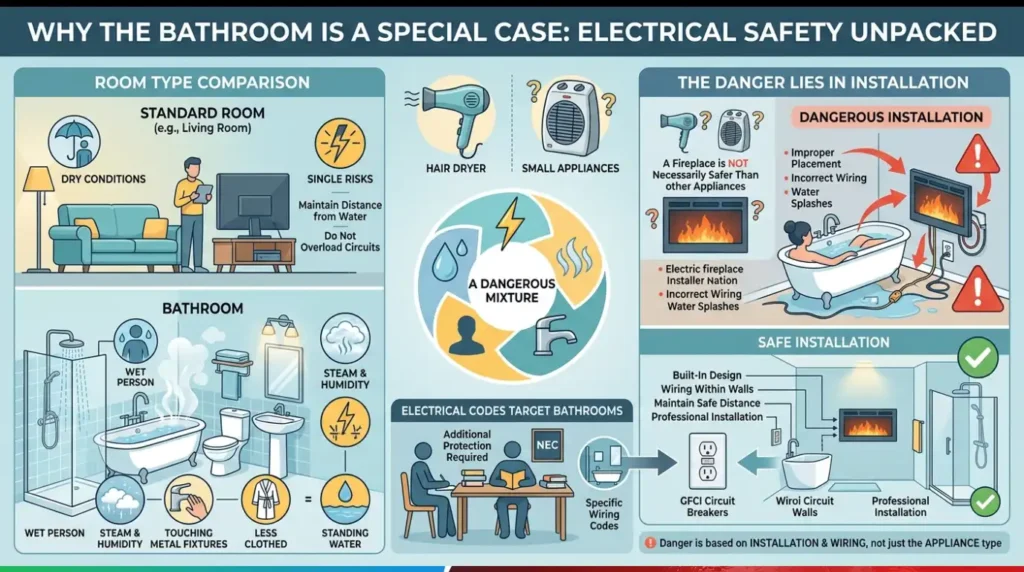
All of the other rooms in the housework with an electrical appliance in the same manner: maintain a distance between it and standing water, do not overload the circuit and you are generally safe. Bathrooms are unique since it is a three-way mixture of water, steam and a human being who is usually wet, less clothed and touching metal. It is precisely that mix that makes electrical code writers target the single bathrooms with additional protection not afforded to a living room or bedroom.
A fireplace is not necessarily safer than a hair dryer or a space heater, which is an electric fireplace. The danger lies in its installation and wiring, rather than its type of appliance.
What “Bathroom-Approved” Actually Means
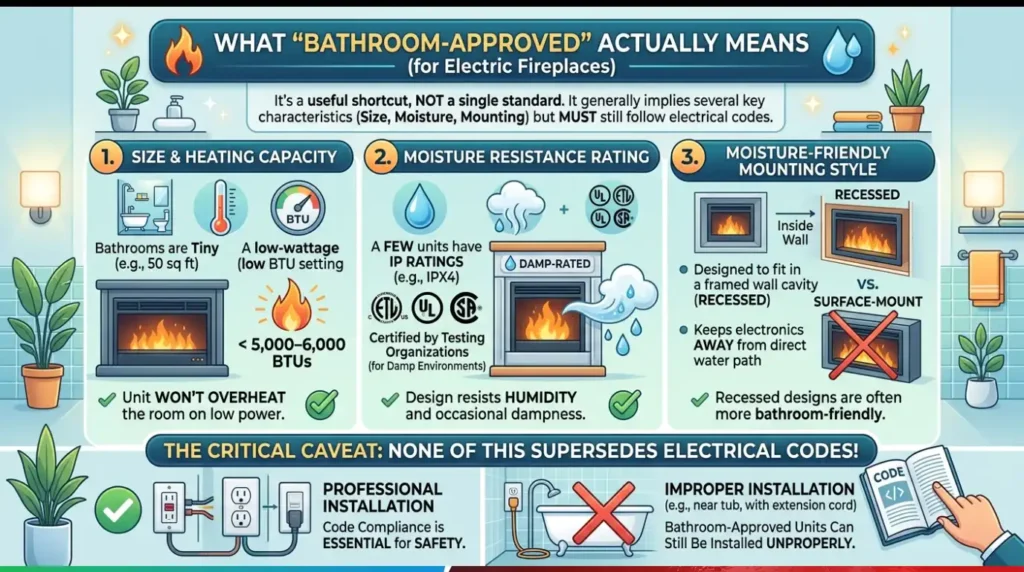
You will find fireplaces sold as being bathroom approved, and it is a handy shortcut, although it does not imply one standard. Practically it typically means one or a combination of the following:
- Size and heating capacity, Bathrooms are tiny, and a unit less than about 5,000-6,000 BTUs (or equivalent low power setting) will not overheat the room.
- Moisture resistance rating. A few of them have an IP rating (see below) or are certified by testing standards organizations, such as UL, ETL, or CSA, as suitable in damp environments.
- Mounting style. Numerous electric fireplaces that are made to fit into a hole in the wall are designed to be bathroom-friendly, such as electric fireplaces that are mounted inside a wall instead of being mounted on a surface.
None of that supersedes the electrical code provisions below a fireplace can be sold as bathroom-approved and can be installed improperly.
The Zone Rule: How Far from the Tub or Shower?
This is the section that most fireplace purchasing guides have omitted and it is the legal reality to the question of whether it is safe.
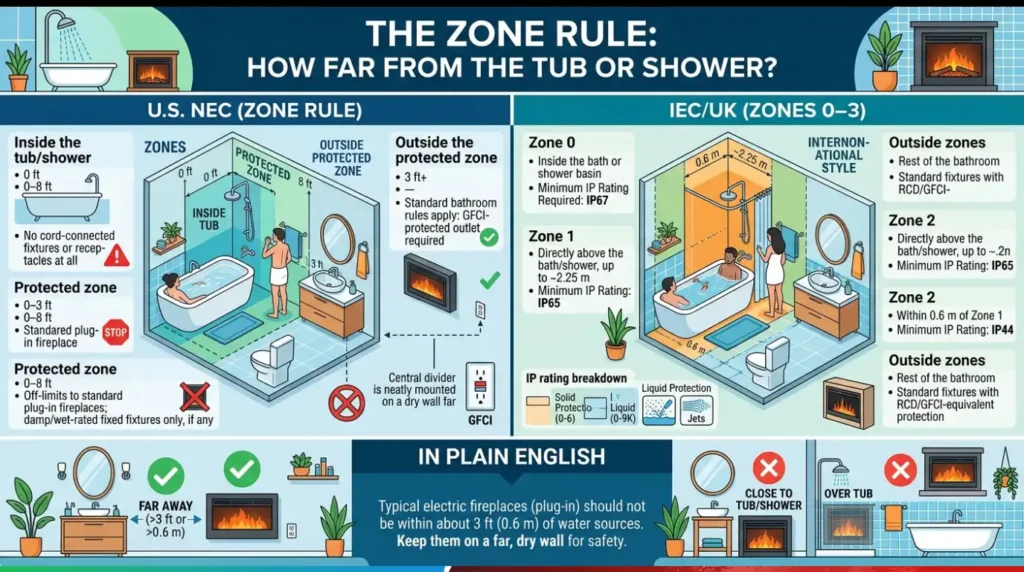
The National Electrical Code (NEC) in the U.S. outlines a type of protected area around all bathtubs and showers. According to NEC 410.10(D) and parallel receptacle rule in 406.9(C), no receptacle by cord connection, lighting track, pendant, or standard receptacle may be situated in a zone that is within 3 feet high and 8 feet in the vertical direction of the top of the rim of a tub or a shower threshold.
That area is inclusive of everything – it is the space that is directly above the tub and not only the walls on the sides.
| Zone (U.S. NEC) | Horizontal Distance from Tub/Shower | Vertical Height from Rim | What’s Required |
| Inside the tub/shower | 0 ft | 0–8 ft | No cord-connected fixtures or receptacles at all |
| Protected zone | 0–3 ft | 0–8 ft | Off-limits to standard plug-in fireplaces; damp/wet-rated fixed fixtures only, if any |
| Outside the protected zone | 3 ft+ | — | Standard bathroom rules apply: GFCI-protected outlet required |
In the UK and the EU (or any country that uses the IEC 60364-7-701 wiring standard, of which the UK uses BS 7671 Part 701) the idea is similar, but with different measurements, zones 0-3 are defined based on distance and height to the bath or shower, with minimum Ingress Protection (IP) level requirements.
| Zone (IEC/UK) | Location | Minimum IP Rating Required |
| Zone 0 | Inside the bath or shower basin | IP67 |
| Zone 1 | Directly above the bath/shower, up to ~2.25 m | IP65 |
| Zone 2 | Within 0.6 m of Zone 1 | IP44 |
| Outside zones | Rest of the bathroom | Standard fixtures with RCD/GFCI-equivalent protection |
Callout: What an IP rating is. The two figures following IP indicate solid and liquid protection. The initial figure (06) is the dust/particle resistance; the second (09K) is the water resistance. IP44 is resistant to splashing water in all directions – most bathroom locations fall within the immediate wet area. Protection of low-pressure water jets (IP65 and higher) is needed more in proximity to a shower.
In plain English: a typical electric fireplace, which is connected to a typical outlet, should not be anywhere in the range of about 3 feet of your tub or shower, nor should it be directly over it. Beyond that distance, on a dry wall, it’s a different and much safer situation.
GFCI Protection Isn’t Optional
Unrelated to the distance rule, the U.S. code (NEC 210.8) mandates all 125-volt, 15- and 20-amp receptacles in a bathroom to be GFCI-protected, full stop, whether or not something is plugged in it or how far it is located relative to the tub. A GFCI (Ground Fault Circuit Interrupter) is an electrical device that measures the flowing current and de-energizes in less than a second when the current flowing somewhere it shouldn’t be is detected, such as when a person touches an electric circuit.
This is of particular concern to fireplaces since: Is it Safe to Put an Electric Fireplace in the Bathroom?
- Electric fireplaces consume a lot of current (most of them use 1,2001500 watts on the heat setting), and a correctly rated circuit is important.
- A cord on top of a bathroom floor will be exposed to splashes, mopping and humidity in a manner that a cord in a living room will not be.
- When the internal wiring or heating element of a fireplace malfunctions in any way, GFCI protection is what helps to ensure that the malfunction does not turn into a shock hazard.
The condition of your bathroom outlet not being GFCI-protected (usually indicated by the presence of test and reset buttons on the outlet or a GFCI breaker on your panel) is a different, low-cost repair (usually $150300 of professional labor) that must occur before, not after installing a fireplace.
Recessed vs. Wall-Mounted vs. Freestanding: Which Is Actually Safer?
| Style | How It’s Installed | Bathroom Suitability | Typical Cost (Unit Only) |
| Recessed / built-in | Set into a framed wall cavity, flush or near-flush with the wall | Best option keeps the unit and cord out of splash paths, looks intentional | $400–$1,800 |
| Wall-mounted (surface) | Hangs on the wall surface, plugs into a nearby outlet | Workable only if placed well outside the 3-ft/8-ft zone; avoid mounting over or beside a tub | $200–$1,200 |
| Freestanding / tabletop | Sits on the floor or a stand, plugged into an outlet | Fine on dry floor space away from water, but easiest to accidentally place too close to a tub | $150–$800 |
Both the product advice of eFireplaceStore and the technical FAQ of We Love Fire point to the same practical solution: do not have an electric fireplace wall-mounted directly next or opposite a tub and put it into a wall wherever the room space will allow it.
That is not purely a design choice – physically recessing the heating element makes the gap between the heating element and any water vapor in the air larger, and it keeps the heating cord out of the splash area on the floor altogether.
How Big a Fireplace Does a Bathroom Need?
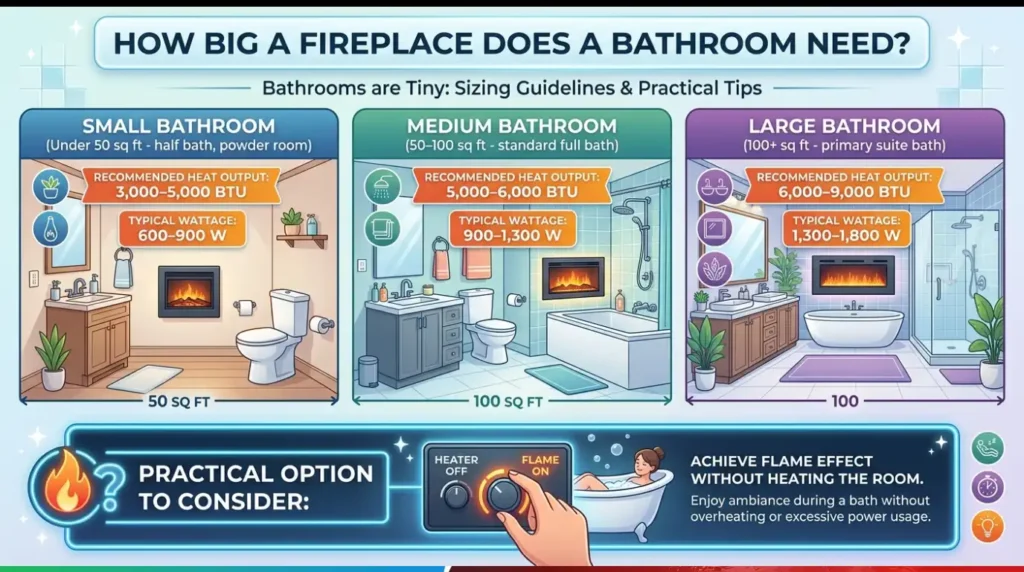
The bathrooms are tiny, and it alters the calculations when purchasing a fireplace in a living room.
| Bathroom Size | Recommended Heat Output | Typical Wattage on Heat Setting |
| Small (under 50 sq ft — half bath, powder room) | 3,000–5,000 BTU | 600–900 W |
| Medium (50–100 sq ft — standard full bath) | 5,000–6,000 BTU | 900–1,300 W |
| Large (100+ sq ft — primary suite bath) | 6,000–9,000 BTU | 1,300–1,800 W |
The majority of electric fireplaces allow you to enable the flame effect with the heater off, and this is an option to consider in a bathroom you can achieve the fireplace effect during a bath without heating the room beyond a comfortable level or powering an unnecessary amount of wattage on a shared circuit.
What It Costs to Do This Right
| Cost Item | Typical Range |
| Freestanding / tabletop electric fireplace | $150–$800 |
| Recessed / built-in electric fireplace unit | $400–$1,800 |
| Framing + drywall for a recessed install (materials) | $150–$400 |
| Electrician: adding/upgrading a GFCI-protected circuit | $150–$400 |
| Full professional recessed install (unit + framing + electrical) | $800–$2,500 |
That is against a vented gas fireplace, which the highest-ranking competitor models are priced at 3500-7500 to install professionally, including gas line and vent work – a significant consideration that makes electric the default option in bathrooms in particular.
Electric vs. Vent-Free Gas vs. Ethanol vs. Vented Gas: Bathroom Comparison
| Fuel / Type | Installation Difficulty | Moisture Impact | Ventilation Required | Realistic Bathroom Choice? |
| Electric | Low (plug-in or simple recess) | Low (when located in a dry area) | None | Yes, most practical choice |
| Vent-Free Gas | Medium (requires a gas line) | Adds humidity as a combustion byproduct | Room ventilation recommended | Workable, but adds moisture to an already humid room |
| Ethanol (Vent-Free) | Low (no gas line or venting needed) | Produces water vapor and $\text{CO}_2$ | Fresh air exchange recommended | Good alternative for those avoiding gas lines/byproducts |
| Vented Gas | High (gas line + exterior/roof venting) | Low (combustion gases are vented outside) | Required (built-in system) | Authentic, but most expensive and intrusive to install |
Step-by-Step: Installing an Electric Fireplace in a Bathroom Safely
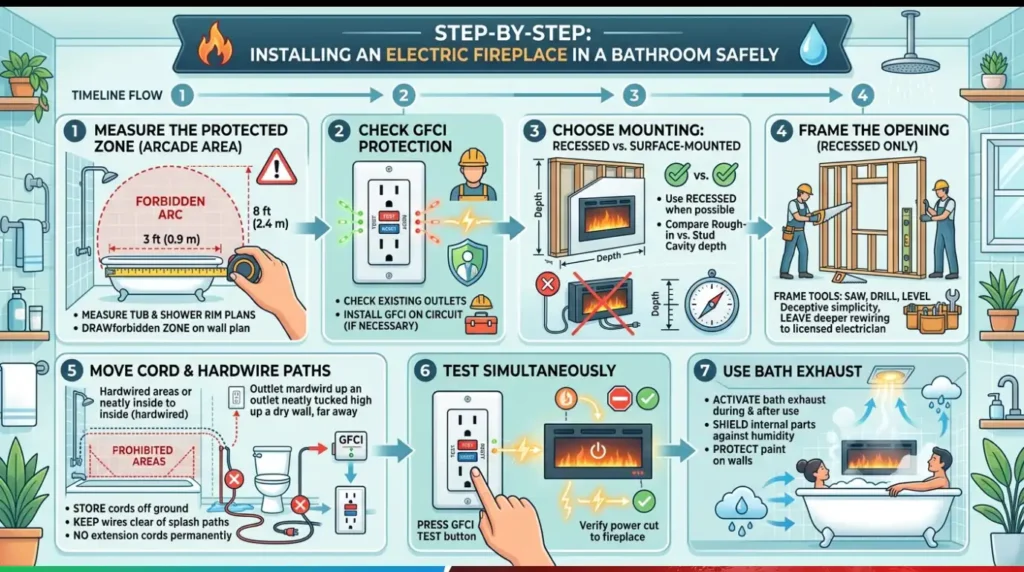
- Measure the arcaded area initially. Before you decide on a location, draw 3 feet out and 8 feet up on your wall plan on the rim of the tub or shower threshold.
- Check GFCI protection on the circuit. Check any existing outlet or, where none is available, install GFCI protection on the circuit, as an electrician would do.
- Use recessed where possible, instead of surface-mounted, when the wall depth permits it. Compare the required rough-in depth specified by the manufacturer with the depth available in the stud cavity of the wall.
- Frame the opening (when it is recessed). This is done with standard framing tools – saw, drill, level, deeper rewiring is left to a licensed electrician.
- Move the cord or hardwire out of the splash paths. Store the cords off the ground around the tub and should not use an extension cord as a permanent solution.
- Test the unit and the GFCI simultaneously. Use the GFCI test button and make sure that the fireplace is operating and that power is going through the GFCI as anticipated.
- Use the bath exhaust when bathing and after. This not only shields internal parts of the fireplace against years of humidity, but also the paint on your walls.
Ventilation and Humidity: The Overlooked Risk
The majority of safety discussions surround contact with water but this is where the discussion ends, yet the more hidden danger to any electrical device that may be residing in a bathroom over time is the chronic humidity.
The steam in a hot shower does not have to come into direct contact with a fireplace to create issues, condensation can accumulate in vents, connector, and circuit boards, with months of exposure.
A properly-sized exhaust fan (based on the square footage of your bathroom) that operates during the time you are taking a bath and 15-20 minutes after the bath meaningfully reduces that exposure. In the case of your current bathroom, which is solely dependent on an operating window, then it is worth upgrading before installing any other electrical device.
Common Mistakes That Actually Cause Problems
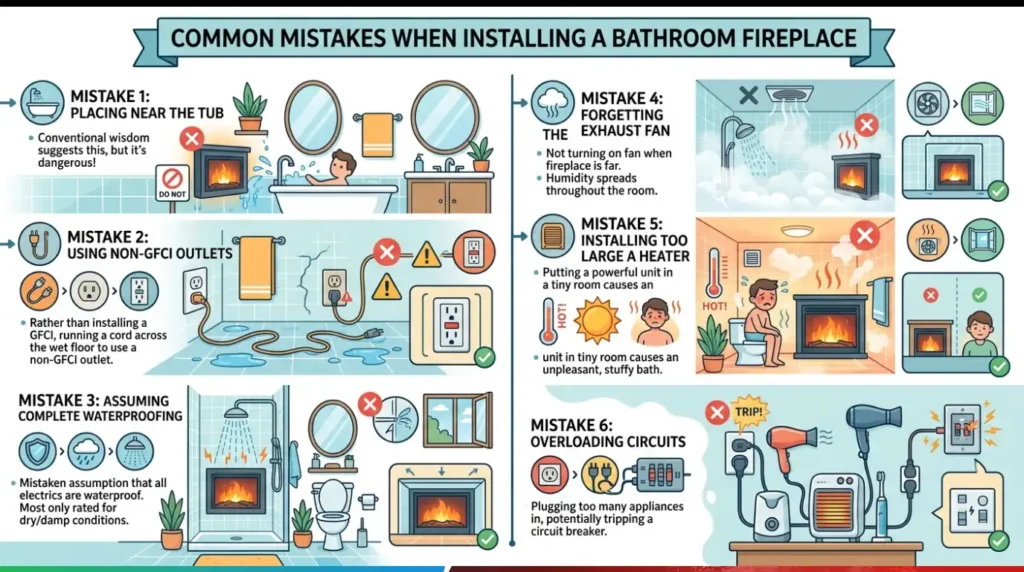
- Conventional wisdom: Put a fireplace in your face or next to the tub since that is what it looked like.
- Rather than installing a GFCI-protected outlet, running a cord across the floor to use an outlet which is not GFCI-protected.
- Electric is just an automatic assumption that is waterproof. Most will only be rated as use in dry or wet conditions, not sprayed directly.
- Not turning on the exhaust fan since the fireplace is not close to the shower- humidity is spread throughout the entire room.
- Installing too large a heater in a small bathroom causing an unpleasantly hot and stuffy room when taking a bath.
Maintenance Checklist
- Check the cord and plug after every few months to check whether it is cracked, discoloured or burnt.
- Clean the front of the glass using a soft, dry cloth; cleaners that are abrasive should not be used close to any printed or coated area.
- Check the GFCI outlet every month with its inbuilt test button.
- Do not have dust and lint accumulating around the air intake and outtake vents in the unit.
- Check the circuit with a licensed electrician when the circuit is flickering, you have tripped breakers or it smells of burning – do not use the unit until the electrician inspects it.
You May Also Read:
- Where to Place an Electric Fireplace in Your Home?
- Why Are There 2 Watts Settings on an Electric Fireplace?
FAQs:
Will an electric fireplace be safe in a bathroom?
Yes, provided it is not within the 3-foot/8-foot area of protection around the tub or shower and it is plugged into a GFCI-protected outlet. The actual risk depends on placement and wiring and not the type of appliance used.
What is the maximum distance between an electric fireplace and a bathtub?
The minimum distance of cord-connected fixtures and standard receptacles in the U.S. code is 3 feet in the horizontal direction and 8 feet in the vertical direction of the rim of the tub.
Are electric fireplaces required to have a GFCI outlet in the bathroom?
Yes, The U.S. electrical code makes every 125-volt bathroom receptacle be GFCI-protected, irrespective of the plug type and distance to the tub.
Will an electric fireplace become wet?
The vast majority of the models are rated as being used in dry or at best, damp, situations not in direct water contact or spray. Consider “electric” as not necessarily waterproof unless a wet-location rating is specifically stated by the manufacturer.
Would a recessed electric fireplace be safer than a wall-mounted in a bathroom?
Generally, yes. Recessing will keep the unit and the cord further away than a surface-mounted unit mounted close to a tub.
What will be the size of the electric fireplace required in a bathroom?
A 3,000-6,000 BTU (approximately 600-1,300 watts on the heat setting) is typically sufficient to serve most bathrooms; larger primary-suite bathrooms may have up to 9,000 BTU.
What is the cost of installing an electric fireplace in a bathroom?
A simple standalone unit costs between $150-800. An installation with any required electrical work that is professional recessed usually costs between 800 to 2,500.
Is it possible to use an extension cord in an electric fireplace in the bathroom?
No, Extension cords are not a long-term wiring solution and introduce an additional point of vulnerability in a room where exposure to moisture is already high. Locate an outlet in the proper place instead.
Better than electric in a bathroom is a vent-free gas fireplace?
It depends on your priorities. Vent-free gas eliminates the problem of electrical wiring but introduces humidity as a byproduct of combustion in a room that is already subject to moisture – electric does not make such a tradeoff.
Should I hire someone to install a bathroom electric fireplace?
A DIY project can be a freestanding unit that is plugged into an existing GFCI outlet. Recessed install, or any other new wiring/GFCI circuit, must be sent to a licensed electrician.
Would I be able to have an electric fireplace on during a bath?
Yes, when it is located outside of the guarded area and on a GFCI-protected circuit, most commonly purchased to do just that, to run the flame effect with or without heat.
Will an electric fireplace add humidity to the bathroom?
No – unlike other types of gas or ethanol units, electric fireplaces do not produce any byproducts of combustion, so they do not cause moisture to add to the room itself.
What should one do in case water enters an electric fireplace?
It can fault a correctly operating GFCI instantly which is just the kind of protection you desire. Switch off the unit and do not turn it back on until it has been tested and have an electrician evaluate the circuit in case the GFCI is not reset.
My Final Thought:
The use of an electric fireplace is certainly a safe, low-maintenance method of adding warmth and atmosphere to the bathroom eFireplaceStore and We Love Fire advice on this issue concurs that electric is the easiest of the bathroom-fireplace systems and the above code rules explain why place it outside the 3-foot/8-foot zone around your tub or shower, put it on a GFCI-protected circuit, and favor a recessed installation over a surface-mounted installation facing your tub.
Get all three of them correct and the question of whether they are safe or not is a definite yes. And miss any of them, and all the stylish flame effects in the world are no compensation. Having doubts about your particular bathroom installation, a quick phone call to a licensed electrician will be worth much more than another product review.