Where to Place an Electric Fireplace: Room by Room Electric Fireplace Placement Guide.
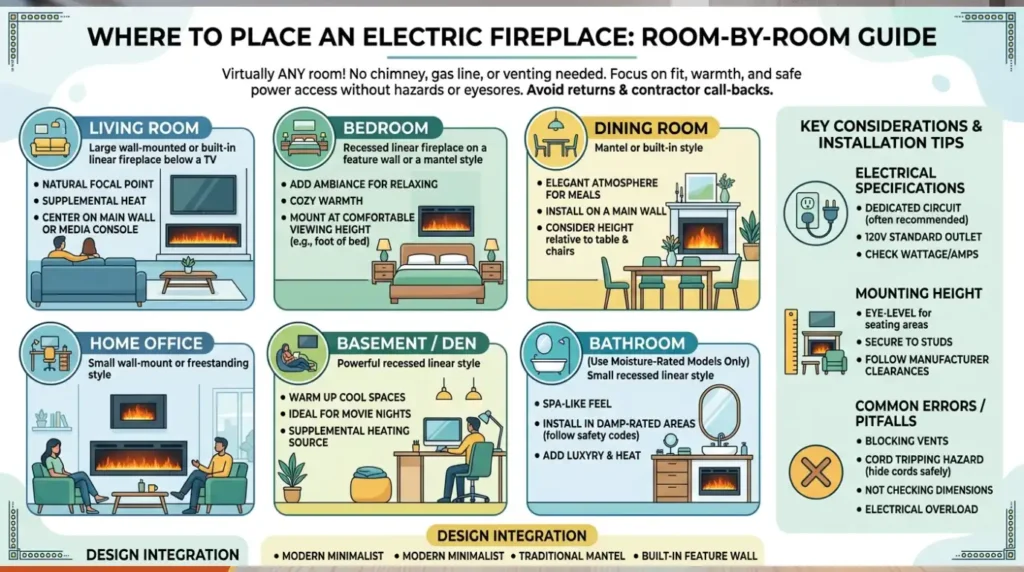
Where to Place an Electric Fireplace in Your Home? an electric fireplace can be installed in virtually any room, as it does not require a chimney, a gas line, or any type of venting. It is not whether you can put one somewhere, but where will it really fit, warm the room you use the most, and fit into an outlet without becoming a tripping hazard and an eyesore.
This manual takes one through each of the large rooms, the electrical specifications that no one tells well, the mounting heights, and the errors that continually occur in the requests of returns and in the call-backs of the contractor.
Key Takeaways
- Electric fireplaces do not require a chimney or exterior wall – they can be located anywhere.
Most popular are the living room and bedroom, though basements, home offices and even bathrooms (with the right rating) are also, of course, fine. - The majority of units require a regular 120-volt outlet; larger built-ins are fed on a separate circuit.
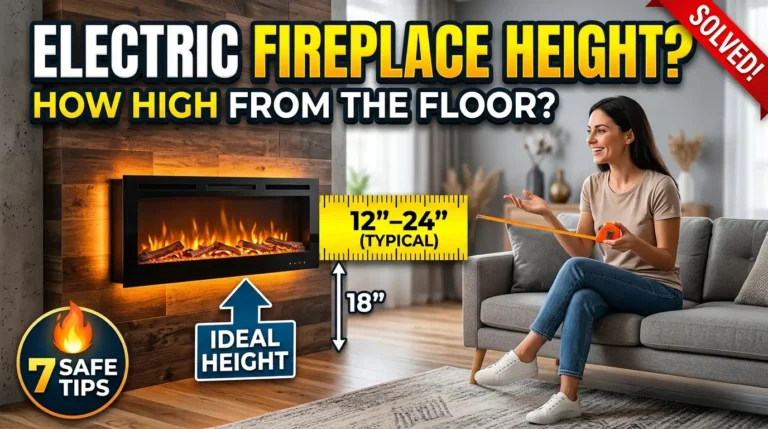
- Wall-mounted units generally will appear best 12-18 inches away the floor with no TV directly above them.
- It is not the room that is the greatest error, but when it is raised too high, or too near the furniture, or it is in the direct sunshine, and the flame effect is lost.
What to Think About Before You Pick a Spot
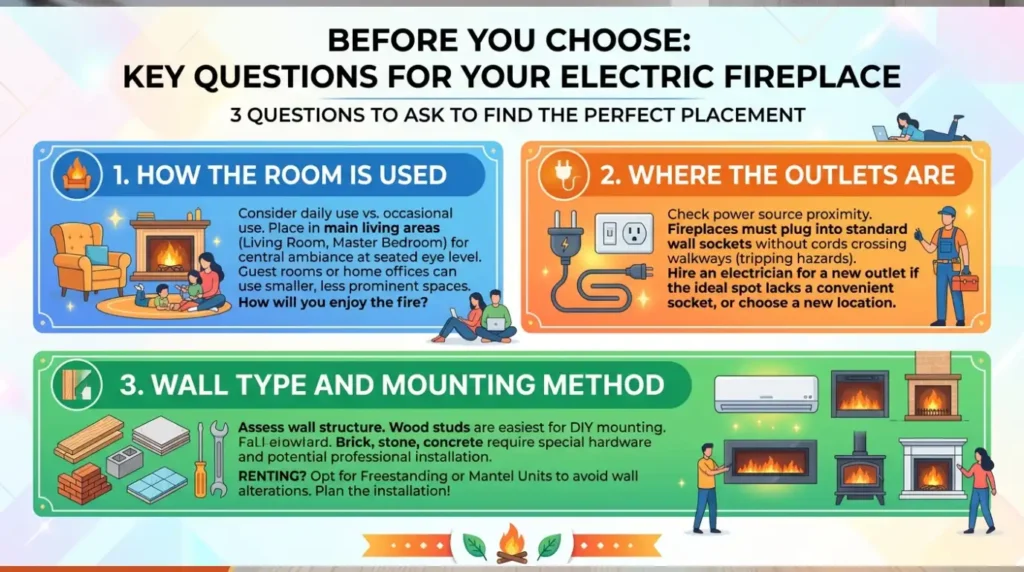
There are three questions that you should walk through before falling in love with a particular wall. They will reduce your choices quicker than scrolling through photos.
How the room is used
A fireplace that you will sit by every night (living room, primary bedroom) should have a large wall, where you would be sitting, at eye level. A guest room or home office fireplace can be moved somewhere smaller and not so central.
Where the outlets are
This is the thing that all purchasers remember until the day of installation. Electric fireplaces are powered by regular wall sockets, however the socket must be able to be placed close enough so that the wiring does not have to run over a walkway. When the closest outlet is on the wrong wall, you either have to hire an electrician to install one or you choose a new location.
Wall type and mounting method
Wood studs are the simplest to mount drywall on. Different hardware and in some instances a professional installer are required by brick, stone, concrete or tile. When you are renting, a freestanding or mantel-unit will not require any wall alterations.
The Best Rooms for an Electric Fireplace
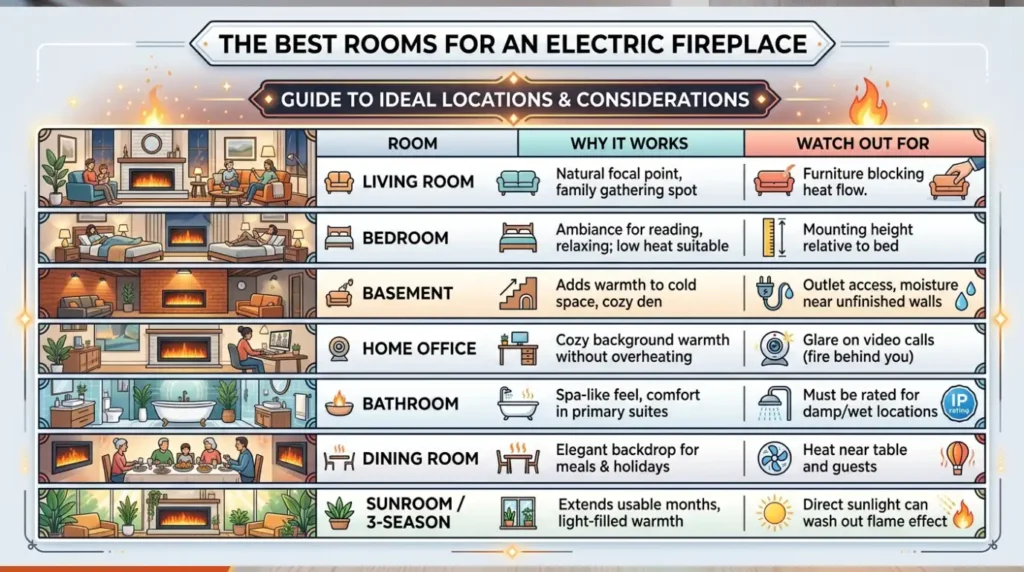
| Room | Why It Works | Watch Out For |
| Living room | Natural focal point; family gathers here most | Furniture blocking heat flow |
| Bedroom | Ambiance for reading/relaxing; low heat is often enough | Mounting height relative to the bed |
| Basement | Adds warmth to an often-cold space | Outlet access and moisture near unfinished walls |
| Home office | Cozy background warmth without overheating the room | Glare on video calls if flame is behind you |
| Bathroom | Spa-like feel in primary suites | Must be rated for damp/wet locations |
| Dining room | Elegant backdrop for meals and holidays | Heat near a table full of guests |
| Sunroom / three-season room | Extends usable months | Direct sunlight can wash out the flame effect |
Living Room Placement Ideas
Living room is still the most popular, and with a reason – this is where the families sit. The most typical methods:
- The focal point is the central wall, which frequently substitutes or surrounds a TV, and thus the seating arrangement revolves around the fireplace.
- Corner installation; This is applicable in open-concept areas where there is not a main wall.
- Mounted in a media console or entertainment center, which is a good idea when renting as nothing will be attached to the wall.
An efficient hint that competitors seldom discuss: determine your seating distance first. When your sofa is farther than 1012 feet away, a 40-inch or bigger model will be more readable than a mini model that seems to be lost in a wall of large size.
Bedroom Placement Ideas
Any bedroom fireplace is more a matter of atmosphere than anything to heat the room, most individuals will not desire a heater on all night. Popular placements:
- At the end of the bed, over the foot (positioned in a way that can be seen when lying down, say 2436 inches below the floor, lower than living room mounting).
- On a dresser or media console, a no-installation choice commonly used in primary suites.
- Inbuilt on a feature wall, occasionally with shiplap or stone veneer appearance.
At least keep it several feet away from bedding and curtains and never put it where there is direct air that blows on the pillows should you wish to have the heater on at night.
Basement Placement Ideas
The place that is underrated is the basement. Their temperature is normally the lowest in the house and an electric fireplace provides actual functional warmth and not just the appearance. Due to the concrete or framed-out stud walls of basement walls, a freestanding or insert-style unit can be simpler to install than a full wall-mount, and it also avoids any issues of moisture related to below-grade walls.
Bathroom Placement Ideas
This is among those hidden gem placements that competitors have neglected. A small electric fireplace close to a soaking tub or vanity will turn a primary bathroom into a spa. The trick: the unit should be made damp or wet (verify the IP rating of the manufacturer) and be kept far away of the tub or shower according to local electrical code. This is among placements where employing a licensed electrician is not an option.
Dining Room, Home Office, and Other Rooms
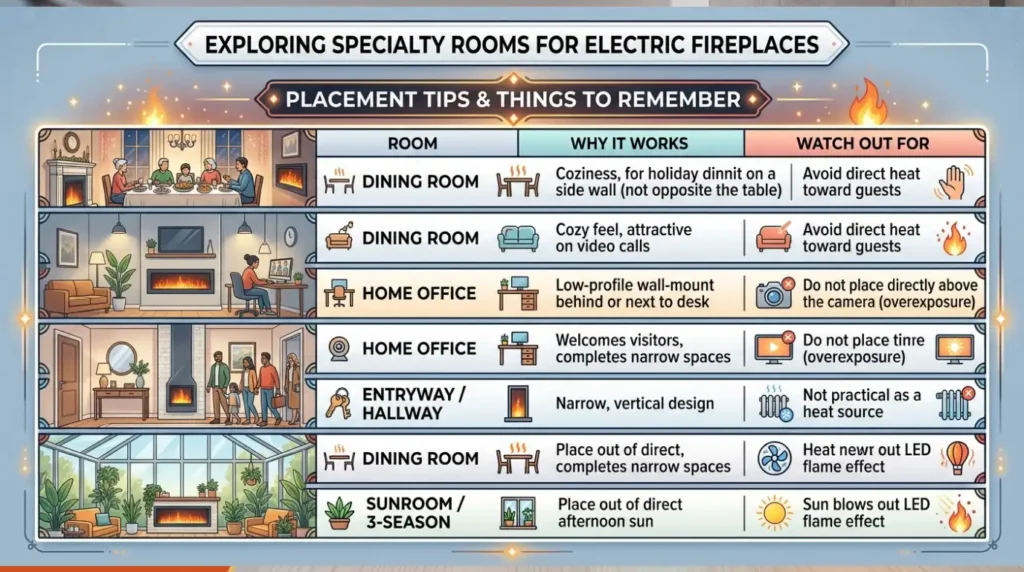
- Dining room: wall-mounted or mantel unit on a side wall (not directly opposite the dining table) provides coziness during holiday dinners, without direct heat being directed towards the guests.
- Home office: A low-profile wall-mount that is placed behind or next to your desk adds a cozy feel and is very attractive on video calls, but not directly above your camera, which can overexpose the shot.
- Entryway or hallway: A narrow, vertical element welcomes visitors and adds a narrow space to look complete, but it is not very practical as a heat source.
- Sunroom or three-season room: This works well to increase the number of months the room is used but be sure to place it out of the direct afternoon sun, which tends to blow out the LED flame effect.
Small Apartments and Rental-Friendly Placement
Where to Place an Electric Fireplace in Your Home?
Three options of the placement do not involve any changes that may be made to the walls: Renters and small space dwellers.
- Freestanding cabinet-like units – plug and place.
- Tabletop or mantel-top units – are placed on an existing dresser, console or shelf.
- TV stand with inbuilt firebox – doubles up as furniture, requires no mounting.
In the case of a studio apartment, it is best to locate the fireplace in a place that can be seen by both the sleeping and living areas (a partial room divider or open shelving unit) so that it can be used most effectively with only one unit.
Electrical and Outlet Requirements
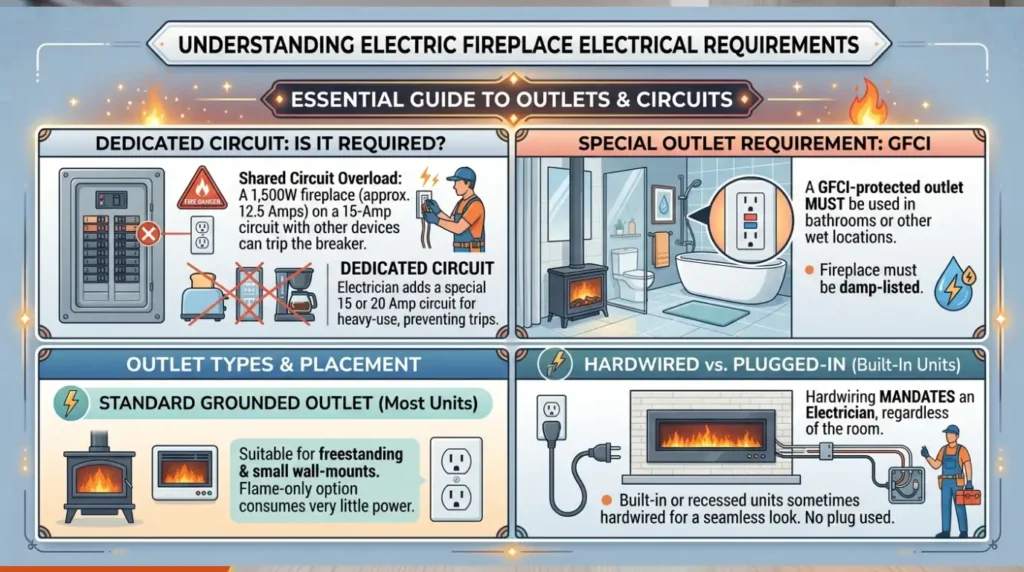
Does it need a dedicated circuit?
The typical electric fireplace pulls approximately 1,500 watts on the heater setting (approximately 12.5 amps on a standard 120-volt circuit) near the capacity of a typical household 15-amp circuit when shared with other devices. In case of larger built-in units or when the fireplace will be on the same circuit with other high-draw units, an electrician may add a special 15-, or 20-, amp circuit to prevent a circuit breaker from tripping.
Can you plug it into any outlet?
On most freestanding and smaller wall-mount units, yes, a standard grounded outlet will be fine, and the flame-only (no-heat) option will consume very little power. There are two cases which modify that:
- A GFCI-protected outlet must be used in bathrooms and other wet places, and the fireplace should be listed as damp.
- Hardwired instead of plugged-in Built-in or recessed units are sometimes hardwired, which mandates an electrician no matter the room.
Mounting Height and Clearance Guide
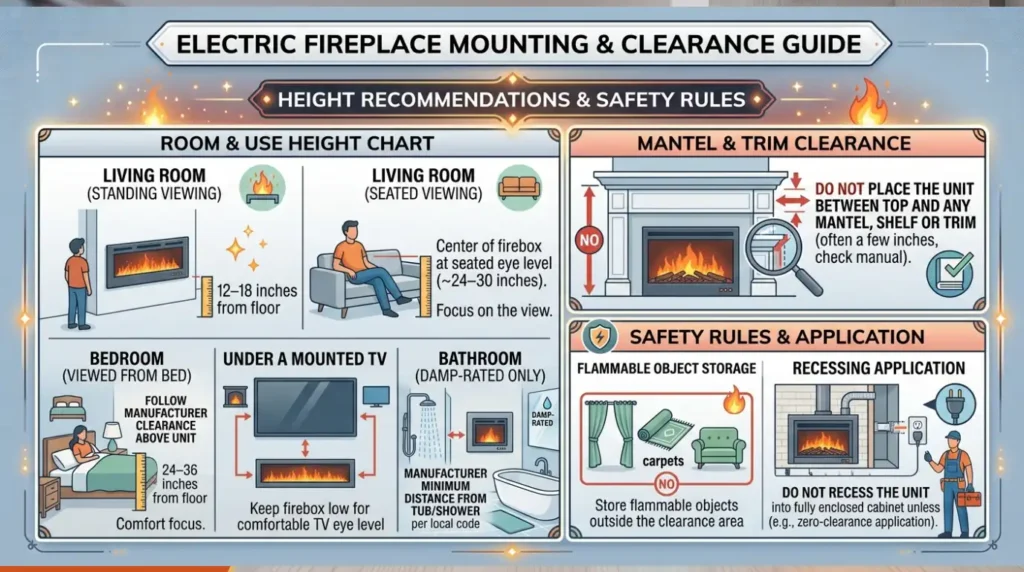
Wall-mount height chart
| Room / Use | Recommended Bottom-of-Unit Height |
| Living room, standing viewing | 12–18 inches from floor |
| Living room, seated viewing (sofa) | Center of firebox at seated eye level, ~24–30 inches |
| Bedroom, viewed from bed | 24–36 inches from floor |
| Under a mounted TV | Follow manufacturer clearance above the unit; keep the firebox low enough that the TV sits at comfortable eye level |
| Bathroom (damp-rated only) | Manufacturer minimum distance from tub/shower per local code |
Clearance rules
Do not place the unit between the top and any mantel, shelf or trim (often a few inches, depending on the model, always consult the manual). Store flammable objects such as curtains, carpets and upholstered furniture outside the clearance area, and do not recess the unit into a fully enclosed cabinet unless the manufacturer specifies its use in a zero-clearance built-in application.
Should You Put an Electric Fireplace Under a TV?
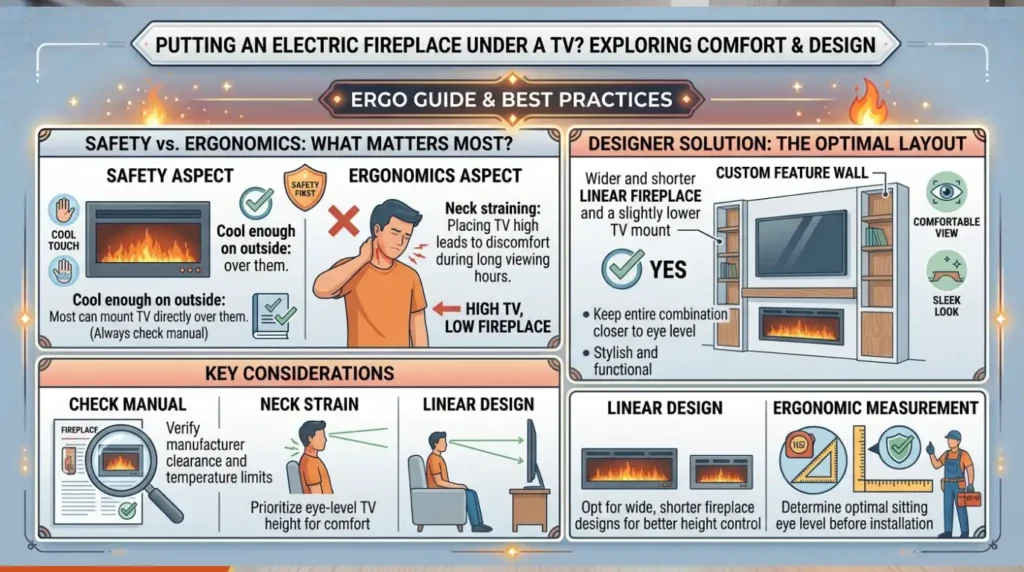
It is considered to be one of the most-searched placement questions, and the truth of the matter is: it depends on whether one looks at comfort and not safety. Electric fireplaces are cool enough on the outside that most can be mounted on a TV directly over them – be sure to check the manual. The fact is that it is ergonomics: when the fireplace is placed at the lower level and the TV is at the higher one, your neck will be straining upwards during the long-lasting watching hours. One of the solutions that most designers resort to is a wider and shorter linear fireplace and a slightly lower TV mount to keep the entire combination lower to eye level.
Where NOT to Place an Electric Fireplace (Common Mistakes)
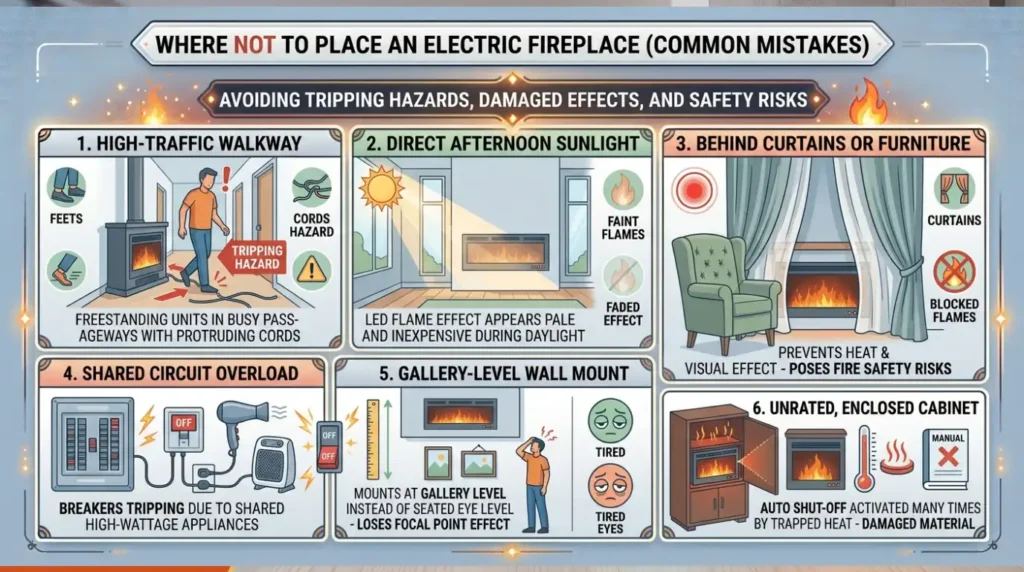
- Right in a busy passageway or aisle directly in front of a person in a high-traffic walkway- cords and stick-out freestanding units pose a tripping hazard.
- During daylight, in the direct and powerful sunlight, the LED flame effect appears pale and inexpensive.
- Behind heavy curtains or upholstered furniture – prevents the heat and the visual effect, and may be a safety issue with fire, unless clearances are observed.
- In a common circuit with other large appliances — space heaters and hair dryers on the same breaker as your fireplace is a prescription to breaker tripping.
- High on the wall too high a fireplace is attached to the wall at gallery level instead of eye level and loses its effect as a focal point.
- Unrated, enclosed cabinet – the auto shut-off of the unit may be activated many times by trapped heat or the nearby material may suffer damage.
Electric Fireplace Types and How They Affect Placement
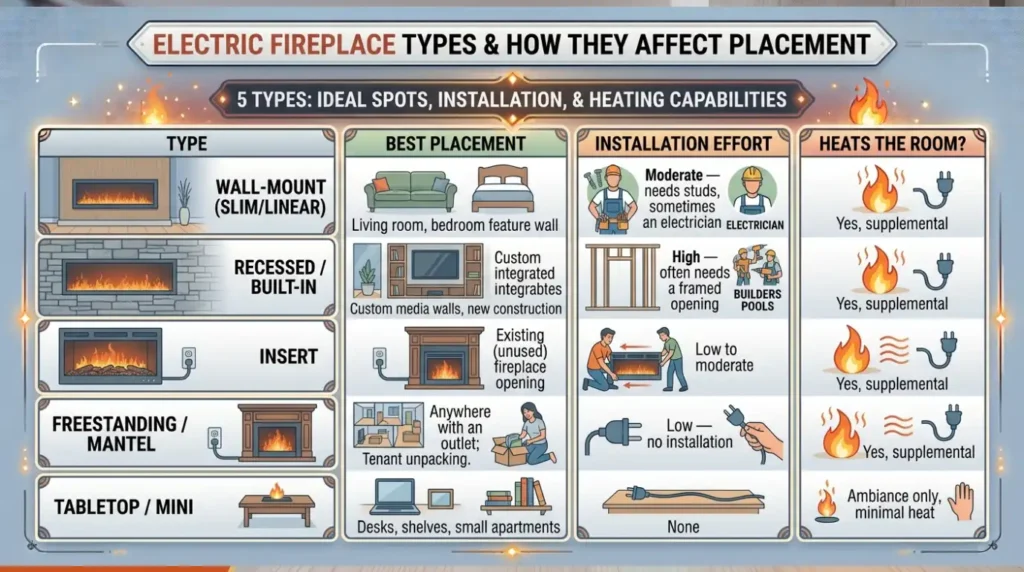
| Type | Best Placement | Installation Effort | Heats the Room? |
| Wall-mount (slim/linear) | Living room, bedroom feature wall | Moderate — needs studs, sometimes an electrician | Yes, supplemental |
| Recessed / built-in | Custom media walls, new construction | High — often needs a framed opening | Yes, supplemental |
| Insert | Existing (unused) fireplace opening | Low to moderate | Yes, supplemental |
| Freestanding / mantel | Anywhere with an outlet; rentals | Low — no installation | Yes, supplemental |
| Tabletop / mini | Desks, shelves, small apartments | None | Ambiance only, minimal heat |
Cost Snapshot by Placement Type
Precise pricing is broadly contingent on brand, size, and finish, and should be seen as a guide range, rather than a quote. Tabletop units and freestanding are most commonly the cheapest units as they do not demand any installation labor. Wall-mount units will be a moderate cost addition should you require the services of an electrician to install a new outlet or a dedicated circuit. Recessed, in-built units are usually the costliest type of placement since such units usually require framing and trim work and sometimes hardwiring – take a written quote with a licensed installer before going this way.
Step-by-Step: How to Choose Your Spot
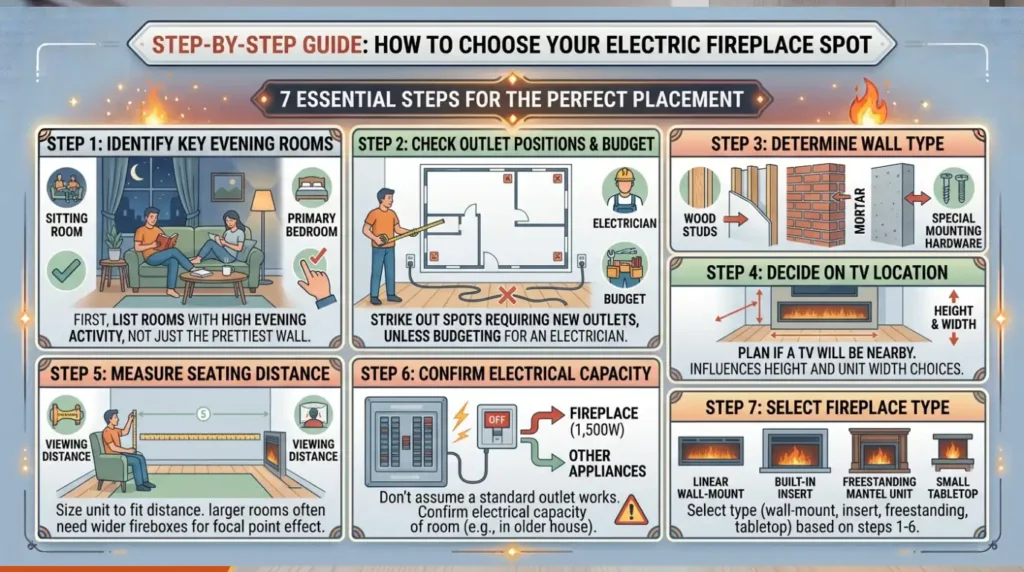
1.First, list the rooms in which you really spend evening time. not with the prettiest wall.
- Check outlet positions within each candidate room. Strikes out any position that requires a new outlet unless you are budgeting an electrician.
- Determine the type of wall (drywall, brick, stone) to determine whether you will require some special mounting hardware.
- Choose whether or not you should have a TV nearby. This has an influence on height and unit width.
- Measure seating distance in order to size unit to fit well in larger rooms tend to require wider fireboxes to be seen as a focal point.
- Don’t assume a normal outlet will work a 1,500-watt heater setting on a standard outlet unless you have confirmed the electrical capacity of the room, particularly in an older house.
- Select the type of fireplace (wall-mount, insert, freestanding, tabletop) according to steps 1-6, not vice versa.
You May Also Read:
- Why Are There 2 Watts Settings on an Electric Fireplace?
- Do water vapor electric fireplaces leave residue?
FAQs:
Will an electric fireplace fit any wall?
Yes, in most houses, because electric fireplaces do not require a chimney or exterior wall and can be placed anywhere on the interior wall where there is an outlet. The exceptions are wet areas such as bathrooms which require a damp rated unit and GFCI protection.
Should an electric fireplace be close to a window?
No. Since electric units do not require outside venting like wood or gas fireplaces, one does not need to be near an exterior wall or window.
So, what is the optimal height of an electric fireplace?
When sitting in the living room, the target of the firebox should be the center at an approximate of the seated eye level which is usually between 2430 inches of the floor. Bedroom units as seen in the bed will tend to be a bit lower.
Is it possible to install an electric fireplace below the TV?
It is rated on most models, though read your manual, but it is more important to have a comfortable neck angle than exactly matching heights.
Are electric fireplaces required to have a special outlet?
To use the standard units, a 120-volt grounded outlet is required. Bigger built-ins might require a special circuit, and a bathroom installation must have a GFCI-protected, damp-rated system.
Will an electric fireplace heat a room?
Most models are added onto the room heating, not replacing central heating, and heat a few hundred square feet, depending on the amount of watts in the unit and the insulation of the room.
Will I be able to install an electric fireplace myself?
Wall-mount units can be freestanding and plug-in, which are typically DIY-compatible. Hardwired or built-in installations should be recessed to be taken by a licensed electrician.
Can an electric fireplace be placed next to a couch?
Yes, provided that you are careful not to violate the clearance distance of the manufacturer, which is typically listed in the product manual.
Where can I place an electric fireplace in a small apartment?
Freestanding or TV-stand unit does not require alterations on the wall and can be moved in case of a change in location.
Is an electric fireplace allowed in a bathroom?
It must be explicitly specified to be used in a damp or wet environment, and put on a GFCI-protected circuit, preferably with a licensed electrician.
Are electric fireplaces required to be clearance by the ceiling?
The top clearance requirements are low in most wall-mount units, but we always recommend that you check the specific distance in the manual of your particular unit before attaching it to shelving or trim.
What is the difference between a fireplace insert and a wall-mount so that it can be mounted?
The placement of an insert is determined by the existing structure of your home since it is placed into an existing fireplace. A wall-mount may be located anywhere with a stud wall and outlet.
Will an electric fireplace be able to be mounted on plasterboard or drywall without striking a stud?
A majority of manufacturers need to be mounted in studs or in special wall anchors to support the weight of the unit – consult the installation manual before attaching to drywall only.
In front of the fireplace should there be a window?
It should not be turned to direct sunlight as it tends to be strong in the daytime, and the flame effect is difficult to notice.
Is a corner any good location with an electric fireplace?
Yes, particularly in open-concept rooms where there is no single focal wall (that is, corner-rated or angled units are designed to this end).
My Final Thought:
No one room is necessarily right to install an electric fireplace – the correct location is the one that fits with the way you actually use the area, easy access to outlets, and does not violate the manufacturers clearance and electrical standards. Begin with the room where you spend most evenings and make sure that you have all the outlets you need, and then go on that decision and what kind of unit will be most useful to you in a wall-mount, insert, freestanding or tabletop.