What are 2 Watt settings in an Electric Fireplace? A Clear Explanation
If you just pulled out the manual or the remote for your new electric fireplace and noticed it lists two different wattage numbers, you’re not imagining things, and nothing is wired wrong. It’s a normal design choice, and once you understand the reason behind it, choosing the right setting for your room takes about five seconds.
Quick Answer:
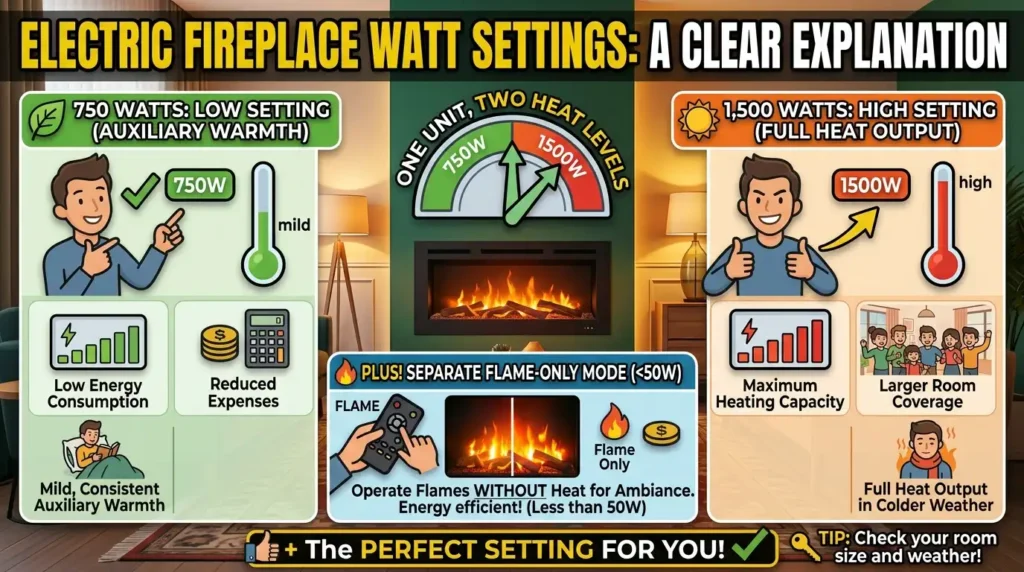
Why Are There 2 Watts Settings on an Electric Fireplace? Electric fireplaces have two-watt options so you can regulate the amount of heat generated they emit without purchasing two separate devices. The burner with a lower setting (usually 750 watts) provides you with more mild, auxiliary warmth and reduces the operating expenses. Higher setting (usually 1,500 watts) is used when giving full heat output during colder days or larger rooms. Other fireplaces also combine a heat mode with a separate flame-only mode consuming less than 50 watts, as the flame effect and the heater are two entirely different systems within the unit.
What the Two Watt Settings on Your Electric Fireplace Actually Mean
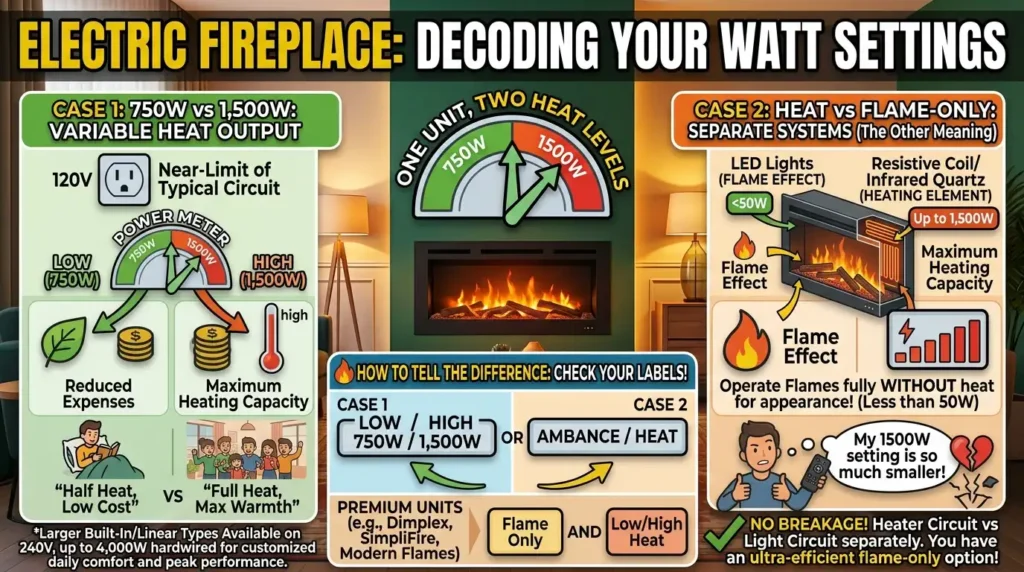
In fact, we have two distinct two-setting situations, which are confounded in searches, so it is good to distinguish between them.
The Most Common Pairing: 750 Watts and 1,500 Watts
The majority of plug-in electric fireplaces and space-heater-style inserts sold in North America are designed around a 1,500-watt heating element, since that is near the limit of a typical 120-volt, 15-amp household circuit. Instead of having it run off or full blast, manufacturers have the second lower power step (almost always 750 watts) wired in, thus providing you with a middle ground.
- 750 watts (low): Approximately half the amount of heat, applied on milder days or smaller rooms.
- 1,500 watts (high): 1,500 watts is full heat and is applied on cold days or when the room is larger.
There are larger built-in or linear types available on a 240-volt circuit and can provide a larger jump, e.g. 1,500 watts on a standard outlet and 2,500-4,000 watts hardwired to 240 V. The reasoning is the same, a single environment to customize to daily comfort and another to give peak performance.
The Other Kind of “Two Settings”: Heat Mode vs. Flame-Only Mode
When people talk of two watt settings, the second meaning of this is not actually the amount of heat, but two distinct systems within one unit:
- Flame effect: This is powered by LED lights that mimic flickering flames. This normally attracts less than 50 watts, regardless of the brightness and realism.
- Heating element: A resistive coil, or infrared quartz element, which upon activation can consume up to 1,500 watts.
The flame effect can be fully operated without heat, only appearance, which explains why you will find some owners with a flame effect that is set to 1,500W and a much smaller figure and think something has broken. There is no breakage; you are just viewing heater circuit and light circuit separately.
How to Tell Which Type of Dual Setting Your Fireplace Has
The labels are located on your control panel, remote or in your owners manual. When you find Low/High or two numbers that are next to each other such as 750W/1,500W, then you have variable heat output. When you find a flame setting and an ambiance mode adjacent to a heat setting, you have the flame-versus-heat pairing. Numerous of the higher end units, such as some Dimplex, Modern Flames, and SimpliFire, do provide both: a flame-only option, as well as low and high heat.
Why Manufacturers Build Fireplaces with Two Wattage Levels
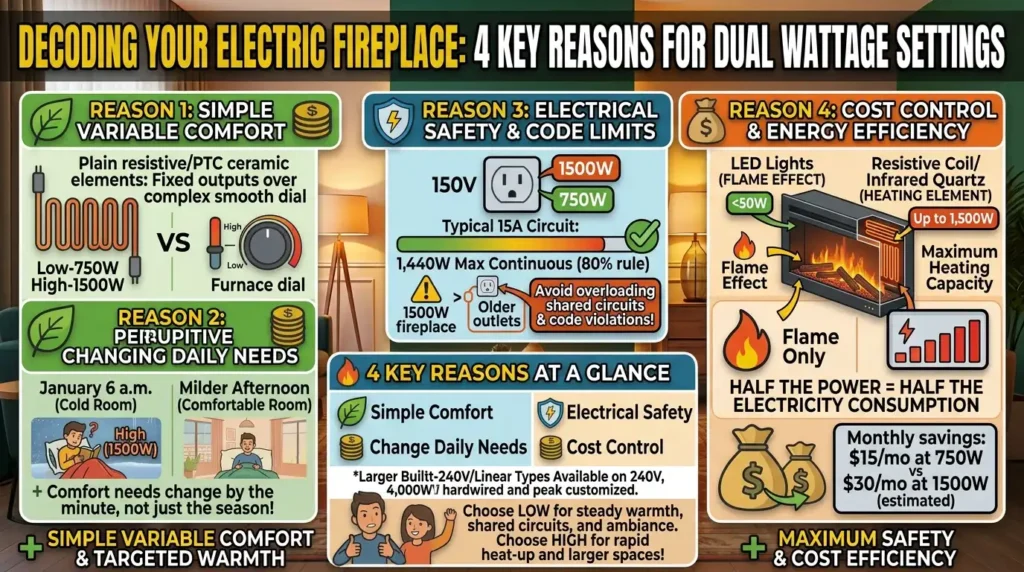
Reason 1: Resistive Heating Elements Only Have a Few Speeds
Compared to a furnace with a modulating gas valve, most electric fireplace heaters use a plain resistive component or a PTC (positive temperature coefficient) ceramic component. These are cheap and dependable but they are normally designed to operate at either one or two fixed output levels instead of a smooth dial. The easiest, least expensive method of providing variable comfort, without introducing complex electronics, is building in a second wattage step.
Reason 2: Comfort Needs Change by the Minute, Not Just the Season
An afternoon room that is 68F does not require as much heat as the same room in January at 6 a.m. The low mode will allow you to keep the room warm after it is already pleasant and the high mode is provided in case of the first warm-up or in case of truly cold weather. It is this reasoning that causes the low/medium/high on a portable space heater.
Reason 3: Electrical Safety and Circuit Limits
An average domestic U.S. circuit is 120 volts with a rating of 15/20 amps. Electrical codes advise against operating at over 80 percent of the continuous rated capacity of a circuit and this limits a 15 amp circuit to approximately 1,440 continuous watts and a 20 amp circuit to approximately 1,920 watts. A 1500-watt fireplace is already in close proximity to that ceiling on a 15-amp circuit, particularly when other devices are sharing the outlet. The bottom position provides you with a much more secure choice in case you are sharing a circuit with other appliances, on an extension cord or an older-style outlet.
Reason 4: Cost Control
Use 750 watts rather than 1,500 watts reduces electricity consumption of that appliance by half. To any person who may use the fireplace many hours a day, as atmosphere in the evening, say, then that difference will be accumulated in a heating season.
Watts vs. BTU: Why Your Fireplace Doesn’t Just List One Number
The two terms Watts and British Thermal Units (BTUs) quantify are dissimilar, and the explanation of this distinction would resolve much confusion:
| Metric | What it Tells You | Typical Electric Fireplace Value |
| Watts | How much electricity the unit draws | 750W (low) / 1,500W (high) |
| BTU/hr | How much heat the unit outputs | Roughly 2,560 BTU/hr (low) / 5,120 BTU/hr (high) |
The rough conversion is 1 watt ≈ 3.412 BTU/hr. A 1,500-watt heating element generates approximately 5,120 BTU/hr of heat – can be used to compare the heat output of an electric fireplace to a gas fireplace or space heater in BTUs. Almost all of the power used by an electric fireplace is immediately transduced into heat at the point of consumption, as it does not have a chimney or a flue to dissipate the heat to the exterior.
How Much Does Each Setting Actually Cost to Run?
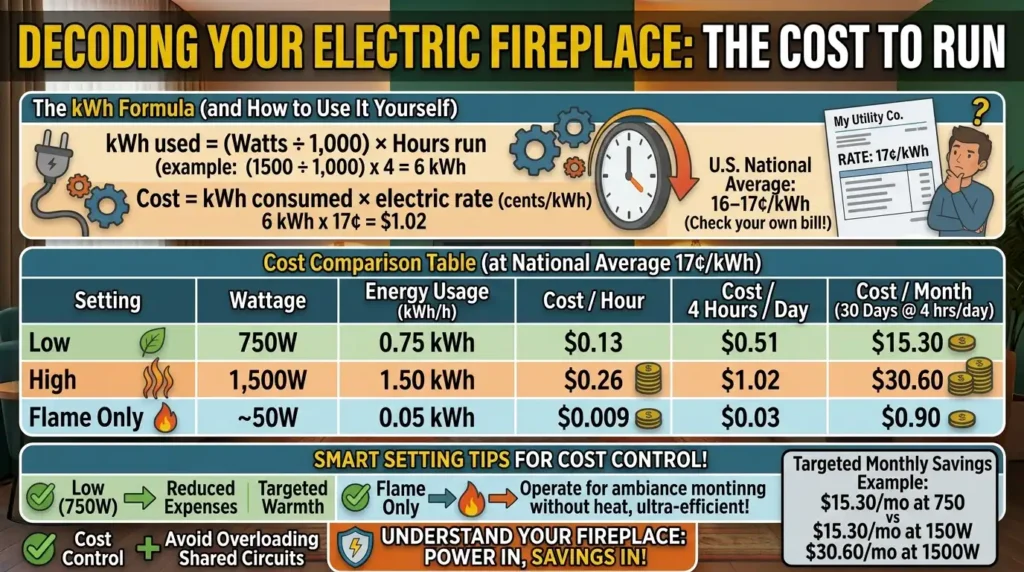
The kWh Formula (and How to Use It Yourself)
The electric charges are not in watts but in kilowatt-hours (kWh). The equation is not very complicated:
kWh used = (Watts ÷ 1,000) × Hours run
Cost = kWh consumed x your electric rate (cents per kWh).
The average residential electric rate of the U.S. is about 16–17 cents per kilowatt-hour as of 2026, but this differs by state and utility, so look at your own bill to be sure.
Cost Comparison Table
The following is the cost of running a 750-watt low mode and 1,500-watt high mode by using a national average cost of $0.17/kWh (cost with your area might be different):
| Setting | Wattage | Energy Usage (kWh/h) | Cost / Hour | Cost / 4 Hours / Day | Cost / Month (30 Days @ 4 hrs/day) |
| Low | 750W | 0.75 kWh | $0.13 | $0.51 | $15.30 |
| High | 1,500W | 1.50 kWh | $0.26 | $1.02 | $30.60 |
| Flame Only | ~50W | 0.05 kWh | $0.009 | $0.03 | $0.90 |
Important lesson learned: Your electricity bill to run your fireplace high or low will be about half of the same 4-hour session with the flame on, and it will burn a fraction of the cost of a heat setting.
Is 750 Watts Enough to Heat a Room?
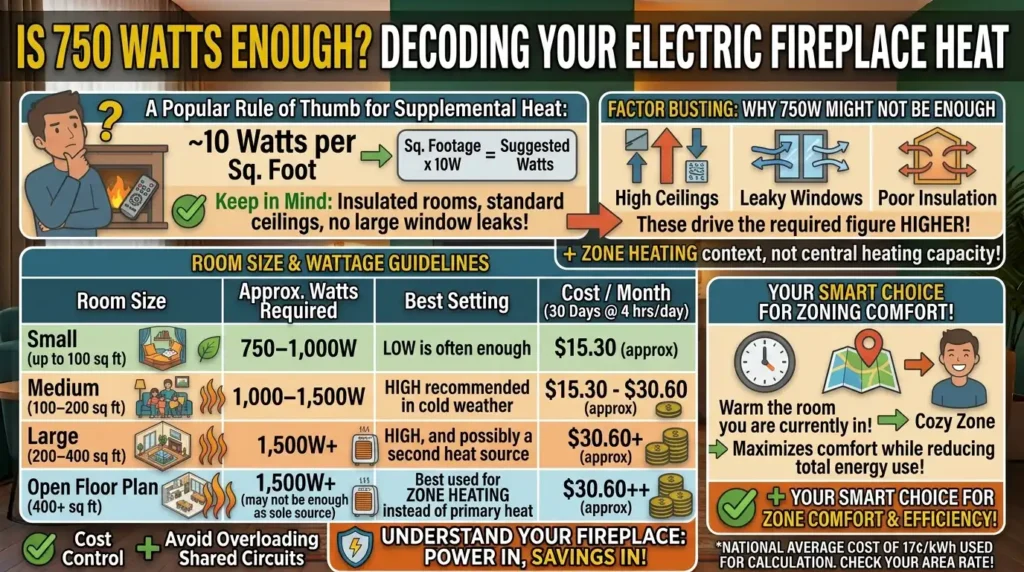
It depends on the room. One of the more popular rules of thumb regarding supplemental electric heat is about 10 watts per square foot in a reasonably well insulated room, but insufficient insulation, high ceilings or leaky windows drive the figure higher.
| Room Size | Approx. Watts Required | Best Setting |
| Small (up to 100 sq ft) | 750–1,000W | Low is often enough |
| Medium (100–200 sq ft) | 1,000–1,500W | High recommended in cold weather |
| Large (200–400 sq ft) | 1,500W+ | High, and possibly a second heat source |
| Open Floor Plan (400+ sq ft) | 1,500W+ (may not be enough as a sole source) | Best used for zone heating instead of primary heat |
Electric fireplaces are typically intended to be used in the context of zone heating – to warm the room you are currently in, and not central heating, so do not interpret the wattage as heating capacity of the entire house.
Will the High Setting Trip a Breaker?
It is able, but in most cases only when other loads are already on the circuit. Even a 1,500-watt fireplace alone trips approximately 12.5 amps on 120-volt, within the range of a typical 15-amp breaker, but not much more. Breakers usually clear when:
- The fireplace has an outlet or circuit with another heating device (space heater, hair dryer, toaster).
- The outlet is utilizing a pre-existing 15 amp circuit with multiple rooms.
- Extension cord or power strip with a rating lower than 15 amps is used (not recommended with any heater).
When your breaker is high but not low, it is a good indication that the circuit is approaching its limit – changing it to the 750-watt setting or using the fireplace on its own dedicated outlet, typically fixes the problem.
Which Setting Should You Actually Use?
Decision Table by Room and Situation
| Situation | Recommended Setting |
| Mild weather, just want warmth topped up | Low (750W) |
| Cold morning, room feels chilly | High (1,500W) to warm up, then switch to low |
| Small bedroom or home office | Low is usually sufficient |
| Living room with high ceilings or open layout | High, used as supplemental zone heat |
| Evening ambiance, no heat needed | Flame-only mode |
| Circuit shared with other devices | Low, to stay well under the circuit’s rated capacity |
| Overnight use | Low, ideally with the built-in thermostat set to a target temperature rather than “constant” |
An efficient plan that many owners settle on: turn the run high in the first 15-20 min to get a cold room to temperature and then turn the run down to low (or leave a built-in thermostat to turn the unit on and off) to hold temperature.
Common Mistakes People Make with Dual Wattage Settings
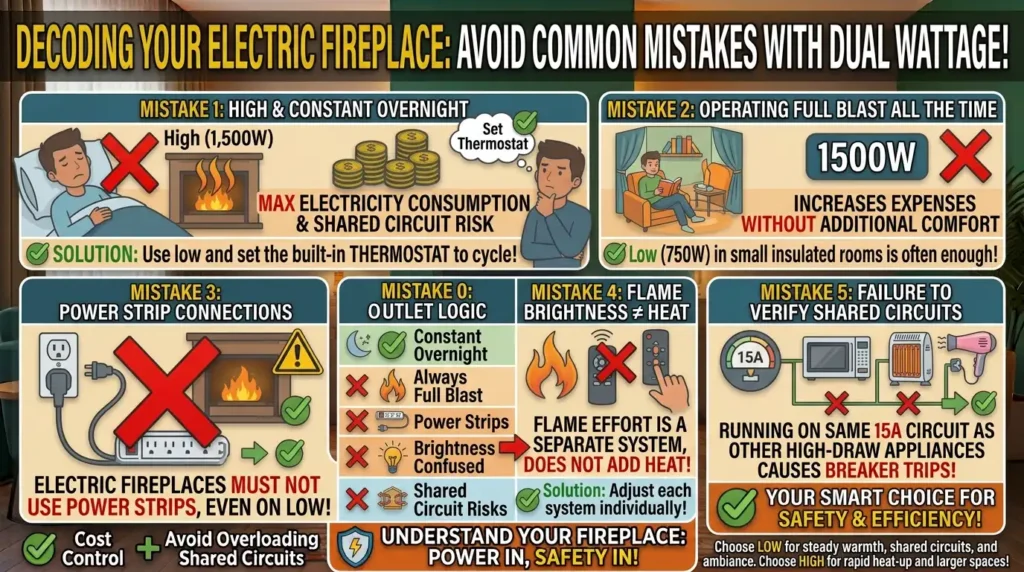
- Leaving it on high and constant overnight. This maximizes the amount of electricity consumed and the (non-negligible but still minor) chance of overloading a common circuit. With the thermostat setting, the unit turns on and off.
- Low will not help to assume. 750 watts in a small well-insulated room is usually sufficient – operating full blast all the time will simply increase the expense with no additional comfort.
- Connection to a power strip. Electric fireplaces must not be connected to power strip or extension cord, even with the lowest wattage setting.
- Mistaking the brightness of flames with heat. The flame effect does not add heat to the flame, and it is a separate system as discussed above.
- Failure to verify that the circuit used is shared. It is one of the most frequent causes of nuisance breaker trips to run the fireplace on the same 15-amp circuit as a microwave or space heater.
Myth vs. Fact
| Common Myth | Reality |
| “A brighter flame means more heat.” | Flame brightness is controlled by LEDs on a separate low-wattage circuit; it doesn’t affect the heating element. |
| “Electric fireplaces waste a lot of energy.” | Nearly 100% of the electricity drawn is converted to heat in the room, with no venting losses, unlike gas or wood. |
| “You should always run it on high for efficiency.” | Running on low for longer, rather than cycling high on and off, is often more cost-effective for steady-state warmth. |
Key Takeaways
- Electric fireplaces usually have two heat settings, usually 750 watts (low) and 1,500 watts (high), to allow you to adjust the amount of heat to the room and the weather.
- There are units which provide a flame-only mode (below 50 watts) which operates without the heating element.
Electricity draw is measured in watts, heat output in BTUs – both are important numbers when comparing heating appliances. - Low power usage can reduce by half the amount of electricity you use, compared to high power use, over the same duration.
- The high setting is near the safe limit of a typical 15-amp circuit, so shared circuits are the most frequent cause of tripped circuit breakers.
- The most cost-effective method to use an electric fireplace is to use zone heating with the proper setting, i.e. not running all the time.
You May Also Read:
FAQs:
What is the meaning of my electric fireplace being 750-watt and 1500-watt?
The low and the high heat output are these. Its 750-watt setting produces approximately half the amount of heat at a lower price, and its 1,500-watt setting produces the maximum amount of heat, which is usually the maximum safe continuous rating of a typical 120-volt household outlet.
Which is less expensive to operate my electric fireplace on low or on high?
Low costs less over the same period of time, as it consumes half the amount of electricity. Nevertheless, when you just require the room to be warm during a short burst, sometimes it is more cost-effective to run high during the burst, rather than running low over a considerably longer period.
What flame only on my electric fireplace?
It indicates that you have the LED flame effect on and no heating element is on. This mode usually consumes less than 50 watts, meaning you obtain the visual ambiance at a fraction of the price of operating the heat.
Am I able to leave my electric fireplace on high the whole day?
You can, but it will consume a lot more electricity than the low setting, and full-load operation at all times will put your unit nearer to the rated current of a standard circuit. Most owners like heating the room at high temperature and then low or resorting to the thermostat option.
Does the brightness of the flame depend on the wattage setting?
No. Flame brightness is typically set independently with its own LED control, regardless of the amount of heat wattage being used.
What is causing my fireplace to keep on tripping the breaker when it is on high only?
This can normally imply that the circuit is operating near capacity, which is typically due to other appliances using the same circuit. It is usually solved by switching to low, or to putting the fireplace on its own dedicated outlet.
How many amps does 1,500-watt electric fireplace consume?
A 1,500-watt fireplace will use approximately 12.5 amps at 120 volts, which fits within the range of a 15-amp breaker, but leaves few other devices on the same circuit.
Can 750 watts warm a bedroom?
In a small, fairly well insulated bedroom, 750 watts can be a sufficient amount of heat to keep the room comfortable, especially as a supplement to a central heating system.
What is the difference between watts and BTUs on an electric fireplace?
Watts gauge the amount of electricity that the unit attracts; BTUs gauge the amount of heat the unit actually generates. In a crude calculation, 1 watt would be equal to approximately 3.412 BTU/hr.
Are the electric fireplaces all two watts?
No. Simple or purely decorative models include flame-only models with no heat source whatsoever, and a few smaller models with single fixed heat output. Two-setting configurations are predominantly seen on mid-range and more expensive models that are intended to be used as supplemental heating.
Can my fireplace be ruined in the long term by the low setting?
No. Cycling between low and high, leaving a unit on low long periods of time is normal use and will not cause damage.
Can I leave my electric fireplace on during the night?
When you do, then set it to the low level and have the integrated thermostat adjusted to a target temperature instead of having it operate all the time and ensure that the unit is not on the same circuit with other high-drawing appliances.
Does an electric fireplace with 240 volts have varying wattage?
Yes. Wired 240 V units may be able to step up past the standard 1,500-watt limit, occasionally to 2,500 to 4,000 watts, as a 240 V circuit can carry more power.
Does it have a remote wattage control?
On the majority of the modern models, yes, the remote or wall control usually switches between low heat and high and separately switches between the flame-only mode.