What is the best thermostat setting in an electric fireplace (Depending on Room, Season and Budget)?
Best Thermostat Setting for Electric Fireplace? Unless you have recently purchased an electric fireplace, then you have likely stared at the front of it, wondering what number you should punch in. Too low, and it hardly takes the chill off. Too much and you are wasting money.
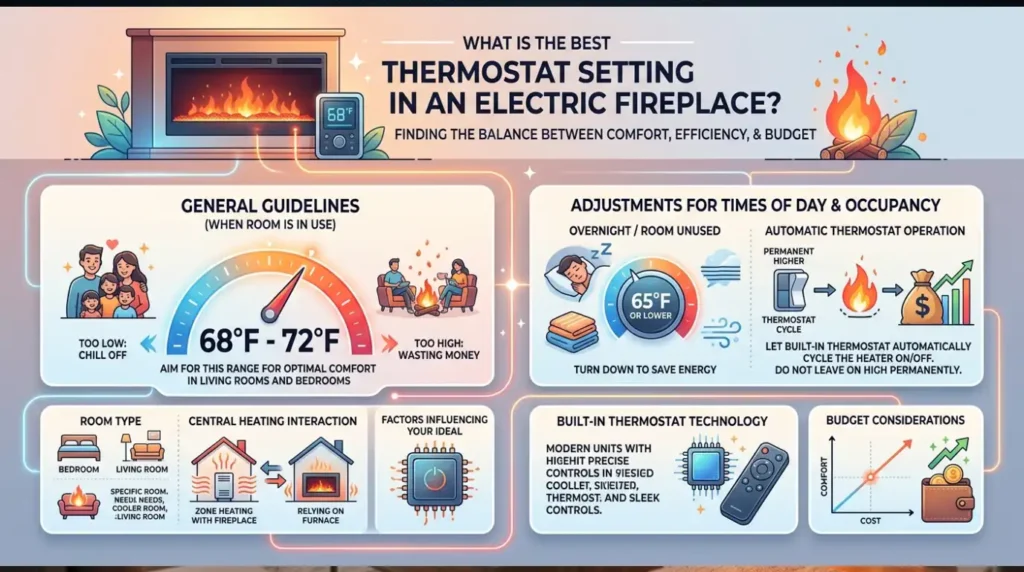
The short answer: when the room is in use, depending on your living room and bedroom, aim to set your electric fireplace thermostat between the range of 68°F and 72°F Turn it down to 65°F or lower overnight or when no one is around, and have the built-in thermostat of the unit switch the heater on and off to maintain that temperature automatically rather than leave it on under the permanent setting of Higher.
That one environment will not suit every room, every fireplace or every budget, though. The entire breakdown by type of room, by time of day, and by how it interacts with your central heating system in the home is listed below, so that you can set your home to a setting that actually matches what fits your space.
Quick Facts
- The average electric fireplace heater consumes approximately 1,500 watts (1.5 kW) when operating on the highest heat level, no matter the brand.
- 1-500 watt heater is generally used to cover 400-500 square feet in a fairly insulated room.
- Operating a 1,500-watt fireplace on high burns about **$0.23 to 0.38 an hour, at your local electricity rate.
- 68F is the recommended at-home winter setpoint, and 7-10F night setback or out-of-home setback can reduce heating bills by as much as 10 percent annually, according to the U.S. Department of Energy.
- Electric fireplaces do not need to send any of the electricity they consume to the room into a flue as gas units do, but instead directly into the room as heat.
How Electric Fireplace Thermostats Actually Work
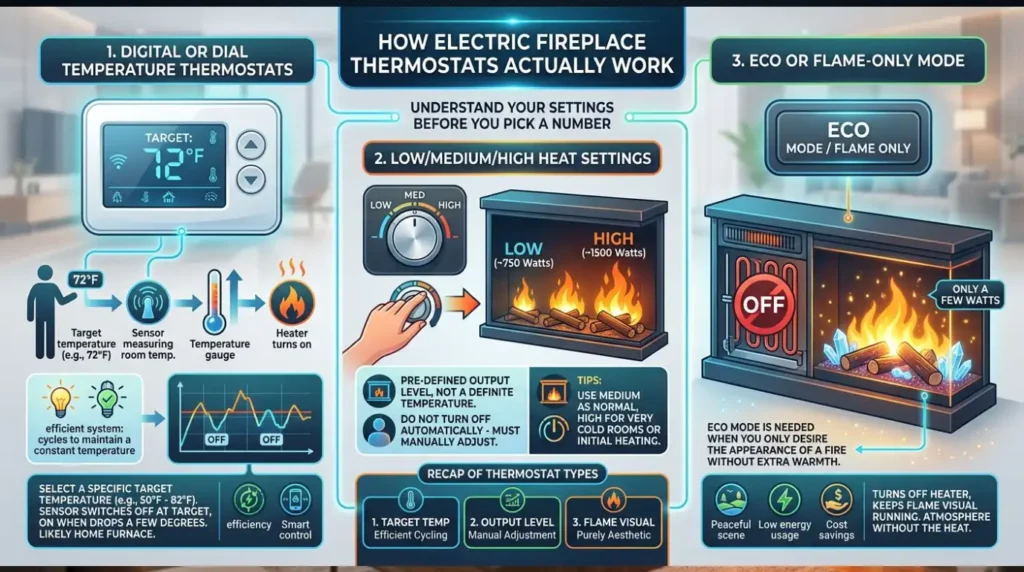
It is better to know what you are setting before you pick a number. Electric fireplaces work with one of three types of thermostats and each of them has slightly different behavior.
The digital or dial temperature thermostats allow you to select a specific target temperature, typically between 50°F and 82°F. When the room attains that number, a sensor within it switches off the heating element. It switches back on when the room goes a few degrees lower than the target. This is the most efficient system since the unit is not operating at full blast throughout the day it is cycling to maintain a constant temperature, just like your home furnace.
The simpler/older models usually have Low/Medium/High heat settings. You are not selecting a definite temperature, but a pre-defined output level (usually about 750 watts on Low and 1,500 watts on High). These units do not automatically turn off once the room has reached a comfortable temperature – you are required to manually turn them down or off.
Eco or flame-only mode off heater and keeps flame visual running. This is something to be aware of since a massive portion of the atmosphere of an electric fireplace the flickering logs or crystal display, uses a few watts, and has nothing to do with the heating component. Eco mode is needed, not Low, when you only desire to have the appearance of a fire without the extra warmth.
In case your fireplace has a real temperature dial, utilize it – set a desired number and allow the device to self-adjust. Where it is only Low/Medium/High, use the Medium as your normal environment and the High as very cold rooms, or as the initial 20-30 minutes of heating a cold room.
The Best Setting by Room and Situation
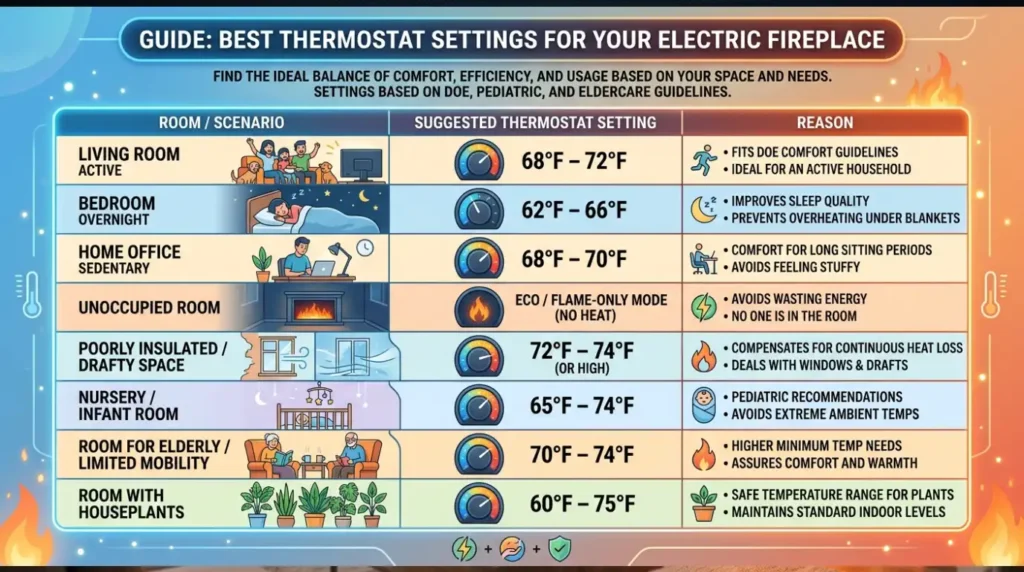
No one right number exists that can be used in all homes. The place you want to be will be determined by what is in the room, the time of the day, and what the fireplace is doing to you, is pure ambiance, an addition to your core heating or your primary source of heat in that room.
| Room / Scenario | Suggested Thermostat Setting | Reason |
| Living room (Active household, day/evening) | 68°F – 72°F | Fits DOE comfort guidelines for an active household. |
| Bedroom (Overnight) | 62°F – 66°F | Cooler air improves sleep quality and prevents overheating under blankets. |
| Home office | 68°F – 70°F | Comfortable for long periods of sedentary work without feeling stuffy. |
| Unoccupied room (Fireplace on) | Eco / Flame-only mode (No heat) | Avoids wasting energy heating a room that is not in use. |
| Poorly insulated room / Drafty space | 72°F – 74°F (or High setting) | Compensates for continuous heat loss through walls, windows, or drafts. |
| Nursery / Infant room | 65°F – 74°F | Aligns with pediatric recommendations to avoid extreme ambient temperatures. |
| Room for older adults or limited mobility | 70°F – 74°F | Accommodates higher minimum temperature requirements for comfort and warmth. |
| Room with houseplants | 60°F – 75°F | Keeps plants within a safe, standard indoor temperature range. |
On that nursery and elderly occupant guidance: it is only some general comfort ranges, not medical advice. In the event that anybody in the house has certain health or heating requirements, it is better to inquire with their doctor instead of using a blog post.
Electric Fireplace Thermostat vs. Your Home’s Central Thermostat
This is the article that most guides omit, and, in fact, it is the one that can save you money: your electric fireplace thermostat and your central HVAC thermostat should not act as competitors but rather collaborate.
This is referred to as zone heating – with a smaller and more focused heat source (your fireplace) being used to heat up the room you are actually in, and leaving the central system a bit colder elsewhere.
| Strategy | Central Thermostat | Electric Fireplace Thermostat | Result |
| No Zone Heating | Set to 68°F – 70°F | Off | Furnace or heat pump heats all rooms equally, including empty ones, leading to higher energy usage. |
| Standard Zone Heating | Lowered to 62°F – 65°F | Set to 68°F – 72°F | Central heating runs less frequently while the fireplace heats the active room, reducing overall energy consumption. |
| Aggressive Zone Heating | Lowered to 58°F – 62°F | Set to 70°F – 74°F | Delivers maximum energy savings, keeping the active room warm while allowing unused spaces and hallways to stay cool. |
The math behind this: The Department of Energy estimates that eight hours a day of setting your central thermostat at 7-10F can save you about 10 per cent. annually in heating bills, and some energy companies even estimate that you can save about 1-3 per cent. a year of every degree that you turn down. Combining that loss with an electric fireplace in your primary living room allows you to only have one room warm without forcing your entire HVAC system to strain.
A major condition: an electric fireplace is an addition, not a substitution to central heating. It is not large or configured to make an entire house to be warm, and using your furnace on a very low burn in a home that is not well insulated may create cold spots, condensation or frozen pipes in extreme weather conditions.
How Much Does an Electric Fireplace Actually Cost to Run?
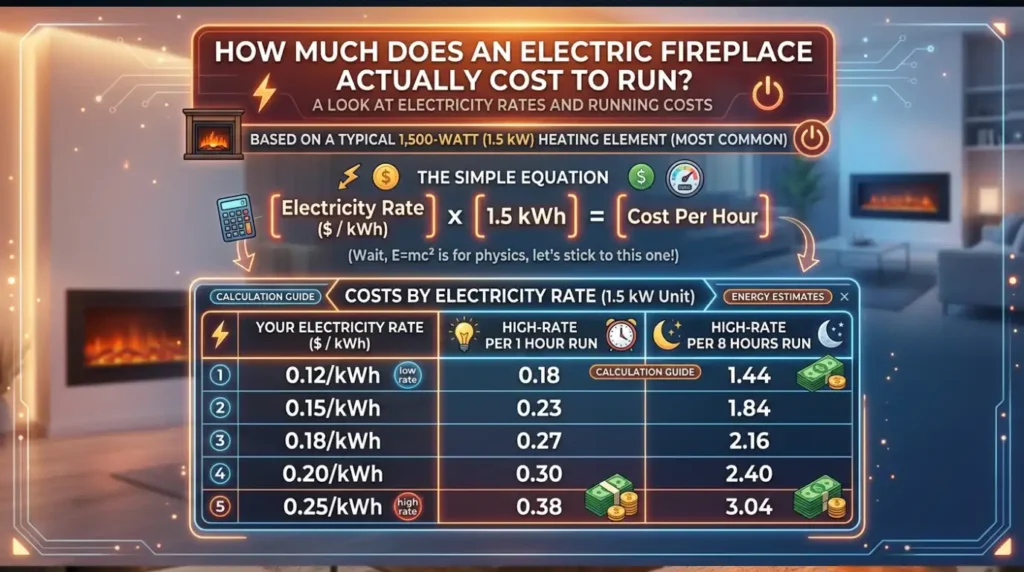
The actual question of what setting to use is normally electricity cost. The following is the calculation, based on a typical 1,500-watt (1.5 kW) heating element that is included in most electric fireplace inserts and stoves.
Equation: E=mc2 electric rate (/kWh) 1.5 kWh = cost per hour.
| Your Electricity Rate | High-Rate per 1 Hour Run | High-Rate per 8 Hours Run |
|---|---|---|
| $0.12/kWh | $0.18 | $1.44 |
| $0.15/kWh | $0.23 | $1.84 |
| $0.18/kWh | $0.27 | $2.16 |
| $0.20/kWh | $0.30 | $2.40 |
| $0.25/kWh | $0.38 | $3.04 |
There are two items that make real-world costs a lot lower than the column of 8 hours on High. One, a thermostat-controlled unit switches off when the room reaches your desired temperature, thus it is not consuming 1,500 watts at all times. Second, the majority of individuals operate their fireplace on the Medium or mid-range temperature as opposed to full blast, and it can potentially reduce the wattage, and consequently the price, by half.
Choose the Size: BTU, Wattage, and Your Room.
A thermostat setting would never be able to help much when the fireplace itself is too small to fit the room. Electric fireplace heaters are rated in watts (amount of electricity consumed) and BTUs (amount of heat generated) – as a crude rule of thumb, estimate 20 BTUs of heating capacity per square foot of room area, increasing with poor insulation, high ceilings or drafty old houses and decreasing with small rooms that are well-insulated.
| Room Size | Approx. BTUs Required | Standard Wattage | Notes |
| Up to 150 sq ft | 2,000 – 3,000 BTU | 600W – 900W | Small bedroom, home office |
| 150 – 300 sq ft | 3,000 – 6,000 BTU | 900W – 1,500W | Standard bedroom or den |
| 300 – 500 sq ft | 5,000 – 5,200 BTU | 1,500W | Most living rooms — industry-standard 120V unit |
500+ sq ft 5,200+ BTU or more units Open-concept or great rooms; can require additional sources
When the fireplace is smaller than the room, turning the thermostat up will not help, the unit will just work with the maximum power continuously without the ability to achieve your desired temperature. Then the more appropriate solution would be to close doors to seal the space, seal drafts, or select a larger unit, rather than override the thermostat.
Adjusting Your Setting Through the Heating Season
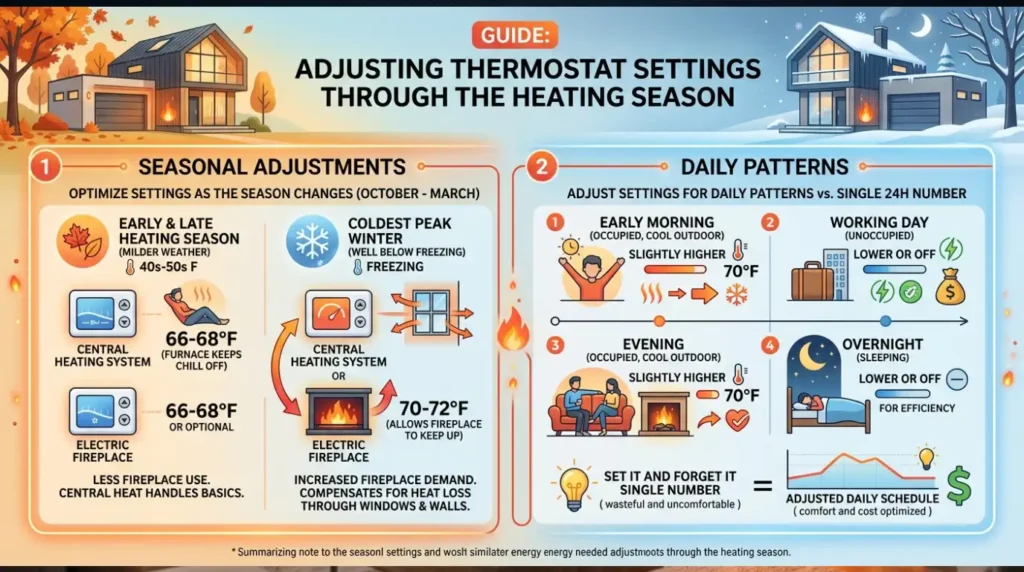
Your optimal thermostat may not be the same all October through March. During the heating season (early and late), when the outside temperature is in the 40s and 50s F, it is possible to set the central heating system to a lower temperature (usually 66-68 F) to remove the chill in a room because the central heating system is already at work. When it gets colder in the coldest part of winter, and the outside air is well below freezing, the heat is lost more quickly through windows and outside walls, so pushing the thermostat to 7072F would allow the fireplace to keep up.
Adjusting to daily patterns is also worthwhile instead of having a single setting that runs 24 hours in a day. A slightly higher in the early morning and evening when the room is in use and outdoor temperatures are coolest at their lowest and a lower or off setting during the working time when no one is at home will be more likely to perform better than just a set it and forget it number in both comfort and cost.
Troubleshooting: When the Setting Doesn’t Seem to Work
When you have set the thermostat to a sensible target temperature, but the room is not yet comfortable, it is not typically the thermostat setting that is the issue. First of all make sure the unit itself is in place a fireplace in a corner, behind the furniture, or covered by a rug or curtain will not heat evenly, regardless of the temperature you have set it to. Then the insulation of the room, older houses, single-pane windows and exterior-door rooms lose heat at a rate that the fireplace is unable to sustain, and even the adequately-sized unit can be perceived as underpowered.
Worth investigating the location of the thermostat sensor also can be worthwhile. On numerous units, the sensor is installed into the unit close to the flame display, and thus the sensor is able to detect a warmer temperature than what the rest of the room actually feels, particularly in large or open spaces. After eliminating placement and insulation, use the square footage of your room to match up with the size chart of BTU sizing above- it is not unusual to see a buyer undersize a fireplace to fit an open-space floor plan including an adjoining kitchen or hallway.
How to Set Your Electric Fireplace Thermostat: Step by Step?
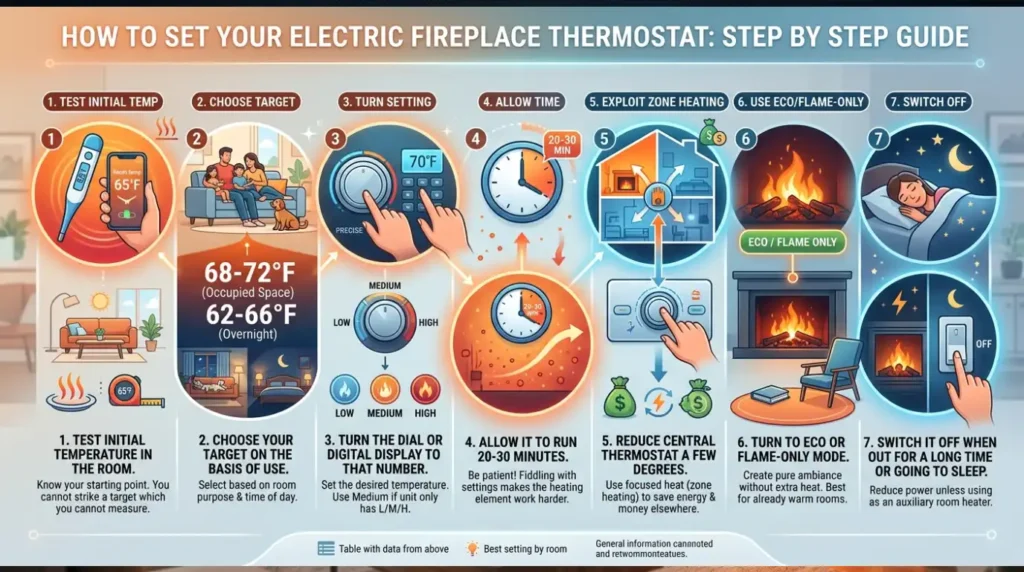
- Test the initial temperature in the room. Take a thermometer or an app on your home in case one is available – you cannot strike a target which you cannot measure.
- Choose your target on the basis of use. Refer to the table above which shows room by room: 68-72°F during an occupied living space, 62-66°F during an overnight.
- Turn the dial or digital display to that number or Medium in case your unit only has Low/Medium/High.
- Allow it to run 2030 minutes before resetting once more. Be patient with rooms to respond and fiddling with the setting up and down is only going to make the heating component work harder.
- Reduce central thermostat a few degrees in rest of house in order to exploit zone heating.
- Turn to Eco or flame-only mode when you are looking to create the ambience but not to add heat, or when the room is already warm.
- Switch it off when you are out of the room a long time or going to sleep unless you are using it as an auxiliary room heater.
Common Mistakes vs. What Actually Works
Best Thermostat Setting for Electric Fireplace?
| Common Myth | Reality / Explanation |
| “Setting it higher heats the room faster.” | Electric fireplaces operate at a fixed wattage regardless of the target temperature. Setting it to 80°F instead of 70°F won’t heat the room any faster—it simply runs longer and risks overshooting your desired comfort level. |
| “Running it on High all day saves money by avoiding restarts.” | Continuous high-wattage operation almost always costs significantly more than allowing the thermostat to cycle the unit on and off to maintain a steady temperature. |
| “It can fully replace my furnace in winter.” | Electric fireplaces are supplemental zone heaters. They are not sized, rated, or designed to serve as a primary whole-home heat source in cold climates. |
| “The flame effect uses a lot of electricity.” | The LED flame effect draws very little power (just a few watts) compared to the 1,500-watt heating element. Running the flame display alone costs virtually nothing. |
| “Placement doesn’t affect the setting I need.” | Units placed near drafty windows, exterior walls, or under high ceilings require higher thermostat settings or longer runtimes to maintain the same comfort level as those on insulated interior walls. |
Safety Tips Worth Following
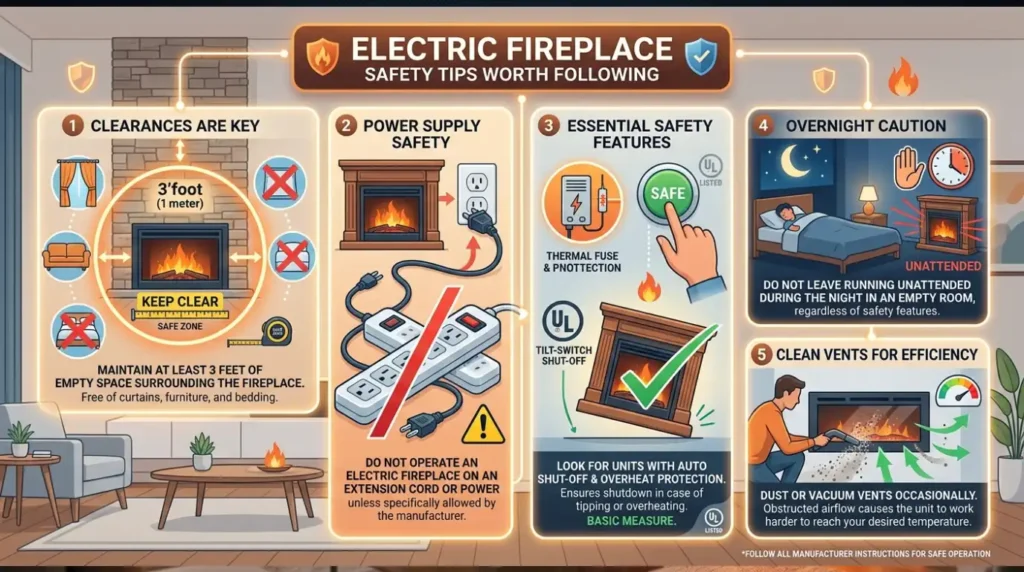
- Have at least 3 feet of empty space surrounding the fireplace, free of curtains, furniture, and bedding.
- Do not operate an electric fireplace on an extension cord unless the manufacturer specifies that it can be used in this way.
- Find units that have an auto shut-off and overheat protection – this is a basic safety measure that almost all well known brands have and will see the unit shut down in case it starts to become hot or tip over.
- Do not leave an electric fireplace, designed to appear like a fireplace, running unattended during the night in a room that is empty, regardless of the safety shutoffs it may have.
- Dust or vacuum the vents occasionally – obstructed airflow causes the unit to work more to achieve your desired temperature.
You May Also Read:
FAQs:
What is the best temperature to use with my electric fireplace?
Most occupied rooms are comfortable and efficient at 68-72 F. Reduce to 6266 F during the night or when no one is around.
Is 72 degrees excessive to an electric fireplace?
No -72-degree F fits in the normal comfort zone, particularly in a colder room or during a certain cold spell of the weather. It falls at the higher side of usual settings hence anticipate that the unit would be run more frequently to keep it going.
Is it better to leave my electric fireplace on Low or High?
Use Medium on a daily basis. Set too high to warm up a cold room then turn down to a comfortable level. Where there is a temperature dial on your unit rather than Low/Medium/High, you can use that and allow it to regulate itself.
Is a higher thermostat level more electrically consuming?
Yes, indirectly. Higher target temperature means that the heating element will run a longer total time to get up to and maintain that temperature and consumes more electricity in general, but the wattage used per unit of time does not change.
Why is the thermostat on the fireplace different than that of my home?
The main thermostat in your house is used to regulate the furnace or heat pump of the entire house. The thermostat in your electric fireplace is only the heating unit of that particular unit. When the fireplace is used in combination (zone heating) you can turn down the central setting and allow the fireplace to heat the room you are occupying with that warmth.
Can I operate my electric fireplace as a single source of heat?
Only in one little room, and not in extreme climates. It is constructed and sold as an attritionary heater and not a complete replacement of a furnace in the home.
Why does my electric fireplace not get to the temperature I set it to?
The usual reasons are a small size of the unit to fit the room, a drafty area, blocked vents or a thermostat sensor that is too close to the flame display (which can read artificially warm). Check the actual size of the room with the above BTU chart.
Does the flame effect increase the heat of the room?
Barely. When compared to the heating element, the LED flame display consumes a low level of electricity and barely adds any warmth.
So, what is the recommended temperature that I should set it to overnight in a bedroom?
A temperature of 62-66 F is generally considered comfortable to sleep in, which is consistent with the broader range of 60-67 F that sleep experts recommend bedrooms to have.
Can an electric fireplace be left on overnight?
Most have continuous-use ratings and have auto shut-off features, but you should only run it when the room is occupied and should follow manufacturer-specific instructions (such as not leaving it unattended or unoccupied) when running.
What environment would I want when I just want ambiance and not heat?
Turn to Eco or flame only, where possible. This operates the effect of the visual flame without using the heating component.
Key Takeaways
- 68-72 degrees is the ideal temperature of an occupied living room; 62-66 degrees is good at night or in bedrooms.
- Turn on your real-life temperature dial in the fireplace when it is there – it has an automatic cycle that the heater runs instead of a fixed Low/Medium/High that runs all day and is more efficient.
- Combine your fireplace and a lower central thermostat setting in rooms not in use – that’s zone heating, and that is where the savings are made.
- Select the wattage/BTU rating of a unit that matches your room size; no thermostat setting makes a smaller heater.
- Turn on Eco or flame-only when you desire the appearance of a fire but not the cost of the heat.