7 Powerful Reasons Electric Fireplaces Are Not Tacky (Even Designers Are Agree)
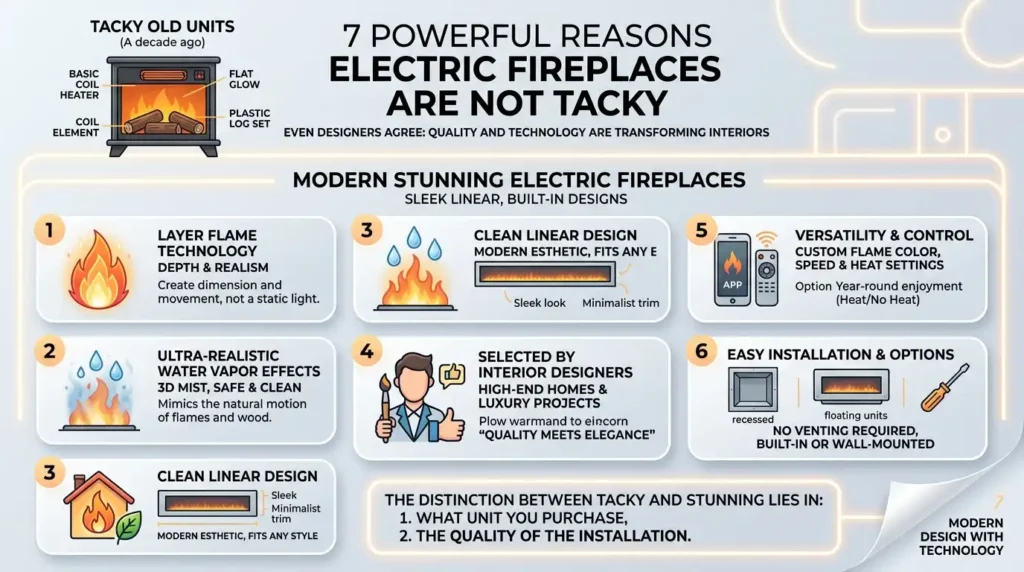
7 Powerful Reasons Electric Fireplaces Aren’t Tacky. It’s a fair worry. Perhaps you have come across one of those old wall units that have a flat orange glow flickering behind a piece of plastic logs, and it has been in your head since then. It is precisely that image which has created the “tacky” reputation, as well as the fact that it is nearly ten years old.
The brief form of it is as follows: electric fireplaces do not necessarily look tacky. The particular product line of inexpensive coil heaters with a plastic log set that was a few years old was the tacky one. Electric fireplace, in the modern world, incorporates layer flame technology, ultra-realistic water vapor effects, and clean linear designs actively being selected by interior designers in high-end houses. The distinction between tacky and stunning lies in two aspects; what unit you purchase, and the quality of the installation.
Seven reasons, supported by how the technology, design trends, and installation standards have actually evolved, why a well-selected electric fireplace is a valid design upgrade, rather than a compromise are discussed below.
Key Takeaways
The tackiness image dates back to the early 2010s coil-and-acrylic-log units, rather than the technology itself.
Modern flame technology (multi-layer LED, water vapor, and virtual/video flame) has bridged most of the visual disparity with gas and wood fire.
- The quality of installation is about as significant as the product itself – an excellent unit in a shallow half-finished enclosure will be out of place.
- Electric fireplaces are frequently specified by interior designers, as they can be installed where gas and wood can simply not: interior walls, apartments, rentals, and rooms without chimneys.
- Frameless linear designs are the present day norm and are unlikely to appear old-fashioned in the near future.
- The entry-level units do not get eliminated and may still appear inexpensive – being aware of what makes them different than high-quality models will save you the misstep of making a bad buyer.
What Actually Makes an Electric Fireplace Look Tacky?
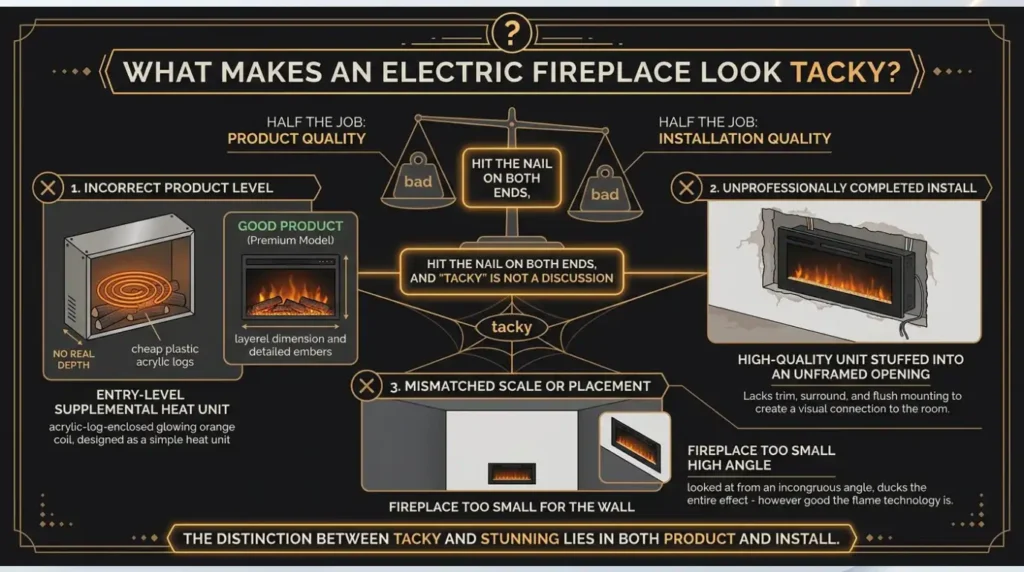
To enter the seven reasons it is useful to define the problem precisely, as there are always three particular, preventable problems that tacky nearly always comes down to.
Incorrect product level. An acrylic-log-enclosed glowing orange coil on a surface-mounted box looks like a fake one because, technically, it is. These entry-level units were designed as simple supplemental heat units, not to resemble fire. Premium models employ multi-layer flame projection and dimensional ember beds that have been designed to replicate depth and motion.
Unprofessionally completed install. A high-quality unit is stuffed into a small or non-framed opening. The trim, surround, and flush mounting are those elements that create the visual connection of the fireplace to the room.
Mismatched scale or placement. A fireplace which is too small to fit the wall, or is looked at in an incongruous angle, ducks the entire effect – however good the flame technology is.
In other words: the product does a half a job in terms of final appearance and installation, the other half. Hit the nail on the head on both ends, and “tacky” is not a term of discussion.
1. Flame Technology Has Revolutionized Essentially.
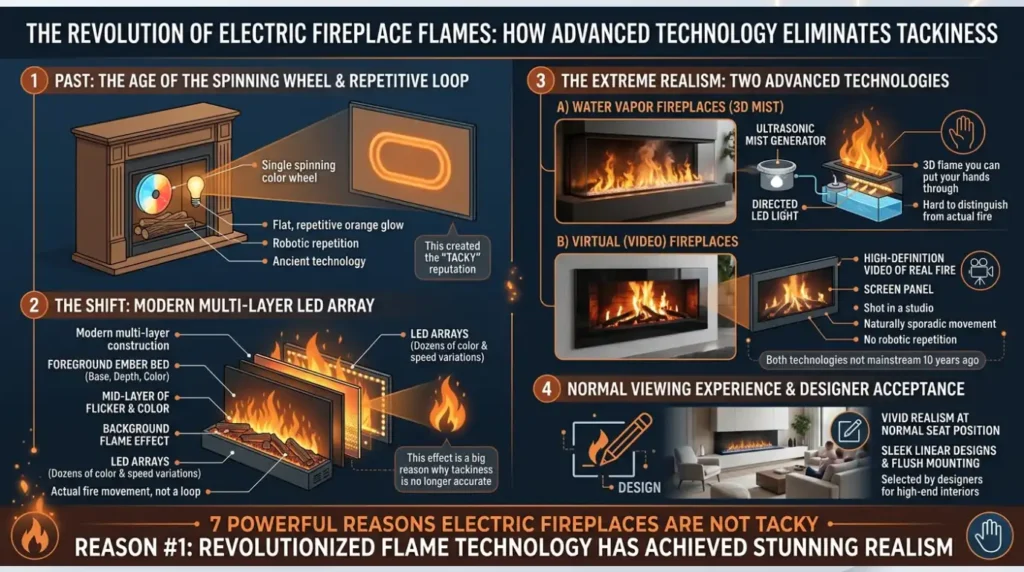
That the flame does not even appear like it did is the single biggest reason why electric fireplaces are no longer tacky.
The earliest electric fireplaces consisted of a single spinning color wheel and a source of light to project a flat, repetitive orange light onto a screen or plastic logs. It was as much like a light trick as it was a light trick. That is the image the majority of people continue to associate with the term electric fireplace, despite the fact that the units that propelled the image of the same have ceased selling years ago.
The modern flame engines are constructed in layers. A foreground ember bed, a background flame, and a mid-layer of flicker and color variation give the embers their base, depth, and color. Together with LED arrays that can have dozens of color and speed variations, the effect is that of actual fire movement, not a repetitive loop, particularly when viewed when sitting in the normal seat position.
Two more recent types take this to the extreme:
- Water vapor fireplaces have ultrasonic mist and a directed LED light that offers an effect of a three-dimensional flame which you can put your hands through. It is truly hard to distinguish it at normal viewing distance, with actual fire.
- Virtual (video) fireplaces project high-definition video of a real fire, shot in a studio, on a screen panel. Since it is real fire on video, the movement is naturally sporadic as natural flame is – not the robotic repetition of an ancient LED loop.
Both of these technologies were not available in the mainstream, affordable form ten years ago. They are here and they are a big reason why the tag of tackiness is no longer accurate when applied to the category.
2. Frameless Linear Designs Match Contemporary Architecture
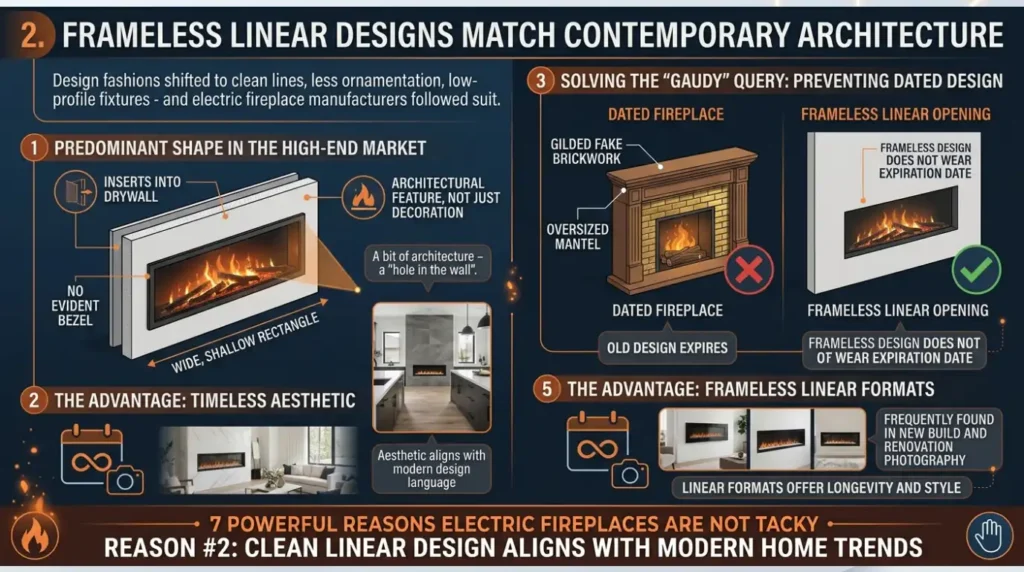
Design fashions shifted to clean lines, less ornamentation, low-profile fixtures – and the manufacturers of electric fire places followed suit.
The frameless linear fireplace: a wide shallow rectangle that inserts into drywall and has no evident bezel is the predominant shape in the high-end market today. It is not written so much like a fireplace as a bit of architecture – a hole in the wall rather than a decoration machine. The aesthetic aligns well with the presentation of the same design language that most new-build and renovated houses are already employing: quartz counters, matte black hardware, wide-plank flooring.
This is important to the gaudy query precisely since dated design rather than technology is often what contributes to any feature of the home feeling out of place a decade later. Gilded fake brickwork or oversized mantels of a certain design time period then come to be outdated no matter what is in them. The difference between a plain, frameless linear opening and a changeable surround is that they do not wear that same expiration date, and that is a big portion of the reason you can find linear formats in the new page and renovation photography so frequently.
3.Interior Designers Specify Them for Real Projects
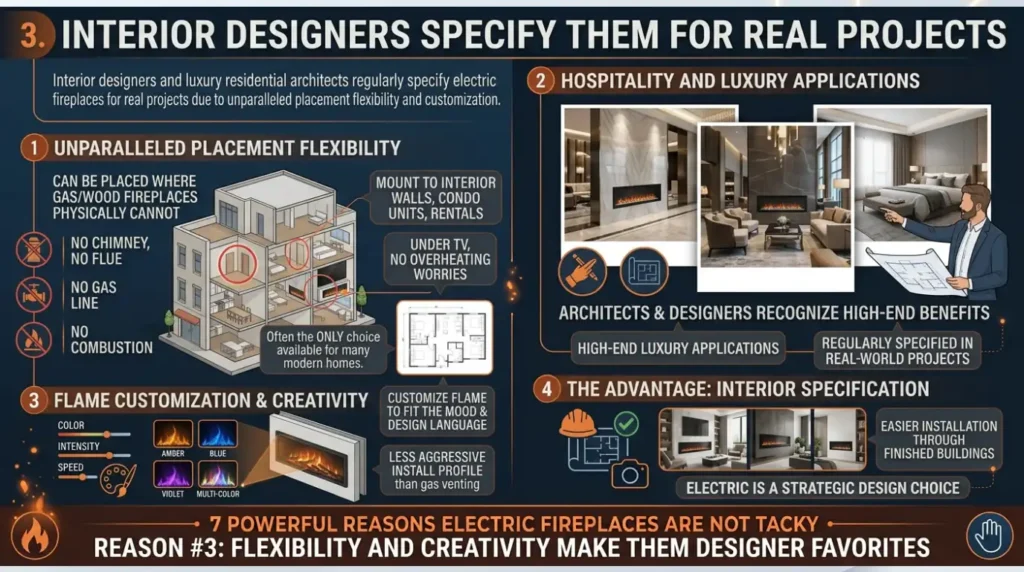
Once electric fireplaces were an alert of a low-end renovation, professional designers would not be the ones who recommend it, but they do it regularly, due to a practical consideration: An electric fireplace can be placed where a gas fireplace or a wood fireplace physically cannot be.
Having no chimney, no flue, no gas line, and there being no means of combustion, an electric unit can be mounted to an interior wall, under a mounted television, in a condo, or in a rental where structural modifications are not an option. To a vast proportion of houses being refurbished or furnished nowadays, the word electric is not replacing gas but it is the only choice of fireplace available.
Hospitality and luxury residential architects have also been attracted to the high-end electric and water vapor units due to the ability to customize flames (color, intensity, speed) and provide them with a sense of creativity they do not have with a gas flame, and because the installation profile is much less aggressive than venting a gas line through a finished building.
4. Build Quality Has Caught Up to the Visual Promise
The realistic flame effects are only important when supported by the rest of the unit. This is the point at which the high-end and low-end products separate radically and it is better to be aware of the particular indicators of each range before you shop.
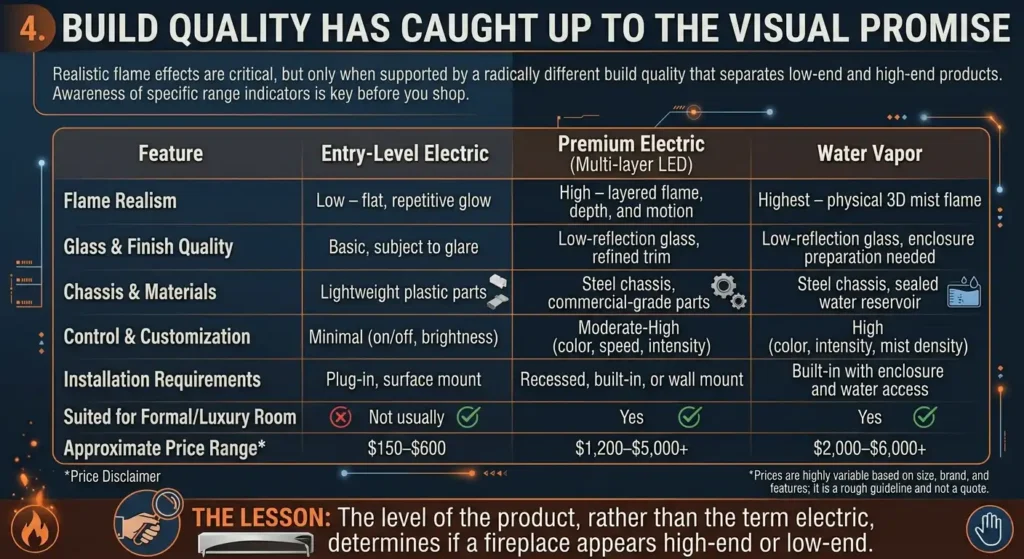
Comparison Table: Entry-Level vs. Premium vs. Water Vapor Electric Fireplaces
| Feature | Entry-Level Electric | Premium Electric (Multi-layer LED) | Water Vapor |
| Flame Realism | Low – flat, repetitive glow | High – layered flame, depth, and motion | Highest – physical 3D mist flame |
| Glass & Finish Quality | Basic, subject to glare | Low-reflection glass, refined trim | Low-reflection glass, enclosure preparation needed |
| Chassis & Materials | Lightweight plastic parts | Steel chassis, commercial-grade parts | Steel chassis, sealed water reservoir |
| Control & Customization | Minimal (on/off, brightness) | Moderate-High (color, speed, intensity) | High (color, intensity, mist density) |
| Installation Requirements | Plug-in, surface mount | Recessed, built-in, or wall mount | Built-in with enclosure and water access |
| Suited for Formal/Luxury Room | Not usually | Yes | Yes |
| Approximate Price Range* | $150–$600 | $1,200–$5,000+ | $2,000–$6,000+ |
Prices are highly variable based on size, brand and features; it is a rough guideline and not a quote.
The lesson to learn in this table is simple: the level of the product, rather than the term electric, will make a fireplace appear high-end or low-end. A $200 plug-in device and a recessed linear model with a cost of 3000 are hardly of the same product type though both qualify as electric fireplaces.
5. They are Realistically Practical – And Practicality is not Dressy.
Not all of the electric fireplace backlash is about aesthetics, some of it is merely the belief that comfort and style cannot go together. However, the practical argument in favor of electric fireplaces is so good that they alter the perception of them.
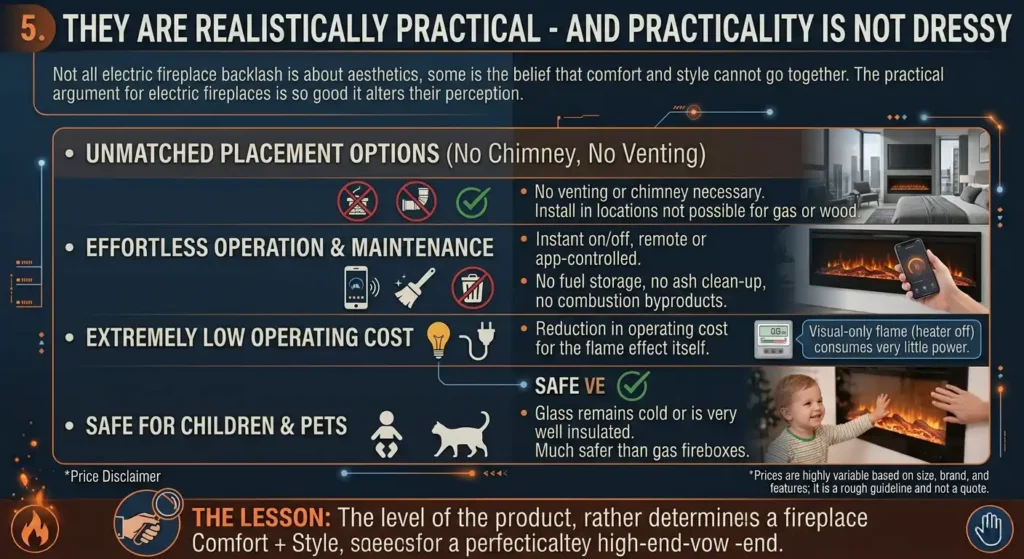
- No venting or chimney is necessary, making installation locations gas and wood can use that is not possible.
- Instant on/off, remote or app-controlled, no fuel storage, no ash clean-up, no combustion byproducts.
- Reduction in operating cost of the flame effect itself because the visual display alone (heater off) consumes very little power.
- Safe with children or pets, as the glass usually remains cold or is very well insulated when compared with a gas firebox.
All this does not mean that a fireplace will necessarily appear good, but it does mean that the reason so many homeowners and designers prefer electric despite the apparent availability of gas is that this category is a choice and not a compromise.
6. Personalization You Can Style any Room.
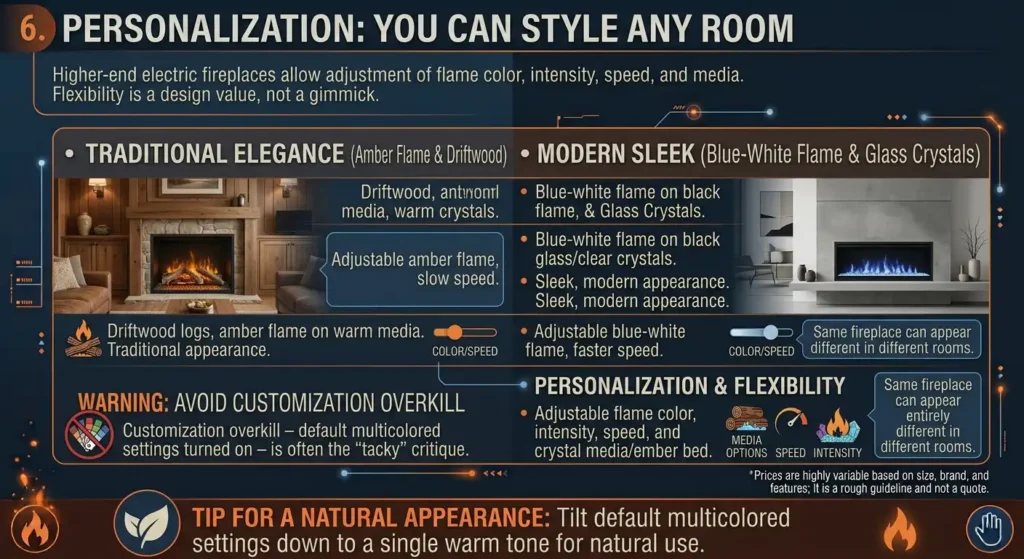
There is only one color that can be used in a wood or gas fire. The majority of higher-end electric fireplaces allow you to adjust the flame color, intensity, speed and often, the crystal media or ember bed beneath it, so the same fireplace can appear entirely different in different rooms.
When it is exercised with discretion that flexibility is a design value, rather than a gimmick. A Driftwood-log-shaped amber flame on a warm flame with black glass or crystals, is traditional; a blue-white flame on black glass or clear crystals is sleek and modern. One of the reasons that electric fireplaces fit better into more interior design than an actual gas or wood fire could is the capability to adjust the effect to suit the existing interior design.
The warning here: customization overkill – the default settings of any multicolor settings turned on – is just the sort of thing that critics refer to when they declare electric fireplaces as tacky. It is not the technology that is the problem but the environment. Tilt it down to a one warm tone to use most of the time and to achieve a natural appearance.
7. Installation Quality Is (Mostly) Under Your Control.
The reason why electric fireplaces are not necessarily tacky is the most practical one: most of the elements that make an installation look off-puttable can be sorted out even before the time you ever unplug the unit.
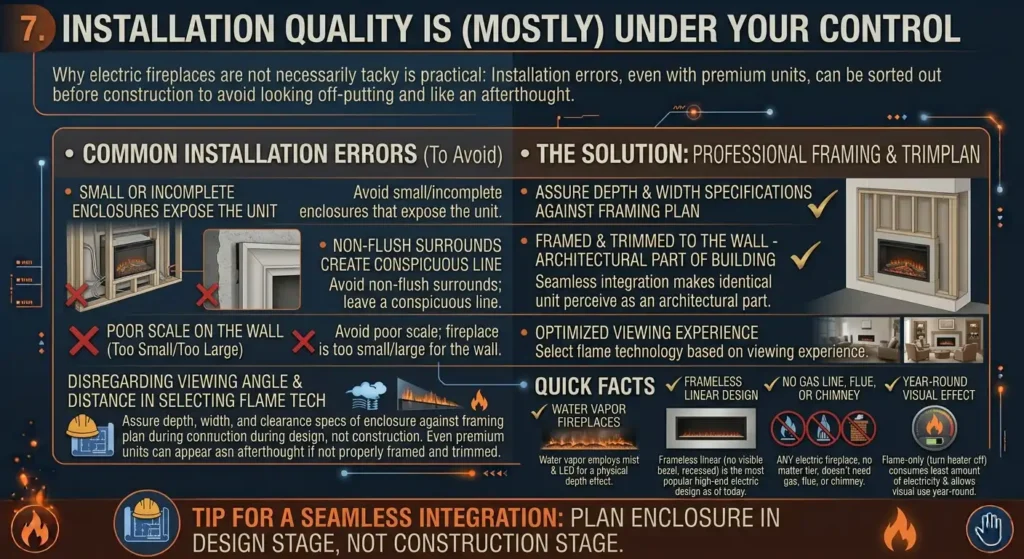
The most frequent errors made during installation are the same throughout the industry:
- Small or incomplete enclosures that expose the unit.
- Non-flush surrounds, which leave a conspicuous line between the fireplace and wall.
- Poor scale of the wall – a fireplace that is too small (or too large) in the place it occupies.
- Disregarding viewing angle and distance in selecting flame technology, which is more critical to water vapor and virtual units than typical LED.
None of these demand any special knowledge to prevent – they demand assuring depth and width and clearance specs of enclosure against framing plan, not after the construction. Even a premium unit that got dropped in a rough or improvised opening will still appear as an afterthought. When framed and trimmed all the way to the wall, the identical unit perceives as an architectural part of the building.
Quick Facts
7 Powerful Reasons Electric Fireplaces Aren’t Tacky
- Water vapor fireplaces employ ultrasonic mist and LED light to create a physical depth of a flame effect.
- Frameless linear (no visible bezel, recessed) is the most popular high-end electric fireplace design as of today.
- Any electric fireplace, no matter its tier, does not need a gas line, flue or chimney.
- Flame-only (turn the heater off) consumes the least amount of electricity, and allows you to operate the visual effect throughout the year.
How to Make Sure Your Electric Fireplace Doesn’t Look Tacky: A Quick Checklist
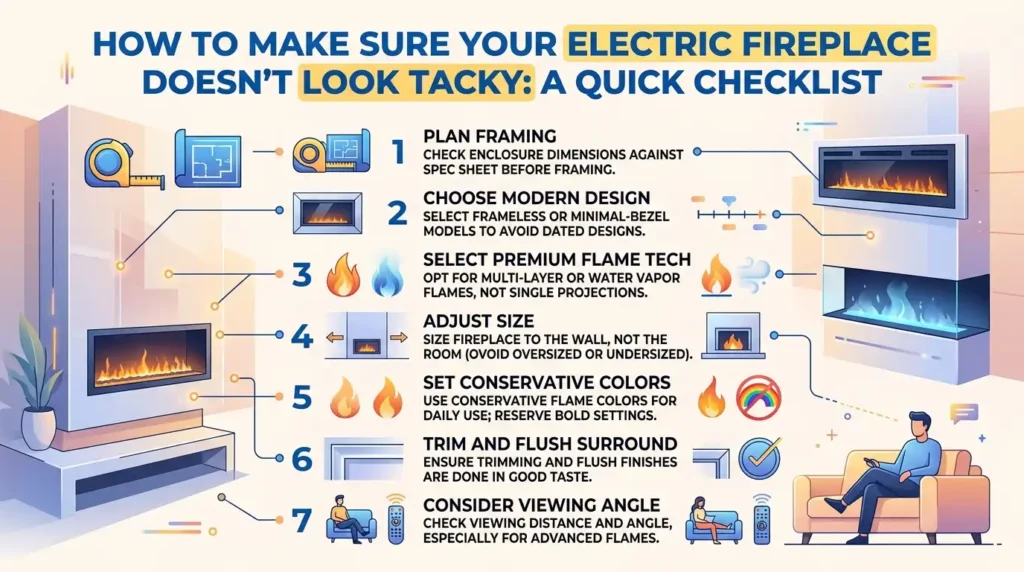
- Check the depth, width and clearance of the enclosure versus the spec sheet of the unit prior to erecting any framing.
- Select a frameless or minimal-bezel linear model to use in case you do not want to have an outdated design in several years.
- Check the flame technology level – specifically, but not necessarily, multi-layer or water vapor flame as opposed to a single, stationary projection.
- Adjust the size of the fireplace to the wall, not the room – oversized or undersized units send the same message of off.
- Conservatively set flame color and intensity to use on a daily basis; do not use bold color settings except on an occasion and not in default viewing.
- Have the surround trimmed and flushed in good taste this is one thing which influences the finished appearance more than nearly anything.
- Check viewing distance and angle particularly water vapor or virtual units as realism may differ depending on where people are actually seated.
You May Also Read:
- 6 Powerful Tips to Maximize Electric Fireplace Efficiency
- Are There 240V Electric Fireplaces? Powerful Heat Options
FAQs:
Do interior designers believe electric fireplaces are tacky?
No – not the high-end of the category. High end linear and water vapor electric fireplaces are commonly specified by designers to be installed in renovation and new construction projects, in part due to their installation where gas and wood fireplaces are not allowed. The stigma is nearly all on entry-level, plug-in units which were never intended to be architectural.
So, what is the real difference between a low-cost electric fireplace and an upscale one?
The most basic units are those with a single flame projection layer, simple LED or coil lighting and inexpensive plastic parts creating a flat, tiled radiance. Premium units are based on multi-layer flame technology, dimensional ember beds, steel chassis, and superior glass – the differences that can be noticed at once when they are placed side by side.
Is it possible to make an electric fireplace as realistic as gas or wood?
Yes, to a good number of the viewers, particularly in combination with high-quality multi-layer LED units, and, more so, with water vapor models, which produce a three-dimensional flame physically via the use of mist and light. Even at the typical distance of a living-room, it is actually hard to differentiate between a high-end water vapor flame and real fire.
Does the quality of the installation really have any effect on the appearance of the fireplace?
Significantly. A too shallow enclosure, a non-flush surround, or a unit that is not the correct size to fit the wall, will cut even the finest flame technology. The installation itself contributes to the final appearance around half of what the fireplace itself provides.
Will an electric fireplace be outdated in a couple of years?
The frameless linear style has been the predominant style a few years back and with no indication of dropping out of style, mainly due to the fact that it is architecturally neutral and not limited to a particular decorating style. The most likely to date is a fancy ornamental framework – a plain frame that can be swapped out at a later date will eliminate that possibility.
Can electric fireplaces be used where I do not have a gas line?
Yes – this is one of their fundamental benefits. There is no combustion, and thus electric fireplaces do not require a venting or a flue, or gas line, thus can be fitted into most wall assemblies without structural modification. Electric is usually the only real fireplace choice that is available, especially in renovations or apartments where the addition of gas service is not feasible.
Are electric fireplaces actually warm or are they merely a show?
The vast majority of electric fireplaces contain a heater (usually a fan-forced or infrared heating coil) rated at supplemental heating in a single room and most allow you to operate the flame display with the heater off. They are not usually designed to substitute the main heating system of a home, like most gas inserts and stoves.
What is a water vapor fireplace?
A water vapor fireplace is an ultrasonic mister that is lit at the bottom or behind with LED lights to give a flame-like appearance with the real physical depth and motion- realistic enough to pass the hand through without getting wet or hot.
Why are there still electric fireplaces that look like a fake fireplace?
It boils down to layering of flame, media quality, and glass. Single-flat projection, low-resolution flame, and standard (not low-reflection) glass units are more likely to be interpreted as artificial since the flame would not have visual depth. This is nearly purely a tier problem and not a inherent limitation of electric fireplace technology.
My Final Thought:
The tackiness of electric fireplaces was based on a particular, outmoded product line, rather than the technology itself. Multi-layer LED flame engines, water vapor and frameless linear designs have bridged most of the visual gap between gas and wood fire and interior designers call upon them often exactly because of their location installation capability and the extent to which they can be customized.