6 Powerful Tips to Maximize Electric Fireplace Efficiency (and Cut Your Heating Bill
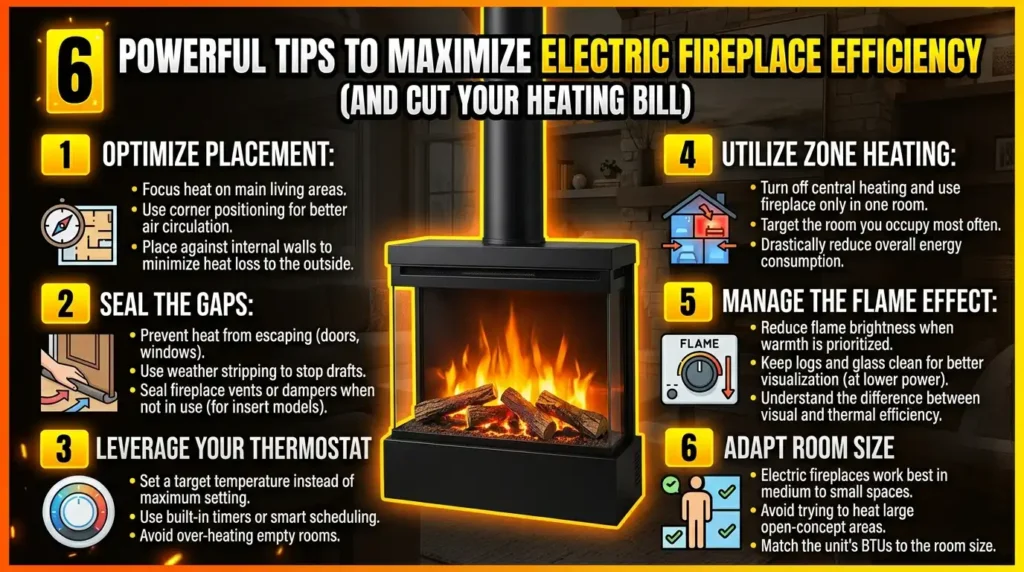
6 Powerful Tips to Maximize Electric Fireplace Efficiency: If your electric fireplace looks cozy but doesn’t seem to be pulling its weight on your energy bill, you’re not imagining things. Most electric fireplaces are already about 99% efficient at turning electricity into heat the real efficiency losses happen from how they’re used, not the appliance itself. A fireplace running on the wrong setting, placed against a cold exterior wall, or left blasting a room the size of a gymnasium will always underperform, no matter how good the unit is.
The good news: small changes make a big difference. Below are six practical, expert-backed ways to get more warmth and more savings out of the electric fireplace you already own.
Key takeaways:
- Electric fireplaces convert nearly all their electricity into heat, but room conditions and settings determine how efficient that heat feels.
- Standard units draw 750–1,500 watts and produce roughly 3,000–5,000 BTUs — enough for supplemental zone heating, not whole-home heating.
- The single biggest efficiency win is pairing the right wattage with the right room size, then closing the door.
- A programmable thermostat setting and a timer typically save more energy than any hardware upgrade.
What Does “Efficiency” Actually Mean for an Electric Fireplace?
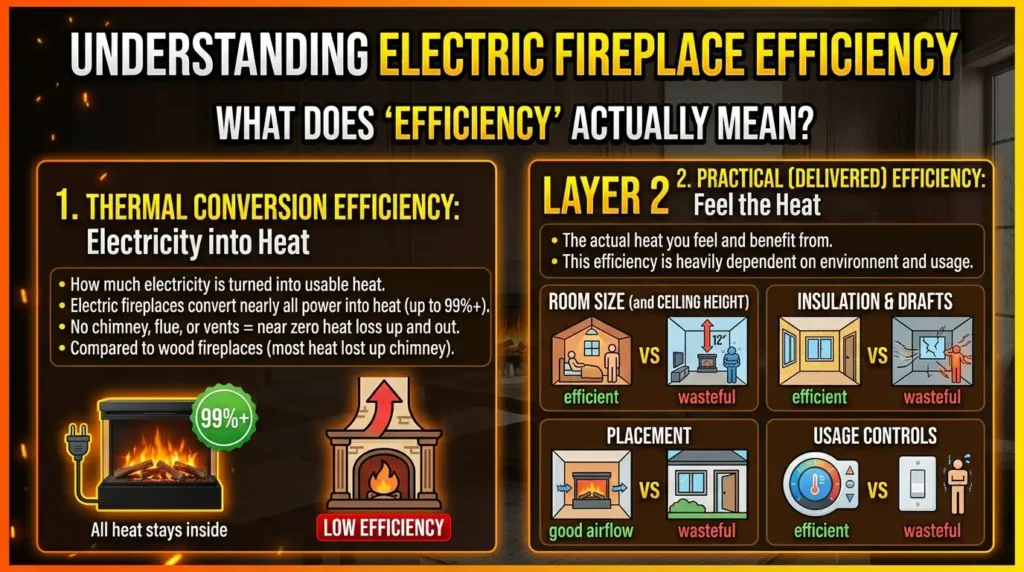
Efficiency for an electric fireplace has two layers, and mixing them up is where most confusion starts.
Thermal conversion efficiency is how much of the electricity becomes usable heat. Electric fireplaces convert almost all of their power draw into heat, since there’s no chimney, flue, or combustion byproduct carrying warmth outside. That’s a meaningfully higher conversion rate than a wood fireplace, which loses the majority of its heat straight up the chimney.
Practical (delivered) efficiency is different — it’s how much of that heat you actually feel and benefit from. This depends on room size, insulation, placement, drafts, and how you use the controls. A fireplace can be 99% thermally efficient and still feel like a waste of money if it’s heating an open-concept living room with a 12-foot ceiling.
The tips below target that second, more controllable layer 6 Powerful Tips to Maximize Electric Fireplace Efficiency:
Tip 1: Match Wattage and BTU to Your Room Size
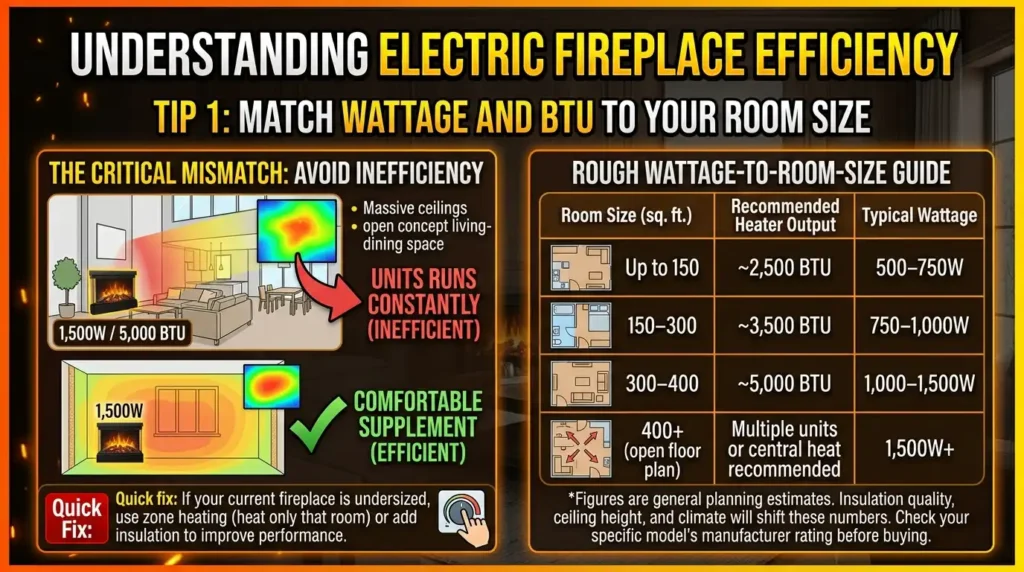
The most common efficiency mistake is a mismatch between the fireplace’s heat output and the space it’s meant to warm.
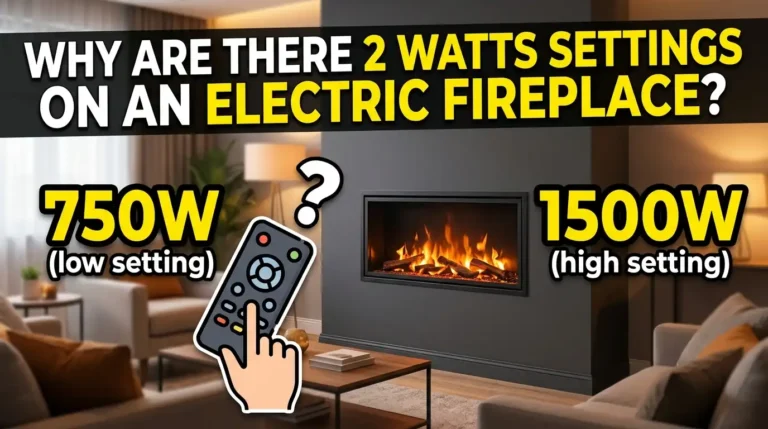
Most electric fireplaces use between 750 and 1,500 watts on their heat setting, producing roughly 3,000 to 5,000 BTUs of heat. That’s enough to comfortably supplement heating in a room around 300 to 400 square feet with average insulation. Ask a 1,500-watt unit to heat an open living-dining combo space, and it will run constantly while barely making a dent — which is the definition of inefficient.
Rough Wattage-to-Room-Size Guide
| Room Size (sq. ft.) | Recommended Heater Output | Typical Wattage |
|---|---|---|
| Up to 150 | ~2,500 BTU | 500–750W |
| 150–300 | ~3,500 BTU | 750–1,000W |
| 300–400 | ~5,000 BTU | 1,000–1,500W |
| 400+ (open floor plan) | Multiple units or central heat recommended | 1,500W+ |
Figures are general planning estimates. Insulation quality, ceiling height, and climate will shift these numbers, so check your specific model’s manufacturer rating before buying or relying on one unit for a larger space.
Quick fix: If your current fireplace is undersized for the room, don’t just crank the thermostat higher — it won’t create heat that isn’t there. Instead, close doors to shrink the effective space, or add a second small unit rather than overworking one.
Tip 2: Use the Thermostat, Not Constant High Heat
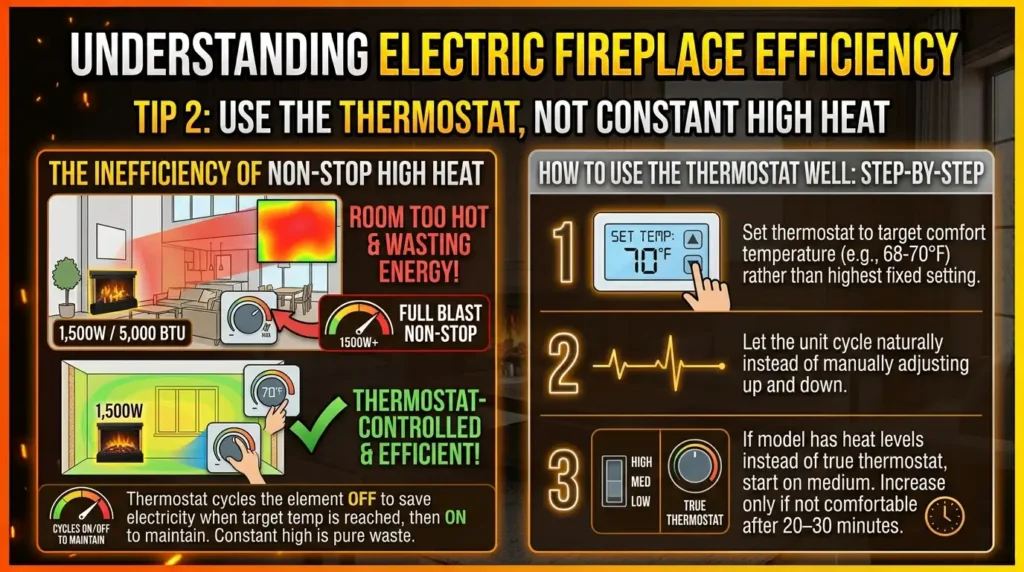
Many people run their electric fireplace on “high” the entire time it’s on, assuming that’s the fastest way to warm up. In reality, a thermostat-controlled setting is almost always more efficient.
Here’s why: once a room reaches a comfortable temperature, a thermostat cycles the heating element off and on to maintain that temperature, using far less electricity than a unit stuck on full blast. Running full heat non-stop after the room is already warm is pure energy waste.
How to use it well:
- Set the thermostat to your target comfort temperature (many people find 68–70°F ideal) rather than leaving it on the highest fixed setting.
- Let the unit cycle naturally instead of manually adjusting it up and down.
- If your model has multiple heat levels instead of a true thermostat, start on medium and only increase if the room isn’t reaching a comfortable temperature after 20–30 minutes.
Tip 3: Separate the Flame Effect from the Heat
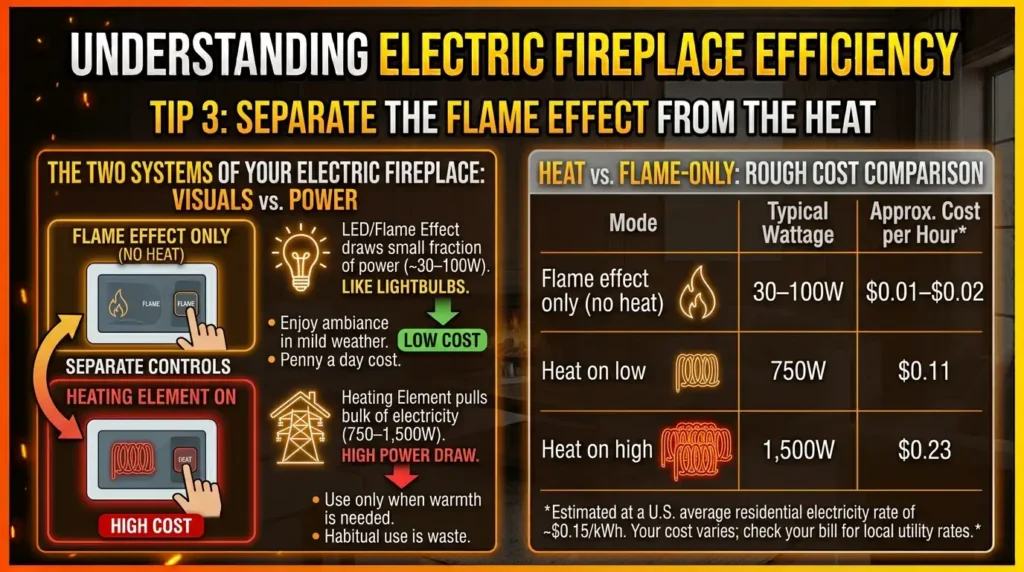
One of the most underused efficiency tricks is remembering that the flame visuals and the heating element are two separate systems on most electric fireplaces.
The LED or flame-effect display alone typically draws a small fraction of the power the heater uses — often in the range of 30 to 100 watts, similar to a couple of light bulbs. The heating element is what pulls the bulk of the electricity, usually 750 to 1,500 watts.
That means you can:
- Enjoy the ambiance during mild weather, summer evenings, or daytime with the heater switched off, for pennies a day.
- Turn the heat on only when you actually need warmth, rather than out of habit.
- Use flame-only mode in a room you’re not actively heating (like a bedroom you’re decorating with ambiance but not occupying).
Heat vs. Flame-Only: Rough Cost Comparison
| Mode | Typical Wattage | Approx. Cost per Hour |
|---|---|---|
| Flame effect only (no heat) | 30–100W | $0.01–$0.02 |
| Heat on low | 750W | $0.11 |
| Heat on high | 1,500W | $0.23 |
Estimated at a U.S. average residential electricity rate of about $0.15/kWh. Your actual cost will vary based on local utility rates — check your bill for your exact rate before budgeting.
Tip 4: Improve the Room Around the Fireplace, Not Just the Unit
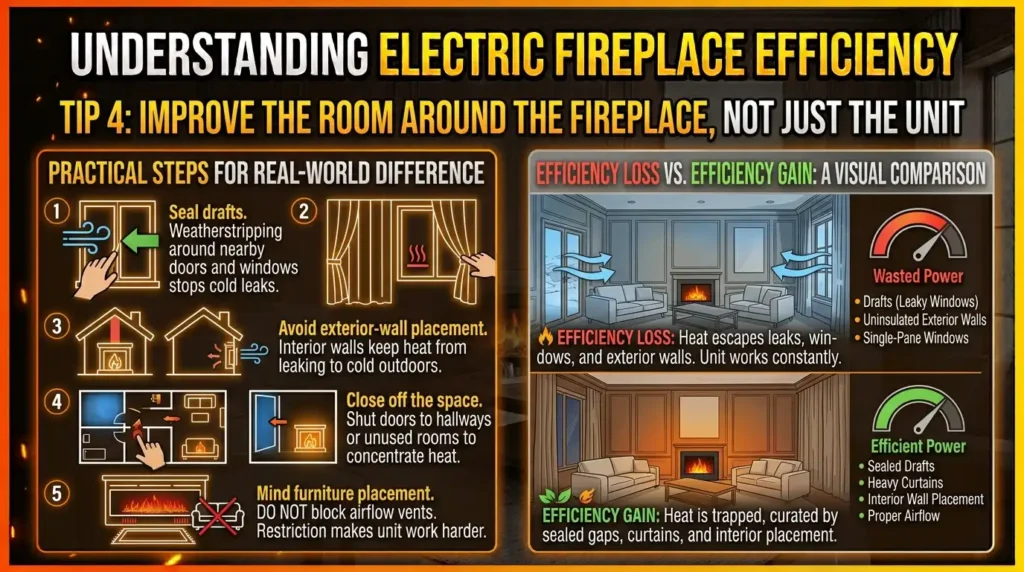
An electric fireplace can only be as efficient as the room lets it be. Heat that escapes through drafts, single-pane windows, or an uninsulated exterior wall is heat your fireplace has to keep replacing.
Practical steps that make a real difference:
- Seal drafts. Weatherstripping around doors and windows near the fireplace keeps warm air from leaking out and cold air from sneaking in.
- Use curtains strategically. Heavy curtains on nearby windows, closed at night, add a meaningful insulating layer.
- Avoid exterior-wall placement when possible. A fireplace mounted on an interior wall loses less heat to the outdoors than one on an exterior wall backed by cold air.
- Close off the space. Shutting doors to hallways or unused rooms concentrates the heat where you actually are, instead of trying to warm the whole floor plan.
- Mind furniture placement. Don’t block the airflow vents with furniture or rugs — restricted airflow forces the unit to work harder for the same result.
Tip 5: Use It for Zone Heating, Not Whole-Home Heating
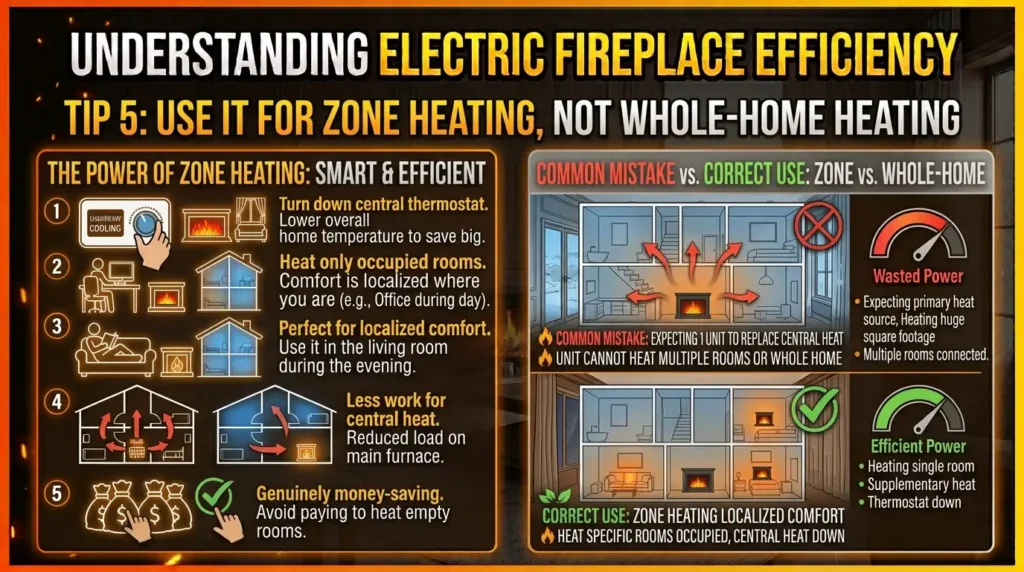
This is less a “trick” and more a mindset shift, but it’s the one that saves the most money overall.
Electric fireplaces are built for zone heating warming the specific room you’re in — not for replacing a central furnace or heat pump. Because a typical unit only produces around 3,000–5,000 BTUs (compared to the tens of thousands of BTUs a furnace or gas fireplace can put out), trying to heat multiple rooms or an entire home with one electric fireplace is where “inefficient” complaints usually come from.
Used correctly, zone heating is genuinely money-saving: turn your central thermostat down a few degrees and let the electric fireplace carry the room you’re actually occupying — the living room in the evening, a home office during the day. You heat only occupied space instead of paying to heat empty rooms.
Callout Common Mistake: Expecting one electric fireplace to replace central heat for an entire home. Even a large 1,500-watt unit is designed to supplement a single room, not act as a primary heat source for a whole house.
Tip 6: Keep the Unit Clean and Well-Maintained
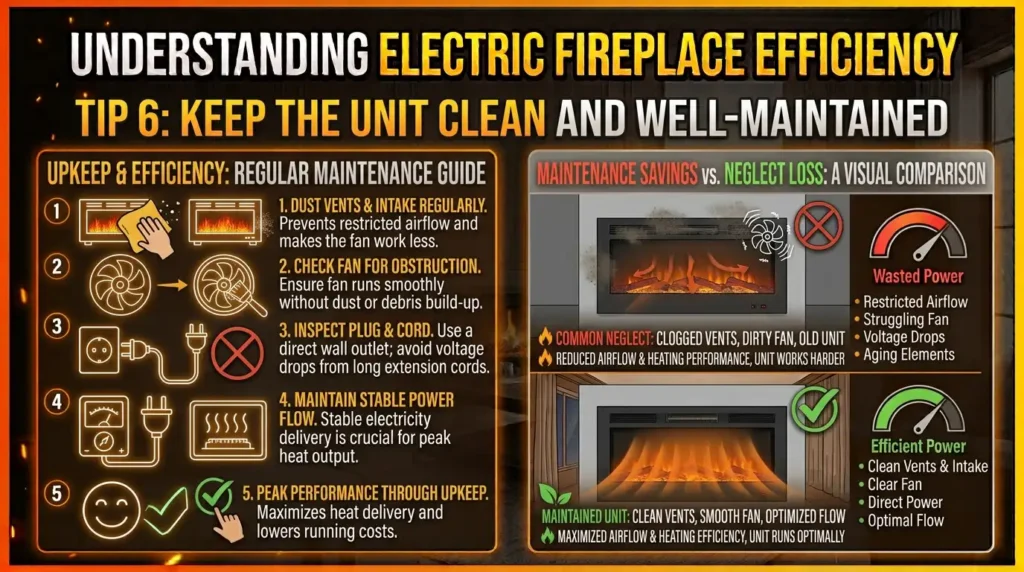
Electric fireplaces don’t need a chimney sweep, but they still need basic upkeep to run efficiently.
- Dust the vents and intake regularly. Dust buildup restricts airflow, making the fan work harder and reducing heat output.
- Check the fan for obstruction. A fan struggling against dust or debris draws more power for less airflow.
- Inspect the plug and cord. A worn outlet or extension cord can cause voltage drops that reduce heating performance — plug directly into a wall outlet when possible rather than a long extension cord.
- Update or replace aging units. Older resistive heating elements are generally less efficient than newer infrared or advanced fan-forced designs; if your unit is many years old and underperforming, an upgrade may pay for itself in lower running costs.
How to Calculate Your Own Running Cost
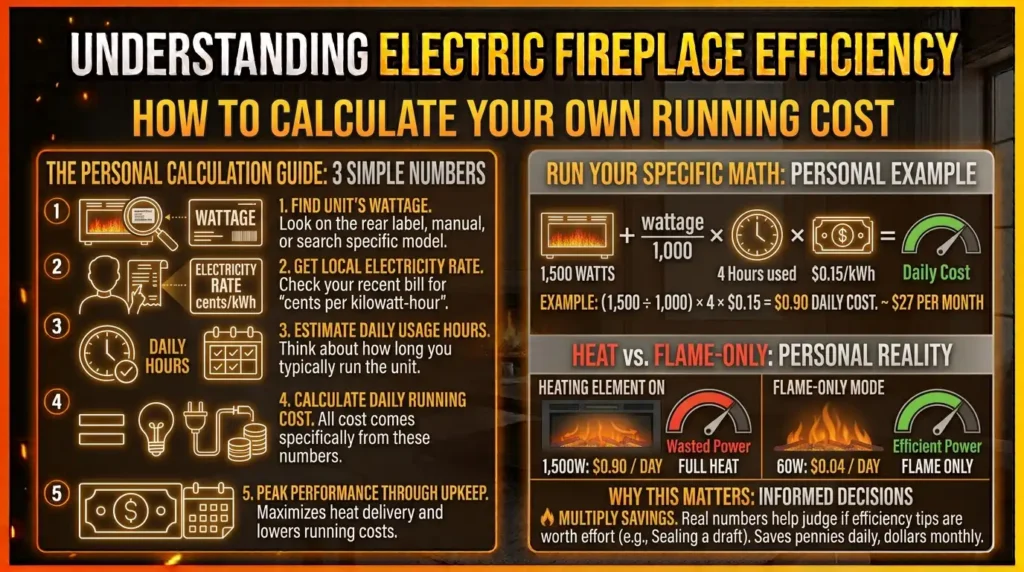
Instead of relying on general averages, it only takes a minute to work out what your specific electric fireplace actually costs you. You need three numbers: the unit’s wattage (check the label or manual), your local electricity rate in cents per kilowatt-hour (found on a recent utility bill), and how many hours a day you typically run it.
The formula: (Wattage ÷ 1,000) × Hours Used × Electricity Rate = Daily Cost
Example: A 1,500-watt fireplace run for 4 hours a day at $0.15/kWh: (1,500 ÷ 1,000) × 4 × $0.15 = $0.90 per day, or roughly $27 per month.
Run the same math on flame-only mode at 60 watts for the same 4 hours, and the cost drops to about $0.04 a day — a useful reminder of how much of the bill comes specifically from the heating element rather than the fireplace itself. Doing this calculation once with your own numbers is far more useful than any generic “average cost” figure, since local electricity rates can vary by more than double from one region to another.
Knowing your real number also makes it easier to judge whether a given efficiency tip is worth the effort. Sealing a drafty window, for instance, might only save a few cents a day on the fireplace itself — but multiplied across an entire heating season, and across every appliance affected by that draft, it adds up.
Electric vs. Gas vs. Wood: Efficiency at a Glance
| Feature | Electric Fireplace | Gas Fireplace | Wood Fireplace |
|---|---|---|---|
| Thermal efficiency | ~99% | ~70–90% (varies by unit) | Often below 15% (open masonry) |
| Heat loss via chimney/flue | None (no venting needed) | Some, depending on venting | Significant |
| Typical heat output | 3,000–5,000 BTU | 20,000–40,000+ BTU | Varies widely |
| Best used as | Zone/supplemental heat | Primary or supplemental heat | Ambiance / supplemental |
| Ongoing maintenance | Low (dusting, cord check) | Moderate (inspections) | High (chimney sweeping, wood) |
| Emissions | None | Low, but present | Higher (smoke, particulates) |
This is why “is my electric fireplace efficient” and “will it heat my whole house” are really two different questions. On thermal efficiency, electric wins outright. On raw heating power for large or multiple spaces, gas and wood-burning systems (used correctly) can output far more heat.
Myth vs Fact
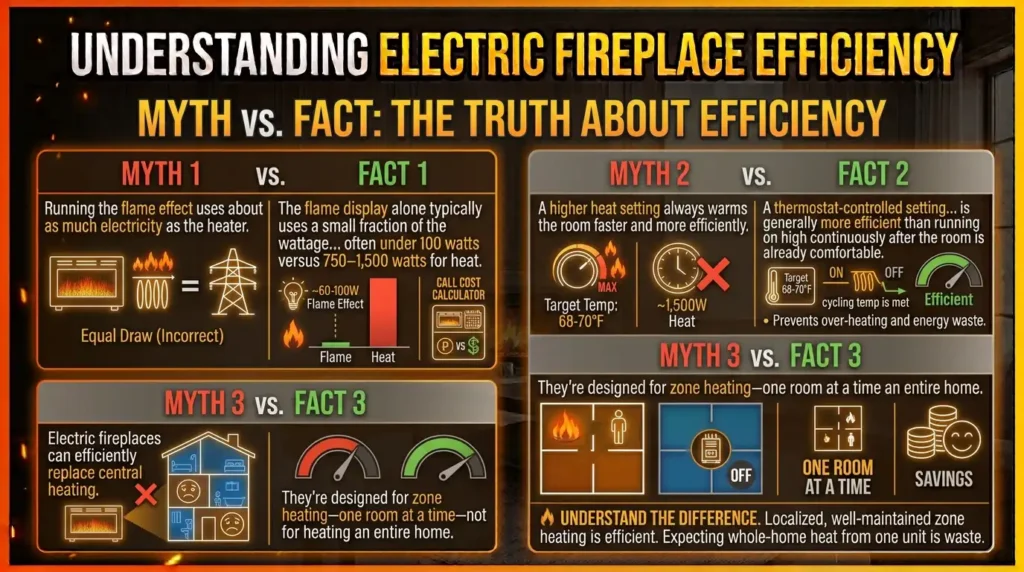
| Myth | Fact |
| Running the flame effect uses about as much electricity as the heater. | The flame display alone typically uses a small fraction of the wattage of the heating element—often under 100 watts versus 750–1,500 watts for heat. |
| A higher heat setting always warms the room faster and more efficiently. | A thermostat-controlled setting that maintains a target temperature is generally more efficient than running on high continuously after the room is already comfortable. |
| Electric fireplaces can efficiently replace central heating. | They’re designed for zone heating—one room at a time—not for heating an entire home. |
You May Also Read:
- Are There 240V Electric Fireplaces? Powerful Heat Options
- Can I Safely Install an Electric Fireplace in a Mobile Home?
FAQs:
Are electric fireplaces cheap to run?
Yes, relative to their heat output. A typical unit at 1,500 watts costs roughly $0.20–$0.25 per hour to run on high at average U.S. electricity rates, making it comparable to running a space heater.
Do electric fireplaces heat a whole house?
No. They’re built for zone heating a single room, typically up to around 400 square feet. They work best as a supplement to central heating, not a replacement for it.
What setting should I use on my electric fireplace to save energy?
Use the thermostat function set to your desired room temperature rather than a fixed “high” setting and turn off the heater (keeping only the flame effect) once the room is comfortable.
Is it cheaper to run an electric fireplace or central heat?
For heating just one occupied room, an electric fireplace is often cheaper than running a whole-home furnace or heat pump to warm the entire house. For heating multiple rooms at once, central heating is typically more cost-effective.
How do I get more heat from my electric fireplace?
Make sure the wattage matches your room size, keep vents unobstructed, close doors to concentrate heat, reduce drafts near windows and exterior walls, and keep the unit’s fan and vents free of dust.
How many watts does an electric fireplace use per hour?
Most residential models use between 750 and 1,500 watts on the heat setting, and as little as 30–100 watts when only the flame effect is running.
Do electric fireplaces raise your electric bill a lot?
Used as intended for zone heating a single room rather than continuous whole-home heating the added cost is usually modest and can be offset by turning down the central thermostat while it’s running.
Why is my electric fireplace not warming the room?
Common causes include an undersized unit for the square footage, blocked vents, drafts from nearby windows or doors, or running only the flame effect without the heater engaged.
Do electric fireplaces need maintenance to stay efficient?
Yes, though it’s minimal: periodically dust the vents and fan, check the power cord and outlet, and avoid extension cords when possible.
Is an electric fireplace insert more efficient than a standalone unit?
Inserts and standalone units use similar heating technology, so efficiency mainly comes down to wattage, room fit, and usage habits rather than the format itself.
Can I run my electric fireplace all day without wasting energy?
You can, but it’s more efficient to use a thermostat setting and/or a timer so the unit cycles or shuts off once the room reaches a comfortable temperature, rather than running continuously on a fixed high setting.
Quick Efficiency Checklist
- Confirm your fireplace’s wattage matches your room’s square footage
- Use the thermostat setting instead of a fixed high setting
- Turn off the heater (flame-only) when you don’t need warmth
- Seal drafts around nearby windows and doors
- Close doors to concentrate heat in the occupied room
- Keep vents and the fan free of dust
- Avoid long extension cords; plug directly into the wall
- Use it for zone heating and lower your central thermostat while it runs
My Final Thought:
An electric fireplace is already one of the most thermally efficient heating appliances you can plug in the real opportunity for savings is in how it’s set up and used. Match the wattage to the room, lean on the thermostat instead of constant high heat, separate the flame effect from actual heating, tighten up drafts nearby, treat it as zone heat rather than a furnace replacement, and keep it clean. Together, these six changes typically add up to a noticeably warmer room and a smaller dent in your energy bill no upgrade required.