Why Is my electric fireplace blowing cold air? 7 Causes and Fixes
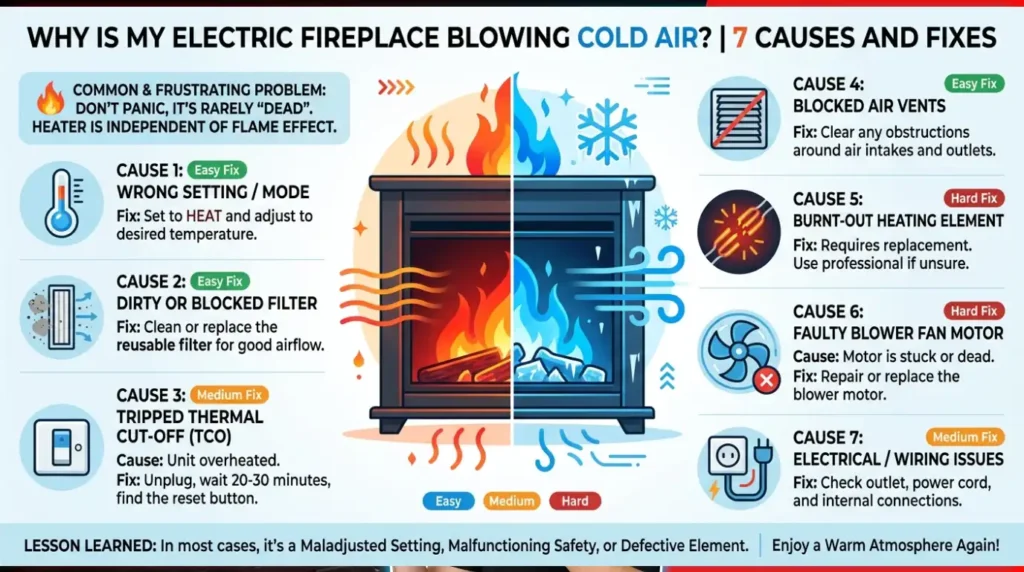
Why Is My Electric Fireplace Blowing Cold Air? You turn your electric fireplace on waiting to get a warm atmosphere and all you get is a fan of chilled air. It is a weirdly frequent lament, and the good news is that it is practically never an indicator that your entire unit is dead. Electric fireplaces do not tie the flame effect to the heater; thus, it is even possible to have a lovely, blazing fire that extinguishes zero heat.
Lesson learned: In the vast majority of instances, an electric fireplace that blows cold air reduces to one of three options: a maladjusted setting, a malfunctioning safety feature, or a defective heating element. This guide will take you through each of the seven causes, the difference between them and precisely what should be done about each.
Is It Normal for an Electric Fireplace to Blow Cold Air at First?
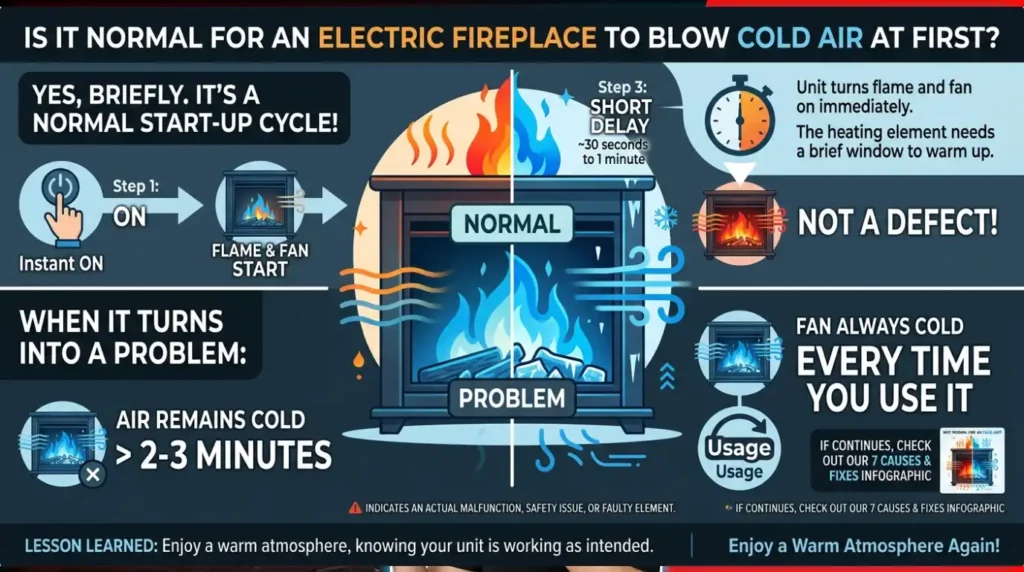
Yes, briefly. The majority of electric fireplaces turn the flame effect and the fan that blows on them the instant you switch them on but waits anywhere between a few seconds to approximately a minute to turn the heating element on. That little window of cool or room-temperature air is not anything out of the ordinary and is not a defect.
When it turns into a problem: when the air remains cold longer than two or three minutes or the fan becomes cold each and every time you use the unit, then, indeed, something is going on.
Quick Diagnostic Table” Why Is My Electric Fireplace Blowing Cold Air?”
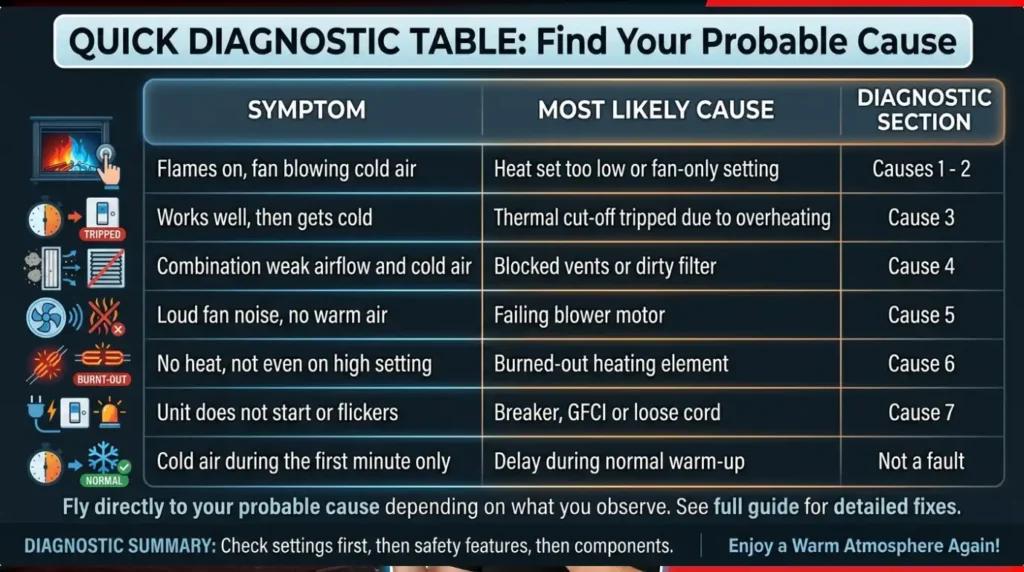
The following table will allow you to fly directly to your probable cause depending on what you observe.
| Symptom | Most Likely Cause | Section |
| Flames on, fan blowing cold air | Heat set too low or fan-only setting | Causes 1 – 2 |
| Works well, then gets cold | Thermal cut-off tripped due to overheating | Cause 3 |
| Combination weak airflow and cold air | Blocked vents or dirty filter | Cause 4 |
| Loud fan noise, no warm air | Failing blower motor | Cause 5 |
| No heat, not even on high setting | Burned-out heating element | Cause 6 |
| Unit does not start or flickers | Breaker, GFCI or loose cord | Cause 7 |
| Cold air during the first minute only | Delay during normal warm-up | Not a fault |
7 Common Reasons Your Electric Fireplace Blows Cold Air
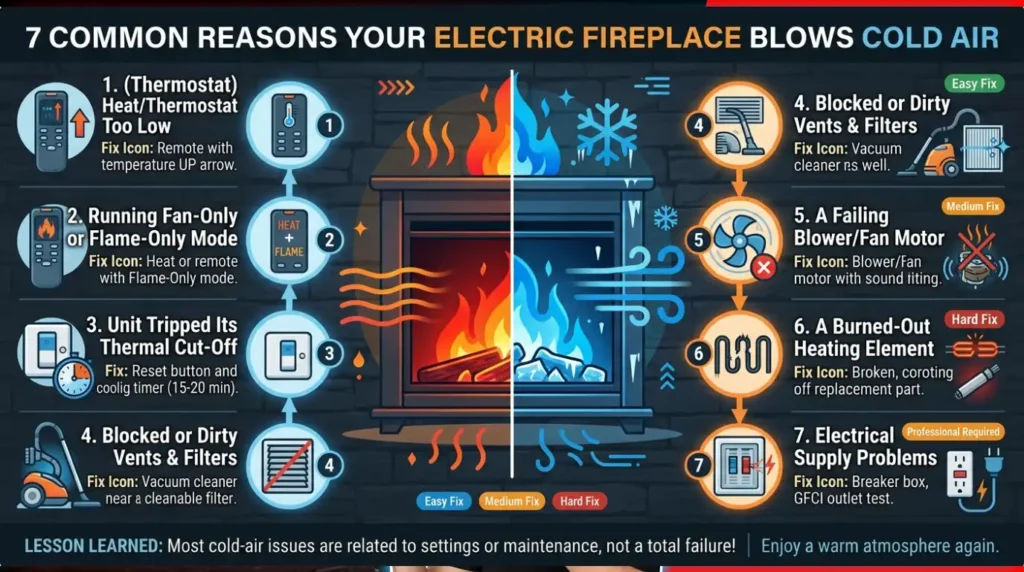
1. The Heat or Thermostat Is Turned Too Low.
This is by far the most common cause, and the easiest to fix. Lots of electric fireplaces have an inbuilt thermostat that measures the ambient room temperature against your desired temperature. When the room is already near or hotter than your desired temperature, the heater will just not be started up even though the flames will still be burning.
How to Fix: Use the thermostat dial or remote control and adjust it to a few degrees higher than the present room temperature and allow some time to elapse, say two to three minutes. When warm air comes on that proves the thermostat logic, and not a failed component, was the problem.
2. It’s Running in Fan-Only or Flame-Only Mode
The majority of contemporary units allow you to operate the flame visual and the fan separately of the heater, commonly referred to as flame-only or ambiance mode. It is a really practical quality during warmer weather, yet an easy switch to knock against an out-of-place remote.
How to Fix: Check your mode button or remote display. Go through the settings until you are in the heat or flame + heat and not flame or fan.
3. The Unit Tripped Its Thermal Cut-Off (Overheat Protection)
All electric fireplaces contain a thermal safety switch which disconnects the heating unit – but in many cases, maintains the flame and fan on – in case the internal temperatures increase excessively. This is not a defect but rather a fire-preventing feature.
How to Fix: Unplug the unit and allow it to cool down (15-20 minutes) and then plug it in again. Should it become overheated once again, ensure that the airflow is not blocked (see Cause 4) before attempting to use it again.
4. Blocked or Dirty Vents and Filters
Electric fireplaces should have vents of clear intake and exhaust to circulate air over the heating element. The accumulation of dust, furniture in the vicinity, curtains or a rug that is pressed to the base may inhibit airflow to the extent of activating the thermal cut-off or just reducing heat generation.
How to Fix: Maintain a minimum distance of 3 feet between the vents. Vacuum the intake and exhaust grilles, and in the case of your model, a replaceable filter (standard on Dimplex Purifire units) rinse or replace.
5. A Failing Blower/Fan Motor
When the fan does not sound right, is grinding or switches on and off without any warning, the blower motor itself might be getting tired. A weak motor is not strong enough to push enough air across the heating element to heat it, and so you experience a lot of cold air although technically, the heating element is running.
How to Fix: Hear grinding or rattling. When it exists, this usually involves a new blower assembly- not a DIY set up change.
6. A Burned-Out Heating Element
The vast majority of electric fireplaces have either a ceramic (ptc) heating element or an infrared quartz element. Such components wear out and are abused over time, particularly in machines that operate day in day out during winter. The dead element provides that the fan will blow air, but never heat, regardless of the thermostat setting.
How to Fix: Once causes 1-4 have been eliminated, the most likely cause of the unit not heating is the element itself. Others are sold separately by the manufacturers; in sealed or older models, it is often more convenient to have a professional repair or replacement of the fireplace.
7. Electrical Supply Problems (Breaker, GFCI, Loose Cord)
Electric fire places usually consume 12-15 amps on a normal 120 V. The unit can start running the fan on the leftover power when a partially tripped GFCI outlet, a loose plug, or a shared circuit with other high-draw appliances result in the heating element (which requires more current) not being energized.
How to Fix: Directly plug the fireplace into a wall outlet (not a power strip or extension cord), test the outlet with a different appliance, and verify your breaker panel that a GFCI switch was tripped.
Step-by-Step: How to Fix an Electric Fireplace Blowing Cold Air
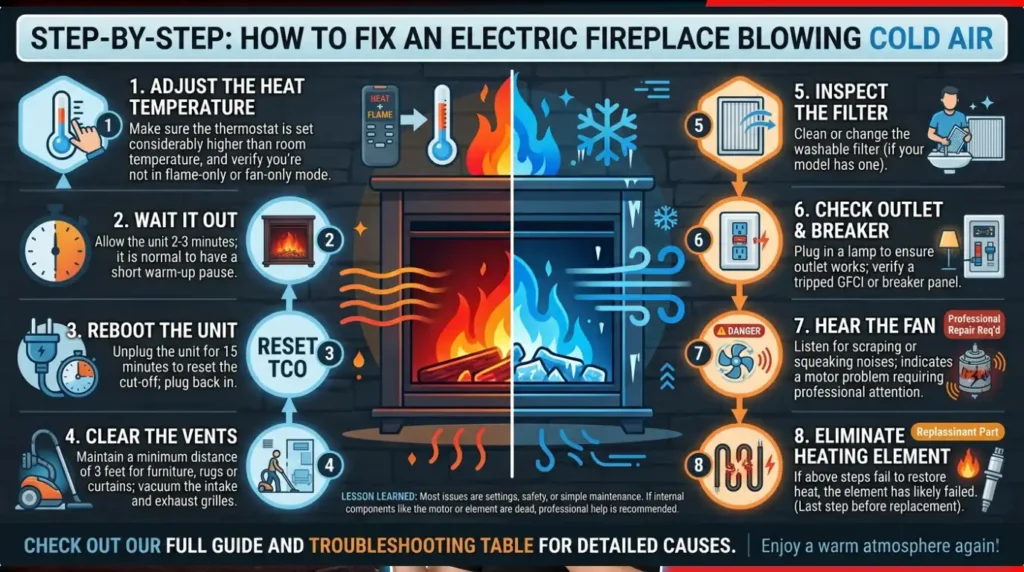
- Adjust the heat temperature. Make sure to adjust the thermostat considerably higher than the room temperature and that you are not in flame-only or fan-only mode.
- Wait it out. Allow the unit 2-3 minutes; it is normal to have a short warm-up pause.
- Reboot the unit by unplugging it 15 minutes to reestablish the thermal cut-off and reattach it.
- Clear the vents. Makes furniture, rugs or curtains available as well as vacuums the grilles (within 3 feet).
- Inspect the filter. Clean or change one (assuming your model has one).
- Check outlet and breaker. Plug in a lamp to ensure outlet is working and check a tripped GFCI or breaker.
- Hear the fan. Scraping or squeaking noises to a motor problem that requires professional attention.
- Eliminate heating element as the final step. In case the above fails to restore heat, then the element has probably failed.
Brand-Specific Quirks
| Brand | Known Quirk | What to Check First |
| Dimplex (with Purifire models) | Has an air filter that is washable and can turn off heating with a clogged filter silently | Take out and rinse the Purifire filter |
| Dimplex | Heat setting and flame brightness can be set on the same dial, which can result in accidental fan-only operation | Make sure the mode dial is set on “heat” and not only flame |
| Dimplex | Smaller portable sizes are very dependent on the thermal cut-off as a safety measure | Allow it to cool down for 20 minutes before declaring it broken |
Remote-based thermostat sensor may drift out of calibration over time Remote-based thermostat sensor may drift out of calibration over time Compare the room temp as shown on the fireplace display to a real room thermometer Compare the room temp shown on the fireplace display to a real room thermometer
DIY Fix or Call a Pro? Cost and Difficulty Breakdown
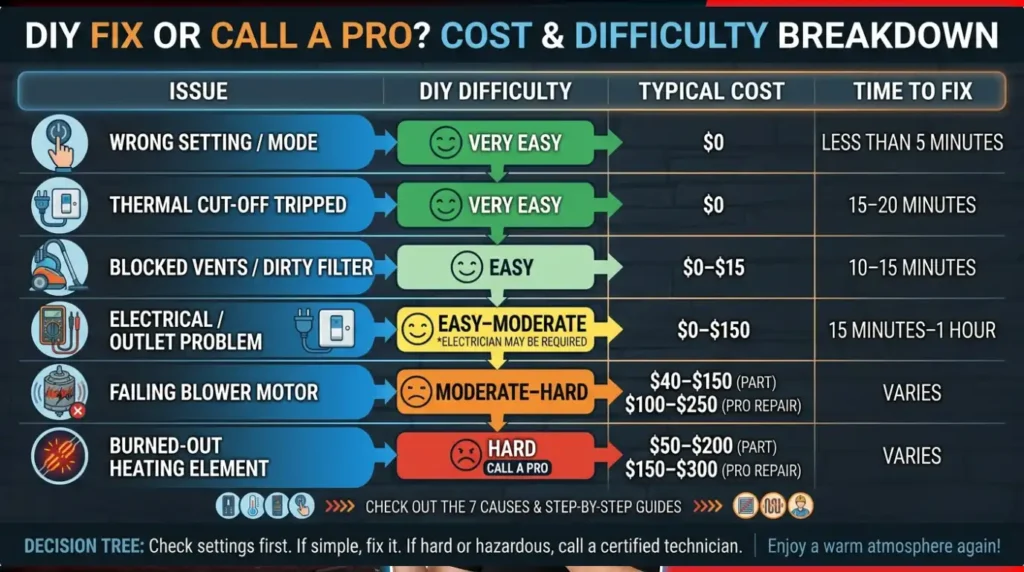
| Issue | DIY Difficulty | Typical Cost | Time to Fix |
| Wrong setting / mode | Very easy | $0 | Less than 5 minutes |
| Thermal cut-off tripped | Very easy | $0 | 15–20 minutes |
| Blocked vents / dirty filter | Easy | $0–$15 | 10–15 minutes |
| Electrical / outlet problem | Easy–Moderate | $0–$150 (electrician may be required) | 15 minutes–1 hour |
| Failing blower motor | Moderate–Hard | $40–$150 (part) or $100–$250 (pro repair) | Varies |
| Burned-out heating element | Hard | $50–$200 (part) or $150–$300 (pro repair) | Varies |
Costs are approximate prices depending on average replacement-part prices and independent-technician prices; always check with your fireplace manufacturer or a licensed technician before buying parts.
Myth vs Fact
| Myth | Fact |
| “If the flames work, the fireplace is fine.” | The flame effect and heater are separate systems — flames can run perfectly with zero heat output. |
| “Cold air always means it’s broken.” | A brief cold-air period on startup is a normal, built-in delay on most models. |
| “A blowing fan means the heating element is working.” | The fan can run independently of the heating element, especially in fan-only mode. |
| “Electric fireplaces don’t need maintenance.” | Vents and filters still collect dust and need periodic cleaning to keep the heater working. |
How to Prevent This from Happening Again
- Filter and empty vacuum every 4-6 weeks during high use season.
- Maintain a minimum of 3 feet of space around unit.
- Do not use a power strip, plug directly into a wall outlet.
- Do not leave the heater on long hours without a break, particularly with old models.
- Check the heat feature every beginning of each cold season and not only when you require it.
You May Also Read:
- 7 Powerful Reasons Electric Fireplaces Aren’t Tacky
- 6 Powerful Tips to Maximize Electric Fireplace Efficiency
FAQs:
Why does my electric fireplace blow cold air and the fire still functions?
Since both the flame display and heater are two distinct systems. The heat can be turned off by a low thermostat setting, by setting it to fan-only, or by turning on a tripped thermal cut-off, without affecting the flame effect.
Why does my electric fireplace just blow cold air a minute then heat up?
It is an inherent lag in most models, allowing the heating element to come on once the fan is on. It is no big deal and not a vice.
What is the time expected to take an electric fireplace to begin to blow warm air?
Usually less than two minutes. In case it takes much longer or never heats up, eliminate the causes above beginning with the thermostat setting.
Will a dirty filter indeed prevent an electric fireplace to heat?
Yes. A blocked filter will inhibit air passing over the heating element, and this may cause the overheat alarm to be activated, and the heater turned off, with the fan continuing to run.
Is it safe to continue using an electric fireplace that blows cold air?
Yes, in a way that it is not generating undesirable heat, but when it is cutting off its thermal cut-off every now and then, that is indicative of limited airflow that ought to be eliminated prior to normal operation.
Why does my Dimplex electric fireplace force cold air out in particular?
Dimplex Purifire models employ an air filter that can be washed and in case it becomes clogged, the heating operation was shut off as a precautionary measure. The first thing is to check and clean the filter.
My electric fireplace was heating yesterday and is blowing cold air today, what happened?
Sudden onset normally indicates a tripped thermal cut-off since the last time it was used, a setting that was altered by mistake on the remote, or covered vents by an object moved close to the unit.
Does an electric fireplace have to heat as a furnace?
Not so literally as a furnace, but most of the units do have a delay with their internal operation before a heating element is activated, which can seem like it.
Is it possible to change the heating element?
In certain models the component is a removable component; in others it is a sealed-in component. Look in your owner manual, and in case it is not easily available, employ a professional technician in order not to void your warranty or destroy wiring.
Why does my remote turn on and tell me that the heating is on, yet I still feel cold air?
This normally indicates a hardware problem such as a tripped thermal cut-off, a broken blower motor or a burnt heating element as opposed to an issue with the settings, as the settings are already adjusted.
Is it natural that an electric fireplace blows cold air during summer?
Yes – lots of you switch on the flame effect and turn off the heat deliberately in summer in flame-only or fan-only mode. That is not abnormal, but a normal behavior.
When should I contact the manufacturer instead of troubleshooting myself?
If you’ve ruled out settings, dust, bulbs, and a firmware reset, and the flame still won’t work or if opening the unit would void your warranty. it’s time to contact support.
Is a non-moving flame always a sign something’s wrong?
No. Some electric fireplace models use a fixed LED panel design rather than a rotating rod, so a static flame is normal on those units. Check your model’s specifications.
Does unplugging my electric fireplace reset the flame effect?
Yes, a full 60-second unplug is the standard way to force a hard reset on units with digital controls, and it resolves many freeze-related flame issues.
Why is my flame moving unevenly or jerkily instead of smoothly?
This points to the rotating motor or reel struggling, often due to dust, debris, or early motor wear rather than a full failure.
Can I replace the flame bulbs myself?
In most models, yes, if you follow the manual’s access-panel instructions and use the exact bulb type specified. If the unit is sealed or still under warranty, check warranty terms before opening it.
What’s the safest way to clean the inside of my fireplace?
Always unplug the unit and let it cool first. Use a dry, soft microfiber cloth or a vacuum with a brush attachment avoid liquid cleaners near the bulbs and wiring.
Why does my flame look the wrong color?
This is usually a color setting that’s been changed, either accidentally on the remote or through a night-mode or ambiance setting. Check your remote’s color options first.
Key Takeaways
- It is normal to have a short cold-air period when starting up; a duration longer than a couple of minutes is normally indicative of a genuine problem.
- Troubleshoot settings (thermostat, mode) first, there are other parts that may be wrong.
- The thermal cut-off switch is not a fault but a safety measure, and is usually solved by a 15 minute cool-down.
An obvious cause of no-heat complaints often missed is blocked vents and dirty filters.
Only the following causes on the list are likely to involve paid repair: a failed blower motor or an element in the heating system that burns out. - Select your particular symptom on the diagnostic table above to go directly to the correct repair.