Why Is My Electric Fireplace Too Loud? Reasons, Solutions, and When to hire an expert.
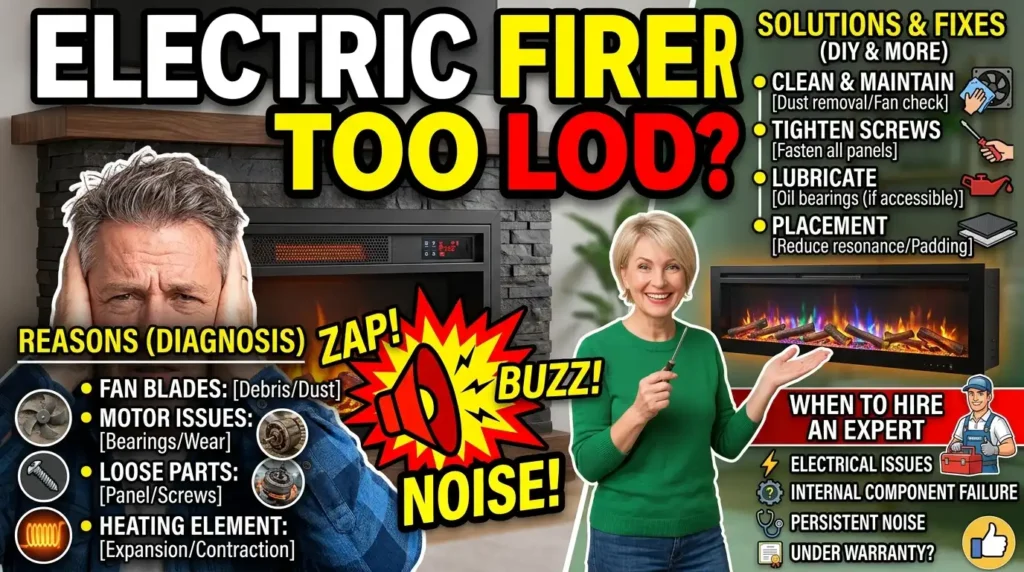
An electric fireplace must not be loud; it must be cozy and, in the background, not in competition with your TV. When yours has become noisier over the years – or was noisy when new – you are in the midst of one of a few easy-to-detect, easy-to-fix issues.
In short, most loud electric fireplaces are noisy due to dust in the fan, loose internal panels or screws, a worn-out fan motor, or an uneven installation surface. The normal sound is a soft hum or a crackle here and there; grinding, rattling, buzzing or clicking will normally indicate something to be cleaned, tightened or replaced.
Key Takeaways
- The humming or whoosh of the fan is not a defect, but normal.
- Loud rattling, buzzing, grinding or clicking can be grouped into five main causes: dust, loose parts, worn fan motor, uneven placement, or electrical fault.
- The majority of causes can be resolved at home within 30 minutes and using simple tools.
- Fan-driven fireplaces are noisier, by nature, than infrared or water-vapor models that have minimal or no moving components.
- Electrical safety concerns, such as burning smells, sparks or a tripped breaker, unplug the unit and call a technician.
Is Some Noise Normal?
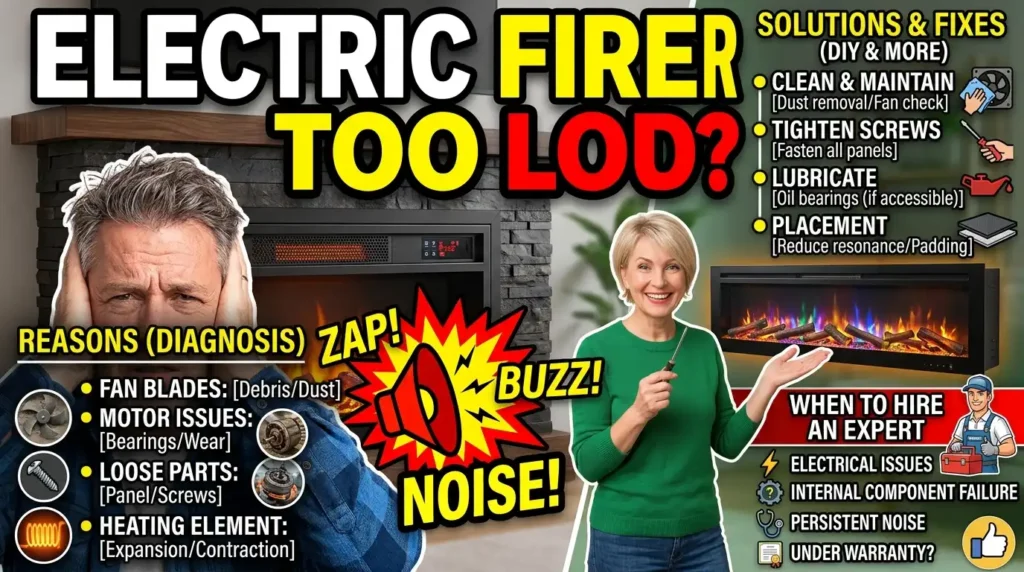
Yes. Electric fireplaces aren’t silent, and they aren’t supposed to be. Two types of noises are normal: a humor whoosh of a fan, because most units have a fan-forced heater and it will always make some noise, and a slight popping or crackling, due to an internal ember bed or speaker effect that simulates a real fire.
To compare, a fan on low power will usually sound more or less like a silent library, with a high power being more or less like normal speaking. Should the sound in your fireplace meaningfully increase, or does it not sound the way it did recently, you should take a look into it.
How an Electric Fireplace Actually Works (and Why That Matters for Noise)?
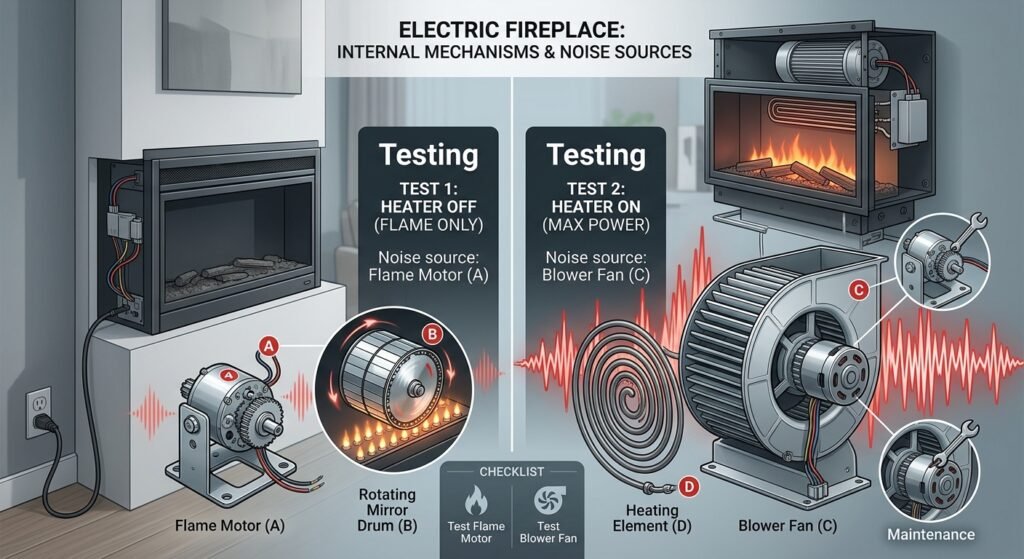
The vast majority of electric fireplaces operate two independent systems simultaneously, and either of them could be a sound source. The flame effect system operates a tiny motor that causes mirrors to rotate or moves a light source to appear to flicker like a flame – the system usually runs when the unit is on, even without the heater on. The warm air enters the room via the heating system, which blows past a heating element and out through a blower fan – nearly always the noisiest single element.
Their independence allows testing them individually: the presence of a rattle with the heater on only indicates the presence of the fan, whereas the presence of a noise even with the heater off only indicates the presence of the flame motor. This difference is reiterated in the checklist below.
Normal vs. Problem Noise at a Glance
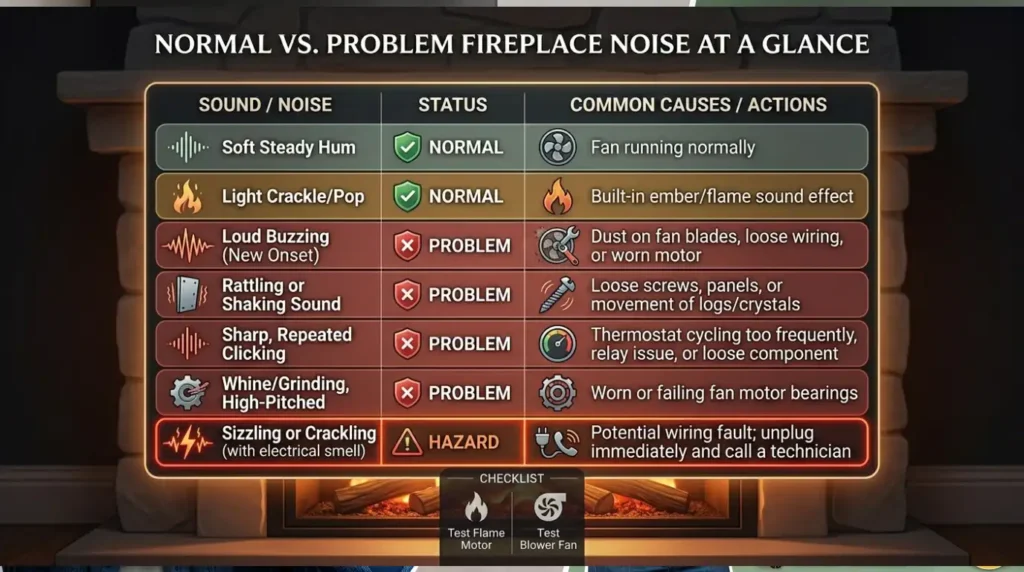
| Sound / Noise | Normal or Not Normal? | What It Normally Is / Cause |
| Soft steady hum | Yes | Fan running normally |
| Light crackle/pop | Yes | Built-in ember/flame sound effect |
| Loud buzzing (new onset) | No | Dust on fan blades, loose wiring, or worn motor |
| Rattling or shaking sound | No | Loose screws, panels, or movement of logs/crystals |
| Sharp, repeated clicking | Typically not | Thermostat cycling too frequently, relay issue, or loose component |
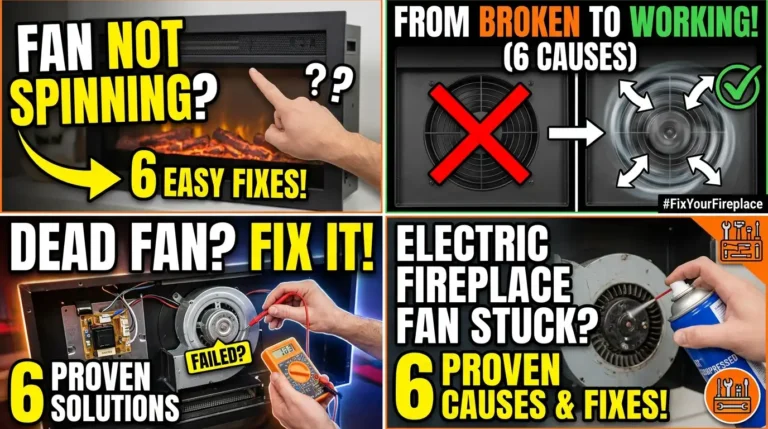
| Whine/grinding, high-pitched | No | Worn or failing fan motor bearings |
| Sizzling or crackling (with electrical smell) | No (Hazard) | Potential wiring fault; unplug immediately and call a technician |
Why Is My Electric Fireplace So Loud? 8 Common Causes
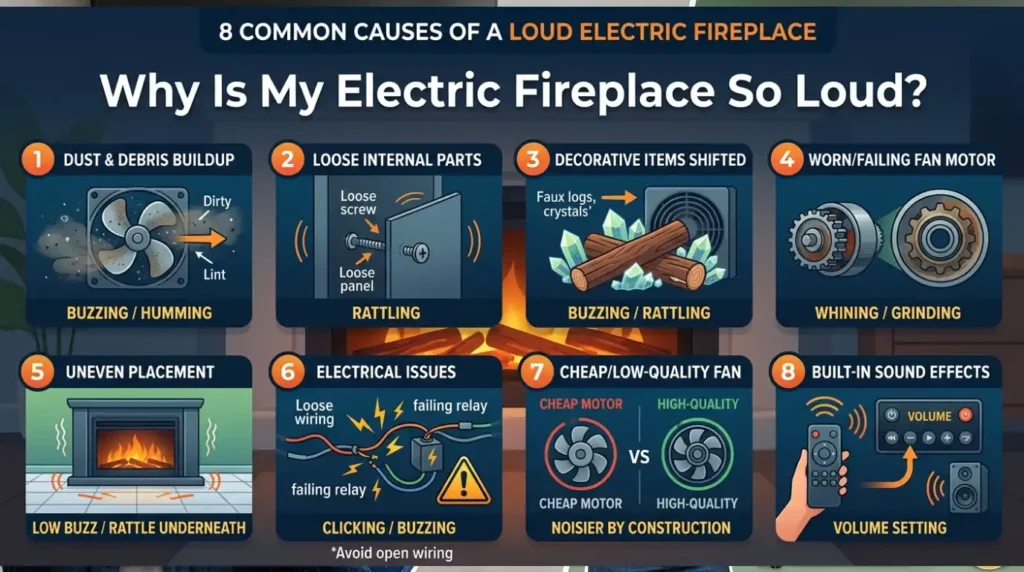
1. Dust and Debris Buildup in the Fan
This is the most prevalent cause of noisy electric fireplace. Fan-forced units use vents to draw room air into the system to cool internal parts and to force heat out. The same airflow carries dust, pet hair, and lint, which deposits unevenly on the fan blades. Blades that are unequally coated lose their balance, thus, the wobbling begins making a buzzing or humming noise, which increases in volume as more debris accumulates. This accumulation is more rapidly experienced in households that have pets or forced-air heating.
2. Loose Internal Parts (Screws, Panels, Brackets)
When the fan or heating element is turned on, electric fireplaces shake a little. With months of usage, that vibration can loosen the screws connecting the side panels, the front grille or brackets located internally. A rattle is a vibration when something is loose. It is particularly prevalent when a fireplace has been relocated as transportation is likely to shake hardware that was initially tightened in the factory.
3. Decorative Logs, Crystals, or Embers Have Shifted
When your model has faux logs, glass crystals, or a pebble bed over the flame projector, they may be displaced during shipping, transportation or even during normal operation. A crystal that is against the fan housing or a log on the heater vent will buzz or rattle each time the unit is running. This reason is hard to neglect as the noise may be similar to some fan issue, although the fan itself is totally alright.
4. A Worn or Failing Fan Motor
Fan motors bearings wear out with age and usage. A motor that is nearing the end of its life normally makes a whiner, a grinding noise or a whirring that becomes louder and louder with time. This usually occurs more frequently in units which have been in operation several seasons of heating, especially when the fan has never been serviced. As opposed to dust or loose-part noise, motor wear is more likely to be progressive – it begins mild and gradually increases in severity during weeks, instead of manifesting itself abruptly.
5. Uneven or Unstable Placement
When the fireplace (or the media console/insert it is mounted in) is not level, or placed on an unsteady surface, the entire unit can vibrate against the floor or cabinet whenever it is activated. This can be heard as a low buzz or rattle underneath the unit and not inside the unit. This vibration is transmitted and amplified in hard flooring surfaces such as tile or hardwood much more than in carpet.
6. Electrical Issues (Loose Wiring or a Failing Relay)
The clicking noises are usually the relay of the thermostat turning the heater on and off again – perfectly normal. However, clicking rapidly, loudly, or unevenly, or any buzzing that appears to originate in the wiring and not in the fan, may be a sign of a loose connection, or of a defective relay. This is the only category in which DIY troubleshooting must end with look and listen – do not open up wiring on your own. The connection of the loose plug may also give a faint buzz at the outlet itself and is worth listening to.
7. Cheap or Low-Quality Fan Design
Fan motors are not all constructed alike. Even under the condition of everything being clean and in place, budget units will occasionally install lower-quality fans that are merely noisier by construction. Having a noisier fireplace than you desire, even when it was new, could be the cause of the problem and not a repairable defect.
8. Built-In Sound Effects Set Too High
Others, such as the Kustom K-1000, have adjustable crackling or fire-sound effects via a small speaker. When this setting is switched on, it may sound like a fault is occurring when it is actually a volume setting. Before assuming that you have a mechanical issue, you should check your remote or control panel, and there is a sound or effects setting.
How to Diagnose the Noise: A Step-by-Step Checklist?
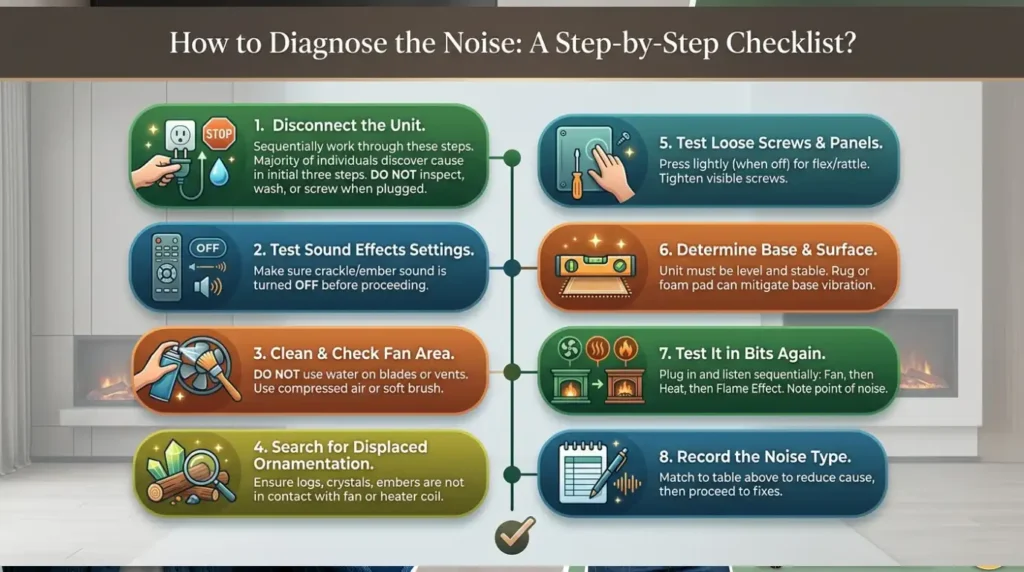
Sequentially work through these steps. The majority of individuals discover the cause in the initial three steps.
- Disconnect the unit. Do not inspect, wash or screw anything when in a plugged position.
- Test the sound effects settings. Before proceeding, make sure that the sound of crackle / ember is turned off.
- Clean and check fan area. Do not use water on the blades or vents, use a soft brush or compressed air.
- Search for displaced ornamentation. Make sure that logs, crystals or embers do not come into contact with fan, or heater coil.
- Test loose screws and panels. Press on panels (when off) lightly, they should not flex or rattle, tighten visible screws.
- Determine the base and surface. Make sure the unit is level and stable; a rug or foam pad may mitigate base vibration.
- Test it in bits again, plugging in and listening first the fan, then heat, then flame effect, and at what point does it begin to make noise.
- Record the type of noise. Find it on the table above to reduce the cause and then proceed to fixes.
How to Fix a Loud Electric Fireplace?
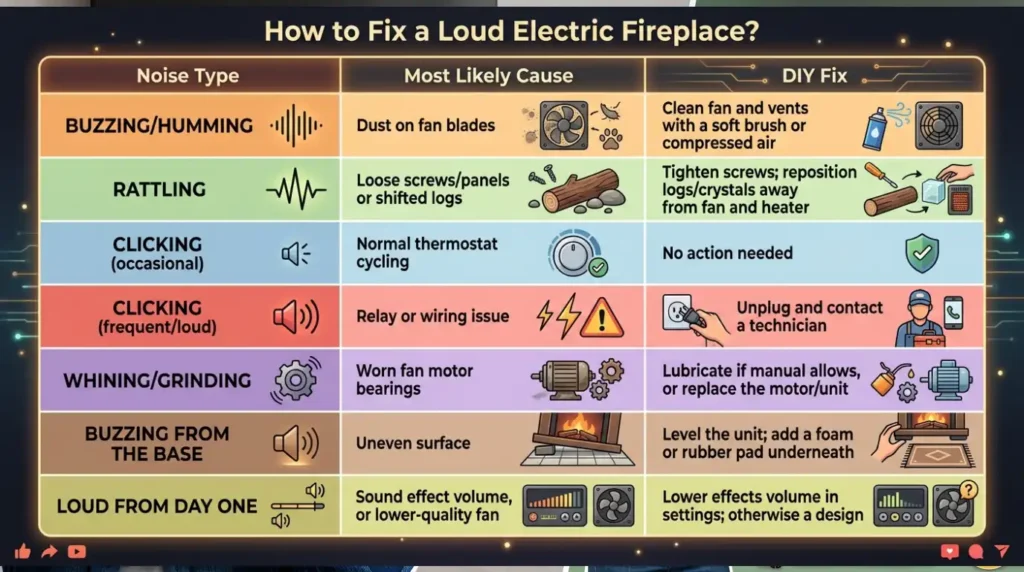
| Noise Type | Most Likely Cause | DIY Fix |
| Buzzing/humming | Dust on fan blades | Clean fan and vents with a soft brush or compressed air |
| Rattling | Loose screws/panels or shifted logs | Tighten screws; reposition logs/crystals away from fan and heater |
| Clicking (occasional) | Normal thermostat cycling | No action needed |
| Clicking (frequent/loud) | Relay or wiring issue | Unplug and contact a technician |
| Whining/grinding | Worn fan motor bearings | Lubricate if manual allows, or replace the motor/unit |
| Buzzing from the base | Uneven surface | Level the unit; add a foam or rubber pad underneath |
| Loud from day one | Sound effect volume, or lower-quality fan | Lower effects volume in settings; otherwise a design limitation |
Fixes You Can Do Yourself
- Clean the fan and vents. Unplug, clean with a brush attachment or compressed air and wipe down the accessible surfaces with a dry cloth. Repeat every 1–3 months.
- Tighten loose hardware. Simple screwdriver works on side panel, front grille, and any brackets that are visible.
- Reposition decorative elements. Ensure that nothing is resting against the fan housing, the heater coil or flame projector.
- Level the unit. Place a small level upon the fireplace and any console around it; pad with felt pads or shims, where necessary.
- Add vibration dampening. The unit is mounted on a thin foam or rubber pad that minimizes noise that would be passed to the floor.
- Change settings. Find an independent volume control on crackling or ember sound effects.
When to Call a Professional
Contact a licensed electrician or a service line at the manufacturer in case you observe: the presence of a burning smell, smoke or sparks; the unit is tripping a breaker; the buzzing appears to be coming from the wiring and not the fan; the grinding persists despite cleaning; or the unit is still under warranty, as repairing it yourself will cancel the warranty.
Fan-Forced vs. Infrared vs. Water Vapor: Which Is Quietest?
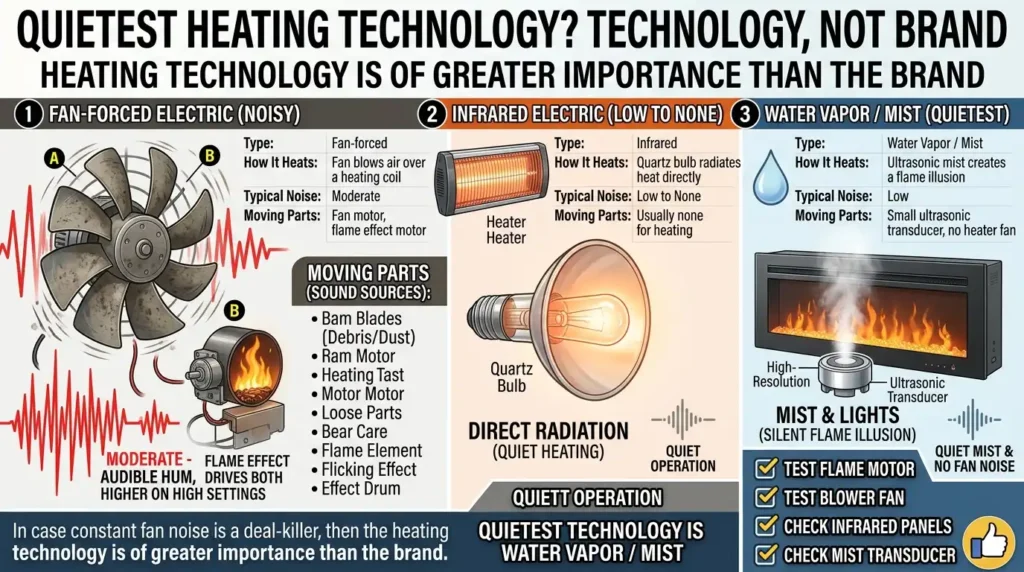
In case constant fan noise is a deal-killer, then the heating technology is of greater importance than the brand.
| Type | How It Heats | Typical Noise Level | Moving Parts |
| Fan-forced electric | Fan blows air over a heating coil | Moderate — audible hum, higher on high settings | Fan motor, flame effect motor |
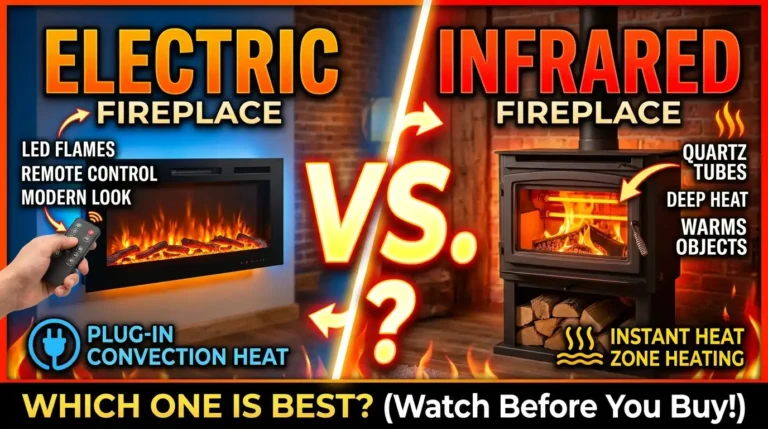
| Infrared electric | Quartz bulb radiates heat directly | Low to none | Usually none for heating |
| Water vapor/mist | Ultrasonic mist creates a flame illusion | Low | Small ultrasonic transducer, no heater fan |
IR and water-vapor models can be considered in case you want ambiance with a little or no sounding fan, as they do not have a fan or use a much quieter system.
Electric Fireplace Too Loud? Myth vs. Fact
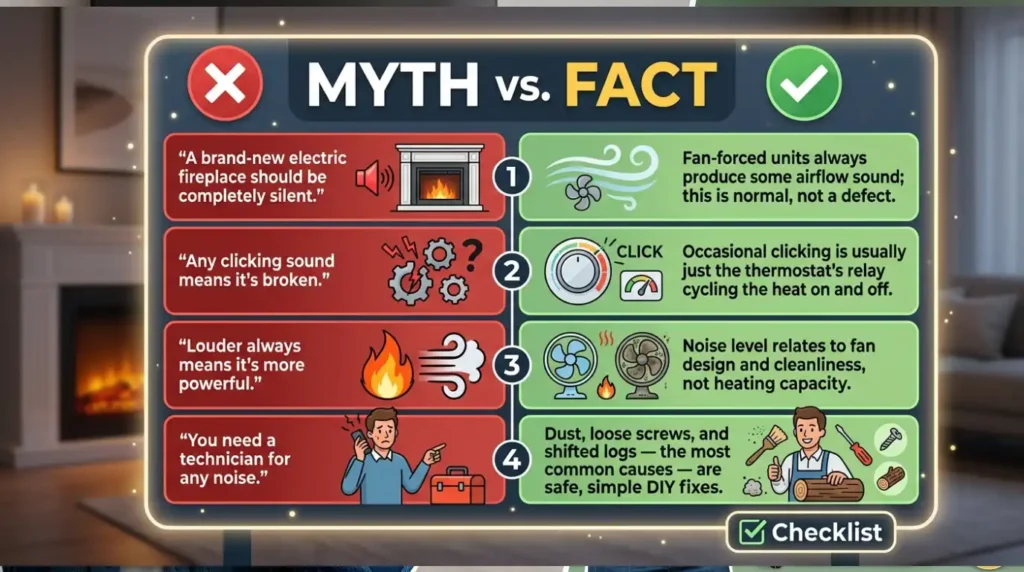
| Myth | Fact |
| “A brand-new electric fireplace should be completely silent.” | Fan-forced units always produce some airflow sound; this is normal, not a defect. |
| “Any clicking sound means it’s broken.” | Occasional clicking is usually just the thermostat’s relay cycling the heat on and off. |
| “Louder always means it’s more powerful.” | Noise level relates to fan design and cleanliness, not heating capacity. |
| “You need a technician for any noise.” | Dust, loose screws, and shifted logs — the most common causes — are safe, simple DIY fixes. |
Maintenance Schedule to avoid future noise.
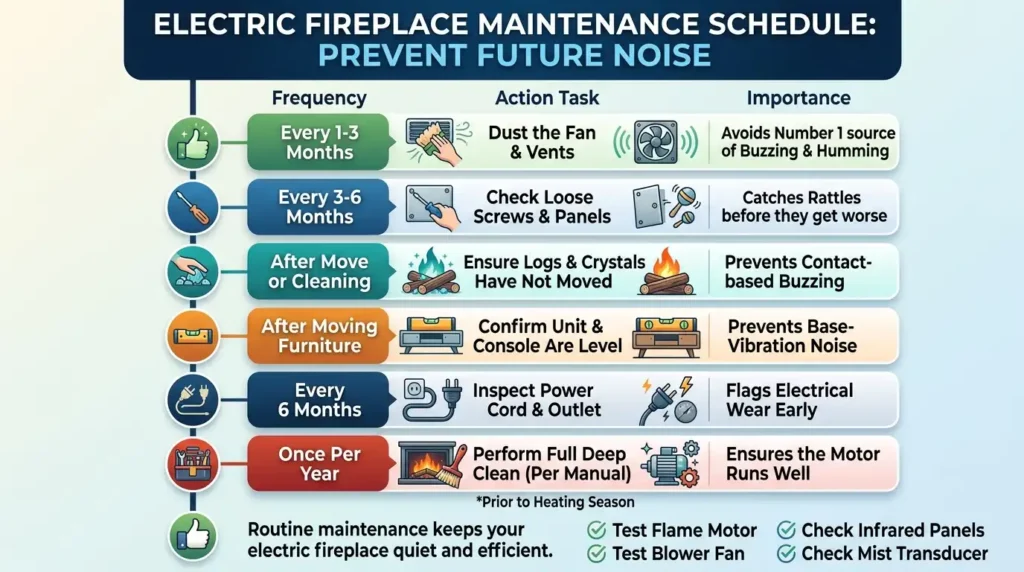
Most of the causes listed above would not occur at all due to routine maintenance:
| Frequency | Reason Why | Importance to the Worker |
|---|---|---|
| Dust the fan and vents | Every 13 months, or so | Avoids the Number 1 source of buzzing and humming |
| Check loose screws or panels | Every 3-6 months | Rattles before getting any worse |
| Check that logs/crystals not moved | After move or cleaning | Prevents contact-based buzzing |
| Check unit/console is still level | After moving furniture | Prevents base-vibration noise |
| Inspect the power cord and outlet | Every 6 months | Flags electrical wear early |
| Full deep clean according to manual | once per year, prior to heating season | Makes the motor run well |
Typical Repair Costs.
When cleaning and tightening fail to fix the noise, then you might be faced with an element-level repair. The most frequent paid remedy to continuing whining or grinding is a replacement of the fan motor, which varies in price based on the type of motor used, be it a standard or proprietary. A replacement of the relay or control board is required in case of clicking or buzzing the traces to the electronics – that is a job of the technician and not of the DIY.
In the case of older or budget units, full replacement may at times be as expensive as a proprietary motor repair when labor is factored in. Check your warranty initially fan motor and electrical problems can be covered the first one to three years, and DIY repairs can invalidate that warranty.
You May Also Read:
FAQs:
Why is my electric fireplace all of a sudden making more noise than it did previously?
Typically, the dust accumulates on the fan blades, causing them to be unbalanced. The second most frequent cause is loose screws or panels as a result of months of vibration.
Is clicking of an electric fireplace normal?
Yes–that is likely the thermostat relay that switches the heater. Regular or frequent clicking may be a sign of a wiring or relay problem that should be examined.
Why is my electric fireplace buzzing with the heat on but not in flame-only?
This indicates the fan/heating component and not the flame motor. Clean off dust on the fan and ensure that nothing around the heater coil is touching the fan.
Am I able to repair a noisy electric fireplace myself or would I require a professional?
The majority of reasons, dust, lost components, moved logs, not placed evenly, etc., are harmless DIY solutions when they are not connected to power. A technician should go with internal wiring, sparking or a tripped breaker.
Will the noise be prevented by lubricating the fan motor?
It can make a whine out of dry bearings, which is mild, but only when your manual particularly permits lubrication.
Is an electric fireplace noisy? Is it a fire hazard?
Noise is not generally harmful but buzzing with a burning odor and a spark or a tripped circuit breaker is a red flag – unplug and get a professional.
Why is my electric fireplace noisier at the maximum heat?
Increased heat settings tend to increase the speed of the fan to move more warm air out and the speed of fans is directly related to noise.
Are any electric fireplaces fans?
No. Fan-forced models are most widespread and noisiest. The infrared and water-vapor/mist fireplaces do not have the fan or have a much less noisy system.
What is the frequency of cleaning my electric fireplace to avoid noise?
After every 1-3 months of the majority of households, more frequently with pets or daily use at a full heating season.
My electric fireplace is new, and it is loud out of the box- is that normal?
It may be, particularly with low-cost fan motors. Check nothing moved during shipping first; even then it is still noisier than it should be, that can be a design limitation that can be brought to attention of the retailer.
What is it that my fireplace smells of burning and the noise?
Turn it off and immediately call a professional. This mixture is indicative of an electrical malfunction, and not a mere mechanical bang.
My Final Thought:
The crackle and the hum of a small fan are all you can do is to make your electrical fireplace work. When it has become distinctly noisier, troubleshoot the reasons in that order of probable causes dust, loose parts, moved logs, placement, etc. before thinking the worst. The majority of fixes will require less than half an hour and no special tools. Call in the electrician when smoke, spark, or a tripped circuit, or wiring that you can not safely check yourself.
This is a general troubleshooting guide only, never work on or examine internal electrical parts without the unit completely disconnected, and always consult the manual of the particular model. In this case, refer to a licensed technician in case of doubt.