Electric vs Infrared Fireplace: Cost Comparison, Differences, Pros & Cons
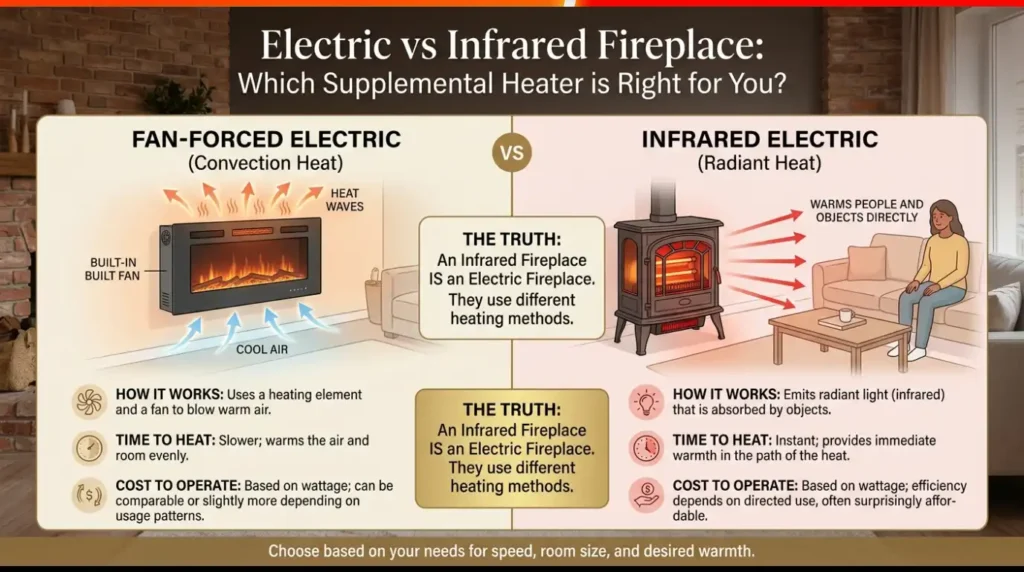
When you have been researching your supplemental heater, you have likely come to find that the terms infrared fireplace and electric fireplace are used almost interchangeably online and that is one of the reasons why there is confusion. And the brief answer is an infrared fireplace is an electric fireplace. It is not a matter of electric or infrared but rather, fan forced electric or infrared electric since infrared is just one of the two heating systems that the electric fireplaces utilize.
This guide has divided down the minute-by-minute operation of each method, which one heats in less time, which one really costs less to operate (the answer to this one is surprising to most people), and which one suits your room, your budget, and your home.
Is Electric and Infrared Fireplace the Same Thing?
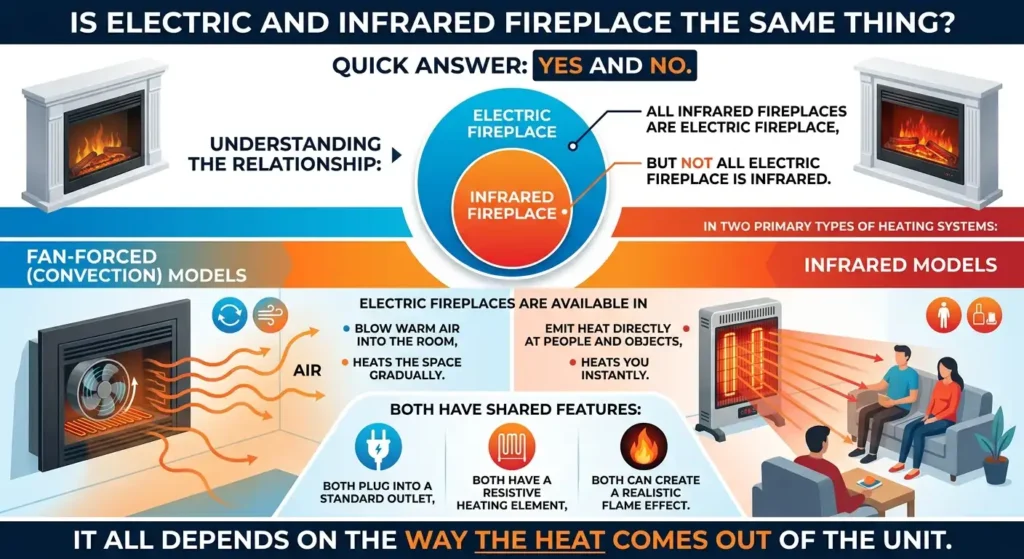
Quick answer: Yes and no. All infrared fireplaces are electric fireplace, but not all electric fireplace is infrared. Electric fireplaces are available in two primary types of heating systems: fan-forced (convection) models, which blow warm air into the room, and infrared models, which emit heat directly at people and objects. They both plug into a standard outlet, both have a resistive heating element and both can create a realistic flame effect. It all depends on the way the heat comes out of the unit.
What Is an Infrared Electric Fireplace?
An electric fireplace with infrared technology consists of a quartz tube or coil wrapped around a heating element with a reflector to direct infrared light waves into the room. You do not see those waves, however, but you feel them in the form of heat the instant they touch your skin or furniture or floor the same way the sun warms you on a chilly day. Since infrared heat does not make use of a fan to move air about, it heats individuals and surfaces directly instead of heating the air first.
IR electric fireplaces still have an electrical inlet to a standard wall socket, still have an appearance of a flame (typically light-emitting diodes and a spin or flicker effect), and also are subject to the same 1,500-watt safety limit as practically any plug-in space heater offered in the U.S.
How Each Type Actually Heats a Room
How Standard (Fan-Forced) Electric Fireplaces Work
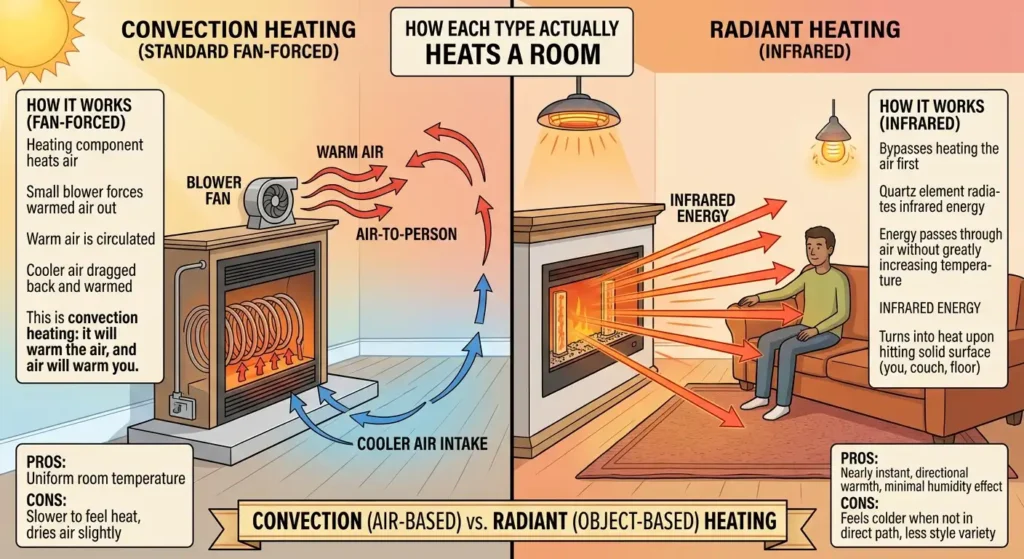
A fan-forced electric fireplace has a heating component (usually a metal coil or a ceramic component) that heats the air, and a small blower forces the warmed air out into the room. The warm air is circulated and the cooler air is dragged back through the unit and warmed back up and made to recirculate. That is convection heating: it will warm the air, and air will warm you.
How Infrared Fireplaces Work
A fireplace with an infrared bypass the heat the air first procedure. The quartz element heats and radiates infrared energy that passes through the air without greatly increasing its temperature and turns into heat as soon as it hits a solid surface – you, your couch, your floor. It is radiant heating, and the same physical principle that warms the sunshine, the heat-lamps and makes you feel warm even when you stand in cold air with a campfire.
Electric vs Infrared Fireplace: Full Comparison Table
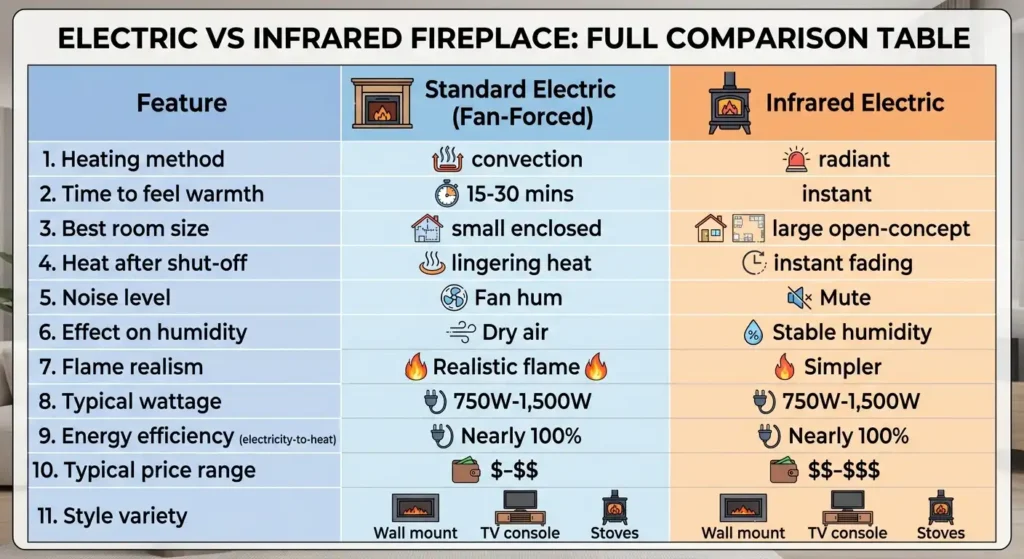
| Feature | Standard Electric (Fan-Forced) | Infrared Electric |
| Heating method | Convection (warms air) | Radiant (warms people/objects) |
| Time to feel warmth | 15–30 minutes | Nearly instant |
| Best room size | Small to medium, enclosed rooms | Larger or open-concept rooms |
| Heat after shut-off | Lingers 30–60+ minutes | Fades almost immediately |
| Noise level | Soft fan hum | Silent (no fan) |
| Effect on humidity | Can dry air slightly over long use | Minimal effect on humidity |
| Flame realism | Wide range, often very realistic | Usually simpler, less customizable |
| Typical wattage | 750W–1,500W | 750W–1,500W |
| Energy efficiency (electricity-to-heat) | Nearly 100% | Nearly 100% |
| Typical price range | Budget to mid-range | Mid-range to premium |
| Style variety | Wall mount, mantel, insert, TV console | Freestanding stoves, inserts, some mantels |
Which Heats a Room Faster?
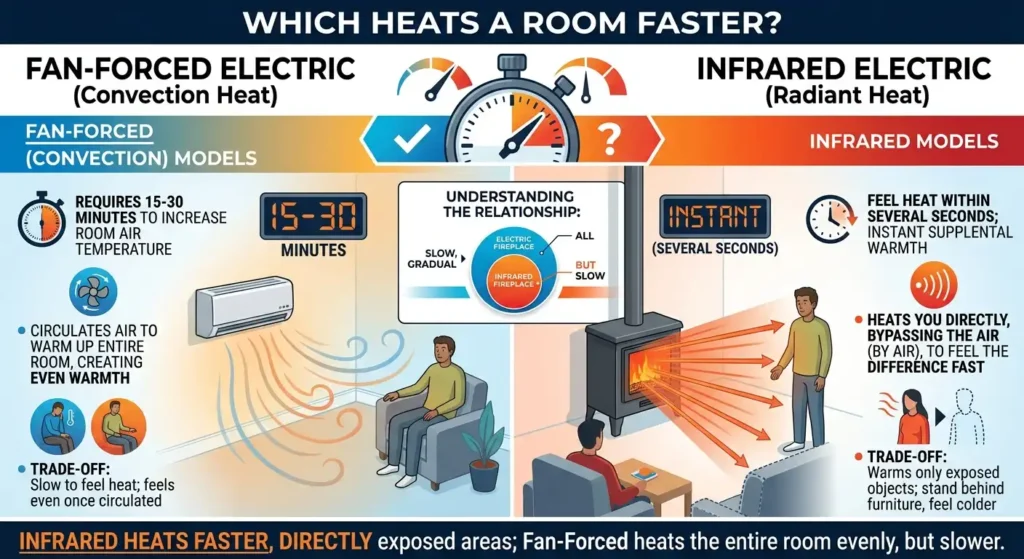
Infrared succeeds in this and it is not even close. Since infrared heat will warm you rather than having to heat and push the air around to warm it up first, you will feel the difference within several seconds of switching it on. The electric units operated by fans usually require 15 to 30 minutes to significantly increase the air temperature of a room, as the fan must be able to circulate large volumes of warm air to alter the overall sensation of the entire space.
The trade-off: infrared heat can warm only that which is directly exposed to it. Go to the other part of the room, or stand behind furniture, and you’ll feel much cooler. Fan-forced electric heat is slow to develop, but evenly dispersed when the air has been circulated.
Which Type Costs Less to Run Electric or Infrared?
Most competing articles have this wrong and it is worth halting down on. One of the most popular statements on the internet is that infrared fireplaces are merely more energy efficient than conventional ones that use electricity. That’s not accurate. Both technologies work based on electrical resistance to convert electricity to heat, and both work with a nearly 100% efficiency- effectively, all the electricity you put in comes out as heat, whether that heat is radiant heat or fan-driven heat. They are not inherently efficient over each other.
Wattage and runtime is what really makes you expensive, but not the heating method. An infrared unit (1,500 watts) and a fan-forced unit (1,500 watts) cost the same amount to operate per hour. The infrared will pay off in other areas where it saves you money: since it heats people, rather than air, it can be used in shorter bursts or at lower thermostat settings in the room you are actually sitting in, sometimes referred to as zone heating.
Sample Cost Breakdown
By taking the national average U.S. home electricity rate (approximately 17.8 cents per kilowatt-hour) here is the average cost of running a typical space heater, whether it is infrared or fan-forced:
| Wattage | Cost/Hour | Cost/8-Hour Evening | Cost/30 days (4 hrs/day) |
| 750W | ~$0.13 | ~$1.07 | ~$16.02 |
| 1,000W | ~$0.18 | ~$1.42 | ~$21.36 |
| 1,500W | ~$0.27 | ~$2.13 | ~$32.04 |
Rates will depend on the state and utility company – your current bill will show your real per-kWh rate before you can budget.
Summary: Electric and infrared are not necessarily any less expensive. Whichever one allows you to switch off your central heating and only use the heating in the room you are in is the less expensive option – and that only reduces to the technology being matched to your room size and habits.
Room Size: Which One Fits Your Space?
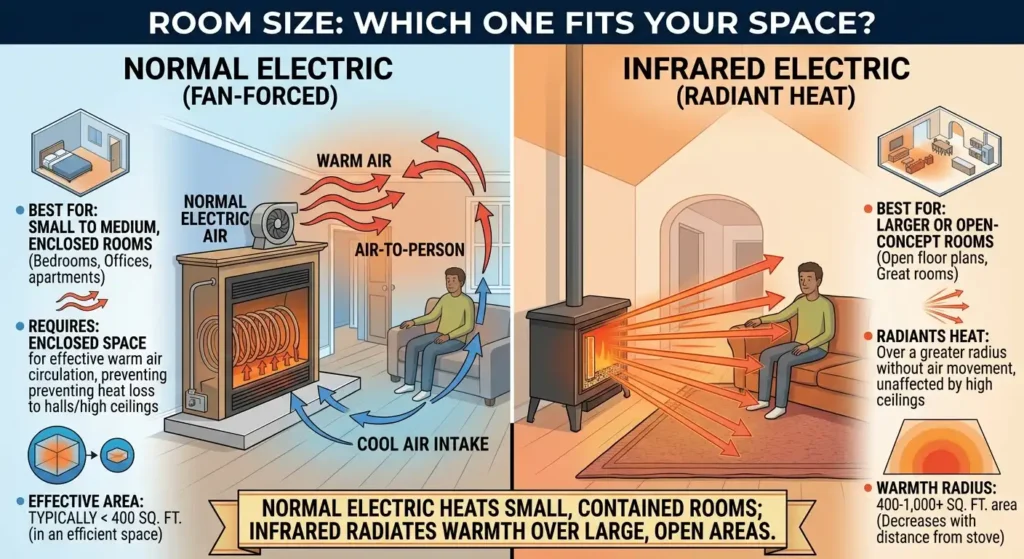
- Infrared fireplaces are typically more suitable to larger or open-concept rooms, as the radiant heat can radiate visible warmth over a greater radius without the use of air movement. Most infrared units are designed to comfortably warm areas of up to the 400-1,000 square feet area, though effectiveness decreases the farther one is away.
- Normal electric fireplaces are usually effective in small to medium and closed rooms – bedrooms, home offices, apartments, etc. – where a fan can effectively circulate warm air, without it escaping into open hallways or high ceilings.
Air Quality, Humidity, and Noise
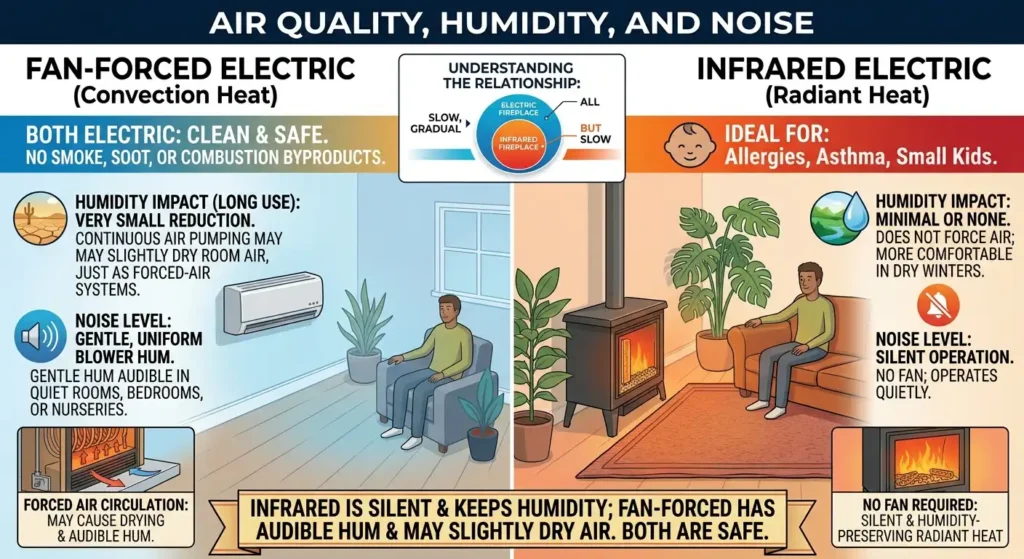
Neither one smokes, emits soot or byproducts of combustion, as both operate on electricity, and that is a huge benefit over a more traditional fireplace to anyone with allergies, asthma, or little kids in the house.
- Humidity: fan-forced electric Fan-forced electric units continuously pump air through a room, which can also have a very small ability to reduce the humidity in a room over extended periods of usage – just as any forced-air system does. IR units do not force air, therefore have minimal or no impact on the humidity of the room, which is more comfortable to some individuals in dry winter.
- Noise: Infrared fireplaces are quiet, as there is no fan. Fan-forced electric systems cause a gentle, uniform hum of the blower – not usually noticeable, but audible in a quiet bedroom or nursery.
Safety Comparison
Both electric and infrared fireplaces are significantly safer than wood or gas fireplaces: no open fire, no gas line, no chimney to clean and no risk of carbon monoxide. Both types have surfaces that tend to remain cool or warm instead of hot to the touch, which is important when you have children or pets.
At that, they remain electric space heaters and the general safety principles of the U.S. Consumer Product Safety Commission can be applied equally to all types:
- Maintain a minimum of three feet of distance between the unit and curtains, bedding, furniture and any flammable materials.
- Directly plug into a wall outlet – never into an extension cord or power strip.
- Do not leave either type unattended or when asleep.
- Select a model that has been tested and approved by a reputed safety lab (finds UL or ETL certification).
- Examine the cord and plug prior to use, particularly older units.
According to CPSC data, portable electric heaters have been associated with approximately 1,600 house fires and an average of approximately 70 deaths annually based on the misplacement and inappropriate use, but not the type of unit (infrared or fan-forced).
Style, Design, and Flame Realism
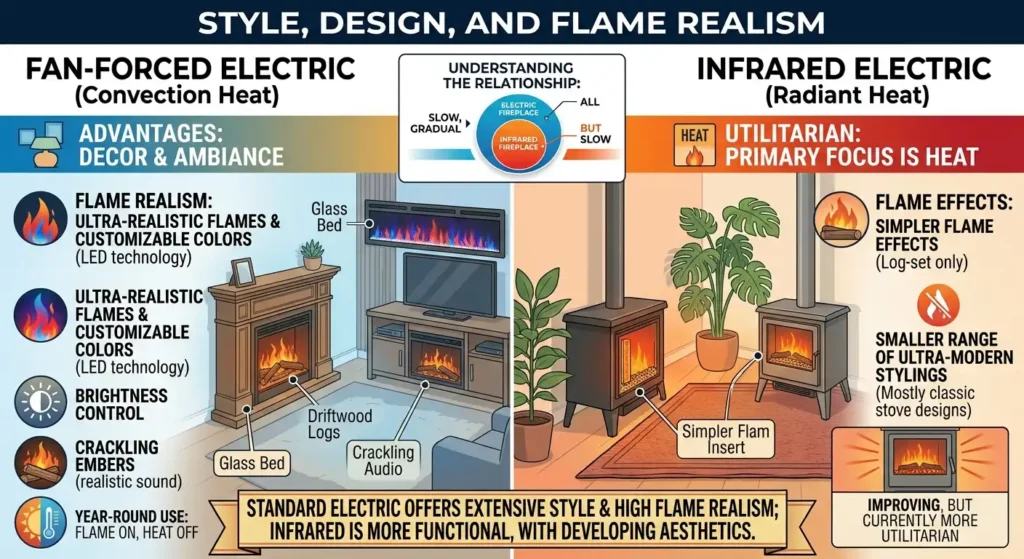
Unless ambiance and decor are secondary concerns to you (when compared to heat), conventional electric fireplaces are at present at a disadvantage. They come in a much wider range of form factors; wall-mounted, recessed, mantel packages, TV media consoles, and often have a much wider range of customizable flame colors, crackling embers, and brightness control. A majority of models allow you to turn the flame effect on without the heat on, thus giving you the appearance of a fire when it is not cold.
Although they are getting better, IR fireplaces remain more utilitarian. There will be freestanding stoves and a few flame effect inserts, but there will be a smaller number of ultra-modern or minimalist stylings than the standard electric range.
Pros and Cons at a Glance
| Fireplace Type | Advantages (Pros) | Disadvantages (Cons) |
| Standard Electric Fireplace | • Room-wide, even warmth after being heated • Greatest variety of styles and flame effects • Post heat-checking after turning it off • Typically less expensive base models | • Takes more time to heat the room (15–30 minutes) • Fan noise, however slight • Can make the air dry to some extent when used long term |
| Infrared Electric Fireplace | • Near-instant warmth • Suits bigger or open spaces • Silent operation • Does not influence room humidity | • Heat does not last long when switched off • Feels colder when you are not close to the unit • Fewer style and flame-effect choices |
Myth vs. Fact
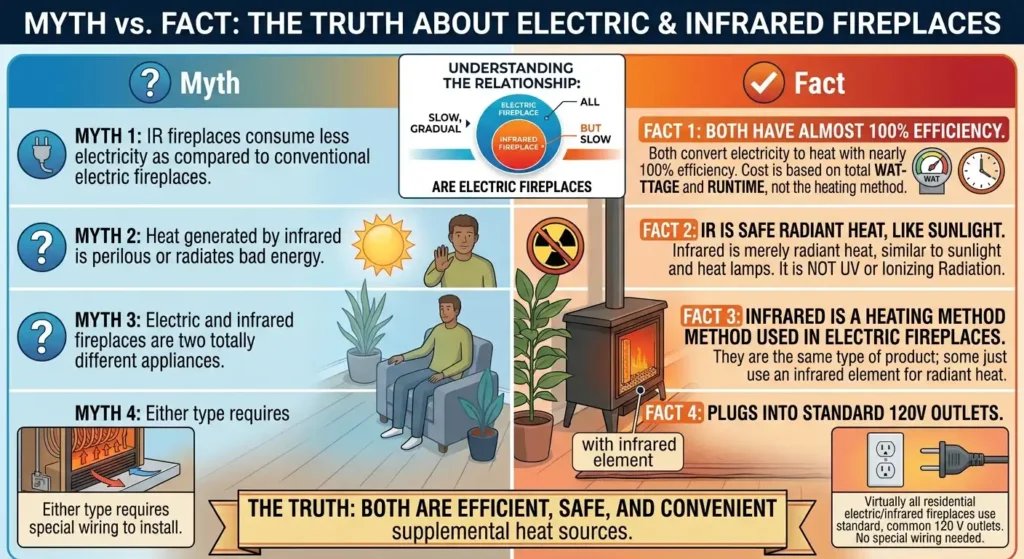
| Myth | Fact |
| IR fireplaces consume less electricity as compared to the conventional electric fireplaces. | Both transform electricity to heat with almost 100% efficiency. Price is based on wattage and runtime, not on method of heating. |
| Heat generated by infrared is perilous or radiates bad energy. | IR heat is merely radiant heat, like sunlight and heat lamps. It is not similar to UV or ionizing radiation. |
| Electric and infrared fireplaces are two totally different appliances. | The use of infrared is in heating some electric fireplaces – they are the same type of product. |
| Either type requires special wiring to install. | Virtually every residential electric and infrared fireplace will fit into a standard 120 V outlet, and no special wiring is needed. |
Which Should You Choose? A Simple Decision Guide
Select a fireplace with infrared electric as well as in case:
- You desire heat immediately you switch it on.
- You have a large room, open, or high-ceiled.
- you desire silent action.
- You’re sensitive to dry air
Select a typical electric fireplace when:
- You desire whole-room warmth, even.
- Your area is small to medium and closed.
- Fireside realism, ornament, to you.
- You would like the most diverse styles and prices.
Common Mistakes to Avoid
- Purchasing on the basis of claims of efficiency. Your electric bill is significantly influenced by the wattage and usage patterns than the heating methodology does as discussed above.
- Under-Room sizing. A small room rated infrared unit will leave cold spots in a large room and the other way around with an underpowered fan- forced unit.
- Leaving 3 foot of space between the space heater and any flammable item. Both types require this distance to avoid catching fire- and this is the number one cause of space heater fires.
- Plug-in space heaters (electric or infrared) have a maximum output of about 1,500 watts by law, which is sufficient to do supplemental, zone heating, but not whole-home heating.
- Not checking the safety certification. Always look at the UL or ETL certification prior to purchase, particularly with brands that are not well known.
Key Takeaways
- IR fireplaces: Infrared fireplaces are not a different category, but an electric fireplace.
- IR is quicker and it is more efficient in large or open rooms; electric using fans is more efficient in small and enclosed rooms spreading warmth evenly.
- Both are not cheap to operate per se – cost will be determined by wattage and length of time running.
- They are both much safer than wood or gas fireplaces and still require the same basic space-heater safety measures.
- Select on the basis of the room size, how much you are sensitive to noise, and the degree to which you are concerned with flame styling, not on efficiency myths.
You May Also Read:
FAQs:
Does an infrared fireplace resemble an electric fireplace?
Yes, an infrared fireplace is an electric type of fireplace that does not require a fan to heat a room, rather it uses radiant heat. They both (plug in) to a regular outlet and operate on electricity.
What is infrared electric fireplace?
It is an electric fireplace that is heated with a quartz element and reflector to produce infrared radiation, which warms people and objects directly, without first warming the surrounding air.
Which is cheaper to operate, electric or infrared?
Nor does either have a natural cost advantage – both can convert electricity to heat with almost 100% efficiency. The price you actually pay is based on the wattage of the unit and the number of hours that you operate the unit, rather than the heating method.
Are infrared fireplaces considered to dry out the air?
No or very little. Infrared units do not depend on a fan to circulate the air, and thus they have minimal impact on the humidity of the home, as compared to some fan-forced heating system that are used over the long term.
Do fireplaces that are electric dry out the air?
The forced-air heater can reduce humidity in closed room slightly with extended use of any fan-forced heater, but this effect is usually not very significant in comparison to forced-air heating of entire homes.
How much is the size of the area that an infrared fireplace will warm?
Depending on model and wattage, most residential infrared systems have a range of about 400 to 1000 square feet with the warmest sensation being near the unit.
Can infrared fireplaces be used in houses with children or pets?
Infrared, as well as standard electric fireplaces, are generally safe when used correctly, and most have cool-touch housing. Regular space-heater safety measures, including keeping flammables away, never leaving equipment unattended, etc. also apply to both.
On either type can I operate the flame effect without the heat?
On the majority of models of each sort, yes. This allows you to have the feel of the day when the weather is not hot, without the need to put additional heat in the room.
Do infrared and electric fireplaces require special electrical wiring?
No. Most residential units are hardwired to a typical 120 V wall socket. Some larger built-in units might need their own circuit – always consult the manufacturers specifications before installation.
Which is quicker, infrared or electric, to warm a room?
The heating process of infrared is significantly quicker since it warms people and objects directly instead of having to warm and circulate air and use a fan-forced unit which may require 15 to 30 minutes.
My Final Thought:
No one method is better or worse than the other in terms of electric or infrared fireplaces, as they are addressing a slightly different problem. You need to have a room that warms evenly, are fond of the appearance of a realistic fire, and you are heating a smaller or closed-in area, then a conventional fan-forced electric fireplace is the way to go. When you need heat immediately you turn a switch, you have a larger or open room, and you would not like the sound of a fan, an infrared electric fireplace is the wiser choice.