Electric Fireplace Code Requirements Installation Guide:
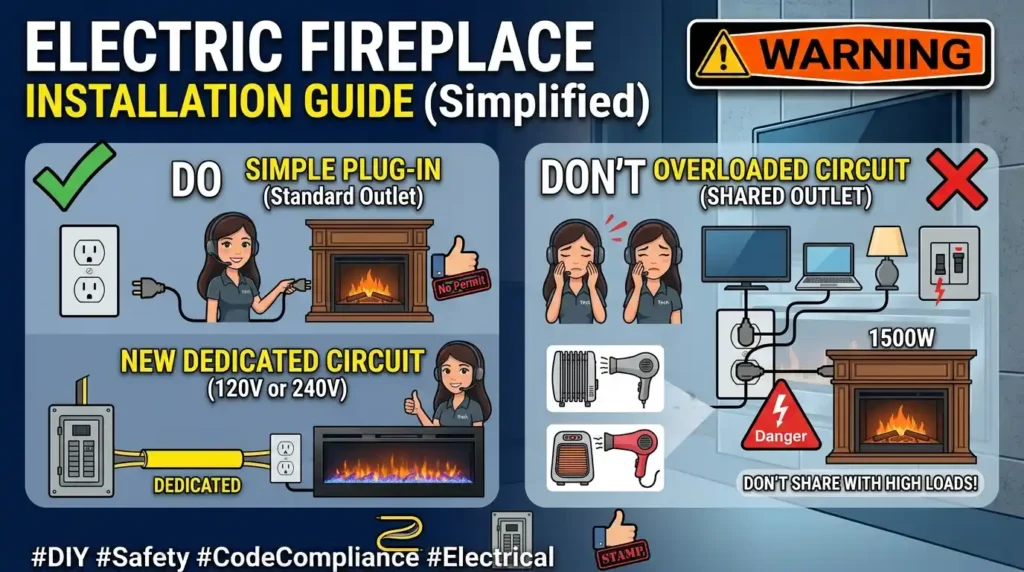
Installation of an electric fireplace is easy, just plug in, switch on, and savor the atmosphere. However, when you start to ask yourself whether this requires its own circuit or whether you can share the circuit with your TV you have entered the arena of electrical code, and to get it wrong will result in a tripped circuit at best and a house fire or inspection failure at worst.
This guide will dissect precisely what the National Electrical Code (NEC) and most local jurisdictions are asking of an electric fireplace installation dedicated circuits, amperage, wire gauge, type of outlets, permits, what you can and can not share a circuit with. It gathers the figures that the electricians deal with in real life, not the hand-wave of consult a professional that most fireplace store websites give you.
There is a rapid disclaimer: Electrical code is a local enforced one. Most U.S. states have the NEC as their basis, but it can be amended by your city, county, or state. Before you wire anything, always verify final requirements with your local building department, or a licensed electrician.
Quick-Answer Summary
| Question | Short Answer |
| Should an electric fireplace be hard-wired? | Not mandated by the NEC, but strongly suggested and frequently practically mandated after you do the amperage calculations. Several manufacturers require it in the owner manual. |
| Is it pluggable to an ordinary outlet? | Yes, when it is a typical 120 V, less than 1,500 W plug-in device, and the outlet is on a lightly loaded circuit—but not when used in a power strip, surge protector, or extension cord. |
| Is it possible to have a TV and fireplace on one outlet? | Typically yes on the outlet itself (duplex receptacle has two slots), but only in cases where the total load does not exceed 80 percent of the circuit breaker current limiting value. |
| Do I need a permit? | In the case of a simple plug-in, freestanding, or mantel-style unit: typically no. On hardwired, built-in, or 240 V insert: yes, in most jurisdictions. |
| What is the most common unit voltage? | 120 V (standard household outlet) in units of up to about 1,500 W; 240 V (hardwired) in larger built-ins and inserts that are 2,500–5,000+ W. |
1. Is an Electric Fireplace required to have a dedicated circuit?
It is the one question that is most searched on this topic, and most articles that are competing provide a wishy-washy answer. The exact version is given here.
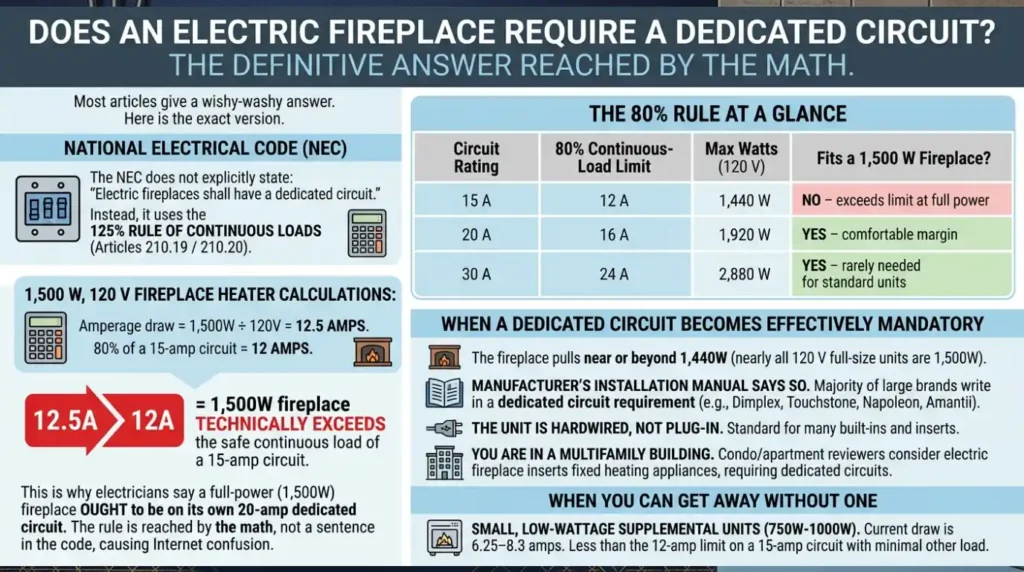
The NEC itself does not contain such a line as “electric fireplaces shall have a dedicated circuit” but rather contains a line which regulates the size of the circuit breaker branch conductors, the so-called 125% rule of continuous loads (Article 210.19 / 210.20): any load that operates continuously must be counted as a continuous load and the circuit must be sized to ensure that the load never exceeds 80 percent of the breaker current rating.
Calculate the numbers on a 1,500 W, 120 V heater on a fireplace:
- Amperage draw = 1,500W ÷ 120V = 12.5 amps
- 80% of a 15-amp circuit = 12 amps
- 12.5A > 12A = 1,500W fireplace is technically over the safe continuous load of a 15-amp circuit.
This is why, in reality, virtually any electricians will tell you that a full-power (1,500W) electric fireplace ought to be on its own 20-amp dedicated circuit, although not a single sentence in the NEC contains the term electric fireplace. It is not a rule given by name, it is a rule reached by the math, which is the very cause of so much confusion on the Internet.
The 80% Rule at a Glance
| Circuit Rating | 80% Continuous-Load Limit | Max Watts (120 V) | Fits a 1,500 W Fireplace? |
| 15 A | 12 A | 1,440 W | No — exceeds limit at full power |
| 20 A | 16 A | 1,920 W | Yes — comfortable margin |
| 30 A | 24 A | 2,880 W | Yes — rarely needed for standard units |
The situations in which a Dedicated Circuit Becomes Effectively Mandatory.
- The fireplace pulls near or beyond 1,440W (nearly all full-size electric fireplaces do it – 1,500W is the industry standard maximum of 120 V units).
- The installation manual of the manufacturer says so. The majority of large brands (Dimplex, Touchstone, Napoleon, Amanti) write in a dedicated circuit a dedicated circuit (and when it is in the manual, your local inspector can make it a condition of complying with the code, and your insurer can make it available after a claim).
- Hardwired, not plug-in The unit is hardwired, not plug-in. Hardwired units (240 V built-ins and most inserts) are not a choice, but a common, standard practice to install the unit as an appliance.
- You are in a multifamily building. Condo and apartment code reviewers are starting to consider electric fireplace inserts as any other fixed heating appliance, which generally drives them to dedicated-circuit requirements during permitting.
When You Can Get Away Without One
Small, low-wattage supplemental units (750W-1000W, found on small wall-mount or tabletop units) have a maximum current of 6.25-8.3 amps. On a 15-amp circuit where nothing else is important, that would be less than the 12-amp continuous-load limit, so a shared circuit is actually not in violation, at least not assuming that there is nothing else on the circuit that would push the total above 80 percent.
2. Is an Electric Fireplace Pluggable into a Decent outlet?
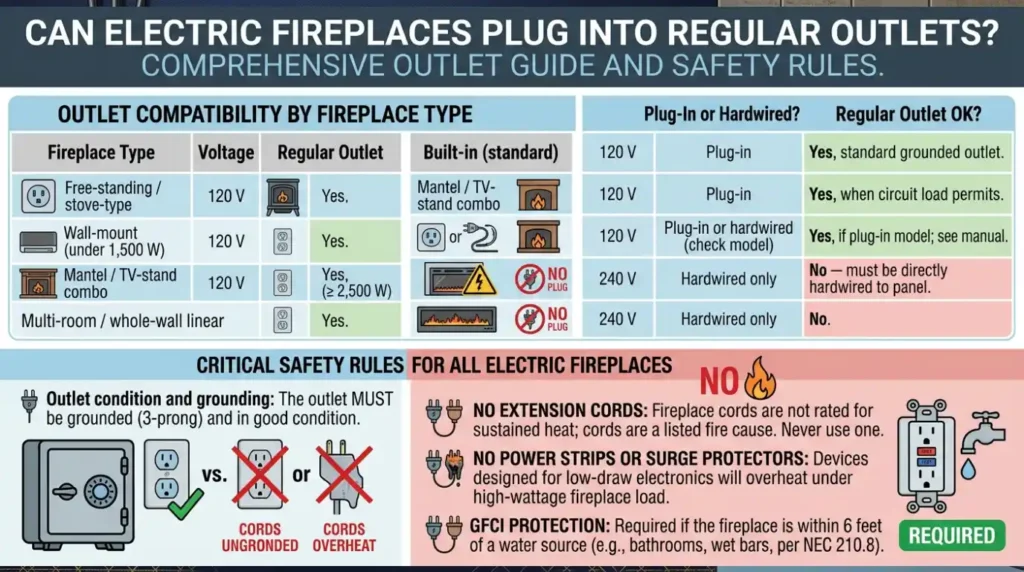
Yes, with conditions. The following is a breakdown by unit type.
| Fireplace Type | Voltage | Plug-In or Hardwired? | Regular Outlet OK? |
| Free-standing / stove-type | 120 V | Plug-in | Yes, standard grounded outlet. |
| Wall-mount (under 1,500 W) | 120 V | Plug-in | Yes, when the circuit load permits. |
| Mantel / TV-stand combo unit | 120 V | Plug-in | Yes. |
| Built-in (standard) | 120 V | Plug-in or hardwired (as model demands) | Yes, if plug-in model; see manual. |
| Large built-in insert (2,500 W or more) | 240 V | Hardwired only | No — must be hardwired directly to panel, no plug. |
| Multi-room / whole-wall linear units | 240 V | Hardwired only | No. |
Major rules that are applicable irrespective of the size of the unit:
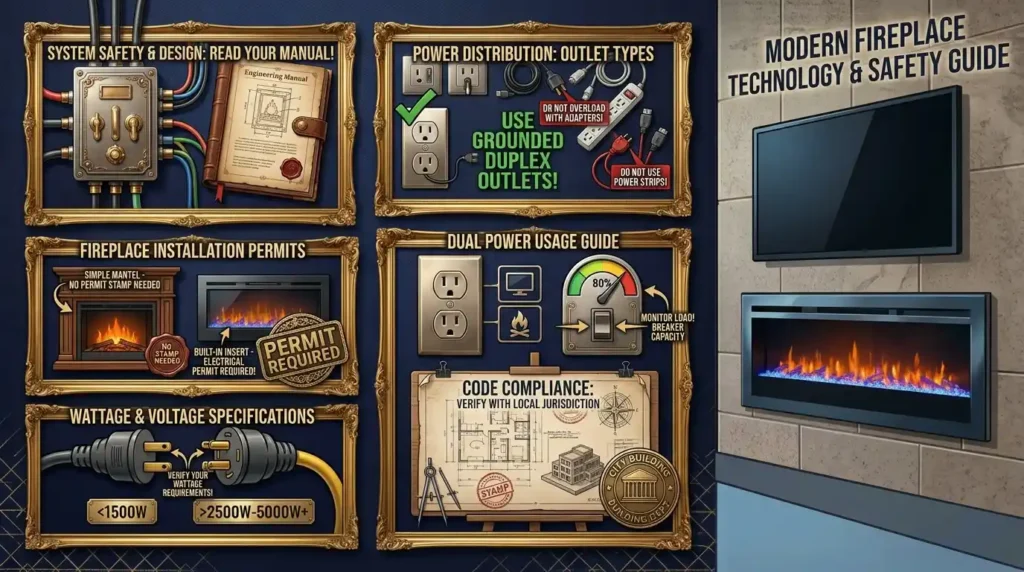
- The outlet should be grounded (3-prong) and in good condition. Electric fireplaces should not be operated on a two-prong, ungrounded outlet or a cheater/ground-lift adapter.
- Do not use an extension cord. All major manufacturers as well as all sources of electricians are agreement on this; cords are not rated to withstand the sustained heat and amperage drawn by a fireplace heater, and are a listed category of fire cause in NFPA data of space-heating appliances.
- Do not plug into a power strip or surge protector. They are designed around low-draw electronics, not non-stop high-wattage heating components, the inside fuses and wiring will overheat.
- GFCI is required sometimes in the fireplace installation where the fireplace is located within 6 feet of a water source (e.g., a bathroom or a wet bar) per NEC 210.8.
3. Wattage, Amperage & wire Gauge Reference Chart.
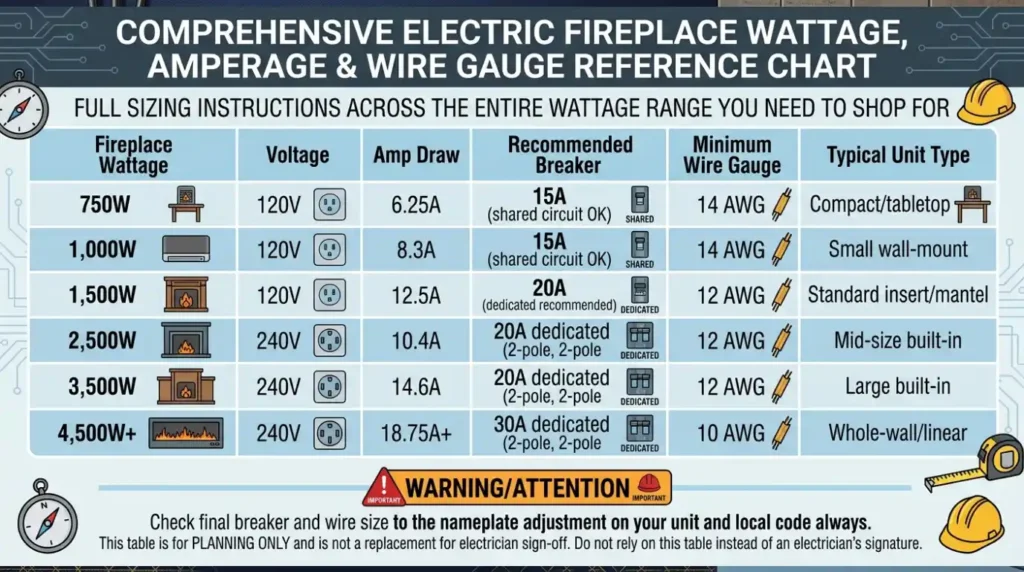
This is the chart that competitor articles omit out of — full sizing instructions over the entire range of wattage you will actually need to shop to buy a fireplace.
| Fireplace Wattage | Voltage | Amp Draw | Recommended Breaker | Minimum Wire Gauge | Typical Unit Type |
|---|---|---|---|---|---|
| 750W | 120V | 6.25A | 15A (shared circuit OK) | 14 AWG | Compact/tabletop |
| 1,000W | 120V | 8.3A | 15A (shared circuit OK) | 14 AWG | Small wall-mount |
| 1,500W | 120V | 12.5A | 20A (dedicated recommended) | 12 AWG | Standard insert/mantel |
| 2,500W | 240V | 10.4A | 20A dedicated (2-pole) | 12 AWG | Mid-size built-in |
| 3,500W | 240V | 14.6A | 20A dedicated (2-pole) | 12 AWG | Large built-in |
| 4,500W+ | 240V | 18.75A+ | 30A dedicated (2-pole) | 10 AWG | Whole-wall/linear |
Check final breaker and wire size to the nameplate adjustment on your unit and local code always- this table is planning only, not a replacement of electrician sign-off- do not rely on this table instead of an electrician’s signature.
4. Is it possible to have an electric fireplace and TV on the same power outlet?
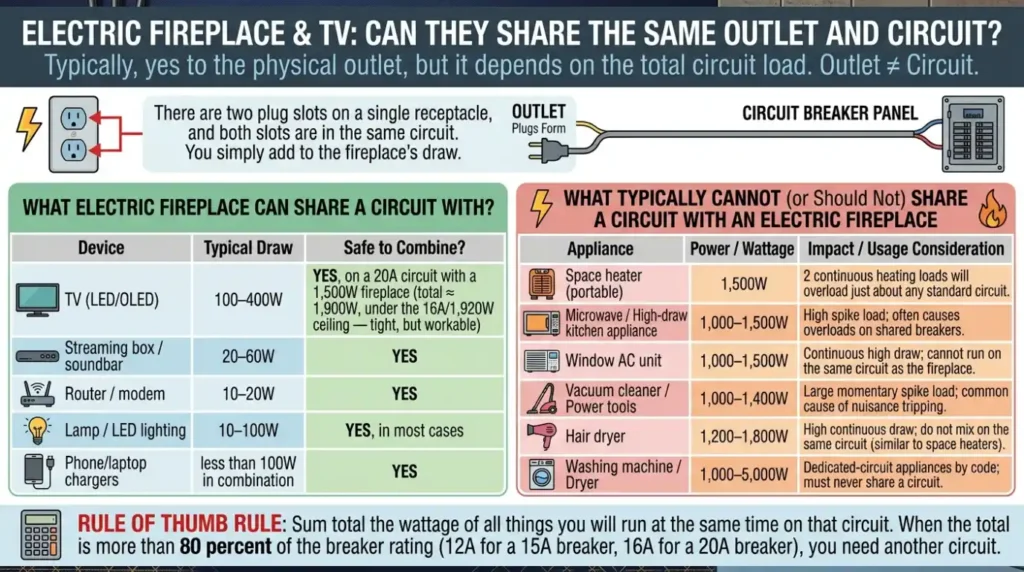
Short answer: Typically, yes to the physical outlet, but again, it depends on the overall circuit load and not only the outlet. This is a major point of confusion – people believe that outlet and circuit are one thing. They’re not.
There are two plug slots on a single duplex receptacle, and those two slots are in the same circuit. And therefore, when you plug a television in one side of the plug and a fireplace on the other side you do not form a new circuit, you simply add to what the fireplace is already consuming.
What Electric Fireplace Can Share a Circuit With?
| Device | Typical Draw | Safe to Combine? |
|---|---|---|
| TV (LED/OLED) | 100–400W | Yes, on a 20A circuit with a 1,500W fireplace (total ≈ 1,900W, under the 16A/1,920W ceiling — tight, but workable) |
| Streaming box / soundbar | 20–60W | Yes |
| Router / modem | 10–20W | Yes |
| Lamp / LED lighting | 10–100W | Yes, in most cases |
| Phone/laptop chargers | less than 100W in combination | Yes |
What Often CANNOT (or Should Not) Share a Circuit with an Electric Fireplace
What Typically CANNOT (or Should Not) Share a Circuit with an Electric Fireplace
Here is the cleaned-up and properly structured table based on your data:
| Appliance | Power / Wattage | Impact / Usage Consideration |
| Space heater (portable) | 1,500 W | 2 continuous heating loads will overload just about any standard circuit. |
| Microwave / High-draw kitchen appliance | 1,000–1,500 W | High spike load; often causes overloads on shared breakers. |
| Window AC unit | 1,000–1,500 W | Continuous high draw; cannot run on the same circuit as the fireplace. |
| Vacuum cleaner / Power tools | 1,000–1,400 W | Large momentary spike load; common cause of nuisance tripping. |
| Hair dryer | 1,200–1,800 W | High continuous draw; do not mix on the same circuit (similar to space heaters). |
| Washing machine / Dryer | 1,000–5,000 W | Dedicated-circuit appliances by code; must never share a circuit. |
Rule of thumb rule:
sum total the wattage of all the things you will run at the same time on that circuit. When the total is more than 80 percent of the breaker rating (12A/1,440W on a 15A circuit, 16A/1,920W on a 20A circuit), switch something to another circuit – the TV and low-current electronics are by far the simplest things to leave in, but in fact other heating or motor-driven appliances do cause the actual conflicts.
5. Do You Need a Permit for an Electric Fireplace?
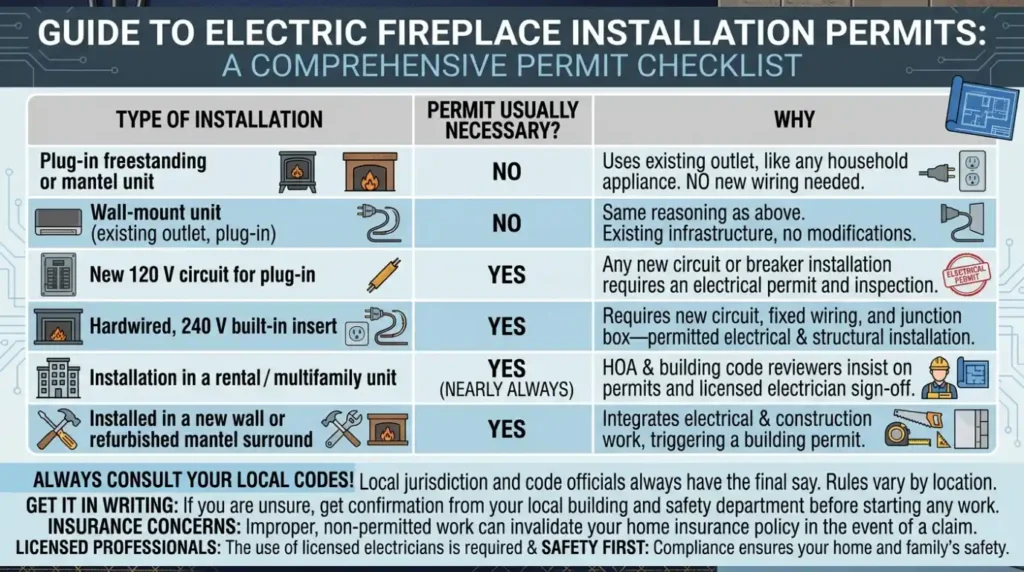
| Type of Installation | Permit Usually Necessary? | Why |
| Plug-in freestanding or mantel unit | No | No new wiring, uses an existing outlet — like any other household appliance. |
| Wall-mount unit (existing outlet, plug-in) | No | Same reasoning as above. |
| New 120 V circuit for plug-in | Yes | Any new circuit being run and new breaker installation requires an electrical permit and inspection. |
| Hardwired, 240 V built-in insert | Yes | Requires a new circuit, fixed wiring, and usually a new junction box — a permitted electrical (and sometimes structural) installation. |
| Installation in a rental / multifamily unit | Yes (nearly always) | HOA and building code reviewers normally insist on permits and licensed-electrician sign-off. |
| Installed in a new wall or refurbished mantel surround | Yes | Integrates electrical and construction work, which triggers the need for a building permit. |
This is where the answer actually differs per jurisdiction – but here is the trend that prevails in most cities and counties in the U.S.
Why this matters beyond “getting caught”: illegal electrical work can cancel the insurance claim of your homeowner in case of a fire outbreak, may also make selling your house difficult during an inspection, and in condos or apartments, will overstep the covenants of your building even when the city itself would not have insisted on a permit had it been a stand-alone house. You are in a multifamily building, verify with your HOA or property management, as well as your local building department, as both are applicable.
6. Hardwired vs. Plug-In: Which Does Your Fireplace Need?
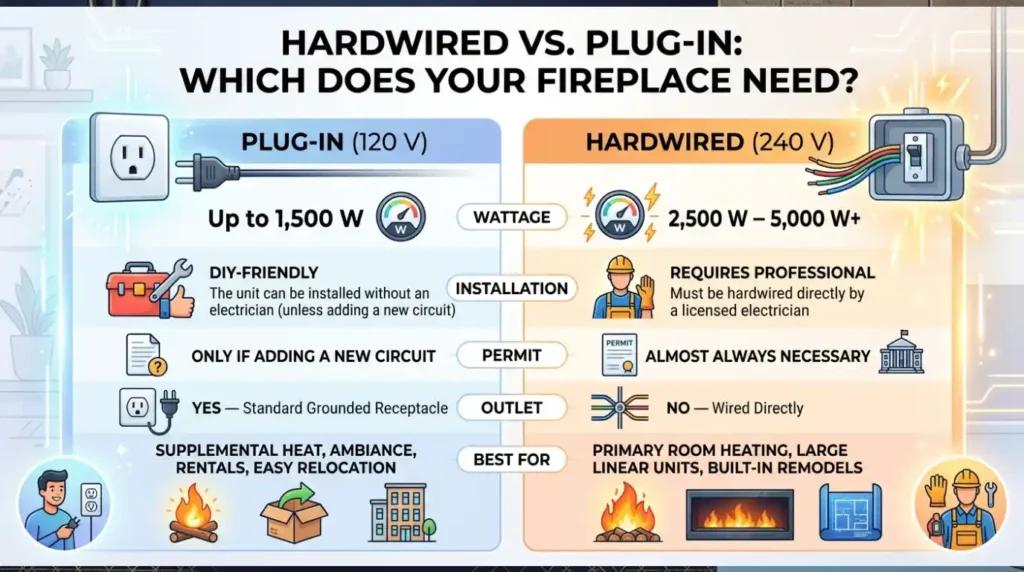
| Factor | Plug-In (120 V) | Hardwired (240 V) |
| Typical Wattage | Up to 1,500 W | 2,500 W – 5,000 W+ |
| Installation | DIY-friendly: The unit itself can be installed without hiring an electrician (unless adding a new circuit). | Requires Professional: Must be hardwired directly into a junction box by a licensed electrician. |
| Permit | Only necessary when running a new circuit | Almost always necessary |
| Outlet Required | Yes — standard grounded receptacle | No — wired directly into a junction box |
| Best For | Supplemental heat, ambiance, rentals, easy relocation | Primary room heating, large linear units, built-in remodels |
7. Step-by-Step: Confirming Your Installation Is Code-Compliant Electric Fireplace Code Requirements?
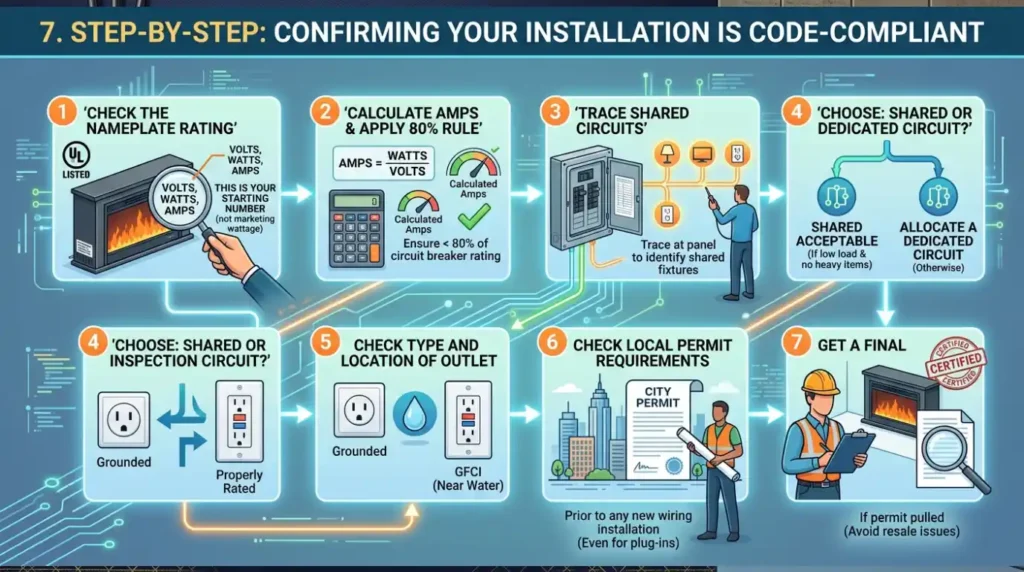
- Check the nameplate rating. All UL-listed electric fireplaces include a label with the volts, watts, and amps – this is your starting number not the marketing wattage on the box.
- Divide watts by volts to obtain amps and ensure that the value is less than 80 percent of your planned circuit breaker current.
- Trace what is on that circuit. Trace the circuit at your panel (or an electrician), to determine what other outlets and fixtures share it.
- Choose: shared or dedicated circuit? When the fireplace alone consumes less than the breaker rated output of the breaker, and there is nothing on the circuit that is heavy enough to share the circuit, a shared circuit may be acceptable. Otherwise, allocate a dedicated circuit.
- Check type and location of outlet. Grounded, properly rated, and (when in close proximity to water) GFCI-protected.
- Check local permit requirements prior to any new wiring installation, even when the fireplace itself is a simple plug-in.
- Get a final inspection when a permit was pulled – this is the most fuzzy step most of the time where homeowners get caught up when they go to resale.
8. Common Mistakes That Violate Code (or Just Aren’t Safe)
- Operating a 1,500W fireplace on 15-amp circuit with a microwave or space heater.
- “Temporary” use of a heavy-duty extension cord rather than installing permanent wiring.
- Using a power strip due to the closest being under furniture.
- An assumption that what is hardwired 240 V can be converted to a plug-in without an assessment by an electrician.
- Forgoing the permit on a new dedicated circuit due to it being a fireplace.
- Not following clearance instructions given by combustible materials (mantels, trim, curtains) by the installation manual – this is a fire-code concern and is not related to the electrical circuit question.
You May Also Read:
FAQs:
Should an electric fireplace have its own circuit?
The math on a standard 1,500W unit (12.5A) has it at the very threshold of what can be safely operated continuously on a 15-amp circuit, not necessarily by the letter of the NEC, but that is the reason why a dedicated 20-amp circuit is the standard professional recommendation — and often the one the manufacturer manual will insist on.
Will an electric fireplace fit in a standard outlet?
Yes, with 120 V plug-in units, provided that the outlet is grounded, and the circuit is not already occupied by other heavy appliances. Do not use an extension cord, power strip or surge protector.
Is it possible to have an electric fireplace and TV on the same outlet?
Usually yes – the low power of a TV would rarely cause a circuit of adequate size to exceed its safe continuous-loads operation. The appliances to be considered are other heat emitting or motor driven appliances and not electronics.
Is an electric fireplace permitted?
No plug-in units that utilize an existing outlet normally need one. Almost all new dedicated circuits and hardwired 240 V installations do.
What can you not operate with the same circuit as an electric fireplace?
Other continuous or high-draw loads – space heaters, microwaves, window AC units, hair dryers, and vacuum cleaners are the most frequent culprits of nuisance breaker trips.
My Final Thought:
Actually, electric fireplaces are very low-maintenance devices, but the perception of plugging it in and being done with it obscures actual math of electrical codes. Most full-size 1,500W units (budget) A dedicated 20-amp circuit is budgeted – it is what the NEC continuous-load rule refers to, what manufacturers recommend, and what licensed electricians actually install.
Often a circuit can be shared safely with smaller supplemental units but not until you have added all the other devices that are already plugged in. And when there is new wiring to be done– dedicated circuit or hardwired 240 V unit– take out the permit and have the inspection. It is the distinction between a comfortable, compliant install and an issue that comes out when you sell your house or file a claim with your insurance company.