Electric Fireplace Error Codes (E1, E2, E3, E4, E5): Causes Fixes Explained
An electric fireplace should not be something that is causing you to be more stressed out in a room when you need the warmth of it. Therefore, when the screen suddenly shows error codes such as E1, E2, E3, E4 or E5 rather than flames, the first thought that comes to mind is that something is amiss.
Electric Fireplace Error Codes indicates there are some issues with you insert that need to be solved promptly.
Some of electric fireplace error codes appears due to a minor issue or safety system while some may indicate a more serious issue with you heating unit.
Our guide will explain the most frequent codes of electric fireplace errors, namely, E1, E2, E3, E4, and E5. You will find out what these error codes mean, their potential causes and how they can be fixed. We will also tell you which problems you can safely troubleshoot, and which error codes need expert advice or professional repair.
Follow us in this guide and we will discuss these error codes.
Why Error Codes Trigger on Electric Fireplace Insert?
The vast majority of error codes are simply your fireplace safety system doing its job correctly which is to shut down before a sensor issue, blocked vent or overheating concern escalates into a bigger problem.
In most instances, you can simply clear the code without any outside assistance in less than 20 minutes without opening the unit or placing any phone calls.
This guide will follow through each of the codes (E1 to E5), what normally leads to their occurrence, the quickest remedy to attempt initially, and, more importantly, how to know when a code is a five-minute nuisance, and when it is an indication, you require a technician.
Quick-Reference Chart: E1–E5 at a Glance
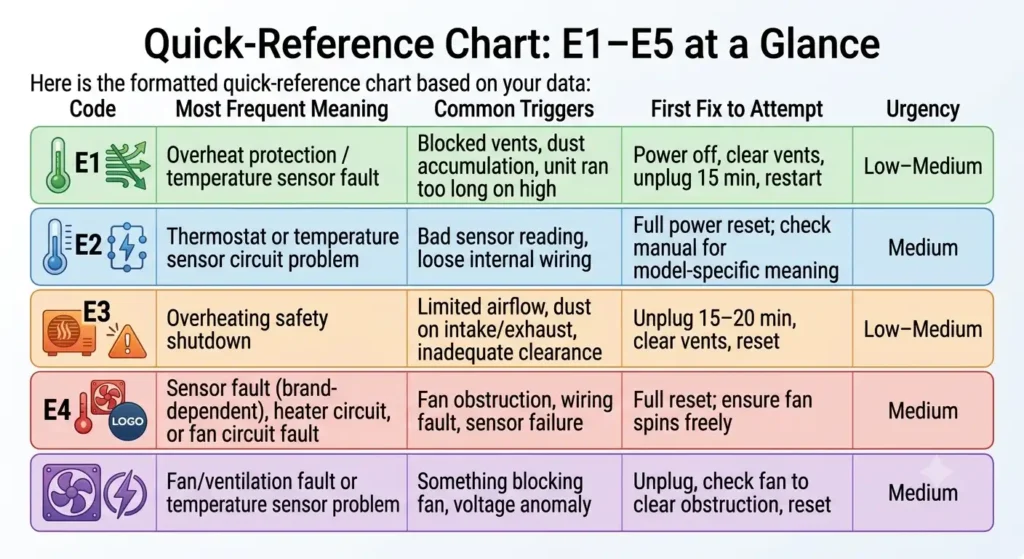
Here is the formatted quick-reference chart based on your data:
| Code | Most Frequent Meaning | Common Triggers | First Fix to Attempt | Urgency |
| E1 | Overheat protection / temperature sensor fault | Blocked vents, dust accumulation, unit ran too long on high | Power off, clear vents, unplug 15 min, restart | Low–Medium |
| E2 | Thermostat or temperature sensor circuit problem | Bad sensor reading, loose internal wiring | Full power reset; check manual for model-specific meaning | Medium |
| E3 | Overheating safety shutdown | Limited airflow, dust on intake/exhaust, inadequate clearance | Unplug 15–20 min, clear vents, reset | Low–Medium |
| E4 | Sensor fault (brand-dependent), heater circuit, or fan circuit fault | Fan obstruction, wiring fault, sensor failure | Full reset; ensure fan spins freely | Medium |
| E5 | Fan/ventilation fault or temperature sensor problem | Something blocking fan, voltage anomaly | Unplug, check fan to clear obstruction, reset | Medium |
Quickly read through this table first, then skip down to the code-specific section below to go through the entire walkthrough.
Before You Do Anything: Try the Universal Reset
Ahead of troubleshooting any particular code, perform this reset – it removes much of all error codes automatically as it allows internal sensors to cool down and allows the control board time to purge its memory:
- Turn the fireplace off in the remote or control panel.
- Disconnect it at the wall socket (or turn off the breaker, in hardwired models).
- Wait at least 15 minutes – do not short-change this time even when impatient; internal thermal sensor requires time to fully cool.
- Reinsert and switch on. When the code is lost you are done, but you’d better read the section on prevention below before it hits you on the head. When the code returns immediately or a few minutes after running, then proceed to steps specific to the code.
Electric Fireplace E1 Error Code What it means & How to Fix it
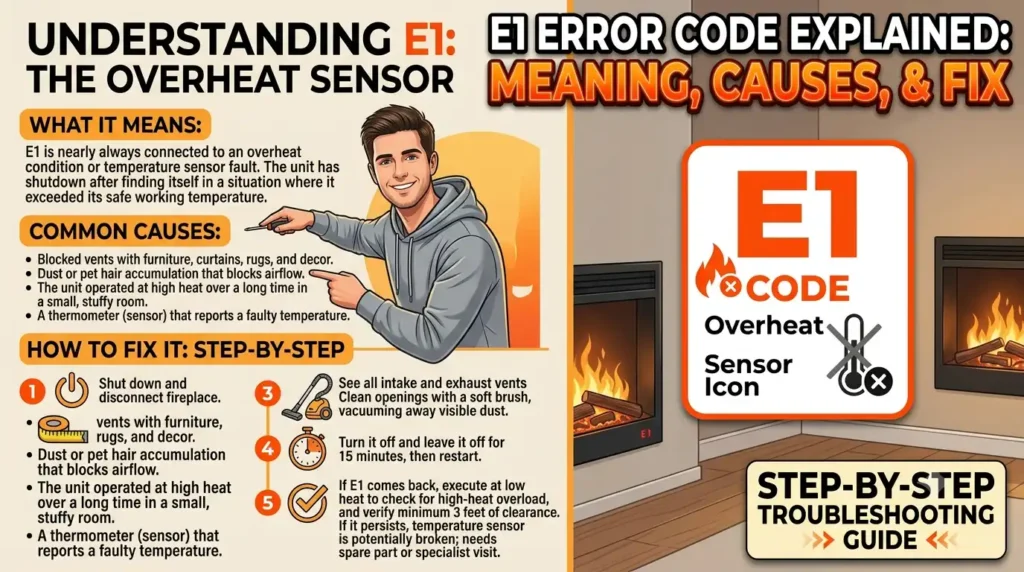
E1 is nearly always connected to the overheat of a fireplace or its temperature sensor. The unit has also found itself in a situation where it has overheated, which is beyond its safe working temperature and has closed down.
Common causes:
- Blocked vents with furniture, curtains, rugs, and decor.
- Dust or pet hair accumulation that blocks airflow.
- The unit that has to operate at high heat over a long time in a small or stuffy room.
- A thermometer that reports a faulty temperature.
How to fix it:
- Shut down and disconnect fireplace.
- See all intake and exhaust vents are clear- the most frequent cause is furniture too close.
- Clean with a soft brush attachment the openings of the vents by vacuuming away the visible dust.
- Turn it off and leave it off 15 minutes then restart.
- In case E1 comes back at once, execute it at a low heat setting to determine whether it is a high-heat overload problem in particular, and to verify that there is a minimum of 3 feet of clearance around the unit. In case it continues to reappear: the temperature sensor is potentially broken, which will need a spare part or a visit to a specialist.
Electric Fireplace E2 Error Code Causes & Fixes
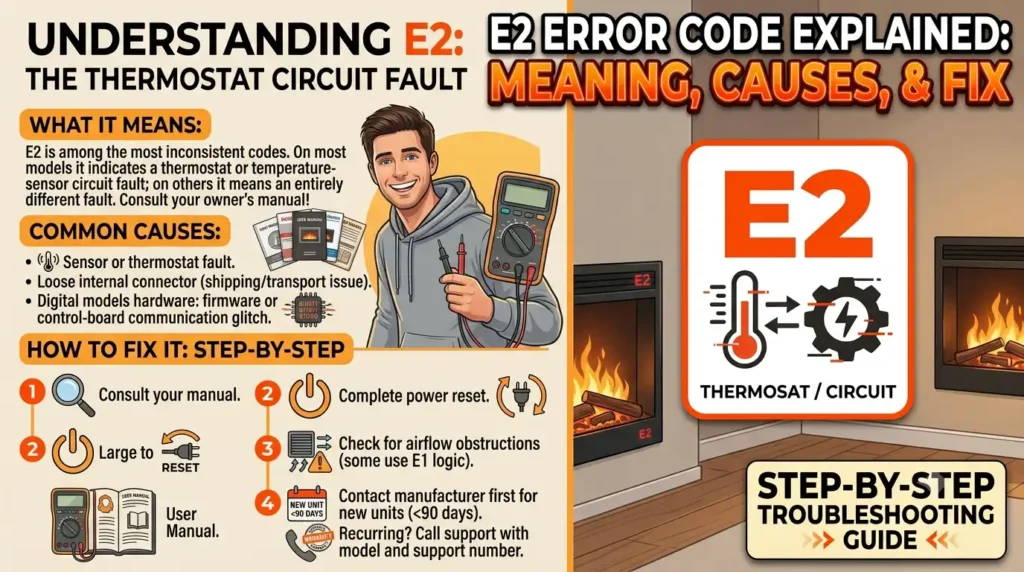
E2 is among the most inconsistent brand codes. On most models it indicates a thermostat or temperature-sensor circuit fault; on others an entirely different fault. This is the code in which it is most important to check the manual on your owner.
Common causes:
- Senor or thermostat fault.
- Loose internal connector (possibly due to shipping/transport vibration on new units)
- Digital models Hardware: a firmware or control-board glitch in communication.
How to fix it:
- Consult your manual beforehand – E2 is different enough among manufacturers that this step does save time.
- Perform the complete power reset mentioned above.
- Make sure nothing is covering airflow, as some brands pass the E2 over the same overheat-protection logic as E1.
- If it is a new unit (less than 90 days old) then contact the manufacturer first before trying to inspect it internally, this will not void your warranty. In case it recurs: Have your model number handy, call the manufacturer and provide your support number.
Due to the great range of meanings of E2, in most cases, phone support can tell you if it is a sensor, thermostat or board issue in your particular model within a minute or two.
E3 Error Code of an Electric Fireplace: Causes & Solution
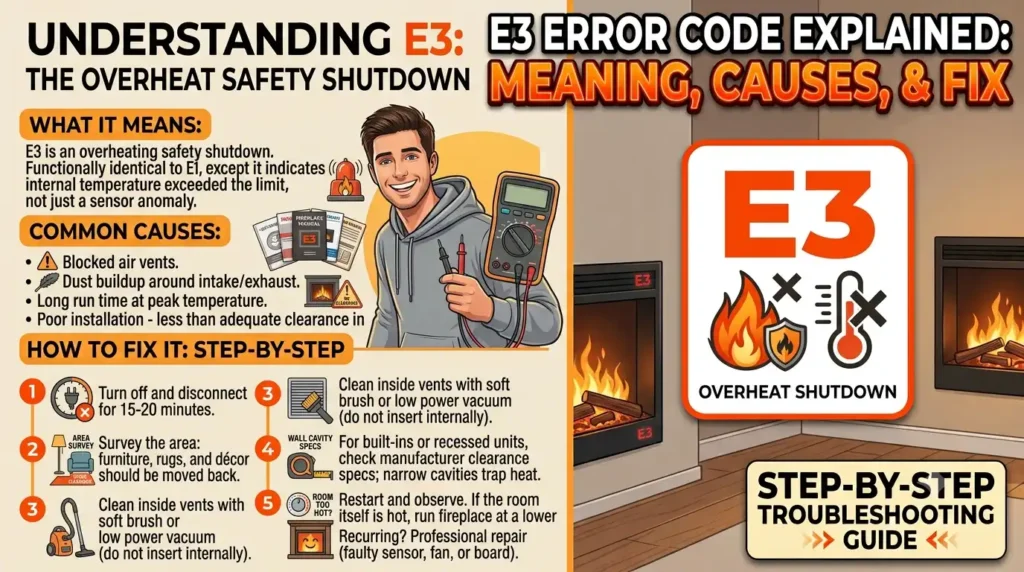
E3 is typically an overheating safety shutdown – functionally identical to E1, except that on most brands it specifically indicates that internal temperature has exceeded the shutdown limit, rather than merely a sensor anomaly.
Common causes:
- Blocked air vents
- Dust buildup around intake/exhaust
- Long run time at peak temperature.
- Poor installation – less than adequate clearance in a built in or wall mounted unit.
How to fix it:
- Turn off and disconnect 15-20 minutes.
- Survey the area around: the most common are furniture, rugs, and other decorative materials.
- Clean inside vents using a soft brush or low power vacuum – do not put anything in internal parts.
- In built-ins or recessed units, beware of the clearance specs of the manufacturer; narrow wall cavities trap heat.
- Restart and observe in case the room itself is hot, it is possible to run the fireplace at a lower level. When it recurs: this is usually an indication of a faulty temperature sensor, a non-functional fan, or a control board problem, all professional-repair space.
What Does E4 Error Code Mean on Electric Fireplace?
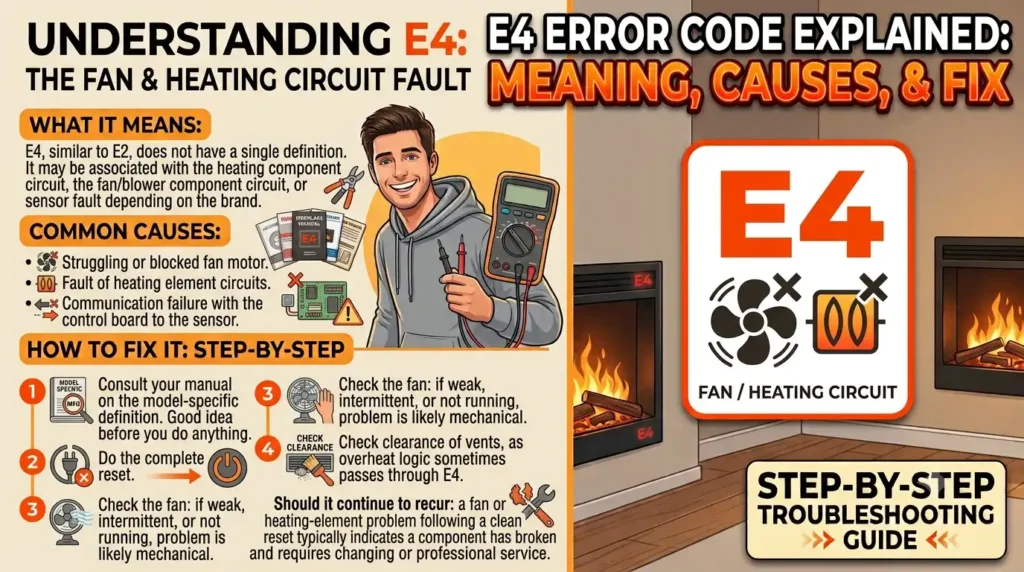
E4, similar to E2, does not have a single definition. It may be associated with the heating component circuit, the fan/blower component circuit, or sensor fault depending on the brand.
Common causes:
- Struggling or blocked fan motor.
- Fault of heating element circuits.
- Communication failure with the control board to the sensor.
How to fix it:
- Consult your manual on the model-specific definition – this is a good idea before you do anything with E4.
- Do the complete reset.
- Check the fan: when it is weak, intermittent, or not running, this is a good indication that the problem is mechanical as opposed to electrical.
- Check clearance of vents, as the overheat logic of certain brands passes through E4. Should it continue to recur: a fan or heating-element problem following a clean reset typically indicates a component has broken and requires changing or professional service.
Electric Insert E5 Error Code Causes & Fixes
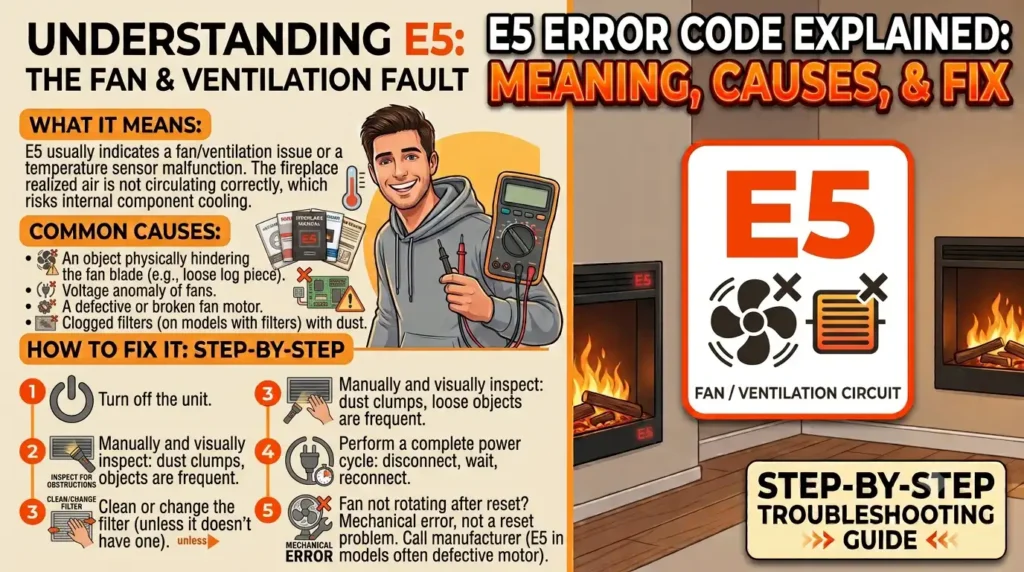
E5 usually indicates a fan/ventilation issue or a temperature sensor malfunction – the fireplace has realized that air is not circulating correctly, and that poses a risk to the internal components cooling.
Common causes:
- An object that is physically hindering the fan blade.
- Voltage anomaly of fans.
- A defective or broken fan motor.
- Clogged filters (on models with filters) with dust.
How to fix it:
- Turn off the unit.
- Manually and visually inspect that nothing is obstructing the fan – a loose ornamental log, a dust clump, or an object is a frequent cause.
- Clean or change the filter (unless it does not have one).
- Perform a complete power cycle: disconnect and leave a few minutes before reconnecting.
- When the fan does not rotate when it is reset, it is a mechanical error, not a reset problem. In case it continues to reoccur call the manufacturer.
The E5 cases on cheaper models are often caused by a defective fan motor that would require replacement, and most of those warranties or paid-repair jobs, but not a DIY one.
Why the Same Code Means Different Things
This is the section the majority of guides miss out on and why troubleshooting tips found online can be confusing. Manufacturers construct their own diagnostic logic; thus the same two-character code may correspond to entirely different faults across different brands.
Here is the comparison table formatted for quick reference:
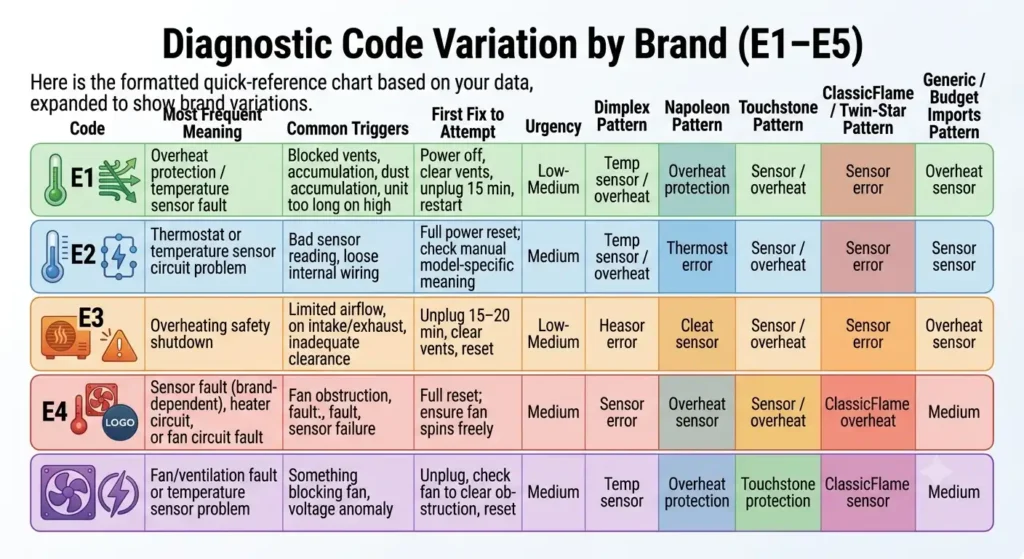
Diagnostic Code Variation by Brand (E1–E5)
| Brand (General Pattern) | E1 | E2 | E3 | E4 | E5 |
| Dimplex | Temp sensor / overheat | Thermostat circuit | Overheat shutdown | Heater circuit fault | Fan/sensor fault |
| Napoleon | Overheat protection | Sensor fault | Overheat shutdown | Communication / board fault | Fan fault |
| Touchstone | Sensor / overheat | Thermostat fault | Overheat shutdown | Fan circuit | Ventilation fault |
| ClassicFlame / Twin-Star | Sensor error | Overheat sensor | Shut off / overheat sensor | Heater / fan sensor | Fan / vent sensor |
| Generic / Budget Imports | Overheat sensor | Varies widely | Overheat shutdown | Varies widely | Fan / vent fault |
The real-world conclusion: E1, E3, and E5 are most likely to be universal by brand (overheating/sensor, and fan/ventilation problems, respectively). The two codes in which check your manual is not merely a boilerplate directive are E2 and E4 and they are the best way to get a correct answer the quickest.
Troubleshooting Decision Tree
This basic flow can be used when you prefer the step-by-step approach over reading code-by-code:
1. Is there burning odor, smoke or scorching that is visible?
Yes: Turn off, do not turn on, summon professional help. Spare the remaining part of this listing.
No: Continue.
2. Have you attempted a complete power shutdown (unplug 15 or longer)?
No: Do this first – it solves a great portion of codes by itself.
Yes, and the code cleared: You’re done. Read the following prevention tips.
Yes, and the code returned: Continue.
3. Does it have blocked or dusty vents, intake or exhaust areas?
Yes: Clean up, reestablish good clearance, reset.
No: Continue.
4. Does the fan sound weak, make grinding noises, or not run at all?
Yes: This is an indicator of a mechanical problem with the fan – a professional repair or spare part is probably required.
No: Continue.
5. Code re-emerged on more than a single occasion following cleaning and resetting?
Yes: Call the manufacturer or a skilled technician and have your model number ready.
No: Start monitoring after the next few uses; isolated codes may sometimes occur without any underlying fault.
Repair or Replace?
Here is the structured decision table based on your data:
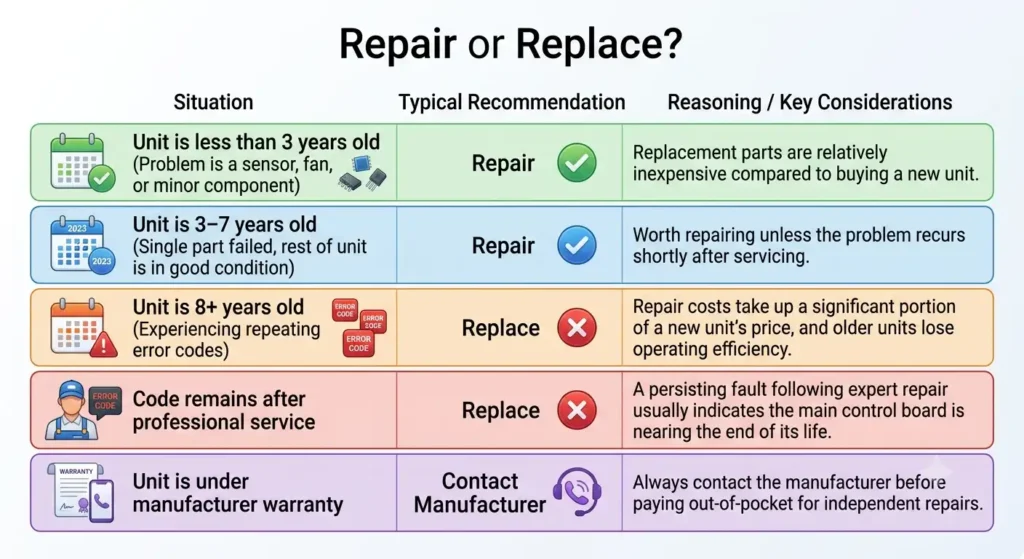
| Situation | Typical Recommendation | Reasoning / Key Considerations |
| Unit is less than 3 years old (Problem is a sensor, fan, or minor component) | Repair | Replacement parts are relatively inexpensive compared to buying a new unit. |
| Unit is 3–7 years old (Single part failed, rest of unit is in good condition) | Repair | Worth repairing unless the problem recurs shortly after servicing. |
| Unit is 8+ years old (Experiencing repeating error codes) | Replace | Repair costs take up a significant portion of a new unit’s price, and older units lose operating efficiency. |
| Code remains after professional service | Replace | A persisting fault following expert repair usually indicates the main control board is nearing the end of its life. |
| Unit is under manufacturer warranty | Contact Manufacturer | Always contact the manufacturer before paying out-of-pocket for independent repairs. |
Note on cost: The exact cost of the repair will be dependent on your fireplace brand, the part required and the wage rates of the area and as such we will not give a precise dollar value here, get a quote with a licensed technician or the manufacturers service line to get the correct dollar value.
When to Stop Troubleshooting & Call a Professional:
The majority of error codes are not dangerous but can be worked through but must be ceased immediately and an experienced technician contacted. If you notice that the error codes of electric fireplace are triggering again and again or notice any of the below:
- visible scorching or molten plastic on any part of the unit, a burning smell.
- Repeated, sporadic, or recurring sparks and smoke or a tripping circuit breaker when the fireplace is in operation.
- A broken power cord, or a plug that is hot to the touch.
- The error code was re-emerging after cleaning and resetting.
- The not spinning fan or making a grinding/screeching sound.
Frequent overheating shutoffs are no inconvenience to fuss with, they are the thermal cutoff system operating as intended.Correct the cause and not the past again and again.
How to Prevent Error Codes of an Electric Fireplace from Coming Back
- Vents and intake areas: Clean vents and intake areas are cleaned every 4-6 weeks in heavy-use season.
- Maintain at least 3 feet of clearance around the unit and adhere strictly to manufacturer clearance requirements with built-in units.
- Do not leave the unit operating on full blast over a long period of time in a small room.
- Do not put furniture, rugs or decorations over vents.
- Also have the manual (or a PDF version) available so that codes specific to a brand can be easily consulted.
- Arrange a routine checkup after every one year as long as fireplace is utilized seasonally.
Key Takeaways
- E1, E3 and E5 are relatively consistent across brands – they tend to lead to claims of overheat, sensor failure, or fan/ventilation problems.
- E2 and E4 are the most different in manufacturers; and, therefore, your owner’s manual is the quickest route to the correct diagnosis.
- A complete power reboot (unplug 15+ minutes) will fix a significant proportion of error codes with no additional troubleshooting.
- A code that repeats itself after cleaning and resetting is an indicator of a true hardware malfunction rather than a user error – then it is time to call in the service.
- Stop using the unit, then, when you see smoke, burning odors or a hot power line.
You May also read:
FAQs
What is E1 on an electric fireplace?
E1 normally means that the overheat protection has been activated or a temperature sensor has indicated a problem. Unblock obstructions in vents, allow the unit to cool 15 minutes then restart.
What is the E2 when using an electric fireplace?
E2 generally has to do with a thermostat or a temperature-sensor circuit, though its definition differs more than any other code across brands.
Always consult your manual. So, what is the E3 in an electric fireplace?
Most commonly E3 is an overheating safety shutdown caused by limited air flow, dusty conditions, or prolonged high-heat operation.
What is the meaning of E4 on an electric fire?
Depending on the manufacturer, E4 can be associated with the heater circuit, fan circuit or sensor fault, your owner manual will include the definition of E4 in relation to your model.
What is E5 on a fireplace of the electric kind?
E5 typically indicates that there is a problem with the fan or ventilation, or a temperature sensor that has detected a problem. Before resetting, make sure that nothing is blocking the fan.
What is the procedure to restart my electric fireplace?
Turn it off, unplug it off the wall (or switch off the breaker on hardwired units), wait at least 15 minutes, then re-plug it and turn it on. This overwrites the memory of the control board and fixes a lot of error codes.
My electric fireplace error code is reappearing after I reset it?
The underlying cause, blocked vents, a failed sensor, or a problem with the fan is often not addressed by a code that is reappeared after an appropriate reset. Wipe the unit first, it remains, then most probably the component should be dealt with by a professional.
Do all brands have the same electric fireplace error codes?
No. There’s no industry standard. Dimplex, Napoleon and Touchstone among others have their own systems and even models of the same brand may vary.