Do Water Vapor Electric Fireplaces Residue? The Honest Answer
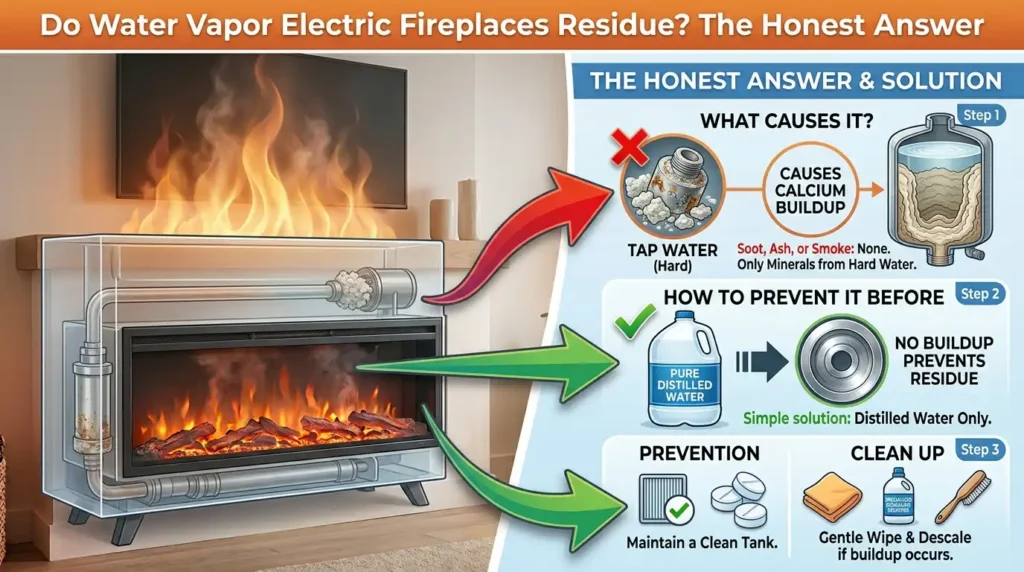
Do water vapor electric fireplaces leave residue? No, vapor fireplaces do not leave any soot, ash or smoke behind since nothing burns. But they do leave a good white mineral deposit on internal parts in case you use hard tap water rather than distilled or demineralized water in the tank.
It’s the whole enchanted image – and it’s not as simple as most product pages would have you think. We will discuss below precisely what is meant by the term residue in this type of fireplace, what causes it, how to prevent it before it occurs, and how to clean up when it does occur.
Key Takeaways
- Combustion residue (soot, ash, creosote, smoke stains): zero. Fireplaces powered by water vapor do not use any fuel, so this group of mess never occurs.
- Mineral residue (limescale, white mist, cloudy film): may happen but can be avoided. It is not produced by the fireplace but dissolved in tap water.
- The most significant thing that ever happens is the presence of residue is determined by distilled or demineralized water.
- The most likely parts that can exhibit mineral build-up over time are the reservoir, ultrasonic transducer, and mist outlet.
- Quick wipe-down and monthly clean reservoir keeps most units clean of residue over years.
What Is a Water Vapor Electric Fireplace?
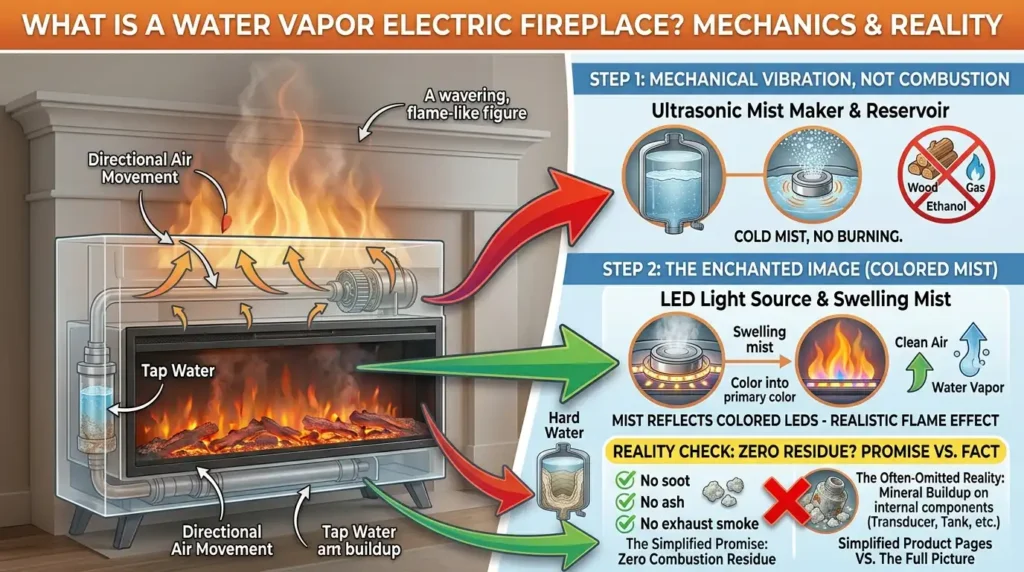
Some types of electric fireplaces resemble water vapor fireplaces, with the steam fireplace, 3D flame fireplace, or mist fireplace as alternatives to burning wood, gas, or ethanol; in these fireplaces the look of flames is achieved with an ultrasonic mist maker and colored LEDs. The mist maker is fed via a water reservoir and vibrates the water into a fog of tiny droplets at ultrasonic frequency. Underneath it is LED panels that light up the swelling mist, and directional movement of air forms it into a wavering, flame-like figure.
Due to lack of combustion, lack of chimney, lack of flue and lack of exhaust gas to vent. This is the primary selling point of most competitor pages at this subject – however this is where the zero residue promise is simplified.
How Water Vapor Fireplaces Actually Work
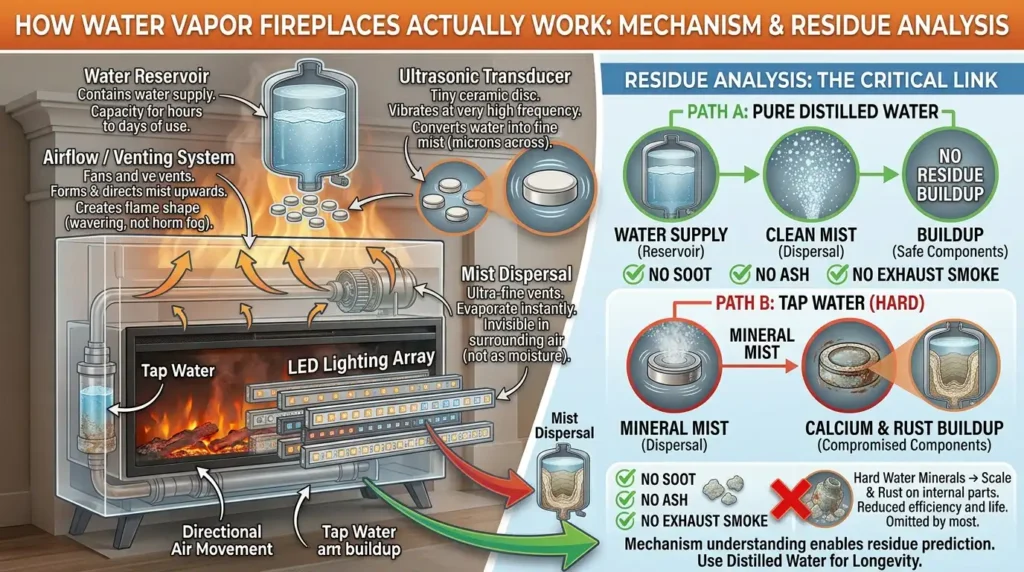
The mechanism is much easier to answer with an understanding of the residue question:
- Water reservoir – contains a water supply, usually sufficient to last several hours to a few days of use, depending on the height of flames and the size of the tank.
- Ultrasonic transducer -a tiny ceramic disc which vibrates at a very high frequency, converting water into a fine mist (particles only a few microns across).
- LED lighting array — colored LEDs typically stacked in orange, red and blue light, light up the rising light mist to simulate actual flame color and movement.
- Airflow/venting system – fans or vents form and direct the mist upwards making it more like a flame rather than floating like fog.
- Mist dispersal – the ultra-fine droplets are meant to evaporate in the surrounding air nearly instantaneously instead of falling out as a visible moisture.
All of that mist stream – 1, 3 especially – is either where the mineral matter in the water remains dissolved and harmless, or where it is deposited as residue when the water evaporates.
Do Water Vapor Fireplaces Leave Residue? The Core Answer
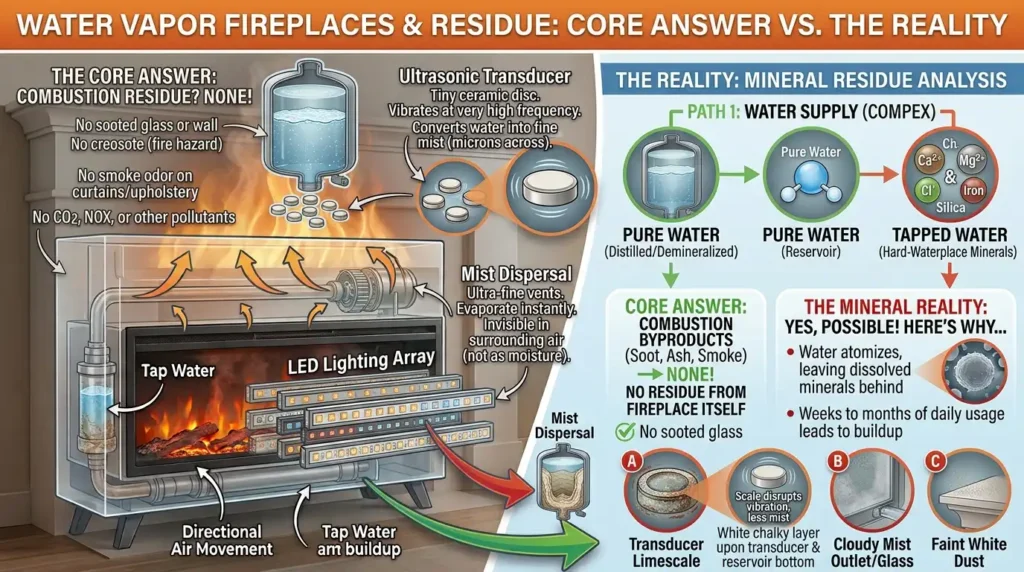
The answer to the question: The Combustion residue no soot, no ash, no smoke.
This is easy to understand and it is the same in all reputable sources: since the water vapor fireplaces do not burn fuel, they do not produce the byproducts of combustion. That means:
- No sooted glass or wall around it.
- No dust to brush away.
- No creosote accumulation (true fire-hazard issue with wood-burning units).
- No smoke odor impregnated on curtains or upholstery.
- No CO2 or other pollutants.
Should you be more concerned with the type of soot that a wood or gas fireplace produces, you can take that off the list as well. And this is the residue claim that most rival articles are making– and it is true.
The Mineral Residue Answer: Yes, It’s Possible — Here’s Why
This is where the line gets swept over: the water itself is not pure. Tapped water is dissolved with the minerals mostly calcium and magnesium, and, in most places, it is contaminated with chlorine, iron or silica. When this water is atomized and is released to the air, the water molecules are dissipated, but the dissolved minerals are not. They’re left behind as microscopic solid particles.
In weeks and months of daily usage, such particles may build up as:
- A white chalky layer upon the transducer disc and the bottom of the reservoir (limescale)
- A cloudy film on the interior of mist outlet or glass panel.
- Less mist, as accreted scale may disrupt the vibration of the transducer.
- Sometimes, a faint white dust may settle on surrounding surfaces in case the unit is operated long without cleaning.
This is essentially a water-quality problem, and not a design defect. It is the same cause as a glass humidifier or an electric kettle will create a scale in a hard-water place. The fireplace does not produce residue, it only shows what was dissolved in your water supply.
Water Vapor Fireplace Residue: Comparison by Fireplace Type
| Fireplace Type | Soot/Ash Residue | Smoke Odor | Mineral/Scale Residue | Chimney Needed | Typical Cleaning Frequency |
| Wood-burning | High | High | None | Yes | Weekly (ash removal), annual chimney sweep |
| Gas fireplace | Low–moderate (glass fogging, sooting on logs) | Low | None | Yes (vented models) | Annual professional service |
| Standard electric (heater-only) | None | None | None | No | Occasional dusting |
| Water vapor / mist fireplace | None | None | Low–moderate (tap water only; avoidable with distilled water) | No | Weekly wipe-down, monthly reservoir clean |
What Determines How Much Residue You’ll Get
The mineral residue risk is controlled by three factors which are ranked by order of importance:
- Water hardness in your location- the largest variable by far.
- The type of used water — distilled/demineralized and straight tap water.
- Run time and cleaning frequency –The longer the scale has time to accumulate, the higher the run time between cleanings.
Water Hardness Reference Table
| Level of Hardness of Water | General Mineral Content | Risk of Residue in a Vapor Fireplace |
| Soft water / Low | Low calcium/magnesium | Low – sometimes light film may occur |
| Moderately hard water | Evident mineral content | Moderate – visible scale in weeks unless treated |
| Hard water | High calcium/magnesium | High – scale may develop in a few days of use |
| Very hard water | Very high in minerals | High – often descaling is required without distilled water |
In the event you are not aware of the hardness of your local water, the vast majority of municipal water authorities have yearly reports on their water quality, and home test strips of hardness are cheap and common.
How to Prevent Mineral Residue from the Start
The good news: the prevention of residue is nearly completely based on what you put into the tank, rather than how you use the fireplace.
- Only distilled or demineralized water should be used. This is the most efficient step that can be done, it eliminates the minerals before it gets to the transducer.
- Do not use tap water, not even soft tap water, because even low-mineral tap water does have dissolved solids over time.
- Do not use fragrance oils or additives that have not been specified as compatible by the manufacturer – unapproved additives may block the mist outlet and leave traces of their own.
- Empty standing water when the unit is not going to be used over a span of a few days and instead of evaporating slowly in the tank, empty standing water.
- Read the manual of the manufacturer of the model used, to determine any model-specific guidance on water, as some commercial units have internal filtration or scale-reducing technology.
How to Clean and Descale a Water Vapor Fireplace
In most cases, a regular cleaning routine solves the problem once a residue has already manifested itself:
- Before cleaning the unit, unplug it and allow the reservoir to drain.
- Take off the water reservoir (removable) and wash it with clean water.
- Wet visually visible parts (reservoir, transducer housing) with a light solution of water and white vinegar to dissolve mineral deposits – do not use bleach or other harsh cleaners that can harm plastic parts and LED housings.
- Wipe the transducer disc with a soft, non-abrasive cloth; do not scrub, this part is fragile.
- Wipe the ammonia-free glass cleaner on the glass or mist outlet to prevent streaking.
- Fill the components completely before refilling and starting again, to avoid the possibility of mold or mildew in a moist reservoir.
- Only distilled water should be used in future.
Suggested cleaning cadence: Do water vapor electric fireplaces leave residue?
| Task | Frequency |
| Wipe exterior/glass | Weekly |
| Check and top off water level | Every 1–3 days of use (model-dependent) |
| Empty and rinse reservoir | Monthly |
| Vinegar-soak descale of transducer | Every 1–3 months, based on water hardness and use |
| Full component inspection | Every 3–6 months |
Signs Your Unit Already Has Mineral Buildup
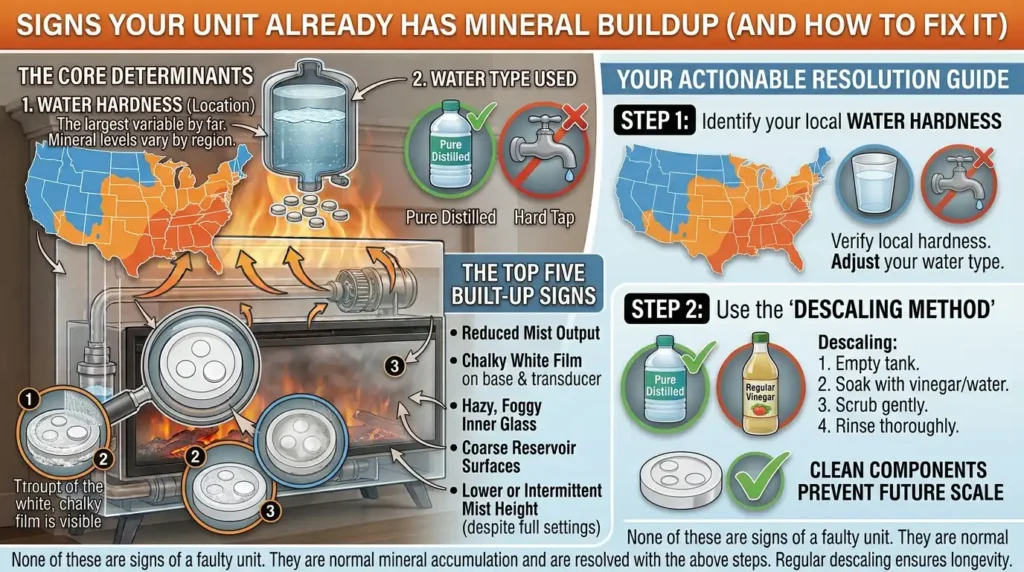
- Reduced or diminished mist output compared to when the unit was new.
- On the base of the reservoir or the transducer, a white, chalky film is visible.
- Hazy water on the inner side of the glass or foggy window.
- A little coarse when wiping the inside of the reservoir.
- Lower flame height or intermittent mist despite full settings
None of these are signs of a faulty unit, they are normal signs of the accumulation of minerals and can be resolved with the above descaling steps.
Myth vs Fact
| Myth | Fact |
| “Water vapor fireplaces never leave any residue at all.” | They never produce soot, ash, or smoke — but tap water can leave mineral residue on internal parts. |
| “Any water works fine in the tank.” | Water quality is the main variable in whether residue appears; distilled water is strongly recommended. |
| “Mineral buildup means the unit is defective.” | It’s a normal water-hardness effect, not a manufacturing flaw, and it’s fully cleanable. |
| “The mist will dampen my walls and furniture.” | In normal operation, the mist is fine enough to evaporate into the air rather than settle as moisture. |
| “You need professional servicing to descale it.” | Most units can be descaled at home with a mild vinegar-and-water solution and basic tools. |
Does the Mist Leave Residue on Walls, Floors, or Furniture?
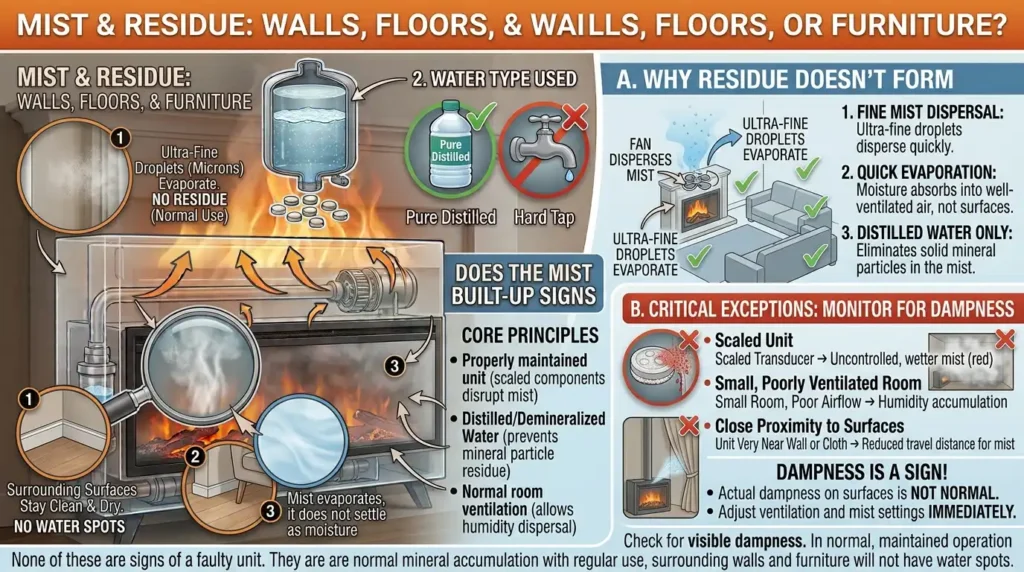
No, in the case of a properly maintained and well-operating unit. The droplets of the mist are actually made to be very fine (few microns across) such that they are dispersed and can evaporate into the surrounding air instead of settling as visible moisture. With normal use in a well-ventilated room, the surrounding walls and furniture should not have water spots.
However, there are some exceptions to this:
- Weakly maintained or scaled unit could result in a less controlled, wetter mist.
- Using the fireplace in a very small, poorly ventilated room may cause excessive humidity to accumulate than the room can absorb.
- When the unit is very near a wall or cloth surface, the distance that the mist must travel to come in contact with something is minimized.
When you can see that there is actual dampness on the nearby surfaces, this is an indicator to adjust the ventilation and mist settings, not a sign that it is normal.
Water Vapor vs. Wood, Gas, and Standard Electric Fireplaces
| Feature | Water Vapor | Wood-Burning | Gas | Standard Electric |
| Gives out real heat | No (ambiance only) | Yes | Yes | Yes |
| Needs a chimney/vent | No | Yes | Usually | No |
| Soot/ash cleaning | None | High (ash, creosote) | Low | None |
| Mineral residue | Low to High (depending on water) | None | None | None |
| Realistic movement of flames | High (3D LED + mist) | Highest (real fire) | High | Moderate |
| Safe to touch by kids/pets | Yes (cool to touch) | No | No | Depends on model |
| Installation flexibility | Very high (no venting) | Low | Moderate | High |
You May Also Read:
FAQs:
Do the water vapor fireplaces leave anything on the wall taken behind them?
Not during normal operation. The mist is supposed to evaporate into the air before it can form moisture on the surfaces around.
Is tap water suitable with a water vapor fireplace?
You can, but it also puts you at risk of accumulated mineral residue with time. Distilled or demineralized water is recommended by most manufacturers to avoid buildup.
Why is there a white residue in the tank of my water vapor fireplace?
That is mineral scale that is dissolved calcium and magnesium in tap water. It is natural, not a flaw, and can be washed out in vinegar-and-water.
Do water vapor fireplaces burn smoke or soot?
No. No smoke, no soot, no ash, no sort of combustion byproduct of any type because nothing is being burned.
What is the frequency of cleaning a water vapor fireplace?
It will be normal to have a weekly exterior wipe-down and a monthly reservoir clean; further descaling is necessary once a month or once every three months based on your local water hardness.
Is mineral accretion harmful?
No. It is a cosmetic and performance problem (less mist output) not a safety hazard and does not harm the unit provided it is cleaned after a period.
Does a water vapor fireplace raise the humidity in a room?
Yes, a little, because it evaporates water in the atmosphere. This is minor in most rooms, but it should be taken into account in already-humid climates or very small rooms.
Is it possible to put scented oils into the water?
Only when specially authorized by the manufacturer. The additives that are not approved may block the mist mechanism and leave their own residue.
Do water vapor fireplaces leave a stain on furniture or fabric?
Not usually, as the mist is created to spread and not settle. It is also safer to have the unit as a distance as possible to fabric surfaces.
What is the difference between mineral residue and soot?
Soot refers to the deposition of fuel burning and is a black and oily residue. Mineral residue is formed by evaporated water and is seen as a white, chalky film – there are two entirely different causes and methods of cleaning.
How often do I need to clean a water vapor fireplace?
A weekly exterior wipe-down and a monthly reservoir clean is typical; deeper descaling is needed every one to three months depending on your local water hardness.
Is mineral buildup dangerous?
No. It’s a cosmetic and performance issue (reduced mist output), not a safety hazard, and it doesn’t damage the unit if cleaned periodically.
Does a water vapor fireplace increase humidity in a room?
Yes, slightly, since it releases water vapor into the air. In most rooms this is minor, but it’s worth considering in already-humid climates or very small spaces.
Can I add scented oils to the water?
Only if the manufacturer specifically approves it. Unapproved additives can clog the mist mechanism and leave their own residue.
Do water vapor fireplaces stain furniture or fabric?
Not typically, since the mist is designed to disperse before settling. Keeping the unit, a reasonable distance from fabric surfaces further reduces any risk.
How is mineral residue different from soot?
Soot comes from burning fuel and is a black, oily deposit. Mineral residue comes from evaporated water and appears as a white, chalky film the two have completely different causes and cleaning methods.