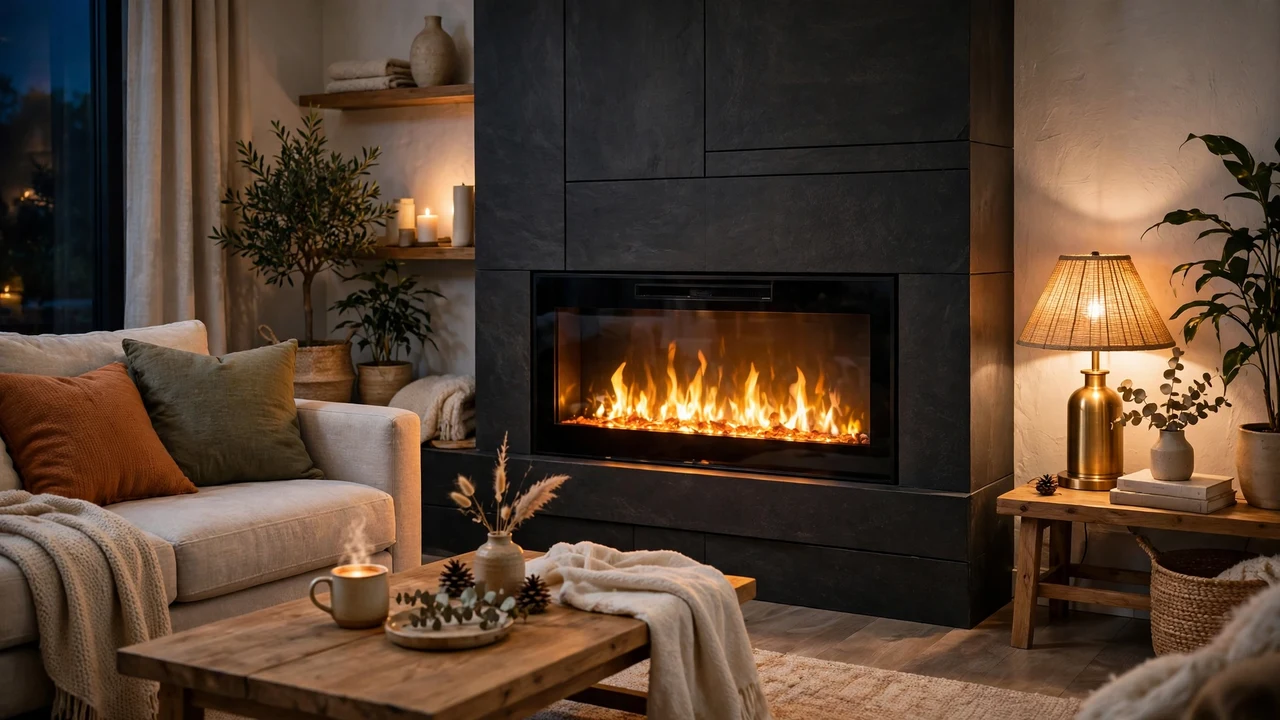
Does an Electric Fireplace Use More Electricity Than Central Heat? The Honest Comparison
Does an electric fireplace use more electricity than central heat? The short answer is: it depends on how you use it, and on what kind of central heat you have. An electric fireplace usually draws less power per hour than a whole-house electric heating system, because it heats one room instead of an entire home.
That does not automatically mean your bill drops. A fireplace left on high all day in a room you rarely sit in can waste power, while a central system left running at a high temperature for an empty house can waste far more. The real comparison is about area, hours, and thermostat habits, not about one appliance in isolation.
This guide compares the two side by side, shows a worked cost formula you can run with your own electricity rate, and explains when zone heating with a fireplace helps and when central heat is the better choice. No single number fits every home, so where figures vary, this article says so plainly.
⚠️ Electrical safety first
Plug an electric fireplace directly into a wall outlet on a circuit that can handle its load. Never run it from an extension cord or a power strip, and never plug another large heater into the same outlet.
Keep curtains, bedding, paper, and furniture clear of the heater outlet, follow the clearance distances in your manual, and call a licensed electrician if the breaker trips, the plug feels hot, or the outlet looks discolored. This article is general guidance, not electrical advice for your home.
At a glance
- One room vs. whole house: a fireplace heats where you sit; central heat warms every room on the system.
- Per-hour draw: a typical plug-in fireplace draws less power than a whole-house electric furnace or heat pump running at full output.
- What decides the bill: wattage, hours on heat, room size, insulation, and whether you turn the central thermostat down.
- Gas central heat is a different comparison: it mainly uses electricity for fans and controls, while the heat comes from gas.
The Short Answer, With the Catch
Hour for hour, an electric fireplace does not use more electricity than central heat for a whole house. A typical plug-in model draws around 750 watts on low and 1,500 watts on high, with some larger or hardwired models drawing more. Check the label on your own unit, because wattage varies by model and heat setting.
A central system, by contrast, is sized to heat a whole home. Even an efficient heat pump or furnace moves far more air and serves far more space than a single-room fireplace. The catch is area: the fireplace warms one room well and the rooms beyond it poorly, if at all.
So the fair question is not which appliance draws more watts. It is whether heating one occupied room with a fireplace, while the rest of the house runs cooler, uses less total energy than heating the whole house to the same comfort level. Often it does. When the fireplace becomes an extra heater on top of unchanged central heating, it does not.
How Each System Actually Uses Electricity
An electric fireplace turns almost all of its electrical input into heat in the room, plus a small amount for the flame effect and fan. Many models let you run the flame effect with no heat at all, which draws far less power than the heater setting. That flame-only mode is for looks, not warmth.
Central heat works differently depending on fuel. A gas furnace or boiler burns gas for heat and uses electricity mainly for the blower, pump, ignition, and controls. An electric furnace uses resistance heating for the whole house, and a heat pump moves heat rather than creating it from resistance wire, which changes its efficiency in cold weather.
That difference matters for your bill. If your central heat runs on gas, adding an electric fireplace adds electricity use, even if it cuts gas use. If your central heat runs on electricity, a fireplace may replace some of that load for the room you use most. To learn the parts behind that flame and fan, see how an electric fireplace works.
Side-by-Side Comparison
The table below keeps the comparison honest by separating what each system heats, what drives its running cost, and where each one falls short. Treat wattage figures as typical ranges, not promises for your model.
| Electric fireplace | Central heat | |
|---|---|---|
| Area heated | One room or open living area | Whole house, or every zone on the system |
| Typical electrical draw | About 750–1,500 watts on heat for a typical plug-in model; check your label | Varies widely by system size, fuel, and outdoor temperature; whole-house load is normally higher |
| Best use | Evenings in the room you occupy, with central heat turned down | Keeping the whole home at a steady temperature, day and night |
| Weak spot | Cannot heat distant rooms or a full house evenly | Heats empty rooms too, unless you have zones or close vents thoughtfully |
| Main cost lever | Heat setting and hours used | Thermostat setting, run time, insulation, and system efficiency |
For a broader look at fuel and running-cost trade-offs, the site’s gas vs. electric fireplace comparison covers where each type fits best. The point here stays narrower: electricity use for space heating depends on area served, not on the fireplace alone.
Work Out Your Own Cost in Four Lines
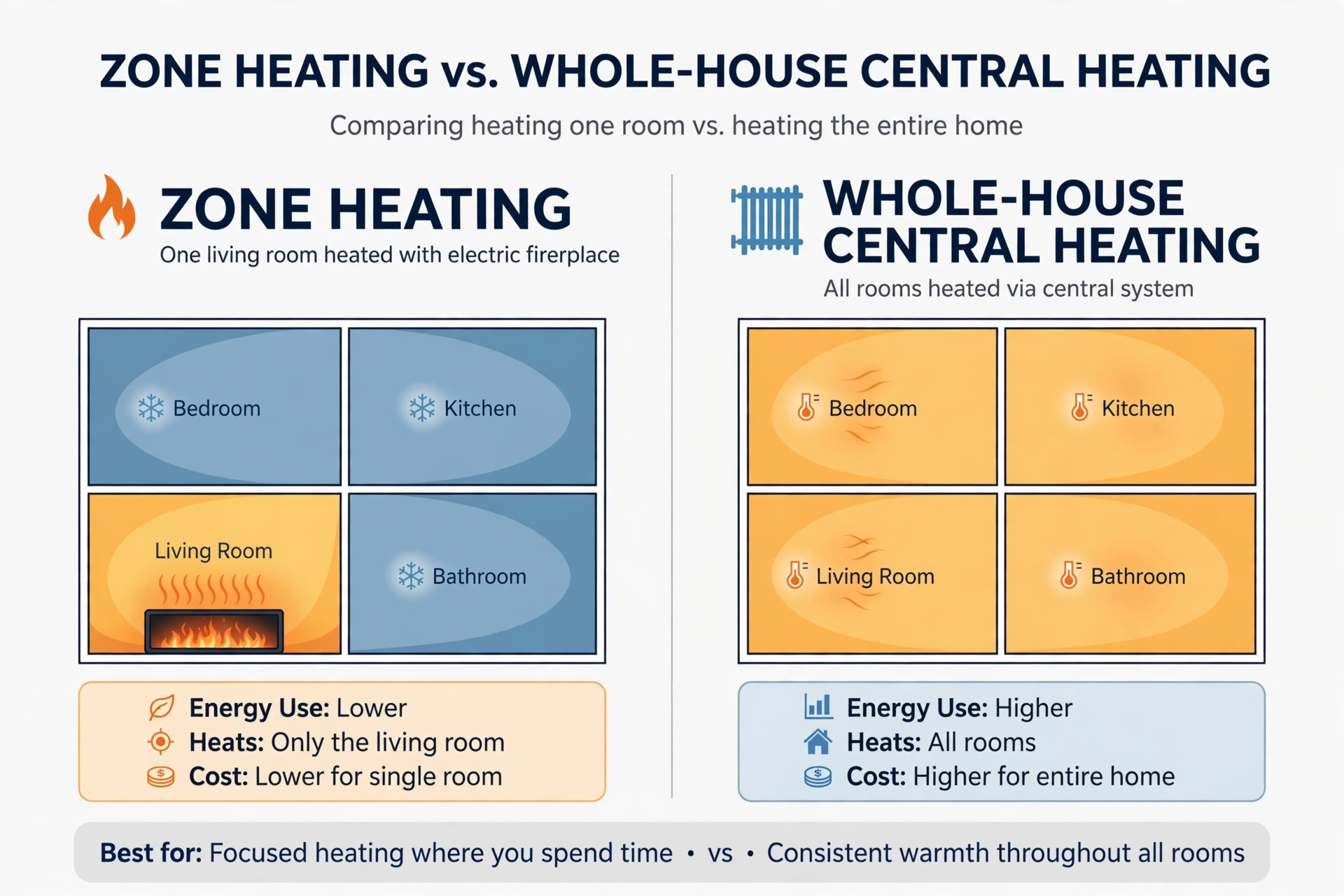
Do not rely on a stranger’s bill. Your rate, your wattage, and your hours decide the answer. The formula below works for any electric fireplace, and you can find your rate on your electricity bill or supplier account.
The cost formula
Cost = (watts ÷ 1,000) × hours × your rate per kWh
Example with an illustrative rate only: a 1,500-watt fireplace on high for 4 hours uses 6 kWh (1.5 × 4). At an illustrative $0.17 per kWh, that evening costs $1.02.
On low at 750 watts for the same 4 hours, use is 3 kWh, which would be $0.51 at that same illustrative rate. Replace $0.17 with your own rate before drawing any conclusion about your home.
Flame-only mode changes the picture, because the heater is off and only the lights and display draw power. That draw is small compared with the heater, but the exact figure varies by model, so check your manual rather than assuming a number.
Also watch for cycling. Many fireplaces switch the heater on and off to hold a set temperature, so a unit rated at 1,500 watts may not draw full power for every minute it is switched on. That is one more reason to treat the formula as an upper-bound estimate for a session on high, not a meter reading.
When the Fireplace Wins, and When It Loses
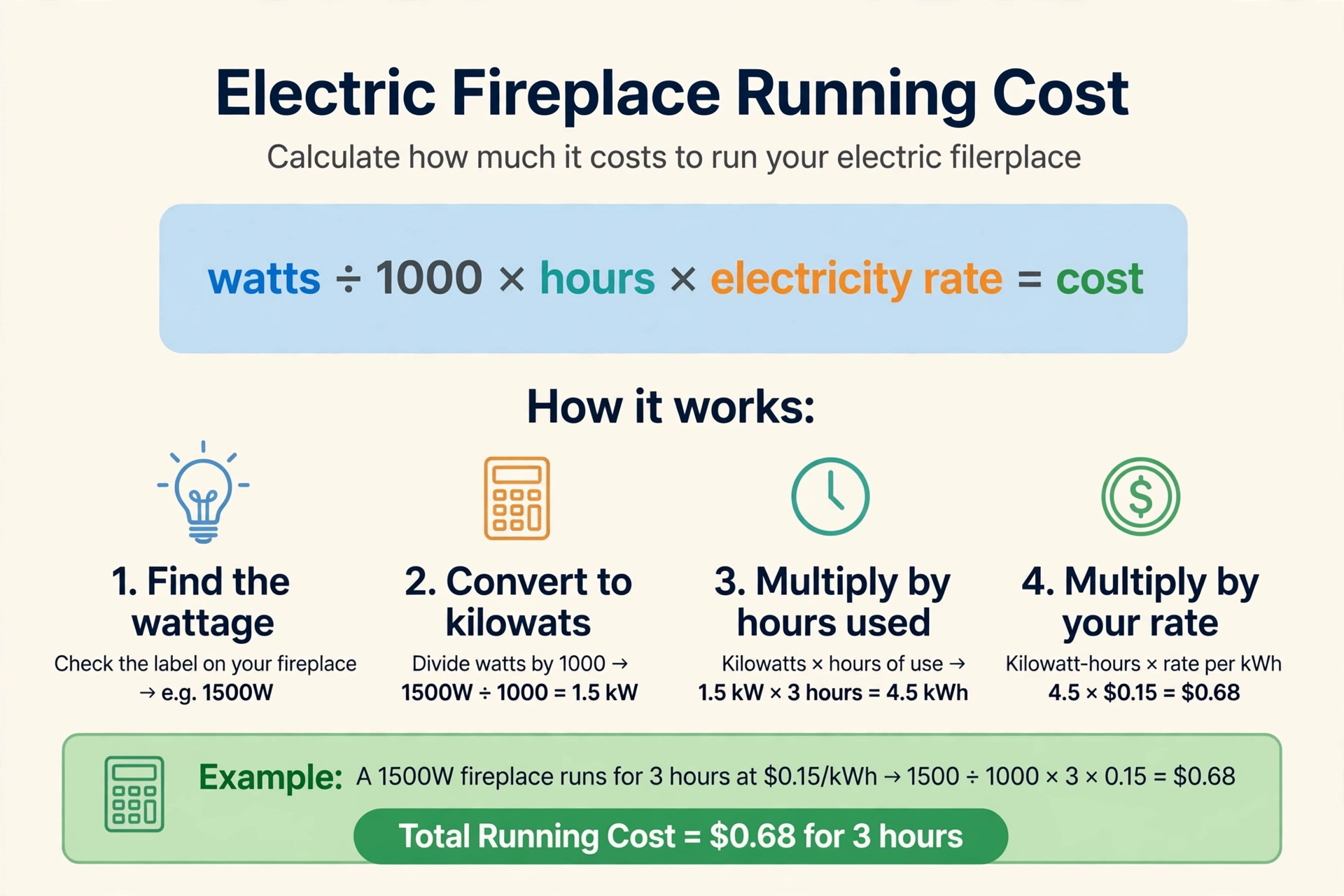
The fireplace wins when it replaces central heating for the hours and rooms that matter. Picture an evening spent in the living room: the fireplace warms that room, and the central thermostat drops a few degrees for the rest of the house. Total energy can fall, because one small heater replaces whole-house heating for that period.
The fireplace loses when it runs on top of everything else. If central heat stays at its normal setting, doors stay open, and the fireplace heats a room that was already warm, you have added load without removing any. The same applies to all-day use in a draughty room with poor insulation, where heat escapes as fast as the heater makes it.
Central heat wins outright for whole-house comfort, cold snaps, and homes where people spread across several rooms. It also wins where pipes, pets, or houseplants need a minimum temperature in rooms the fireplace never reaches. A fireplace is a room heater with a flame effect, not a substitute heating system.
Three Habits That Decide the Bill
Turn the central thermostat down when the fireplace is on. This is the single change that turns zone heating into a saving. Without it, the fireplace is an extra cost, not a replacement. A modest drop for the evening is enough to test the effect on your next bill.
Close the room off, within reason. Shutting doors to unused rooms keeps fireplace heat where you sit. Leave enough airflow for comfort and safety, and never block the heater outlet or air intake. If a room feels stuffy or the heater cycles oddly, open the door and check the manual.
Use the thermostat and timer on the fireplace. A set temperature stops the heater running at full power longer than needed, and a timer stops an empty room being heated after bedtime. Both features exist to cut waste, so use them rather than leaving the unit on high by habit. For more on overall running costs, see how much energy an electric fireplace uses.
Common Mistakes That Push Costs Up
- Heating with the doors wide open. Heat drifts to the hall and the rest of the house, so the fireplace works harder for a room that never feels warm.
- Running on high all evening. High is for warming a cold room. Once the room is comfortable, low or thermostat mode usually holds it.
- Using an extension cord or power strip. This is a safety problem first and a cost problem second: heaters draw sustained current, and undersized cords can overheat. Plug directly into a wall outlet.
- Ignoring the rest of the house. Letting unused rooms fall too cold can cause discomfort, condensation, or frozen pipes in cold weather. Zone heating means cooler, not freezing.
If your breaker trips, your outlet feels warm, or you smell burning, switch the fireplace off, unplug it once it is safe to do so, and call a licensed electrician. Do not keep resetting a tripping breaker to finish an evening. For the efficiency angle in more depth, see are electric fireplaces energy efficient.
Frequently Asked Questions
Does an electric fireplace use more electricity than central heat?
No, not hour for hour for a whole house. A typical plug-in fireplace draws about 750 to 1,500 watts, while a whole-house central system serves far more space and normally draws more. The bill depends on hours used and whether central heat is turned down.
Does an electric fireplace save money on heating bills?
It can, when it replaces central heating in the room you occupy and the central thermostat is turned down. It adds cost when it runs on top of unchanged central heating.
How much does it cost to run an electric fireplace for one evening?
Use this formula: watts divided by 1,000, times hours, times your rate per kWh. A 1,500-watt fireplace for 4 hours uses 6 kWh, so multiply 6 by your own rate from your bill.
Can an electric fireplace heat a whole house?
No. An electric fireplace is made to heat one room or open living area. It cannot replace central heat for a whole house, especially in cold weather.
Is it safe to run an electric fireplace on an extension cord?
No. Plug it directly into a wall outlet, keep clearances from curtains and furniture, and call a licensed electrician if the breaker trips or the plug feels hot.
Quick reference
- Typical plug-in fireplace: about 750 watts on low, 1,500 watts on high — check your label.
- Formula: (watts ÷ 1,000) × hours × your rate per kWh = cost.
- Example: 1,500 watts × 4 hours = 6 kWh; at an illustrative $0.17 per kWh, that is $1.02.
- Zone-heating rule: fireplace on, central thermostat down, doors to unused rooms shut.
- Safety rule: wall outlet only, no extension cords or power strips, clearances kept, electrician called for tripping breakers or hot plugs.
The Bottom Line
An electric fireplace uses less electricity per hour than heating a whole house, but it heats far less space. Used as a zone heater with the central thermostat turned down, it can cut total heating energy for the evening. Used as an extra heater with nothing turned down, it adds to the bill.
Run the formula with your own wattage and rate, watch one bill cycle, and let that result guide you. That number, not a generic claim, is the answer for your home.