Are Wall-Mounted Electric Fireplaces Safe? A Clear Answer for Your Home
Are Wall-Mounted Electric Fireplaces Safe? For most homes, the answer is yes — when the unit is mounted into wall studs, wired on a circuit that can carry the load, and kept clear of curtains, bedding, and other items that can catch fire. A wall-mounted electric fireplace has no real flame, no gas line, and no chimney, so it removes the biggest risks that come with wood and gas fires. The risks that remain are the ones you can control: a weak mount, an overloaded outlet, and blocked airflow.
This guide walks you through each of those risks in plain terms. You will learn how to check your wall, how to check your circuit, how much space to leave around the unit, and what to do with a TV mounted above it. By the end, you will know whether your room is a good fit and what to fix before you hang anything.
Heads Up: Read This Before You Mount Anything
Electricity and heat can cause fires and shocks. If your wiring is old, your breaker trips often, or you are unsure about your wall, call a licensed electrician before you drill. Never run a fireplace heater on an extension cord or a power strip. This guide gives general safety facts only and does not replace your model’s manual or local electrical code.
TOTAL TIME
2–4 hours
ACTIVE TIME
60–90 minutes
DIFFICULTY
Beginner to moderate
What You Need
- Stud finder and painter’s tape
- Level (at least 24 inches long)
- Drill, drill bits, and a socket or wrench set
- Lag bolts or the mounting hardware that came with your unit
- Tape measure and pencil
- Your fireplace manual (for weight, clearances, and circuit needs)
- Flashlight to check the outlet and breaker panel
- A second person to lift and hold the unit
At a Glance: The 7 Safety Checks
- Find the studs and check the wall
- Confirm the circuit can carry the load
- Measure clearances around the unit
- Mount the bracket into studs
- Hang the unit and test the heater
- Set daily-use rules for heat and airflow
- Inspect the mount and cord each season
The Short Answer: Yes, With the Right Mount and Wiring
A wall-mounted electric fireplace is safe when three things are true. The bracket is bolted into solid wood studs. The heater runs on a circuit with enough spare capacity.
Nothing flammable sits close to the heat outlet. Miss one of those three, and the risk rises fast.
The unit itself helps you. There is no open flame and no fuel to leak. Most models add a fan, a thermostat, and a shut-off that trips if the unit gets too hot.
Those features lower risk, but they do not fix a bad mount or a weak circuit. Your job is to get the install right and keep the area around it clear.
Look for a UL or ETL mark on the box or rating plate before you buy. Those marks show that an independent lab tested the unit to a safety standard. A unit with no mark and no clear manual is a warning sign. Pick a different model if you cannot find the rating plate or the maker’s name.
How a Wall-Mounted Electric Fireplace Works
Most wall-mounted units use a heating element and a fan. Air is pulled in, warmed as it passes the element, and blown back into the room. The flame you see is an LED effect on a screen or behind glass. It gives light and movement, but it gives off no heat by itself.
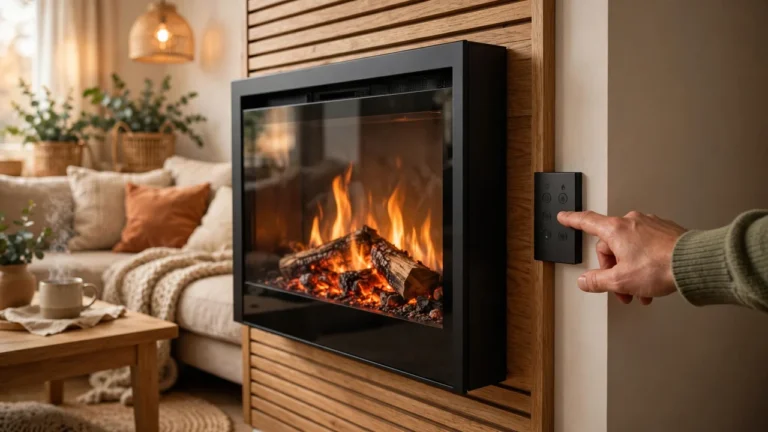
Many units offer two modes. Flame-only mode runs the lights with no heat, and it draws very little power. Heat mode runs the element and fan, and that is when the unit pulls real current. Knowing the difference matters, because the safety rules in this guide apply most to heat mode.
Heat comes out of a vent, usually at the top or the front of the unit. Warm air rises from that vent and spreads into the room. Anything placed above or in front of the vent can trap that heat. That is why clearances and TV placement need care, and why this guide covers them in full below.
Typical Power, Heat, and Weight Numbers
Numbers help you plan. The table below shows the ratings you will see on most wall-mounted models sold in the United States. Your model’s manual is the final word. If your numbers differ from this table, follow your manual.
| Rating | Typical value | What it means for you |
|---|---|---|
| Heater power | 750 W (low) / 1,500 W (high) | High heat draws about twice the power of low heat. |
| Current at 120 V | 6.25 A low / 12.5 A high | A 1,500 W heater nearly fills a 15-amp circuit by itself. |
| Heat output | About 2,560 BTU low / 5,100 BTU high | Enough to warm a small to medium room, not a whole house. |
| Room size | About 150–400 sq ft on high | Room size claims vary by maker; insulation and ceilings change the result. |
| Unit weight | 30–80 lbs for most models | Large linear models can weigh more; check your manual. |
| Plug type | Standard 120 V plug on most models | Some large models need a 240 V line or a hardwired install. |
The current row deserves a second look. A standard bedroom circuit in the United States is often 15 amps. A 1,500-watt heater pulls 12.5 amps on high, which leaves almost no room for a lamp, a phone charger, or a TV on the same circuit.
That is the main reason breakers trip when a fireplace heater runs. A 20-amp circuit gives you more headroom, and a circuit used by the heater alone is the safest setup of all.
If you want the full picture on circuits and breakers, read our guide to electric fireplace breaker requirements. It explains how to read your panel and how to tell whether a circuit is shared with other rooms.
Check the Wall and Find the Studs
Your wall decides whether the mount holds. Drywall alone cannot hold a 40- or 60-pound fireplace, and plastic anchors made for picture frames are not enough either. The bracket must bite into solid wood studs, or into blocking fixed between studs.
Run a stud finder across the wall at the height where the bracket will sit. Mark each stud edge with painter’s tape, then mark the center of each stud. Studs in most homes sit 16 inches apart, center to center. Some walls use 24-inch spacing, so measure rather than guess.
Tap the wall with your knuckles as a cross-check. A solid, dull sound often marks a stud, while a hollow sound often marks the gap between studs. The stud finder is the tool to trust. The tap test only backs it up.
Check what the wall is made of before you drill. Standard drywall over wood studs is the most common case and the one this guide covers. Plaster, brick, concrete, and metal studs each need different anchors and bits. If your wall is brick or concrete, use masonry anchors rated for the unit’s weight, or call a pro for the mount.
Confirm the Circuit Can Carry the Load
Find the outlet you plan to use and trace it to your breaker panel. Turn off breakers one at a time and note which rooms lose power. That tells you what else shares the circuit. Write the list down before you go further.
Add up the other loads on that circuit. A TV, a game console, and a lamp can add several amps. If the total with the heater on high passes 80 percent of the breaker rating, the circuit is too full.
For a 15-amp breaker, that limit is 12 amps of steady load. A 1,500-watt heater already passes it on its own.
The fix is a dedicated circuit or a lower heat setting. A dedicated circuit means the heater is the only load on that breaker. An electrician can add one, and that is the right call if your panel has space and your heater will run for hours each day. Running the heater on low heat is a short-term option, not a fix for a crowded circuit.
Heads Up: Never Use an Extension Cord
A fireplace heater pulls high current for long stretches. Extension cords and power strips can overheat, melt, and start a fire under that load. Plug the unit straight into a wall outlet. If the cord cannot reach, move the unit or have an electrician add an outlet closer to the mount point.
Watch for warning signs each time the heater runs. A warm outlet cover, a plug that feels hot, a buzzing sound, or a breaker that trips more than once all mean something is wrong. Turn the heater off, unplug it, and call a licensed electrician. Do not keep resetting a tripping breaker and hoping the problem goes away.
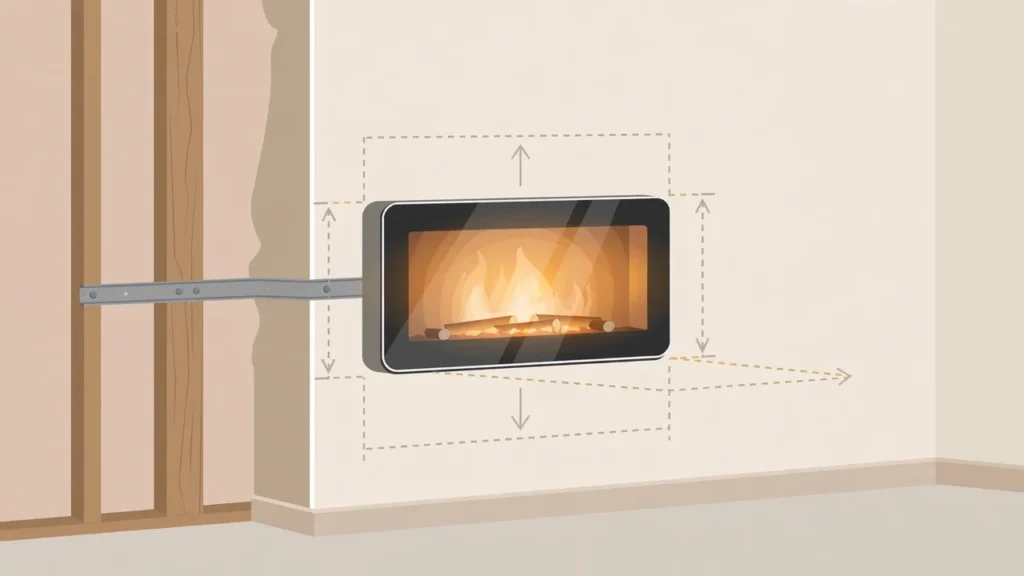
Measure Clearances Around the Unit
Clearances are the empty space around the fireplace. They let hot air escape and keep heat away from things that can burn. Every model has its own numbers, printed in the manual.
The table below shows the minimums that appear in many manuals, so you can plan the spot before you buy. Your manual wins if its numbers are larger.
| Space to leave | Common minimum | Why it matters |
|---|---|---|
| Above the unit | 12 inches to a shelf or mantel | Hot air rises straight up from a top vent. |
| In front of the heater outlet | 36 inches clear | Keeps bedding, drapes, and paper out of the hot airflow. |
| To each side | 6–12 inches | Lets the fan pull in cool air without strain. |
| Below the unit | 12 inches above the floor | Keeps rugs, pet beds, and toys away from the vent. |
| Curtains and drapes | 36 inches to the side | Fabric can drift into the airflow when a window is open. |
Measure with the tape, not with your eye. Mark the clearance zone on the wall with painter’s tape before you drill. Stand back and look at the room. If a curtain rod, a bookshelf, or a floor lamp sits inside the taped zone, move it or pick a different wall.
Bedrooms need extra care. A bed, a pile of blankets, or a laundry basket can end up in front of the heater without anyone noticing. If you plan to put a unit in a bedroom, read our guide on whether you can put an electric fireplace in a bedroom. It covers placement and overnight use in more depth.
Mount the Bracket Into Studs
Hold the bracket against the wall at your marked height and check it with the level. A bracket that is off by a small amount will show in the finished unit, and the glass front will make the tilt plain to see. Mark every bolt hole through the bracket with a pencil.
Drill pilot holes into the center of each stud you marked. Pilot holes keep the wood from splitting and help the lag bolts bite straight. Use a bit slightly smaller than the bolt shaft.
If the bit spins free with no resistance, you missed the stud. Stop, re-check with the stud finder, and mark again.
Drive lag bolts through the bracket and into the studs. Tighten them until the bracket sits flat and does not shift when you pull on it. Do not over-tighten to the point where the bolt head sinks deep into the bracket or the wood cracks.
Test the bracket by hanging your full body weight from it for a few seconds. If it moves at all, remove it and start over.
Pro Tip: Two People, One Lift
Wall-mounted units are wide, heavy, and awkward to hold with one pair of hands. Have a second person lift with you, and agree on your words before you lift: “ready,” “lift,” and “hold.” A dropped unit can crack the glass, bend the bracket, and hurt your back in the same second.
Some walls have no stud where the bracket needs to go. That happens often with wide linear models. The safe fix is to open a small section of drywall and add wood blocking between the studs, then patch and paint.
It takes more time, but it gives the bracket solid wood at every bolt point. Toggle bolts through drywall alone are not a safe substitute for a heavy fireplace.
Hang the Unit and Test the Heater
Lift the unit onto the bracket with your helper and lock it in place per the manual. Some models hook over the top of the bracket and screw in at the bottom. Others slide down onto tabs and lock with side screws. Follow the steps in your manual in order, and do not skip the locking screws.
Plug the unit straight into the wall outlet. Run flame-only mode first and check that the lights, the remote, and the display all work. Then switch to low heat for 10 minutes and listen. The fan should run smooth and steady, with no rattle, grind, or burnt smell.
Switch to high heat for 15 minutes and feel the air at the vent. It should be warm, not scorching. Touch the outlet cover and the plug after that test.
Both should feel cool or barely warm. If the plug is hot, turn the unit off and call an electrician. That is not a normal result.
Check the wall behind and above the unit after the test. The drywall should feel warm at most, never hot to the touch. If the paint feels soft or the wall is too hot to hold your hand on, turn the heater off and add more clearance or move the unit. Heat damage to drywall builds up over time, so a wall that feels too hot on day one will not improve on its own.
Set Daily-Use Rules for Heat and Airflow
Daily habits keep a safe install safe. Keep the 36-inch zone in front of the heater clear at all times. That means no drying rack, no laundry pile, and no pet bed in front of the vent. Make it a house rule that everyone knows.
Use the thermostat and timer instead of running the heater on high all day. Set the room to the temperature you want and let the unit cycle on and off. A timer that shuts the heater off at night saves power and cuts the hours the element runs. Many models include both features, so use them.
Keep the air intake and outlet free of dust and pet hair. Vacuum the vents with a brush head once a month during heating season. A clogged intake makes the fan work harder and can trip the overheat shut-off. If the unit shuts off on its own often, clean the vents first, then check the clearances again.
Turn the heater off when you leave the house for a long stretch. Flame-only mode is fine to leave on for light, since it draws little power and makes no heat. Heat mode is different. Treat it like any other heater: off when no one is home to watch it.
Wall-Mounted vs Freestanding vs Insert: Safety Compared
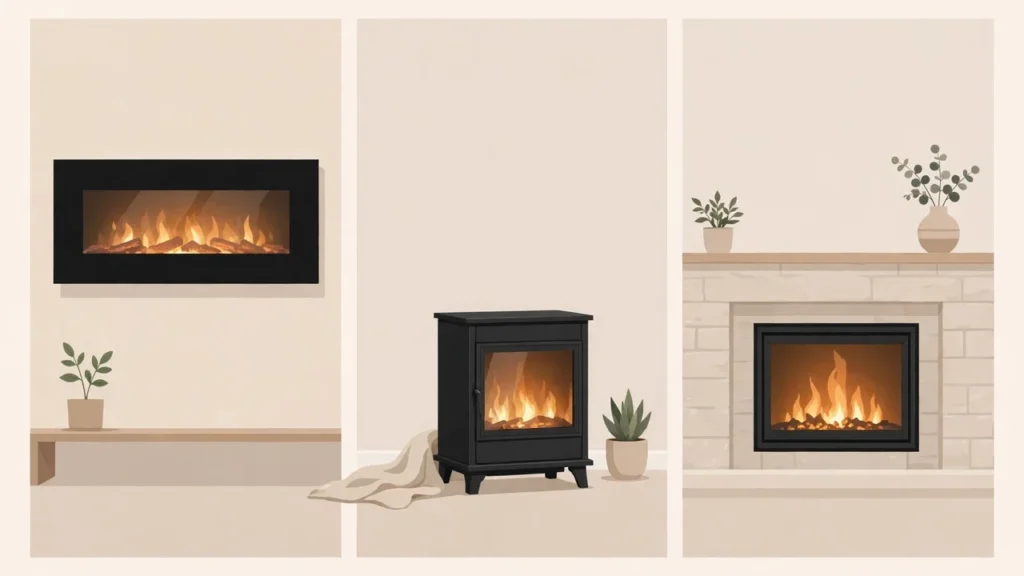
Each style has its own risk profile. A wall-mounted unit stays off the floor and out of the path of kids and pets, but it depends on the mount. A freestanding unit needs no mount at all, but it can tip if it is bumped. An insert sits inside a firebox or a built wall, which hides the sides but traps heat if the vents are blocked.
| Safety factor | Wall-mounted | Freestanding | Insert |
|---|---|---|---|
| Tip-over risk | Low when bolted to studs | Medium; can tip if bumped | Low; held by the surround |
| Mount failure risk | Main risk; needs studs | None; sits on the floor | Low; frame carries the load |
| Child and pet contact | Low; glass sits above reach | Higher; unit is at floor level | Low to medium by height |
| Vent blockage risk | Medium; items hung below it | Medium; items pushed against it | Higher; trim can block vents |
| Install skill needed | Moderate; drilling and leveling | Low; place and plug in | High; framing and trim work |
Wall-mounted units win on floor safety. Nothing sits on the floor to trip over, and the glass front sits above the reach of small children. The trade-off is the mount itself.
A freestanding unit has no mount to fail, but it is easier to knock over and easier for a toddler to touch. Pick the style that fits your room and your household, not the one that looks best in a photo.
If you are still choosing between a surface mount and a recessed build, our guide to how to install an electric fireplace walks through both paths. It covers framing, wiring, and trim choices for each style.
Heat, Drywall, and the TV Above
A TV above a fireplace is a popular look, and it can work with an electric unit. The heat that rises from the vent is the part to manage. Most TV makers list a safe operating temperature range in the manual, often up to about 104°F (40°C).
Measure the air at the TV’s spot while the heater runs on high for 30 minutes. If the air there stays well under that limit, the setup is sound.
A mantel shelf or a heat deflector helps. A shelf mounted between the fireplace and the TV pushes rising warm air out into the room instead of letting it wash straight up the TV. Leave at least 12 inches between the top of the fireplace and the shelf, and leave space between the shelf and the TV. Our guide on how to mount a TV above an electric fireplace gives exact spacing and mounting steps for this setup.
Watch the wall itself over the first month. Look for paint that bubbles, tape seams that lift, or drywall that feels soft near the vent. Those are signs that heat is pooling in one spot.
Add clearance, add a shelf, or lower the heat setting. A wall that shows damage in the first month will only get worse through the winter.
Electric Fireplaces vs Space Heaters
Many readers ask how a wall-mounted electric fireplace stacks up against a portable space heater. The fireplace has the edge on most safety points. It is fixed to the wall, so it cannot tip over.
Its heating element sits behind glass and a housing, so nothing can touch it by accident. It also runs on a thermostat, which cuts the hours the element stays hot.
A space heater is easier to move, and that is part of its risk. It can end up too close to a bed, a curtain, or a pile of clothes. It can also be knocked over by a pet or a child.
Some space heaters have tip-over switches, but a fixed fireplace removes the tip-over question entirely. For a full side-by-side, read our page on whether electric fireplaces are safer than space heaters.
Troubleshooting: If This Happens, Try This
| If this happens | Try this |
|---|---|
| Breaker trips when heat turns on | Turn the heater to low, unplug other items on the circuit, and call an electrician about a dedicated circuit. |
| Unit shuts off on its own | Clean the vents, clear the space in front of the unit, and let it cool for 30 minutes before a restart. |
| Plug or outlet feels hot | Turn the unit off, unplug it, and call a licensed electrician. Do not use that outlet again until it is checked. |
| Wall above the unit feels very hot | Add clearance, fit a mantel shelf, or run the heater on low. Check the wall again after a week. |
| Fan rattles or grinds | Turn the unit off, clean dust from the vents, and check that the mount screws are tight. Call the maker if the noise stays. |
| Bracket shifts or sags | Take the unit down at once, re-check the studs, and remount with lag bolts into solid wood. Do not hang it on a loose bracket. |
Inspect the Mount and Cord Each Season
Put a reminder on your calendar for the start of heating season. Check each lag bolt with a wrench. A bolt that turns with little force has worked loose and needs tightening. Look at the bracket for bends or cracks, and look at the wall for new cracks around the bolt holes.
Check the cord from end to end. Look for flat spots where furniture pressed on it, nicks in the outer cover, and plugs with bent prongs. A damaged cord is not a repair job for tape. Replace the cord per the maker’s guide, or call a pro if the cord is wired into the unit.
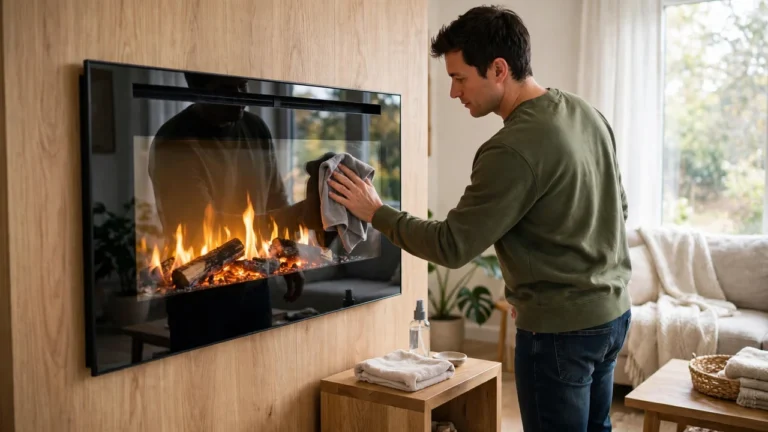
Vacuum the vents and wipe the glass with a soft cloth. Dust on the glass dims the flame effect, and dust in the vents makes the fan work harder. While you clean, confirm that nothing new has moved into the clearance zone. A new chair, a plant stand, or a stack of books can creep into the zone over a summer.
Frequently Asked Questions
Frequently Asked Questions
Can a wall-mounted electric fireplace fall off the wall?
It can fall if the bracket is fixed to drywall alone or to anchors that are too light for the weight. A bracket bolted into solid wood studs with lag bolts holds the load well. Check the bolts each season and take the unit down at once if the bracket shifts.
Do wall-mounted electric fireplaces need a dedicated circuit?
A dedicated circuit is the safest setup, because a 1,500-watt heater pulls 12.5 amps on high and nearly fills a 15-amp circuit by itself. Many homes run the heater on a shared circuit without trouble, but a tripping breaker means the circuit is too full and needs an electrician.
Can you hang a TV above a wall-mounted electric fireplace?
Yes, in most cases, as long as the air at the TV stays within the TV maker’s temperature limit and you leave space between the fireplace, a mantel shelf, and the TV. Measure the air temperature at the TV spot with the heater on high for 30 minutes before you call the job done.
Is it safe to leave a wall-mounted electric fireplace on overnight?
Use the thermostat and timer and keep the clearance zone clear if you run it overnight. Most modern units have an overheat shut-off, but no heater should run for hours in a room with blocked vents or items piled in front of it. When in doubt, turn the heat off and run flame-only mode.
Do wall-mounted electric fireplaces damage drywall?
They can damage drywall if the vent blows straight at the wall with too little clearance or if heat pools behind a shelf. Keep the clearances in your manual, check the wall during the first month, and add a mantel shelf or more space if the wall feels too hot to touch.
Quick Reference Card
Mount: lag bolts into wood studs, never drywall anchors alone.
Circuit: 1,500 W pulls 12.5 A at 120 V; a dedicated circuit is best; no extension cords.
Clearance: 36 inches clear in front, 12 inches above, 12 inches below.
TV above: measure air at the TV for 30 minutes on high; add a mantel shelf if needed.
Daily rule: keep vents clear, use the thermostat and timer, turn heat off when no one is home.
Season check: tighten bolts, inspect the cord, vacuum the vents.
The Bottom Line
Are Wall-Mounted Electric Fireplaces Safe? Yes, when the mount, the circuit, and the clearances are all right. Bolt the bracket into studs, give the heater a circuit with room to spare, and keep the space in front of it clear. Those three habits cover almost all of the risk.
If you want more background on electric fireplaces in general, read our guide on whether electric fireplaces are safe. It covers the whole family of electric models, from inserts to freestanding units, and it pairs well with the checks in this guide.
Take your time with the mount and the first heat test. A careful hour on install day buys years of warm evenings with no worry. If any part of the job feels beyond your skill, call a licensed electrician and let them finish it. That call is part of doing the job right.