Electric Fireplace Remote Not Working? 7 Fixes That Bring Back Control
Electric Fireplace Remote Not Working? 7 Fixes can solve most remote faults in under 15 minutes, and this guide walks you through them in the order that wastes the least time. You press a button, nothing changes, and the fireplace sits there glowing while the heat stays off. That gap between the remote and the fireplace is where the fault hides, and it is often a dead battery or a blocked sensor rather than a broken unit.
By the end of this guide, you will know whether the remote, the sensor, or the fireplace itself is at fault. You will have tested the remote, cleaned the sensor, tried a reset and a re-pair, and checked for interference and the wrong remote. Work through the steps in order, and stop at the step that brings the fireplace back to life.
Heads Up — Electrical Safety: Unplug the fireplace before you open any panel, touch wiring, or reach inside the unit. Never bypass a safety switch, fuse, or thermal cut-off, and never open the main body of the fireplace. If you smell burning, see scorch marks, or feel unsure at any point, stop and call a licensed electrician or the maker’s service team.
TOTAL TIME
10–30 minutes
ACTIVE TIME
10–15 minutes
DIFFICULTY
Beginner
What You Need
- Fresh batteries in the size printed inside the remote (often AAA or AA)
- A soft, dry cloth and a cotton swab
- A phone camera (to test the infrared signal)
- The fireplace manual, or the model number from the rating label
- A small screwdriver, if the battery cover uses a screw
- A second set of batteries, in case the first set is weak from the drawer
At a Glance — The 7 Fixes
- Replace the batteries with a fresh set
- Test the remote signal with a phone camera
- Clean the sensor window and clear the path
- Reset the fireplace and re-pair the remote
- Check for the wrong remote or a model mismatch
- Remove sources of signal interference
- Test the manual controls to find the real fault
Start With the Fast Checks
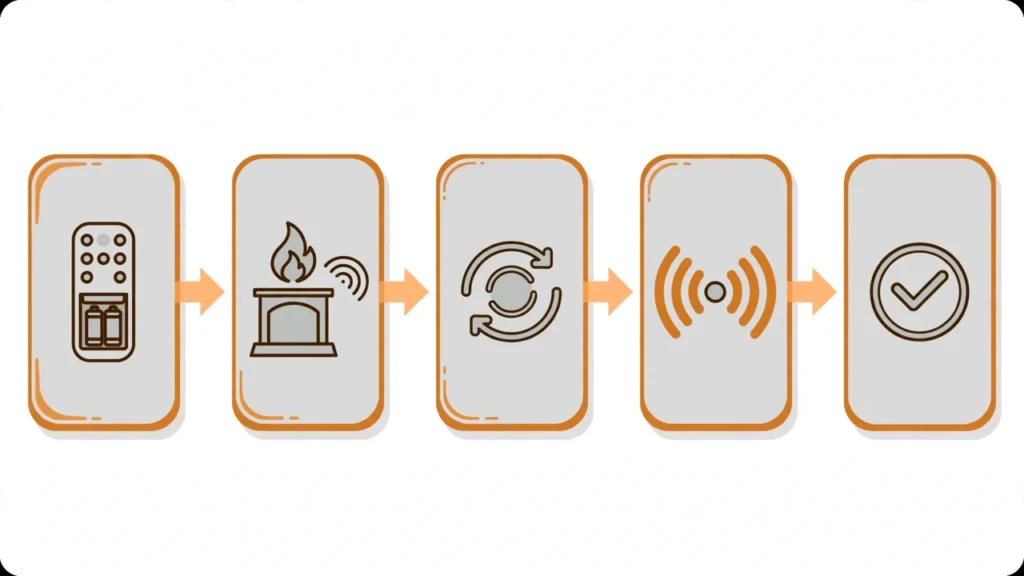
Most remote faults fall into three groups: power, signal, and pairing. Power means the batteries are dead or fitted the wrong way round. Signal means the infrared beam never reaches the sensor, because the path is blocked or the sensor window is dirty. Pairing means the remote and the fireplace lost their link, which can happen after a power cut or a battery change.
Two quick tests narrow the fault before you touch anything else. Press a button on the fireplace itself, if it has manual controls. If the fireplace answers the manual button but not the remote, the fault sits with the remote or the signal path. If the fireplace ignores the manual controls too, the fault sits with the fireplace, and the remote may be fine.
That split saves a lot of guessing. A remote that works on a different fireplace of the same model points to the sensor or receiver in your unit. A remote that fails everywhere points to the remote itself. Keep that test in mind as you work through the fixes below.
1. Replace the Batteries With a Fresh Set
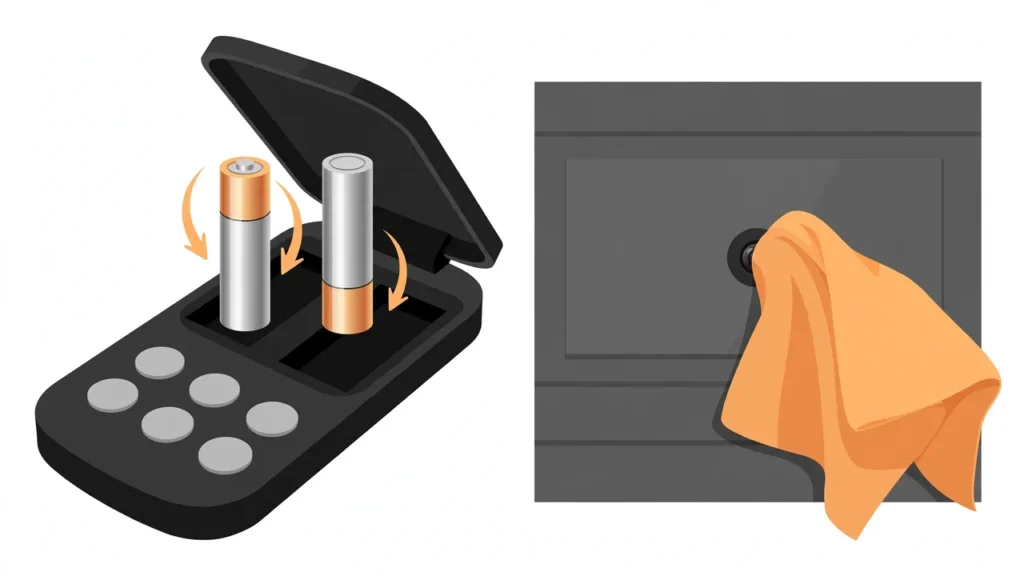
Open the battery cover on the back of the remote and take the old batteries out. Check the size printed inside the compartment, then fit a brand-new set from a sealed pack, matching the + and − marks exactly. A set pulled from a drawer or another remote can look fine and still be too weak to send a signal.
Press the power button while you point the remote at the fireplace from about 2 metres (6 feet) away. If nothing happens, press and hold the button for 2 seconds rather than tapping it fast. Some remotes need a longer press to wake from a low-power state after a battery change.
Look for a small light on the remote when you press a button. Many remotes flash a red or green LED with each press. A flash with no response from the fireplace points to a signal or sensor fault, which the next steps cover. No flash at all points back to the batteries or the remote itself.
Pro Tip: Write the battery size and the date on a small label inside the battery cover. The next change takes seconds, and you will never fit the wrong size in a hurry.
2. Test the Remote Signal With a Phone Camera
Point the front of the remote at your phone camera and press any button while you watch the screen. An infrared remote sends a beam your eyes cannot see, but most phone cameras pick it up as a pale purple or white glow from the small window at the front of the remote. A clear glow means the remote is sending a signal.
Try the test in a dim room, and try both the front and rear cameras on your phone. Some newer phones filter infrared light on one camera and not the other, so a blank result on one camera is not proof the remote is dead. Test a known working remote, such as a TV remote, the same way to confirm your phone shows the glow.
If you see a glow but the fireplace still ignores the remote, the beam is leaving the remote and the fault lies further along the path. Move on to the sensor check in the next step. If you see no glow on either camera with fresh batteries fitted, the remote itself has likely failed and needs repair or replacement.
3. Clean the Sensor Window and Clear the Path
Find the small dark window on the front of the fireplace, often near the control panel or behind the lower front trim. That window is the infrared sensor, and it needs a clear line of sight to the remote. Wipe it with a soft, dry cloth, then run a dry cotton swab around the edges where dust collects.
Move anything that sits between you and the fireplace: a coffee table book, a blanket draped over the front, a plant, or a child gate. Infrared signals do not pass through solid objects, and they bounce poorly off glass and shiny metal. Stand within 3 metres (10 feet), point the remote straight at the sensor, and press the power button again.
Bright sunlight across the front of the fireplace can swamp a weak infrared signal. Close the curtains or test again in the evening if the room gets strong direct sun. If the remote works in dim light but not in bright sun, the sensor is fine and the light was the problem. For a deeper clean of the unit, see our guide on how to clean an electric fireplace.
4. Reset the Fireplace and Re-Pair the Remote
Unplug the fireplace from the wall socket and wait a full 60 seconds. That pause lets the control board lose its stored charge and clear a stuck state. Plug it back in, switch it on at the manual control if needed, and try the remote again before you change anything else.
If the reset alone does not help, re-pair the remote using the method in your manual. On many models, you press and hold a pairing button on the fireplace for 3 to 5 seconds until a light blinks, then press a button on the remote within 10 seconds. Other models pair when you hold the power and heat buttons on the remote together for a few seconds. The exact method varies by brand, so the manual is the authority here.
Check the manual for the pairing steps for your exact model number, and keep the remote close to the fireplace during pairing, within about 1 metre (3 feet). A pairing attempt from across the room can fail even when both parts work. If the fireplace has no pairing step in its manual, it uses a fixed infrared code and pairing does not apply.
Heads Up: Never open the fireplace body to reach the receiver board. That board carries mains voltage even when the heater is off, and opening the unit can void the warranty. Leave board-level work to a qualified technician.
5. Check for the Wrong Remote or a Model Mismatch
Look at the model number on the remote and compare it with the model number on the fireplace rating label, usually on the back or side of the unit. Remotes from the same brand often look alike but send different codes, so a remote from a second fireplace in the house may do nothing at all. A replacement remote bought online can also be the wrong match for your model year.
Test the remote on the fireplace it came with, if you have a second unit. If it works there, you have a mismatch rather than a broken remote. Order a replacement using the fireplace model number, not the remote’s looks, and buy from the maker or an authorised parts seller so the code matches.
Some universal remotes list electric fireplaces in their code tables, but coverage is patchy. Check the code list for your exact fireplace brand and model before you buy, and keep the receipt until you have tested every button. If the flame, heat, timer, and temperature buttons all need to work, a universal remote that covers power alone will leave you short.
6. Remove Sources of Signal Interference
Switch off nearby devices that send infrared signals, such as a TV, a soundbar, or a second heater remote, then test the fireplace remote on its own. Two remotes sending at once can confuse the sensor, and a stuck button on another remote can flood the room with a constant signal. Remove the batteries from the other remote for a minute if you suspect it.
Move a bright lamp, a compact fluorescent bulb, or a plasma TV away from the line between the remote and the sensor. Those light sources can throw out infrared noise that drowns the remote’s beam. LED strip lights fitted behind or above the fireplace can cause the same trouble, so switch them off for the test.
Try the remote from a shorter distance, about 1 metre (3 feet), and from straight in front of the sensor rather than from an angle. Infrared sensors read best head-on, and the range drops fast at a sharp angle. If the remote works up close but not from the sofa, the batteries may be weak or the sensor may be partly blocked, so repeat the battery and cleaning steps.
7. Test the Manual Controls to Find the Real Fault
Press the power and heat buttons on the fireplace itself, using the touch panel or the buttons behind the front trim. If the fireplace answers every manual button, the heater, flame effect, and control board are working, and the fault is limited to the remote or the sensor. That result points you toward a replacement remote or a sensor repair.
If the fireplace ignores the manual controls as well, the fault sits inside the unit. Check that the socket has power by plugging in a lamp, and check the plug fuse if your plug has one. A tripped breaker, a loose socket, or a blown fuse can cut power to the whole fireplace, and no remote can fix that. Our guide on why an electric fireplace is not turning on covers those power checks in full.
Listen for a click or a hum when you press the manual power button. A click with no flame or heat can mean a failed control board or heater element. A unit that keeps cutting out after it starts points to a different fault, covered in our guide on why an electric fireplace keeps shutting off. In both cases, note what you hear and see, then call a professional with those details ready.
Match the Symptom to the Cause
The table below links what you see to the most likely cause and the fix to try first. Work down the rows that match your symptom, and test the remote after each fix rather than changing three things at once. Changing one thing at a time shows you which fix worked, and that answer helps if you later need to order a part.
| What you see | Most likely cause | Fix to try first | Chance it helps* |
|---|---|---|---|
| No light on the remote when you press a button | Dead or weak batteries | Fit fresh batteries, correct polarity | High — the top cause |
| Remote light flashes, fireplace does nothing | Blocked or dirty sensor | Clean the sensor, clear the path | High |
| Remote works up close, not from the sofa | Weak batteries or poor angle | Fresh batteries, aim straight on | High |
| Remote stopped after a power cut | Lost pairing | Unplug 60 seconds, re-pair per manual | Medium |
| Some buttons work, others do not | Worn buttons or wrong remote | Check model match, test each button | Medium |
| No glow in the phone-camera test | Failed remote | Fresh batteries, then replace remote | High |
| Manual controls dead too | No power or board fault | Check socket, fuse, breaker; call a pro | Needs a professional |
*Ratings are a practical guide from common repair experience, not measured statistics. No published failure-rate data covers every brand and model.
When to Call a Professional
Call a licensed electrician or the maker’s service team if the manual controls are dead, if you smell burning, or if the fireplace trips a breaker each time you switch it on. Those signs point to a fault inside the unit, and opening the case puts you near mains voltage. Note the model number, the symptoms, and which steps you already tried before you call.
A sensor or receiver repair is also a job for a technician when cleaning and re-pairing fail. The receiver sits on the control board, and replacing it means handling wiring and mains parts. If the unit is still under warranty, check the warranty terms before you order parts, because opening the case or fitting non-approved parts can end the cover.
If the fireplace has no heat even without the remote, check whether it can run flame-only mode. Some models run the flame effect with no heat, which can help while you wait for a repair. Our guide on using an electric fireplace without heat explains that mode. If you need a spare remote in the meantime, check whether your model still has battery backup for the clock and timer, covered in our guide on electric fireplace battery backup.
Troubleshooting Table
| If This Happens | Try This |
|---|---|
| Remote does nothing at all | Fit fresh batteries, check polarity, then test the signal with a phone camera. |
| Remote light flashes but the fireplace ignores it | Clean the sensor window, clear the path, and aim straight at the sensor from under 3 metres. |
| Remote stopped working after a power cut | Unplug the fireplace for 60 seconds, plug it back in, and re-pair the remote per the manual. |
| Only the power button works | Check the remote model matches the fireplace, and test each button up close. |
| Remote works in the evening but not in daylight | Close the curtains or move the light source, since bright sun can swamp the infrared signal. |
| Manual controls are dead too | Check the socket, plug fuse, and breaker, then call a licensed electrician or the service team. |
Frequently Asked Questions
Why is my electric fireplace remote not working all of a sudden?
Dead batteries are the most common cause, followed by a dirty or blocked sensor and a lost pairing after a power cut. Work through fresh batteries, a sensor clean, and a 60-second unplug reset before you order a replacement.
How do I reset my electric fireplace remote?
Unplug the fireplace for 60 seconds, plug it back in, and then re-pair the remote using the steps in your manual. Most models pair by holding a button on the fireplace until a light blinks, then pressing a button on the remote within 10 seconds.
Can I use a universal remote with my electric fireplace?
Sometimes, but coverage is patchy, so check the code list for your exact fireplace brand and model before you buy. A universal remote that covers power alone will not run the flame, heat, timer, and temperature controls.
Why does my remote work up close but not from the sofa?
Weak batteries, a poor angle, or a partly blocked sensor all cut the range. Fit fresh batteries, aim straight at the sensor, and clear anything between you and the fireplace.
How do I know if the remote or the fireplace is broken?
Press the manual controls on the fireplace itself. If they work and the remote does not, the fault sits with the remote or the sensor. If the manual controls are dead too, the fault sits inside the fireplace.
Do electric fireplace remotes need batteries?
Most do, usually AAA or AA batteries, and the size is printed inside the battery compartment. A few models use a small coin battery, so check the manual or the compartment label before you buy a set.
Quick Reference Card
What you need: Fresh AAA or AA batteries, a soft dry cloth, a cotton swab, a phone camera, your fireplace manual.
Steps:
- Fit fresh batteries, matching + and −.
- Test the signal with a phone camera.
- Clean the sensor and clear the path.
- Unplug for 60 seconds, then re-pair.
- Check the remote model matches the fireplace.
- Switch off interfering devices and lights.
- Test the manual controls to find the fault.
Call a professional if the manual controls are dead, you smell burning, or the breaker trips.
Electric Fireplace Remote Not Working? 7 Fixes gave you a clear path from the fastest check to the real fault, and most readers will find the answer in the first three steps. Keep a spare set of batteries near the fireplace, and note your model number where you can find it fast next time.
If the remote is the fault, order a replacement by fireplace model number and test every button on arrival. If the fireplace itself is the fault, book a technician and share the notes you made during these checks. Either way, you now know which part needs attention, and that is the hard part done.