Infrared vs Oil-Filled Heaters: Which Is Better for Your Home?
If you need extra heat in one room, the choice between infrared vs oil-filled heaters can feel harder than it should. Both plug into a standard wall outlet. Both cost about the same to run at the same wattage. Both warm a room without a flame.
The real difference is how the heat reaches you, and that difference decides which one fits your room, your routine, and your budget.
This guide compares the two types side by side. You will see how each one works, how fast each warms a room, what each costs to run at common wattages, how each feels, how loud each is, and how to use each one safely. At the end, you will find a clear verdict for bedrooms, living rooms, home offices, and other common rooms.
Heads Up: Space Heaters and Fire Risk
Space heaters cause real fires every winter. The U.S. Consumer Product Safety Commission reports that portable heaters were involved in an average of 1,600 fires a year, with an average of 70 deaths and 150 injuries a year, based on 2020 to 2022 data.
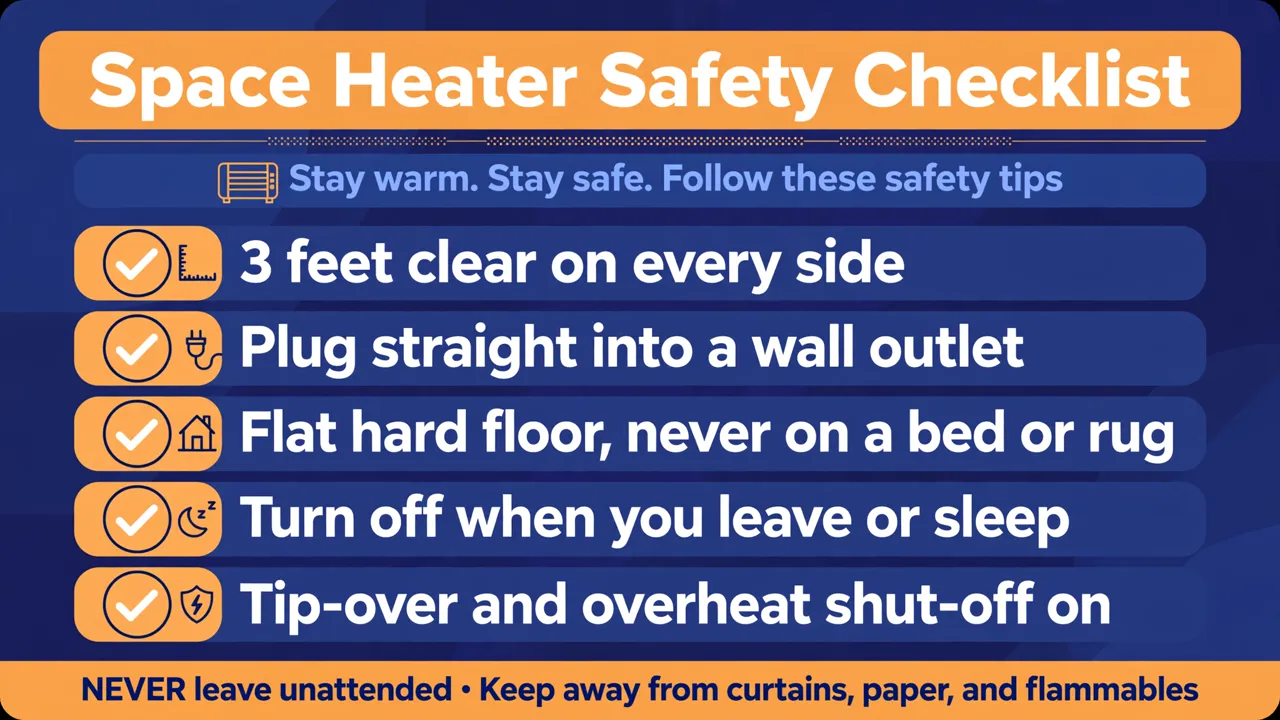
Keep every heater at least 3 feet from beds, curtains, furniture, paper, and clothes. Plug it straight into a wall outlet, never into an extension cord or power strip. Turn it off when you leave the room or go to sleep. The safety section near the end of this guide covers each rule in full.
This guide shares general safety information. It is not a substitute for your heater manual or local fire safety rules. Always follow the manual that came with your heater.
Quick Answer
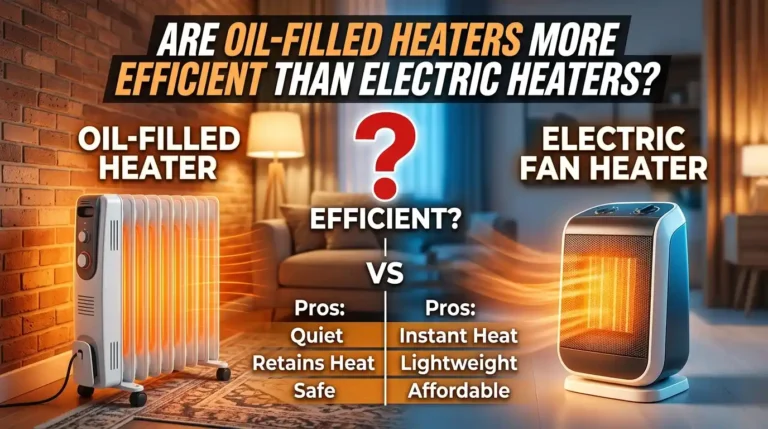
Pick an infrared heater when you want warmth you can feel fast while you sit in one spot, such as a desk, a reading chair, or a cold corner of a living room. Pick an oil-filled heater when you want slow, steady heat that fills a whole room and stays warm for a while after you switch it off, such as a bedroom through the night. At the same wattage, both types use the same amount of electricity, so the running cost is the same. What differs is speed, feel, noise, and how the heat spreads.
How Each Heater Works
The two heaters look alike at first glance. Both are tall, freestanding units with a power cord and a thermostat. Inside, they work in very different ways, and that is why they feel so different in a room.
How an Infrared Heater Works
An infrared heater warms people and objects in its path, not the air itself. A heating element, often a quartz tube or a metal coil, gives off infrared radiation. That radiation travels in a straight line until it hits a surface, such as your skin, a chair, or a wall. The surface absorbs the radiation and feels warm right away.
Think of sunlight through a window on a cold day. The air in the room may still feel cool, but the patch of sun on your arm feels warm. An infrared heater works on the same idea. Many models add a small fan to push some warm air around the room, but the direct radiant warmth is the main effect.
Because the heat goes straight to people and objects, an infrared heater can feel warm within a minute or two of switching it on. The trade-off is range. Step out of its line of sight, or sit behind a sofa, and you feel far less of its warmth. A large open room warms unevenly with infrared heat alone.
How an Oil-Filled Heater Works
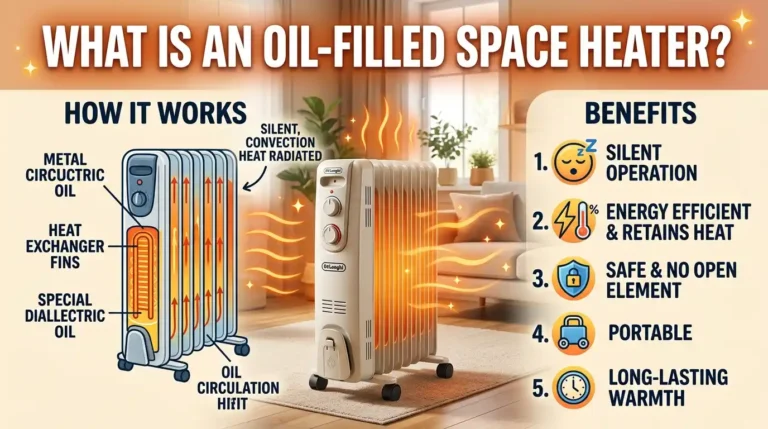
An oil-filled heater, also called an oil-filled radiator, warms the air around it. An electric element inside the unit heats a sealed body of special thermal oil. The hot oil warms the metal fins or columns of the radiator.
Those fins then warm the air touching them. Warm air rises, cool air moves in to take its place, and the room warms in a slow, steady cycle.
The oil never burns and never needs topping up. It sits inside a sealed unit and passes heat from the element to the metal surface. You should never open an oil-filled heater or try to refill it. If one leaks oil, stop using it and replace it.
An oil-filled heater takes longer to change how a room feels. The metal and the oil need time to heat up, and the air in the room needs time to circulate. The pay-off comes later. Once the unit is hot, it keeps giving off warmth for a while after you switch it off, because the oil and metal cool down slowly.
Infrared vs Oil-Filled Heaters at a Glance
This table sums up the main differences before we look at each one in detail. The rest of the guide explains each row, so you can see why the winner changes with the room and the way you heat.
| Feature | Infrared Heater | Oil-Filled Heater |
|---|---|---|
| How it heats | Radiant heat aimed at people and objects | Convection heat that warms the air in the room |
| Warmth you feel | Within a minute or two, in its line of sight | Slow build, often 20 to 40 minutes for the whole room |
| Heat after switch-off | Fades fast once the element cools | Keeps giving off warmth while the oil cools |
| Running cost at same wattage | Same, about $0.23 per hour at 1,500 W and $0.15 per kWh | Same, about $0.23 per hour at 1,500 W and $0.15 per kWh |
| Noise | Silent, or a low fan hum on fan models | Silent, no fan, with rare clicks as metal warms |
| Surface heat | Element area gets very hot, case can feel hot | Fins get hot to the touch, cooler than an exposed element |
| Best for | Spot warmth, desks, drafty rooms, short sessions | Whole-room heat, bedrooms, long steady sessions |
| Weight and moving | Light, simple to carry from room to room | Heavy, rolls on casters, awkward on stairs |
Heat-Up Speed and Warmth Feel
Speed is where the two types part ways most clearly. An infrared heater starts warming you almost at once. Sit in front of one, switch it on, and your skin feels the heat within a minute or two. The room air may still be cool, but you feel warm where the heater points.
An oil-filled heater works the other way round. It warms the air first, and the air warms you. In a typical bedroom, you may notice a real change in how the room feels after 20 to 40 minutes, based on the room size, the starting temperature, and the wattage you run. A small, closed room warms faster than a large room with high ceilings and drafts.
That slow start is not a flaw on its own. It is the price of even heat. Once an oil-filled heater has warmed the air, the whole room feels the same temperature.
With an infrared heater, the spot in front of the unit can feel warm while the far corner still feels cold. If you move around the room, an oil-filled heater treats you more evenly.
The warm-up gap also flips after you switch the heater off. An infrared heater stops warming you almost at once, since the element cools fast. An oil-filled heater keeps radiating warmth for a while as the oil and metal cool down. That leftover heat is one reason oil-filled models suit bedrooms, where steady warmth through the night matters more than a fast start.

Running Cost: Worked Examples
Here is the part most buyers get wrong. At the same wattage, an infrared heater and an oil-filled heater cost exactly the same to run. Both turn nearly all the electricity they use into heat.
A 1,500-watt heater of either type uses 1.5 kilowatt-hours of electricity per hour at full power. The bill depends on the wattage and your electricity rate, not on the heater type.
Use this formula to work out the cost for any heater. Take the wattage, divide by 1,000 to get kilowatts, then multiply by your electricity rate per kilowatt-hour.
The Cost Formula
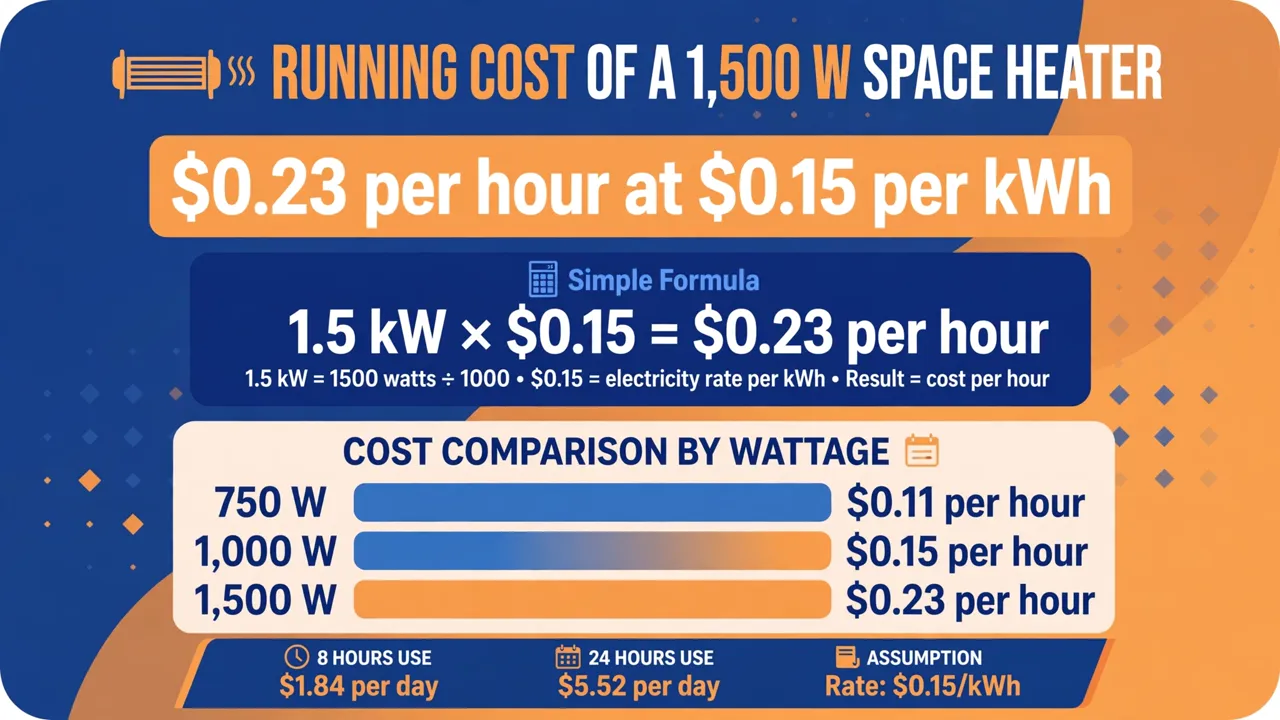
Cost per hour = (watts / 1,000) x your rate per kWh. Example: a 1,500 W heater at $0.15 per kWh costs 1.5 x $0.15 = $0.23 per hour at full power.
The table below works out the cost at three common wattages, using $0.15 per kWh as the rate. All figures are estimates. Your rate will differ, so check your own bill and swap in your number. Heaters with a thermostat also cycle on and off once the room reaches the set temperature, so real costs often run lower than the full-power figures here.
| Wattage | Cost per Hour* | Cost for 8 Hours* | Cost for 30 Days at 8 Hours a Day* |
|---|---|---|---|
| 750 W | $0.11 | $0.90 | $27.00 |
| 1,000 W | $0.15 | $1.20 | $36.00 |
| 1,500 W | $0.23 | $1.80 | $54.00 |
*Estimates at $0.15 per kWh, running at full power with no thermostat cycling. Your rate and your real cost will differ.
So how can one type still feel cheaper in real use? The answer is run time, not wattage. An infrared heater can warm you in minutes, so you may run it for a short session and switch it off.
An oil-filled heater may run for hours to hold a whole room at a steady temperature. Over a month, the heater you run for fewer hours costs less, even though both cost the same per hour.
That is why the room and the routine matter more than the label. Short bursts of warmth at a desk favor infrared. Long, steady heat across a bedroom favors oil-filled. Before you buy, pick the right wattage for your room size, since an oversized heater cycles on and off and an undersized one runs at full power all day.
Comfort and Feel
Warmth is not one single feeling. Infrared heat feels like sun on your skin. It warms you directly, even if the air around you is still cool. That makes it a good fit for a drafty room, a workshop, or a spot near a cold window, where warming the air first would take a long time and much of the heat would leak away.
Oil-filled heat feels more like central heating. The air warms first, so the whole room rises to a steady temperature. There are no hot spots in front of the heater and cold corners behind you.
If you sit still in one place, infrared can feel warmer faster. If you move around, cook, or share the room with family, oil-filled heat feels more even.
Neither type dries the air in a way you need to worry about, but the feel differs. Infrared models with a fan move air across the room, and some people find that moving air feels drying or stirs up dust. Oil-filled heaters have no fan, so they do not blow air or dust around. People with dust allergies or sensitive skin often prefer the still air of an oil-filled model.
One more comfort point is control. Most infrared heaters warm up fast, so you can switch them on when you sit down and off when you leave. Most oil-filled heaters work best when you switch them on ahead of time and let the thermostat hold the room steady.
If your routine is regular, such as a bedroom warmed before bed, an oil-filled heater fits that rhythm. If your routine is irregular, such as a home office you use in short bursts, infrared fits better.
Noise
Noise is a small difference, but it matters in a bedroom or a quiet office. Oil-filled heaters are silent. They have no fan and no moving parts.
The only sound you may hear is a soft click or tick as the metal expands while it warms and contracts while it cools. Most people stop noticing it after a few days.
Infrared heaters vary by model. A basic infrared panel with no fan is silent, like an oil-filled heater. A tower or cabinet infrared heater with a fan makes a low hum while the fan runs.
The hum is mild, close to a quiet desk fan on its low setting, but light sleepers may still notice it. If silence matters to you, check the product details for a fan-free model, or test the fan noise before you commit to using it at night.
Safety: What to Know Before You Buy
Both types are electric heaters with no flame and no fuel to burn, which makes them safer than open-flame heat. Both still carry the same fire and burn risks as any space heater, and both need the same care. The U.S. Consumer Product Safety Commission advises buyers to look for a heater that carries the mark of a nationally recognized testing lab, such as UL or ETL, and to check that it has tip-over shut-off and overheat shut-off.
Hot surfaces are the first risk. The fins of an oil-filled heater get hot to the touch while it runs, and they stay hot for a while after you switch it off. The front of an infrared heater can get very hot near the element.
Keep both types away from children and pets, and teach children not to touch any heater. A heater with a cool-touch case or a guard over the element adds a layer of safety, but no heater is safe to touch while it runs.
Placement is the second risk. Keep at least 3 feet of clear space on every side of the heater, front, sides, and back. That means no beds, curtains, sofas, clothes, papers, or laundry within that zone.
Set the heater on a flat, hard floor where it cannot tip over. Never place a heater on a bed, a rug, a table, or a stack of books. Never run its cord under a rug or carpet, where damage can go unseen.
Heads Up: Never Use an Extension Cord
Plug any space heater straight into a wall outlet. Never use an extension cord or a power strip, even a heavy-duty one. A 1,500-watt heater draws a large current, and a cord or strip can overheat and catch fire. If the only outlet is too far away, move the heater closer to an outlet instead of stretching a cord to reach it.
Overnight use needs extra care. The Consumer Product Safety Commission advises against leaving a portable heater running while you sleep or while the room is empty. Many people do run oil-filled heaters overnight because the steady, silent heat suits a bedroom, and our guide to leaving an oil-filled heater on while you sleep covers that choice in detail. If you do run one at night, keep the 3-foot zone clear, plug it straight into the wall, use a model with tip-over and overheat shut-off, and set the thermostat low rather than running it at full power.
Oil-filled heaters have one risk infrared heaters do not share. The oil inside is sealed for the life of the unit. Never open the unit, never drill into it, and never try to refill it.
A heater that leaks oil, smells odd, or shows dents and damage should go out of service at once. For the power side of the rules, see our guide on why you should never plug a space heater into an extension cord.
Size, Weight, and Moving Them
An infrared heater is the lighter of the two. Most portable models weigh a few pounds and have a handle, so you can carry one from the office to the living room with one hand. That suits homes where one heater serves several rooms through the day.
An oil-filled heater is heavy. The sealed oil and the metal fins add up, and a full-size model can weigh 15 to 25 pounds. Most come with caster wheels, so you can roll one across a hard floor.
Lifting one up stairs or into a car is a two-hand job, and the wheels do not roll well on thick carpet. If you plan to move your heater often, weight matters as much as heat output.
Size also differs. Infrared panels can be slim and flat, which suits a tight spot beside a desk. Oil-filled radiators are wider and deeper, since they need fin area to warm the air. Measure the spot where the heater will sit, and leave the 3-foot clear zone in your plan, not as an afterthought.
Best Room for Each Type
The right heater depends on the room. A bedroom needs steady, silent heat. A desk needs fast warmth in one spot.
A large living room needs even heat across the whole space. The table below matches each type to common rooms.
| Room or Use | Better Pick | Why |
|---|---|---|
| Bedroom | Oil-filled | Silent, steady heat that holds through the night |
| Home office or desk | Infrared | Fast warmth where you sit, off when you leave |
| Living room, seated area | Infrared | Direct warmth on the sofa without heating empty space |
| Living room, whole family moving around | Oil-filled | Even warmth across the room, no cold corners |
| Drafty room or workshop | Infrared | Warms people, not air that leaks away |
| Nursery or room with pets | Oil-filled, with care | No fan, no exposed element, but fins get hot, so keep it guarded and out of reach |
| Bathroom | Neither, unless rated for it | Most portable heaters are not rated for wet rooms, so check the manual first |
| Covered patio or garage | Infrared | Radiant heat works in open air, where warmed air drifts away |
For outdoor heat, the same radiant idea applies on a bigger scale. If you are weighing heat sources for a patio, our comparison of electric vs propane patio heaters covers the outdoor side of that choice.
Which One Should You Buy? The Verdict by Use Case
There is no single winner. The better heater is the one that fits how you heat. Use this verdict to match the type to your case.
Buy an Infrared Heater If You
Want warmth you can feel in a minute or two. Sit in one spot for short sessions, such as a desk, a reading chair, or a workbench. Heat a drafty room where warmed air leaks away fast.
Move the heater from room to room through the day. Warm a covered patio or a garage where open air makes convection heat weak.
Buy an Oil-Filled Heater If You
Want steady, even heat across a whole room. Heat a bedroom through the night and value silence. Share a room with family and want the same temperature in every corner.
Prefer a heater with no fan and no moving air. Like heat that lingers for a while after switch-off.
When Either Type Works
For a small, closed room used for a few hours at a time, either type will do the job. In that case, pick on price, size, noise, and safety features rather than on the heating method. Look for a thermostat, a timer, tip-over shut-off, overheat shut-off, and a testing-lab mark such as UL or ETL. A good thermostat matters more than the heater type, since it stops the heater from running at full power once the room is warm, and that saves more on your bill than any difference between infrared and oil-filled heat.
Buying Checklist
Before you pay, run through this short list. It applies to both types, and it keeps you from buying the wrong size or a heater with weak safety features.
First, match the wattage to the room. A 1,500-watt heater suits a medium room, while a small room may need only 750 watts. An oversized heater will cycle on and off, and an undersized one will run flat out and still feel cold.
Second, check the safety features. Look for tip-over shut-off, overheat shut-off, and a testing-lab mark. Check that the cord is long enough to reach a wall outlet without a stretch, and that the plug fits the outlet snugly.
Third, think about noise and weight. If the heater will sit in a bedroom, pick a fan-free model. If you will move it often, pick a light model with a handle or good wheels.
Fourth, read the manual for the room you have in mind. Some heaters are not rated for bathrooms or damp rooms. Some should never run while you sleep. The manual for your exact model is the final word.
Frequently Asked Questions
Which heats a room faster, infrared or oil-filled?
Infrared heats you faster. You feel its warmth within a minute or two when you sit in its path. An oil-filled heater takes longer, often 20 to 40 minutes, to warm the air in a whole room. For fast warmth in one spot, infrared wins, and for even warmth across a room, oil-filled wins.
Which costs less to run, infrared or oil-filled?
Neither. At the same wattage, both cost the same to run, since both turn nearly all the electricity they use into heat. A 1,500-watt heater of either type costs about $0.23 per hour at $0.15 per kWh. What changes your bill is how many hours you run it and the wattage you pick, not the heater type.
Can I leave an oil-filled heater on overnight?
The Consumer Product Safety Commission advises against leaving any portable heater running while you sleep. If you do run an oil-filled heater at night, keep 3 feet of clear space on every side, plug it straight into a wall outlet, use a model with tip-over and overheat shut-off, and set the thermostat low. Never leave a heater running in an empty room.
Are infrared heaters safe around children and pets?
They can be, with care. The area near the element gets very hot, so keep children and pets out of reach and never let them touch the heater while it runs. Pick a model with a guard over the element, tip-over shut-off, and overheat shut-off. Keep the 3-foot clear zone free of toys, bedding, and clothes.
Which is better for a bedroom, infrared or oil-filled?
Oil-filled is the better pick for most bedrooms. It is silent, it warms the whole room evenly, and it holds its heat for a while after switch-off. Infrared suits a bedroom only when you want fast warmth for a short time before bed and plan to switch it off when you sleep.
Do oil-filled heaters need oil refills?
No. The oil sits inside a sealed unit and never needs topping up or changing. Never open an oil-filled heater or try to refill it. If it leaks oil or shows damage, stop using it and replace it.
Which one is quieter?
Oil-filled heaters are silent, since they have no fan. Fan-free infrared panels are silent too. Infrared models with a fan make a low hum while the fan runs. If silence matters, pick an oil-filled heater or a fan-free infrared panel.
Sources
Safety figures and rules in this guide come from the U.S. Consumer Product Safety Commission, including its January 2026 winter safety release on portable heaters and its portable heater safety guidance. The National Fire Protection Association also publishes the 3-foot rule for heating equipment. Running-cost figures are worked examples using the formula in this guide, based on a stated rate of $0.15 per kWh, and are labeled as estimates. Your rate and your real cost will differ.